Scrolls exhibit tops 200,000-tickets goalI'm not surprised.
The Dead Sea Scrolls exhibit at Discovery Place in Charlotte has proved to be as popular as museum leaders had hoped.
Officials at the museum, 301 N. Tryon St. uptown, reported Thursday that ticket sales have topped the goal of 200,000 -- 204,663 to be exact, with 186,692 visitors through Wednesday. ...
Saturday, May 20, 2006
THE DEAD SEA SCROLL EXHIBIT IN CHARLOTTE has met its sales target, with more than a week to spare. The Charlotter Observer reports:


ANCIENT ARAMAIC CULTURE IN BULGARIA? Evidently.
"Twin" of Bulgarian Tatul Sanctuary Found in Syria
Lifestyle: 19 May 2006, Friday. (Sofia News Agency)
The sanctuary located in the Bulgarian village of Tatul has an almost identical analog in Syria.
The founder of the Tatul sanctuary professor Nikolay Ovcharov broke the news upon his return from an expedition in Syria and Jordan. Professor Ovcharov explained that he visited a town hewn into the rocks on the top of which he discovered the temple that resembled the Bulgarian sanctuary. The town was situated some 60 km northwest of Damascus.
There is an old Aramaic sanctuary built up during the Roman period and its construction history is almost the same as the one of the Bulgarian temple.
[...]
Friday, May 19, 2006
THE MASADA DATE PALM is discussed by horticulturalist Maureen Gilmer of DIY Network.
(Via Archaeologica News.)
2,000-year-old seed has roots in King Herod's palaceThe essay has a lot of interesting information about the biology and history of date palms.
By MAUREEN GILMER
DIY Network (Scripps Howard news Service)
15-MAY-06
In Israel, at Kibbutz Ketura, a 14-inch seedling date palm goes by the name Methuselah.
The seed from which it sprouted 14 months ago was found in archeological excavations of King Herod's palace on Mount Masada. Lying dormant for 2,000 years, it is the oldest seed to ever produce a viable tree. And this is no ordinary date palm, but the extinct Judean form considered uniquely medicinal.
[...]
So whether you grow a California date or one like Methuselah raised from the dustbin of history, all Phoenix dactyliferas carry an extraordinary heritage. It is perhaps the most ecumenical plant ever, shared by Judaism, Christianity and Islam.
And it is chronicled in the ancient literature of all three religions for its diverse powers _ from an aphrodisiac to a contraceptive _ and as a cure for a wide range of diseases including cancer, malaria and toothache. Now modern scientists may one day have a chance to test those contentions.
(Via Archaeologica News.)
MUCH DA VINCI CODE HYPE, with the worldwide release of the movie today. I can't bring myself to read even a representative sampling of the reviews, but a lot of people seem to think it's boring. If you're interested, here's Google's Da Vinci Code" review results page. Enjoy.
UPDATE: Ben Witherington has seen the movie and thinks it isn't too bad.
UPDATE: Ben Witherington has seen the movie and thinks it isn't too bad.
Thursday, May 18, 2006
THE INDIAN GOVERNMENT is blocking release of the Da Vinci Code movie:
UPDATE: The early response to the movie is not promising anyway, although Lesa Bellevie reports the good news that some of the anti-Catholic elements in the book have been toned down. I'm planning on seeing it on Monday. I'll let you know what I think.
India puts Da Vinci Code film on holdI think it's a bad sign when governments start interfering with things like this to protect people's sensitivities. Related comments here.
UNI (DNA)
Tuesday, May 16, 2006 19:43 IST
NEW DELHI: Taking a cautious approach, the government has decided not to give clearance to the screening of the controversial film, the Da Vinci Code, till the Information and Broadcasting Ministry and Catholic Church are satisfied the film will not hurt the sensitivity of Christians in the country.
Information and Broadcasting Minister P R Dasmunsi told reporters here on Tuesday that he along with members of the Catholic Church, and officials of the I&B ministry and Censor Board would view the movie in camera and only then a decision would be taken about its screening.
[...]
UPDATE: The early response to the movie is not promising anyway, although Lesa Bellevie reports the good news that some of the anti-Catholic elements in the book have been toned down. I'm planning on seeing it on Monday. I'll let you know what I think.
DARRELL BOCK reviews Tabor's The Jesus Dynasty for Christianity Today. Excerpt:
Four major historical problems exist with Tabor's portrait beyond the mere worldview issues that drive his portrait. It is ironic that what Tabor's study represents is a type of reverse Marcionism. Whereas Marcion in the second century wished to reduce and remove those Jewish features tied to Christianity, Tabor, by reducing the status of Paul and the books of Luke and Acts, rejects those very books Marcion wanted to keep. Perhaps the solution is to reject both the approach of Marcion, who shut out the Jewishness of early Christianity, and the approach of Tabor, who in seeking to maintain the Jewishness leaves out the contribution of the most Jewish-instructed of all the apostles, Paul.
Wednesday, May 17, 2006
FORGERY BOMBSHELL? Well, maybe. The Biblical Archaeology Society has posted the following on its website:
Second, if this paper is such a bombshell, let's see it published in a peer-review journal. I'll be much more inclined to take the time to read it if that happens.
Not such a slow news day after all.
(Via the Agade list.)
Update—Finds or Fakes?I've read the summary, but not the full report. It sounds interesting, but I have two comments. First, the summary concludes:
Forgery Bombshell
May 16, 2006
The ossuary inscribed "James, son of Joseph, brother of Jesus" has recently been studied by Professor Wolfgang E. Krumbein, a world-renowned authority. He has reached startling conclusions that will change the debate over this highly controversial artifact. Printed below is a summary of Professor Krumbein's report; click the following links for the full text of the report and the accompanying photographs.
As this is being written, Israeli antiquities collector Oded Golan is being tried in criminal court for forging the now-famous James ossuary inscription ("James, son of Joseph, brother of Jesus"). A new report by a leading German scientist, however, may blow the case out of the water.
According to Professor Wolfgang E. Krumbein, of Oldenburg University, Germany, a well-known expert in geology, geochemistry and microbiology, "We can state with certainty that a period of 50-100 years, at least, was necessary for the formation of the specific composition of patina whose traces were identified inside the ossuary inscription."
[...]
Professor Krumbein also analyzes the Yehoash (or Jehoash) inscription and the ornamentation on a stone oil lamp, both of which have been charged to be forgeries. In these cases, too, Professor Krumbein finds evidence supporting the authenticity of the inscription and the ornamentation.That puts me off some, since I think on philological grounds that the Jehoash inscription is probably a forgery.
Second, if this paper is such a bombshell, let's see it published in a peer-review journal. I'll be much more inclined to take the time to read it if that happens.
Not such a slow news day after all.
(Via the Agade list.)
THE CONTROVERSY over the Leon Levy Foundation's $200 million contribution to NYU is noted in the Art Newspaper, but with no new details as far as I can see.
Storm of criticism greets Levy donation
Academics are divided over $200m gift
By Martha Lufkin | Posted 16 May 2006
NEW YORK. A gift of $200m to New York University (NYU) to fund a new Institute for the Study of the Ancient World has resulted in a resignation and in criticism from archaeologists because of the source of the donation.
[...]
HERE'S A GOOD DA VINCI CODE HEADLINE:
Slow news day.
"Veni, Vidi, Da Vinci: The Code's Appeal"This one is from CTV.ca, but I also saw "Veni, Vidi, Da Vinci" in a Saturday Times headline a week or two ago. In fact, a Google search indicates that a number of people have thought of it, going back to Publisher's Weekly in 2003. (Actually, the headline appeared in the Seattle Weekly in 1998, long before The Da Vinci Code was published, with reference to a museum exhibtion on Leonardo.
Slow news day.
Tuesday, May 16, 2006
JEWISH STUDIES, AN INTERNET JOURNAL has posted another article in volume 4 (2006) which can be downloaded in Word or PDF formats from the website:
Ishay Rosen-Zvi, "'Tractate Kinui’: A Forgotten Tannaitic Debate About Marriage, Freedom of Movement and Sexual Supervision"The article is in Hebrew, but there is an English abstract:
Mishnah Sotah opens with a discussion of the evidence required to force a married woman to undergo the biblical ordeal for a suspected adulteress (sotah). The first two Mishnayot in this tractate discuss the mandatory warning procedure (kinui) whose violation (setirah) renders a woman a suspected adulteress, requiring her to undergo the sotah ritual. Through a close reading of these two Mishnayot, related Tannaitic material, and the discussion of the relevant passages in the two Talmudim, this paper offers a reconstruction of a large scale rabbinic debate about the limits of freedom of movement and socializing for married women. This debate stems from a fundamental dilemma: On the one hand, the rabbis, unlike some of their Hellenistic Jewish contemporaries, were unwilling to completely lock up married women in their homes. On the other hand, the rabbis were extremely troubled by the dangers of free socializing. This paper analyzes the different and sometimes contradictory solutions offered by rabbinic sources to this dilemma.
JAMES TABOR responds to the Toronto Star article on his book:
Thanks for the mention of the Toronto Star article on my book, The Jesus Dynasty in your blog recently. As reporters go I felt that Mr. Laidlaw did a fair job but he really got some things wrong, especially about the DNA business. I surely did not say I hope to live to see the bones of Jesus or the tomb of Jesus found--that to me would be an exceptionally foolish and silly thing to say. What I did say is that Gibson and I had formally asked that DNA tests be done on the James ossuary remains to compare them with the extensive DNA profile we already have of the 17 individuals in the "Tomb of the Shroud," and we were turned down. As far as I know the remains from the 1980 Talpiot tomb were long ago lost or buried, though the names remain interesting and might be statistically studied. I do indeed think that the entire James ossuary inscription is likely authentic based on evidence that the owner has presented to others which I am not at liberty to disclose. In addition I have not found the IAA report given the subsequent discussion thereof by critics, as catalogued at the BAS Web site, for example, convincing on several points. The matter is complex of course, but I hope in due course will come out. In the meantime I continue to think there is strong circumstantial evidence the James ossuary, even with "James son of Joseph," alone, came from the Shroud tomb.On the last point, Shimon Gibson, the tomb's excavator, agrees. As for the disputed part of the James Ossuary inscription (the "brother of Jesus" phrase), I haven't done any serious work on it, but from what I've seen, the epigraphic and philological evidence point away from its being genuine, but not decisively so. But the clinching argument seems to be the modern origin of the patina, and I am not qualified to evaluate that. My starting position is to be skeptical, but I'll keep watching the discussion with interest.
THE ISRAEL ANTIQUITIES TRIAL THUS FAR -- The Boston Globe has a summary:
Trial sheds light on shadowy antiquities worldAnd here's something to worry about:
By Matthew Kalman, Globe Correspondent | May 16, 2006
JERUSALEM -- Testimony in a Jerusalem District courtroom is giving a rare glimpse into the shadowy world of biblical antiquities.
Three of Israel's most respected experts in ancient archeological treasures are on trial, charged with 18 counts of fraud, receiving money through deception, damaging antiquities, and violations of Israeli antiquities laws.
The defendants -- collector Oded Golan, dealer and writer Robert Deutsch, and former Israel Museum conservator turned dealer Rafi Brown -- are accused of faking a range of artifacts, including the burial box of Jesus's brother, a wine decanter used in Solomon's Temple and ancient seal impressions and inscriptions, some of which were sold for hundreds of thousands of dollars.
Since the trial began in September 2005, witnesses have described furtive encounters with Arab graverobbers, international smuggling, and transactions involving hundreds of thousands of dollars based on a handshake.
Lawyers involved in the case expect court proceedings to continue for at least another year.
[...]
Commander Shaul Naim, head of the two-year police investigation, said: ''This was fraud of a sophistication and expertise which was previously unknown. They took authentic items and added inscriptions to make them worth millions."Not everyone is convinced, though. Developing ...
Naim said forgers managed to fake inscriptions, decorations, and even the patina -- the thin sediment created over centuries by moisture collecting on the item underground or in a cave. ''We believe that there are many more items in museums and collections around the world which are yet to be identified," he said.
LAG B'OMER AND BAR KOKHBA -- Eli Kavon has some reflections in "The birth of Lag Ba'omer" in the Jerusalem Post. Excerpt:
IN OUR own epoch the centuries-old rabbinic critique has been replaced by a much different perception. The Zionist movement rehabilitated Simon Bar Kosiba, failed messiah, and converted him into Simon Bar Kochba, rebel hero.
Lag Ba'Omer, a minor Jewish holiday rooted in the legend of the cessation of a plague that killed the students of Rabbi Akiva, became a celebration of the last chapter of Jewish sovereignty in Eretz Yisrael.
No longer did Jews associate Bar Kochba with the devastation of a hopeless rebellion fueled by a messianic fantasy that a small group of Jews could overthrow an all-powerful empire. Rather, Bar Kochba was the forerunner of the heroes of the modern Zionist movement and State of Israel.
Although Bar Kochba himself signed his letters as "Bar Kosiba," the latter name has been expunged from the collective memory of the Jewish people. Today we celebrate the man's heroism as a national icon, forgetting that his rebellion was crushed in a national catastrophe.
WHILE WE should certainly celebrate the Bar Kochba revolt as a heroic attempt to establish an independent Jewish state in the face of overwhelming odds - that is, indeed, the story of modern Zionism - we should not just discount a long-standing perception of the rebellion's leader.
Rabbi Akiva, despite his best intentions, his fervent love of the Jewish people, and his death as a martyr at the hands of Rome, was, in the end, tragically mistaken. Bar Kosiba was not the messiah, and the Roman Empire would not be defeated in an apocalyptic final battle.
MEKHILTA ONLINE: Manuscript Boy reports the following over at Hagahot:
The Tosefta Online site now has complete transcriptions of all manuscripts of the Mekhilta de-Rabbi Yishmael.The Mekhilta de-Rabbi Ishmael is one of the earlier ("Tannaitic," that is pertaining to rabbis mainly of the first and second centuries C.E.) midrashim.
OBITUARIES for Simon Parker, John C. Trever, and Daryl D. Schmidt have been published in this month's SBL Forum.
Monday, May 15, 2006
JOHANN ALBERT FABRICIUS (1668-1736) was an amazingly prolific polymath who published, among other things, vast histories of Greek and Latin literature (the Bibliotheca Latina and Bibliotheca Graeca), an edition of New Testament Apocrypha (the Codex Apocryphus), and the first scholarly collection of Old Testament pseudepigrapha: Codex pseudepigraphus Veteris Testamenti (1722-23). Unfortunately, Fabricius's Wikipedia entry does not at present mention his work on the Old Testament pseudepigrapha. Perhaps one of my readers would like to remedy that. I don't have time right now myself.
(For those new to this site, the Old Testament pseudepigrapha are ancient books that claim [fictionally] to be written by characters in the Old Testament/Hebrew Bible or to be set in OT/HB times, but which do not belong to the Jewish, Catholic, Protestant, or [with an exception or two] Orthodox biblical canons. For more discussion and some related definitions see here, here, and here.)
Anyhow, as I was getting ready for a seminar presentation on the More Old Testament Pseudepigrapha Project which Alex Panayotov and I gave last Wednesday, on a whim I checked the St. Andrews University Library catalogue and I found that it has a copy of Fabricius's Codex pseudepigraphus. Our library used to be a copyright library and it seems to have nearly everything that was published in the early modern period, but this copy, as you will see, seems to have come to it only recently. (I have commented on other treasures in it here and here.) So I went down to the Archives and requested the book. Here are some photographs. You can click on each one to get a larger image.
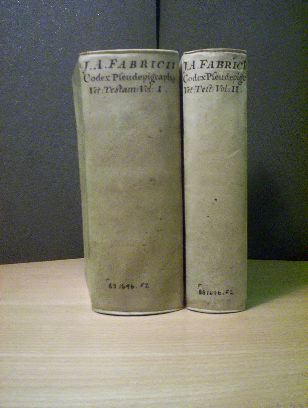 These are the two volumes of Fabricius's Codex pseudepigraphus Veteris Testamenti.
 Here are the frontispiece and title page of volume one. (The beaded necklaces are called "snakes" and are used by librarians to hold open a fragile book. These volumes were tightly bound and somewhat brittle, so we had to be very careful not to open them too wide, lest we crack the binding.)
 Here is the title page of volume 2.
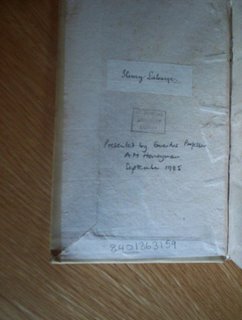 Apparently this set was owned by someone named Henry Labarge (?) about whom I know nothing. It passed into the hands of St. Andrews Semitist A. M. Honeyman, who donated it to the University Library in 1985.
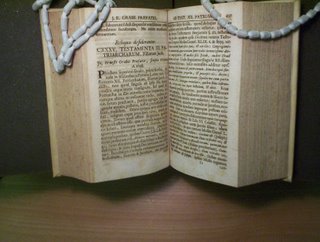 Fabricius included many of the works found now in the two Pseudepigrapha volumes edited by Charlesworth, although not all of the Charlesworth texts were know in Fabricius's time. Here is the entry for the Testaments of the Twelve Patriarchs.
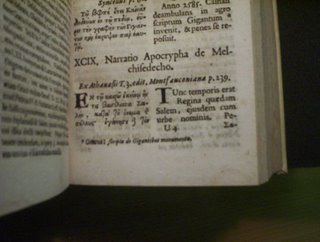 Fabricius also included some texts that are not in the Charlesworth volumes but which are now included in the More Old Testament Pseudepigrapha Project. For example, the Story of Melchizedek is a Greek rewritten scripture about Melchizedek. Sometimes it is attributed pseudonymously to Athanasius but mostly it is transmitted without an author.
 Likewise, the Melchizedek Story in the Chronicon Paschale is part of the MOTP corpus.
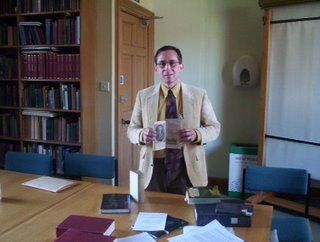 I brought both volumes to the seminar on Wednesday. You can see other pseudepigrapha collections (Charles, Charlesworth, James) and related works (including M. R. James's ghost stories and my own book) scattered about on the table.
I am grateful to the Special Collections Department of the Main Library of the University of St. Andrews for making these volumes available to me, our students, and the readers of PaleoJudaica.
[PHOTO ESSAY -- bumped to the top of the page for 15 May. Lots more posts below.]
(For those new to this site, the Old Testament pseudepigrapha are ancient books that claim [fictionally] to be written by characters in the Old Testament/Hebrew Bible or to be set in OT/HB times, but which do not belong to the Jewish, Catholic, Protestant, or [with an exception or two] Orthodox biblical canons. For more discussion and some related definitions see here, here, and here.)
Anyhow, as I was getting ready for a seminar presentation on the More Old Testament Pseudepigrapha Project which Alex Panayotov and I gave last Wednesday, on a whim I checked the St. Andrews University Library catalogue and I found that it has a copy of Fabricius's Codex pseudepigraphus. Our library used to be a copyright library and it seems to have nearly everything that was published in the early modern period, but this copy, as you will see, seems to have come to it only recently. (I have commented on other treasures in it here and here.) So I went down to the Archives and requested the book. Here are some photographs. You can click on each one to get a larger image.
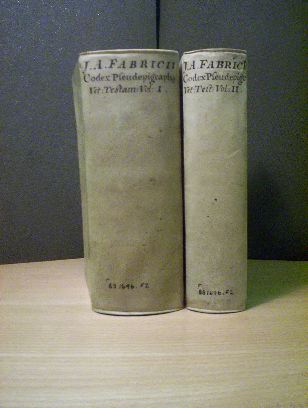 These are the two volumes of Fabricius's Codex pseudepigraphus Veteris Testamenti.
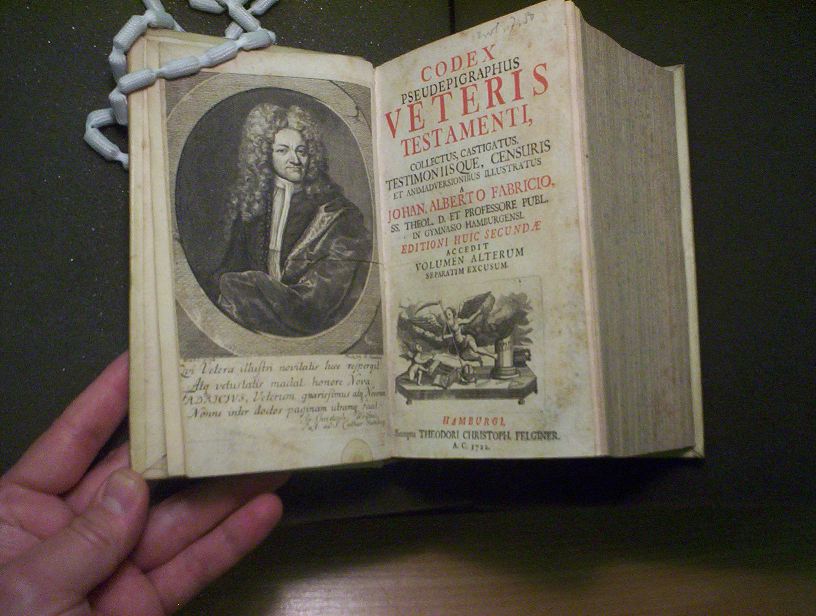 Here are the frontispiece and title page of volume one. (The beaded necklaces are called "snakes" and are used by librarians to hold open a fragile book. These volumes were tightly bound and somewhat brittle, so we had to be very careful not to open them too wide, lest we crack the binding.)
 Here is the title page of volume 2.
 Apparently this set was owned by someone named Henry Labarge (?) about whom I know nothing. It passed into the hands of St. Andrews Semitist A. M. Honeyman, who donated it to the University Library in 1985.
 Fabricius included many of the works found now in the two Pseudepigrapha volumes edited by Charlesworth, although not all of the Charlesworth texts were know in Fabricius's time. Here is the entry for the Testaments of the Twelve Patriarchs.
  Fabricius also included some texts that are not in the Charlesworth volumes but which are now included in the More Old Testament Pseudepigrapha Project. For example, the Story of Melchizedek is a Greek rewritten scripture about Melchizedek. Sometimes it is attributed pseudonymously to Athanasius but mostly it is transmitted without an author.
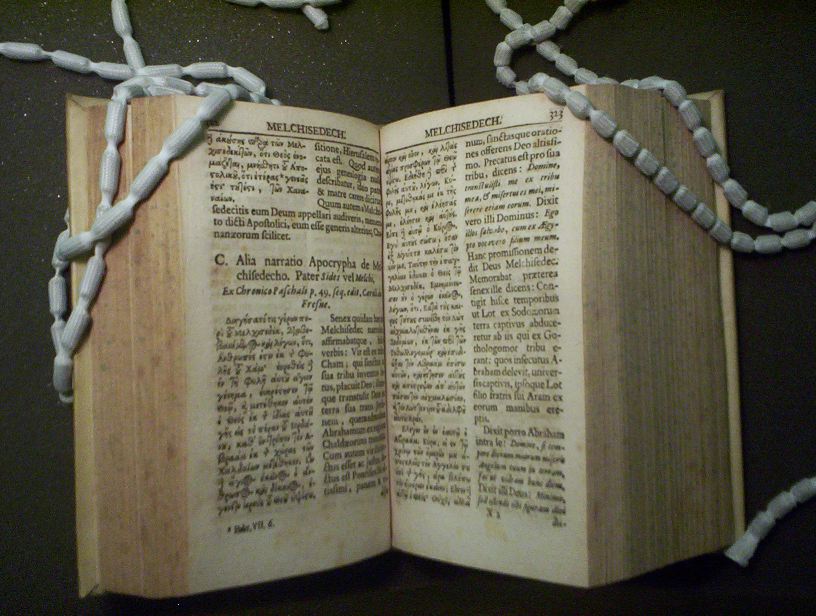 Likewise, the Melchizedek Story in the Chronicon Paschale is part of the MOTP corpus.
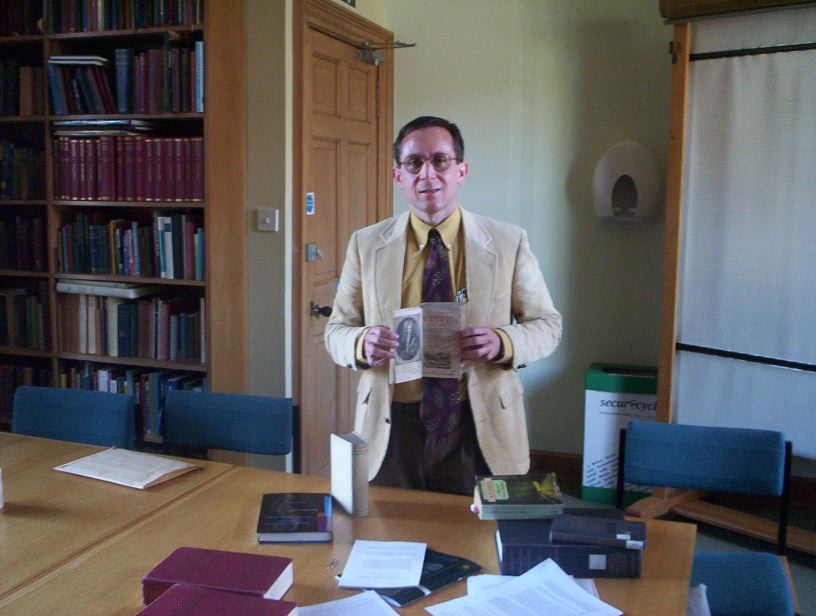 I brought both volumes to the seminar on Wednesday. You can see other pseudepigrapha collections (Charles, Charlesworth, James) and related works (including M. R. James's ghost stories and my own book) scattered about on the table.
I am grateful to the Special Collections Department of the Main Library of the University of St. Andrews for making these volumes available to me, our students, and the readers of PaleoJudaica.
[PHOTO ESSAY -- bumped to the top of the page for 15 May. Lots more posts below.]
WHEN IT RAINS IT POURS. It figures that when I spend hours putting together a big post with lots of photos and I save it for a Monday for maximum exposure, on that Monday I'm deluged with other things to post -- to the point that I'm pretty sure this is my record for number of postings on a single day. I didn't plan it that way, but there it is. Actually, I have a couple more things I still want to post but, all things considered, I think I'll leave them for tomorrow.
THE BIBLE PLACES NEWSLETTER, by Todd Bolen, has just published a new issue (Vol 5, #2 - May 15, 2006). There are some good Featured Photos of Jericho, including the synagogue that was reported to have been destroyed. According to Bolen there is now no discernible damage to it.
JEWISH STUDIES, AN INTERNET JOURNAL, has just published a new article in volume 4 (2006) which can be downloaded in Word or PDF formats from the website:
UPDATE: I've also corrected the mistake in the title.
Aharon Mondschein, "From Prayer of Personal Gratitude to Cosmic Hymn: The Riddle of Ibn Ezra’s Commentary on Chronicles"UPDATE (16 May): I should note that the article is in Hebrew.
UPDATE: I've also corrected the mistake in the title.
I GUESS ASTERIX SHOULD STICK TO LATIN. The Asterix books are a lot of fun and are generally well done. And some of them have even been published in Latin. But Simon Montagu at the the Al Ha veDa blog has caught an embarrassing Phoencian-language error in one of them.
Subscribe to:
Posts (Atom)