The Talmud’s Absolute Value
Through reasoning, the rabbis brought all of natural creation under the rule of law
By Adam Kirsch|April 30, 2013 12:00 AM|
One of the recurring patterns I have noticed in my reading of the Talmud is the way the text puts off explaining its key terms. From the beginning of Tractate Eruvin, for instance, it has been axiomatic that on Shabbat it is permitted to move only within a 2,000-amot techum or boundary. But why is the boundary 2,000 amot in the first place? If the Talmud were a textbook, this would be explained on the first page. But the compilers of the Talmud clearly did not envision it being read the way I, and many others doing Daf Yomi, read it—that is, in isolation.
Rather, the Talmud is a product of and commentary on a living tradition, whose principles have been passed on from generation to generation, in word and action. Presumably, in the fifth century CE, every Jewish child would have known about the 2,000-amot boundary from the time he or she began to walk. It was a rule handed down for centuries—ostensibly, since Moses received the Oral Law on Sinai—and it didn’t need to be explained or justified.
In this week’s reading, however, the rabbis finally did explain where the 2,000-amot figure comes from—and the explanation raises as many questions as it answers. ...
Thursday, May 02, 2013
Catchword tag and turbulent waters in the Talmud
THIS WEEK'S DAF YOMI COLUMN by Adam Kirsch in Tablet


Biblical Studies Carnival
THE APRIL 2013 BIBLICAL STUDIES CARNIVAL has been published at the ἐνθύμησις blog.
Gabriel Revelation inscription in Israel
THE GABRIEL REVELATION STONE is now on display at the Israel Museum: Conversations with Gabriel (Jerusalem Post). It is part of an exhibition on the archangel Gabriel:
Background on the Gabriel Revelation/Vision of Gabriel inscription is here and just keep following those links back.
As for me, I am back in St. Andrews. I got home yesterday evening and am back in the office this morning.
These writings trace the development of the figure of the Angel Gabriel in early rabbinic Judaism, Christianity and Islam. The works include the “War Scroll” – a fragment of the Dead Sea Scrolls discovered at Qumran in 1947, the Book of Daniel from the 13th-century Damascus Codex of the Hebrew Bible, the Gospel of Luke from a rare 10th-century Latin manuscript of the Four Gospels from France and a Koran from Iran from either the 15th or the 16thcentury.Also, despite the lurid headline, this Daily Mail article is pretty good: Does this mysterious Hebrew stone reveal a messiah BEFORE Jesus? Controversial 'Gabriel stone' tablet goes on show in Jerusalem. The answer to the headline question is probably not.
Also on display are prayer books from the three monotheistic religions that contain illustrations of the Angel Gabriel.
Background on the Gabriel Revelation/Vision of Gabriel inscription is here and just keep following those links back.
As for me, I am back in St. Andrews. I got home yesterday evening and am back in the office this morning.
Wednesday, May 01, 2013
Ancient demonization of paganism
ASOR BLOG: Ecclesia Diaboli: The Demonization of the Gentile Religion in Jewish and Christian Thought (Aleksander Michalak, Independent Researcher, Poland, Andrew W. Mellon Fellow).
Schiffman on Philo and Josephus
LAWRENCE SCHIFFMAN: Second Temple Period Rationales for the Torah: Philo; Second Temple Period Rationales for the Torah’s Commandments: Josephus.
Related post noted here.
Related post noted here.
Tuesday, April 30, 2013
Another Syriac manuscript in Turkey
HERE WE GO AGAIN: Priceless 300-year-old religious manuscript in Syriac discovered in eastern province (Hurriyet Daily News).
What is it with Turkey and "priceless" smuggled manuscripts? There is a photo of this one, but the resolution is too poor to make out the contents. It is a codex written in red and black ink, with a lot of deterioration around the edges and what looks like considerable water damage. I don't know how the estimate of the date was arrived at or how accurate it is, but 300-year-old Syriac manuscripts are not particularly hard to come by and I doubt that one would be "priceless" unless its contents were very unusual.
Again, it's good to see that the Turkish authorities are being vigilant about manuscript smuggling, but I suspect that nothing much will come of the extraordinary claims about this one, any more that the claims about an ancient Gospel of Barnabas manuscript that turned out to be an early modern copy of the Gospel of Matthew or that supposed nineteen-hundred-year-old Torah manuscript.
UPDATE (5 May): More here.
What is it with Turkey and "priceless" smuggled manuscripts? There is a photo of this one, but the resolution is too poor to make out the contents. It is a codex written in red and black ink, with a lot of deterioration around the edges and what looks like considerable water damage. I don't know how the estimate of the date was arrived at or how accurate it is, but 300-year-old Syriac manuscripts are not particularly hard to come by and I doubt that one would be "priceless" unless its contents were very unusual.
Again, it's good to see that the Turkish authorities are being vigilant about manuscript smuggling, but I suspect that nothing much will come of the extraordinary claims about this one, any more that the claims about an ancient Gospel of Barnabas manuscript that turned out to be an early modern copy of the Gospel of Matthew or that supposed nineteen-hundred-year-old Torah manuscript.
UPDATE (5 May): More here.
Manichaean texts from Turfan
AT HIEROI LOGOI: Manichaean Texts at the Digitales Turfan-Archiv and TITUS. These Manichaean (Manichean) manuscripts from Turfan include important fragments of a Turkic translation of the Book of Giants which are being translated by Peter Zieme (along with fragments in Aramaic and Manichaean Iranian being translated by others) for volume 2 of the More Old Testament Pseudepigrapha Project.
Monday, April 29, 2013
Arrived
NOW IN OXFORD and enjoying the hospitality of Wolfson College. Aside from my missing my first train by five seconds, the trip was uneventful, and I spent most of it reading page proofs.
Lag B'Omer update
R. SHIMON BAR YOCHAI: Tsunami of prayers at Rashbi’s tomb: Hundreds of thousands of people gather in northern town of Meron to celebrate mystic Jewish holiday.
Background here and links.
Background here and links.
Cairo Geniza presentation
THIS HANDOUT summarizes a presentation recently made by two St. Andrews biblical-studies doctoral students in one of our postgraduate seminars: Cairo Geniza Presentation Interactive Handout by Garrick Allen and Adam Harger.
Incidentally, Garrick produced the indices for my translation of the Hekhalot literature mentioned in the previous post.
Incidentally, Garrick produced the indices for my translation of the Hekhalot literature mentioned in the previous post.
Hekhalot literature lecture at Oxford University
I'M OFF TO OXFORD to give a presentation at their Qumran Forum postgraduate seminar. The subject matter of the seminar is wider than the title implies, and I will be speaking on "Translating the Hekhalot Literature." This is a slightly revised and updated version of the paper I gave in Edinburgh in January, the handout for which is posted at the link. The handout for the one I am giving tomorrow in Oxford is pretty much the same.
As for the translation itself, I am currently going through the second and final page proofs for the volume and it should be out this summer.
I shall be very busy in the next few days, but I will blog as much as time and internet access permit. In any case, I have pre-posted something for each day, so do keep coming back as usual. I expect to be home on Wednesday evening.
As for the translation itself, I am currently going through the second and final page proofs for the volume and it should be out this summer.
I shall be very busy in the next few days, but I will blog as much as time and internet access permit. In any case, I have pre-posted something for each day, so do keep coming back as usual. I expect to be home on Wednesday evening.
Sunday, April 28, 2013
On Jesus the exorcist
AT BIBLE AND INTERPRETATION:
Spirit Possession, Exorcism and the Historical Jesus
Thus, Jesus’ experience as portrayed in Mark closely resembles those of healers across cultures, whose careers often begin with a period of illness or spirit possession, followed by a period of trials or testing, during which the healers learn to control their spirits. Once this has been achieved, they are able to control the spirits of others. In other words, they become healers and exorcists themselves.
See Also: Jesus, the Galilean Exorcist. (Bloomsbury T&T Clark, 2012)
By Amanda Witmer
Department of Religious Studies
Conrad Grebel University College, University of Waterloo
Waterloo, ON Canada
March 2013
Saturday, April 27, 2013
Lag B'Omer
LAG B'OMER is observed beginning tonight at sundown. Best wishes to all those celebrating.
Also, the same day in the Jewish calendar is the yahrzeit for R. Shimon bar Yochai, as noted by Arutz Sheva (although it's a pity they couldn't be bothered to extend their research beyond Wikipedia). More on R. Shimon bar/ben Yochai here and links.
Also, the same day in the Jewish calendar is the yahrzeit for R. Shimon bar Yochai, as noted by Arutz Sheva (although it's a pity they couldn't be bothered to extend their research beyond Wikipedia). More on R. Shimon bar/ben Yochai here and links.
Friday, April 26, 2013
Report on DSS "kickoff event"
AT BRANDEIS: Professors discuss import of Dead Sea Scrolls: Kickoff event held for educational collaboration with Museum of Science.
Background here and links.
Background here and links.
Irish apocrypha again (etc.)
PHILIP JENKINS has more on Irish apocrypha: THE THREE WISE DRUIDS.
Background here.
UPDATE: And here's another interesting post from Jenkins to which I meant to link: CANONS OF SCRIPTURE. Excerpt:
Background here.
UPDATE: And here's another interesting post from Jenkins to which I meant to link: CANONS OF SCRIPTURE. Excerpt:
If you want to understand the history of Christian thought, in the sense of what a substantial majority of Christians actually thought and believed through much of the history of the faith, then you cannot ignore these many alternative scriptures, texts like the Gospel of Nicodemus and pseudo-Matthew, the infancy gospels and the Book of Enoch. They really were that influential. Nor was their impact confined to the poor and uneducated.Indeed.
Thursday, April 25, 2013
Covergence and Divergence in Pentateuchal Theory
CONFERENCE:
Convergence and Divergence in Pentateuchal Theory:
Bridging the Academic Cultures of Israel, North America and Europe
Date: May 12–13, 2013
Location: Israel Institute for Advanced Studies, The Hebrew University.
The Pentateuch lies at the heart of the Western humanities. Yet despite nearly two centuries of critical scholarship, the human origins of this monument of civilization remain shrouded in the past. Indeed, the traditional conception of a unified, self-consistent foundation narrative has long been given up. Critical scholarship has isolated multiple layers of tradition, inconsistent laws, and narratives that could only have originated from separate communities within ancient Israel, and were joined together at a relatively late stage by a process of splicing and editing.
Recent developments in academic biblical studies, however, jeopardize the revolutionary progress that has been made over the last two centuries. The so-called “Documentary Hypothesis” has dominated academic discourse on the Pentateuch since the end of the nineteenth century. More recently, however, the source-critical method has come under unprecedented attack. In fact, in many quarters it has been rejected entirely. While new perspectives are constantly being generated to replace traditional paradigms, the past forty years of scholarship have witnessed not simply a proliferation of intellectual models, but the fragmentation of discourse, especially among Israeli, European, and North American scholars.
This conference seeks to further international exchange and re-establish a shared intellectual. Presentations will be offered by a group of twenty-five international scholars, drawn from the fields of Biblical Studies, Second Temple/Dead Sea Scrolls, and Jewish Studies, with extensive time for discussion and debate.
Organizers: Bernard M. Levinson, University of Minnesota; Konrad Schmid, University of Zurich; Baruch J. Schwartz, The Hebrew University of Jerusalem; and Jan Christian Gertz, Heidelberg University.
Speakers: Joel Baden, Yale University; Mark J. Boda, McMaster Divinity College; David Carr, Union Theological Seminary; Cynthia Edenburg, The Open University of Israel; Jan Joosten, University of Strasbourg; Reinhard G. Kratz, University of Göttingen; Christoph Levin, University of Munich; Noam Mizrahi, Tel Aviv University; Christophe Nihan, University of Lausanne; Thomas Römer, University of Lausanne and Collège de France; Christopher Rollston, George Washington University; Dalit Rom-Shiloni, Tel Aviv University; Michael Segal, The Hebrew University of Jerusalem; Jean Louis Ska, Pontifical Biblical Institute; Jean-Pierre Sonnet, Pontifical Gregorian University; Jeffrey Stackert, University of Chicago; Jakob Wöhrle, University of Münster; David Wright, Brandeis University; Molly Zahn, University of Kansas.
For more information: ias.huji.ac.il/convergence
Samaritan Passover 2013
HAARETZ:
Samaritans make annual sacrifice - and preserve a way of lifeMore on Samaritan Passover here and links. More on the succession of the Samaritan high priesthood in 2010 here. And a recent post on the new translation of the Samaritan Pentateuch is here.
Although there are now less than 800 Samaritans, their Passover sacrifice - set according to calendar different from the mainstream Jewish one - draws an even bigger crowd.
By Andrew Esensten | Apr.24, 2013 | 5:55 PM | 2
The Samaritan community conducted its annual Passover sacrifice Tuesday evening under the leadership of a new high priest, as 50 sheep were slaughtered on Mount Gerizim in an ancient ceremony that attracted more than 1,000 spectators from around the world.
High Priest Aabed-El Ben Asher was elevated to his position, which is reserved for the eldest member of the priestly family, following the death last week of High Priest Aaron Ben Ab-Hisda at age 84. Ben Asher, 78, is the 133rd high priest in a line that the Samaritans claim stretches back to Aaron, brother of Moses.
[...]
Wednesday, April 24, 2013
2013 York Christian Apocrypha Symposium
TONY BURKE: 2013 York Christian Apocrypha Symposium. Happening in September.
Talmud latest
A TALMUD MUSICAL: A Talmud Tale: A Musical: by Judith Abrams, David Schechter, Ned Paul Ginsburg. Published, but apparently not yet performed.
Happy St. George's Day!
CANDIDA MOSS: St George's Day, celebrating a mythical martyr? It seems she doesn't believe the bit about the dragon.
Ignore her, she probably doesn't believe in Santa Claus either.
More on Professor Moss's work here, on St. George here, and on St. Nicholas here and links.
Ignore her, she probably doesn't believe in Santa Claus either.
More on Professor Moss's work here, on St. George here, and on St. Nicholas here and links.
Tuesday, April 23, 2013
Speaking of Jewish messiahs ...
THIS WEEK'S DAF YOMI COLUMN BY ADAM KIRSCH IN TABLET: When Messiah Is an Afterthought: The Talmud’s pragmatism and wonder meet in a technical problem about the height of a boundary line.
Previous Daf Yomi columns are noted here and links.
As best I can recall, in my Talmud reading so far there has been only one reference to the Messiah. This came in Tractate Berachot, where one sage was cited as saying that the deeds of the Messiah would not be supernatural, but political—that the only difference between our world and the messianic age would be the restoration of Jewish sovereignty. And it makes sense that messianism should not, at least so far, be a major concern of the Talmud’s rabbis. After all, they are not theologians but legislators, concerned with how Jews should live in the here and now.A flying Messiah, no less, which brings to mind flying Jesus, as well as the flying Man from the Sea in 4 Ezra 13 who is mentioned in the article cited in the immediately preceding post.
In this week’s Daf Yomi reading, however, the subject of the Messiah returned, in an utterly unexpected and roundabout fashion. ...
Previous Daf Yomi columns are noted here and links.
Review of Boyarin, The Jewish Gospels
DANIEL BOYARIN'S BOOK THE JEWISH GOSPELS receives a quite sympathetic review by Simon Rocker at The Jewish Chronicle: Why a 'divine' messiah was not beyond belief: A new book by a leading Jewish scholar turns some of our preconceptions about Jesus and the origins of Christianity on their head. Excerpt:
But a daring new book by one of the world’s leading Jewish scholars challenges this simple contrast. The Jewish Gospels is a short work aimed at general readers by Daniel Boyarin, a professor of Talmud at the University of California in Berkeley. In ancient times, the borders between what Judaism and Christianity were far more porous than we conceive today, he argues: it was not until the fourth century that the doctrinal differences were clarified, not least because of the desire of the Roman-backed church to put clear water between the spreading new faith and those it considered Jews.Background here and links, where you will see that Peter Schäfer's review of the book goes rather further than believing "that Boyarin overstates his case."
His most explosive contention is that the concept of a divine messiah was not an alien import but part of the cauldron of ideas that bubbled in the volatile world of classical Judaism. “The basic underlying thoughts from which both the Trinity and the incarnation grew are there in the very world into which Jesus was born,” he writes.
Monday, April 22, 2013
Ancient church discovered in Shiloh?
REPORT: Nearly 1,700-year-old Church found in Shiloh, Israel (YourJewishNews.com).
UPDATE (23 April): Joseph Lauer e-mails to point out that a very similar story circulated back in 2006. It was noted at PaleoJudaica here. It looks as though the new story is just a recycling of the old one.
One of the oldest churches ever to be excavated in Israel was recently discovered at the archaeological site of Tel Shiloh, where the temporary Jewish Temple once stood, in Samaria.This is the only report of the discovery I can find and, as you can see, it seems pretty vague on geography and chronology. The report says that some mosaics and then the church were discovered when a drainage ditch was dug to clear the excavation of rain water.
The church, dating from the fourth century CE, was discovered at the site believed that once housed the Ark of the Covenant of the ancient Israelis. The discovery has created much excitement among Christians.
UPDATE (23 April): Joseph Lauer e-mails to point out that a very similar story circulated back in 2006. It was noted at PaleoJudaica here. It looks as though the new story is just a recycling of the old one.
The historical Jesus
ASKING THE IMPORTANT QUESTIONS: Is Historical Jesus Research Futile? (James McGrath).
Syriac in Turkey again
SYRIAC WATCH:
Turkey’s Syriacs yearn to be able to teach Syriac to their childrenMore stories on Syriac in Turkey here, here, here, and links.
21 April 2013 /YONCA POYRAZ DOĞAN, İSTANBUL (Today's Zaman)
Turkey’s Syriacs have long been seeking ways to teach their ancient language, culture and religion to their children; they finally asked a court in Ankara to right a wrong and allow them to open schools which would include a Syriac education.
“My family has been living in Anatolia for centuries, but I don’t know Syriac. I wish there were kindergartens that started Syriac language education at an early age,” said Nazan Söğüt, who has a daughter in the eighth grade and a son in the third grade in İstanbul.
“We would like to have schools at the kindergarten level in accordance with the Education Ministry’s instructions and with certain hours of language courses in Syriac. We only want to prevent the death of our 5,500-year-old language,” said Ezel Muratoğlu, a mother of two children who live in İstanbul’s Moda district. The battle of Syriacs in the Turkish bureaucracy has failed a number of times in its effort to teach their children their ancient language. In the middle of last year, the local education authority in İstanbul did not give them permission to open kindergartens that could teach Syriac. The Syriacs then went to the directorate of private schools with the same demand, but to no avail.
[...]
Adam Kadmon on television
PHILOLOGOS: How Adam Kadmon Made the Leap From The Kabbalah to Italian Television: Primordial Man Has Had a Long, Strange History.
Is he an imaginative Italian investigative journalist? The descendant, as he claims to be, of an ancient family endowed with mystical powers, stemming from seven androids created thousands of years ago by an extraterrestrial geneticist in ancient Sumeria? A former peace activist — as he also claims — who was attacked and put out of commission in 1986 by a secret group of mobsters called “the Illuminati,” only to resurface again, in 2009, as a popular media figure?
It’s anyone’s guess. Meanwhile, as the guessing goes on, so does a weekly show on Italia 1 television in which Adam Kadmon, which means “primordial man” in the Hebrew of the Kabbalah, unravels such “mysteries” as the abdication of Pope Benedict, the death of Hugo Chávez and the secret life of Michael Jackson, and tilts with the Illuminati, who are still out to get him.
Despite his Hebrew name, there’s no need to suspect that he’s Jewish, because the kabbalistic figure of Adam Kadmon has had literary currency outside the Jewish world for a century or more; this goes back at least as far as the late 19th-century vogue for Theosophy, a movement that drew eclectically on a wide range of mystical sources.
DSS "kick-off event" at Brandeis
DEAD SEA SCROLLS IN BOSTON: Dead Sea Scrolls come alive at Brandeis April 23: Brandeis educational partnership with the Museum of Science provides unique insight into the era.
Background here and here and links.
Background here and here and links.
More on Palmyra
SYRIA CONFLICT: Syria’s war is blasting the past (Adam Blitz, The Times of Israel).
Today it is Palmyra’s turn to face the bullet. It too is caught in conflict albeit with the Assad regime, Hezbollah’s bedfellow, and rebel opposition forces. It remains highly strategic. Quite simply Palmyra is “smack-bang” in the middle of Syria. ...More on Palmyra in the present conflict and on its historical and archaeological significance here and links.
Palmyra remains an artistic marvel. It was one of the top tourist-destinations prior to the civil war. Its artistic heritage derives from its unique role as a buffer city which it first held in the 2nd Century between Rome in the West and Parthia (Iran) in the East. Palmyra responded to a state of “betwixt and between” and became one of the most prosperous of all caravan cities. As merchants of antiquity crisscrossed the desert, wealth flowed through the sands of Palmyra. Affluence found expression in a distinct yet hybrid art. It borrowed from Greek, Roman, Semitic and Iranian traditions while at the same time it offered its own local contribution.
This artistic endeavour finds its voice in the rich funerary art which can now be seen in the great museums of the world. In the town itself soaring burial towers, colonnades and temples dominate the landscape. The Temple of Bel is the most monumental of all of the temple-complexes in Palmyra. As with Baalbek, the Temple of Bel has retained the name of an earlier Semitic cult. It was associated with the Mesopotamian Baal, chief god of the pantheon. And as with Baabek’s Temple of Jupiter, the Temple of Bel also sits on the site of a much older Semitic temple.
Sunday, April 21, 2013
"David era" temple/palace found near Jerusalem?
A COLUMN FROM AN IRON-AGE STRUCTURE has been found in "a deep cave south of Jerusalem." Everyone seems to agree on that much with reference to a story first published in English by the Jewish Press: King David Era Find ‘Buried’ by Authorities for Political Reasons (Yori Yanover). Excerpt:
At this point all we know is a little about the structure and that the IAA had known about it for some time, but had elected, for reasons not yet clear, not to make it public. All else is speculation. Note that the first comment at Bolen's blog post, by Israeli archeologist Aren Maier, casts doubt on the structure being as early as the United Monarchy. A potentially "complete" ruin of a structure of this sort from any time in the Monarchic Period would still be exciting, but would not be as profoundly important as one from as early as the United Monarchy.
Just as an aside, I'm having trouble getting a mental picture of how you get a column attached to the relatively untouched (at least recently) ruin of an Iron-Age palace buried in the wall of a deep cave. But maybe that's just me. Presumably the full picture will become clear as more details emerge.
All of the links above were circulated by Joseph I. Lauer on his e-mail list.
That’s the story of a remarkably rare archeological discovery, which no one has heard about. For some reason, possibly political, the Israeli authorities have been trying to silence this discovery which could usher in a breakthrough in our understanding of the periods of King David and his son, King Solomon.The story has also been covered by Arutz Sheva: Is the State Hiding a Major Bible Era Find? Makor Rishon says authorities are keeping lid on what may be a royal castle from David's time. For those who read Hebrew, the Makor Rishon article that broke the story is here. And Todd Bolen has a blog post up on the subject as well at his Bible Places Blog: Royal Architecture Found Near Jerusalem.
The column crown Tropper ran, or rather climbed down into, is very likely part of a complete temple or palace buried underground.
Tropper, who expected nothing short of a medal for his fortunate discovery, called over the field school’s director, Yaron Rosenthal, who in turn alerted a senior employee of Israel’s Antiquities Authority. But no medals were to come any time soon.
At this point all we know is a little about the structure and that the IAA had known about it for some time, but had elected, for reasons not yet clear, not to make it public. All else is speculation. Note that the first comment at Bolen's blog post, by Israeli archeologist Aren Maier, casts doubt on the structure being as early as the United Monarchy. A potentially "complete" ruin of a structure of this sort from any time in the Monarchic Period would still be exciting, but would not be as profoundly important as one from as early as the United Monarchy.
Just as an aside, I'm having trouble getting a mental picture of how you get a column attached to the relatively untouched (at least recently) ruin of an Iron-Age palace buried in the wall of a deep cave. But maybe that's just me. Presumably the full picture will become clear as more details emerge.
All of the links above were circulated by Joseph I. Lauer on his e-mail list.
Bible jobs in Norway
AT THE UNIVERSITY OF OSLO:
(HT Liv Ingeborg Lied.)
Professor/Associate Professor: Hebrew Bible/Old Testament StudiesThere is a catch: you have either to show up knowing a Scandinavian language or agree to learn Norwegian within two years.
Professor/Associate Professor in the New Testament
(HT Liv Ingeborg Lied.)
Saturday, April 20, 2013
Sherman, Babel’s Tower Translated
NEW BOOK FROM BRILL:
Babel’s Tower Translated
Genesis 11 and Ancient Jewish Interpretation
Phillip Michael Sherman, Maryville College, TN
In Babel's Tower Translated, Phillip Sherman explores the narrative of Genesis 11 and its reception and interpretation in several Second Temple and Early Rabbinic texts (e.g., Jubilees, Philo, Genesis Rabbah). The account of the Tower of Babel (Genesis 11:1-9) is famously ambiguous. The meaning of the narrative and the actions of both the human characters and the Israelite deity defy any easy explanation. This work explores how changing historical and hermeneutical realities altered and shifted the meaning of the text in Jewish antiquity.
Friday, April 19, 2013
Anglo-Saxon biblical apocrypha and pseudepigrapha
THE ANGLO-SAXON CHURCH, Philip Jenkins tells us, was really into their Old Testament Apocrypha and pseudepigrapha and their New Testament apocrypha: THE FIRST ENGLISH BIBLE.
UPDATE: Dead links now fixed! Sorry about that.
Anglo-Saxon England was converted in the century or so after 597, and in the following centuries became one of the liveliest cultural centers of Western Europe. Scandinavian invasions caused massive damage in the ninth century, but Anglo-Saxon culture and literature continued to flourish until the Norman Conquest of 1066. Within a couple of generations after that cataclysm, the Anglo-Saxon language ceased to matter as a learned tongue. When we find a text associated with the Anglo-Saxon church, then, we can say confidently that it was used somewhere between 600 and 1066 or so, and is very unlikely to be much earlier or later.For early Irish Old Testament pseudepigrapha, see this essay by my colleague Grant Macaskill: The Pseudepigrapha in the Irish Church.
A century ago, M. R. James remarked that “the Anglo-Saxon and Irish scholars seem to have been in possession of a good deal of rather rare apocryphal literature,” mainly in Latin but occasionally even in Greek. ...
UPDATE: Dead links now fixed! Sorry about that.
Thursday, April 18, 2013
No reconstructing Herod's tomb
WELL, THAT WAS AN AMBITIOUS IDEA:
Background on the Israel Museum's Herod exhibition and on the site is here and keep following the links back.
Israeli plan to rebuild Herod’s tomb scrapped due to experts' criticismI'm not particularly keen on the idea of full on-site reconstructions of important ancient ruins. Let's stick to scale models that can be updated and corrected as our understanding improves. And in this case, as the article points out, we're not even entirely certain that this is Herod the Great's tomb.
The reconstruction of the West Bank monument, which would have set a precedent as the world's first archaeological structure to be fully restored, was championed by a local politician but slammed by archaeologists and academics as ostentatious and populist.(Nir Hasson, Haaretz)
[...]
The Israel Nature and Parks Authority said in a statement, “Following the public hearing organized by the authority, new insights were received that will enrich and improve the proposal [to restore the tomb]. The Israel Museum exhibition will close in eight months, and after that the findings will be returned to Herodion and be integrated into the restoration.”
Background on the Israel Museum's Herod exhibition and on the site is here and keep following the links back.
DSS in Utah
DEAD SEA SCROLLS ARE COMING TO SALT LAKE CITY:
Dead Sea Scrolls coming to Leonardo in Salt Lake CityBackground here with many, many links.
By Sean P. Means
| The Salt Lake Tribune
First Published Apr 17 2013 10:55 am • Updated 5 hours ago
A display featuring some of the Dead Sea Scrolls — the parchments that include the earliest known manuscripts of the Hebrew Bible — is coming to Salt Lake City.
Twenty scrolls, some of which date back to near the time of Christ, will be part of an exhibit that will open in mid-November at The Leonardo, downtown Salt Lake City’s art-and-technology museum, officials announced Wednesday.
[...]
Salt Lake City is one of only 10 cities to host the "Dead Sea Scrolls: Life and Faith in Ancient Times." The exhibit has been shown in New York, Philadelphia and Cincinnati, and will open May 19 at Boston’s Museum of Science.
[...]
Wednesday, April 17, 2013
More on that man in a plastic bag
SIMON HOLLOWAY has more on that story about the man who sealed himself in a plastic bag on an El Al flight, including a survey of relevant Talmudic etc. passages and halakhic issues: Sons of Aharon (Davar Akher).
Tuesday, April 16, 2013
Hurtado on revelatory experiences
LARRY HURTADO summarizes his recent lecture series: “Revelatory” Experiences and Religious Innovation.
I have some related thoughts on ancient and more recent revelatory experiences here and here.
I have some related thoughts on ancient and more recent revelatory experiences here and here.
"Channeling" the Tannaim
THIS WEEK'S DAF YOMI COLUMN BY ADAM KIRSCH IN TABLET: Crossing the Line: By avoiding authoritative rulings in favor of nuanced debate with the ideas of the past, the Oral Law refuses to simplify.
It’s not often that the subject of the weekly Daf Yomi reading makes headlines in the blogosphere. But last week, the web—especially its Jewish corners—was buzzing over a bizarre photograph of an Orthodox Jewish man on an airplane, completely wrapped in a plastic bag. Many commenters on the photo assumed this had something to do with sexual purity or avoiding women, but in fact, as knowledgeable readers pointed out, it actually involved another taboo entirely.Earlier Daf Yomi columns are noted here, here, and links.
The man must have been a Kohen, a member of the priestly class, and Kohanim are prohibited from coming into contact with corpses. Passing over a cemetery—even, in this case, at 30,000 feet—qualifies as such a contact. By wrapping himself in plastic, the man in question must have been guarding himself against that kind of impurity or tumah. Since most Orthodox Jews, even Kohanim, do not regularly fly in plastic, it’s clear that the man in the photo was adopting a minority position about what’s required to avoid contamination. (I’d be glad to hear from knowledgeable commenters about the law on this issue.)
As it turned out, just this question—how a Kohen can travel through a cemetery—was addressed in the Talmud last week, in Eruvin 30b. ...
Monday, April 15, 2013
OT Pseudepigrapha in the Biblioblogosphere
OLD TESTAMENT PSEUDEPIGRAPHA WATCH:
Philip Jenkins discusses the musical history of interpretation of the Sibylline Oracles: AS THE SIBYL SANG.
Lawrence Schiffman has a post on another important pseudepigraphon: Second Temple Period Rationales for the Torah’s Commandments: Book of Jubilees.
Philip Jenkins discusses the musical history of interpretation of the Sibylline Oracles: AS THE SIBYL SANG.
Lawrence Schiffman has a post on another important pseudepigraphon: Second Temple Period Rationales for the Torah’s Commandments: Book of Jubilees.
Sunday, April 14, 2013
BMCR reviews
RECENT REVIEW FROM BMCR:
Bryn Mawr Classical Review 2013.04.13
Mireille Hadas-Lebel, Philo of Alexandria: A Thinker in the Jewish Diaspora. Studies in Philo of Alexandria, 7. Leiden; Boston: Brill, 2012. Pp. 240. ISBN 9789004209480. $140.00.
Reviewed by Maren R. Niehoff, The Hebrew University of Jerusalem, Mt. Scopus (msmaren@mscc.huji.ac.il)
Preview
This guide to Philo’s life, thought and political activity is an important addition to Philonic scholarship, which has been flourishing and reaching out to other disciplines. While A. Kamesar has recently collected introductory essays on Philo by a team of international researchers, who highlight the status quaestionis in their respective fields,1 Hadas-Lebel singlehandedly offers a comprehensive study of Philo, lucidly outlining the different aspects of his personality without striving to provide an updated picture of Philonic research. She initially describes his historical context in Alexandria and then provides an analysis of his writings and thought, concluding with an overview of his influence among early Christians. Hadas-Lebel forcefully argues for a significant connection between Philo’s Diaspora setting and his thought: he cannot be subsumed within rabbinic Judaism, but is the main exponent of a form of Judaism that took Greek culture very seriously into account, while maintaining a strong and visible Jewish identity.
[...]
Bryn Mawr Classical Review 2013.04.23
J. Albert Harrill, Paul the Apostle: His Life and Legacy in Their Roman Context. New York: Cambridge University Press, 2012. Pp. xv, 207. ISBN 9780521757805. $24.99 (pb).
Reviewed by Paul B. Harvey, Jr., Pennsylvania State University (pbh1@psu.edu)
Preview
Harrill has published extensively on the socio-economic contexts (especially slavery) of Paul’s letters;1 here he offers a biographical sketch of Paul with a very welcome discussion of how and to what extent ancient authors appropriated Paul and his teachings. Harrill urges that Paul be reckoned among the “key figures” of ancient Mediterranean history. Few scholars acquainted with the modern study of early Christianity would, I think, quarrel with Harrill’s assessment of the apostle’s historical significance and influence. Indeed, many would surely agree with Bruce Chilton’s apothegm: without Paul, no Christianity.2
[...]
Saturday, April 13, 2013
Tsedaka and Sullivan, The Israelite Samaritan Version of the Torah
IN THE MAIL:
Benyamim Tsedaka and Sharon Sullivan et al. The Israelite Samaritan Version of the Torah: First English Translation Compared with the Masoretic Version (2013)A complimentary copy from Eerdmans. Some background on the project is here, here, and here.
Friday, April 12, 2013
Consensus
BIBLE AND INTERPRETATION: Against Consensus (Joel S. Baden). I note that the author criticizes scholars for appealing to consensus without giving specific references. Fair enough, but this essay itself speaks only in generalizations and does not give a single reference, opening itself to the criticism of debunking a straw man.
Via James McGrath, who also comments. There was a discussion about consensus among the biblioblogs in 2005, but most of the links are now gone. My thoughts are here and here.
UPDATE: Mark Goodacre's posts are now here and here. Mark also has reminded me of another brief post of mine in the thread.
Via James McGrath, who also comments. There was a discussion about consensus among the biblioblogs in 2005, but most of the links are now gone. My thoughts are here and here.
UPDATE: Mark Goodacre's posts are now here and here. Mark also has reminded me of another brief post of mine in the thread.
Pulsa deNura
THE PULSA DENURA RITE IS BACK IN THE NEWS: Wait…There Are Jewish Death Curses? Naftali Bennett just received one (Adam Chandler, Tablet).
Background here and links.
Background here and links.
DSS lecturer
IAN WERRETT: Saint Martin’s Society Of Fellows Welcomes Dead Sea Scrolls Scholar As Spring Colloquium Speaker. Ian wrote his doctoral thesis on ritual purity in the Dead Sea Scrolls under my supervision.
Review of Barbour, The Story of Israel in the Book of Qohelet
H-JUDAIC REVIEW:
Jennifer Barbour. The Story of Israel in the Book of Qohelet: Ecclesiastes as Cultural Memory. Oxford: Oxford University Press, 2012. xv + 225 pp. $135.00 (cloth), ISBN 978-0-19-965782-7.
Reviewed by Jennifer L. Koosed (Albright College)
Published on H-Judaic (April, 2013)
Commissioned by Jason Kalman
The History-Haunted Meditations of Qohelet
Jennie Barbour’s The Story of Israel in the Book of Qohelet provides a new perspective on the issue of history in Qohelet. The scholarly consensus has been that historical reference is completely absent from Qohelet, a book that does not seem to be interested in either the figures or the events of ancient Israel. Barbour challenges this consensus. She argues that “history haunts Ecclesiastes” (p. 3). Barbour is not, however, trying to revive some Jewish and Christian traditional exegesis which assumes Solomonic authorship and imposes an allegorical and historicizing interpretation on the book. Rather, Barbour proposes that the author of Qohelet (highly educated and literate) is drawing on a wealth of textual traditions and a deep cultural memory that has been shaped by the experience of the Babylonian destruction and exile. This experience, then, leaves its mark on Qohelet’s meditations as well.
[...]
Thursday, April 11, 2013
The Akitu Festival
FROM SETH LARKIN SANDERS ON FACEBOOK:
'Today (11 April 2013) at sunset is Babylonian New Year, Day 1 of the Month Nisannu of Year 2324 of the Seleucid Era, the beginning of the Akitu festival. It's now time for reading Enuma Elish and praying to Marduk' - Mathieu OssendrijverAs usual, best wishes to all those celebrating.
Lovecraftian ruin
OBVIOUSLY LEFT BY THE ELDER THINGS: Monumental Cone-Shaped Structure Found in Sea of Galilee. I hope the archaeologists don't go and stir up a Shoggoth.
I also hope no one responds to this blog post with a peer-reviewed article.
I also hope no one responds to this blog post with a peer-reviewed article.
Oldest Ethiopic manuscript of 1 Enoch
LOREN STUCKENBRUCK has been photographing the Oldest Known Text of Ethiopic Enoch (Anthony Le Donne).
A commenter asks about recent translations of 1 Enoch. My comment is in moderation, but meanwhile, the industry standard is George W. E. Nickelsburg and James C. Vanderkam, 1 Enoch: The Hermeneia Translation (Fortress, 2012). It is based on the magisterial two-volume Hermeneia commentary by the same authors:
George W. Nickelsburg 1 Enoch 1 (Fortress, 2001);
George W. E. Nickelsburg and James C. Vanderkam 1 Enoch 2: A Commentary on the Book of 1 Enoch, Chapters 37-82 (Fortress, 2011).
A commenter asks about recent translations of 1 Enoch. My comment is in moderation, but meanwhile, the industry standard is George W. E. Nickelsburg and James C. Vanderkam, 1 Enoch: The Hermeneia Translation (Fortress, 2012). It is based on the magisterial two-volume Hermeneia commentary by the same authors:
George W. Nickelsburg 1 Enoch 1 (Fortress, 2001);
George W. E. Nickelsburg and James C. Vanderkam 1 Enoch 2: A Commentary on the Book of 1 Enoch, Chapters 37-82 (Fortress, 2011).
New JHS articles
NEW ARTICLES have been posted at the online Journal of Hebrew Scriptures. Click on the link to download the pdf file of the article.
Robert REZETKO, “The Qumran Scrolls of the Book of Judges: Literary Formation, Textual Criticism, and Historical Linguistics”
Abstract: This is a pilot attempt to combine literary-critical, text-critical, and historical linguistic approaches in an analysis of selected linguistic variants between the MT and DSS with an application to the book of Judges. The result of this interdisciplinary exercise is that future research on the history of BH will have to contend more earnestly with the “fluidity” (or “changeability”) of language and the “non-directionality” (or “patternlessness”) of linguistic variants in biblical texts.
Jeremiah W. CATALDO, “Yahweh’s Breasts: Interpreting Haggai’s Temple through Melanie Klein’s Projective Identification Theory”
Abstract: Haggai’s emphasis on the temple is driven more by a concern for a defensive preservation of social-political identity than it is for the institutional restoration of the cult. As a heuristic device, Melanie Klein's theory on projective identification helps identify constructivist elements in Haggai that highlight postures of defensive preservation as legitimations of the Jerusalem temple as a shared object. Haggai’s vision of a “restored” society is based on his belief that the symbolic value of the temple is a necessary, constructive element in the creation or manifestation of that society and its corresponding identity.
Also, there are new reviews added to the review page.
Robert REZETKO, “The Qumran Scrolls of the Book of Judges: Literary Formation, Textual Criticism, and Historical Linguistics”
Abstract: This is a pilot attempt to combine literary-critical, text-critical, and historical linguistic approaches in an analysis of selected linguistic variants between the MT and DSS with an application to the book of Judges. The result of this interdisciplinary exercise is that future research on the history of BH will have to contend more earnestly with the “fluidity” (or “changeability”) of language and the “non-directionality” (or “patternlessness”) of linguistic variants in biblical texts.
Jeremiah W. CATALDO, “Yahweh’s Breasts: Interpreting Haggai’s Temple through Melanie Klein’s Projective Identification Theory”
Abstract: Haggai’s emphasis on the temple is driven more by a concern for a defensive preservation of social-political identity than it is for the institutional restoration of the cult. As a heuristic device, Melanie Klein's theory on projective identification helps identify constructivist elements in Haggai that highlight postures of defensive preservation as legitimations of the Jerusalem temple as a shared object. Haggai’s vision of a “restored” society is based on his belief that the symbolic value of the temple is a necessary, constructive element in the creation or manifestation of that society and its corresponding identity.
Also, there are new reviews added to the review page.
Do crosses walk, talk, and blog?
TWENTY-FIRST CENTURY PROBLEMS: Peer-reviewed article responding to a blog post: what is the etiquette? (Mark Goodacre).
I think the comment by Deane Galbraith is spot on.
I think the comment by Deane Galbraith is spot on.
Wednesday, April 10, 2013
Rollston on lab testing
CHRISTOPHER ROLLSTON: LABORATORY TESTING OF ANCIENT INSCRIPTIONS: METHODOLOGICAL REFLECTIONS.
Related recent item here.
In sum, the use of laboratory tests for inscriptions from the market is auspicious, but the labs conducting the tests must be vetted, protocols for the testing must be put in place in every case, and the results of the laboratory tests must be fully published so that they can be scrutinized as well. In short, there is much to be hopeful about, but methodological doubt must be maintained as well.Just in case you thought the results of lab testing were conclusive.
Related recent item here.
How much interpretation is too much?
THIS WEEK'S DAF YOMI COLUMN BY ADAM KIRSCH IN TABLET: Are Truffles Food? As our Talmud column returns, debates over Oral Law range from the existential to the mundane. Two topics from Tractate Eruvin in this one:
This numerical inflation reminded me of the saying chanted by the Israelites, in the First Book of Samuel, about Saul and David, comparing their greatness in battle: “Saul has slain his thousands, and David his tens of thousands.” In Talmudic times, Jewish manliness was no longer measured in Philistine corpses, but in legal creativity. Still, there is a point, Eruvin 13b teaches, beyond which a sage can become too intellectually advanced.
[...]
What kinds of food, the rabbis ask, are capable of creating an eruv? Any food or drink, the Mishnah says in Eruvin 26b, except for salt and water. The food does not even have to be a kind that the person in question can actually eat. A Nazirite, for instance, vows not to drink wine, but it is permissible to use wine to create an eruv for him. This might seem so plain as to require no further discussion. But, of course, there is one, because of a principle the Gemara goes on to explain. “We cannot learn from general rules,” Rabbi Yochanan says, because any rule might carry unstated exceptions.
[...]
Reflections on the Lod Mosaic
MORGAN MEIS: Artspotting: Lod Mosaic. "Sometimes a floor is just a floor."
Background here and links.
Background here and links.
Ancient mikveh in Jerusalem
DISCOVERY:
Mikve from era of Second Temple excavated in J'lem
By JPOST.COM STAFF
04/10/2013 10:42
In preparing to build a new highway near Jerusalem's Kiryat Menachem neighborhood, archeologists have discovered an ancient treasure.
An archeological excavation by the Israel Antiquities Authority prior to the construction of a new road in Jerusalem's Kiryat Menachem neighborhood has led to the discovery of an ancient mikve (ritual bath) from the era of the Second Temple.
Binyamin Storchen, who headed the excavation, said that many mikves have been discovered in recent years, but the water running through this particular ritual bath is "unique and unusual."
[...]
Tuesday, April 09, 2013
Authenticating the Gospel of Judas
TESTS:
By the way, what ever happened to those authentication tests on the Gospel of Jesus' Wife? You know, the ones being arranged by the entirely impartial and disinterested owner of the fragment? And the tests to authenticate the fake metal codices? The ones that were going to take three weeks back in April of 2011? But don't even get me started on that one.
UPDATE: On the question of whether the Gospel of Judas "casts Judas as a co-conspirator of Jesus, rather than a betrayer," see here and links. This was the view of the scholars that published the text, but it has been very much disputed since then.
UPDATE (10 April): Related post here.
Truth Behind Gospel of Judas Revealed in Ancient InksAn interesting story detailing the process of authenticating the Gospel of Judas. (HT David Meadows.) Here's an image gallery, also at LiveScience. More on the Gospel of Judas here with many links.
Stephanie Pappas, LiveScience Senior Writer
Date: 08 April 2013 Time: 11:30 AM ET
A long-lost gospel that casts Judas as a co-conspirator of Jesus, rather than a betrayer, was ruled most likely authentic in 2006. Now, scientists reveal they couldn't have made the call without a series of far more mundane documents, including Ancient Egyptian marriage licenses and property contracts.
[...]
By the way, what ever happened to those authentication tests on the Gospel of Jesus' Wife? You know, the ones being arranged by the entirely impartial and disinterested owner of the fragment? And the tests to authenticate the fake metal codices? The ones that were going to take three weeks back in April of 2011? But don't even get me started on that one.
UPDATE: On the question of whether the Gospel of Judas "casts Judas as a co-conspirator of Jesus, rather than a betrayer," see here and links. This was the view of the scholars that published the text, but it has been very much disputed since then.
UPDATE (10 April): Related post here.
Temple treasures in the Vatican?
REQUEST: Pope Francis, please inventory the spoils of Titus! (Rosie Rosenzweig, The Examiner).
Which brings us to the present with Pope Francis advocating a “poor church for poor people;” this caused a flurry among Catholic writers to interpret this. Dr. William Oddie, former editor of the Catholic Herald immediately asked: “Should Pope Francis sell off the Vatican’s art collection and give the money to the poor? The answer is an emphatic ‘No’!” It’s not the paintings that would be a gesture to Jews curious to know if the Vatican archives still house the spoils of Titus from the Holy Temple. In 1996, Israel’s Minister of Religious Affairs, based on research at the University of Florence, Shimon Shetreet asked Pope John Paul II to help locate the menorah described in the Bible and depicted in Titus Arch. At another time, Israeli President Moshe Katzav asked the Vatican to inventory a list of Judaica and Temple treasures held there.The idea that the Vatican might have some of the Temple treasures in its archives has been around for a while and I have explained here why I don't think it's likely. For Sean Kingsley's theory that they are in a monastery in the Holy Land see here and links. According to the legends in the external tractate Massekhet Kelim, the treasures are hidden in various sites in Palestine and Babylon. It is possible that the Copper Scroll is a list of Temple treasures hidden in Palestine in advance of the Great Revolt in 70 CE, but if so, most of the hiding places have probably been plundered and the treasures dispersed long since. I don't think the Temple treasures are at the bottom of any sea, but I would be surprised if any substantial portion of them remains collected at any one place today.
Presently, the heirs of owners contesting many art treasures stolen by the Nazis, join the posse of many museums in Iraq and Iran seeking museum missing treasures stolen during their country’s various invasions. It would be a grand gesture of good will to the Vatican’s “elder brothers” to research the archives for the Temple treasures. And then, if found, would it make the Vatican’s archives that much poorer, to return these ritual items to the country where they were made? Of course it may be that the Vatican treasury doesn’t contain Titus’ spoils from the sacking of the Temple as Edward Gibbon suggests, and that these treasures may be somewhere at the bottom of the Mediterranean Sea.
Monday, April 08, 2013
Herod in the CSM
THE HEROD THE GREAT EXHIBITION IN THE ISRAEL MUSEUM is reviewed in the Christian Science Monitor: In the Holy Land's columns, frescoes, and desert palaces, Herod the Great lives on: King Herod is best known to Christians for trying to kill the infant Jesus. But he also left his mark with stunning architectural achievements, as seen in a new exhibit at the Israel Museum.
Nothing much new in the article, but it looks like a good overview. Background on Herod and on the exhibition is here and links.
Nothing much new in the article, but it looks like a good overview. Background on Herod and on the exhibition is here and links.
Saturday, April 06, 2013
Friday, April 05, 2013
Byzantine-era wine press etc.
HERE IS THE CHURCH, HERE IS THE STEEPLE ... Discoveries at Hamei Yoav: A 1,500 year old wine press and a ceramic model of a church.

photograph: Clara Amit, courtesy of the Israel Antiquities Authority
JERUSALEM.- A settlement from the Byzantine period in which an impressive wine press and a ceramic model of a church were preserved was exposed in salvage excavations the Israel Antiquities Authority conducted near Hamei Yoav prior to the construction of an events garden by the Shevet Ahim group, led by the Yifrah Brothers.The link is to (and the quote from) an article at ArtDaily. The original IAA press release (from which the photo comes) is here (HT Joseph Lauer). Follow the links for more photos of the site.
[...]
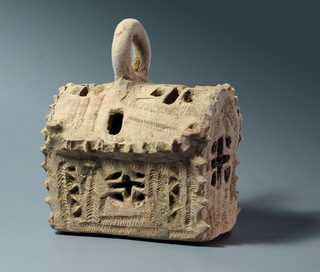
photograph: Clara Amit, courtesy of the Israel Antiquities Authority
DSS crowds in Cincinnati
POPULAR: Cincinnati Museum Center: Some Dead Sea Scrolls exhibit times extended to accommodate crowds.
Exhibitions of the Dead Sea Scrolls are generally very successful.
Background on this one is here and links.
Exhibitions of the Dead Sea Scrolls are generally very successful.
Background on this one is here and links.
Thursday, April 04, 2013
Forthcoming: Encyclopedia of Hebrew Language and Linguistics
COMING SOON FROM BRILL:
Encyclopedia of Hebrew Language and LinguisticsAnd for you, special deal: a pre-publication price of only 850 Euros! (This is in the e-mail announcement, but I don't see it on the web page.)
The Hebrew language has one of the longest attested histories of any of the world’s languages, with records of its use from antiquity until modern times. Although it ceased to be a spoken language by the 2nd century C.E., Hebrew continued to be used and to develop in the form of a literary and liturgical language until its revival as a vernacular in the 20th century.
In a four volume set, complete with index, the Encyclopedia of Hebrew Language and Linguistics offers a systematic and comprehensive treatment of all aspects of the history and study of the Hebrew language from its earliest attested form to the present day. The encyclopedia contains overview articles that provide a readable synopsis of current knowledge of the major periods and varieties of the Hebrew language as well as thematically-organized entries which provide further information on individual topics, such as the Hebrew of various sources (texts, manuscripts, inscriptions, reading traditions), major grammatical features (phonology, morphology, and syntax), lexicon, script and paleography, theoretical linguistic approaches, and so forth. With over 950 entries and approximately 400 contributing scholars, the Encyclopedia of Hebrew Language and Linguistics is the authoritative reference work for students and researchers in the fields of Hebrew linguistics, general linguistics, Biblical studies, Hebrew and Jewish literature, and related fields.
Fighting in Palmyra
TEMPLE OF BAAL: Syria's ancient oasis city of Palmyra threatened in fighting.
(Reuters) - The millenia-old oasis city of Palmyra is being damaged in clashes between Syrian President Bashar al-Assad's forces and rebels fighting for his overthrow in the midst of the precious archaeological site, a resident said on Wednesday.Background here.
Wednesday, April 03, 2013
Rollston on unprovenanced inscriptions
THE ASOR BLOG: Using Inscriptions from the Antiquities Market: Polarized Positions and Pragmatic Proposals (Christopher A. Rollston). I agree with his conclusions and would put it perhaps a little more aggressively: unprovenanced inscriptions should be regarded as forgeries in the absence of strong positive evidence to the contrary. I have some related thoughts here and links.
Criticism of the Lod Mosaic exhibition
THE DAILY PENNSYLVANIAN: Professors critique Penn Museum's ‘Lod Mosaic’ exhibit: The professors submitted a statement to the museum director with their concerns.
Limited information is known about the history of the Lod Mosaic, but a number of Penn faculty have voiced concern that the piece is presented without any archaeological context. “We don’t want to celebrate a master work in isolation,” said Professor of Roman architecture Lothar Haselberger, who initiated the conversation on how the mosaic is presented.Via Joseph I. Lauer. Background on the exhibition and the mosaic is here with many links.
“Nothing is conveyed to the public that [the mosaic] is more than a carpet,” Haselberger said, referencing the fact that mosaics like the “Lod Mosaic” were popular in this time period as floor decorations in many buildings.
“This is an exhibit that really focuses on the meticulous conservation by the Israel Antiquities Authority of a dazzling Roman mosaic that was found during highway construction,” said Brian Rose, Curator-in-Charge of the Mediterranean Section at the Penn Museum.
More on Herod the Great
BIBLE HISTORY DAILY: Herod the Great: Friend of the Romans and Parthians?Jason M. Schlude explores how King Herod manipulated his position between two regional powers.
Background on Herod and the current exhibition about him at the Israel Museum is here, leading to many links.
Background on Herod and the current exhibition about him at the Israel Museum is here, leading to many links.
Shanks, Christianity & Rabbinic Judaism
OUT IN A SECOND EDITION, FROM BAS:
Christianity & Rabbinic Judaism 2nd EditionFollow the link for TOC and ordering information.
Christianity and Rabbinic Judaism
A Parallel History of their Origins and Early Development
Edited by Hershel Shanks
ITEM: 7H192 Hardcover
ISBN 978-1-935335-52-8
A unique look at two of the world’s great religions
This newly revised parallel history of Judaism and Christianity presents the first six centuries in the development of both religions in one understandable volume. This unprecedented book takes readers from the middle of the first century—when a distinction between Judaism and Christianity first became apparent—to theArab conquest. This book begins where its companion volume, Ancient Israel, ends.
The first edition appeared more than two decadesago and has since become a standard text book and reference work for undergraduate, graduate and Bible study courses across the country. The book’s editor and contributing authors have now written a completely updated and revised edition that incorporates the most important finds andi nsights from the past two decades of archaeological, historical and biblical research.
More than 65 images enhance the text, many illustrating the most dramatic and importantf inds discovered in the Holy Land and elsewhere in recent decades. It also includes, for the first time, informative maps detailing the many sites and regions where the shared histories of these two world religions unfolded
Macaskill, The Slavonic Texts of 2 Enoch
NOW PUBLISHED BY BRILL:
The Slavonic Texts of 2 EnochSome background here. Cross-file under "Old Testament Pseudepigrapha Watch."
In The Slavonic Texts of 2 Enoch, Grant Macaskill publishes the manuscript evidence for this important pseudepigraphon in a format that, for the first time, allows synoptic comparison of the variants encountered. With the long and short recensions represented on facing pages, and variants listed against two exemplars (J and A), readers will be able to weigh the textual and linguistic evidence in a way that has previously been hindered by the available publications of 2 Enoch. The book also includes an introductory discussion of the manuscripts and the problems associated with text-critical work on them, and a translation of the neglected manuscript B, with notes on the significance of its readings for the reconstruction of an ur-text.
Tuesday, April 02, 2013
Shroud of Turin latest
THERE'S AN APP FOR THAT: Shroud 2.0: A High-Tech Look at One of Christianity’s Most Important Artifacts.
Background on the Shroud of Turin is here and links.
Background on the Shroud of Turin is here and links.
Ancient synagogue damaged but not destroyed
JOBAR SYNAGOGUE:
Ancient Syrian synagogue hit by looting, shellingA similar report comes from the AP: Historic synagogue in Damascus damaged, looted. It sounds as though JTA got ahead of itself when it reported yesterday that the synagogue was destroyed. So the current status is that the news is bad, but not nearly as bad as was initially reported. I hope the current report is the one that is accurate.
BEIRUT | Mon Apr 1, 2013 6:10pm BST
(Reuters) - Theft and shelling have damaged a 2,000 year-old synagogue in Damascus, one of the oldest in the world, Syrian government and opposition activist sources said on Monday.
Syria's historic monuments have increasingly become a casualty of the civil war has killed more than 70,000 people. Parts of Aleppo's medieval stone-vaulted souk have been reduced to rubble, and many ancient markets, mosques and churches across the country are threatened with destruction.
The damage has so far been light at the Jobar Synagogue, built in honour of the biblical prophet Elijah, according to Mamoun Abdulkarim, the head of Syria's antiquities department.
"Local community officials say the place's sanctity has been violated and there were thefts but I cannot verify the nature of the thefts without investigation," Abdulkarim told Reuters by telephone.
"Four months earlier they (Jewish authorities) tried to go in and were prevented from entering due to the presence of fighters."
He said that authorities believed looters have mostly stolen gold chandeliers and icons dating back 70 to 100 years.
But Abdulkarim said he doubted that thousands of priceless manuscripts had been stolen from the synagogue as most of them, including Torahs in filigreed silver cases, had already been moved to the synagogue inside Damascus's Old City, a UNESCO world heritage site.
[...]
Monday, April 01, 2013
The Walking Dead
EASTER THOUGHTS FROM JARED CALAWAY: Creepiest Part of Jesus' Death and Resurrection in the Gospels.
Matthew 27:52-53 is an odd passage that leaves many loose ends and open questions. Why does it say "many bodies" as though the souls might be elsewhere, leaving ... zombies? What were the reactions of the hapless folk in the Holy City when confronted by these reanimated bodies? Joy at seeing lost loved ones again? Terror? Confusion? Baseball bats? What happened to these bodies? Did they have souls and settle in and rejoin society for an extra lifetime? Did they go back to their graves after a while and climb back in? Were they all slain again by the living? Or did they shuffle off into the wilderness to prey on passers by?
The implications of the passage arising from an intertextual reading with the zombie apocalypse have been noted before, and I have commented on them here.
Matthew 27:52-53 is an odd passage that leaves many loose ends and open questions. Why does it say "many bodies" as though the souls might be elsewhere, leaving ... zombies? What were the reactions of the hapless folk in the Holy City when confronted by these reanimated bodies? Joy at seeing lost loved ones again? Terror? Confusion? Baseball bats? What happened to these bodies? Did they have souls and settle in and rejoin society for an extra lifetime? Did they go back to their graves after a while and climb back in? Were they all slain again by the living? Or did they shuffle off into the wilderness to prey on passers by?
The implications of the passage arising from an intertextual reading with the zombie apocalypse have been noted before, and I have commented on them here.
Bar Kokhba
I BLOG, YOU DECIDE: Bar Kochba and Pesach: Zionist Hero or Rabbinical Rogue? (Times of Israel).
Ancient synagogue destroyed
REPORT: Historic Damascus synagogue looted and destroyed: Assad forces and rebels trade blame for destruction of 2,000-year-old Jobar shul, Syria’s holiest Jewish site (JTA).
UPDATE (2 April): It looks as though the report was not accurate: current accounts from Reuters and the AP say the synagogue has been damaged but not destroyed.
The synagogue is said to be built on the site where the prophet Elijah concealed himself from persecution and anointed his successor, Elisha, as a prophet. It had been damaged earlier this month by mortars reportedly fired by Syrian government forces.Assuming the report is accurate, this is yet another tragedy in the disaster that is currently Syria.
The rebels said the Syrian government looted the synagogue before burning it to the ground, Israel Radio reported Sunday.
The government said the rebels burned the synagogue and that so-called Zionist agents stole its historic religious items in an operation that had been planned for several weeks, the Arabic Al-Manar Television reported, citing the Arabic Syria Truth website.
The news came as Jews around the world marked the final days of Passover, the festival of freedom.
One of the oldest synagogues in the world, the shul was partially destroyed by Syrian government shelling four weeks ago, according to a video posted to YouTube.
UPDATE (2 April): It looks as though the report was not accurate: current accounts from Reuters and the AP say the synagogue has been damaged but not destroyed.
Sunday, March 31, 2013
Shroud of Turin
'TIS THE SEASON: New experiments on Shroud [of Turin] show it’s not medieval (Vatican Insider).
It's dismaying to see how readily this has been taken up by the media and blogs. Here's a helpful rule of thumb: stories timed for Easter about how the Shroud of Turin turns out to be ancient after all are likely to have some problems with them. Steve Caruso has a blog post that sums up the problems with this one: "New experiments on [the Shroud of Turin] show it’s not medieval" -- What?? (the Aramaic Blog).
Briefly, if your multiple scientific test results give you a (95% certain!) 1500-year range, maybe rather than averaging them you should start thinking about whether your samples are contaminated or incorrectly provenanced. Perhaps not coincidentally, the Archbishop of Turin (who as the official custodian of the Shroud would have every reason to welcome the conclusion) doubts that the samples are actually from the Shroud and dismisses the results.
Background on the Shroud of Turin and the endless less-than-securely-founded theories about it is here and just keep following those links back.
It's dismaying to see how readily this has been taken up by the media and blogs. Here's a helpful rule of thumb: stories timed for Easter about how the Shroud of Turin turns out to be ancient after all are likely to have some problems with them. Steve Caruso has a blog post that sums up the problems with this one: "New experiments on [the Shroud of Turin] show it’s not medieval" -- What?? (the Aramaic Blog).
Briefly, if your multiple scientific test results give you a (95% certain!) 1500-year range, maybe rather than averaging them you should start thinking about whether your samples are contaminated or incorrectly provenanced. Perhaps not coincidentally, the Archbishop of Turin (who as the official custodian of the Shroud would have every reason to welcome the conclusion) doubts that the samples are actually from the Shroud and dismisses the results.
Background on the Shroud of Turin and the endless less-than-securely-founded theories about it is here and just keep following those links back.
Easter
HAPPY EASTER to all those celebrating!
New Testament resurrection narratives are noted here, although for some reason I neglected to mention 1 Corinthians 15:1-8. I see that in the same post I also linked to the resurrection narrative in the Gospel of Peter. All the links in that post have rotted, but you can find a live link to the Gospel of Peter here.
New Testament resurrection narratives are noted here, although for some reason I neglected to mention 1 Corinthians 15:1-8. I see that in the same post I also linked to the resurrection narrative in the Gospel of Peter. All the links in that post have rotted, but you can find a live link to the Gospel of Peter here.
Ultimate monster battle
BETTER THAN GODZILLA VS. KING KONG: Leviathan vs. Behemoth ( Jared Calaway).
Saturday, March 30, 2013
Syriac tattoo
ARAMAIC WATCH: Here's a nice Syriac tattoo for Steve Caruso. But I bet this one doesn't have errors in it.
Other tattoos in ancient languages, some quite unfortunate, are noted here and links.
Other tattoos in ancient languages, some quite unfortunate, are noted here and links.
Joseph Aviram
MEMORIES:
Israel's archeological triumphs through the eyes of a man who was always there
Joseph Aviram, 97, brought Ben-Gurion one of the Dead Sea Scrolls and took Yigael Yadin up to Masada in the 1960s.
By Nir Hasson | Mar.29, 2013 | 9:59 AM (Haaretz)
In the world of Israeli archaeology, Joseph Aviram is the man who was there. He was there when Alexander Zaid [a founder of Hashomer, a Jewish defense organization] arrived on horseback to show a group of students the Beit She'arim excavations in the 1930s. He organized the first professional Jewish digs in the 1940s. He brought David Ben-Gurion one of the Dead Sea Scrolls that was found in the Judean Desert in the 1950s, and he took Yigael Yadin up to Masada in the 1960s.
Aviram, who is 97, probably holds the record for successive employment at the same place of work. For 70 years he has been with the Israel Exploration Society (previously known as the Society for the Reclamation of Antiquities ). Next month, the IES will celebrate its centenary, an achievement matched only by a handful of institutions in Israel.
[...]
Friday, March 29, 2013
Karaite and Samaritan Passover
OTHER PASSOVER TRADITIONS: Samaritans, Karaites take Passover back to its ancient roots (judy lash balint at Jweekly.com).
More on Karaite Passover here and links, and more on Samaritan Passover here and links.
More on Karaite Passover here and links, and more on Samaritan Passover here and links.
Good Friday
TODAY IS GOOD FRIDAY. Best wishes to all observing it. References to the Passion of Jesus in the New Testament are gathered here (but the links have rotted). And for something different, here is the account of the Passion and Resurrection in the apocryphal Gospel of Peter.
No Israel Prize
THERE MUST BE AN INTERESTING STORY BEHIND THIS: No Israel Prize for Archeology This Year (Arutz Sheva).
The prize will not be given because the prize committee attempted to award it to two candidates, in violation of ministry rules which state that each prize may be given to only one winner.
Review of Klawans, Josephus and the Theologies of Ancient Judaism
BOOK REVIEW ON H-JUDAIC:
Jonathan Klawans. Josephus and the Theologies of Ancient Judaism. Oxford: Oxford University Press, 2013. 400 pp. $74.00 (cloth), ISBN 978-0-19-992861-3.
Reviewed by Kenneth Atkinson (University of Northern Iowa)
Published on H-Judaic (March, 2013)
Commissioned by Jason Kalman
Rethinking Flavius Josephus as a Witness to Early Jewish Theologies
Jonathan Klawans’s monograph is a welcome addition to the increasing body of literature devoted to the works of the first-century CE Jewish-Roman historian Flavius Josephus. Well known for his work in the history of Jewish law and ritual, Klawans in this book attempts to put Josephus closer to the center of all studies of ancient Judaism. His book focuses on Josephus’s descriptions of the three major Jewish religious movements (the Pharisees, the Sadducees, and the Essenes) to understand the theologies of ancient Judaism. He proposes that ancient Jewish religious disputes revolved primarily around matters of ritual law, including disagreements over the calendar, and purity practices. Through his examination of Josephus, Klawans challenges the widespread belief that Judaism was shattered by the cumulative events of 70 CE and 135 CE (First and Second Jewish Revolts). For Klawans, Josephus demonstrates that much of the vitality associated with rabbinic Judaism existed in the first century CE, and that there is no evidence that the three major Jewish movements disappeared after the 70 CE Roman destruction of the Jerusalem temple.
[...]
Thursday, March 28, 2013
Rollston on the Cyrus Cylinder
CHRISTOPHER ROLLSTON: Nebuchadnezzar’s Destruction of Jerusalem, The Cyrus Cylinder, and the Building of the Second Temple.
Background here with many links.
Background here with many links.
Vermes on crucifixion
GEZA VERMES: Was Crucifixion a Jewish Penalty? (Standpoint Magazine).
The doctoral dissertation by Gunnar Samuelsson discussed in the article is noted here and links.
Tangentially related (via crucifixion—'tis the season) from Bible History Daily: The Staurogram: The earliest images of Jesus on the cross. I noted a lecture by Larry Hurtado on the subject (as well as his book) in 2007, here.
The doctoral dissertation by Gunnar Samuelsson discussed in the article is noted here and links.
Tangentially related (via crucifixion—'tis the season) from Bible History Daily: The Staurogram: The earliest images of Jesus on the cross. I noted a lecture by Larry Hurtado on the subject (as well as his book) in 2007, here.
Job at University of Edinburgh
A CHANCELLOR'S FELLOWSHIP at the University of Edinburgh is available with the School of Divinity and is open to a specialty in biblical studies.
(HT Timothy Lim on Facebook.)
UPDATE (29 March): Further particulars here.
(HT Timothy Lim on Facebook.)
UPDATE (29 March): Further particulars here.
Wednesday, March 27, 2013
Egyptian blogger latest
EGYPTIAN BLOGGER ALAA is once again being pursued by the Egyptian authorities, this time apparently for comments left on his blog: Egyptian blogger accused of violence released (AP). The new bosses don't seem to like him much better than the old bosses. I give the AP credit for keeping a close eye on the situation.
Did I mention that the world is watching?
Background here, here, here, here, here, and here, with many links, going back to the Mubarak regime in 2005.
Did I mention that the world is watching?
Background here, here, here, here, here, and here, with many links, going back to the Mubarak regime in 2005.
The Talmud Diet?
JONATHAN K. CRANE, IN The Talmud and Other Diet Books (NYT), proposes a Talmudic solution to the obesity epidemic:
Physiology of emotions aside, the approach, whether Talmudic or not, of pushing away from the table before you're stuffed is generally pretty effective.
That said, there may well be an element of making the best of a bad job in the Talmud's advice. Scarcity of resources, including food, was the norm in the brutal world of antiquity.
Among these old arguments is the novel idea of eating less than what fills one’s belly. The Talmud teaches that people should eat enough to fill a third of their stomachs, drink enough to fill another third, and leave a third empty. (A hadith in the Islamic tradition also teaches this.) Rashi, a medieval French rabbi, interpreted the Talmud to mean that the final empty third is necessary so that the body can metabolize emotions. If one ate until one’s belly was completely full, there’d be no room left to manage one’s emotions and one would burst asunder.Typically, no reference is given. I trust that some alert PaleoJudaica reader can provide one.
However absurd this may seem to us today, it made physiological sense in the premodern world as the emotions were considered physical things that, like food and drink, were metabolized by the body. A body stuffed with food and drink is full only of biology; it leaves no room for biography, for what makes us human.
Physiology of emotions aside, the approach, whether Talmudic or not, of pushing away from the table before you're stuffed is generally pretty effective.
That said, there may well be an element of making the best of a bad job in the Talmud's advice. Scarcity of resources, including food, was the norm in the brutal world of antiquity.
DSS Decalogue
THE QUMRAN TEXT OF THE TEN COMMANDMENTS IN DEUTERONOMY is going on display at the end of the week in the Dead Sea Scrolls exhibition at the Cincinnati Museum Center: EXCLUSIVE: Ancient document to go on display: Dead Sea Scroll features the Ten Commandments (cincinnati.com).
Background here and links.
The tightly guarded Ten Commandments scroll – one of the most important of the approximately 900 ancient Dead Sea Scrolls still in existence – will be on display from Friday through April 14 at the Cincinnati Museum Center.
That will add considerable star power to the last 17 days of the blockbuster exhibit “Dead Sea Scrolls: Life and Faith in Ancient Times,” which also has 10 other scroll fragments from Israel on display.
[...]
Background here and links.
Herod exhibition review
THE HEROD THE GREAT EXHIBITION is reviewed by Amotz Asa-El in the WSJ: Shards of a Reputation. Excerpt:
One Herod biographer, Hebrew University's Abraham Schalit, wrote in 1960 that the king's successors "were weaklings," and that the spiritual elite, the Pharisees, "were too introverted to appreciate all that was useful about the great king's legacy." And the university's current authority on this era, Daniel Schwartz, says Herod's "balancing act" between Rome and Judea reflected his belief that Rome was "here to stay," and that it fostered peace, tolerance and prosperity. That is why Herod built both Jerusalem and Caesarea, "in effect giving the country two capitals and positing a separation of religion from state," Mr. Schwartz said.More on Herod and the exhibition here and links.
Yes, none of this justifies Herod's violence. But, then again, confronting Rome brought even more violence.
For its part, the Israel Museum avoids judging Herod. "Our role is merely to look at history through artifacts," says Director James Snyder. Thanks to this well-crafted exhibition, judging Herod's place in history becomes even more challenging than it already was.
Tuesday, March 26, 2013
Textual uniformity and diversity in the NT, Qur'an, etc.
LARRY HURTADO: Textual Criticism, the New Testament, and the Qur’an.
As Hurtado notes, the New Testament also reached a high level of textual uniformity in time, but no one seems to have had any interest in suppressing the earlier manuscripts that preserved a greater diversity.
As to results, Small repeatedly notes that the Qur’an manuscripts exhibit a remarkable stability in the text across many centuries, from the earliest to the latest. In general terms, not much more than orthographic variants (vowel differences in the consonantal script) and other minor variants are found. There are occasional copyist mistakes, but no major differences involving whole clauses or sentences. This accords with traditional, popular Muslim beliefs/claims about the stability of the text of the Qur’an.The development of the Masoretic Text of the Hebrew Bible is similar: the surviving manuscripts show a remarkable textual uniformity, but earlier, pre-Masoretic evidence from the Dead Sea Scrolls and the Septuagint shows that an earlier textual diversity had to be suppressed to achieve the uniformity of the MT. This appears to be a fairly common pattern as texts achieve a greater or lesser level of canonicity or authority. In my work on the Hekhalot Literature it has become clear that the later manuscripts of the complete major texts (albeit themselves often highly corrupt) come from a tradition edited into uniformity by the Haside Ashkenaz in the thirteenth century. The earlier fragments of these texts from the Cairo Geniza show considerably more textual diversity.
But Small also notes that the other evidence (especially palimpsests and reports from early centuries) suggest strongly that there was, in the earliest period, a considerably greater diversity in the text of the Qur’an than is reflected in the extant manuscripts studied. Moreover, as is widely accepted, in the late 7th century, disturbed by the diversity in the text of the Qur’an, the Caliph Uthman organized a standardization of the consontantal text (early Arabic, like ancient Hebrew, was a consonantal aphabet with no written vowels), suppressing variant versions.
As Hurtado notes, the New Testament also reached a high level of textual uniformity in time, but no one seems to have had any interest in suppressing the earlier manuscripts that preserved a greater diversity.
Yannai and Passover
THE TALMUD BLOG: Some Notes on Yannai and Pesach: Between Exegesis and Received Traditions (Yitz Landes).
Metatron coming to Supernatural
ARCHANGEL METATRON WATCH: ‘Supernatural’ Season 8 Spoilers: What Famous Angel Is on Its Way?
SpoilerTV reports that ‘Supernatural’s’ producers have begun casting the role of one of the most famed angels of all, that of the “Metatron,” to appear in the final three episodes of the season, and potentially recur into the ninth. The character is described as an older angel, the scribe of God and one present before the time of Adam and Eve. To Dean’s would-be delight no doubt, Metatron is seen as a cross between Obi-Wan Kenobi and ‘The Usual Suspect’ character Verbal Kint/Keyser Söze.
Monday, March 25, 2013
Groningen scholarship
THE UNIVERSITY OF GRONINGEN, Faculty of Theology and Religious Studies, has just announced a new scholarship: Qumran Institute presents the Florentino García Martínez Research Master Scholarship.
(HT Mladen Popovic.)
(HT Mladen Popovic.)
Sunday, March 24, 2013
Tenth anniversary
HAPPY TENTH BLOGIVERSARY TO PALEOJUDAICA!
I began this blog on Monday, 24 March, 2003. The first two posts are here and here.
Most years (last year I was busy and couldn't be bothered), I have put up a retrospective anniversary post. You can find links to all of them in the eighth anniversary post.
For the history and significance of "Biblioblogging" over the last decade, see my 2005 SBL Forum article Assimilated to the Blogosphere: Blogging Ancient Judaism (Blogger reformatting has killed most of the links. Thanks, Blogger!); my 2005 SBL paper, Enter the Bibliobloggers; and my 2010 SBL paper, What Just Happened.
Here are a few of my favorite posts over the last couple of years.
2012-13 (year 10)
I began this blog on Monday, 24 March, 2003. The first two posts are here and here.
Most years (last year I was busy and couldn't be bothered), I have put up a retrospective anniversary post. You can find links to all of them in the eighth anniversary post.
For the history and significance of "Biblioblogging" over the last decade, see my 2005 SBL Forum article Assimilated to the Blogosphere: Blogging Ancient Judaism (Blogger reformatting has killed most of the links. Thanks, Blogger!); my 2005 SBL paper, Enter the Bibliobloggers; and my 2010 SBL paper, What Just Happened.
Here are a few of my favorite posts over the last couple of years.
2012-13 (year 10)
- The Economist on the fake metal codices (and follow the links!)
- Lecture on Hekhalot translation
- SBL 2012 (with a link to my 2012 SBL paper, "The Ninety-four Books of Ezra and the Angelic Revelations of John Dee")
- Frank Moore Cross, 1921-2012
- Is Christopher Rollston being "disciplined" for a HuffPo essay?
- A Coptic gospel that mentions Jesus' wife?
- Search engine referrals
- Off to the Colloquium Biblicum Lovaniense
- The Samaritans in Der Spiegel
- A Syriac apocryphal gospel manuscript in Turkey?
- Afghan manuscripts update (follow the many links back for this interesting story)
- Off to California (with a link to my 2011 SBL paper, "Ritual Praxis in Ancient Jewish and Christian Mysticism")
- The Legend of the Ten Martyrs
- Enoch Seminar: Response to Najman
- At the Biblioteca Ambrosiana
- Quotations from Lost Books in the Hebrew Bible
- News on the More Old Testament Pseudepigrapha Project (Yeah, I know the book isn't published yet. Soon, I hope.)
- Popular culture, Metatron, Talmud, science fiction, Gnosticism ...
- Davila on "The Golb Affair"
- Ezekiel plates—and a legend of the Temple treasures
Obama at Petra
PRESIDENTIAL TOUR: Barack Obama tours ancient 'lost' city of Petra (The Telegraph).

No sign of the Holy Grail.

No sign of the Holy Grail.
The New New Testament
GOOFY HEADLINE OF THE WEEK: Dead Sea Scrolls part of pastor's 'New New Testament' (Deseret News).
Er, no. The Dead Sea Scrolls don't contain any New Testament texts, even noncanonical ones. What the article is trying to say is that this book includes translations of Coptic Gnostic Christian scriptures from the Nag Hammadi Library (in Egypt) among the canonical New Testament books. These are definitely not Jewish Hebrew and Aramaic scriptures etc. from the Dead Sea region. The Amazon page for the book has more information on the book and the project. It seems a little gimmicky to me, but I'm always happy to see the noncanonical scriptures get more attention.
Er, no. The Dead Sea Scrolls don't contain any New Testament texts, even noncanonical ones. What the article is trying to say is that this book includes translations of Coptic Gnostic Christian scriptures from the Nag Hammadi Library (in Egypt) among the canonical New Testament books. These are definitely not Jewish Hebrew and Aramaic scriptures etc. from the Dead Sea region. The Amazon page for the book has more information on the book and the project. It seems a little gimmicky to me, but I'm always happy to see the noncanonical scriptures get more attention.
Subscribe to:
Posts (Atom)