Saturday, January 13, 2007

THE GODS OF ROME are important for the second season of the series Rome. Beliefnet has an article on pagan religion in the series:
The Pagans of 'Rome'
The HBO series, entering its second season, explores the Romans' oft-ignored devotion to their many different gods.
By Ted Phillips

If the past is a foreign country, then ancient religion may be its most exotic locale. The HBO series "Rome," which returns for its second season on Sunday, is hardly "Fodor's Guide to Paganism," but by venturing off some well-worn cinematic paths, the show has given the worship of the gods a generous treatment in a genre dominated by stories of gladiators and the advent of Christ.

The creators of the serial drama, which focuses on the power struggles during the last days of the Roman Republic in the first century B.C.E., wanted to portray Roman religion not as a doomed prologue to Christianity but as a vibrant and meaningful part of everyday life.

[...]
Ancient Judaism also makes an appearance:
Headed the opposite direction is the amoral Jewish horse trader and henchman Timon, who slowly embraces the ethical tenants of Judaism when his zealous brother pays him a visit from Judea. His brother's influence comes to a head while Timon tortures a rival of his patron and discovers there is a limit to how much brutality he is willing to put another human being through.

Friday, January 12, 2007

TEMPLE MOUNT WATCH (2): A volunteer reports on a visit to the salvage excavation of the Temple Mount rubble dumped by the Waqf:
Sifting through history

BY: ARI Z. ZIVOTOFSKY Special to the CJN (Cleveland Jewish News)

(Israel) - About a dozen volunteers, including my three children, were dumping buckets of dirt over wire mesh, washing the dirt down with a hose, and hoping to find 2,500-year-old coins.

They were among the hundreds of volunteers and tens of professionals who have assisted in a most unusual archaeological project, currently taking place in Tzurim Valley just below the Mount Scopus campus of Hebrew University.

[...]

Having visited Barkai's [i.e., archaeologist Gabriel Barkay] work area and realizing the unique opportunity involved, I took my family for a morning of “junior archaeologist.” We walked down a steep hill from the Hebrew University parking lot and were seated with several other volunteers on benches to hear a short introduction to the work and methodology, as well as to see photos of some of the previous finds. Before any of us had shown up, a mechanical sifter had been used to separate the earth into heaps consisting of material of differing sizes.

The finest pile was going to be sifted by hand by us. We were each given a bucket of dirt to pour onto the wire mesh “sifters,” where the dirt was thoroughly rinsed and the tedious process of searching for centimeter-sized objects began. After all of the material was examined, an experienced assistant checked the work, and what was left was dumped into a second pile for discarding. All found objects were sorted into six categories and left for the professionals to examine and study.

We found nothing more significant than a few mosaic tiles, but a good time was had by all. And knowing that we had sifted dirt from the Temple Mount, where our two destroyed temples had stood and that now gave forth a coin from almost 1,900 years ago that bore the Hebrew phrase L'Herut Tzion - “For the Freedom of Zion,” gave us a special feeling.

There is still much dirt to be sorted, and the project is open for volunteers, both individuals and organizations, who can participate by contacting the Ir David organization (ElAd), which is now funding and coordinating the project (www.cityofdavid. org.il/).
For some recent background, see here and here.
TEMPLE MOUNT WATCH (1): More controversy over the bridge to the Mugrabi Gate:
Archaeologists knock Western Wall bridge plan
By Nadav Shragai (Haaretz)

Senior archaeologists have come out in harsh criticism against the Israel Antiquities Authority (IAA) for authorizing plans for a bridge to connect the Dung Gate in Jerusalem's Old City to the Mugrabi Gate, located next to the Western Wall and leading to the Temple Mount.

Work on the bridge is to begin Sunday, after it received a green light from the city's planning division.

The archaeologists say that the bridge's pylons will damage one of the most significant archaeological parks in Israel and the world, located outside the southwestern corner of the Temple Mount.

They also say the plan was not held up to professional and public scrutiny, that the conservation committee of the IAA was not called together to discuss it, and that other alternatives were not given proper consideration. They are thus calling for a halt to work until the plan can be reevaluated.

The IAA rejects the criticism outright and says "the construction of the bridge was conditioned on archaeological excavations that would expose the ancient remains completely, preserve them and present them to the public as part of the Archaeological Park." The rabbi of the Western Wall, Shmuel Rabinovich, who has promoted the plan, says that from his point of view, the Mugrabi Gate could be closed, but since the police insist on its continued use, and the plan was approved and alternatives carefully examined, the bridge is the lesser evil.

[...]
For some background to this story, see here.

Thursday, January 11, 2007

A GENDER-NEUTRAL PENTATEUCH? Insofar as that is possible:
Scholars Wrestle With Language of Torah Without Throwing It Away
January 11, 2007 - Rachel Silverman (Jewish Exponent)

As a biblical scholar, Ellen Frankel sees the Torah as a sacred, absolute text.

But when it comes to issues of gender, Frankel -- the author of a women's commentary on the Torah, among other books -- feels that the work of God could stand for a little revision.

As the editor-in-chief of the Jewish Publication Society explained it, "I had to figure out how to wrestle with the Torah and still not throw it away."

Out of this need The Contemporary Torah: A Gender Sensitive Adaptation of the JPS Translation was born.

In refashioning the text, a team of scholars -- including Frankel; David E.S. Stein, a Reconstructionist rabbi and editor; Adele Berlin, a Hebrew Bible expert at the University of Maryland; and Carol Meyers, a religion professor at Duke University -- tried to meld contemporary interests about gender with an ancient text -- and world -- that is predominantly male-centric.

[...]
This is an interesting project whose principles seem to have been worked out quite sensibly:
In some cases, these questions led the scholars to retain gendered language.

For example, a verse in the '62 translation mentions that the wife of a male slave should leave with him when he becomes free.

But what if the roles were switched: Would a man go off with a newly freed female slave?

Ensuing research proved that this would not have occurred. Such an act would have been a transgression of ancient mores that made women more or less property of men. Therefore, the new editors felt the original sentence should not be refashioned. And so it reads: "If [a male slave] came single, he shall leave single; if he had a wife, his wife shall leave with him."

In other cases, gendered terms were extracted and more generic ones applied.

For instance, the editors explain in the prefatory material to the the new volume that it was not uncommon for ancient Hebrews to refer to both male and female herders as "herdsmen." Ancient audiences, too, would have interpreted the term figuratively.

But in today's gender conscious society, the editors felt that most readers would assume "herdsmen" meant solely men. So, to better enable modern audiences to grasp the meaning of the line -- found in Genesis 13 -- they decided to go with "herders."
Regarding the Tetragrammaton:
The editors agreed that the tetragrammaton -- the unpronounceable four-letter name for God -- presented their biggest hurdle.

Though Judaism as a theology does not ascribe a gender to God, the 1962 Torah translation consistent- ly refers to God as "the lord." This has left many Jews with a sense that God is in fact male, a sentiment the authors said they did not want to propagate.

To handle the issue, Stein asked 18 biblical scholars to weigh in on how to represent God in a gender-sensitive light.

After much wrangling -- Frankel admitted that most respondents couldn't even produce an answer -- the editors decided to keep the Hebrew lettering that corresponds to the English consonants YHWH.

In addition to satisfying the gender-neutral requirement, this solution was meant to separate God's name from the rest of the text, explained Frankel.
That is probably the best solution, in that YHWH was the proper name of the Israelite God and it's not entirely clear what it meant. The mistranslation "Lord" comes from the Septuagint (the ancient Greek translation). But that also doesn't change the fact that YHWH was considered male in ancient Israel. Indeed, the Israelites clearly thought of YHWH as a really big guy who sat on his throne up in heaven and ruled the universe. In at least some Israelite circles he seems even to have had a goddess wife.

But, of course, this patriarchal view of God is offensive and theologically unacceptable to many if not most people today, and it just won't do. Nevertheless, the text should still be translated to say what it actually says, like it or not. This translation seems to have side-stepped the problem, at least for the most part. Although I do wonder how they handle the the gender of pronouns referring to YHWH.

Wednesday, January 10, 2007

IN THE MAIL:
Jane Dammen McAuliffe (ed.), The Cambridge Companion to the Qur'an (CUP, 2006)

Daniel H. Frank and Oliver Leaman (eds.), The Cambridge Companion to Medieval Jewish Philosophy (CUP, 2003)

Stefan C. Reif, (ed.), The Cambridge Genizah Collections: Their Contents and Significance (CUP, 2002)

Abraham Wasserstein and David J. Wasserstein, The Legend of the Septuagint: From Classical Antiquity to Today (CUP, 2006)
BIBLICAL STUDIES CARNIVAL - BEST OF 2006 has been posted on the Codex blog by Tyler Williams. It's an excellent retrospective of the year in the Biblioblogosphere.

UPDATE: Note also the recent Patristics Roundup by Phil S. at hyperekperissou.

Tuesday, January 09, 2007

Monday, January 08, 2007

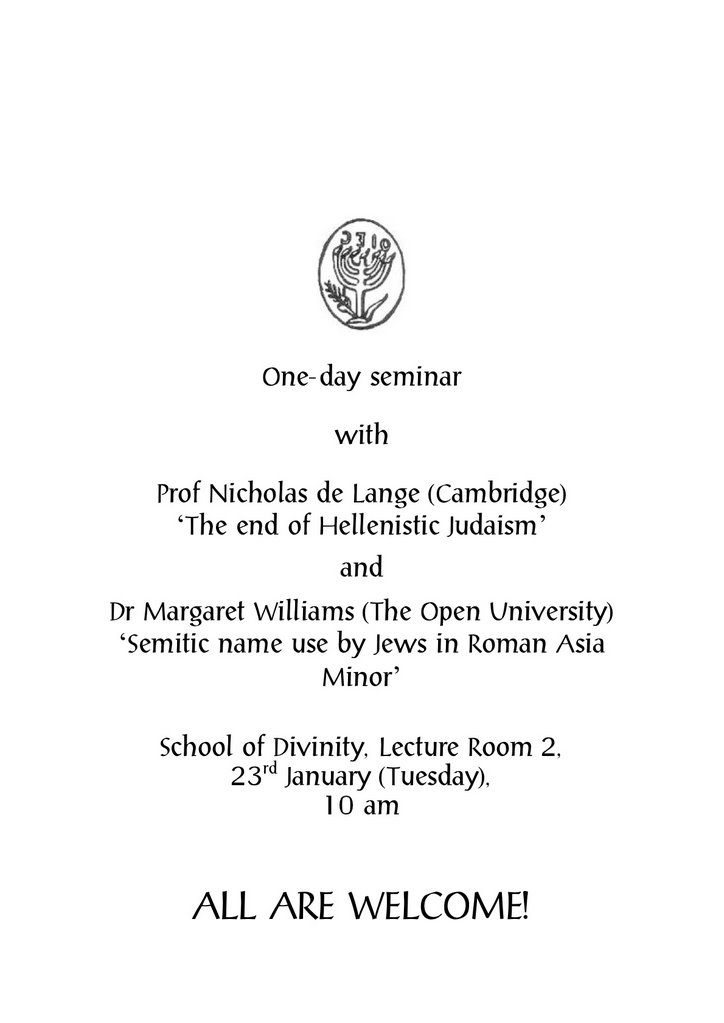
A SEMINAR ON JEWS AND JUDAISM IN THE HELLENISTIC AND ROMAN PERIODS will be held here at St. Mary's College on Tuesday, 23 January. Nicholas de Lange and Margaret Williams are the speakers. Alex Panayotov has asked me to post this flier:Click on the image for a larger version. If you're in the vicinity, hope to see you there.
W. MONTGOMERY WATT - 1909-2006. This is slightly outside PaleoJudaica's usual range, but still of interest:
The Rev Professor W. Montgomery Watt
March 14, 1909 - October 24, 2006 (Times of London)

Eminent scholar who studied the origins of Islam

Professor W. Montgomery Watt was the foremost British scholar of his time in investigating the origins of Islam, studying it as a religious phenomenon, and examining how the vast and complex edifice of early Islamic philosophy and theology came into being.

[...]

Watt, as a priest of the Scottish Episcopal Church, held fast to his Christian faith but viewed Muhammad as a genuine, inspired prophet, whose revelations from God, gathered in the Koran, were divine injunctions which inspired Muhammad’s followers and enabled them to build up a vast edifice of faith which purely material considerations, those of empire and plunder, could never have achieved.

His Muhammad at Mecca (1953) and Muhammad at Medina (1956) were based on a radical critique of the historical sources from early Islamic times and of the body of Islamic tradition, the reported sayings and doings of the Prophet and his early followers that speedily took shape after Muhammad’s death in 632, since he regarded the Koran itself as too allusive and fragmentary to form the basis for a fully fleshed-out historical account.

In these two books Watt examined the political and social setting for the unfolding of Muhammad’s career as the inspired channel for divine revelation; he showed him as an organiser and war leader of genius, who nurtured the Muslim community so that, after his death, the new faith would dominate the Near East within three decades.

Watt’s work here has stood the test of time, for the last half-century has seen no comparable fresh work on Muhammad's career. ...
I read those two books many years ago and found them very helpful. Watt was born here in Fife and taught at the University of Edinburgh until his retirement in 1979. I had no idea he was still alive so recently. Requiescat in pace.

(Via the Agade list.)
THE LATEST ON INDIANA JONES 4: It's produced by Lucas (who says it will be the best of the lot); directed by Spielberg; Ford says he's not too old; and it's due out in the summer of 2008. If the three most recent Star Wars movies are any indication of Lucas's judgment, I would take his opinion on this one with a grain or two of salt.

(Again, via Explorator.)

Sunday, January 07, 2007

THE MAFIA CODE? According to the Times of London, the Vatican is being consulted on a code published by "the new Mafia Godfather" which uses a passage from the Latin Vulgate of Ecclesiastes 3:2:
Matteo Messina Denaro, a ruthless killer noted for his designer clothes and playboy lifestyle, is widely regarded as the new boss of Cosa Nostra after the arrest last April of Bernardo Provenzano, 73, who had been on the run for more than 40 years.

[...]

He was better known for his love of PlayStations, Porsches and glamorous women than his learning. But each year Messina Denaro places in a local newspaper a memorial notice to his father, Francesco, who died in 1998. Police noted that this time it takes the form of an amended Latin passage from the Old Testament.

The first part is a familar passage, very loosely based on Chapter III of Ecclesiastes. Investigators reading Il Giornale di Sicilia spotted that the second part, after the word “sed” (but), is not in the Old Testament at all. It means: “Only he who wants to will fly, and your flight has forever been sublime.”
According to the article, Bible codes are standard practice for Mafia bosses. This one sounds to me like some sort of insider allusion that would only make sense to someone who had been in on an earlier conversation.

(Via Explorator.)
JEFFREY ARCHER jumps on the Anne Rice bandwagon, but with a different trendy twist:
Archer writes gospel of Judas

Richard Brooks, Arts Editor (Sunday Times)
Christ’s betrayer is just misunderstood, says the great storyteller

THE greatest story ever told is about to get the Jeffrey Archer treatment. Archer, who has told a few incredible tales in his time, is to publish a book called The Gospel According to Judas, which will attempt to rehabilitate the life of Christ’s betrayer.

The book, which is to be published worldwide in March, will present Judas as a misunderstood man who did not betray Jesus for money.

In an unusual step for the novelist, who is more used to knocking out page-turners such as Kane and Abel and First Among Equals, he has co-written the book with an eminent Australian biblical scholar. The result is described as a “story for 21st-century readers” that would be “credible to a 1st- century Christian or Jew”.

[...]
The co-writer is Frank Moloney. It's interesting that both Rice and Archer pick up on themes from apocryphal New Testament writings (Rice explicitly and Archer at least in the title of his book).

UPDATE (8 January): Here's an A.P. article that specifically mentions the Coptic Gospel of Judas in connection with Archer's novel.

Saturday, January 06, 2007

TEDDY KOLLEK'S CONTRIBUTION to the founding of the Israel Museum is described in a Jerusalem Post article:
Teddy's museum
By MEIR RONNEN

Back in the Fifties, Teddy Kollek was director-general of the Prime Minister's Office when he realized that Jerusalem and the nation needed a national museum of art and archeology located in the Capital. It was obvious that the tiny Bezalel Museum established by Boris Schatz in what is now the Jerusalem Artists House would not do.

Teddy sat down with leading archeologist Yigal Yadin and the two submitted a proposal to the government that would enable a two-wing museum to be built on a rocky hillside overlooking the little Jerusalem suburb of Neve Sha'anan.

Yadin had other fish to fry and the project became the baby of Teddy. Early in the Sixties, well before the museum was built, he told this writer that as there were no funds for acquisitions of art and artifacts, these would have to come from private Jewish collectors and/or their estates. He explained to me that collectors thought of their collections as their children; and that "every Jewish family wants their children to have a good home."

[...]
MORE CONTROVERSIES, personal ones, about the publication of the Gospel of Judas:
Was it virtue or betrayal?
By Louis Sahagun, [Los Angeles] Times Staff Writer
January 6, 2007

THE National Geographic Society hailed it as one of the most significant archeological discoveries of our time, a 1,700-year-old text that portrayed Judas Iscariot as a hero, not a villain, for betraying Jesus.

The portrayal of Judas as a favored apostle who handed Jesus over to the Romans at his master's request made National Geographic's publication of "The Gospel of Judas" — and the companion TV documentary — a worldwide media event.

When the gospel was released last spring, another book appeared, "The Secrets of Judas," which sneered at the notion that the new gospel was revolutionary or that it revealed anything new about Jesus. Author James M. Robinson, a giant in the world of early Christian studies, also accused National Geographic of sensationalizing the gospel "in order to make as large a profit as possible."

Robinson, who had long railed against scholars who tried to restrict access to biblical texts, was especially dismayed that the Judas project was conducted largely in secret with the help of Marvin Meyer, Robinson's friend and former student at Claremont Graduate University.

Without directly invoking the payment Judas received from the Romans, Robinson made his point: National Geographic and its team of translators had received their 30 pieces of silver.

In the months to come, the specialized field of Coptic translation dissolved into public bickering and dark whispers by scholars who spoke of the jealous graybeard with a tender ego or the younger, irresponsible grandstander seduced by the prospect of celebrity.

[...]
The article is mostly about the regrettable personal conflict between Robinson and Meyer, but it also touches on the question of the interpretation of the Gospel of Judas:
But some others, including Gnostic scholar John D. Turner, have come to believe that "the prospects of increasing his fame and notoriety got the best of Marvin."

Turner also says he has discovered numerous errors in National Geographic's English translation of the Judas Gospel. He argues the mistakes could have been avoided if the translation team had included a wider variety of experts.

Meyer, an elder at a Santa Ana Presbyterian church who conducts courses on peacemaking, acknowledged that scholars "bring personal issues and presuppositions to the table."

"A question I often ask myself," he said, "is this: Do we gravitate to self-fulfilling prophecies? In this case, is a man of peace such as myself painting Judas as a nice guy? Have we found a Judas in our own image?"
Oddly, Louis Painchaud's challenge to this interpretation (now apparently supported by Craig Evans) is not mentioned.
WALNUTS in the Midrash and the Kabbalah.

Friday, January 05, 2007

THE REAL CYRUS CYLINDER ONLINE: Jona Lendering, the editor of the Livius website on ancient history, has e-mailed the following to Jack Sasson's Agade list:
Until now, there was no edition of the Cyrus Cylinder available on the internet; the only thing that was available, was a falsified translation -possibly created by followers of the late Shah- in which Cyrus is presented as saying that he will respect foreign customs and decreeing religious freedom.

This falsification is not recognized as such, and several well-meaning scholars who sought to explain that -whatever his virtues- Cyrus was not the author of the first charter of human rights, have received highly offensive messages.

Propaganda needs to be countered by quoting the full texts of original documents, so here it is:

http://www.livius.org/ct-cz/cyrus_I/cyrus_cylinder.html
http://www.livius.org/ct-cz/cyrus_I/cyrus_cylinder2.html

I like to thank dr. H. Schaudig for allowing me to use his edition, and prof.dr. R.J. van der Spek for translating and proofreading the text.

I invite webmasters, if they think this is important, to link to these pages, to make sure that they will be picked up by google and will be read by people who would otherwise find the falsified translation.
I was not aware of the fake version of the Cyrus Cylinder, but I have countered the over use of the real one as a human rights precedent here and here. No one has bothered to send me any highly offensive messages in response, which makes me feel a bit neglected.

UPDATE (13 January): Over at samarkeolog, Sam Hardy corrects one of my above-cited earlier posts on one point: the abolition of slavery was raised as a possibility by some in antiquity.

Thursday, January 04, 2007

THE BOG PSALTER is being compared to the Book of Kells in the Times of London:
Treasure emerges from the mud of history
Dalya Alberg, Arts Correspondent

To the untutored eye, it looks like a lump of mud, but experts say that an 8th-century psalter found in an Irish peat bog is exceptionally significant.

Even though the vellum pages of the early Book of Psalms are a crumpled mass, they are likening it to the Book of Kells, one of the world’s most beautiful illuminated manuscripts.

As the find is thought to date from the late 8th century, the illuminators of both books would have been contemporaries, within ten or twenty years of each other. The two books — among few survivals of an age of outstanding manuscript production — are comparable in their large-format size.

[...]

Specialists from the museum and Trinity College Dublin — which was given the Book of Kells in the 17th century — are collaborating with international experts on an ambitious project to separate the more than 100 leaves, each measuring 32.4cm by 22cm (12.7in by 8.6in) and with about 30 lines to a page. Decoration on the first page includes an interlaced border and the figure of an eagle.

The psalter, written in Latin, is still in its original binding and is, said Mr Read, of “a very high standard”. Such lavish books would have been produced in scriptoria attached to important monasteries. There were once six such monasteries within about 15km (9 miles) of Faddan More. The nearest was Birr, 7km away.

[...]
THE ONLINE RESPONSA PROJECT is now available from Bar Ilan University:
The Online Responsa Project The Wisdom of the Ages - The Technology of the 21st Century

The Global Jewish Database (the Responsa Project) contains the world's largest electronic collection of Jewish texts in Hebrew ever recorded, which embody thousands of years of Jewish learning. The database includes numerous works from the Responsa Literature - rabbinic case-law rulings which represent the historical-sociological milieu of real-life situations. In addition, the database includes the Bible, the Talmud and their principal commentaries; works about Jewish law and customs; major the codes of Jewish law, such as Maimonides' Mishneh Torah and the Shulchan Aruch with its principal commentaries; midrashim, Zohar, etc…

This internet version of the Responsa Project includes a variety of tools and capabilities in its various features of search, navigation of texts, and hypertext links between books in different databases.
(Via Arutz Sheva.)
LECTURES ON JUDAISM to be given at the University of North Carolina, Chapel Hill:
Curator to hold talk on gallery

CHAPEL HILL -- John Coffey of the N.C. Museum of Art will discuss the museum's Judaic Art Gallery on Jan. 31 at UNC.

His talk will be the first of five free, public speeches in the spring 2007 lecture series of the Carolina Center for Jewish Studies.

All lectures will be at 7:30 p.m. in the theater of UNC's Sonja Haynes Stone Center for Black Culture and History on South Road.

Coffey, curator of American and modern art and deputy director for art at the Raleigh museum, will discuss the history, mission and collection of the Judaic gallery. He is a UNC graduate and Raleigh native. Other series events include:

-- Feb. 15: "Ancient Judaism and the Prism of Orthodoxy." Michael Stone, professor of religious studies at the Hebrew University in Jerusalem, will consider challenges facing Jewish and Christian scholars of Judaism in the ancient world.

-- Feb. 28: "New Light on the Phoenicians and the Maccabees: Excavations at Tel Kedesh, Israel." Andrea Berlin, associate professor in the department of classical and near Eastern studies at the University of Minnesota, will discuss how recent discoveries provide new evidence of political and social interactions among Jews, Phoenicians and Greeks in second century B.C. Palestine.

-- March 20: "Mysticism, Magic and Rabin's Murder: The Pulsa DeNura Ritual." Zion Zohar, director and chair of the program for the study of Sephardic and Oriental Jewry at Florida International University, will discuss a controversial death curse/ritual performed by rabbis who influenced the assassin of Yitzhak Rabin.

-- April 16: "Kurt Weill's Kol Nidre and Jewish Memory." Tamara Levitz, associate professor at the University of California, Los Angeles, will explore the composer's use of the melody of the Kol Nidre -- a Jewish prayer recited on Yom Kippur -- in three of his works.
BIBLICAL STUDIES CARNIVAL XIII has been posted by Tyler Williams at his Codex blog. It is very thorough, with more than 70 entries. And he will also be posting a Best of 2006 edition soon. Well done!