Saturday, August 12, 2006


HUGOYE: JOURNAL OF SYRIAC STUDIES has a new issue out (Vol. 9 No. 2, July 2006). Table of contents:
Obituary
Helga Anschütz (April 19, 1928 - May 13, 2006).
Andreas Juckel, University of Münster
Papers
Rhetorical Practice in the Chreia Elaboration of Mara Bar Serapion.
Catherine Chin, The Catholic University of America
Classical Syriac Manuscripts at Yale University: A Checklist.
Leo Depudyt, Brown University
Caught in a Compromising Position: The Biblical Exegesis and Characterization of Biblical Protagonists in the Syriac Dialogue Hymns.
Kristi Upson-Saia, Duke University
Publications and Book Reviews
Jerome A. Lund, The Old Syriac Gospel of the Distinct Evangelists: A Key-Word-in-Context Concordance.
David G.K. Taylor, University of Oxford
Ignatius Aphram I Barsoum (translated and edited by Matti Moosa). The Scattered Pearls: A History of Syriac Literature and Sciences.
David G.K. Taylor, University of Oxford
Conference Reports
Dorushe Graduate Student Conference for Syriac Studies at CUA, February 3-5, 2006.
Jean-Nicole Saint-Laurent, Brown University
Travelogue
Encountering the Suryoye of Turkey.
Jean-Nicole Saint-Laurent, Brown University
Announcements
Call for Papers for Syriac Book of Steps (Liber Graduum) Volume.
Advertisements
Journal of Aramaic Studies
Beth Mardutho Amazon Associates
Journal of the Canadian Society of Syriac Studies
Gorgias Press
Friday, August 11, 2006
HADRIAN was made emperor on this day in 117 CE. It must be cosmically significant that I walked on Hadrian's Wall this afternoon for the first time, but I'm not exactly sure how.

UPDATE (12 August): Photo added. More coming.
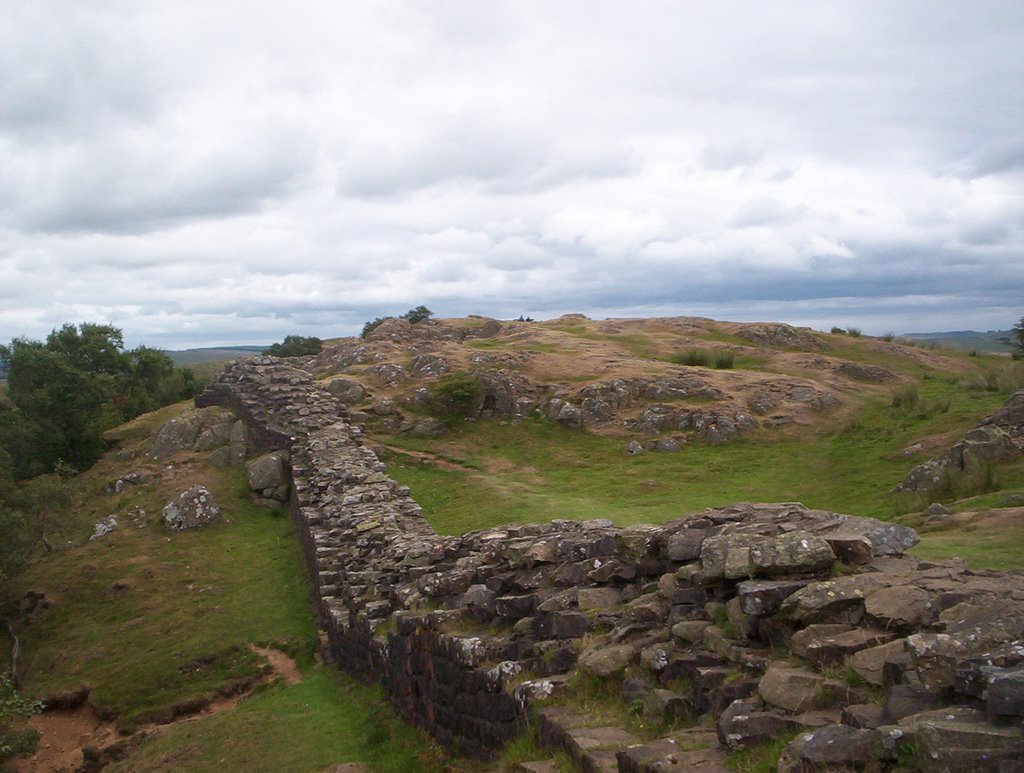
UPDATE (12 August): Photo added. More coming.
MORE ARCHAEOLOGICAL SITE UPDATES on the BAS website. Ramat Rahel is still excavating, the Kinneret excavation has been canceled, and the harbor of ancient Byblos is suffering from the oil spill. And more.
Wednesday, August 09, 2006
 "MINIMUS SUM. MUS SUM." "I am Minimus. I am a mouse." So begins Minimus: Starting Out in Latin, an excellent children's introduction to Latin. It's pitched just right for kids; based around two comic-book-format episodes in each lesson, in which we learn about Minimus the mouse, his nemesis Vibrissa the cat, and the human family they live with in the military town of Vindolanda at Hadrian's Wall. My son and I spent the last year going through the book at a leisurely pace, with lots of backtracking and review. As a result, he now knows the parts of speech, some basic Latin grammar and vocabulary, and a little about the Roman occupation of Britain. He already knew the Greek and Roman mythology, but it's been reinforced too. Pretty good for someone who's not yet ten. The book is engaging and makes the subject fun, and I recommend it highly. We're about to start the second volume in the series.
I'm less enthusiastic about the Minimus Teacher's Resource Book. It's true that I know Latin and didn't need it,
There is also a Minimus website. I haven't looked at it much, but it has lots of ancillary material.
I bring all this up not only to praise the pupil's book, though it deserves it, but because, in celebration of finishing it we're heading south this morning to visit Vindolanda, which is an important Roman-era excavation and tourist attraction at Hadrian's Wall, between Carlisle and Newcastle. We hope to get better acquainted with the people we've been reading about and to learn more about how they lived and the records they left. We also want to visit the nearby Roman Army Museum. Blogging will be on hiatus unless I run across a wireless hotspot, which seems unlikely. But we'll be coming back up on Friday and spending Friday night with our friends in Edinburgh, so I should be able to check in with you then. And I'll have a report and photographs for you when we get back to St. Andrews.
UPDATE (11 August, evening): I'm back in Edinburgh, after a great trip to the Wall. More from me later, but for now let me note that a couple of people, including the book's illustrator, have written to demonstrate that Vibrissa does mean "whiskers" in scientific Latin. The Lewis & Short entry defines it as human nose hairs, but close enough. Sorry about that; I have struck out that complaint.
Also, I have a number of other supplements and corrections to post, but I've been away and I'm pretty busy right now. If you wrote to me, assume I got it. I'll try to put up a round of updates in the next couple of days.
UPDATE (18 August): I see that my review brought Minimus at least one new customer. Good.
Tuesday, August 08, 2006
HAPPY BIRTHDAY TO ME! And maybe I am in a time warp. Or, more likely, Google News, which for some reason has a lot of articles from some years ago on today's listing.
I'm taking this week off work and will probably get out of the house for the day, although the weather isn't quite as nice as it has been. And we've got an historic holiday planned, starting tomorrow. More on that presently.
I'm taking this week off work and will probably get out of the house for the day, although the weather isn't quite as nice as it has been. And we've got an historic holiday planned, starting tomorrow. More on that presently.
IS THIS REPRINTS WEEK or am I in a time warp? The Skeptical Inquirer has reprinted an article on the James Ossuary from its March 2003 issue. As with the article on the Temple Mount mentioned below, unless readers notice the date, they will be getting information that is now quite out of date. Online reprints should take more care about such things.
TEMPLE MOUNT WATCH: Two pieces have been posted online about the illicit WAQF excavations on the Temple Mount. The first, "The Destruction of the Temple Mount Antiquities," by Mark Ami-El, is a reprint of an August, 2002, article, now republished by an organization called the Jerusalem Center for Public Affairs. Unfortunately, readers who don't pay attention to the date will get some out-of-date information which should have been corrected. The second, "The Abomination on the Temple Mount Continues," is out on the Temple Mount Faithful website. The latter has a number of dubious statements and errors in the first paragraph:
Regular reader will be well aware of my concern about the unauthorized and destructive digging on the Temple Mount. But it should be opposed with accurate and up-to-date information.
UPDATE (14 August): Diana Muir e-mails:
The Temple Mount, the Hill of G-d, is still under terrible Islamic and Arab abomination. From the first moment that the Arabs occupied the Temple Mount, Jerusalem and Israel in 638 CE they began to destroy the last remains of the Second Temple which still existed on the Temple Mount especially the Western Wall of the Temple which was still standing and was the Western Wall of the Holy of Holies. They also destroyed the altar and other important parts of the Temple complex. They robbed vessels that they found in between the ruins of the Temple. At the end of the 7th Century they built the Dome of the Rock on the most holy place of the Jewish nation and the location of the First and Second Temples. They also built a mosque on the Holy Hill of the G-d of Israel and named it Al Aqsa. They did this evil without asking permission from G-d Who stated again and again in all the Scriptures that on this Holy Hill only the Temple could stand that the Jewish people would build for His name. They also did not ask the permission of the Jewish people, they just did it as a part of their imperialistic occupation of half of the world which started at this time. They did not do it only in Jerusalem but all over the wold in every place they occupied by their imperialistic forces. They destroyed churches and built mosques in their place. They did not even hesitate to destroy the Ayah Sofia church in Constantinople and built a big mosque instead of it. This church was the center of Eastern Christianity. Then they renamed Constantinople as Istanbul. ...I have never heard that there were an altar or hidden vessels on the site by the time of the Muslim conquest and this seems wildly unlikey. Nor have I heard that the walls around the complex were damaged, and this too seems unlikely, given that mosques were being built there. The Hagia Sophia Church was transformed into a mosque during its history, but it was not destroyed and it is now a church again. And the name Istanbul is a corruption of a Greek phrase (eis ten polin) which means "into the city." The change of name has no Islamic ideological element.
Regular reader will be well aware of my concern about the unauthorized and destructive digging on the Temple Mount. But it should be opposed with accurate and up-to-date information.
UPDATE (14 August): Diana Muir e-mails:
Small error. Hagia Sophia was indeed turned into a mosque at the conquest in 1456, an, yes, Ataturk did turn it into a museum, a purposeful act of laicite. However, it is still a museum. At a guess, you probably read something about the careful restoration of the byzantine mosaics and frescoes a couple of years ago, and your memory misled you into thinking that the restoration was a restoration of the building to the original function.I don't think my mistake was quite that up to date, but thanks for the correction.
Monday, August 07, 2006
RAGEH OMAAR'S new BBC series on the miracles of Jesus gets a rather unfriendly review by Caitlin Moran in the London Times:
Still, did you know that Scott’s middle name was Falcon? Or that Jesus’s real name was Joshua? The latter was one of the intriguing facts thrown up by The Miracles of Jesus (BBC One, Sunday). Well, actually, it was the only fact thrown up by The Miracles of Jesus.Teddy Jamieson in The Herald is a little less sarcastic, but not terribly satisfied either:
This was a programme of such fluffiness that it would have made anyone — up to and including the Archbishop of Canterbury — shout “But have you got any science? Any facts? Anything other than re-creations of Middle Eastern peasants constantly hassling Jesus to sort something else out?”
The fact that it was fronted by Rageh Omaar didn’t help.
There aren’t many television personalities for whom a blithe lack of self-awareness is a handicap — by-and-large, the less they realize they’re idiots, the more hilarious it is for us — but Omaar really is the dizzy limit. I’ll never forget him fronting a wafer-thin show on the Iraq War — during the months he was the “Scud stud” — and opening it with the line “I want to ask you what you remember of the Iraq War? Was it shock and awe, or Jessica Lynch, or even the red and dusty skies?” like he was Richard bloody Burton reading Under Milk Wood.
Here he’s just as moony and portentous — reverently trailing his hand over ancient Hebrew texts, staring out to seas where Jesus might have been, and posing with one foot up on a boulder, crotchily. Omaar! You’re a news reporter! You can’t say things like “Who’s to say it wasn’t a miracle?” If you think the miracles of Jesus are anything other than metaphorical hogwash, then you need to be presenting a show called How Every Scientific Achievement of the Last 500 Years Must be Wrong!
Unfortunately, there are a couple of problems with The Miracles of Jesus. Rageh's arguments are being presented as, well, gospel. Last night's programme didn't offer much room for doubt or debate. And most of its running time was given over to dramatic reconstructions of the miracles in question. The Beeb have obviously spent a lot of money on these, and presumably want to make as much of them as possible - but this meant the discourse came out a poor second to the drama. Pity, that.I didn't notice that the show was on last night, but I'm not sure I would have taken the time to watch it if I had.
THE TOMB OF THE KINGS IN JERUSALEM -- YNet Travel has a description:
UPDATE (14 August): A reader who wishes to remain anonymous e-mails:
In memoriam: The Tomb of the KingsBiblePlaces.com has an article with photos.
The Tomb of the Kings, considered one of the largest and most luxurious tombs in the area, has long been popular with tourists
Ron Peled
Imagine a magnificent burial plot covering several acres with an enormous courtyard at the entrance, many pyramids and decorations, stairs that lead to a plaza, a burial cave with an impressive burial stone, and wells and channels that bring rain waters to them. Now imagine that this is all carved in stone and has been in Jerusalem for 2,000 years.
[...]
Today the tomb is owned by the French, and a French flag flies over it. Enter the site through a metal door on the corner of Nablus Road and Salah a-Din Street, near the American Colony Hotel and the Justice Ministry. The tomb has no formal visiting hours, so just knock hard on the door or ring the bell. Entrance is NIS 3.
[...]
Josephus, who described the tomb in the first century C.E., tells of a queen named Helena who came to Jerusalem from Adiabene in Kurdistan in northern Iraq. Her family converted to Judaism and built a palace, apparently in the area of the City of David, at the end of the Second Temple Period. They also donated treasures to the Temple and helped the people in times of famine.
Josephus adds that Helena’s son Monobaz had her remains and those of his brother buried at a distance of “three stadia from Jerusalem,” and that this burial cave belongs to Helena and her family. It was medieval Europeans who mistakenly identified the tomb as belonging to the Kings of Judah. The kings’ burial place is mentioned in the Bible, but it has never been found.
[...]
UPDATE (14 August): A reader who wishes to remain anonymous e-mails:
Re: the so called Tomb of the Kings in Jerusalem
I visited the Tomb sometime last fall with a group from the Albright Institute, which is just down the street from the tomb. I doubt if getting access is as easy as pounding on the gate. We had to get an appointment - graciously arranged by the director of the Albright. A better option might be to contact the French consulate ahead of time.
The link that you give does have some great pictures, but the first caption "Entrance and Mikvot" is incorrect. There are no Mikvot at the site. The water system that you can see in the picture is designed to prevent rain water from running down into the tombs. You can clearly see two cisterns with water channels leading to them. (Actually, the two holes might be connected into one cistern; I do not remember exactly.) If you look closely there is another cistern on the right hand wall. There are also channels in the staircase that direct the water off of the stairs and over to the right-hand side into the water channels visible in the picture. It's a clever system, possibly added after the first rain storm flooded the tombs, but no Mikvot.
FALLOUT FROM THE LOOTING OF HEBREW MANUSCRIPTS from the Bibliotheque Nationale:
Dealer sues Christie's over stolen scroll
By Harry Mount in New York
(Filed: 07/08/2006) (The Telegraph)
An antiques dealer is suing Christie's, the auction house, for selling him an ancient Jewish manuscript believed to have been stolen from France's greatest library.
Christie's sold the 13th-century Torah and another five scrolls to Yosef Goldman, of New York, in 2000.
The Bibliotheque Nationale, the national library of France, sued Mr Goldman for the return of the Torah, claiming that it had been stolen.
[...]
Sunday, August 06, 2006
THE SPECIFIC PLACE where the Irish Psalms codex was found has been made public:
Location of ‘Ireland’s Dead Sea Scrolls’ revealedAnd there's more information on the codex itself:
05/08/2006 - 09:50:08 (Ireland Online)
The exact location of the discovery of what has been dubbed ‘Ireland’s Dead Sea Scrolls’ has been revealed by the National Museum of Ireland.
The Psalter, or Book of Psalms was pulled out of a bog in the townland of Faddan More in north Tipperary, where it was first hidden around 1,000 years ago.
Archaeologists and conservators from the National Museum spent the last seven days excavating the bog and recovered a few other important pieces.The bog has produced other important early medieval artifacts in the past, although nothing this important.
A fine leather pouch in which the book was kept originally was discovered as well as other small fragments of the manuscript and its cover.
The museum said the investigation results suggest that the owner concealed the book deliberately, perhaps with a view to recovering it at a later date.
All the new material is being conserved and analysed in the National Museum and samples of the peat surrounding the find spot have been sent for specialist analysis.
The extensive fragments of the manuscript appear to be of an Irish Early Christian Psalter, written on vellum. Initial examinations show there are about 45 letters per line and a maximum of 40 lines per page.
RABBAN YOHANAH BEN ZAKKAI is the subject of a post-Ninth of Av meditation by Rabbi Reuven Hammer in the Jerusalem Post. Excerpt:
As with so many ancient tales, we may never know exactly what happened, but the general story is clear. He escaped from Jerusalem, made contact with the Romans and was given permission to reside in Yavne together with "its Sages." Some speculate that other Sages had been kept in detention in Yavne, others that it was simply a center for study. Whatever the case, Yavne then became a center for the preservation of Jewish tradition and the Sages were able to lead the nation when all political frameworks had been destroyed.UPDATE (14 August): A while ago Carl Kinbar e-mailed:
Regarding the subject of R. Hammer's article in the Jerusalem Post, may I refer you to an article in the Jewish Studies Internet Journal, vol.4, "Yohanan ben Zakkai, Amicus Caesaris: A Jewish Hero in Rabbinic Eyes" by Avram Tropper at http://www.biu.ac.il/JS/JSIJ/ca.htm. Tropper parses the various attitudes toward Yohanan that appear in the early sources.I noted the article some time ago, but it's helpful to note it again in this context.
JSIJ is a fine example of an open access, electronic peer-reviewed journal. In my estimation, it is unsurpassed in the broader field of Jewish Studies journals and a hopeful sign for OA in the humanities.
Subscribe to:
Posts (Atom)