Saturday, January 13, 2007

THE GODS OF ROME are important for the second season of the series Rome. Beliefnet has an article on pagan religion in the series:
The Pagans of 'Rome'
The HBO series, entering its second season, explores the Romans' oft-ignored devotion to their many different gods.
By Ted Phillips

If the past is a foreign country, then ancient religion may be its most exotic locale. The HBO series "Rome," which returns for its second season on Sunday, is hardly "Fodor's Guide to Paganism," but by venturing off some well-worn cinematic paths, the show has given the worship of the gods a generous treatment in a genre dominated by stories of gladiators and the advent of Christ.

The creators of the serial drama, which focuses on the power struggles during the last days of the Roman Republic in the first century B.C.E., wanted to portray Roman religion not as a doomed prologue to Christianity but as a vibrant and meaningful part of everyday life.

[...]
Ancient Judaism also makes an appearance:
Headed the opposite direction is the amoral Jewish horse trader and henchman Timon, who slowly embraces the ethical tenants of Judaism when his zealous brother pays him a visit from Judea. His brother's influence comes to a head while Timon tortures a rival of his patron and discovers there is a limit to how much brutality he is willing to put another human being through.

Friday, January 12, 2007

TEMPLE MOUNT WATCH (2): A volunteer reports on a visit to the salvage excavation of the Temple Mount rubble dumped by the Waqf:
Sifting through history

BY: ARI Z. ZIVOTOFSKY Special to the CJN (Cleveland Jewish News)

(Israel) - About a dozen volunteers, including my three children, were dumping buckets of dirt over wire mesh, washing the dirt down with a hose, and hoping to find 2,500-year-old coins.

They were among the hundreds of volunteers and tens of professionals who have assisted in a most unusual archaeological project, currently taking place in Tzurim Valley just below the Mount Scopus campus of Hebrew University.

[...]

Having visited Barkai's [i.e., archaeologist Gabriel Barkay] work area and realizing the unique opportunity involved, I took my family for a morning of “junior archaeologist.” We walked down a steep hill from the Hebrew University parking lot and were seated with several other volunteers on benches to hear a short introduction to the work and methodology, as well as to see photos of some of the previous finds. Before any of us had shown up, a mechanical sifter had been used to separate the earth into heaps consisting of material of differing sizes.

The finest pile was going to be sifted by hand by us. We were each given a bucket of dirt to pour onto the wire mesh “sifters,” where the dirt was thoroughly rinsed and the tedious process of searching for centimeter-sized objects began. After all of the material was examined, an experienced assistant checked the work, and what was left was dumped into a second pile for discarding. All found objects were sorted into six categories and left for the professionals to examine and study.

We found nothing more significant than a few mosaic tiles, but a good time was had by all. And knowing that we had sifted dirt from the Temple Mount, where our two destroyed temples had stood and that now gave forth a coin from almost 1,900 years ago that bore the Hebrew phrase L'Herut Tzion - “For the Freedom of Zion,” gave us a special feeling.

There is still much dirt to be sorted, and the project is open for volunteers, both individuals and organizations, who can participate by contacting the Ir David organization (ElAd), which is now funding and coordinating the project (www.cityofdavid. org.il/).
For some recent background, see here and here.
TEMPLE MOUNT WATCH (1): More controversy over the bridge to the Mugrabi Gate:
Archaeologists knock Western Wall bridge plan
By Nadav Shragai (Haaretz)

Senior archaeologists have come out in harsh criticism against the Israel Antiquities Authority (IAA) for authorizing plans for a bridge to connect the Dung Gate in Jerusalem's Old City to the Mugrabi Gate, located next to the Western Wall and leading to the Temple Mount.

Work on the bridge is to begin Sunday, after it received a green light from the city's planning division.

The archaeologists say that the bridge's pylons will damage one of the most significant archaeological parks in Israel and the world, located outside the southwestern corner of the Temple Mount.

They also say the plan was not held up to professional and public scrutiny, that the conservation committee of the IAA was not called together to discuss it, and that other alternatives were not given proper consideration. They are thus calling for a halt to work until the plan can be reevaluated.

The IAA rejects the criticism outright and says "the construction of the bridge was conditioned on archaeological excavations that would expose the ancient remains completely, preserve them and present them to the public as part of the Archaeological Park." The rabbi of the Western Wall, Shmuel Rabinovich, who has promoted the plan, says that from his point of view, the Mugrabi Gate could be closed, but since the police insist on its continued use, and the plan was approved and alternatives carefully examined, the bridge is the lesser evil.

[...]
For some background to this story, see here.

Thursday, January 11, 2007

A GENDER-NEUTRAL PENTATEUCH? Insofar as that is possible:
Scholars Wrestle With Language of Torah Without Throwing It Away
January 11, 2007 - Rachel Silverman (Jewish Exponent)

As a biblical scholar, Ellen Frankel sees the Torah as a sacred, absolute text.

But when it comes to issues of gender, Frankel -- the author of a women's commentary on the Torah, among other books -- feels that the work of God could stand for a little revision.

As the editor-in-chief of the Jewish Publication Society explained it, "I had to figure out how to wrestle with the Torah and still not throw it away."

Out of this need The Contemporary Torah: A Gender Sensitive Adaptation of the JPS Translation was born.

In refashioning the text, a team of scholars -- including Frankel; David E.S. Stein, a Reconstructionist rabbi and editor; Adele Berlin, a Hebrew Bible expert at the University of Maryland; and Carol Meyers, a religion professor at Duke University -- tried to meld contemporary interests about gender with an ancient text -- and world -- that is predominantly male-centric.

[...]
This is an interesting project whose principles seem to have been worked out quite sensibly:
In some cases, these questions led the scholars to retain gendered language.

For example, a verse in the '62 translation mentions that the wife of a male slave should leave with him when he becomes free.

But what if the roles were switched: Would a man go off with a newly freed female slave?

Ensuing research proved that this would not have occurred. Such an act would have been a transgression of ancient mores that made women more or less property of men. Therefore, the new editors felt the original sentence should not be refashioned. And so it reads: "If [a male slave] came single, he shall leave single; if he had a wife, his wife shall leave with him."

In other cases, gendered terms were extracted and more generic ones applied.

For instance, the editors explain in the prefatory material to the the new volume that it was not uncommon for ancient Hebrews to refer to both male and female herders as "herdsmen." Ancient audiences, too, would have interpreted the term figuratively.

But in today's gender conscious society, the editors felt that most readers would assume "herdsmen" meant solely men. So, to better enable modern audiences to grasp the meaning of the line -- found in Genesis 13 -- they decided to go with "herders."
Regarding the Tetragrammaton:
The editors agreed that the tetragrammaton -- the unpronounceable four-letter name for God -- presented their biggest hurdle.

Though Judaism as a theology does not ascribe a gender to God, the 1962 Torah translation consistent- ly refers to God as "the lord." This has left many Jews with a sense that God is in fact male, a sentiment the authors said they did not want to propagate.

To handle the issue, Stein asked 18 biblical scholars to weigh in on how to represent God in a gender-sensitive light.

After much wrangling -- Frankel admitted that most respondents couldn't even produce an answer -- the editors decided to keep the Hebrew lettering that corresponds to the English consonants YHWH.

In addition to satisfying the gender-neutral requirement, this solution was meant to separate God's name from the rest of the text, explained Frankel.
That is probably the best solution, in that YHWH was the proper name of the Israelite God and it's not entirely clear what it meant. The mistranslation "Lord" comes from the Septuagint (the ancient Greek translation). But that also doesn't change the fact that YHWH was considered male in ancient Israel. Indeed, the Israelites clearly thought of YHWH as a really big guy who sat on his throne up in heaven and ruled the universe. In at least some Israelite circles he seems even to have had a goddess wife.

But, of course, this patriarchal view of God is offensive and theologically unacceptable to many if not most people today, and it just won't do. Nevertheless, the text should still be translated to say what it actually says, like it or not. This translation seems to have side-stepped the problem, at least for the most part. Although I do wonder how they handle the the gender of pronouns referring to YHWH.

Wednesday, January 10, 2007

IN THE MAIL:
Jane Dammen McAuliffe (ed.), The Cambridge Companion to the Qur'an (CUP, 2006)

Daniel H. Frank and Oliver Leaman (eds.), The Cambridge Companion to Medieval Jewish Philosophy (CUP, 2003)

Stefan C. Reif, (ed.), The Cambridge Genizah Collections: Their Contents and Significance (CUP, 2002)

Abraham Wasserstein and David J. Wasserstein, The Legend of the Septuagint: From Classical Antiquity to Today (CUP, 2006)
BIBLICAL STUDIES CARNIVAL - BEST OF 2006 has been posted on the Codex blog by Tyler Williams. It's an excellent retrospective of the year in the Biblioblogosphere.

UPDATE: Note also the recent Patristics Roundup by Phil S. at hyperekperissou.

Tuesday, January 09, 2007

Monday, January 08, 2007

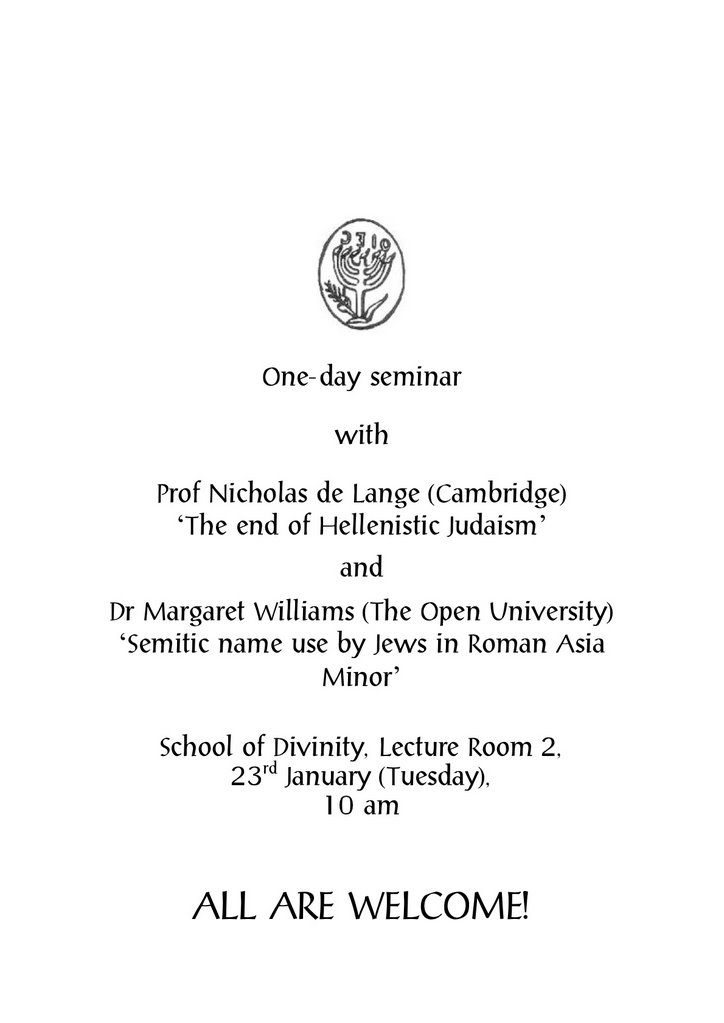
A SEMINAR ON JEWS AND JUDAISM IN THE HELLENISTIC AND ROMAN PERIODS will be held here at St. Mary's College on Tuesday, 23 January. Nicholas de Lange and Margaret Williams are the speakers. Alex Panayotov has asked me to post this flier:Click on the image for a larger version. If you're in the vicinity, hope to see you there.
W. MONTGOMERY WATT - 1909-2006. This is slightly outside PaleoJudaica's usual range, but still of interest:
The Rev Professor W. Montgomery Watt
March 14, 1909 - October 24, 2006 (Times of London)

Eminent scholar who studied the origins of Islam

Professor W. Montgomery Watt was the foremost British scholar of his time in investigating the origins of Islam, studying it as a religious phenomenon, and examining how the vast and complex edifice of early Islamic philosophy and theology came into being.

[...]

Watt, as a priest of the Scottish Episcopal Church, held fast to his Christian faith but viewed Muhammad as a genuine, inspired prophet, whose revelations from God, gathered in the Koran, were divine injunctions which inspired Muhammad’s followers and enabled them to build up a vast edifice of faith which purely material considerations, those of empire and plunder, could never have achieved.

His Muhammad at Mecca (1953) and Muhammad at Medina (1956) were based on a radical critique of the historical sources from early Islamic times and of the body of Islamic tradition, the reported sayings and doings of the Prophet and his early followers that speedily took shape after Muhammad’s death in 632, since he regarded the Koran itself as too allusive and fragmentary to form the basis for a fully fleshed-out historical account.

In these two books Watt examined the political and social setting for the unfolding of Muhammad’s career as the inspired channel for divine revelation; he showed him as an organiser and war leader of genius, who nurtured the Muslim community so that, after his death, the new faith would dominate the Near East within three decades.

Watt’s work here has stood the test of time, for the last half-century has seen no comparable fresh work on Muhammad's career. ...
I read those two books many years ago and found them very helpful. Watt was born here in Fife and taught at the University of Edinburgh until his retirement in 1979. I had no idea he was still alive so recently. Requiescat in pace.

(Via the Agade list.)
THE LATEST ON INDIANA JONES 4: It's produced by Lucas (who says it will be the best of the lot); directed by Spielberg; Ford says he's not too old; and it's due out in the summer of 2008. If the three most recent Star Wars movies are any indication of Lucas's judgment, I would take his opinion on this one with a grain or two of salt.

(Again, via Explorator.)

Sunday, January 07, 2007

THE MAFIA CODE? According to the Times of London, the Vatican is being consulted on a code published by "the new Mafia Godfather" which uses a passage from the Latin Vulgate of Ecclesiastes 3:2:
Matteo Messina Denaro, a ruthless killer noted for his designer clothes and playboy lifestyle, is widely regarded as the new boss of Cosa Nostra after the arrest last April of Bernardo Provenzano, 73, who had been on the run for more than 40 years.

[...]

He was better known for his love of PlayStations, Porsches and glamorous women than his learning. But each year Messina Denaro places in a local newspaper a memorial notice to his father, Francesco, who died in 1998. Police noted that this time it takes the form of an amended Latin passage from the Old Testament.

The first part is a familar passage, very loosely based on Chapter III of Ecclesiastes. Investigators reading Il Giornale di Sicilia spotted that the second part, after the word “sed” (but), is not in the Old Testament at all. It means: “Only he who wants to will fly, and your flight has forever been sublime.”
According to the article, Bible codes are standard practice for Mafia bosses. This one sounds to me like some sort of insider allusion that would only make sense to someone who had been in on an earlier conversation.

(Via Explorator.)
JEFFREY ARCHER jumps on the Anne Rice bandwagon, but with a different trendy twist:
Archer writes gospel of Judas

Richard Brooks, Arts Editor (Sunday Times)
Christ’s betrayer is just misunderstood, says the great storyteller

THE greatest story ever told is about to get the Jeffrey Archer treatment. Archer, who has told a few incredible tales in his time, is to publish a book called The Gospel According to Judas, which will attempt to rehabilitate the life of Christ’s betrayer.

The book, which is to be published worldwide in March, will present Judas as a misunderstood man who did not betray Jesus for money.

In an unusual step for the novelist, who is more used to knocking out page-turners such as Kane and Abel and First Among Equals, he has co-written the book with an eminent Australian biblical scholar. The result is described as a “story for 21st-century readers” that would be “credible to a 1st- century Christian or Jew”.

[...]
The co-writer is Frank Moloney. It's interesting that both Rice and Archer pick up on themes from apocryphal New Testament writings (Rice explicitly and Archer at least in the title of his book).

UPDATE (8 January): Here's an A.P. article that specifically mentions the Coptic Gospel of Judas in connection with Archer's novel.

Saturday, January 06, 2007

TEDDY KOLLEK'S CONTRIBUTION to the founding of the Israel Museum is described in a Jerusalem Post article:
Teddy's museum
By MEIR RONNEN

Back in the Fifties, Teddy Kollek was director-general of the Prime Minister's Office when he realized that Jerusalem and the nation needed a national museum of art and archeology located in the Capital. It was obvious that the tiny Bezalel Museum established by Boris Schatz in what is now the Jerusalem Artists House would not do.

Teddy sat down with leading archeologist Yigal Yadin and the two submitted a proposal to the government that would enable a two-wing museum to be built on a rocky hillside overlooking the little Jerusalem suburb of Neve Sha'anan.

Yadin had other fish to fry and the project became the baby of Teddy. Early in the Sixties, well before the museum was built, he told this writer that as there were no funds for acquisitions of art and artifacts, these would have to come from private Jewish collectors and/or their estates. He explained to me that collectors thought of their collections as their children; and that "every Jewish family wants their children to have a good home."

[...]
MORE CONTROVERSIES, personal ones, about the publication of the Gospel of Judas:
Was it virtue or betrayal?
By Louis Sahagun, [Los Angeles] Times Staff Writer
January 6, 2007

THE National Geographic Society hailed it as one of the most significant archeological discoveries of our time, a 1,700-year-old text that portrayed Judas Iscariot as a hero, not a villain, for betraying Jesus.

The portrayal of Judas as a favored apostle who handed Jesus over to the Romans at his master's request made National Geographic's publication of "The Gospel of Judas" — and the companion TV documentary — a worldwide media event.

When the gospel was released last spring, another book appeared, "The Secrets of Judas," which sneered at the notion that the new gospel was revolutionary or that it revealed anything new about Jesus. Author James M. Robinson, a giant in the world of early Christian studies, also accused National Geographic of sensationalizing the gospel "in order to make as large a profit as possible."

Robinson, who had long railed against scholars who tried to restrict access to biblical texts, was especially dismayed that the Judas project was conducted largely in secret with the help of Marvin Meyer, Robinson's friend and former student at Claremont Graduate University.

Without directly invoking the payment Judas received from the Romans, Robinson made his point: National Geographic and its team of translators had received their 30 pieces of silver.

In the months to come, the specialized field of Coptic translation dissolved into public bickering and dark whispers by scholars who spoke of the jealous graybeard with a tender ego or the younger, irresponsible grandstander seduced by the prospect of celebrity.

[...]
The article is mostly about the regrettable personal conflict between Robinson and Meyer, but it also touches on the question of the interpretation of the Gospel of Judas:
But some others, including Gnostic scholar John D. Turner, have come to believe that "the prospects of increasing his fame and notoriety got the best of Marvin."

Turner also says he has discovered numerous errors in National Geographic's English translation of the Judas Gospel. He argues the mistakes could have been avoided if the translation team had included a wider variety of experts.

Meyer, an elder at a Santa Ana Presbyterian church who conducts courses on peacemaking, acknowledged that scholars "bring personal issues and presuppositions to the table."

"A question I often ask myself," he said, "is this: Do we gravitate to self-fulfilling prophecies? In this case, is a man of peace such as myself painting Judas as a nice guy? Have we found a Judas in our own image?"
Oddly, Louis Painchaud's challenge to this interpretation (now apparently supported by Craig Evans) is not mentioned.
WALNUTS in the Midrash and the Kabbalah.

Friday, January 05, 2007

THE REAL CYRUS CYLINDER ONLINE: Jona Lendering, the editor of the Livius website on ancient history, has e-mailed the following to Jack Sasson's Agade list:
Until now, there was no edition of the Cyrus Cylinder available on the internet; the only thing that was available, was a falsified translation -possibly created by followers of the late Shah- in which Cyrus is presented as saying that he will respect foreign customs and decreeing religious freedom.

This falsification is not recognized as such, and several well-meaning scholars who sought to explain that -whatever his virtues- Cyrus was not the author of the first charter of human rights, have received highly offensive messages.

Propaganda needs to be countered by quoting the full texts of original documents, so here it is:

http://www.livius.org/ct-cz/cyrus_I/cyrus_cylinder.html
http://www.livius.org/ct-cz/cyrus_I/cyrus_cylinder2.html

I like to thank dr. H. Schaudig for allowing me to use his edition, and prof.dr. R.J. van der Spek for translating and proofreading the text.

I invite webmasters, if they think this is important, to link to these pages, to make sure that they will be picked up by google and will be read by people who would otherwise find the falsified translation.
I was not aware of the fake version of the Cyrus Cylinder, but I have countered the over use of the real one as a human rights precedent here and here. No one has bothered to send me any highly offensive messages in response, which makes me feel a bit neglected.

UPDATE (13 January): Over at samarkeolog, Sam Hardy corrects one of my above-cited earlier posts on one point: the abolition of slavery was raised as a possibility by some in antiquity.

Thursday, January 04, 2007

THE BOG PSALTER is being compared to the Book of Kells in the Times of London:
Treasure emerges from the mud of history
Dalya Alberg, Arts Correspondent

To the untutored eye, it looks like a lump of mud, but experts say that an 8th-century psalter found in an Irish peat bog is exceptionally significant.

Even though the vellum pages of the early Book of Psalms are a crumpled mass, they are likening it to the Book of Kells, one of the world’s most beautiful illuminated manuscripts.

As the find is thought to date from the late 8th century, the illuminators of both books would have been contemporaries, within ten or twenty years of each other. The two books — among few survivals of an age of outstanding manuscript production — are comparable in their large-format size.

[...]

Specialists from the museum and Trinity College Dublin — which was given the Book of Kells in the 17th century — are collaborating with international experts on an ambitious project to separate the more than 100 leaves, each measuring 32.4cm by 22cm (12.7in by 8.6in) and with about 30 lines to a page. Decoration on the first page includes an interlaced border and the figure of an eagle.

The psalter, written in Latin, is still in its original binding and is, said Mr Read, of “a very high standard”. Such lavish books would have been produced in scriptoria attached to important monasteries. There were once six such monasteries within about 15km (9 miles) of Faddan More. The nearest was Birr, 7km away.

[...]
THE ONLINE RESPONSA PROJECT is now available from Bar Ilan University:
The Online Responsa Project The Wisdom of the Ages - The Technology of the 21st Century

The Global Jewish Database (the Responsa Project) contains the world's largest electronic collection of Jewish texts in Hebrew ever recorded, which embody thousands of years of Jewish learning. The database includes numerous works from the Responsa Literature - rabbinic case-law rulings which represent the historical-sociological milieu of real-life situations. In addition, the database includes the Bible, the Talmud and their principal commentaries; works about Jewish law and customs; major the codes of Jewish law, such as Maimonides' Mishneh Torah and the Shulchan Aruch with its principal commentaries; midrashim, Zohar, etc…

This internet version of the Responsa Project includes a variety of tools and capabilities in its various features of search, navigation of texts, and hypertext links between books in different databases.
(Via Arutz Sheva.)
LECTURES ON JUDAISM to be given at the University of North Carolina, Chapel Hill:
Curator to hold talk on gallery

CHAPEL HILL -- John Coffey of the N.C. Museum of Art will discuss the museum's Judaic Art Gallery on Jan. 31 at UNC.

His talk will be the first of five free, public speeches in the spring 2007 lecture series of the Carolina Center for Jewish Studies.

All lectures will be at 7:30 p.m. in the theater of UNC's Sonja Haynes Stone Center for Black Culture and History on South Road.

Coffey, curator of American and modern art and deputy director for art at the Raleigh museum, will discuss the history, mission and collection of the Judaic gallery. He is a UNC graduate and Raleigh native. Other series events include:

-- Feb. 15: "Ancient Judaism and the Prism of Orthodoxy." Michael Stone, professor of religious studies at the Hebrew University in Jerusalem, will consider challenges facing Jewish and Christian scholars of Judaism in the ancient world.

-- Feb. 28: "New Light on the Phoenicians and the Maccabees: Excavations at Tel Kedesh, Israel." Andrea Berlin, associate professor in the department of classical and near Eastern studies at the University of Minnesota, will discuss how recent discoveries provide new evidence of political and social interactions among Jews, Phoenicians and Greeks in second century B.C. Palestine.

-- March 20: "Mysticism, Magic and Rabin's Murder: The Pulsa DeNura Ritual." Zion Zohar, director and chair of the program for the study of Sephardic and Oriental Jewry at Florida International University, will discuss a controversial death curse/ritual performed by rabbis who influenced the assassin of Yitzhak Rabin.

-- April 16: "Kurt Weill's Kol Nidre and Jewish Memory." Tamara Levitz, associate professor at the University of California, Los Angeles, will explore the composer's use of the melody of the Kol Nidre -- a Jewish prayer recited on Yom Kippur -- in three of his works.
BIBLICAL STUDIES CARNIVAL XIII has been posted by Tyler Williams at his Codex blog. It is very thorough, with more than 70 entries. And he will also be posting a Best of 2006 edition soon. Well done!
FINDADIG.COM is now available from the Biblical Archaeology Society:
More than two dozen archaeological digs throughout Europe and the Middle East are looking for volunteers this summer to help them excavate history. Whether you’re interested in the worlds of Kings David and Solomon, want to walk in the footsteps of Jesus and the apostles, or search for the heroes of the Trojan War, we’ve got a dig for you.

For each dig, we provide an in-depth description including location, historical and Biblical significance and what you’ll be doing while on the dig. You can also learn all about the dig directors and professors who will lead your summer adventure.
BLOG WATCH: Jim Darlack e-mails to report that his James the Just blog now has a new location and a new title. You can find it as the Old in the New blog. The masthead says:
This blog houses resources and research on early Jewish and Christian literature - particularly how this literature appropriated "Scripture." Formerly this blog was known as "James the Just." Though now called "Old in the New," the blog will still host resources for studying the Epistle of James, James the Just, and other related topics.
ABADDON makes an appearance on Torchwood in the season finale, which aired in Britain on Sunday and Wednesday. Pete Phillips comments in detail at the postmodernbible blog. And it looks as though Captain Jack got his wish at the end of the episode, doesn't it?

Wednesday, January 03, 2007

TEDDY KOLLEK, former longtime mayor of Jerusalem, has died at the age of 95. He had a long and illustrious political career that started long before he became mayor in 1965. He was involved in the purchase of the Dead Sea Scrolls and was a major force behind the building of the Israel Museum. He was called the greatest builder of Jerusalem since Herod the Great. The Jerusalem Post has a long biographical article here.

Watch for imbeciles to claim that he was finally done in by their pulsa de-nura curse, which they put on him more than twenty-five years ago.

May his memory be for a blessing.
ANOTHER QUMRAN LATRINE ARTICLE:
Ancient latrine fuels debate at Qumran
Posted 1/2/2007 11:54 PM ET

By Matti Friedman, Associated Press
QUMRAN, West Bank — Researchers say their discovery of a 2,000-year-old toilet at one of the world's most important archaeological sites sheds new light on whether the ancient Essene community was home to the authors of many of the Dead Sea Scrolls.

In a new study, three researchers say they have discovered the outdoor latrine used by the ancient residents of Qumran, on the barren banks of the Dead Sea. They say the find proves the people living here two millennia ago were Essenes, an ascetic Jewish sect that left Jerusalem to seek proximity to God in the desert.

[...]
The article looks good and accurate and is worth a read. This bit in particular caught my eye:
Still, there is no way to date the fecal parasites, which could have been left by Bedouin who are known to have inhabited the area. To counter this, the paper quotes a Bedouin scholar as saying the nomadic tribespeople do not bury their feces.

Another problem is that archaeologists have already identified a toilet at Qumran — inside the settlement. But Zias believes it was for emergencies: In some cases, divine commandments notwithstanding, nine minutes outside the camp was too far to go.
Also, reactions from Norman Golb and Stephen Pfann are quoted. Not surprisingly, Golb is very skeptical of the Essenes connection. In any case, the question of the date of the latrine needs to be addressed.

Tuesday, January 02, 2007

THE PALESTINIAN AUTHORITY sent out the old year with a bout of Jewish-Temple denial, according to Israel Insider:
From the Arab Press
Sunday, December 31, 2006
‘Western Wall Is not Jewish’
A Palestinian Authority Television program featured Hassan Khader, founder of the Al-Quds [Jerusalem] Encyclopedia, denied any Jewish historical connection to the Western Wall and Temple Mount.


The true name of the Western Wall of the Temple, according to the PA academic, is the Al Buraq Wall, named after Mohammed’s winged horse which ostensibly flew him to Jerusalem.

“We did not invent this place,” Khader said. “This is the place where Al-Buraq landed and the Prophet tied him [to the wall]”
I have noted this claim already up here and here (and compare here). The story of Buraq is found in the Hadith, the post-Qur'anic traditions about the life of Muhammad. Based on Surah 17.1, it reports that Muhammad was miraculously transported to Jerusalem, where he encountered Buraq and rode the beast (who was half horse and half mule) through the seven heavens. Whatever one believes about the Buraq story, it has no bearing whatever on the historical origins of the Western Wall, which is part of the platform of the Herodian Temple (on which see here).
If there was any doubt about whether there would be freedom of worship if the Palestinians achieve their aim of establishing Jerusalem as their capital, Khader made it clear: There would be no Jewish or Christian worship in the city or at any of its sites.

Khader not only praised Arab efforts to prevent Jewish access to the Western Wall in the 20th century, he condoned terrorist attacks against the Jews if they continued to claim the Wall as their holy site.

The bottom line, he said, is that “the Jewish connection to this site is fabricated.”
Obscene politics to go with bogus history.

Monday, January 01, 2007

SADDAM'S OBITUARY in the Times of London mentions his obsession with Nebuchadnezzar and some of its effects:
Saddam Hussein
April 28, 1937 - December 30, 2006
Iraqi dictator whose brutal and reckless rule brought untold miseries on his people and encompassed their utter ruin

Saddam Hussein was a tyrant whose actions brought down unimaginable catastrophe on Iraq and its peoples. From an early age, he had enjoyed inflicting suffering on those around him and, when he came to positions of political power, those whom he could not force or corrupt into submitting to his will, he maimed, murdered or made to flee.

He started two international wars — one against Iran, the second as a result of aggression against Kuwait — which cost an estimated one million lives. He instituted genocidal campaigns against the Kurds in the north of Iraq and the Marsh Arabs in the south. Ruling through the Sunni minority of which he was a member, he ignored the claims of the country’s majority Shia population.

The third war in the region, which brought him and his regime down, was not directly begun by him, but by apparent American — and British — fears of a perceived threat his weapons posed to international security. This time Saddam misjudged the event — and certainly the American mood. Having been let off the hook after his defeat over his Kuwait adventure, he clearly felt that the international community did not have the stomach for a fight. He may have been right in that. But a new American president, George W. Bush, determined to find a scapegoat for the terrorist attacks on the US on September 11, 2001, was in no mood to abide by the niceties of international law. In the determination of President Bush and his advisers, Saddam at length met his match, though the internecine aftermath of the campaign that overthrew him gave his conquerors little enough satisfaction.

[...]

A fervent admirer of Hitler on account of the latter’s boldness and hatred of Jews, he told his official biographer in 1980 that he wanted Iraqis to think of Nebuchadnezzar every day. “We could march into Palestine and bring all those Jews here in Babylon with their hands tied behind their backs once more”, he said.

[...]

Motivated by the prospect of humiliating “the ancient Persian enemy” and increasing his chances of becoming the overall leader of the Arab world, Saddam declared the agreement he had signed with the Shah in 1975 invalid, saying that he had signed it when Iraq was militarily weak. On September 22, 1980, Iraqi tanks rolled into Iran and attempted to cut the southern oilfields of Khuzistan from the rest of the country. It proved to be a costly mistake. ...
My emphasis. One of the first PaleoJudaica posts was on Saddam and Nebuchadnezzar. Alas, all the links in it have rotted, but the overall content stands. See also here for the same quote as in today's obituary, and here and here for Saddam's own brick inscriptions in Babylon and Hatra.

UPDATE: The American Thinker and Arutz Sheva are drawing an additional parallel between the legendary Nebuchadnezzar of Daniel 4:30 (English version 4:33) and Saddam in his spider hole. And perhaps its worth being reminded by Robert Windrem on the MSNBC Blog of the other person who served as a major inspiration for Saddam:
Publicly, he liked to be compared to the great Mesopotamian leaders who had created the earliest cultures: Hammurabi and Nebuchadnezzar. But privately, he kept a portrait of the equally paranoid Stalin, the low-born Georgian thug he so resembled. If he had studied Soviet history closely though, he would have seen that arrogant miscalculation had almost undone Stalin. And in fact, it was such miscalculation that did undo Saddam: the Iran-Iraq War that killed almost a million Iranians and Iraqis, the invasion of Kuwait that led to the Gulf War and his belief that the US would never invade Iraq.
AMY-JILL LEVINE'S BOOK, The Misunderstood Jew, is reviewed by Julie Galambush in the New York Times:
Interfaith Approach to Forgiving Trespass

By JULIE GLAMBUSH
Published: January 1, 2007

As a child Amy-Jill Levine insisted on attending catechism class at a Catholic church. She faithfully administered Holy Communion to her Barbie doll. This, despite being, then as now, an observant Jew. A professor of New Testament studies at Vanderbilt Divinity School, Ms. Levine has spent a lifetime exploring the profound connections and equally profound divisions between Christianity and Judaism — and, perhaps more important, between Christians and Jews.

The premise of “The Misunderstood Jew: The Church and the Scandal of the Jewish Jesus” is simple: Jews and Christians need to understand one another. The implicit corollary: Despite years of trying, and to their mutual harm, they do not.

In a book intended for Jews and Christians alike (but mostly addressed to Christians) Ms. Levine offers both critique and corrective on topics as seemingly disparate as the Jewish content of the Lord’s Prayer and Christian responses to the Israeli-Palestinian conflict. But that is Ms. Levine’s point: to show how frequently and disastrously inaccurate beliefs about Jesus and early Judaism produce distorted relationships in the present.

[...]

Jewish-Christian dialogue, having come into its own in the aftermath of the Holocaust, has seemed less compelling in recent decades. Ms. Levine’s chilling tales of casual anti-Judaism among scholars who should know better rekindles the urgency of the task. She covers a vast canvas and of necessity does so in broad strokes, some more effective than others. But it is a book whose strengths far outweigh its flaws, and whose flaws count only because its subject matters so deeply.
HAPPY NEW YEAR! For your New Year's present, I've updated the PaleoJudaica links page, which you can access by clicking on the link or by going to the links bar on the right. I've added memorable PaleoJudaica posts through 2006; updated the blogger roll; and added all of my online publications to the present. I've also purged all the dead links I could find and corrected some but not all of the bad links that need correction. Have a good 2007!

Sunday, December 31, 2006

"THE EPIC OF GILGAMESH: Clinical Practice Guidelines for Post-Deployment Health Evaluation and Management" -- brought to you by the VA/DoD. As David Meadows says in this week's Explorator, this application of the Epic is "somewhat strange."
RALPHIES 2006. Ed Cook (here, here, and here) and Mark Goodacre have posted their annual best-of the-year Ralphie awards, so I suppose I may as well post mine as well.

MUSIC: Sorry, I didn't listen to any new music this year.

MOVIES: Didn't go to the cinema either, except to take my son to two or three children's blockbusters, all of which were forgettable. Of the pre-2006 movies I saw outside the cinema and for the first time this year, my favorite was the eerie Donnie Darko (a mentally disturbed teenager is led to save the universe by a spirit guide who takes the shape of a giant rabbit). I liked the quasi-shamanic wounded-healer theme that drives it. I saw the Director's Cut, which, from what I can tell, makes more sense than the original version. See also the helpful Wikipedia FAQ, which, however, contains many spoilers.

BOOKS: I managed to read a number of technical monographs, mostly to review them. All of them were good and some were excellent, but none really stands out as best of the year. But I'll just mention one of the excellent ones that is likely to be of some general interest to regular PaleoJudaica readers:
Philip Alexander, The Mystical Texts: Songs of the Sabbath Sacrifice and Related Manuscripts (Library of Second Temple Studies, 61, Companion to the Qumran Scrolls, 7; London and New York: T & T Clark International, 2006), pp. x + 171. £65. ISBN 0-567-04082-8.
Surveys the Dead Sea Scrolls that have mystical content and places them in the larger context of the mystical tradition in Judaism.

I read a fair number of novels this year, mostly science fiction. Again, many were good and some were excellent, but the best was unquestionably:
Charles Stross, Accelerando (London: Orbit, 2005 [but paperback 2006])
Traces a future history of the Singularity, starting from the second decade of this century. Bizarre enough to be plausible.

TELEVISION: British television had a number of very good new series this year. My favorite was Life on Mars. (A man in 2006 is trapped in his own comatose body after a car accident and subjected to the persistent and fully realistic hallucination that he has been transported to 1973 - or has he actually somehow been astrally projected there? - while his doctors at first think he's brain dead and then begin to resort to risky experimental measures to try to reawaken him before his weakening body gives out. To conclude in season two in 2007.) The 2006 season of Doctor Who, with David Tennant as the new Doctor, and Torchwood (a Doctor Who spinoff featuring Captain Jack Harkness as an alien hunter in Cardiff) come in neck and neck for a close second place. Spooks (the adventures of MI5 agents) deserves honorable mention as well. My favorite new children's series was ITV's Prehistoric Park (nature presenter Nigel Marven travels back in time to rescue extinct species from oblivion). My favorite television moment of 2006 was Nigel coaxing two baby T-Rexes through the Time Portal with a ham sandwich while, in the background, the fireball from the dinosaur-destroying meteorite blasts toward them at two hundred times the speed of sound.

UPDATE: More Ralphies from Chris Brady and Tyler Williams.
COLLOQUIUM ON REVELATION IN ANTIQUITY -- Moulie Vidas e-mails the following:
Revelation, Literature and Community in Antiquity, Colloquium at Princeton University

On 14-16 January, 2007, Princeton University will host a three-day colloquium which sets to explore the connection between revelation and literary and social configurations, focusing on texts written between the hellenistic period and the rise of Islam. Seventeen papers will be presented by faculty members and graduate students from Princeton University as well as guest speakers from other institutions. For full details, see our website: http://www.princeton.edu/~religion/revelation. Please e-mail mvidas@princeton.edu if you wish to attend.
The program includes quite a lot on ancient Judaism, and also deals with Manicheism, Platonism, Hermeticism, early Christianity, the Qur'an, etc. I wish I could go.
A BRIEF REVIEW of books on The Gospel of Judas:
New books respond to Gospel of Judas

By Jean Peerenboom
jpeerenb@greenbaypressgazette.com

The Gospel of Judas made a big splash when it was revealed to the world in April, and naturally, it spawned several books analyzing, discrediting or praising it.

Noted theologian N.T. Wright, bishop of Durham in the Church of England put together a short treatise that essentially dismisses the new gospel as shedding any true light on early Christianity or presenting a challenge to the Christian church. He offers an orthodox Christian response in "Judas and the Gospel of Jesus: Have We Missed the Truth about Christianity?" (Baker Books, $18.99).

[...]

A second look at the gospel of Judas comes from religious studies professor Bart D. Ehrman in "The Lost Gospel of Judas Iscariot: A New Look at Betrayer and Betrayed" (Oxford University Press, $22). Written for a more general audience, it talks about what the gospel teaches and how it relates to the other gospel texts — those in the New Testament and those not included in the Bible.

[...]

Saturday, December 30, 2006

STAND UP FOR HEROD! A site called "Anarkismo.net" has published an essay by Uri Cohen which offers us some more Herod revisionism. Cohen seems to want to rehabilitate Herod the Great and even to draw an analogy between him and the current president of the Palestinian Authority.
Stand up, stand up for Herod!
by Uri Cohen - 21st Century Socialism Thursday, Dec 28 2006, 3:41pm
uri.cohen@portman-aptus.com phone: UK 07968-859-322
mashriq / arabia / iraq / history / non anarchist press

Ancient Palestine
It is a seasonal story of ancient Palestine: the Arab Jewish king, the suicidal religious militants, the re-invention of God and the abolition of Jerusalem. The historical truth is both stranger and more familiar than the tales in the Gospel. It is a sound historical analysis of Palestine 37-4 BC.
Stand up, stand up for Herod!
A seasonal story of ancient Palestine: the Arab Jewish moderate king, the suicidal religious militants, the re-invention of God and the abolition of Jerusalem. The historical truth is both stranger and more familiar than the tales in the Gospel.

King Herod the Great, who ruled Palestine from 37 to 4 BC, is vilified by both Jewish and Christian traditions. Like more recent Palestinian leaders, King Herod enjoyed relative autonomy under the menacing shadow of the world’s most powerful empire and its brutal army of occupation. Like the current Palestinian president, King Herod was politically undermined by popular religious militants. The ancient Jewish fundamentalists denounced Herod as a Roman imperialist puppet and a corrupt heathen ruler.

But why stand up for Herod? Partly, for the sake of historical truth. For example, Herod’s massacre of the innocents as described in the Gospel of Mathew – which is the main thing that people today ‘know’ about the much-maligned monarch - certainly never happened. The event is not mentioned in any other contemporaneous account and cannot be reconciled with the date on which we are told that Jesus was born.

[...]
Yes, the story in Matthew doesn't have any verification and is generally taken to be a legend. But it's not correct that the supposed date of the event is irreconcilable with the date of Jesus' birth, since we don't actually know exactly when Jesus was born. It's true that it's widely recognized that if Herod was still around when Jesus was born, Jesus must have been born before Herod's death, which is generally taken to have been 4 BCE. But if the massacre of Bethlehem story is legendary, any connection of Jesus' birth with the reign of Herod becomes tenuous. Luke does place the conception of John the Baptist in Herod's day (1:5], but his chronology of Jesus' birth has its own problems.
Monotheism, the cult of the single invisible god, was imposed on the Jerusalem city-state by the Zoroastrian Persian Empire, at around 500 BC. The Persian invaders installed a priestly aristocracy who set out to merge a number of pagan deities into a single male god: called Jehovah. To achieve this spiritual task, the Jerusalem priesthood reformed the old Palestinian gods and goddesses.

In Palestine, the pagan pantheon of deities was dominated by the male god Jehovah and his female consort, the goddess Ashera, and another prominent male god El or Elion and his female consort Eilat. The Jerusalem monotheists divorced the female goddesses from their husbands, banishing the female side of godliness and violently repressing all female cults. Then the monotheists set about merging the remaining male gods into a single male, invisible, macho and homicidal God. This single God was called either Jehovah or Elohim (the Hebrew plural for Gods).

[...]

In 37 BC Palestine, Herod inherited a kingdom that was beset by social and religious strife. While maintaining the authority of the priestly aristocracy, Herod tried to rule in name of all Palestinians.

He was later vilified by Jews and Christians for tolerating pagan communities and promoting religious freedom. Herod was an Arab leader with a strong Jewish faith, who ruled in a secular way - he could perhaps teach current Arab and Jewish politicians a trick or two. But above all he had to please imperial Rome and its insatiable appetite for material tribute, new highways, forts, conscript armies and mineral riches.

[...]
Was Herod an Arab? One can make that case. He was three-quarters Nabatean (his mother was Nabatean and his father Idumean but with a Nabatean mother), but culturally he was Idumean. The Nabateans were an Arabian ethnic group that spoke an Arabic dialect originally, but adopted Aramaic language and culture, at least in educated circles. The Idumeans, however, were not Arabians; they were descendants of the Edomites, an ethnic group that spoke a Northwest Semitic dialect (i.e, closely related to Hebrew, Aramaic, and Phoenician) in the Iron Age II and had a polytheistic religion that included the worship of a god called Qaus. The surviving Idumean inscriptions in the Persian and Hellenistic periods are in Aramaic. (See here and here.) The Idumeans were forcibly converted to Judaism in the Hasmonean period and from that point on they seem to have considered themselves Jews.

So Herod was genetically three-quarters Arabian and presumably was exposed to some Nabatean language and culture from his mother, but he himself was vigorously committed to Judaism. There is no cultural or religious continuity between the polytheistic Nabateans of Herod's time and modern Palestianian Arabs, but some of the latter surely transmit some Nabatean genetic material, and modern Palestinians speak a variant dialect (coming from Islamic Arabia) of the language that the Nabateans originally spoke. Add all that up as you will. (For more on such questions, see here.)

As to Herod's personality and rule, whether or not Matthew's story of the slaughter of the innocents is true, it's typical enough of the sort of thing he might have done. (More on that here). By the standards of his own time he may not have been as bad as he looks to us, but he was nothing to be proud of. As despots go, he accomplished more than some, but I think a little standing up for Herod goes a long way.

Also, I'm a bit baffled by this "Jehovah" business. The name Jehovah is an erroneous form created accidentally by Christian Hebraists who didn't know that the vowels added to the name YHWH in the Masoretic text were meant to indicate that the name should be read as "Adonay," "My Lord." The name Jehovah never existed in antiquity, and it's odd to see it used repeatedly in an article that is so concerned with giving the true story of Second Temple era history. Incidentally, the origin of the word Elohim is messy, but is probably something like the following. It is actually a singular abstract noun formation rather than a plural and means "divinity" (cf. Hebrew Ne(uRiM [נערים], meaning the quality "youth"). Because its ending coincidentally resembles the masculine plural noun ending, it secondarily became the plural of the word El, "god" as well, which makes for some ironic confusion.

Otherwise, the essay presents an anti-Zionist, revisionist reading of the history of the Second Temple period. This is kind of interesting but it contains a good bit of wild speculation (e.g., the claim that monotheism was imposed by the Persian Empire or the confidently reconstructed polytheistic cults of Yahweh/Asherah and El/Elyon/Eilat).

Cohen appears to be inviting modern Palestinian Arabs to claim Herod as one of their own. I suppose they can have him if they want him. His Judaism credentials are debatable too and I don't imagine many Jews would mind sharing him. But the historical links to modern Palestinians are tenuous and the historical analogy to the present strikes me as weak. Be that as it may, if Palestinians want to adopt Herod, they will need to accept the existence of the Second Jewish Temple, whose renovation and rebuilding was his greatest achievement.

UPDATE (31 December): Reader E.K. e-mails:
On the subject of Herod's Arab background (and evaluation in early Judaism), it is worthy to note a stream of exegesis that saw in Herod the fulfillment of either Daniel 9:24-27, Genesis 49:10, or both (attested in Eusebius, Epiphanius, Slavonic Josephus, with echoes in Justin Martyr and Julius Africanus), which William Adler regarded as having an earlier Jewish provenance ("The Apocalyptic Survey of History Adapted by Christians: Daniel's Prophecy of 70 Weeks," by William Adler, published in The Jewish Apocalyptic Heritage in Early Christianity, 1996). In this reading, Herod would be the prophesied Gentile who would take the scepter of Judah away and/or come "to destroy the city and sanctuary". The Herodian interpretation of these scriptures would have then survived in Christian exegesis for some time.
EPHRAIM ISAAC cites the Ethiopic book of Enoch in an interview on the Ethiopic calendar:
Ethiopia: Scholar Says Ethiopian Calendar Neither Gregorian Nor Julian

The Ethiopian Herald (Addis Ababa)

December 29, 2006
Posted to the web December 29, 2006

ENA
Addis Ababa

A renowned Ethiopian born U.S scholar, Prof. Ephraim Isaac said that the Ethiopian calendar is unique in that it belongs neither to the Julian, nor to the Gregorian calendars.

He also said that close to 2,000 African-Americans living in the U.S have been organizing themselves to come to Ethiopia for the celebration of the New Ethiopian Millennium.
Oracle Content & Collaboration

Prof. Ephraim who is Director of the Institute of Semitic Studies in the United States, said that most scholars, including himself, believe Ethiopia has retained the old Egyptian system of calendar.

[...]

In addition to Mestehafe-Hissab, the professor said, there is a very famous book called, Mestehafe-henok, (The Book of Enoch) which is found only in Ethiopia with chapters that deals with some calculation of the years.

[...]
He's referring to the Astronomical Book, which was originally a separate and longer work, but now is found in chapters 72-82 of 1 Enoch. Extensive fragments of the original Aramaic Astronomical Book were found among the Dead Sea Scrolls.

Friday, December 29, 2006

INTERACTIVE MACCABEES FOR CHILDREN:
‘MACCABEES’ (Sunday through Thursday) Courtesy of a time machine (bet you didn’t know Brooklyn had one), children 5 and older can journey back to ancient Judea and experience the Hanukkah story as an interactive tour. (Through Jan. 7.) Sunday at noon, 1, 2:30 and 4 p.m.; Mondays through Thursdays at 12:30, 1:30, 3 and 4:30 p.m., at the Jewish Children’s Museum, 792 Eastern Parkway, at Kingston Avenue, Crown Heights, Brooklyn, (718) 467-0660, jcm.museum; $10; $15 includes museum admission. (NYT)

Thursday, December 28, 2006

MUSSOLINI'S VILLA -- the one with the ancient Jewish catacombs underneath -- is back in the news. The Times of London has an article on its reopening to the public, but I don't see anything new in it.
Mussolini's Roman villa restored to glory
Paul Bompard, Rome
# Il Duce paid rent of one lira a month
# Interior ruined by Allies then vandals

The magnificent historic villa that was the home of Benito Mussolini when he was the all-powerful Duce of Italy has been reopened to the public after nearly 30 years of restoration.

The nine buildings and gardens of the Villa Torlonia, which were largely built in the 19th century by the Torlonia princes of the Vatican aristocracy, will now house an art museum dedicated to the Roman school of 20th-century painting.

The complex will also house a high-tech playground and a museum of the Holocaust, dedicated to the 2,000 Jews who were deported from Rome during the German occupation of 1943-44.

[...]

n 1919 it was discovered that the villa stood over an underground Jewish cemetery from the Ancient Roman period, and its main chamber, richly decorated, can now be visited.

After languishing for decades, the buildings and the gardens, set in peaceful tree-lined avenues with ornamental pools and fountains, are once more fully open to visitors.

Wednesday, December 27, 2006

VIN DIESEL'S HANNIBAL MOVIE is still in the works:
Diesel follows trend for dead languages with film in Punic
By Jonathan Brown (The Independent)
Published: 27 December 2006

For film students with a passion for archaic languages awaiting the release of Mel Gibson's bloodcurdling Mayan adventure Apocalypto next week, 2007 could prove to be something of a vintage year.

Following in the footsteps of the controversial star comes another movie tough guy with the desire to be treated as a serious artist.

Vin Diesel is hoping to replicate the success of Gibson's Aramaic-language film The Passion of the Christ and to a lesser extent the Yucatec Maya-scripted Apocalypto by starting production of his own adaptation of the life of Hannibal Barca in the original Punic.

The Hollywood rumour mill has been abuzz with talk of the forthcoming historical epic for months. But many have dismissed as little more than a bad joke suggestions of Diesel recreating the life of the man considered by many to be the greatest military strategist of all time.

However, the shaven-headed star with the gym-buffed physique insists that he is deadly serious. Having recruited the same academic who translated Passion for Gibson, he spent much of this year scouting Spain for suitable locations. Diesel has said that he will direct and star in Hannibal the Conqueror, which is expected to go on general release in 2008.

[...]
For more on Diesel's Hannibal project, see here and follow the links. And on a related note, this month's Archaeology Magazine has an article on Hannibal (abstract here).
GNOSTICISM SCHOLAR MARVIN MEYER has given a lecture on The Gospel of Judas at the University of Judaism in Los Angeles.

Tuesday, December 26, 2006

A FEW MORE ITEMS from Joseph I. Lauer's list in recent days:

First, from CNN: " Shortcuts: How to make it as an archaeologist"

An unflinching look at the profession. Excerpt:
Even Howard Carter, whose discovery, in 1922, of the tomb of Tutankhamun made him one of the few archaeologists ever to attain the status of international celebrity, endured decades of unrecognized penury before eventually hitting the big time (at one point he was so poor he was reduced to producing sketches for tourists to fund his work). If you are not utterly obsessed with the subject, to the exclusion of all else, then archaeology is probably not for you.
Second, Lauer writes the following:
The Ingeborg Rennert Center for Jerusalem Studies has scheduled a very interesting program for its 12th Annual Meeting to be held at Bar-Ilan University on Thursday, December 28, 2006. The subject is "New Studies on Jerusalem"
Following is the English version of the day-long program.
I have also received the program in Hebrew and have it in Word document form. I would be happy to forward it to any interested person. [His e-mail address is josephlauer at hotmail dot com if you want to contact him.]

**************************************

The Ingeborg Rennert Center, The Martin (Szusz) Department of Land of Israel Studies and Archaeology, The Faculty of Jewish Studies, Bar-Ilan University
in cooperation with:
The Center for the Study of the Land of Israel,
the Israel Antiquities Authority, the Jerusalem District


Invite you to
The 12th Annual Meeting of
the Ingeborg Rennert Center for Jerusalem Studies
"NEW STUDIES ON JERUSALEM"


8:45 gathering
9:00 opening remarks:
Prof. M. Orpali, Dean of the Faculty of Jewish Studies, Bar-Ilan University
Prof. J. Schwartz, Director of the Ingeborg Rennert Cetner for Jerusalem Studies

Session 1 – 9:15- 10:45
Chair: Joshua Schwartz

Avraham Faust
Jerusalem's Countryside during the Middle Bronze Age
Eilat Mazar
The Fortifications of Jerusalem in the Second Millennium BCE in Light of the New Excavations in the City of David
Gabriel Barkay
An Ancient Hebrew Weight from the Temple Mount
Boaz Zissu
A "Vanished Settlement" from the Iron Age: Excavations near the “Cave of the Ramban”, Upper Qidron Valley, Jerusalem

Session 2 - 11:15- 12:45
Chair: Moshe Fischer

Joseph Patrich
The Location of the Second Temple - A New Proposal
Orit Peleg
Architectural Decoration from Judea during the Second Temple Period in Light of the Finds from Jerusalem
Eyal Regev
The Ritual Baths Near the Temple Mount: What Were They Used For?
Yehoshua Peleg
The Meaning of the Word "Xystos" in the Writings of Josephus
Discussion

Lunch Break

Session 3 - 14:00 15:50
Chair: David Adan-Bayewitz

Ronny Reich and Guy Bar-Oz
The Jerusalem City Dump in the Late Second Temple Period: A Quantitative Study
Ehud Weiss, Ram Bouchnik, Guy Bar-Oz and Ronny Reich
A Dump Near the Temple? Two Difficulties Regarding the City Dump Adjacent to the Second Temple
Ram Bouchnik, Guy Bar-Oz and Ronny Reich
Faunal Remains from the Late Second Temple Period: A View from the Village of Burnat and Jerusalem City Dump Assemblages
Emmanuel Friedheim
Jerusalem in the Light of Greek and Roman Authors
Leah Di Segni
Epigraphic Finds Reveal New Chapters in the History of the Church of the Holy Sepulcher in the Sixth Century.
Discussion

Break

Session 4: 16:20- 17:40
Chair Shimon Dar

Yuval Shahar
Was There a Civilian Settlement in Jerusalem between the Two Jewish Revolts?
Amos Kloner
New Dating for the Eastern Cardo of Aelia Capitolina
Ben-Zion Rosenfeld
The Attitude of the Sages toward Jerusalem after the Bar-Kochba Revolt
Oded Shay
The Museums and the Zoological Collections in Jerusalem in Late Ottoman Palestine
Discussion

The conference proceedings (app. 180 pp. including 2 articles in English and 17 in Hebrew, with English abstracts) will be on sale during the conference

For additional information, please contact the Ingeborg Rennert Center (jrslm1@mail.biu.ac.il) or Avi Faust (fausta@mail.biu.ac.il)
And finally, this IAA press release:
The Beit Ha-Kerem Neighborhood in Jerusalem: An Attractive Place in Antiquity Also (December 10, 2006)

In excavations being conducted by the Israel Antiquities Authority in the Beit Ha-Kerem neighborhood of Jerusalem, an archaeological site that was hitherto unknown is currently being uncovered. The site is situated in the heart of the built-up neighborhood and the remains there indicate that throughout a number of periods in antiquity the place was considered a desirable location to live in. In the excavations remains were exposed that date to the First Temple, Second Temple, Byzantine and Mamluk periods.
The Israel Antiquities Authority is carrying out a salvage excavation following the discovery of archaeological remains in a lot slated for construction on Ha-Satat Street in the Beit Ha-Kerem neighborhood of Jerusalem. So far remains from four periods were discovered: the end of the First Temple period (8th -7th centuries BCE), end of the Second Temple period (1st century BCE-1st century CE), Byzantine period (4th-7th centuries CE) and Mamluk period (14th-15th centuries CE).

In one of the excavation areas a cave was revealed that housed an olive oil extraction plant comprised of two phases. The first phase of the installation dates to the Byzantine period. The remains from this period include an especially large stone that was used as a press-bed for a screw-operated olive press from which the oil flowed into an adjacent collecting vat. In the second phase, in the Mamluk period, the floor of the cave was paved with flagstones that also covered the Byzantine press-bed and the collecting vat. Another press installation that was probably operated with weights was made in place of them. The press-bed and collecting vat of this later installation were preserved. A large stone memmel, used for crushing the olives prior to pressing them, was found in the cave.

In the second area a trial excavation was conducted in order to ascertain what antiquities exist there. Another large cave was discovered by chance in which there was a large concentration of masonry stones and numerous fragments of pottery vessels, glass vessels and tesserae from the Byzantine period.

In the excavations that were carried out along the edge of the lot numerous pottery sherds from the end of the First Temple period were discovered on the bedrock surface thus attesting to the presence of a settlement there or in the surrounding area during this period. Two hewn shafts were also exposed from which fragments of pottery vessels were recovered that date to the time of the Hasmonean dynasty (1st century BCE).

Ya’akov Billig, director of the excavations on behalf of the Israel Antiquities Authority, said, “If in the future additional excavations are conducted in the open areas that remain nearby we may learn more about the nature of the settlement that was here during the different periods”.
NORMAN GOLB takes the Seattle Dead Sea Scrolls exhibit to task for its bias in favor of the Essene hypothesis. For more on Golb and his theory see here.

(Via the Agade list and Joseph I. Lauer.)

Sunday, December 24, 2006

THE ANGEL METATRON has taken up professional wrestling in Mexico:
12/10 – Arena Coliseo de Guadalajara
1. Estrella de Jalisco & Exterminador beat Destroyer & Frayle de la Muerte by DQ when Frayle fouled Estrella.
2. Infierno/Magnum/Mr. Trueno defeated Golden/Idolo/Metal Blanco
3. Metatron beat Rey Trueno by DQ when Mr. Trueno ran in. Everyone else in the previous match also got involved and it was decided that there would be a steel cage match on Sunday where all 8 men would put up their masks.
4. Fabian el Gitano/Tigre Blanco/Tigre Metalico defeated Angel Blanco Jr./Hijo del Pierroth/Toxico
5. Dr. Wagner Jr./Gallo/Rey Bucanero beat Averno/Mephisto/Ultimo Guerrero
My emphasis.
NEW TESTAMENT APOCRYPHA WATCH: In the Sunday Times, Peter Stanford has some mostly sensible observations on the New Testamet Apocrypha, largely in response to Robert Beckford's BBC4 program The Secret Family of Jesus. (I haven't seen this show yet, but Grant Macaskill has lent me a video of it and I hope to get to it during the break.) Excerpt:
So, the alternative versions really have the capacity to set pulses racing only if the Gospels in the New Testament are labelled as gospel truth. The church certainly used to label them as such. When I was growing up Catholic in the 1970s, children were strongly dissuaded from reading the Bible. We needed, we were told, a priest to interpret it for us. Just in case we came across awkward elements such as Mary’s other children.

But the reality today, as even a Jesuit professor from the Vatican’s Bible Institute admits on screen in The Secret Family of Jesus, is that the church long ago ceased to claim that every word and detail in the New Testament is sacrosanct. If you want to dispute almost any item of church teaching or dogma, you can find plenty of evidence in the Gospels we already have in the Bible to back you up. Christianity, for instance, is infamously uptight about sex, but Jesus utters scarcely a word about it in Matthew, Mark, Luke or John.

This is not to say that the Apocrypha are not fascinating, tantalising and useful for building a more accurate picture about the circumstances and the factions that surrounded Jesus and the movement that turned his memory into a global force. But we need to be more precise about what they are and what they aren’t. What irks about Beckford’s presentation, therefore, is the underlying claim that, because more gospels have suddenly turned up, we can bin the ones we’ve already got. That is as manipulative of the truth as the early church fathers. Or even Dan Brown.
This is more or less what I've been saying and what any specialist in Christian origins will tell you: the New Testament Apocrypha generally tell us nothing about the time of Jesus, but are full of fascinating information about notions and controversies in early Christianity from about the second century on. The possible exception is the Gospel of Thomas, which may contain some early and useful information about the sayings of Jesus, but even this is contested.

One other point is worth a comment:
When David Jenkins, the erstwhile Bishop of Durham, caused headlines back in 1984 by questioning the literal truth of the Virgin Birth and the Resurrection of Jesus, it was pointed out that he was only saying publicly what had been discussed in the common rooms of theological colleges for decades, some of it influenced by the Gnostic gospels, which often make no mention of Jesus rising from the dead.
I'm not sure which specific texts Stafford has in mind, but there aren't any apocryphal gospels that teach that Jesus was just a good man who died and that was the end of it.
PALEOJUDAICA is profiled briefly in the current issue of Biblical Archaeology Review (January/February 2007). The article is entitled "Archaeology Enters the Blogosphere," but, ironically, the text is not given online. But I'm grateful for the publicity in any case. Welcome to any new readers who have found this blog through the BAR piece.

(Heads-up, G. R. Grena.)

Saturday, December 23, 2006

ANOTHER REVIEW of Geza Vermes's new book, The Nativity: History and Legend, has appeared in the London Times. Excerpt:
In sum, it becomes evident, from Vermes’s account, that Matthew and Luke manipulated quotations from earlier texts, invented episodes and elaborated upon earlier myths to provide compelling narratives of Christ’s birth. Few people will be surprised or offended by his conclusions.

The “facts”, as we may call them, are not new. German biblical scholarship of the 19th century effectively dismissed the scriptures as documents of unimpeachable accuracy. But they are the next best thing. They are works of genius. They have enshrined the mystery, and the majesty, of Incarnation. There may not have been a star, or a flock, or gold, or frankincense, or myrrh. But they constitute the power of a compelling narrative that remains, for many millions of people, the source of inspiration and of comfort. That, in itself, is perhaps worth celebrating in this period of the year.
ARAMAIC WATCH -- Aramaic in Minnesota:
In Jesus' language

Aramaic, the ancient Middle Eastern tongue, is kept alive in churches in the Twin Cities.

By Jean Hopfensperger, [Minneapolis] Star Tribune

Last update: December 23, 2006 – 12:51 AM

The Rev. Rodrigue Constantin belongs to a rare group of Minnesotans who can carry on a conversation in Aramaic, the language believed to have been spoken by Jesus 2,000 years ago.

When he consecrates the bread during his Christmas services, Constantin's words, "Ho no den ee tow faghro deel," will carry an added authenticity, because this is how Jesus would have told his disciples: "This is my body."I find that people are really fascinated by the language; there's a mysterious aspect to it," said Constantin, of Holy Family Maronite Catholic Church in St. Paul. "There's a historic thread starting 2,000 years ago that has reached me."

He is among roughly 100 people in Minnesota who can order loaves and fishes -- or lefse and lutefisk -- in Aramaic. They are mainly immigrants from small Christian communities in southeastern Turkey, one of a few pockets of the Middle East where a dialect of Aramaic remains a living language.

Aramaic also lives on in Minnesota as a liturgical language, used during church services at Holy Family and St. Maron Catholic Church in Minneapolis.

[...]

Downstairs in the church social hall, Susan Youmes is having breakfast with her husband. The daughter of the Cans, she's among the next generation of Aramaic speakers, and proud of it. Listening to Aramaic prayers and songs in church, she says, "brings something to your heart."When I watched 'The Passion of the Christ,' I didn't have to read the subtitles," boasted the young mother from Burnsville.

Language of cinema

That comment brings a smile to the Rev. William Fulco, a Jesuit priest and Aramaic scholar who translated the dialogue in Mel Gibson's movie from English into the ancient language. He also was an adviser to producers of "The Nativity Story," released this month.

Syriac, the Aramaic dialect that Youmes and the Cans speak, is the modern language closest to what Jesus would have spoken, said Fulco, a professor at Loyola Marymount University in Los Angeles.

[...]
Well, maybe, but it's not all that close. Jesus spoke first-century Jewish Palestinian Aramaic, which was a Western dialect. Syriac is an Eastern dialect that was spoken somewhat later in Edessa (in modern-day Turkey) and which became the standardized language of the Eastern, Aramaic-speaking Church. The two dialects are not all that similar, although speakers of one Aramaic dialect can generally get the gist of what's being said in another Aramaic dialect.
THE PERSECUTION OF IRAQ'S RELIGIOUS MINORITIES has now (at last) been the subject of testimony to Congress:
Nina Shea Testifies Before Congress on Behalf of Iraq's Assyrians and Other Minorities
Posted GMT 12-22-2006 21:56:15

(AINA) -- The following testimony of Nina Shea, Director Center For Religious Freedom, was delivered on December 21 Before The US Congressional Committee On International Relations, Subcommittee On Africa, Global Human Rights, And International Operations.

Thank you, Mr. Chairman and Members of the Committee, for allowing me to testify today on behalf of the Center for Religious Freedom.

Chairman Chris Smith has been a dedicated and passionate leader on human rights for many years, and I wish to commend him for all the important hearings held under his chairmanship in this subcommittee. They have held governments around the world accountable, including our own, and given hope and relief to millions of the world's oppressed. This hearing today is no exception.

Egregious religious persecution occurs in North Korea, Saudi Arabia, China, Vietnam, Eritrea, Iran, Sudan and several other countries officially designated by the State Department as "Countries of Particular Concern," and is being addressed by the other witnesses today. There is an additional country where religious groups of various faiths face some of the bloodiest persecution in the world today, a country that is not listed among the CPC's. It is Iraq, and it is on this country, and particularly on the persecution faced by Iraq's smallest, most vulnerable minorities, that I will direct my testimony.

We should view Iraq's smallest religious minorities -- the Christians, Yizidis, Mandeans, Baha'is, Kaka'i and Jews -- as we once did Soviet Jews. The persecution these small minorities face stands out against even the horrific violence now wracking the rest of the population. This is demonstrated by the stark statistic that an estimated half of the members of the small minorities have been driven from their homes in the past two or three years, either to other parts of the country or abroad. Their very survival as communities within Iraq is now threatened by what amounts to ethnic, or rather cultural, cleansing. The State Department's Religious Freedom Reports accurately depicts a defenseless non-Muslim population that is being pounded by all other factions. Al Qaeda terrorists, Sunni insurgents, Shiite militias, Kurdish militants, and criminal gangs all persecute and prey on these small religious minorities.

[...]
Read it all.

Friday, December 22, 2006

UPDATES: I've posted a number of updates and corrections to posts from the last week, so scroll down and have a look.
KYLIE MINOGUE AND GNOSTIC APOCRYPHA? There is a connection, albeit indirect:
Can't get her out of his head

* Helping Kylie Minogue with choreography is just one of Akram Khan's unlikely collaborations, writes Clifford Bishop
* December 21, 2006 (The Australian)

DURING her long and incomparably pert career, Kylie Minogue has provoked some powerful responses in a wide variety of men, but it's a safe bet that no other straight man has responded in quite the same way as the Anglo-Bangladeshi dancer and choreographer Akram Khan. "It was like looking into a mirror at my ideal self," he says. "An image of what I would like to be. The kind of honest, humble human being that I just didn't expect."

Remarkably, he seemed to have just as profound an effect on her. They met this summer, when Khan was working with a different kind of diva, the imperious French ballerina Sylvie Guillem, on a show called Sacred Monsters. Khan, trained from the age of seven in the Indian kathak style of dance, and Guillem, who was even younger than that when she realised ballet would be her life, had grown up immersed in rigorous classical traditions and wanted to explore their feelings of being liberated and, strangely, profaned as they broadened their horizons. "Kylie came to a rehearsal," Khan says, "and afterwards we talked for hours. She was really moved." It was only a matter of months since Minogue's doctors had told her she was cured of the breast cancer that had been diagnosed in 2005. "She told me about coming through that," he recalls, "of how it felt like a second chance and made her want to do something more spiritual."

So, instead of the slow, therapeutic build-up she had planned to her tour, the singer threw herself into two gruelling weeks of learning dance routines based on kathak. ...

This year, he collaborated with minimalist composer Steve Reich. Next year gets even odder. He is creating a piece with the National Ballet of China and collaborating with Juliette Binoche on a two-handed play called Gnosis, loosely inspired by the same apocrypha as The Da Vinci Code.

"It's based on the idea that the body contains all the knowledge you will ever need," he says, "and the goal of your life is to find it. It looks as if I'm diversifying, but I think I started scattered and now, in a funny way, I'm moving towards my beginning, becoming what I want to be." So, in light of what he said earlier, does that mean he's turning into Kylie Minogue? To Khan's infinite credit, whether as an actor or as a human being, when he says "I hope so", you don't doubt him for a minute.
My emphasis. No word on whether Kylie might be cast as Eve. Or Sophia.
MORE ON THE QUMRAN LATRINE from Haaretz:
The hidden latrines of the Essenes
By Ran Shapira

[...]

The resemblance between the 1st century historian's testimony and the content of the Dead Sea Scrolls does not end with the law forbidding spitting into the center of a circle. Magen Broshi, former curator of the Shrine of the Book at the Israel Archaeological Museum in Jerusalem, where the Qumran scrolls are housed, says there are dozens of parallels between Josephus' writing and the content of the scrolls. One of the main similarities regards purification rituals and the Essenes' meticulous hygiene.

Anthropologist Joe Zias, of the Hebrew University Science and Archaeology Department, recently found positive evidence of the Essenes' adherence to these rituals. Together with Dr. James Tabor, Professor of Religious Studies at the University of North Carolina and parasitologist Stephanie Harter-Lailheugue of the CNRS Laboratory for Anthropology in Marseilles, France, Zias found the latrines that were used by the Essenes in Qumran. The three researchers say that, in addition to shedding a great deal of light on the unique culture of the Essenes in Qumran, the discovery represents an archaeological bonanza: Additional proof that the Essenes wrote the scrolls. Zias explains that when feces are left on the desert floor, exposure to sun and wind quickly annihilates intestinal parasites. But when feces are buried in the earth, intestinal parasites may survive for many months and their eggs may be preserved for as long as 2,000 years, as in the case of Qumran.
The most interesting part of the article is Yitzhaq Magen's challenge to this interpretation of the site:
However, Dr. Yitzhak Magen, staff officer of archaeology in the Civil Administration of the West Bank, was not impressed by the new discovery. Last summer, Magen and his colleague, Yuval Peleg, published findings based on 10 years of excavation in the Qumran ruins. Both researchers reached the conclusion that Qumran was not a monastery but an enormous ceramics factory. They found fragments of clay artifacts at the site and many pools, which they believe were used to submerge the sediment that surfaces, to this day, when local rivers overflow to produce tremendous, winter floods. Magen maintains that this sediment provides excellent raw material for pottery production. According to Magen and Peleg, the pools were not ritual baths; nor were they used by the Essenes, who immersed themselves in ritual baths twice a day. "In addition," Magen says, "the Qumran area and particularly the caves surrounding the site, are full of predatory animals and animals that consume carrion, like foxes, hyenas, and leopards. People who lived in this area for years were well aware of that. They feared these animals and certainly would not leave their camps to relieve themselves. Thus, it is unreasonable to assume that the camp's latrine was located at such a distance."

"It was not the Essenes who buried the scrolls in the caves near the Qumran ruins," Magen adds. "The scrolls were buried by Jews who escaped from Jerusalem after the destruction of the Second Temple." One of the main escape routes from Jerusalem passed through Qumran. Jews, who were somewhat unfamiliar with the area and had no knowledge of its predatory animals, did not fear entering the caves to bury the scrolls, he proposes.

Thursday, December 21, 2006

HAPPY WINTER SOLSTICE to all those celebrating.

UPDATE (22 December): Reader Marcus Wood e-mails to point out that, according to the BBC, the solstice is today. I checked a couple of places, including the first link above, and got the 21st as an answer, but whatever. In cases of conflicting dates for sacred holidays (or opportunities to party), the sensible approach is to celebrate both.

Wednesday, December 20, 2006

IT'S M. R. JAMES SEASON at BBC4. (For more on James, see here and follow the links.)

(Heads-up, Grant Macaskill.)

UPDATE (22 December): Reader Rosemary Pardoe e-mails:
A little correction to your blog. The link you give for the "M.R. James season" actually refers to last Christmas. This Christmas there isn't an MRJ season as such, but they're repeating his "A View from a Hill" from last Christmas, along with the MRJ documentary from 2004, and - most importantly - a brand new adaptation of MRJ's story "Number 13". That's tomorrow [i.e., today, the 22nd] on BBC4.
The correct link is here.
THE UNIVERSITY OF SYDNEY has an opening for a Lecturer/Senior Lecturer in Post-Biblical Hebrew and Biblical Studies.

(Via the Agade list.)