Friday, February 09, 2007

TEMPLE MOUNT WATCH:
Palestinian protesters storm key Jerusalem mosque

Times Online and agencies in Jerusalem

Clashes erupted today at Jerusalem’s Al-Aqsa mosque compound - the Holy Land’s most contested religious site - between Palestinian stone throwers and Israeli police who fired off stun grenades.

Police officers and rioters were wounded, a police spokesman said, in troubles that flared after Muslim leaders called for a “day of anger” to protest against Israeli public works that they charge endangers the holy site.

Explosions from stun grenades, bursts of smoke and shouting could be heard at the esplanade of the compound, which is venerated by Muslims as the third holiest site in Islam, and by Jews as the Temple Mount. Reports suggested that as many as 300 protesters had holed up in the mosque.

[...]
Also, this BBC article has a diagram of the area (scroll down).

UPDATE: I just don't have the time and energy right now to keep track fully of developments in this situation. But here are two evaluative pieces noted by Joseph Lauer. The Jerusalem Post has an editorial entitled "Intimidation tactics". Excerpts:
What is Israel doing that has sparked such violent threats? Some years ago, the pedestrian ramp leading up to Jerusalem's Temple Mount fell apart. Now municipal authorities plan to build a permanent ramp to maintain access to this holy site, and are conducting, as required by law, an archeological salvage dig to make sure no artifacts are destroyed in the process.

All of this is completely outside the Temple Mount platform, and bears no relation or threat to that structure, let alone to the Aksa mosque. Why would Israel dream of undermining the Temple Mount, which is Judaism's holiest site? The claim that Israel is doing so is patently absurd, as anyone familiar with the area can immediately see.

So how can the Muslim world be awash in violent threats based on an entirely fabricated pretext? Must there not be something to it?

The answer is that Muslim indignation is taken as self-justifying, and the more violent it is, the more the Western victims of it tend to question themselves.

[...]

Radical Islamist intimidation tactics will continue to multiply if the West, including Israel, does not show minimal respect for itself and the truth. Western condemnation of extremist threats should be swift, universal, and unequivocal. This time the victim happens to be Israel; next time it could be anywhere else.
The second is a backgrounder by Paul Reynolds from the BBC: "In Jerusalem archaeology is politics." Excerpt:
An independent observer, Father Jerome Murphy-O'Connor, from the French institute the Ecole Biblique in East Jerusalem, said that the work was "completely routine".

"This work is not inside the Haram. It is outside, leading to the Moors' Gate. The earth ramp fell down and has to be replaced," Father Murphy-O'Connor, author of an Oxford University guide "The Holy Land", told me.

"I do not know why the Palestinians have chosen to make an issue out of this. It is a recognised Jewish area under the arrangements that prevail in the Old City.

"One can contrast this to the extensive excavations just round the corner in a Muslim area where huge pilgrim hostels from the 8th Century were revealed, with no protest. There has also been no protest over digs at the City of David nearby.

"There is absolutely no danger to the foundations of the al-Aqsa mosque since that is built on the huge Herodian blocks that are still there."

The reason for the protest does not really have much to do with archaeology in fact. It is a protest about presence. The Palestinians and the wider Muslim world have an objection to anything the Israelis do that touches on the Haram.

Such work is seen as symbolising a threat to Palestinian and Muslim identity and a rallying point for Palestinians to express their desire for their own space, their own state.

In this atmosphere, the arguments of the archaeological academics do not carry much force.
Both worth reading in full.
"WATCH OUT DAN BROWN":
Spiritual thriller flying off shelves

February 8, 2007
By Cathleen Falsani sun-times news group

A clandestine sect with evil plans to end the world. An ancient code. Secret saints. And the Kabbalah.

These are the key elements of "The Book of Names," a new spiritual thriller that has been flying off the shelves since its release last month.

The book, co-written by Chicago native Jill Gregory and her best friend/writing partner Karen Tintori, was released Jan. 9 with a first printing of 75,000 copies and already has gone into its second printing, Craig Libman, a publicist for St. Martin's Press, said.

'Watch out Dan Brown'

The foreign publishing rights for "The Book of Names" have been sold in 16 countries, and in Germany, where the book was published as "Das Buch der Namen" in December, it is No. 14 on the bestseller list and has sold more than 155,000 copies.

As the Economist newspaper in London put it in a headline that accompanied a glowing review of "The Book of Names": "Watch out Dan Brown."

[...]

The plot turns on a legend from the Talmud that says in every generation, the fate of the world rests in the hands of 36 righteous people known as lamed vovniks or "hidden ones." These people don't know they are one of the chosen, and neither does anyone else.

The lamed vovniks just go about their everyday lives, doing what is right and good and keeping the rest of the world from God's wrath.

In "The Book of Names," a (fictional) nefarious offshoot sect of the ancient Gnostic tradition known as the Gnoseos has learned the identities of 33 of 36 lamed vovniks and has set about assassinating them to hasten the end of the world.

Through plot murder-mystery-meets-mysticism plot twists, the book's hero, a political science professor named David Shepherd, uncovers the Gnoseos' plans and also realizes that his young stepdaughter is one of the remaining three lamed vovniks the Gnoseos - whose members include heads of state and other luminati - are systematically murdering.

With the help of Yael HarPaz, a fetching Israeli archeologist -Shepherd sets about saving his stepdaughter and the rest of the world by unraveling codes based on gematria, numerology applied to the Hebrew alphabet.

[...]
Sounds like fun, although it's probably also unbearably silly. Ther term lamed vovniks looks Yiddish rather than Talmudic, and I don't know where they come from, if from anywhere outside the imagination of the authors. There weren't any Gnostic groups called the "Gnoseos." The word is just the genitive case of the Greek word gnosis. But in terms of the Dan Brown comparison, the important think is that Gregory and Tintori seem not to be making any outlandish historical claims about their novel.

UPDATE: Stephen Goranson e-mails:
I don't know a lot about this, but the Talmud San. 97b has a statement that there must always be 36 righteous in the world who see the divine presence. Gershom Scholem has a fine essay translated from German in The Messianic Idea in Judaism and Other Essays on Jewish Spirituality, "The Tradition of the Thirty-Six Hidden Just Men." And an earlier novel to use this tradition is The Last of the Just, by Andre Schwartz-Bart.
The phrase "lamed-vav" is just the number 36 written in Hebrew letters. So that much seems to come from the Talmud.

UPDATE: Kate Lingley e-mails:
Another comment on your blog entry about "The Book of Names" -- This is not the first work of popular literature to be written on the theme of the 36 Just Men. Stephen Bilias' book "The Quest for the 36" is a work of speculative fiction from 1988. I bought it by chance back then and really enjoyed it. Far from "Da Vinci Code"-esque thrillers, it is a work of seriocomic speculative fiction, about a New York talent agent (to give you a sense of the humor of the thing, his name is Dexter Sinister) who is recruited to find the Lamed-vov. In the end it is surprisingly touching, actually. I found it delightful.
UPDATE (15 February): The authors respond.
THE OLD TESTAMENT PSEUDEPIGRAPHA BLOG has now opened. I'll be posting the first lecture this afternoon.

Thursday, February 08, 2007

THE INFANCY GOSPEL OF THOMAS MEETS YOUTUBE.

(Via Apocryphicity.)
COPTIC UNICODE FONTS GALORE!

UPDATE: And in case you still need to learn Coptic, there's this.
TEMPLE MOUNT WATCH: More protests of the Mugrabi Gate excavation from Muslims, including from Iran:
Iran's supreme leader calls for retaliation againt Israel

(Irish Examiner)

The supreme leader of Iran has called on Islamic nations to retaliate against Israel over excavations being carried out near a hotly disputed holy site in Jerusalem.

Ayatollah Ali Khamenei did not say what sort of response he intended, but he said the Islamic world should make Israel “regret” what it is doing.

Police today scuffled with an Israeli Islamic leader and several of his followers near the site where Muslims have been protesting against excavations and repairs.

Raed Salah, the fiery leader of the Islamic Movement in Israel, and six supporters were taken for questioning after “a brawl” with police guarding work near the hilltop compound known to Jews as the Temple Mount and to Muslims as the Noble Sanctuary, home of the Al Aqsa mosque complex, police spokesman Micky Rosenfeld said.

It wasn’t clear whether charges would be brought, Rosenfeld said.

Three Palestinian youths were questioned on suspicion of throwing stones at an Israeli bus near the Old City, but there was no other trouble reported this morning, he added.

[...]
Prime Minister Olmert, however, has declined to interfere with the dig:
Olmert spurns bid to stop Jerusalem dig: paper
Thu Feb 8, 2007 2:11 AM EST17

JERUSALEM (Reuters) - Israeli Prime Minister Ehud Olmert has spurned an appeal from his defense minister to halt excavation work near Jerusalem's most important holy site, the Haaretz daily said on Thursday.

Tensions have flared between Israel and the Palestinians over the start of an Israeli excavation near a compound housing al-Aqsa mosque in Jerusalem, Islam's third holiest site.

Arab states have asked Israel to halt the work, which began on Tuesday, saying it could damage the mosque's foundations. Palestinians said a ceasefire in Gaza with the Jewish state might unravel if the work continued.

"A thorough examination of the matter would reveal that nothing about the work underway will harm anyone, and there is no truth in the contentions against the work," the newspaper quoted Olmert's office as saying in rejecting a written appeal from Defense Minister Amir Peretz.

[...]
Meanwhile, Israeli archaeologist Eilat Mazar criticizes the Waqf:
Archeologists: Waqf damaging Temple Mount remains

Senior archeologist says Waqf wants to turn whole of Temple Mount into exclusive mosque for Muslims

Yaakov Lappin
Published: 02.07.07, 15:51 / Israel News

As the structural work near the Temple Mount drew protests from around the Arab world, Israeli archeologists complained Wednesday that the government was not doing enough to protect Jewish artifacts from building work by the Muslim Waqf, which controls the Temple Mount.

"The Waqf has acted terribly, taking thousands of tons of artifacts from the First Temple, the Second Temple, as well as Muslim artifacts, and throwing them away," Dr Eilat Mazor, from the Hebrew University, told Ynetnews.

"They want to turn the whole of the Temple Mount into a mosque for Muslims only. They don't care about the artifacts or heritage on the site."

She added that there was a link between routine denials of the existence of the Jerusalem Temples by senior officials of the Palestinian Authority, and the way the Waqf was treating artifacts on the site.

[...]
UPDATE: Also (via Joseph Lauer), an editorial from Haaretz on Temple Mount Truths. Excerpt:
It is worth mentioning, for those who have forgotten and those who would like to make others forget, that the situation that prevails at the Temple Mount and the Western Wall plaza is based on a quite stable status quo that has been in place for 40 years. David Ben-Gurion described the situation in June 1967 by saying: "The Western Wall is for the Jews at the moment, and the Temple Mount is for the Muslims at the moment, and that is the reality we have to accept."

At the same time, Moshe Dayan determined that the Mugrabi Gate would remain in Israel's exclusive control, to prevent the Muslim authorities from having the ability to unilaterally close all the gates to the Temple Mount. The construction of the bridge from the Western Wall plaza to the Mugrabi Gate is therefore a crucial Israeli interest, which even the Waqf authorities do not deny, and it is part of the status quo.

The incitement against the construction of the bridge is a clear attempt to undercut the status quo. Therefore, it must not influence the authorities' decision to replace the temporary bridge. The activity of the security forces, which ensures that the work is carried out, deserves full support.

All the same, we must remember that the status quo applies not only to the Western Wall plaza, but also to the Temple Mount. For that reason, those who contemptuously reject the charge that the foundations of the Al-Aqsa Mosque are being damaged must also react with the same derision toward attempts by Jewish zealots to change the situation at the Temple Mount or incite against the Muslim Waqf. The situation in the Temple Mount area must be dealt with with sensitivity and intelligence - but also with resolution, to safeguard crucial Israeli interests that were determined two generations ago and retain their validity to this day.
UPDATE: See also the the updates to this post from a few days ago from people unhappy with the coverage by Haaretz. Todd Bolen's rule of thumb has a lot to be said for it.
A JEWISH MUSEUM IN CAIRO?
EGYPT: JEWISH MUSEUM COULD BE A FIRST IN ARAB WORLD

Cairo, 7 Feb. (AKI) - Egyptian foreign minister Ahmed Aboul Gheit has asked culture officials to review a project to build a Jewish history museum in Cairo, the capital of the mostly Muslim North African country. The director of Egypt's supreme council for antiquities Zaki Hawass has been tasked to look into the project, according to a report in the independent daily al-Masri al-Yom. The proposal for the museum, which includes the restoration of Jewish artifacts and other historical objects, was presented to Gheit by an "American Jewish rabbi", al-Masri al-Yom said without naming the rabbi.

Cairo's ancient Shaar Hasaimaim synagogue is the proposed site for the museum, while money for its construction as well as the restoration work could be raised through an international fund-raising campaign, the report said.

[...]
ADOLFO ROITMAN, curator of the Shrine of the Book, is interviewed about the Dead Sea Scrolls by the Canadian Jewish News.

Wednesday, February 07, 2007

TEMPLE MOUNT WATCH: A Hebrew University professor thinks that the Temple compound did not overlap with the stone covered by the Dome of the Rock. Here's the full text of the press release:
Archaeological remains point to exact site of Second Temple, says HU professor February 07 2007

While scholars have put forth various assessments for the location of the Second Temple in Jerusalem, a Hebrew University of Jerusalem professor says that archaeological remains that have so far been ignored by scholars point to the exact location, which is in a spot that differs from prevailing opinion.

The location identified by Prof. Joseph Patrich of the Hebrew University Institute of Archaeology places the Temple and its corresponding courtyards, chambers and gates in a more southeasterly and diagonal frame of reference than have earlier scholars.

In spotting the Temple in this way, Patrich concludes that the rock, over which the Dome of the Rock mosque was built in the 7th century C.E. is outside the confines of the Temple. The rock is considered by Moslems to be the spot from which Muhammad ascended to heaven and for Jews the place at which the binding of Isaac took place.

Patrich basis his proposal on a study of a large underground cistern on the Temple Mount that was mapped by British engineer Sir Charles Wilson in 1866 on behalf of the Palestine Exploration Fund.

The giant cistern, 4.5 meters wide and 54 meters long, lay near the southeastern corner of the upper platform of the Temple Mount. It had a southeasterly orientation with branches extending north and south.

Examining the location and configuration of the cistern together with descriptions of the daily rite in the Temple and its surroundings found in the Mishna (the Rabbinic Oral Tradition compiled in the 3rd century C.E.), Patrich has demonstrated that this cistern is the only one found on the Temple Mount that can tie in with the Mishna text describing elements involved in the daily purification and sacrificial duties carried out by the priests on the altar in the Temple courtyard.

On this basis, he says, one can “reconstruct” the placement of the laver (a large basin) that was used by the priests for their ritual washing, with the water being drawn by a waterwheel mechanism from the cistern. After this purification, the priests ascended the nearby ramp to the sacrificial altar. By thus locating the laver, the water wheel, the ramp and the altar, one can then finally map, again in coordination with the Mishna, the alignment of the Temple itself and its gates and chambers.

All of these considerations have led Patrich to come up with a diagram of the Temple and its surroundings that place the Temple further to the east and south than earlier thought and at a southeasterly angle relative to the eastern wall of the Temple Mount, and not perpendicular to it, as earlier assumed. It is this placement which also leaves the rock in the Dome of the Rock outside of the Temple confines (see attached drawings and caption).

Prof. Patrich stressed that his research concerning the location of the Temple is strictly academic in nature, and that political connotations should not be attributed to it.
This drawing and accompanying text explain the theory further:

Drawing shows Prof. Patrich’s description of the location of the Temple compound (the rectangle defined by a solid line in the center of the drawing). The cistern upon which he basis his research is shown by a dotted line within the rectangle. The Dome of the Rock (octagonal structure) is seen in the lower left hand corner of the Temple compound. Note that given this alignment, the rock in the center of the Dome of the Rock is seen as outside the area of the Temple Compound (Drawing by Leen Ritmeyer)
UPDATE (8 February): The Jerusalem Post has picked up the story.
TEMPLE MOUNT WATCH: Mugrabi Gate update:
Israel Begins Renovation Near Disputed Holy Site
Associated Press

JERUSALEM, Feb 6 - With dozens of policemen looking on, an Israeli bulldozer began work on an archaeological excavation next to the Holy Land's most explosive religious site Tuesday, drawing Palestinian protests and condemnations from the Arab world.

Muslims are angry at Israel's plan to build a new walkway up to the compound where Islamic tradition says Muhammad ascended to heaven and which Jews revere as the site of their two ancient temples. Israel says the project is needed to replace a centuries-old earthen ramp that partially collapsed in a snowstorm three years ago. Its assurances that the work would cause no harm to Islam's holy sites did little to soothe tensions.

Palestinian leaders harshly condemned the project, and Palestinians clashed with Israeli forces in several areas of Jerusalem and the West Bank. No injuries were reported.

"What is happening is an aggression," Mohammed Hussein, the top Muslim cleric in Jerusalem, told the Gaza Strip radio station of the Hamas militant movement. "We call on the Palestinian people to unite and unify the efforts to protect Jerusalem."

The small dig is 50 yards (meters) away from the walls of the hilltop compound in Jerusalem's Old City known to Jews as the Temple Mount and to Muslims as the Noble Sanctuary. Palestinians and Israelis have clashed there in the past.

The dig is meant to ensure that no important artifacts are damaged by the walkway's construction, which is expected to be completed in eight months. Such exploratory digs are required by Israeli law in the ancient city.

"The construction of the bridge, located in its entirety outside the Temple Mount, has no impact on the Mount itself and certainly poses no danger to it," Israeli Prime Minister Ehud Olmert's office said.

[...]
ARAMAIC STUDIES has published a new issue (4.2, July 2006 - requires a paid individual or institutional subscription to access). Bas ter Har Romney e-mails the Hugoye list with the following additional information:
Dear fellow list-members,

At the request of a number of colleagues I send you the Table of Contents of Aramaic Studies 4.2, which appeared recently. Abstracts are still accessible on http://as.sagepub.com, but please note that the journal will be published by Brill from now on. A full announcement will follow, but I can already give away that the journal will become cheaper (yes!).

Best wishes,
Bas Romeny

Edward M. Cook
The ‘Kaufman Effect’ in the Pseudo-Jonathan Targum

Thomas Finley
‘Upon this Rock’: Matthew 16.18 and the Aramaic Evidence

Peter J. Gentry
‘The Role of the "Three" in the Text History of the Septuagint’: II. Aspects of Interdependence of the Old Greek and the Three in Ecclesiastes

D.J.D. Kroeze and E. Van Staalduine-Sulman
A Giant among Bibles: ‘Erfurt 1’ or Cod. Or. Fol. 1210-1211 at the Staatsbibliothek zu Berlin

Jerome A. Lund
Observations on Some Biblical Citations in Ephrem's Commentary on Genesis

David C. Mitchell
Messiah bar Ephraim in the Targums

Jan-Wim Wesselius
Language Play in the Aramaic Letters from Hermopolis

Gillian Greenberg
Book Review: Corpus Linguistics and Textual History: A Computer-Assisted Interdisciplinary Approach to the Peshitta

Bibliography of the Aramaic Bible

Indexes of Aramaic Studies Volume 4
HUGOYE: Journal of Syriac Studies has just published its tenth-anniversary issue (10.1, Winter 2007). Table of contents (from George A. Kiraz on the Hugoye list:
PISCATAWAY, NJ, February 6, 2007�Beth Mardutho: The Syriac Institute (http://www.bethmardutho.org) celebrates its 15th anniversary and the 10th anniversary of its journal Hugoye by launching The Syriac Digital Library, known as project eBethArk�, online at http://www.bethmardutho.org/ebetharkelib, and publishing a special issue of its peer-reviewed academic periodical Hugoye: Journal of Syriac Studies (Vol. 10, No. 1).

The special issue contains invited articles which reflect on the past, present and future of Syriac studies. The contents are:

Introduction to the Commemorative Issue

Obituary: William L. Petersen (1950-2006)


Papers

The Contribution of Departed Syriacists, 1997-2006� by Sebastian P. Brock

Abstract: The 10th anniversary of Hugoye offers an opportunity to reflect briefly on the work of Syriacists who have died during these last ten years. Their contributions to the field of Syriac studies are considered under separate subject headings.


Syriac Studies: The Challenges of the Coming Decade by Lucas Van Rompay

Abstract: In response to an invitation by the General Editor, the paper reflects on the present state of Syriac studies as well as on the opportunities and challenges of the future. In addition to a brief discussion of the geographical changes in the worldwide presence of Syriac Christians and Syriac scholars, some suggestions are offered for work to be carried out in the coming years. The paper closes with some thoughts on the academic study of Syriac.


Forty Years of Syriac Computing by George A. Kiraz

Abstract: The term �Syriac computing� was coined in 1992 and took shape in 1995 when the First International Forum on Syriac Computing was held in conjunction with the Second Syriac Symposium in Washington DC. The term was applied to computer-related activities and projects which support Syriac studies. Syriac computing, however, began much earlier though on a small scale. On the 10th anniversary of Hugoye and the 15th anniversary of its parent Beth Mardutho whose contributions to Syriac computing is well know, this paper aims at outlining the history of Syriac computing, and giving some remarks for future considerations. Regarding personal computing, the paper mostly discusses the PC platform. The paper is arranged topically.


Publications and Book Reviews

Recent Books on Syriac Topics
By Sebastian P. Brock

Susan Ashbrook Harvey, Scenting Salvation. Ancient Christianity and the Olfactory Imagination
By Robert Doran

Jobst Reller and Martin Tamcke, eds. Trinit�ts- und Christusdogma. Ihre Bedeutung f�r Beten und Handeln der Kirche. Festschrift f�r Jouko Martikainen
By Cornelia B. Horn

Erbes, Johann E., The Peshitta and the Versions: A Study of the Peshitta Variants in Joshua 1-5 in Relation to Their Equivalents in the Ancient Versions
By Craig E. Morrison

Joel Thomas Walker, The legend of Mar Qardagh. Narrative and Christian heroism in late antique Iraq
By Andrew N. Palmer

Suha Rassam, Christianity in Iraq: Its Origins and Development to the Present Day
By Jan Witold Weryho


Advertisements

Journal of Aramaic Studies

Beth Mardutho Amazon Associates

Journal of the Canadian Society of Syriac Studies

Gorgias Press

Tuesday, February 06, 2007

ASSIMILATED TO THE BLOGOSPHERE: Matthijs den Dulk, graduate student at the Vrije Universiteit Amsterdam, has a new blog called NT Today, "A weblog on currents in the study of the New Testament and its world."
TEMPLE MOUNT WATCH: More on the Mugrabi Gate bridge:
Israel begins contentious work near disputed holy site in Jerusalem

Canadian Press
Published: Tuesday, February 06, 2007

JERUSALEM (AP) - Under heavy police guard, Israeli workers began a dig Tuesday at a centuries-old walkway that leads to a holy site disputed by Muslims and Jews, a spokesman said.

Palestinians warned this week that work just outside the site, known as the Noble Sanctuary for Muslims and the Temple Mount for Jews, would inflame already high tensions. Muslims fear that Israel is planning to damage the neighbouring hilltop compound, the third-holiest site in their religion.

Israel's Antiquities Authority said it is building a new pedestrian ramp leading up to the compound, which has been the scene of clashes in the past. The original earthen walkway was damaged in a snowstorm three years ago.

[...]
JAMES CROSSLEY'S BOOK is reviewed in The Chronicle of Higher Education. It requires a paid subscription to access it, but here's the abstract:
Why Early Christians Stopped Observing Jewish Codes

By DAVID GLENN

James G. Crossley, a lecturer in New Testament studies at the University of Sheffield, in England

Jesus of Nazareth obeyed kosher dietary rules and otherwise followed traditional Jewish codes of conduct — but within 20 years after his death, the Christian movement had jettisoned many of those laws. In Why Christianity Happened: A Sociohistorical Account of Christian Origins (26-50 CE) (Westminster John Knox Press), Mr. Crossley argues that that broad shift away from law observance was both a cause and an effect of the religion's rapid spread among Gentiles.

Monday, February 05, 2007

"THE LAST MAN WHO KNEW EVERYTHING" -- including Aramaic:
Scientist Young, international man of mystery
The Last Man Who Knew Everything Thomas Young, the Anonymous Genius Who Proved Newton Wrong and Deciphered the Rosetta Stone, Among Other Surprising Feats Andrew Robinson

By Michael Sims, Special to The [LA] Times

SO is the title of Andrew Robinson's new book hyperbole? Of course it is. We all know that no one person can encompass all knowledge, that people who aspire to are nothing more than "Jeopardy!" freaks. But now and then, someone comes along who seems to have received several people's share of curiosity and insight and talent. Thomas Jefferson might be a good example.

Nor are such fabulous beasts extinct: Consider the contemporary English polymath Jonathan Miller, who has excelled in comedy, medicine, the visual arts and television and opera direction.

Born in England in 1773, Young grew up a Quaker but by early adulthood had rejected most of the group's puritanical tenets. He was a child prodigy. All the evidence indicates that he was reading by age 2. Nor were these picture books about duckies; his family reported that by the venerable age of 4, he had twice read through the Bible. Soon he was studying botany, zoology, languages, mathematics. With superhero speed, he absorbed the Greek and Latin that dominated university curricula at the time and on his own branched off into Syriac, Chaldee, Hebrew and Samaritan.

[...]
"Chaldee" is an old term for Aramaic and "Samaritan" just means Hebrew as written by the Samaritans. Plus he nearly deciphered the Rosetta Stone. Not bad for a scientist.
TEMPLE MOUNT WATCH:
Meshaal Warns Against Continued Excavations
06:14 Feb 05, '07 / 17 Shevat 5767 (Arutz Sheva)

(IsraelNN.com) Exiled Hamas leader Khaled Meshaal, in a televised speech from Damascus on Sunday, warned that continued excavation in the “Al Aksa” area would lead to a new popular uprising. He was referring to the excavation of a Roman-era road stretching from the ancient City of David to the Temple Mount. Water used for Temple ceremonies was drawn from the Shiloah spring at the base of the city.

[...]
UPDATE: And there's this from Ha'aretz:
City of David tunnel excavation proceeds without proper permit
By Meron Rapoport, Haaretz Correspondent

The excavation of a tunnel under Jerusalem's City of David has gone on for months without a license from the Israel Antiquities Authority (IAA), as required by law.

In addition, there is no operative plan for developing the site by the Israel Nature and National Parks Protection Authority (INNPPA), which legally administers the area.

Nevertheless, no steps are being taken against the two IAA archaeologists who violated their license; instead, they are being allowed to dig in an area extending another 100 meters, to "explore" the site.

The archaeologists, Professor Gabi Reich and Eli Shukrun, began the dig in the area of the village of Silwan a few months ago, following the discovery of part of a road that may have been Jerusalem's main street in the Second Temple era. The dig is being financed by Elad, an association that, inter alia, works to settle Jews in East Jerusalem.

[...]

This is a very sensitive region for a dig. Should it approach the Temple Mount wall, it will certainly elicit angry reactions from the Muslim Waqf (religious trust), which has repeatedly accused Israel of trying to excavate under the holy places on the mount.

Moreover, most of the excavation site is inhabited by Palestinians, and thus far, no effort has been made to get their permission, as required by law, for digging on and under their property.

But on top of all that, it recently emerged that the dig violates the terms of the license that the archaeologists received in January 2006, and has not been approved by the INNPPA.


[...]
Doesn't sound good.

UPDATE (6 February): Reader Menachem Brody e-mails:
This is a very sensitive region for a dig. Should it approach the Temple Mount wall, it will certainly elicit angry reactions from the Muslim Waqf (religious trust), which has repeatedly accused Israel of trying to excavate under the holy places on the mount.
I think you should sift a little more before reprinting potentially inflammable material.
(I am not objecting to the inaccuracy, but rather to the damage it causes.)
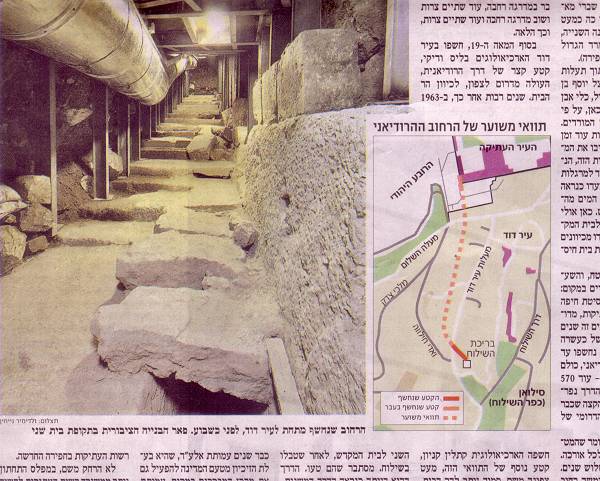
Enclosed map from another article in Ha'aretz this January 24 by Nadav Shragai.
Note that the site of the dig is at the extreme southern end of the City of David, adjacent to the pool, and if they would continue at their present rate northwards, the diggers will approach the southern side of the Old City wall (not the temple Mount) in another 10 or more years...


Thanks for that clarification. But it still sounds as though there are irregularities with this dig which are a cause for concern.

UPDATE (8 February): Todd Bolen says that I've been led astray.
BOOK REVIEW at Bryn Mawr Classical Review:
Leif Carlsson, Round Trips to Heaven: Otherworldly Travelers in Early Judaism and Christianity. Lund Studies in History of Religions, 19. Stockholm: Almqvist & Wiksell International, 2004. Pp. 398. ISBN 91-22-02106-X. $99.50.

Reviewed by Thomas J. Kraus, Hilpoltstein (t.j.kraus@web.de)

Word count: 1686 words

This is the printed version of Leif Carlsson's dissertation prepared under the auspices of his adviser, Tord Olsson (Professor of Comparative Religion), at Lund University, Sweden. Carlsson (C.) addresses a common topic for the period between 200 B.C.E. to 200 C.E., one which is only partly correctly expressed by 'Round Trips to Heaven', because he also deals with other kinds of 'otherworldly' trips to locations that are often everything but heavenly. Basically, this monograph consists of two books in one volume: the first comprises heavenly journey texts that may be denominated as 'Old Testament Pseudepigraphy' (with the exception of 2Corinthians 12:1-5) according to the title of the classical two volumes edited by James H. Charlesworth and published in 1983, while the second is exclusively dedicated to 3Baruch ('A Journey into Death's Waiting Room') and could have formed a book on its own. Everybody who is interested in apocalyptic literature in general and in the specific motif of 'heavenly journeys' in particular will get a sound introduction to the most relevant texts. Profound knowledge in this field of research is not required, because the texts are presented in English only (except 2Corinthians and 3Baruch) and supplemented with introductory sections. Be that as it may and apart from some methodological inconsistencies, Carlsson's study is a significant contribution to the discussion of otherworldly trips in the Jewish and Christian literature of the period of time addressed.

[...]
The review also mentions the online Arbeitshilfen für das Studium der Pseudepigraphen, which I had not seen before. It looks pretty useful, but it seems not to have been updated since April of 2003 and so is getting out of date.

Sunday, February 04, 2007

THE DEAD SEA SCROLLS get lots of attention in the Kansas City Star today in advance of the exhibit at Union Station which opens on 8 February.
Scrolls a great marvel for Christians, Jews
By MORRIS B. MARGOLIES

From Feb. 13 through May 8, some of the original Dead Sea Scrolls will be on display at Union Station.

Kansas City should be immensely proud that it has qualified to exhibit these scrolls.

What importance can they have for us today, given that they’re 2,000 years old? That is the question put to me during and after some 20 lectures I have given on the subject in the past few months.

Within this brief space I shall try to summarize my response.
The response is pretty accurate but needs some corrections and nuancing.
Many of the parables of Jesus are contained in the religious writings of the scroll sect. The career of the group’s leader, whom they designated as the Teacher of Righteousness, eerily foreshadows the life and death of the founder of Christianity.
No, none of the parables of Jesus are found in the Dead Sea Scrolls. And anything beyond the most general of comparisons between Jesus and the Teacher of Righteousness as ancient Palestinian Jewish teachers moves quickly into fringe ideas.
The Dead Sea Scrolls Hebrew Bible had been written more than a thousand years before. A close comparison of this Essene text with the 9th-century Masoretic text reveals virtually an identical rendition.
Well, yes, some of the manuscripts are close to the Masoretic text and one or two are virtually identical, but a fair number of them have quite a few variations, often siding with variants known from the Septuagint Greek translation or the Samaritan Pentateuch. But these are only rarely matters of substance.
The Essenes had clearly broken away from the political and religious leadership of the Holy Temple in Jerusalem. Their writings reveal a much more rigid observance of Jewish ritual than had prevailed in the Holy City.

They set up their own sheltered and exclusivist community at Qumran, just northwest of the Dead Sea. They wrote their biblical and sectarian scrolls with great diligence. When in 66 of the common era the fury of Roman power was aimed at a besieged Jerusalem, the Essenes hastened to hide their writings in the nearby Caves of Qumran, some 10 miles south of the Holy City.
Some version of the Essene hypothesis is probably right, but the degree to which the Qumran sectarians split from the Jerusalem Temple is far from clear. A serious split is implied by the Habakkuk Pesher. One can, but need not, read a split into the Community Rule. The Damascus Document assumes its readers will worship in the Temple, although perhaps not without reservation. And various liturgical texts (e.g., 4Q512) and calendrical texts give directions for worship in the Temple. The whole question of who used which calendar and where and when also figures into the problem. Relations with the Temple may have been better and worse over time; we really just don't know.

The second article:
Sacred texts on secular stage
Pages offer a peek at roots of faiths, and hope of profit for Union Station.
has lots of quotes from biblical and Qumran scholars.

The third:
Here’s how to see the scrolls
is self-explanatory and is of interest to those who plan to attend.
MORE ON THE BODMER PAPYRUS that has just been acquired by the Vatican, and on the Vatican Apostolic Library:
Gospel Papyrus Donated to Vatican

"It Has Not Yet Revealed All Its Secrets"


VATICAN CITY, FEB. 3, 2007 (Zenit.org).- Here is a translation of an article published last week in the semi-official Vatican newspaper, L'Osservatore Romano, entitled "18 Centuries of History: The Bodmer Papyrus 14-15 (P75) Arrives in the Vatican Apostolic Library."

* * *

April 30, 1451: With a papal brief Pope Nicholas V establishes a library "pro communi doctorum virorum commodo" (to facilitate the research of scholars). Thus was born the present Vatican Apostolic Library.

November 22, 2006: the Bodmer Papyrus 14-15, donated to His Holiness Benedict XVI by the generosity of the Sally and Frank Hanna Family Foundation and the Solidarity Association (U.S.A.), as well as the Mater Verbi/Hanna Papyrus Trust, was given to the Vatican Apostolic Library.

During the five and a half centuries that separate these two dates, albeit through different vicissitudes, such as the losses caused by the lansquenets on the occasion of the sack of Rome (1527) or the transfer of the manuscripts to Paris in the Napoleonic age, the Vatican Apostolic Library remained faithful to the mandate it received to enrich, guard and preserve with all care the cultural treasures entrusted to it and to put them at the disposition of qualified scholars.

In the meantime, the initial thousand manuscripts by this time numbered 150,000; beside these were placed 300,000 coins and medals, as well as 100,000 stamps and an important collection of antique prints.

Among the famous monuments of culture deposited at present in the Vatican Library, mention can be made, in the classic line, of the palimsest of Cicero's De Republica (Vat. lat. 5757), of the Virgilio Vaticano (Vat. lat. 3225), of the Virgilio Romano (Vat. lat. 3867), of the Terenzio Vaticano (Vat. lat. 3868), of important manuscripts of Plato (Vat. gr. 1), of Pindar (Vat. gr. 1312) and of the Tavole Facili of Ptolemy (Vat. gr. 1291), not to mention Menander's most precious palimsest discovered a few years ago in Vast. sir. 623.

Numbered among the biblical manuscripts is the most ancient testimony known of the two letters of St. Peter (Papyrus Bodmer 8), the so-called "B codex," one of the two surviving Bibles of the 4th century (Vat. gr. 1209) and the "codex Claromontanus" (Vat. lat. 7223) or even one of the most ancient known paleo-Slavic manuscripts (Vat. gr. 2502).

[...]
And there's lots more on the papyrus itself, which is early and which contained both the Gospel of Luke and the Gospel of John.
TEMPLE MOUNT WATCH: More fallout over those excavations.
Temple Mount closed to non-Muslims Sunday
By ETGAR LEFKOVITS Jerusalem Post)


The Temple Mount will be closed to non-Muslim visitors on Sunday and police will restrict the entry of Arabs for the day, after Islamic leaders accused Israel of carrying out an excavation at the holy site, police said.

The unusual weekday restrictions come after Muslim leaders calls on Arabs to visit the site en masse in response to Israeli excavation work near the Mughrabi Gate.

[...]
UPDATE: And still more:
Islamic scholars say Israel violating Aqsa mosque
Sat 3 Feb 2007 14:45:55 GMT

RIYADH, Feb 3 (Reuters) - A Saudi-based body of Islamic scholars on Saturday condemned Israeli archaeological work near the al-Aqsa Mosque in Jerusalem, saying it was a "blatant violation" of the shrine's sanctity.

"The most serious element is plans to excavate under the walls of the Aqsa Mosque and its underground tunnels," the Islamic Jurisprudence Academy said in a statement carried on Saudi state news agency SPA.

[...]
The charge has also been denied:
Shmuel Rabinowitz, Rabbi of the Western Wall and Jewish holy sites in Israel, said there were no plans to excavate under al-Haram al-Sharif, known to Jews as Temple Mount.
ENTER THE MESOPOTAMIAN UNDERWORLD ... IF YOU DARE!

(Via the Agade list.)

Saturday, February 03, 2007

BIBLICAL STUDIES CARNIVAL XIV has been posted by Chris Weimer at Thoughts on Antiquity.
TEMPLE MOUNT WATCH:
Thousand-year-old pulpit rises from the ashes
From Stephen Farrell and David Sharrock in Jerusalem (Times of London)

Prayers at the al-Aqsa mosque, Islam’s third-holiest site, will have a special significance for Muslims today when an ornate pulpit destroyed by a deranged Christian tourist 37 years ago is finally returned to the place it has occupied for almost a millennium.

The pulpit, which was brought to Jerusalem from Aleppo, Syria, by Saladin after he drove the Crusaders out of the holy city in 1887, has taken years to reconstruct and is considered a jewel of sacred art.

Master craftsmen from Egypt, Turkey and Indonesia collaborated on the project under the guidance of a Saudi academic, Minwer al-Meheid. In spite of the pulpit’s near-total destruction in a fire which swept the al-Aqsa mosque, Dr al-Meheid was convinced that he could rebuild it to its original specifications, fashioned from 16,000 separate pieces.

[...]
For "1887" in the second paragraph read '1187."
“The story of the pulpit is of the liberation of Jerusalem during the Crusades,” said Adnan al-Husseini, director of the Waqf, the Islamic trust that administers the Sharif site. “Its restoration is a step towards freeing the mosque and Jerusalem from occupation.”

[...]
The pulpit was an important historic artifact and I'm glad it has been restored, but this isn't the most constructive spin for the Waqf to put on the story.
In spite of its rich and troubled history Dr al-Meheid sees no controversy over the artefact itself. “This minbar should be a message of peace. It signifies the place of the preacher who carried the word of God, which is the word of peace,” he said.
I think that's a better message.
STILL WAITING: The Dead Sea Scrolls exhibition in Kansas City starts on the 7th of February, and their arrival is presumably imminent:
Stage is set for Dead Sea Scrolls' arrival in KC
By: Barbara Bayer, Staff Writer February 02, 2007

After months of preparation, the Dead Sea Scrolls exhibit will open next week at Kansas City's Union Station.

An Opening Festival, with a late-1940s Middle Eastern theme, takes place from 5:30 to 9:30 on Wednesday, Feb. 7. The exhibit itself opens to the general public on Thursday, Feb. 8, continuing through May 13.

This is the only time the scrolls will be exhibited in the Midwest. The next stop is San Diego. From there, Union Station officials believe the scrolls will return to Israel and stay there. As of Monday this week, more than 26,000 tickets had been pre-sold, according to Sarah Biles, director of communications. (For ticket information, see box, Page 7)

Linda Segebrecht, Dead Sea Scrolls project manager, said organizers expect big crowds.

"On Saturdays and Sundays, we could have up to 5,000 people each day. It is just amazing what ticket sales are," she said.

Union Station has been preparing for the exhibit since Jan. 7. Once the scrolls themselves arrive, a team of three Israel Antiquities Authority officials - Pnina Shor, head of the artifacts treatment and conservation department; Lena Libman, chief conservator of the scrolls; and Hava Katz, chief curator of national treasures - will finalize the setup of the exhibit.

[...]
For those are able to attend, there's lots of detailed information on the exhibit.

Friday, February 02, 2007

"THINK LIKE A FORGER":
Probing Question: How can you spot a forgery?
Thursday, February 1, 2007

By Lisa Duchene
Research Penn State

History is checkered with stories of fakes -- and people duped into believing they were the real thing.

Even an artist as great as Michelangelo was not above being accused of forgery. As the story goes, in 1496 the sculptor created a sleeping cupid figure, treated it to appear ancient, then sold it as such to a cardinal who -- upon learning of the fraud -- demanded a refund. The mystery over the still-lost cupid is credited with drawing attention for the first time to Michelangelo's sculpting work.

So how do you spot a forgery?

Think like a forger, says Baruch Halpern, a Penn State professor of ancient history, classics and religious studies whose class "The Art and Science of Forgery" teaches students to do just that.

"If you don't think like a forger, you're going to get scammed yourself," said Halpern.

[...]
Sounds like an interesting and timely class.
REFRESHING THE SAMARITAN GENE POOL:
Samaritans look further afield to find their future

* The last of an ancient sect have turned to eastern Europe to safeguard their survival, reports Martin Chulov from Jerusalem
* February 03, 2007 (The Australian)

YAIR Cohen is one of the last of the Holy Land's smallest sect, and does not want to let the bloodline die with him.
Facing extinction on the one hand, or grave genetic risks on the other, he did what perhaps no other Samaritan has done in 3000 years - turned a long way from home to find a bride.

Four years ago, Cohen, now 45, returned to Mount Gerizim near the West Bank city of Nablus with a blonde, blue-eyed, fair-skinned 18-year-old Ukrainian woman. Like any budding groom, he was nervous as he took her to meet his parents.

But Cohen had an extra dose of the jitters. His father's blessing would mean much more than his happiness. It would also be an endorsement of a new and critical way out of the Samaritans' chromosomal decay.

[...]
The union did receive the sought-for blessing, but so far has not resulted in any children. I wish them well.
TU B'SHEVAT, the "New Year for Trees," began this evening at sundown. It's an ancient, but postbiblical festival. More here and here.
THE JOURNAL OF BIBLICAL LITERATURE has posted a new issue (125.4, winter 2006) on the SBL website. Unfortunately, you have to be an SBL member to access this issue, although back issues are available at JSTOR.
The articles in JBL 125.4 include:
Bishlam's Archival Search Report in Nehemiah's Archive: Multiple Introductions and Reverse Chronological Order as Clues to the Origin of the Aramaic Letters in Ezra 4-6 Richard C. Steiner; Proverbs 8:22—31: Three Perspectives on Its Composition Alan Lenzi ; Analogical Reasoning in Romans 7:2—4: A Woman and the Believers in Rome Peter Spitaler; Taming the Shrew, Shrike, and Shrimp: The Form and Function of Zoological Classification in Psalm 8 Richard Whitekettle; What Becomes of the Angels' "Wives"? A Text-Critical Study of 1 Enoch 19:2 Kelley Coblentz Bautch; Did Paul Loathe Manual Labor? Revisiting the Work of Ronald F. Hock on the Apostle's Tentmaking and Social Class Todd D. Still; Book Reviews and the Annual Index: Volume 125 (2006)

Thursday, February 01, 2007

CULTURAL ICON WATCH:
Robyn Art's "Vestigial Portions of the Dead Sea Scrolls"

Robyn Art's "Vestigial Portions of the Dead Sea Scrolls"
[ Featured Underground Poet ] - 01.31.07 - by: Marie Lecrivain (Get Underground)

Robyn Art's Vestigial Portions of the Dead Sea Scrolls is a not-quite-convincing collection of poems loosely constructed, and then presented as one long book-length poem. I say "not quite," because the poems do not quite fit together, but this is the trick of the post-post-modern poet: to hammer the square pegs into the round holes and declare that "it fits," splinters and all.

[...]
Catchy title, but the poems appear to have nothing to do with the Dead Sea Scrolls.
EGYPTIAN BLOGGER Abdolkarim Nabil Seliman now has the support of Amnesty International:
Amnesty International today called for the immediate and unconditional release of Karim Amer, the first Egyptian blogger to be tried for writing blogs criticizing Egypt's al-Azhar religious authorities, President Husni Mubarak and Islam.
Their support is very good news. I'm glad this case is finally getting some real attention in the West.
BOOK REVIEW in Commentary Magazine:
Resurrection and the Restoration of Israel by Jon D. Levenson
Reviewed by David Berger

February 2007

“Who Revives the Dead”
Resurrection and the Restoration of Israel: The Ultimate Victory of the God of Life
by Jon D. Levenson
Yale. 274 pp. $40.00

[...]

Jon D. Levenson, a professor of Jewish studies at Harvard, is a distinguished biblical scholar and theologian whose interest in this theme was foreshadowed in his The Death and Resurrection of the Beloved Son: The Transformation of Child Sacrifice in Judaism and Christianity (1993). Here he has given us a beautifully written, multi-faceted work that begins with 19th and 20th-century Jewish theologians and liturgists, moves back in time to touch on Maimonides in the 12th century, back still farther to the Talmud and midrash, and finally turns to the biblical material that stands at the core of the book.

Levenson’s purpose is to refute two widely held positions, or what might be called contemporary orthodoxies. The first of these is a counter-orthodoxy current among many Jews—to wit, that Judaism rejects belief in physical resurrection, either because Judaism is a this-worldly religion or because it accords pride of place to the idea of a disembodied immortality of the soul. As Levenson notes, those who apply either of these characterizations to classical Judaism are very numerous, but uninformed.

A more serious variant of this same contention is that Judaism should reject belief in resurrection, in favor of a putatively more sophisticated alternative. ...

Wednesday, January 31, 2007

"... JUDAS IS AS EVIL AS EVER" in the Gospel of Judas. So April DeConick on her new Forbidden Gospels Blog. There seems to be an emerging counterconsensus on this issue, originated by Louis Painchaud and now with April and Einar Thomassen on board.

April also has a meditation on postmodernism inspired by Thomas the Tank Engine. Really. I quite agree with her conclusion (which actually sounds pretty postmodern): "the historian cannot privilege one set of texts over another, or one position over another." That said, I also would say a word in the defense of postmodernism, or at least poststructuralism. I have found deconstruction and intertextuality to be very helpful for getting my head around the fact that the meaning of ancient texts (and, particulary, ancient scriptures) has been a moving target throughout history and changed, often radically, as times and cultural contexts changed. This does not mean that we can apply whatever meaning we want to ancient texts. Rather, it means that we need to read each text in a repeatedly new context and new light as we study its meaning during the course of its transmission.

UPDATE: April DeConick e-mails:
Jim, I noticed on your post today that you included Einar and me, but also there is John Turner of Nebraska. He is a very important scholar of NH and Coptic, especially Sethian Gnosticism. Einar and Louis had contact in the summer and their opinions may have influenced each other. But John and I worked through the text independent of Louis and Einar. I didn't have a clue what Louis' position was. In fact, when I went to the Sorbonne, I was very nervous about my paper because I thought that I would be a lone voice critiquing the NG translation and interpretation. I think that our independence is important because it is not a bunch of scholars jumping on the counterposition bandwagon started by one person. What has emerged is a counterposition that has developed independently by Coptic scholars across the world.
This is what I had meant to get across, but April has expressed it more clearly.

Tuesday, January 30, 2007

TEMPLE MOUNT WATCH: The Israeli excavations are now being used as an excuse for a terrorist bombing.
FEATURE-Israel excavation work near shrine fans Muslim ire
Mon 29 Jan 2007 12:42 PM ET

By Jonathan Saul

JERUSALEM, Jan 29 (Reuters) - Israeli excavations near Jerusalem's most sensitive shrine have sparked fury among Muslims who fear such works endanger its foundations, but officials involved say they will not damage the holy site.

[...]

On Monday, Palestinian militants who claimed responsibility for a suicide bombing in the Israeli resort of Eilat, which killed three people, said it was a response to Israeli attempts to "defile" al-Aqsa mosque.

[...]

Al Aqsa Brigades spokesman Abu Qusai accused Israel of carrying out building work underneath the mosque as well as continued archaeological digging in the area, which could undermine the foundations of the mosque.

"The attack was in response to the continued Israeli aggression and the attempts to defile the al-Aqsa mosque," Abu Qusai said. The militants added the Eilat attack was just the beginning of operations "in defence of al-Aqsa".

Israeli government spokeswoman Miri Eisin said in response: "Palestinian terror organisations never lack a reason to attack innocent civilians wherever they can. This is why we are always on guard against their activities."

Shmuel Rabinowitz, Rabbi of the Western Wall and Jewish holy sites in Israel, said there were no plans to excavate under al-Haram al-Sharif, known to Jews as Temple Mount.

[...]
There's also more on the controversy over the bridge to the Mugrabi Gate.
A GOOD QUESTION, submitted to Question, Science Times, of the New York Times:
Speaking in Tongues

By C. CLAIBORNE RAY
Published: January 30, 2007

Q. How do researchers know the pronunciation of the languages of long-gone peoples?

A. Scholars do not so much know the pronunciation of ancient languages as extrapolate and guess. They have had more success with some languages than with others, said Emily Teeter, spokeswoman for the Oriental Institute of the University of Chicago, a major center for the study of the ancient Near East. For example, she said, Semitic languages like Babylonian and Akkadian are closely related to ancient Hebrew, providing solid clues about how the other ancient Semitic languages were vocalized.

[...]
Arabic is also very important for comparative Semitics. The answer continues with ancient Egyptian, drawing on the Rosetta Stone and Coptic.

Monday, January 29, 2007

THE OLD TESTAMENT PSEUDEPIGRAPHA COURSE that Grant Macaskill and I are teaching next semester holds its first session on Friday, 9 February. I have fully revised and updated the St. Andrews Old Testament Pseudepigrapha Website and all systems are now go. The course will include a blog, which has been set up, but does not have any posts yet, and which will open on the day of the first class meeting. PaleoJudaica will continue as normally, so I hope you will follow both blogs.

If you want to keep up with the course, you might want to make sure you have access to these books:
James H. Charlesworth (ed.),
The Old Testament Pseudepigrapha, vol. 1, Apocalyptic Literature and Testaments vol. 2, Expansions of the "Old Testament" and Legends, Wisdom and Philosophical Literature, Prayers, Psalms, and Odes, Fragments of Lost Judeo-Hellenistic Works (Garden City, N.Y.: Doubleday, 1983, 1985)
Reading assignments will come from them. They should be available in any decent sized public library. You can also order them through Amazon.

I recommend that you also read the following articles, all of which are available online, although unfortunately mine requires a paid personal or institutional subscription to access:
James R. Davila, "The Old Testament Pseudepigrapha as Background to the New Testament," Expository Times 117.2 (2005): 53-57.

Robert A. Kraft, "The Pseudepigrapha in Christianity," in Tracing the Threads: Studies in the Vitality of Jewish Pseudepigrapha (ed. John C. Reeves; SBLEJL 6; Atlanta: Scholars Press, 1994), 55-86. This article is also available on Professor Kraft's website and can be accessed by clicking here.

Robert A. Kraft, "The Pseudepigrapha and Christianity Revisited: Setting the Stage and Framing Some Central Questions," JSJ 32 (2001) 371-395.
If you can't access my Expository Times article, the following conference paper from some years ago covers much of the same ground:
"Jewish Pseudepigrapha and Christian Apocrypha: (How) Can We Tell Them Apart?" (BNTC, September 2002)
Watch this space.
ASSIMILATED TO THE BLOGOSPHERE: April DeConick has just started a blog on the New Testament Apocrypha and Christian origins. It's called The Forbidden Gospels Blog.
I'd like to start this blog with what may be a shocking observation, but one which I know to be true: the major obstacle to any historical study of early Christianity is the New Testament canon.

Sunday, January 28, 2007

NAZIS. I HATE THESE GUYS:
Neo-Nazi group plans book burning

MINNEAPOLIS, Jan. 27 (UPI) -- Jewish, Christian and Muslim groups in Minnesota have joined to oppose a neo-Nazi group's burning of "anti-white" books.

The books targeted by the National Socialist Movement, which is based in Minneapolis, include the Talmud, the compilation of laws and religious practices and discussions by Jewish rabbis on them.

[...]
THE DEAD SEA SCROLLS are coming to Kansas City any day now. The preparations sound very thorough and a little cloak-and-dagger.
Union Station making ready for Dead Sea Scrolls exhibition
By: Barbara Bayer, Staff Writer [Kansas City Jewish Chronicle] January 26, 2007

The Dead Sea Scrolls are on their way to Kansas City, Mo.

It's just that nobody knows exactly when.

"It will arrive sometime between the end of January and the beginning of February. They don't tell us for security reasons," said Andi Udris, president and CEO of Union Station. "They will tell us about a half hour before it gets here."

Union Station Kansas City will host the international Dead Sea Scrolls exhibit beginning Feb. 8. The exhibit, on display through May 13, was developed in conjunction with the Israel Antiquities Authority. It will feature pieces of 10 scrolls. Six of the scrolls are original and have not been on public display in the United States. The other four are replicas. The exhibit will also feature a replica of the famous Copper Scroll. It also includes more than 100 artifacts - clay jars, sandals, even a hair comb - found in the community of Qumran, near where the scrolls were found.

[...]
I've fixed the typo for them in the headline.

Saturday, January 27, 2007

PHOENICIAN AND PUNIC ARTIFACTS have been donated to a museum in Malta by a collector's nephew. The Times of Malta reports:
Ancient artefacts donated to Heritage Malta

In a highly commendable gesture of altruism, Joseph Sammut yesterday donated a collection of about 300 Punic and Phoenician artefacts to Heritage Malta. The items had belonged to Chev. Sammut's uncle Ganni. Photo: Matthew Mirabelli.

About 300 Punic and Phoenician artefacts collected by a Qormi blacksmith in the early 20th century were yesterday donated to Heritage Malta.

The collection - dating back to pre-Christian times - was donated by Joseph Sammut, nephew of Ganni Sammut who until his death in 1958 collected objects unearthed by building contractors with whom he had business deals. Ganni Sammut also bought a number of artefacts from auctions and sometimes purchased items to prevent foreigners from acquiring them so that the artefacts would remain here.

[...]
There's a photo of a few of the artifacts, which seem mostly to have been plundered from tombs. There's no mention of written materials.
BOOK REVIEW: Diarmaid MacCulloch reviews Martin Goodman's latest on ancient Jews and Romans for the Guardian. MacCulloch opens with a bit of alternate history and maybe belabors the modern applications a bit. But the book sounds interesting.
Original spin

Diarmaid MacCulloch lauds Martin Goodman's compelling account of two crucial centuries in Jewish history, Rome and Jerusalem

Saturday January 27, 2007
The Guardian

Rome and Jerusalem: The Clash of Ancient Civilisations
by Martin Goodman
656pp, Allen Lane, £25

History which never happened both comforts and tantalises by hinting how we might have avoided present miseries. What if Rome had never grown to be more than a small, undistinguished Italian city-state? It is unlikely that any other Mediterranean empire would have obliterated the Temple of Jerusalem, as did the Roman emperor's son Titus in 70CE - at least, it is very unlikely that the temple would not have been rebuilt or redeployed for a new sort of faith. Total destruction was not the way in the ancient Near East: witness the seventh-century struggle over the ancient holy place of Mecca, which Muhammad transformed into the focus of a newly conceived religion. Without the Romans, temple worship would have continued in Jerusalem, with thousands on thousands converging on it yearly, ecstatic to end their pilgrimage in a centuries-old sacred city, as still happens on the hajj to Mecca.

[...]

Martin Goodman's massive new treatment of two crucial centuries of Jewish history should be read by anyone seeking seriously to understand modern Middle Eastern tangles. His subtitle might suggest that he is a believer in Samuel P Huntington's theory of an inevitable "clash of civilisations", that malign banality underlying American neo-conservative meddling in Middle Eastern affairs. In fact, the message of the book is entirely the reverse: the ghastly sequence of events after 66CE was in no way inevitable. The previous century had been one of the most glorious and happy in the holy city's history: the temple, magnificently rebuilt by the somewhat unconvincingly Jewish king, Herod the Great, attracted more pilgrims than ever before. Jewish client kings might be cosmopolitan figures closely linked to powerful Romans: one of them, the ebulliently bisexual Agrippa II, was first a dissolute intimate friend of the Emperor Caligula, and afterwards the man most responsible for frogmarching Caligula's uncle Claudius to the imperial throne. A mark of how little the Romans expected real trouble from the Jews before 66 was the low calibre of the governors sent to this politically insignificant area, and the small numbers of troops thought necessary to govern it.

[...]
UPDATE: The Scotsman also has a review:
Sacrifice at the altar of empire
COLIN DONALD

Rome & Jerusalem - The Clash of Ancient Civilisations
BY MARTIN GOODMAN
Allen Lane, 656pp, £25

ARE CENTURIES OF ANTI- Semitism really just based on ancient political spin? According to Martin Goodman's provocative and closely argued thesis, the answer is yes. If you want to trace the roots of the Holocaust, he argues, you have to dig deep in Roman domestic politics. And while you're digging, you'll find something perhaps just as shocking: that Christians promoted Jew-hating almost from the earliest days of the religion.
Click to learn more...

Goodman, a professor of Jewish Studies at Oxford and a distinguished historian of Rome, has written a magnificent, luxuriantly detailed book of revelations and connections, the implications of which will take time to absorb. Much of what it says about the origins of the Jewish diaspora has a bearing on the modern Middle East, where ancient events remain fresh in the mind.

His book's facility of narrative, wry appreciation of human nature and its clarity and authority in arbitrating on widespread mutual resentments, make it an important addition to studies of the roots of anti-Semitism.

Goodman wears his intimate knowledge of the first few centuries of the Christian era lightly, even jauntily. His confidence comes from the historian's understanding that the politics of the Roman Empire are the politics of all empires, formal and informal. It's a matter of seeing the patterns, and knowing how the tribes related and interacted, philosophically and politically.

[...]

Friday, January 26, 2007

MAIMONIDES AS A MEDIC; a review by Stephen Mark Dobbs in the Jewish News Weekly:
“Maimonides,” by Sherwin B. Nuland, a professor of surgery at Yale, studies Maimonides from this medical perspective.

Maimonides was the most prominent physician to write about medicine from a Jewish perspective and sense of compassion. The Talmud considers the physician as a messenger and a partner of God. In the Mishneh Torah Maimonides writes: “A man should aim to maintain physical health and vigor, in order that his soul may be upright, in a condition to know God.”

As a 12th-century Jew living in a Muslim world, Maimonides read the ancient texts in Arabic, which provided a bridge between the Hellenistic era and that of the Renaissance and then the Enlightenment. Maimonides was among the early vanguard seeking to remove the veils of superstition of the Dark Ages that cast shadows over all learning, including medicine. He and other Jewish physicians were sought after by royal courts throughout the Muslim world and Christian Europe.
NO SNAKES ON A WALL AFTER ALL? On the Agade list, Jack Sasson points to a post by Egyptologist Thomas Schneider on what appears to be an Egyptology discussion list. (I'm not familiar with it.) He is skeptical of Steiner's proto-Northwest Semitic interpretation.
PETER SCHÄFER has published a book on Jesus in the Talmud.
COPTIC TEXTS: A Boharic New Testament is now available online. And the same site already had a Sahidic New Testament.
THERE'S A NEW SLAVONIC PSEUDEPIGRAPHA PROJECT, run by Andrei Orlov at Marquette University. Apparently he sent out an e-mail circular about it which Stephen Carlson, Tyler Williams, and others received, but I didn't. That makes me worry that my junk mail filter has started eating good messages again.
A BODMER PAPYRUS has ended up at the Vatican.

Thursday, January 25, 2007

AN ANCIENT SHIPWRECK, found off the coast of Haifa some years ago, is in the news:
Ancient Boat Shows Israeli Maritime Life

By MATTI FRIEDMAN
The Associated Press
Wednesday, January 24, 2007; 1:04 PM

JERUSALEM -- A boat that plied the coast of the Holy Land 1,300 years ago carrying fish, carobs and olives is helping researchers better understand a little-known period in the region's history.

The boat, discovered in a coastal lagoon near the northern city of Haifa, dates from the early 8th century, not long after the rise of Islam and the Arab conquest of the Middle East. The find suggests that a long tradition of sea trade was not disrupted by the arrival of new rulers from the Arabian desert.

[...]
ARAMAIC WATCH: Aramaic for school children in Los Angeles:
School preserves ancient culture
BY SUSAN ABRAM, [LA Daily News] Staff Writer
Article Last Updated: 01/22/2007 10:45:31 PM PST

TARZANA - Their alphabet, once carved in stone or found on ancient parchment, comes alive in red and blue marker on a white board in a San Fernando Valley classroom.

They might not know it yet, but the dozen or so teens who write out the letters are making history by learning their history.

It's the only way their culture will survive.

"It's really nice to teach them, though it's challenging," said a patient Amir Dinkha, a teacher at the Assyrian American Christian school, the first and only private campus of its kind in the United States.

[...]

On the other side of the world, news reports have detailed increased violence against the Assyrians and other Christian minorities who have called the Ninevah plains of northern Iraq their home since ancient times.

"It's a miracle we're even alive actually, considering all the persecution that we've gone through," Bet-Rasho said.

[...]

On a recent weekday, the students in teacher Dinkha's class read aloud the Aramaic version of a Bible story. There are good-natured giggles along the way as their American-trained tongues try to grasp words similar to those spoken by Jesus Christ.

While the lessons can be tough, some students say they feel as if the school is their home. It is among each other where they have found their identity.

"It used to make me feel kind of down because I would tell people at school I was Assyrian, and they would say, `What's that? Syrian?"' said Justin Atneyel, 14. "I used to bring a book with me to school to show them."

[...]

By the end of the school year, the students might be ready to write to those who remain in their ancestral lands, Bet-Rasho said. He does not want the Assyrian American youth to forget where they came from.

"This school is dedicated to every hero who died of persecution in the homeland," Bet-Rasho said. "They died for their name, their language and their faith."

Wednesday, January 24, 2007

TEMPLE MOUNT WATCH:
Pilgrims' road to Temple unearthed in City of David dig
By Nadav Shragai, Haaretz Correspondent

At the end of the 19th century, the archaeologists Bliss and Dickey discovered a short piece of road dating back to the Herodian period in Jerusalem's City of David. The road ascended from south to north in the direction of the Temple Mount. Many years later, in 1963, the archaeologist Kathleen Kenyon found another piece of the road, a little closer to the Temple Mount. When, a little over a year ago, Israel Antiquities Authority (IAA) archaeologists found yet another section of it, they believed they had solved a puzzle, and that they could now sketch the course of the main road by which many pilgrims of Second Temple times made their way up to the Temple after immersing themselves in the Siloam Spring. It turned out they were wrong. That road was apparently secondary.

The road that IAA archaeologists Ronny Reich and Eli Shukron have now found, which is much grander, wider and more central, is parallel to the one Bliss and Dickey discovered. Reich believes that at a certain point further to the north, these two roads converged.

[...]
The story from last March about the smaller road is here.

Tuesday, January 23, 2007

THE EARLIEST SURVIVING NORTHWEST SEMITIC TEXT?
Hebrew U. presents Semitic snake spells (JTA)
The earliest continuous Semitic text ever deciphered was displayed publicly for the first time Monday at the Hebrew University of Jerusalem.

Richard Steiner, professor of Semitic languages and literature at Yeshiva University, interpreted Semitic passages in Egyptian texts discovered more than a century ago inscribed on the subterranean walls of the pyramid of King Unas at Saqqara in Egypt sometime between the 25th and 30th centuries BCE.
Earlier than PaleoJudaica's usual time frame, but too cool not to mention.
The passages, which were meant to protect royal mummies against poisonous snakes, were written in hieroglyphic characters, but Steiner discovered that they were composed in the Semitic language spoken by the Canaanites in the third millennium BCE, an archaic form of the languages later known as Phoenician and Hebrew.

The Canaanite priests of the ancient city of Byblos, in present-day Lebanon, provided these texts to the kings of Egypt.
It's not strictly speaking "Canaanite," since the "Canaanite shift" (original long a changes to long o) didn't happen until the late second millennium BCE. Still, the early third-millennium natives of Byblos would have spoken a dialect that was perhaps very early (proto-?)Northwest Semitic and ancestral to Phoenician and a sort of great-great aunt to Hebrew.
Although the Egyptians viewed their culture as far superior to that of their neighbors, the find shows that their morbid fear of snakes made them open to borrowing Semitic magic.
Snakes. Why'd it have to be snakes?

UPDATE: The story is also covered in the Jerusalem Post (here via the Agade list). Most of the information is the same, but note the following:
"This finding should be of great interest to cultural historians, linguists and Biblical scholars" Steiner said.

"This is a sensational discovery," said Hebrew University Professor Moshe Bar-Asher who is the president of the Academy of the Hebrew Language.

"It is the earliest attestation of a Semitic language, in general, and Proto-Canaanite, in particular."

The texts also shed light on several rare words in the Bible, Steiner said.
Also, Manuscript Boy e-mails with the information that a lecture by Steiner in Hebrew also deals with this text. You can download it from the Hebrew University website as a PDF file here.

Today's Ancient Judaism Seminar in St. Andrews went very well. I'll try to post something on it tomorrow.

I hope Blogger doesn't eat this update again. I thought we were past that!

UPDATE (24 January): Another tidbit from a widely disseminated A.P. article:
The Semitic language of these texts that have now been deciphered was a very archaic form of the languages later known as Phoenician and Hebrew, Steiner said.

The text includes words that have the same meaning as in Hebrew, like "yad" for hand, "ari" for lion, and "beit" for house, he said.
UPDATE: Reader Aaron Koller e-mails:
Following your links, I read Steiner's paper; it seems he thinks the dialect he's found does show the Canaanite shift. The "traditional" dating is based on its non-existence in Ugaritic, but if Ugaritic is outside the Canaanite family anyway, this may simply push the date of the shift back by a thousand years, and clarify to some extent the position of Ugaritic in NWS.
I seem to recall some limited evidence for the Canaanite shift in the Mari Letters in the early second millennium BCE, but to have it nealy a millennium earlier than that would be very interesting.

UPDATE: Nice wordplay at Metafiller: Snakes off a Pharaoh. Good supplementary links too. I thought about this inscription and its location on a wall and was tempted to say "Snakes on a Plane," but I restrained myself. Until now.

UPDATE (26 January): An Egyptologist is skeptical.

UPDATE (27 January): Duane Smith comments on the Canaanite shift over at Abnormal Interests.

Monday, January 22, 2007

TEMPLE MOUNT WATCH:
Islamic Movement alleges Israeli dig under J'lem's Temple Mount
By Nadav Shragai, Yoav Stern and Meron Rapoport, Haaretz Correspondents

The Southern Branch of the Islamic Movement, headed by Ra'am-Ta'al chairman MK Ibrahim Sarsour, on Sunday accused Israel of carrying out excavations underneath Jerusalem's Temple Mount, known to Muslims as the Noble Sanctuary.

Sarsour also claimed the Israel Antiquities Authority paid a Palestinian vendor $60,000 for his store along the Temple Mount. The Israel Antiquities Authority denied the accusation.

Earlier on Sunday, the Northern Branch of the Islamic Movement presented pictures taken two weeks ago that allegedly documented excavations near the Temple Mount.

[...]

An inquiry by Haaretz revealed that the excavations referred to by Sarsour were carried out some 100 meters from the Temple Mount and were stopped due to lack of funds. The excavations, carried out by the Israel Antiquities Authority at the behest of a Jewish group on property owned by businessman Aaron Mosovitch, was first revealed by Haaretz about a year ago.

In the article, archaeologists said the excavations were not only vertical, but horizontal, and advanced to within 60 meters of the Temple Mount. However, archaeologists claimed the purpose of the dig was to clear out an old garbage-filled tunnel to determine whether it posed a safety hazard.

[...]
There's more coverage of the claims by Al-Jazeerah, Arutz Sheva, and Ynet News. Similar claims were made in January of 2006 and I covered them here.

UPDATE: More, via Joseph I. Lauer:
Hadash calls for urgent Knesset debate on Jerusalem excavation
By Meron Rapoport

The Hadash-Ta'al Knesset faction has requested an urgent debate in the Knesset Interior Committee following the report published in today's Hebrew edition of Haaretz magazine on excavations the Israel Antiquities Authority (IAA) is carrying out in Jerusalem's Old City.

The IAA, which is carrying out the excavation for the Ateret Kohanim association, has dug 12 meters into the foundations of a Jewish-owned building in the Muslim Quarter, 80 meters from the Temple Mount, and has progressed about 20 meters to the east under other buildings, toward the Temple Mount.

[...]

[Director of the Jerusalem district of the IAA, Jon] Seligman said excavation to the east "has ended for the time being." He also said he had not heard about a possibility that the dig would link up to the Western Wall Tunnel. However, sources involved in the excavation said they had heard from its directors that this was the case. Attorney Eitan Geva, who represents the owner of the building, said the intention is to build a museum at the site where finds discovered during the excavation would be displayed. Eitan said the excavation to the east involved clearing out a channel that had been discovered, to ascertain whether it endangered the building's foundation, and that after the earth was removed, it was sealed. There was no intention to use it or continue digging eastward, Eitan added.

[...]
But it appears that people were not informed of digging going under their houses, although there is a legal requirement that they be notified.
WHAT IS A JEWISH MYTH? asks Rabbi Geoffrey W. Dennis in the New-Age-but-thoughtful Llewellyn Journal. The essay is more about what myth is in general, but it does touch on Judaism as well.

Sunday, January 21, 2007

FREE DIGITAL BOOKS ON SYRIAC MATTERS! "Lagus1974" sends the following note to the Hugoye list:
You can download for free the following books (in various digital formats) at this site - http://www.archive.org/details/texts -

Mitchell, C.W. (ed.), S. Ephraim's Prose Refutations of Mani, Marcion, and Bardaisan. Vol. 1: The Discourses Addressed to Hypatius (London: Williams and Norgate, 1912).

Hill, J.H., A Dissertation on the Gospel Commentary of S. Ephraem the Syrian with a Scriptural Index to his Works (Edinburgh: T&T Clark, 1896).

Cureton, W. (ed.), History of the Martyrs in Palestine, by Eusebius, Bishop in Caesarea, Discovered in a Very Ancient Syriac Manuscript (London / Edinburgh: Williams and Norgate / Paris: C. Borrani, 1861).

Payne Smith, J. (ed.), Extracts from the Ecclesiastical History of John, Bishop of Ephesus (Semitic Study Series 13; Leiden: E.J. Brill, 1909).

Payne Smith, R. (tr.), The Third Part of the Ecclesiastical History of John Bishop of Ephesus (Oxford: Oxford University Press, 1860).

Payne Smith, R. (tr.), A Commentary upon the Gospel according to S. Luke by S. Cyril. 2 vols. (Oxford: Oxford University Press, 1859).

Budge, E.A.W. (tr.), The Paradise or Garden of the Holy Fathers, Being Histories of the Anchorites, Recluses, Monks, Coenobites, and Ascetic Fathers of the Deserts of Egypt between A.D. CCL and A.D. CCCC circiter. 2 vols. (London: Chatto & Windus, 1907).

Connolly, R.H. and Codrington, H.W. (eds.), Two Commentaries on the Jacobite Liturgy by George Bishop of the Arab Tribes and Moses Bar Kepha: together with the Syriac Anaphora of St. James and a Document Entitled The Book of Life (London / Oxford: Williams and Norgate, 1913).

Lewis, A.S. (tr.), Select Narratives of Holy Women from the Syro-Antiochene or Sinai Palimpsest as Written above the Old Syriac Gospels by John the Stylite, of Beth-Mari-Qanun in A.D. 778 (Studia Sinaitica 10; London: C.J. Clay and Sons, 1900).

Wensinck, A.J. (ed.), Legends of Eastern Saints Chiefly from Syriac Sources. 2 vols. (Leiden: E.J. Brill, 1911, 1913).

Gibson, M.D. (ed.), The Commentaries of Isho`dad of Merv, Bishop of Hadatha (c. 850 A.D.), in Syriac and English. 3 vols. (Horae Semiticae 5-7; Cambridge: Cambridge University Press, 1911).

Gibson, M.D. (ed.), Apocrypha Arabica: Kitab al-Magall, or The Book of the Rolls; The Story of Aphikia; Cyprian and Justa, in Arabic; Cyprian and Justa, in Greek (Studia Sinaitica 8; London: C.J. Clay and Sons, 1901).

Saeki, P.Y., The Nestorian Monument in China (London: Society for Promoting Christian Knowledge, 1916).

Phillips, G., Syriac Grammar (3rd revised ed.; Cambridge: Deighton, Bell & Co / London: Bell & Daldy, 1866).

Malan, S.C. (tr.), The Book of Adam and Eve, also called the Conflict of Adam and Eve with Satan (London: Williams and Norgate, 1882).
Good stuff. The Story of Aphikia is an Old Testament pseudepigraphon about the legendary wife of Ben Sira. We considered including it in the More Old Testament Pseudepigrapha Project, but we finally decided that it was too late. I see that The Life of Adam and Eve is included at the end of the list as well. We're including new Coptic material for it in the MOTP. I've also mentioned the Nestorian Monument in China recently on PaleoJudaica.

UPDATE (22 January): Another one from gareth030:
That's a very useful list of texts from "lagus1974".

There are titles in other languages too, for any who may find them useful. For example on this site I also found:S. Ephraem Syri Opera, with text in Syriac, Greek and Latin, commentary in Italian. (Ed.)Silvius Ioseph Mercati, Sumptibus Pontificii Instituti Biblici, Rome 1915.

http://www.archive.org/details/ephraemopera00ephruoft
ELAINE PAGELS is interviewed in the LA Times. She discusses her own background and the historical and theological significance of the Gnostic gospels. Excerpt:
What stirred your interest in obscure religious sects in the first place?

My father was a biologist who had no use for religion. He thought it was naive. But at 13 and 14, I began to find religious notions powerful and compelling. Whether it was the great cathedrals of Europe or Hopi dancers, I sensed in them a potent spiritual dimension of life that I just had to explore.

Later, when I went off to study the early history of Christianity at Harvard, I was surprised to discover that my professors had file cabinets filled with early Christian texts that didn't make it into the Bible. We were told they were bizarre, heretical, nonsensical, full of philosophical fantasies and religious junk. That's also what the fathers of the orthodox Christian church said. They called them "illegitimate secret writings."

After a close read, they changed my understanding of what early Christianity was all about.

*

The word "Gnostic" derives from "gnosis," the Greek word for knowledge. But what is Gnosticism?

We really don't know. The term "Gnostic" has been used in so many ways over the years it's hard to say. The label has been used by people who attacked certain early beliefs as the wrong kind of Christianity and by New Agey types.

Referring to the authors of these texts as Gnostic only accepts that negative judgment. But the people who wrote them didn't think of themselves as belonging to a school called Gnosticism. They were spiritual leaders who thought they had gone beyond simple faith to a deeper understanding.

Essentially, they were trying to make a distinction between anthropomorphic notions of God and the divine reality.
I agree that "Gnosticism" isn't a very useful category in scholarly terms. Most of the time it can be replaced with something like "adherence to the demiurgic myth" (the myth that the creator of our world is an imperfect derivative god, not the True God).

I think her answer to this question is correct as far as it goes, but it's also incomplete:
Where do they rank in comparison with the Gospels of Matthew, Mark, Luke and John?

I think of them now as the other texts that were not included in the canon. Much of what was in the canon was to be used in public church. But, as in Judaism, there were certain secret teachings — or advanced teachings — that were not to be taught publicly or even written down.

They were only to be shared with certain disciples when they were ready. In other words, the New Testament Gospels were the texts students of Christianity began with. Some moved on to the secret teachings.
She really should have added that the four canonical gospels can be dated to the second half of the first century or the very beginning of the second century at the latest. All our evidence indicates that the Gnostic gospels come from later in the second century or later still. With the possible exception of the Gospel of Thomas (which I would not count as "Gnostic"), the noncanonical gospels give us no new information about the historical Jesus or the first generation of the Jesus movement.

But anyhow, read it all.