Friday, July 05, 2013

Israeli politician: Hey, let's build a third Temple on the Temple Mount.

TEMPLE MOUNT WATCH: Minister calls for third Temple to be built: Potentially explosive statement by Jewish Home’s Uri Ariel breaks taboo against damaging status quo on Temple Mount (Times of Israel).
We’ve built many little, little temples,” Ariel said, referring to synagogues, “but we need to build a real Temple on the Temple Mount.”
This is really quite unhelpful. The comment was made at an archaeological conference, but no context from the speech is given for the quotation and it may have seemed less rash in its full context, but these days letting that sound bite loose at all was rash.

As I keep saying, no building or excavation on the Temple Mount unless and until it can be done using non-invasive and non-destructive scanning technologies. Which I am inclined to think may not be all that far in the future.

More Cyril and Methodius celebrations

THE PARTY JUST KEEPS GOING:
Czech President Zeman attends Cyril and Methodius celebrations

vydáno: 04.07.2013, 19:46 | aktualizace: 04.07.2013 19:48

Velehrad - Czech President Milos Zeman today arrived for the Velehrad pilgrimage site hosting one of the biggest church events in the country, the Days of Good Will People, within the celebrations of arrival of Saint Cyril and Saint Methodius to Great Moravia kingdom in the 9th century.

Thousands of pilgrims celebrate the 1150th anniversary of the arrival of Cyril and Methodius, Christian missionaries from the 9th century.

Zeman laid flowers at the altar in the Basilica of Ascension of Virgin Mary and Saint Cyril and Saint Methodius.
Background on the 1150th anniversary of the invention of the Slavonic alphabet (and why it matters to PaleoJudaica) is here and here and follow the links back.

Thursday, July 04, 2013

Bet Qama Mosaic on display

THE RECENTLY RECOVERED ANCIENT MOSAIC AT KIBBUTZ BET QAMA (BEIT KAMA) is open to the public for viewing, without charge, today, July 4th. For you, special deal.

More on this mosaic and others in Israel here and links.

Roman base in Galilee

ALL YOUR BASE ARE BELONG TO US:
Israeli archaeologists uncover base of 6th Roman Legion in Galilee
Legion camp served as a type of headquarters for managing Rome's military. From there, 3,500 soldiers ruled over the Galilee and part of Samaria 1,800 years ago.

By Eli Ashkenazi | Jul.03, 2013 | 6:09 PM | 2

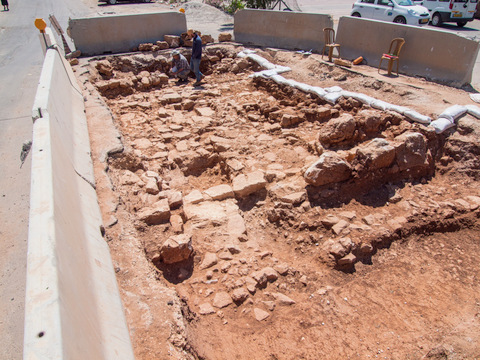
Israeli archaeologists have found ruins they believe are the site of one of the two Roman legions based in the country between 120 and 300 C.E.

Israel Antiquities Authority archaeologist Yotam Tepper had long suspected that the site in the Galilee was the base of the Legio Sexta Ferrata, the 6th Roman Legion, also known as the Ironclad Legion. The other legion in the country was the 10th, based in Jerusalem.

Over the past week, an expedition led by Tepper and archaeologist Matthew Adams found the base of a battery or wall, a moat surrounding the camp, water pipes, a covered sewage channel, coins and tiles. The legion's symbol adorned a broken shingle.

The site sits between two other historical gems: Tel Megiddo, the ancient fortified city that has been named a UNESCO World Heritage site, and the oldest known Christian house of worship, which was discovered around seven and a half years ago about a kilometer south.

[...]
More on the Meggido church here and links.

Finding the base took some effort:
Excavations and surveys over the years found the locations of the Jewish village Othnai in the Megiddo Prison compound, and the Roman-Byzantine city of Maximianopolis near Kibbutz Megiddo. To find the legion camp, Tepper conducted field surveys and relied on surveys from the past.

“I even went to the homes of local people, who poured me out old coins from old tin cans," he says. "In people's gardens, we found archaeological artifacts bearing various inscriptions.”

Slowly he put together the puzzle: aqueducts, burial grounds and the ruins of a civilian settlement at the edge of the camp. There were also remnants of ancient roads and a milestone marking the two-mile mark from the camp. All this helped Tepper conclude that the legion's camp lay under a hill.
Satellite photography and ground-radar scanning were involved as well.

4th of July

HAPPY INDEPENDENCE DAY to all American readers!

Wednesday, July 03, 2013

8 Jewish archaeological discoveries

NBC NEWS: 8 Jewish archaeological discoveries. There are some good ones.

I'm pretty sure that that Leviticus fragment is the one mentioned here and links. For the Khirbet Qeiyafa inscription, see here and links. More on the wall that some have connected with the wall of Nehemiah here and links. Endless links on Herod's possible tomb are here. Posts on the ancient Jerusalem tunnels are collected at the end of this post. And more on revisionist understandings of the fall of Masada can be found here, here, and links.

Lesses on Lilith etc.

REBECCA LESSES: Lilith, women, and magic.

Hurtado on Oxyrhynchus

LARRY HURTADO: New Oxyrhynchus Manuscripts. A possible fragment of an early noncanonical gospel, a Christian amulet, and fragments of what may be the earliest Septuagint Psalms scroll.

UPDATE: Larry has a follow-up post: The Divine Name and Greek Translation.

ARAM conference

JAMES MCGRATH: Final Program for the ARAM Conference on the Mandaeans. It starts next week in Oxford.

Tuesday, July 02, 2013

A Jewish Temple in Egypt

YES, AT ELEPHANTINE: Was there a Jewish temple in ancient Egypt? (Stephen Gabriel Rosenberg, Jerusalem Post).
THIS WAS the story and the European expeditions were desperate to find the temple, but after WWI they lost interest and it was not till 1967 that another expedition was mounted. This was not to search for the temple, but to record all the pagan temples that had been built at this important site in southern Egypt.

They recorded many Egyptian temples of various periods but, after many years, also found what they called “the Aramaic village.” This was a series of mud-brick houses, in ruins, that were lined up along two sides of a central site with a fine plaster surface, and a small building paved in fine tiles.

Luckily, Hebrew University professor Bezalel Porten had published his plan of the Jewish colony houses, based on the papyrus documents, and the German team recognized that what they had found were the Jewish houses around the temple site, all as Porten had predicted from the documents.

The temple itself was small, in fact only half of it remained, but it had a fine tile floor in two layers, indicating that the first had been destroyed and then replaced. It stood in a courtyard of fine plasterwork, while the houses only had crude mud floors. So this was the temple, and the papyri were true.

The final discovery was only made in 1997, but it indicated a small Jewish temple in southern Egypt, built to serve a Jewish colony that acted as garrison to defend the southern approach to the rich country of Egypt.
Hmmm ... I wonder where they got the idea for a Jewish temple?

Much more on the Judean colony at Elephantine and their Aramaic papyri here and links. More on the excavation of the Elephantine temple here. The latter link also discusses the other ancient Jewish temple in Egypt, the one in Leontopolis, which is known so far only from literary references. See also here.

DSS at BOMS

AT THE BOSTON MUSEUM OF SCIENCE: Dead Sea Scrolls Come Into Public View (Jeanne Timmons, Valley News). More of an orientation article than a review of the exhibition.

Background here and here and links.

Monday, July 01, 2013

Donaldson, The Last Dark

IN THE MAIL:
Stephen R. Donaldson, The Last Dark: The climax of the entire Thomas Covenant Chronicles (Putnam, October 2013)
A pre-publication copy very kindly sent to me by the author.

I have a copy of the last Thomas Covenant book. And you don't.

BNTC 2013 - special deal extended!

DUE TO A TECHNICAL GLITCH over the weekend, a number of people were unable to register for the 2013 meeting of the British New Testament Conference in St. Andrews (29-31 August). We have therefore extended the deadline for the less expensive early bird registration to Monday, 8 July. After that, the price goes up substantially. You can book online here. So if you have delayed registering, now's your chance. For you, special deal!

DSS Passion

THE DEAD SEA SCROLLS: A Long History of Passion, Controversy (Jeanne Timmons, Valley News). A pretty good summary of some of the Dead Sea Scrolls controversies.

More at the links on Frank Moore Cross, John Strugnell, and the criticisms of the original team for their tardiness in publication. Full disclosure: I was one of Cross's students who did doctoral research on his lot of Scrolls in the 1908s. My dissertation on unpublished manuscripts of Genesis and Exodus from Cave 4 was published in DJD 12. Much more on the Raphael Golb case (which is now under appeal) here and here and links.

Green Collection research

AT BAYLOR: Ancient Manuscripts Research. This project involves students working with materials from the Green Collection and sounds very worthwhile. Some background on the Green Collection is here and links.

Sunday, June 30, 2013

Dohrmann and Reed (eds.) Jews, Christians, and the Roman Empire

NEW BOOK FROM THE UNIVERSITY OF PENNSYLVANIA PRESS:
Jews, Christians, and the Roman Empire
The Poetics of Power in Late Antiquity

Natalie B. Dohrmann and Annette Yoshiko Reed, Editors

456 pages | 6 x 9 | 12 illus.
Cloth Sep 2013 | ISBN 978-0-8122-4533-2 | $69.95s | £45.50 | Add to cart
Ebook Sep 2013 | ISBN 978-0-8122-0857-3 | $69.95s | £45.50 | About | Add to cart
A volume in the Jewish Culture and Contexts series
View table of contents and excerpt

"Jews, Christians, and the Roman Empire, beginning with the editors' fundamental historiographical and programmatic essay, is the most important collection of studies on Jews in late antiquity I have ever seen. In fact, it is essential reading for all students of late antiquity. Especially admirable is the book's implicit argument that late antiquity was constituted not by a single seismic shift, but by the slow accretion of small changes over time."—Seth Schwartz, Columbia University

In histories of ancient Jews and Judaism, the Roman Empire looms large. For all the attention to the Jewish Revolt and other conflicts, however, there has been less concern for situating Jews within Roman imperial contexts; just as Jews are frequently dismissed as atypical by scholars of Roman history, so Rome remains invisible in many studies of rabbinic and other Jewish sources written under Roman rule.

Jews, Christians, and the Roman Empire brings Jewish perspectives to bear on longstanding debates concerning Romanization, Christianization, and late antiquity. Focusing on the third to sixth centuries, it draws together specialists in Jewish and Christian history, law, literature, poetry, and art. Perspectives from rabbinic and patristic sources are juxtaposed with evidence from piyyutim, documentary papyri, and synagogue and church mosaics. Through these case studies, contributors highlight paradoxes, subtleties, and ironies of Romanness and imperial power.
Follow the link for ToC, ordering information, etc.

Saturday, June 29, 2013

Laderman, Images of Cosmology in Jewish and Byzantine Art

NEW BOOK FROM BRILL:
Images of Cosmology in Jewish and Byzantine Art
God’s Blueprint of Creation


Shulamit Laderman, Schechter Institute of Jewish Studies

Does the design of the Tabernacle in the wilderness correspond to God’s blueprint of Creation? The Christian Topography, a sixth-century Byzantine Christian work, presents such a cosmology. Its theory is based on the “pattern” revealed to Moses on Mount Sinai when he was told to build the Tabernacle and its implements “after their pattern, which is being shown thee on the Mount.” (Exod. 25: 40). The book demonstrates, through texts and images, the motifs that link the Tabernacle and Creation. It traces the long chain of transmission that connects the Jewish and Christian traditions from Syria and ancient Israel to France and Spain from the first through the fourteenth century, revealing new models of interaction between Judaism and Christianity.

Friday, June 28, 2013

BNTC 2013 - last weekend of special deal

REGISTRATION FOR THE 2013 MEETING OF THE BRITISH NEW TESTAMENT CONFERENCE in St. Andrews (29-31 August) is still open and you can book online here.

Early-bird registration is open only until 30 June, i.e., this Sunday. After that the price goes up substantially, so why not register now? For you, special deal!

Sapiential Deuterocanonica

OLD TESTAMENT APOCRYPHA WATCH: Philip Jenkins: FROM THE MOUTH OF THE MOST HIGH.
I recently suggested that we should pay much more attention to the Deuterocanonical books that are no longer found in most Protestant Bibles. Partly this is because of their artistic and cultural influence, but their religious significance is immense.

Two substantial “Second Canon” books in particular demand our attention, namely Wisdom (“the Wisdom of Solomon” and Sirach (Ecclesiasticus). Together with the canonical books of Proverbs and Ecclesiastes, they are major components of the once-vast wisdom literature of the ancient Jewish world, which reached its height in the last two centuries before the Christian era.

[...]

Yadin anniversary

YIGAEL YADIN died 29 years ago today: This day in Jewish history / An archaeologist who brought Israel's history to life, dies: Yigael Yadin helped acquire the Dead Sea Scrolls, identified the historical significance of Masada, and made Israelis feel connected to their ancient history (David B. Green, Haaretz).

UPDATE: Dead link now fixed. Sorry about that.

Pots in a cistern

IAA PRESS RELEASE:
Two Thousand Year Old Evidence of the Siege in Jerusalem (June 2013)

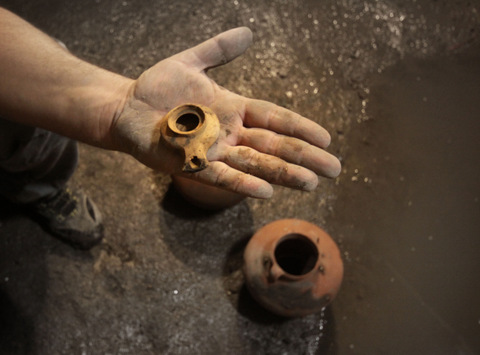
Three complete cooking pots and a small ceramic oil lamp were uncovered inside a small cistern in a drainage channel that runs from the Shiloah Pool in the City of David to Robinson’s Arch


Photograph of the finds in the cistern: Vladimir Naykhin.

The artifacts will be exhibited in a study conference on the City of David organized by the Megalim Institute, which will be held this coming Thursday, July 4, at Ramat Rahel

Recently a small cistern belonging to a building was exposed in an archaeological excavation the Israel Antiquities Authority is conducting near the Western Wall, in the vicinity of Robinson’s Arch in the Jerusalem Archaeological Park. Inside the cistern were three intact cooking pots and a small ceramic oil lamp that date to the time of the Great Revolt.
The vessels were discovered inside the drainage channel that was exposed in its entirety from the Shiloah Pool in the City of David to the beginning of Robinson’s Arch.

According to Eli Shukron, excavation director on behalf of the Israel Antiquities Authority, “This is the first time we are able to connect archaeological finds with the famine that occurred during the siege of Jerusalem at the time of the Great Revolt. The complete cooking pots and ceramic oil lamp indicate that the people went down into the cistern where they secretly ate the food that was contained in the pots, without anyone seeing them, and this is consistent with the account provided by Josephus”.

In his book The Jewish War Josephus describes the Roman siege of Jerusalem and in its wake the dire hunger that prevailed in the blockaded city.

In his dramatic description of the famine in Jerusalem he tells about the Jewish rebels who sought food in the homes of their fellow Jews in the city. These, Josephus said, concealed the food they possessed for fear it would be stolen by the rebels and they ate it in hidden places in their homes.

“As the famine grew worse, the frenzy of the partisans increased with it….For as nowhere was there corn to be seen, men broke into the houses and ransacked them. If they found some they maltreated the occupants for saying there was none; if they did not, they suspected them of having hidden it more carefully and tortured them.”
“Many secretly exchanged their possessions for one measure of corn-wheat if they happened to be rich, barley if they were poor. They shut themselves up in the darkest corners of the their houses, where some through extreme hunger ate their grain as it was, others made bread, necessity and fear being their only guides. Nowhere was a table laid…” (Josephus The Jewish War. Translated by G.A. Williamson 1959. P. 290).

The artifacts will be on display in a study conference on the City of David organized by the Megalim Institute which will take place this coming Thursday, July 4. For details about the conference visit the institute’s website at www.cityofdavid.org.il
That's quite a lot of narrative to get out of some pots in a cistern and an anecdote by Josephus, but maybe.

Thursday, June 27, 2013

Jacobus et al. (eds.), Studies on Magic and Divination in the Biblical World

NEW BOOK FROM GORGIAS PRESS:
Studies on Magic and Divination in the Biblical World
Edited by Helen R. Jacobus, Anne Katrine de Hemmer Gudme & Philippe Guillaume


Title: Studies on Magic and Divination in the Biblical World
Series: Biblical Intersections 11
Availability: In Print
Publisher: Gorgias Press

Availability: In Print
Publication Date: 5/2013
Language: English
Format: Hardback, Black, 6 x 9 in
Pages: 330

This collection of essays by participants in the Magic and Divination in the Biblical World research group of the European Association of Biblical Studies represents a wide ranging, analytical, and often unconventional approach to a relatively neglected area within Biblical Studies. These original articles by new and established scholars include Mesopotamian demonology, Akkadian literary influences, exorcism, healing, calendars, astrology, bibliomancy, dreams, ritual magic, priestly divination, prophecy, magic in the Christian Apocrypha and the New Testament, magic in rabbinic literature, and Jewish Aramaic magic bowls.
Follow the link for TOC etc. and ordering information. This and other Gorgias titles are 30% off until the end of this month. For you, special deal.

Forgotten Palmyra inscription

ROGER PEARSE: A Christian inscription from Palmyra dated 135 AD? Could be. Those two marks framing the last line certainly aren't text-speak kissy x's. I wonder what Larry Hurtado would say about them.

Cross-file under "Aramaic Watch." More on Palmyra and its inscriptions here and links.

When prophecy fails

MARK GOODACRE: The joy of failed predictions. Mark's track record for being ahead of the times with technology is exemplary, but he seems happy enough to have made one wrong call. It's nice of him also to flag one of my prophecies from the same era which seems to be holding up pretty well. That said, the mainstream media is still pretty resistant to correction, but I think we're even making slow progress on that front.

Wednesday, June 26, 2013

God in a cake box

A GROOM'S WEDDING CAKE: The Ark of the Covenant … in Cake Form!

What have the Romans ever done for us?

IAA PRESS RELEASE:
Greetings from the Roman Empire! A Section of an 1,800 Year Old Road was Exposed in Jerusalem (June 2013)

According to the excavation director on behalf of the Israel Antiquities Authority, “This is the first time we have encountered such a finely preserved section of the road in Jerusalem”.


Photographic credit: Assaf Peretz, courtesy of the Israel Antiquities Authority

An ancient road leading from Yafo to Jerusalem, which dates to the Roman period (second–fourth centuries CE), was exposed this past fortnight in the Beit Hanina neighborhood in northern Jerusalem. The road remains were revealed in an archaeological excavation the IAA conducted in Beit Hanina prior to the installation of a drainage pipe by the Moriah Company.

The wide road (c. 8 m) was bounded on both sides by curbstones. The road itself was built of large flat stones fitted to each other so as to create a comfortable surface for walking. Some of the pavers were very badly worn, indicating the extensive use that was made of the road, and over the years the road also underwent a series of repairs.

According to David Yeger, excavation director on behalf of the Israel Antiquities Authority, “Several segments of the road were previously excavated by research expeditions of the IAA, but such a finely preserved section of the road has not been discovered in the city of Jerusalem until now”.
“The Romans attached great importance to the roads in the empire. They invested large sums of money and utilized the most advanced technological aids of the period in order to crisscross the empire with roads. These served the government, military, economy and public by providing an efficient and safe means of passage. Way stations and roadside inns were built along the roads, as well fortresses in order to protect the travelers. The construction and maintenance of the roads was assigned to military units, but civilians also participated in the work as part of the compulsory labor imposed on them by the authorities.”

The road section discovered in the IAA excavations in Beit Hanina is part of the imperial network of roads that led to Jerusalem from the coastal plain. We know about these roads from both historical sources and archaeological excavations. Two main arteries led from Yafo to Jerusalem during the Roman period. One is the road that passes through Bet Horon and the other runs via Shaar HaGai. This particular segment belongs to the Bet Horon road. The road began in Yafo and passed through Lod where it split it two different directions: one to Shaar HaGai and the other by way of Modiin along the route of what is today Highway 443 to Bet Horon. From there the road continued eastward as far as Bir Nabala and turned south to Kefar Shmuel where it merged with the highlands road that led to the Old City of Jerusalem.

In some places we can see that the modern Bir Nabala road was paved just a few centimeters above the route of the ancient road, which indicates that until a few decades ago the ancient road in this region was visible and was used.

More on reviving Aramaic

ARAMAIC WATCH: The Ben Yehudas of Aramaic: The one-time lingua franca of the Fertile Crescent is spoken by only 400,000 people around the world today. But efforts are being made, especially in one village in the Galilee, to ensure that Aramaic does not go quietly into the night (Dorit Shilo, Haaretz).
Shady Khallul and his brother Amir have been working for years to revive the holy language of Aramaean Christians in Israel and to bring it back into everyday use. Their model, Shady says, is none other than Eliezer Ben Yehuda, father of the contemporary Hebrew language renaissance.

"If you, the Jews, were able to revive Hebrew and turn it into a modern language, why can't we?" he asks. "Last year we received permission from the Education Ministry to teach Aramaic in first and second grades at the school in Jish, and we had to draft a curriculum from scratch. Amir wrote the textbooks and I traveled around the world to buy dictionaries and grammar books so that we could translate and adapt them for use in Israel. I brought most of the teaching material from Sweden, and the dictionaries from France. Most Aramaic books today are printed in Lebanon, but we have no way of bringing them in from there."

Unlike biblical Aramaic, written in Hebrew letters, the modern dialect - the Western variant of which is called Syriac - is written in another ancient script, which resembles a melding of the Hebrew and Arabic alphabets. Like Hebrew, the language comprises 22 characters and is written right to left. Each of Aramaic's two principle dialects - Western and Eastern - has its own alphabet. Both, however, share a classical written alphabet, Estrangela, reserved for prayers and religious texts.

The challenge before the Aramaeans in Israel, who use the Western dialect, is twofold: On the one hand they must teach their children to speak the language and persuade them to use it in their everyday lives, with family, friends and at school, and on the other hand teach them to read and write in the two alphabets (the Western and the Estrangela).
More on the Maronite revival of Aramaic in Jish here and links.

The ever-present Temple

THIS WEEK'S DAF YOMI COLUMN BY ADAM KIRSCH IN TABLET: In the Talmud’s Timeless Laws, a Vast Temple of the Mind: Long after the Jerusalem Temple was destroyed, Talmudic rabbis kept it alive in their imaginations, and ours.
All of this is remarkable, not just for its attention to detail, but because of the way the rabbis of the Talmud think about the Temple. There is no acknowledgment, in the cases of the bandage, the wart, and the hinge, that these rules apply to a Temple that does not exist. At the time the Gemara was being composed, the Temple had been gone for three centuries; most of the sages of Babylonia had never even seen the spot where it stood. Yet they continued to legislate for the Temple, to reconcile their own rules with the Temple’s rules, as if it existed in the present tense.
Earlier Daf Yomi columns are noted here and links.

Tuesday, June 25, 2013

Michael Baigent, R.I.P.

MICHAEL BAIGENT HAS DIED:
Writer who sued over Da Vinci Code dies
Updated: 16:06, Tuesday June 25, 2013 (SkyNews.com.au)

New Zealand writer Michael Baigent, who gained attention for launching a lawsuit contending that The Da Vinci Code stole ideas from his own book, has died of a brain hemorrhage at age 65, his literary agent says.

Baigent is best-known for writing the 1982 non-fiction book The Holy Blood and the Holy Grail, which explores theories that Jesus married Mary Magdalene, the couple had a child and the bloodline survives.

In 2006 Baigent and co-author Richard Leigh made international headlines when they sued Dan Brown's publisher for copyright infringement, claiming that Brown 'appropriated the architecture' of their book in a high-profile London court case they eventually lost.

[...]
I followed the case back in the spring of 2006. See here, here, here, here, and here. Also note here.

Stec, The Geniza Psalms

NEW BOOK FROM BRILL:
The Genizah Psalms
A Study of MS 798 of the Antonin Collection. Cambridge Genizah Studies Series

David Stec

The Genizah Psalms (MS 798 of the Antonin Collection) is a Hebrew document of messianic character, apparently presenting itself as the work of David. It is taken by some to date to the time of the second temple, and to be approximately contemporary with some of the literature of Qumran, while others regard it as a medieval composition. From the point of view of a classical hebraist, David M. Stec explores how this text relates to classical Hebrew literature as a whole and considers how viable it is to regard it as a genuine constituent of that body of literature. He presents an edition of the Hebrew text and English translation, together with an introduction, commentary and analysis of language.
These psalms have been translated for the More Old Testament Pseudepigrapha Project by G. W. Lorein and E. van Staalduine-Sulman with the view that they are earlier rather than later.

Oh, and have I mentioned that the first volume of MOTP texts is due out in September: Old Testament Pseudepigrapha: More Noncanonical Scriptures? We're currently working on the page proofs.

Monday, June 24, 2013

BNTC 2013 one-week countdown

REGISTRATION FOR THE 2013 MEETING OF THE BRITISH NEW TESTAMENT CONFERENCE in St. Andrews (29-31 August) is still open and you can book online here.

Early-bird registration is open only until 30 June, i.e., this Sunday. After that the price goes up substantially, so why not register now? For you, special deal!

Congratulations to Matthew Goff

A HUMBOLT RESEACH FELLOWSHIP has been granted to Matthew Goff: Self-proclaimed Bible nerd studies scrolls: FSU associate professor Germany-bound to continue research on Dead Sea Scrolls. I look forward to seeing his work on the giants and the Nephilim.

Friday, June 21, 2013

Midsummer 2013

HAPPY SUMMER SOLSTICE to all those celebrating. For example, here.

Gnosticism

ASKING THE IMPORTANT QUESTIONS: Are Gnostics world-haters? (With the now obligatory Matrix and Inception references.)

Well, the Pope seems to think so. Me, I suppose it depends on what you mean by the world and by Gnosticism.

Related thoughts here and links.

Thursday, June 20, 2013

BNTC 2013 reminder

REGISTRATION FOR THE 2013 MEETING OF THE BRITISH NEW TESTAMENT CONFERENCE in St. Andrews (29-31 August) is still open and you can book online here.

Early-bird registration is open only until 30 June. After that the price goes up substantially, so why not register now? For you, special deal!

Magdalene opera performed

WORLD PREMIER: San Francisco's 'biblical CNN opera'. That is, The Gospel of Mary Magdalene, which was performed for the first time last night in San Francisco. From the review it seems that it draws both on biblical traditions and Gnostic traditions, both heavily and anachronistically updated to be palatable to a twenty-first century audience. I love it that the composer's name is Adamo.

Background here.

UPDATE (21 June): A review in the NYT: The Woman at Jesus’ Side, and in His Bed. Mark Adamo’s Opera Makes a Wife of Mary Magdalene. Excerpt:
That this new opera is such a disappointment is unfortunate because many elements of the project are admirable. ... Mr. Adamo was immersed in the project for more than six years. His reading of varying accounts of Jesus and Mary Magdalene, especially the Gnostic Gospels, led him to envision a kind of truth-based fantasia in which Mary Magdalene is not the reformed prostitute of disputed readings, but a sensual, independent and keenly intelligent woman. This Mary helps Jesus to understand the role of Eros in a godly life, as Mr. Adamo has explained in recent interviews.

He wrote his own libretto, an 86-page text that reads at times like a theological compendium complete with about 100 footnotes. Yet despite passages of affecting dialogue and poetic quotations from Gospels and Psalms, the libretto is long and wordy and sounds even more so in Mr. Adamo’s often ponderous musical setting.
Also, this is interesting:
“The Gospel of Mary Magdalene” has the misfortune of arriving on the heels of the John Adams’s oratorio “The Gospel According to the Other Mary,” which was given its premiere last year by the Los Angeles Philharmonic conducted by Gustavo Dudamel.
Another Magdalene musical composition by another Adam. Cosmic.

Wednesday, June 19, 2013

Hebrew class to study a DSS

COOL: OCU Hebrew students to study Dead Sea Scrolls (edmondsun.com).
OKLA. CITY — Students in a Biblical Hebrew class at Oklahoma City University will get a chance to study one of the Dead Sea Scrolls during the fall 2013 semester.

[...]

The students who will study the Dead Sea Scroll artifact previously have taken Biblical Hebrew I and II with Professor Wolfe. As a class, they will work to determine what part of the Bible is represented in a particular item and investigate what other known scrolls might be closely related to it. They will visit the scroll in person, and then later use special photographic records in class to do their work.

[...]

In praise of Carey Newman

BAYLOR: Carey Newman: How to Rescue a University Press.
When Carey Newman became director of Baylor University Press in 2003 it was teetering on the edge of extinction, as many university presses have in recent years. “I told the university it would take twenty-five years to build up the press,” says Newman. “Ten years to get one-third up the mountain and set up base camp. Ten years to get to the summit and five more to assault it.” A decade later, with net revenues “up 1,500%,” he is happy to state, “We are ahead of schedule.”

[...]
Dr. Newman was also a mover and shaker in the SBL Divine Mediator Figures in Antiquity Group in the 1990s and he and I organized and held an international conference at St. Andrews on the origins of the worship of Jesus in 1998.

Review of Ben-Yehuda, The Myth of Masada

BLAST FROM THE PAST: For some reason Bing has been reviving some old items, including one from a decade ago by Alex Joffe, a review of Nachman Ben-Yehuda, The Masada Myth: Collective Memory and Mythmaking in Israel: Sacrificing Truth: Archaeology and the Myth of Masada (The Middle East Quarterly). Excerpt:
If Ben-Yehuda is too severe in his standards, he does offer an important contribution to Israeli history. His detailed investigative approach, a vital contribution to developing the proper relationship between archaeology and society, should be emulated.
Somehow I missed that review at the time, but I noted others here.

Tuesday, June 18, 2013

Attention, volunteers from the Masada excavation!

ARCHAEOLOGIST AND PALEOJUDAICA READER DAVID STACEY E-MAILS:
Jim - With the 50th anniversary approaching, Eretz magazine - a popular though serious English Language Israeli journal dedicated to the history, archaeology and geography of Israel - is going to produce a Masada 50th special edition. I have been asked to contribute an article from the volunteers perspective - I was there for all but the first fortnight of the second season. I am having great difficulty locating surviving international volunteers particularly those who did not continue in archaeology. Should there be any ex Masada volunteers reading your blog, who would like to share their anecdotes, I would be grateful if they would contact me david.stacey63@ntlworld.com
Background here.

The ocean of Talmud

THIS WEEK'S DAF YOMI COLUMN BY ADAM KIRSCH IN TABLET: How the Talmud Maps Behavior by Exploring Definitions, Not Listing Rules: Daf Yomi: The rabbis examined practical dimensions of deep questions, including those raised around saliva, urine, and sex.
This week’s Daf Yomi reading was a wonderful example of the range of the Talmud’s concerns, and the twisting paths that connect them. What starts out as a discussion of the laws of tefillin becomes an examination of the biology of urination and spitting, which is really a debate on the definition of substances and objects. Finally the rabbis turn to questions of sex, marriage, and the status of women, in which the notion of original sin and its punishment is refined in very unexpected ways. Chapter 10 of Tractate Eruvin is all by itself a good argument for the idea that the Talmud is not just a book but an ocean.
UPDATE: Almost forgot, earlier Daf Yomi columns are noted here and links.

SOTS Booklist 2013

IN THE MAIL:
Deborah W. Rook (ed.) with Holly Morse, Society for Old Testament Study Book List 2013 (London: Sage, 2013)

Monday, June 17, 2013

The Other Old Testament

OLD TESTAMENT PSEUDEPIGRAPHA WATCH: The Other Old Testament (Philip Jenkins). Excerpt:
Although Barnabas is notionally quoting the Exodus story, his citation has precious little in common with the original. He has moreover added a whole eschatological and messianic dimension that absolutely is not in the original. Although he might be inventing these words himself, it is also likely that he is transmitting a whole tradition of Christian midrash on the original Biblical texts.

Christians also drew on the pseudepigrapha, the works attributed to great figures of the Old Testament, to Abraham, Moses or Ezra. Many such works had originated from Second Temple Judaism, but Christian editors soon revised them to their own purposes.
And they wrote a few themselves, very likely more than are immediately obvious.

Reflections on Tisha B’Av

AMBIVALENCE: Tisha B’Av in the 21st century (Binyamin Kagedan, JNS.org). Excerpt:
How could Tisha B’av, traditionally one of the most intense and salient religious experiences of the year, be wholly foreign to a large portion of American Jewry? Surely it cannot simply come down to the fact that most people are averse to fasting—if that were the case, how could we explain the ongoing popularity of Yom Kippur?

The actual answer revolves around the traditional thematic elements of the fast. The narrative of Tisha B’Av centers on the destruction of the holy temple in Jerusalem, a national calamity that marked the end of Jewish sovereignty in ancient Israel and the official onset of the long Jewish diaspora. The day’s liturgy mourns the disappearance of high priests and animal sacrifices, and woven into its eulogizing is the wish for a return to these original forms or worship.

Masada announcement anniversary

JUNE 15, 1954: Remains of King Herod’s Palace Discovered in Israel.

Saturday, June 15, 2013

Psalms of Solomon Conference

OLD TESTAMENT PSEUDEPIGRAPHA WATCH: The First International Meeting on the Psalms of Solomon (University of Strasbourg, 17-18 June 2013). Follow the link for the program.

Thursday, June 13, 2013

Alter's Dtr

ROBERT ALTER has published the latest installment of his translation of the Bible: the Deuteronomistic History. Adam Kirsh has a review in Tablet: Robert Alter Wants Us To Think More Seriously About the Bible as Literature: The scholar, critic, and masterful translator remains dedicated to uncovering the full subtlety and intelligence of the stories in sacred texts. Excerpt:
Reading the Bible in Robert Alter’s translation helps to bring such moments of literary and human power into focus—thanks not just to his clear and elegant translation, but to the comprehensive notes that pinpoint exactly what is happening at crucial moments in the text. Ancient Israel is a perfect opportunity to return to these foundational Jewish stories and see them with fresh eyes—and what you find there may surprise you.
Posts on earlier sections of Alter's Bible translation are here, here, here, here, here, here, here, here, here, and here and follow the links back.

Job in Hebrew Bible and Ancient Judaism

OPENING AT INDIANA UNIVERSITY:
Assistant Professor, Department of Religious Studies

Institution:
Indiana University

Posted:
June 10, 2013

Location:
Indiana

Employment Level:
Tenured, tenure track

Category:
Religion

Employment Status:
Full-time

Religious Studies: Assistant Professor, Department of Religious Studies- Bloomington, IN. Teach, research, and serve in Hebrew Bible and Ancient Judaism for the Department of Religious Studies. Req. PhD in Hebrew Bible/ Ancient Judaism. Applicants should email a letter of application and current resume to the Department Chair, Religious Studies, Indiana University, Prof. Winnifred Sullivan, . Indiana University is an equal employment opportunity/equal access/affirmative action employer and a provider of ADA services.
Follow the link to apply. HT James McGrath.

Wait, I thought they didn't know Aramaic!

ARAMAIC WATCH: An angel sings in Arabic … and Aramaic.
The young and beautiful Lebanese diva, Abeer Nehme, is blessed with the voice of an angel and a natural charm that occasionally borders on shyness. Abeer is totally endearing and she had the audience spellbound from the moment she stepped on stage. Her programme was rooted in the religious traditions of the Middle East. She sang in Arabic, Syriac and Aramaic and she explained in French how each language has its own musical notation. At times the musical tone was set by the Middle eastern kanoun – a type of zither – and at times by an electric organ that gave me a strangely displaced sensation – it sounded more like being in church than being in Fes.
She does have a lovely voice.

Wednesday, June 12, 2013

More on that pulled BBC documentary

POLITICS: BBC Director General faces claims that political pressure led BBC to drop film on 'Jewish exile' (Middle East Monitor).
Six leading pro-Palestinian organisations have written to the BBC's Director General asking for answers over the pulling of a documentary which claims that the mass Jewish exodus from Jerusalem in 70 AD may never have happened.

The documentary, Jerusalem: An Archaeological Mystery Story, was due to be shown on BBC Four, but disappeared from the schedule at the last minute, leaving viewers confused.

Its director, Ilan Ziv, has accused the BBC of bowing to political pressure in its decision to suddenly remove a film which it had been promoting widely.

[...]
As near as I can figure out, the issue here is that the documentary "theorizes that many Jews did not leave Jerusalem after the destruction of the Temple, and that many modern-day Palestinians may be in part descended from those Jews." (From a JTA article noted here). Presumably this notion (I am not ready to call it a "theory") coheres with the Palestinian narrative and thus the protests from Palestinian groups over the documentary not being aired. But it is still not clear to me exactly why the BBC pulled the show in the first place. Follow the last link for earlier coverage of the story and more comments from me.

Merkabah Rider

A WESTERN-HORROR NOVEL ABOUT A BADASS JEWISH MYSTIC: Merkabah Rider: Tales of a High Planes Drifter.

Monday, June 10, 2013

Apocryphal posts

APOCRYPHA WATCH: You’re reading the wrong Book of Esther (Joel J. Miller).

And, related, Philip Jenkins has a blog post up on how Protestants came to lose the Apocrypha.

Imagining an Aramaic "voice"

ARAMAIC WATCH: Novelist Janice Weizman is Thinking in Aramaic, Writing in English. And it isn't easy.

St. Ephrem

SYRIAC WATCH: Yesterday was the Feast Day of St. Ephrem the Syrian.

ABC Radio on Vermes

AN AUSTRALIAN RADIO PROGRAM ON THE LATE GEZA VERMES: The Dead Sea Scrolls and Jesus: the life work of Geza Vermes.

Background here and links.

Berko Park

TRAVEL PIECE: Berko Park, aka ancient Tiberias: King Herod Antipas unwittingly built Tiberias directly over a Jewish cemetery. Luckily, some 130 years later, Rabbi Shimon Bar Yohai decided to purify the place (Aviva and Shmuel Bar-Am, Times of Israel).

Here's an old post on the Tiberias excavation and here's another that involves that cemetery in Tiberias (see the update). And, of course, there is much more on Rabbi Shimon Bar Yochai and other legends about him here and links.

Sunday, June 09, 2013

Manuscripts

ASKING THE IMPORTANT QUESTIONS: Where to find ancient manuscripts? (Peter Head, ETC).

The answer seems obvious, but we keep managing to be surprised by it.

Thursday, June 06, 2013

The DSS and the IRS

SOME LITTLE-KNOWN DEAD SEA SCROLLS LITIGATION: A Bit Of Ancient History Dead Sea Scrolls In Tax Court (Peter J Reilly, Forbes).
In the future, planners would use the non-recognition of sales to grantor trust to great advantage in estate planning. Here it amounted to an income tax disaster.

Latest on tomb of R. Shimon bar Yochai

CONSTRUCTION: Bar Yochai Tomb in Meron Gets New Access Road (Arutz Sheva). Background on Rabbi Shimon Bar Yochai and his tomb is here and links.

Girls studying Talmud

EDUCATION IN ISRAEL: Talmud studies to be offered to girls too: Education minister instructs state-religious schools in which half of parents wants daughters to study ancient rabbinic writings – to allow them to do so (Telem Yahav, Ynetnews.com).

Wednesday, June 05, 2013

Update on Davila's forthcoming books

GOOD NEWS about both of my imminently forthcoming books.

First, the final editing process for my translation of the Hekhalot literature is completed and the book has gone to the printer. It should be out, published by Brill, early next month.
Hekhalot Literature in Translation
Major Texts of Merkavah Mysticism


James Davila

The Hekhalot literature is a motley collection of textually fluid and often textually corrupt documents in Hebrew and Aramaic which deal with mystical themes pertaining especially to God's throne-chariot (the Merkavah). They were composed between late antiquity and the early Middle Ages, with roots in earlier traditions and a long and complex subsequent history of transmission.

This volume presents English translations of eclectic critical texts, with a full apparatus of variants, of most of the major Hekhalot documents: Hekhalot Rabbati; Sar Torah; Hekhalot Zutarti; Ma'aseh Merkavah; Merkavah Rabba; briefer macroforms: The Chapter of R. Nehuniah ben HaQanah, The Great Seal-Fearsome Crown, Sar Panim, The Ascent of Elijah ben Avuyah, and The Youth; and the Hekhalot fragments from the Cairo Geniza.
Second, I have just received the page proofs for Old Testament Pseudepigrapha: More Noncanonical Scriptures, Volume 1, the firstfruits of The More Old Testament Pseudepigrapha Project. (If you are a contributor, the proofs for your contribution should be arriving soon.) The book should be out, published by Eerdmans, by the end of September at the latest.
Old Testament Pseudepigrapha
More Noncanonical Scriptures, Volume 1


Richard Bauckham
James R. Davila
Alexander Panayotov

HARDCOVER; Coming Soon: 9/30/2013
ISBN: 978-0-8028-2739-5
Available for Backorder
Price: $ 90.00

DESCRIPTION
Old Testament Pseudepigrapha (OTP) (Volume 1) stands among the most important publications in biblical studies over the past twenty-five years.

Intended to complement James Charlesworth's Old Testament Pseudepigrapha, this new two-volume collection adds a great many previously unpublished or newly translated texts. Providing the reader with virtually all known surviving pseudepigrapha written before the rise of Islam, OTP presents the sacred legends and spiritual reflections of numerous works that were lost, neglected, or suppressed for many centuries, with authoritative yet accessible introductions to each text.
You can preorder the latter with Amazon at a substantial discount. For you, special deal!

New book: Shaked et al., Aramaic Bowl Spells

FORTHCOMING FROM BRILL:
Aramaic Bowl Spells
Jewish Babylonian Aramaic Bowls Volume One


Shaul Shaked, J.N. Ford, and Siam Bhayro with contributions from Matthew Morgenstern and Naama Vilozny

The corpus of Aramaic incantation bowls from Sasanian Mesopotamia is perhaps the most important source we have for studying the everyday beliefs and practices of the Jewish, Christian, Mandaean, Manichaean, Zoroastrian and Pagan communities on the eve of the Islamic conquests. The bowls are from the Schøyen Collection, which has some 650 texts in different varieties of Aramaic: Jewish Aramaic, Mandaic and Syriac, and forms the largest collection of its kind anywhere in the world. This volume presents editions of sixty-four Jewish Aramaic incantation bowls, with accompanying introductions, translations, philological notes, photographs and indices. The themes covered include the magical divorce and the accounts of the wonder-working sages Ḥanina ben Dosa and Joshua bar Peraḥia. It is the first of a multi-volume project that aims to publish the entire Schøyen Collection of Aramaic incantation bowls.

More on that First-Temple-era column near Jerusalem

MATTI FREIDMAN: Despite secrecy, interest builds around mysterious First Temple find outside Bethlehem: A 2,800-year-old pillar discovered by a tour guide under a Palestinian orchard points to major construction dating from Biblical times. So why isn’t it being excavated? (The Times of Israel). Excerpt:
Early this month, several prominent Israeli archaeologists were brought to inspect the site. Among them was Yosef Garfinkel, an archaeology professor from Hebrew University.

There is no doubt the remains are those of monumental construction from the time of the First Temple, Garfinkel said.

The top of the pillar, known as a capital, is of a type known as proto-aeolic, he said. That style dates to around 2,800 years ago.
Another view of the recently discovered pillar (Courtesy of Binyamin Tropper/Kfar Etzion Field School)

Another view of the recently discovered pillar (Courtesy of Binyamin Tropper/Kfar Etzion Field School)

The pillar marks the entrance to a carved water tunnel reaching 250 yards underground, he said, complex construction that would almost certainly have been carried out by a central government. At the time, the area was ruled by Judean kings in nearby Jerusalem.

In its scale and workmanship, Garfinkel said, the tunnel evokes another grand water project of First Temple times — the Siloam Tunnel in Jerusalem, now underneath the modern-day Arab neighborhood of Silwan. That project is believed to have been undertaken by the biblical king Hezekiah to channel water into the city ahead of an Assyrian siege in the 8th century BCE, according to an account in the biblical Book of Kings.

The existence of a large water tunnel at the new site suggests the presence nearby of a large farm or palace, Garfinkel said.

“The construction is first-rate,” he said. “There is definitely something important there from biblical times, the 9th or 8th centuries BCE.”
So according to Professor Garfinkel the architecture dates to the late Iron Age II but, contrary to the earlier reports, not to the Davidic or Solomonic eras. And it has parallels to the Siloam Tunnel. Wouldn't it be nice if it also had a dedication inscription in Hebrew, like the Siloam Tunnel?

(HT Dorothy Lobel King.)

Tuesday, June 04, 2013

Mapping the Jewish Communities of the Byzantine Empire

PROJECT WEBSITE: Mapping the Jewish Communities of the Byzantine Empire (Cambridge University). About:
The aim of the project is to map the Jewish presence in the Byzantine empire using GIS (Geographical Information Systems).

All information (published and unpublished) about the Jewish communities will be gathered and collated.

The data will be incorporated in a GIS which will be made freely available to the general public on the world-wide-web. [Now linked above - JRD.]

Researchers and members of the public will be able to create maps according to their own specifications.

Chronologically, the project will begin in 650. This is soon after the Arab conquest of Egypt, Palestine and Syria when these regions, with their substantial Jewish populations, were permanently separated from the Byzantine empire. The end-date is fixed by the arrival in the region of large numbers of Jewish immigrants from Spain in 1492.

Geographically, the core areas of Asia Minor, the southern Balkans and the adjacent islands including Crete and Cyprus will be included for the entirety of the period, Byzantine Italy however, will only be covered down to the Norman conquest. Some smaller territories that were only briefly under Byzantine rule may be excluded.
(HT Alexander Panayotov, one of the project's researchers.)

Kahle conference

CONFERENCE ANNOUNCEMENT, sent in by Corrado Martone:
Archives of the Orient: International conference on Paul Ernst Kahle
April 10-11, 2014
Turin
On the occasion of the completion of the KADMOS project (Kahle Documents Management, Organization and Study) and the 50th anniversary of Paul Ernst Kahle’s death, the University of Turin, Dipartimento di Studi Umanistici, is pleased to announce the conference “Archives of the Orient: International conference on Paul Ernst Kahle” that is scheduled for April 10th and 11th 2014 in Turin.

The KADMOS project (2010-2013), realized with the contribution of Regione Piemonte, has allowed a series of activities on the archive, that is part of the Paul Kahle Fonds, aiming at making it available for research to the international scientific community.

The conference will present the project and the goals achieved so far and intends to deepen the knowledge of the research fields addressed and investigated by Paul Ernst Kahle. Aim of the conference is to bring together academicians and scholars from various academic fields related to Oriental studies, in a cross-disciplinary panorama which mirrors Kahle’s manifold research interests, as well as archivists, curators and other professionals who work on research archives.

Papers are invited on subjects relating to the figure, researches and archive of Paul Ernst Kahle in the widest sense; topics include, but are not confined to the following:

- Intellectual milieu and historical context in which the activity of Paul Kahle took place, in Germany, England, and Egypt
- Colleagues or scholars who worked or corresponded with Paul Ernst Kahle
- History and fortune of Paul Kahle’s publications and scientific work
- Islamic studies, Arabic dialectology
- Bible, Jewish studies, Hebrew and Aramaic
- Archival aspects: experiences from archives that can be related to or compared with the Paul Kahle Fonds.

Proposals must always highlight the connection of the proposed subject with Paul Ernst Kahle or the relevance for the management and enhancement of the Paul Kahle Fonds.

Papers should be 20-25 minutes in length with 5-10 minutes for questions and discussion. The language of the conference is English.

The proposal must include:

- Paper title
- Author/s name/s and institutional affiliations
- Abstract (between 350 and 500 words) - Author/s short biography

Proposal must be submitted on the following website:

www.congressiefiere.com, (link on the page “congressi e corsi”)

The deadline for submission of proposal is November 30, 2013; papers acceptance will be notified to authors by the end of January 2014.

Conference proceedings will be published: authors will be asked to provide the full text of their paper before the conference.

For further questions about submissions or to be kept updated on latest news please feel free to contact the organizing secretariat – Centro Congressi Internazionale
info@congressiefiere.com ph.
+39 011 2446911
telefax +39 011 2446950

For more informations about the project and the Paul Kahle Fonds visit our website:
www.paulkahle.unito.it

4Q180-4Q181 it is.

ALEXEY YUDITSKY, one of the researchers involved, has emailed me the following:
The article in Haaretz indeed talks about 4Q180-4Q181. The research was presented in the Orion Center of Hebrew University, see orion.mscc.huji.ac.il/orion/activities/picture/seminar_18-4-13.doc
The improved photo may be found here
http://www.deadseascrolls.org.il/explore-the-archive/image/B-295795
The English notice of the lecture is here [bad link now fixed!].

Background here (immediately preceding post).

Monday, June 03, 2013

A new reading in the DSS

Scholars owe new Dead Sea Scrolls reading to Google:Why was Canaan really exiled? A website featuring ultra-high resolution photographs of the Dead Sea Scrolls brings hidden letters to light for the first time (Nir Hasson, Haaretz). Excerpt:
Prof. Elisha Qimron had been working on the final stages of the second volume of the new edition of the Hebrew writings of the Dead Sea Scrolls when a particular fragment of a Dead Sea Scroll had been posted on the joint website of Google and the Israel Antiquities Authority − the Leon Levy Dead Sea Scrolls Digital Library website.

The website features very high resolution photographs of the Dead Sea Scrolls using a special camera, which not only records the condition of the actual scrolls to help preserve them, but also brings to light for the first time faded and hidden letters.

[...]

The word “El” appears close to the phrase “tent of Shem,” and might indicate that the intent was to “Hashem” as a synonym for God. By comparing this text with another of the Dead Sea Scrolls, the scholars have come up with another interpretation. The scholars believe that the word “tent” can be interpreted as “land,” and that the text may mean that Hashem ‏(God‏) lives in the “land of Shem.” Thus, Canaan invaded a land that was not his, and that was the reason his descendants were exiled, not because of his father’s sin.

This interpretation is also known from the Apocryphal Book of Jubilees, which survived in the Ethiopian sacred language of Gez and in Greek. There, it also states that Canaan’s sin was in taking the land in a manner different than the way Noah had intended to divide it, ignoring his brothers’ warning not to do so. “Whoever wrote this text knew this interpretation from the Book of Jubilees,” Ariel said. The conclusion is that this alternative tradition to the biblical version was common in the Judean Desert in Second Temple times and later disappeared.

[...]
Disappointingly, the article does not say which Qumran fragment this is. I have seen some speculation on Facebook, but nothing I find persuasive yet.

For more on the Google/Israel Museum Digital Dead Sea Scrolls Project and its efforts to recover lost text on the Scrolls, see here and links.

Bit by bit, a letter at at time, whatever it takes. Until we're done. I've been saying that a lot lately, which I take to be a good sign.

UPDATE: A number of people are suggesting that the text is 4Q180. I don't have time to verify for myself.

UPDATE (4 June): Confirmed: it is 4Q180-4Q181.

Book reviews

BOOK REVIEWS ARE NOW AVAILABLE AT: THE ENOCH SEMINAR ONLINE.

Saturday, June 01, 2013

Justin Martyr

TODAY IS THE FEAST DAY OF ST. JUSTIN MARTYR, a second-century Christian apologist. His Dialogue with Trypho (a probably-fictional Jewish character) gives us what seems to be, in a roundabout way, some interesting information on Jews and Judaism just after the Bar Kokhba Revolt.

Friday, May 31, 2013

Mosaics top 10

HAARETZ: Top 10 Israeli ancient mosaic discoveries: A fantastic ancient floor found in the Negev is just the latest in a series of discoveries throughout the country.

PaleoJudaica has posted much coverage of ancient mosaics in Israel over the years. I have listed below all mosaic posts I could find in a reasonable amount of time, and I don't think I missed many. If there are links, follow them, often for much more information.

Finally, outside of Israel, but still Jewish:

Melkite Syriac script

JUST SO YOU KNOW: Adam McCollum has some examples of Melkite Syriac script.

Cross-file under "Aramaic Watch."

Review of Wecker, The Golem and the Jinni

GOLEM WATCH: Strong fiction debut pairs immigrant Golem, Jinni (Joel Boyce, Winnipeg Free Press).
New YORK, 1899. Another boatload of those teeming masses is about to arrive at Ellis Island, among them a solemn, statuesque woman from Danzig.

Caught without a ticket, she leaps off the ship and sinks like a stone, only to walk out onto the banks of the Lower East Side, hours later and miles away. Golem, of course, cannot swim.

Meanwhile, in Little Syria, a tinsmith is labouring over a dented antique oil lamp. Erasing a portion of the ancient script, he is nearly knocked out by the explosive release of an imprisoned desert spirit.

Trapped in human form, the fiery being, whose true name can only be spoken by the wind, is equally surprised by where he's ended up.

These are the opening chapters of American Helene Wecker's literary debut, and they're doozies. Perhaps the most famous beast of Jewish folklore is paired with a creature right out of The Arabian Nights. And they're re-imagined as developed, human-like characters.

[...]
An earlier review and more golem links are here.

Thursday, May 30, 2013

Hey, another geniza!

Antique Lands: The Dome of the Treasury and Genizah of the Umayyad Mosque, Damascus (Adam Blitz, Times of Israel Blog). Excerpts:
Paradoxically it was the lure of Christianity’s sacred writings, which were exempt from the scribal conventions mentioned above, that first drew attention to the Qubbat al Khansa’s genizah. Damascus tradition had long asserted that the structure held guard of the Christian past and that the building was never to be opened except by order of the Sultan. In 1898 by appeal to latter, and in the presence of Kaiser Wilhelm the Second and the New Testament scholar Freiherr (Baron) Hermann von Soden [1852-1914], tradition was defied.

[...]

Von Soden dreamt of another ancient book that could rival Codex Sinaiticus, both in its antiquity and completeness. Back in Germany he secured funding from a Fraulein E. Koenigs to review the Damascus documents with which he had only the most fleeting of acquaintance. On behalf of von Soden Dr. Bruno Violet was sent to Damascus in 1901. He was enlisted to enter the Qubbat al Khanza where he would explore its contents.

[...]

By all accounts Violet’s initial survey was a disappointment. In excess of 150 sacs were retrieved from the building. None of the works von Soden had hoped to locate was forthcoming. The texts, we are told, were in a “fragmentary condition: some were eaten by mice, others were perforated by bookworms, and all were torn or mutilated.” Most of the documents were of the Qur’an or vestiges of Arabic and Turkish literature. After a wearisome nine months Violet reported that he had not found any material of significance. Yet, once the items were brought to Germany and deposited in the Staatsbibliothek (State Library) of Berlin, Violet had cause to revise his opinion. The richness of the genizah now became apparent.

Under its leaden dome the Qubbat al Khansa had stored a world of literature. The body of languages included Greek, Latin, Hebrew, Aramaic, Arabic, Coptic, Georgian, Armenian and Old French. The earliest texts were in Greek and were written between the 4th and 10th Century. Thereafter Arabic became the language of choice for local Christians as Violet’s analysis of Psalm 78, the bi-lingual Greek and Graeco-Arabic (Arabic in Greek script), was to show.

Of the early manuscripts the Qubbat al Khansa could boast: three sheets from a 4th Century version of the Song of Songs, a 4th-5th Century fragment of Paul’s Letter to the Galatians, remnants of a 5th Century Book of Proverbs, a 5th Century scrap of Judith as well as a 6th Century portion of The Book of Esther. And if von Soden’s much sought-after codex did not materialise, the genizah did yield several leaves of a 7th and 8th Century parchment of the Gospel of Mark and Gospel of John.

[...]

At the very least the genizah of Qubbat al Khansa can claim a rightful place within the field of Genizah Studies and should merit a reassessment (however difficult). The existing research is far-flung and disparate. With the exception of recent Italian scholarship, little attempt has been made to consolidate the breadth of the scholarly (secondary) literature. There is also the question of the manuscripts themselves: the status of the corpus is unknown. The National Museum of Damascus does retain several of the Islamic texts. But of the myriad of documents returned to Syria from Berlin in 1909, proof still awaits.
Repartriation of antiquities can be a difficult judgment call, but in this case getting these manuscripts out of the Berlin Staatsbibliothek may have saved them from destruction during World War II. Or not. Who knows? In any case, with the current conflict in Syria one can only hope that they are still okay, that they won't be damaged or destroyed during the war, and that they can be recovered and studied someday.

I'm not sure why "lower criticism" is taken to task in this article. Textual study and philology are what drives interest in such matters, and attention to "broader interests" tends to come only after the philologists have done the exacting work of reconstructing and deciphering the texts. If this geniza has been neglected, it may just be because there haven't been enough philologists to go around.

But in any case, this new attention to the genizah of the Qubbat al Khansa is very welcome indeed and I hope it helps to generate interest in working what we still have of the collection and to tracking down the rest in due course.

World's-oldest-Torah-scroll latest

Hebrew profs weigh in on important 12th century find: The oldest complete Torah scroll is discovered in an Italian university library after being mistakenly catalogued in 1889 (By Nicole Winfield, Times of Israel). Excerpt:
Outside experts said the finding was important, even though older Hebrew bibles do exist.

“It is fairly big news,” said James Aiken, a lecturer in Hebrew and Old Testament studies at Cambridge University. “Hebrew scholars get excited by very small things, but it certainly is important and clearly looks like a very beautiful scroll.”

‘Hebrew scholars get excited by very small things, but it certainly is important and clearly looks like a very beautiful scroll’

However, Giovanni Garbini, a leading expert on ancient Semitic languages and retired professor at Rome’s La Sapienza university, said the discovery doesn’t change much about what the world knows about Hebrew manuscripts.

“It’s an example of an ancient scroll, but from the point of view of knowledge, it doesn’t change anything,” he said in a telephone interview.

But Stephen Phann, acting president of the University of the Holy Land in Jerusalem and an expert in ancient Jewish manuscripts, said if accurately dated, the scroll is a rare and important find. “We don’t have anything much from that period,” Phann said.

There are far older scraps of Torah scrolls that can be dated back to the 8th century, but Phann said it was rare to find a complete manuscript.

The find was also emotionally important, he said because the scroll, as opposed to a bound book, is used for reading Torah portions throughout the year in synagogue.

“It’s almost a friendship — that they have come to know the Torah scroll in their midst, and they draw their knowledge and focus on worship on how they live their daily life,” Phann said.

Perani said it remains a mystery how the scroll came to be part of the Bologna university library but that he anticipated further study would now begin.
Bring it on!

Background here.

Nephilim

ASKING THE IMPORTANT QUESTIONS: How do the Nephilim fit our theology today?

"Living Nephilim-free - that's our challenge today."

Amen.

More on Slavonic Alphabet Day

JUST GO WILD: Celebrating Slavic alphabet and culture. The ‘Slavic Bazaar’ festival to mark the day of Slavic writing and culture was held at the Russian Centre of Science and Culture (RCSC) on May 24. Organised jointly by the Institute of Russian Language and the Centre of Russian Language Teachers Training, the event was aimed at commemorating the 1150th anniversary of the Slavic alphabet.

Background here and links.

Wednesday, May 29, 2013

World's oldest Torah Scroll?

THE BBC:
World's oldest Torah' scroll found at Italy university
Torah scroll found in University of Bologna library This Torah scroll may be more than 850 years old


The University of Bologna in Italy has found what it says may be the oldest complete scroll of Judaism's most important text, the Torah.


The scroll was in the university library but had been mislabelled, a professor at the university says.

It was previously thought the scroll was no more that a few hundred years old.

However, after carbon dating tests, the university has said the text may have been written more than 850 years ago.

[...]
This is a very interesting story, but at the same time I am skeptical. Normally manuscripts of this age are dated by paleography (the shapes of the letters) and other factors such as orthography (spelling) and the physical layout of the manuscript. The article does not indicate what the range of possible dates are for the carbon dating: 850 years would at best be only an average figure. Moreover, an object such as a complete manuscript has often been moved around a lot and could have had ample opportunity to become contaminated. The script and physical features are mentioned, but they are the key factors and I want to know more about them.

Nevertheless, unlike the story about this supposedly oldest copy of the Pentateuch, this one seems to have some merit. At minimum, it sounds as though a rather old complete Torah scroll has been newly identified, and this is a very good thing, whether or not it turns out to be the oldest one extant. And, of course, the issue is that it is a complete copy. Fragments of the Pentateuch from the Cairo Geniza (see, e.g., here) are centuries older than this, and fragments from the Dead Sea Scrolls (see, e.g., here) are well over a millennium older.

UPDATE: I should have also explicitly noted (as reader Robert Labanti emailed with the following two links to remind me) that this is a Torah scroll and that there are older codices (i.e., in bound book format) of the Torah, such as the famed Aleppo Codex (incomplete) and the Leningrad Codex (complete). Cf. Jared Calaway: Really Old Torah Scroll at University of Bologna. Also, Bart Ehrman quotes a press release that addresses some of my concerns: Exciting Discovery of a Hebrew Bible Scroll. It sounds as though the carbon dating was ancillary to the paleographic etc. analysis, which is as it should be.

Talmud study in D.C.

TUESDAY NIGHT IS TALMUD NIGHT IN WASHINGTON, D.C.

More Temple Mount construction woes

TEMPLE MOUNT WATCH:
Western Wall project threatens history, archaeologists warn
Antiquities authority counters: Construction is done according to protocol and with proper preservation work


By Aaron Kalman May 28, 2013, 4:40 pm 1 (Times of Israel)

Archaeologists expressed deep concern over construction and renovation works at the Western Wall enclosure in Jerusalem’s Old City, Maariv reported Tuesday. The work, they said, would greatly damage artifacts under the plaza floor, which would be lost forever.

The Israel Antiquities Authority said in response that extensive preservation work was being conducted at the site.

The ongoing project, which was given the green light in 2009, looks to build a new visitors’ center, expand the public restrooms and add an additional floor to the existing plaza.

[...]
Recent tangentially-related post here.

YU DSS Seminar

YESHIVA UNIVERSITY: Top Scholars Present their Work at YU’s Dead Sea Scrolls Conference.

Background here.

Tuesday, May 28, 2013

DSS workshop in Groningen

QUMRAN INSTITUTE:
June 18th 2013: "Caves and Collections"

2nd Groningen - Leuven encounter on the Dead Sea Scrolls


After our successful pioneering meeting last year, we are now pleased to invite you to join the second meeting of the Groningen – Leuven network of the Dead Sea Scrolls. This will take place on June 18th in Groningen, the Netherlands. These meetings are intended in the first place as informal gatherings. Our main aim is to foster scholarly collaboration, and to discuss recent developments in the field. The meetings are intended for both experienced and beginning scholars, but we also welcome graduate students working on the Scrolls or related literature.

The theme of our next meeting is “caves and collections” by which we aim at deepening our understanding of the classification addressed in our meeting last 2012. ...
Follow the link for details.

Sorting the Cairo Geniza

TECHNOLOGY WATCH:
Computer Network Piecing Together a Jigsaw of Jewish Lore

By JODI RUDOREN (NYT)
Published: May 26, 2013

TEL AVIV — One scholar likened it to finding the orphaned socks for generations of a family. Another compared it to law-enforcement’s use of DNA databases and face-recognition software.

The idea is to harness technology to help reassemble more than 100,000 document fragments collected across 1,000 years that reveal details of Jewish life along the Mediterranean, including marriage, medicine and mysticism. For decades, scholars relied mainly on memory to match up pieces of the Cairo genizah, a treasure trove of papers that include works by the rabbinical scholar Maimonides, parts of Torah scrolls and prayer books, reams of poetry and personal letters, contracts, and court documents, even recipes (there is a particularly vile one for honey-wine).

Now, for the first time, a sophisticated artificial intelligence program running on a powerful computer network is conducting 4.5 trillion calculations per second to vastly narrow down the possibilities.

[...]
Not so long ago 4-terabyte-per-second computing speeds were science fiction.

This project is extraordinarily important and (as the first video linked below notes) could advance the field of Cairo Geniza studies by a generation in a matter of weeks. Fragments from collections all over the world can be compared (mainly by handwriting and fragment shape) and sorted preliminarily into individual manuscripts.

Two other articles have brief videos about the project: Arutz Sheva: High-Tech Solution to Judaism's 'Mystery of the Century'; Your Jewish News: Computer system to reconstruct 100,000 ancient Jewish documents found in Egypt.

Bit by bit, a letter at a time, whatever it takes. Until we're done.

Much more on the Cario Geniza here, here, here, here and links. More on this particular digitization project is here and links. And for other manuscript digitization projects, go here and follow the many links.

Monday, May 27, 2013

Reviewlet of Bloom, The Roman-Judaeo War of 66-74 A.D.

THE STRATEGY PAGE has a brief review by A. A. Nofi of The Roman-Judaeo War of 66-74 A.D.: A Military Analysis, by James Bloom.

WaPo correction

TEMPLE MOUNT WATCH: Kudos to the Washington Post for correcting two errors in an article that involved the ancient Jewish Temples. Naturally, I want to nuance what they say even further, but they're doing pretty well here. I pick on the media a lot when they get it wrong, so it's only fair to note instances in which they are trying hard to get it right.

Day of Slavonic Alphabet

HAPPY (BELATED) DAY OF SLAVONIC ALPHABET (24 May). This is a special anniversary, the 1150th, which merits this commemorative postage stamp.

If you missed the festivities, you can celebrate again on 5 July with the Roman Catholic tradition.

Background here and links.

Kando still has DSS for sale

KANDO the younger, that is, son of the original Kando. Daniel Estrin has published the following AP article: Dead Sea Scroll fragments to hit the auction block: Palestinian family that sold scholars the biblical finds now marketing leftover fragments that were kept in a vault.

Some background links: on the Kandos and their family business: here and here; on the Schøyen collection: here and here and links; on on the Scroll fragments acquired by Azusa Pacific University here and links; on the Scroll fragments acquired by the Southwestern Baptist Theological Seminary: here and links; on the Green Collection here and links; and on Hanan Eshel and that Leviticus scroll fragment here and links.

UPDATE: Related, includes a useful list of collections of Dead Sea Scrolls: The Dead Sea Scrolls at a glance (AP).