Thursday, July 06, 2017

Very old Jewish inscribed copper plates from India

NOT THE COPPER SCROLL, BUT STILL PRETTY INTERESTING: Modi's Gift to Netanyahu: Ancient Jewish Relics From Kerala.
Prime Minister Narendra Modi has gifted his Israeli counterpart Benjamin Netanyahu replicas of two sets of relics from Kerala, regarded as key artifacts of the long Jewish history in India.

[...]

They comprise two different sets of copper plates that are believed to have been inscribed in 9-10th Century, the Prime Minister's Office said.

[...]
The plates are written in the ancient Tamil script, but one or two bear Hebrew writing (apparently Judeo-Persian) as well. The first pair contains a royal charter. The second pair concerns local trade and tax issues.

Some past PaleoJudaica posts on the history of Judaism in India are here, here, and here and links. And for past posts on Judeo-Persian, see here and links. Kerala also has a long history of Syriac-speaking Christianity, on which more here and links.

Visit PaleoJudaica daily for the latest news on ancient Judaism and the biblical world.

Conviction and acquittal in church arson case in Israel

THE CHURCH OF THE LOAVES AND FISHES: Israeli found guilty of church arson attack (Middle East Monitor).
Yinon Reuveni set light to the Church of Multiplication at Tabgha, on the Sea of Galilee, a site where Christians believe Jesus performed the miracle of the loaves and the fishes. Another defendant, 21-year-old Yehuda Asraf was acquitted of all charges in court.

Although the Catholic church’s 5th century mosaic floor was not damaged, “Idols will be cast out or destroyed” was daubed on the walls. The church reopened in February after renovation costing $1 million.
The arson attack happened in June of 2015. I noted it here and here, and noted the arrests here and here. Another post on the story is here.

Visit PaleoJudaica daily for the latest news on ancient Judaism and the biblical world.

Yet another UNESCO resolution on Jerusalem

AN EVERGREEN HEADLINE: Unesco resolution on Jerusalem under fire. The world heritage body passes a ruling condemning Israel for archaeological excavations in the Old City (Lianne Kolirin, Jewish Chronicle).
Unesco has once again inflamed passions in the Jewish world after ruling that Israel is the “occupying power” of the Old City of Jerusalem.

The resolution, put forward by various Arab states, also condemned Israel for archaeological excavations in the Old City and reaffirmed previous UN resolutions denying the country’s claims to East Jerusalem.

Though the proposal was passed, the decision was not unanimous. Ten countries voted in favour while three opposed it and eight abstained.

[...]
I have not seen the latest resolution and I don't have time to dig it up now, so I will not comment further.

For past UNESCO resolutions on Jerusalem and the Temple Mount, start here and follow the links.

Visit PaleoJudaica daily for the latest news on ancient Judaism and the biblical world.

Wednesday, July 05, 2017

Klawans receives BU fellowship

CONGRATULATIONS TO JONATHAN KLAWANS: BU Center for Humanities Names New Fellows. Research interests range from religious forgeries to food production (Rich Barlow, BU Today).
As is another 2017–2018 fellow, Jonathan Klawans, a CAS religion professor. He’d already planned a fall sabbatical, and “the BUCH fellowship makes an enormous difference, by expanding the time frame of my sabbatical from one semester to a full year and by putting me in conversation with an interdisciplinary group of humanities scholars to discuss our works-in-progress.” Klawans plans a monograph on Heresies, Forgeries, and Novelties: Constructing and Crossing the Boundaries of Ancient Judaism, premised in part on the idea that scholars continue to be fooled by ancient Jewish and Christian forgeries. (For example, he’ll disagree with what he calls a scholarly consensus that one ancient text, “Sentences of Pseudo-Phocylides,” was written by a Jew; Klawans believes it the work of an early Christian.)
I agree with Professor Klawans that there is no compelling case that Pseudo-Phocylides is of Jewish origin and that it may well be a Christian composition. See, for example, here, here, and here. I look forward to his monograph.

Congratulations also to the other new BUCH fellows.

Visit PaleoJudaica daily for the latest news on ancient Judaism and the biblical world.

Bar-Asher Siegal et al., Perceiving the Other in Ancient Judaism and Early Christianity

FORTHCOMING BOOK FROM MOHR SIEBECK: Perceiving the Other in Ancient Judaism and Early Christianity. Ed. by Michal Bar-Asher Siegal, Wolfgang Grünstäudl, and Matthew Thiessen. 2017. Approx. 250 pages. forthcoming in October. Wissenschaftliche Untersuchungen zum Neuen Testament. approx. 115,00 € cloth. ISBN 978-3-16-154962-5.
Published in English.
The present volume reexamines both ancient Christian and Jewish portrayals of outsiders. In what ways, both positive and negative, do ancient writers interact with and relate to those outside of their ethnicity or religious tradition? This volume devotes itself to the methodological questions surrounding the use of diverse ancient sources for the construction of the other. The goal is to shed new light on ancient interactions between different religious groups in order to describe more accurately these relationships.

Visit PaleoJudaica daily for the latest news on ancient Judaism and the biblical world.

Cyril and Methodius Day 2017

OLD CHURCH SLAVONIC WATCH: Ss Cyril and Methodius are revered not just by Slovaks but also by other Slavonic nations. The day commemorating the arrival of evangelists from Constaninople, the Saints Cyril and Methodius – July 5 – has been pronounced a state holiday (The Slovak Spectator). The day is celebrated on 24 May in Bulgaria, Macedonia, and Russia, and on 5 July in Slovakia and the Czech Republic. The Roman Catholic Church celebrates their saints' feast day on 14 February. It is celebrated on other days in other churches.

Cyril and Methodius brought literacy to the Slavic world by creating an alphabet for the Slavic language. It was based on their own Greek alphabet and is the ancestor of the Cyrillic alphabet.
They arrived in Greater Moravia in 863 AD and although they left after three years, they continued their work to codify Slavonic as another liturgical language alongside Latin. Cyril, (Constantine) died in 869 in Rome but Methodius returned to Greater Moravia as a teacher and was later pronounced Pannonian Archbishop. After his death in 885 AD, the Latin clergy gradually became the decisive power in the empire and the successors of Methodius were exiled mostly to the historical territories of Bulgaria.
Some important literature, especially Old Testament Pseudepigrapha, is preserved in Old Church Slavonic.

Background here and here and links. For other posts on Church Slavonic and Slavonic Pseudepigrapha, start here and follow the links.

Visit PaleoJudaica daily for the latest news on ancient Judaism and the biblical world.

Tuesday, July 04, 2017

Czachesz on Cognitive Science and the New Testament

THE BIBLE AND INTERPRETATION: Cognitive Science and the New Testament.
Since the early 2000s, a handful of biblical scholars started to turn to scientific explanations of human thought and behavior to understand cognitive processes behind the creation and use of biblical texts, including the biblical concepts of the divine, the rituals of the first Christ-believers, and the social interactions that influenced the formation and growth of their communities.

See Also: Cognitive Science and the New Testament: A New Approach to Early Christian Research (Oxford University Press, 2017).

By István Czachesz
Professor of Biblical Studies
University of Tromsø
July 2017
Cognitive science has opened up an important new realm of research questions and tools for the study of antiquity. It is an area worth watching in biblical studies and the study of ancient Judaism.

I noted a recent review of this book here. And this post is also relevant to the subject.

Visit PaleoJudaica daily for the latest news on ancient Judaism and the biblical world.

Journal of Persianate Studies 10.1 (2017)

BIBLIOGRAPHIA IRANICA: Journal of Persianate Studies – Volume 10, Issue 1. A couple of the articles are on ancient Iran, notably:
Jason M. Silverman: “Achaemenid Creation and Second Isaiah“

Abstract
For many years, scholars have entertained the idea that monotheism appeared in Second Isaiah as a result of Zoroastrian influence. Since the issue of monotheism is inappropriate for either the Persian or the Judaean contexts, this paper argues that a more fruitful angle to pursue the Persian context of Isaiah is through analysis of the concept of creation. This paper takes the Achaemenid creation prologues in the Old Persian inscriptions as a comparator for the use of creation in Second Isaiah, and places these two in a broader ancient Near Eastern context of creation mythology. It is argued that both share distinctive features in the way creation is presented and understood. Given the novel and similar concepts visible in both corpora, it is argued that the vision of creation and form of YHWH as creator are the earliest attested instance of “Iranian influence” on the Judaean tradition.
A paid subscription is necessary to access the full text of the articles.

Visit PaleoJudaica daily for the latest news on ancient Judaism and the biblical world.

Hunt, "Hannibal"

NEW BOOK FROM SIMON AND SCHUSTER: Hannibal. Hardcover – July 11, 2017
by Patrick N Hunt
.
One of the greatest commanders of the ancient world brought vividly to life: Hannibal, the brilliant general who successfully crossed the Alps with his war elephants and brought Rome to its knees.

Hannibal Barca of Carthage, born 247 BC, was one of the great generals of the ancient world. His father, Hamilcar, was also a great strategist and master tactician who imposed Carthaginian rule over much of present-day Spain. After Hamilcar led the Carthaginian forces against Rome in the First Punic War, Hannibal followed in his father’s footsteps, leading Carthage in the Second Punic War.

From the time he was a teenager, Hannibal fought against Rome. He is famed for leading Carthage’s army across north Africa, into Spain, along the Mediterranean coast, and then crossing the Alps with his army and war elephants. Hannibal won victories in northern Italy by outmaneuvering his Roman adversaries and defeated a larger Roman army at the battle of Cannae in 216 BC. Unable to force Rome to capitulate, he was eventually forced to leave Italy and return to Carthage when a savvy Roman general named Scipio invaded north Africa. Hannibal and Scipio fought an epic battle at Zama, which Hannibal lost. The terms of surrender were harsh and many Carthaginians blamed Hannibal, eventually forcing him into exile until his death.

To this day Hannibal is still regarded as a military genius. Napoleon, George Patton, and Norman Schwarzkopf, Jr. are only some of the generals who studied and admired him. His strategy and tactics are still taught in military academies. He is one of the figures of the ancient world whose life and exploits never fail to impress. Historian Patrick N. Hunt has led archeological expeditions in the Alps and elsewhere to study Hannibal’s achievements. Now he brings Hannibal’s incredible story to life in this riveting and dramatic book.
Ten years ago I noted that Dr. Hunt was investigating Hannibal's route through the Alps. This new biography will doubtless tell us about what he found in the interim.

Some past posts on Hannibal and the Punic Wars are collected here and here and links. Cross-file under Punic Watch.

Visit PaleoJudaica daily for the latest news on ancient Judaism and the biblical world.

Marinus De Jonge (1925-2016)

BELATED SAD NEWS: In memoriam Marinus de Jonge (1925-2016) (Henk Jan de Jonge, SNTS).
Marinus (Rien) de Jonge, Professor of New Testament Exegesis and Early Christian Literature at Leiden University from 1966 to 1990, passed away on 26 December 2016. He had turned 91 on 9 December of that year.

[...]
I just found out about the passing of Professor De Jonge a few days ago. I never met him, but I followed his work, especially his many contributions to the study of the Testaments of the Twelve Patriarchs. Requiescat in pace.

Visit PaleoJudaica daily for the latest news on ancient Judaism and the biblical world.

July 4th!

HAPPY AMERICAN INDEPENDENCE DAY to all those celebrating!


Visit PaleoJudaica daily for the latest news on ancient Judaism and the biblical world.

Monday, July 03, 2017

Vridar on Mroczek, The Literary Imagination in Jewish Antiquity

THE VRIDAR BLOG: Divine Revelation Not Limited to the “Bible Canon.” Neil Godfrey discusses Eva Mroczek's recent book The Literary Imagination in Jewish Antiquity, on which more here and links.

If you scroll down to the comments in the post, you will see that Dr. Mroczek liked his discussion.

Visit PaleoJudaica daily for the latest news on ancient Judaism and the biblical world.

A conference on the Temple Mount

PROFESSOR LAWRENCE SCHIFFMAN: A MEETING ABOUT THE MOUNT. His reprinted article in Ami Magazine gives an account of a recent meeting at Providence College in which Jewish, Christian, and Muslim scholars discussed the history of the Temple Mount.
Put simply, the scholars at our conference never doubted nor disputed that there had been a Jewish Temple on today’s Har Habayis [Temple Mount] in antiquity, up until 70 CE. Rather, they argued consistently, with no exception, that the religious traditions and texts of Judaism, Christianity and Islam solidly recognize this reality.
Cross-file under Temple Mount Watch.

Visit PaleoJudaica daily for the latest news on ancient Judaism and the biblical world.

U.S. Supreme Court hears case on terrorism compensation with Iranian artifacts

PERSEPOLIS ARCHIVES UPDATE: High Court Takes Up Assets Case Involving Iranian Artifacts (KEVIN LESSMILLER, Courthouse News Service).
(CN) – The Supreme Court agreed Tuesday to decide whether Americans injured in a 1997 Hamas suicide bombing can seize Iranian artifacts from the University of Chicago to satisfy a $71 million judgment.

The high court’s decision will resolve a circuit split over whether U.S. victims of state-sponsored terrorism have a freestanding right to collect on judgments against foreign countries, even if the targeted assets would be otherwise protected by the Foreign Sovereign Immunities Act, or FSIA.

[...]
Regular readers of PaleoJudacia will remember this case, which involves ancient Iranian artifacts held by the Oriental Institute. It has been going on for a long time.
The artifacts include about 30,000 clay tablets of some of the oldest writings in the world, which Iran loaned to the Institute in 1937, known as the Persepolis Collection.

Also at issue are Dr. Ernst Herzfeld’s collection of about 1,200 prehistoric artifacts found in Persia in the early 1900s, which the Field Museum bought in 1945, as well as clay seal impressions from the ancient Chogha Mish settlement, which the Institute acquired in the 1960s.
The most recent previous development of the legal case of which I am aware was in 2014 (see here. Follow the link there for past posts on the legal case, my own comments on it, and past posts on the Persepolis Fortification Archive. For more recent posts on Persepolis and this archive, start here and follow the links. The Persepolis Fortification Archive Project Blog notes the latest developments here

Visit PaleoJudaica daily for the latest news on ancient Judaism and the biblical world.

T. Abraham: a face-off with Death

READING ACTS: The Death of Abraham – Testament of Abraham 15-20.

Past posts in Phil Long's series on the Old Testament Pseudepigrapha (recently focusing on the Testamentary literature) are noted here and links. He is now posting on Ephesians. I don't know if he will be coming back to the OTP. Cross-file under Old Testament Pseudepigrapha Watch.

Visit PaleoJudaica daily for the latest news on ancient Judaism and the biblical world.

Sunday, July 02, 2017

Another review of Stronk, Semiramis’ Legacy

BIBLIOGRAPHIA IRANICA: Review of Semiramis’ Legacy. Notice of Safaee, Yazdan. 2017. “[review of] Semiramis’ Legacy: The History of Persia According to Diodorus of Sicily“, Iranian Studies 50:5, 752-754.

Past posts on Stronk, Semiramis’ Legacy etc. are here and here and links.

Visit PaleoJudaica daily for the latest news on ancient Judaism and the biblical world.

The Lebanese are mostly Phoenician

PHOENICIAN WATCH: New Study Proves Lebanese Ancestry Is Mostly Phoenician (ByAnthony B. Kantara, The961).
The latest study led by the Wellcome Trust Sanger Institute in England and in collaboration with universities from around the world, including Lebanon, Switzerland, and New Zealand, proves that most of the Lebanese ancestry is Phoenician.

In fact, they argue that the links go further back to the Canaanites, the historic and biblical people – who include the Phoenician people.

[...]
This is not a surprising result, but genetic studies are still important even when they tell us what we thought we already knew. And this one also told us that there were Eurasians in Lebanon in antiquity, which we might have guessed, but now we know.

Sometimes the results are surprising. For example, this recent study of the DNA of ancient Egyptian mummies: DNA discovery reveals genetic history of ancient Egyptians (CNN).
Researchers from the University of Tuebingen and the Max Planck Institute for the Science of Human History in Jena, both in Germany, have decoded the genome of ancient Egyptians for the first time, with unexpected results.

Publishing its findings in Nature Communications, the study concluded that preserved remains found in Abusir-el Meleq, Middle Egypt, were closest genetic relatives of Neolithic and Bronze Age populations from the Near East, Anatolia and Eastern Mediterranean Europeans.

Modern Egyptians, by comparison, share much more DNA with sub-Saharan populations.

The findings have turned years of theory on its head, causing Egyptologists to re-evaluate the region's history while unlocking new tools for scientists working in the field.
For past posts on Phoenician and Jewish DNA studies, see here and links.

Visit PaleoJudaica daily for the latest news on ancient Judaism and the biblical world.

Rahab's sisters in parallel timelines?

DR. SHIRA GOLANI: Were Rahab’s Sisters Saved? Making sense of small differences between biblical lists: a look at the merit of different reading strategies (TheTorah.com).

We find potential parallel universes in the story of Rahab the prostitute in Joshua 2 and 6. The Hebrew Masoretic Test (MT) and the translations of the Syriac Peshitta and the Greek Septuagint (LXX) tell the story somewhat differently.

Did the spies refuse to spare them? Did they not make it to the house in time? Did she not have sisters in the first place? Or are we just dealing with different ways of saying that her whole family was saved?

For a similar, but less ambiguous, case in which King Zedekiah finds himself in two parallel timelines in the MT and LXX of Jeremiah, see here.

Visit PaleoJudaica daily for the latest news on ancient Judaism and the biblical world.

Greek Apocalypse of Peter

NEW TESTAMENT APOCRYPHA WATCH: Apocalypse of Peter (Greek text) (Mark Goodacre, NT Blog). Professor Goodacre has updated his transcription of the Greek Akhmim fragment. I don't seem to have noted the original transcription when he posted it back in 2005. I am happy to do so now.

A couple of past PaleoJudaica posts on the Apocalypse of Peter are here and here. Incidentally, the Akhmim manuscript (P.Cairo 10759) also contains most of the Book of the Watchers (1 Enoch 1-36) in Greek. The manuscript has 19:3-21:9 plus 1:1-32:6a.

Visit PaleoJudaica daily for the latest news on ancient Judaism and the biblical world.

Saturday, July 01, 2017

Immersion pools exavated at Machaerus

BIBLE HISTORY DAILY: King Herod’s Ritual Bath at Machaerus. Ritual purification high above the Dead Sea (Robin Ngo). As usual, this essay summarizes an article in the current issue of BAR: Győző Vörös, "Machaerus: A Palace-Fortress with Multiple Mikva’ot."

I noted the recent discovery of the large mikveh (immersion pool) at Machaerus here. Follow the links there for past posts on the site.

Visit PaleoJudaica daily for the latest news on ancient Judaism and the biblical world.

Novenson on The Grammar of Messianism

THE CSCO BLOG: The Grammar of Messianism, PT. 1. A video of Dr. Matthew Novenson of the University of Edinburgh. He speaks about his new book with the same title.

Visit PaleoJudaica daily for the latest news on ancient Judaism and the biblical world.

Ancient Ethiopic is alive in Israel

ETHIOPIC WATCH: Israel's Ethiopian Jews keep ancient language alive in prayer (Mordechai Goldman, Al-Monitor).
On June 7, another group of about 70 Falash Mura (people of Jewish origin) immigrated to Israel from Ethiopia. Their arrival revived discussions of the preservation of Ethiopian Jewry's ancient traditions, particularly their language, Ge'ez.

Ge'ez is an ancient Semitic language with its own unique alphabet. It served as the national language of the Ethiopian Empire until about one thousand years ago. It is survived by its close relatives, the contemporary Semitic languages of Ethiopia: Tigre, Tigrinya and Amharic. With the penetration and growth of Amharic, Ge'ez was increasingly marginalized. Now, it is only used as the liturgical language of the Ethiopian Church, the Eritrean Church and the Ethiopian Jewish community.

[...]
Ge'ez is best known, at least in my circles, as the only language in which the full text of 1 Enoch survives. Some recent past PaleoJudaica posts about Ge'ez and Ge'ez literature are here, here, here, here, and here.

Visit PaleoJudaica daily for the latest news on ancient Judaism and the biblical world.

Church Slavonic for children?

CHURCH SLAVONIC WATCH: Russian Orthodox Church thinks kids should have to learn Church Slavonic (The Calvert Journal). This sounds like a good idea to me, but then I also think that children in the West should have to learn Latin. I'm not sure that either idea is going to catch on right away.

For many past posts on (Old) Church Slavonic, Slavonic philology, Slavonic Old Testament Pseudepigrapha, etc., see here and here and follow the links.

Visit PaleoJudaica daily for the latest news on ancient Judaism and the biblical world.

Friday, June 30, 2017

The Talmud on when he's getting better

THIS WEEK'S DAF YOMI COLUMN BY ADAM KIRSCH IN TABLET: What Happens When a Dying Man Doesn’t Die? A question of morals for a loopy Coen-brothers script, in this week’s ‘Daf Yomi’ Talmud study.
But what happens, the Talmud asks, if a man makes a gift thinking he is about to die, and then he recovers? He is placed in an awkward position: He may have given away all his property on the assumption that he wouldn’t need it anymore, and when he recovers he is destitute. To prevent this outcome, the Mishna in Bava Batra 146b explains that a gift from a dying man who recovers “does not stand.” But this is the case only if it was a gift of everything he owned because a person presumably would not give away all his property unless he believed he was going to die. If, on the other hand, he reserved for himself “any amount of land,” the assumption is that this provision was meant to suffice for him in case he recovered, so that the rest of his gift remains in force.
Earlier Daf Yomi columns are noted here and links.

Visit PaleoJudaica daily for the latest news on ancient Judaism and the biblical world.

T. Abraham: evading death

READING ACTS: “No One Escapes Death” – Testament of Abraham 1-9. Phil Long continues his series on Testamentary literature as part of his longer series on the Old Testament Pseudepigrapha. For notice of past posts see here (also on the Testament of Abraham) and follow the links.

Visit PaleoJudaica daily for the latest news on ancient Judaism and the biblical world.
Lambdin on Egyptian loan words in Hebrew

NEWS YOU CAN USE: Egyptian Loanwords in Tanach (Mitchell First, Jewish Link of New Jersey).
Did you ever wonder which words in Tanach are not Hebrew but are Egyptian? Others have been wondering as well! In 1953, the classic article on this topic was published by Thomas Lambdin in the Journal of the American Oriental Society. Lambdin was a professor of Semitic languages at Harvard for many years. (His “Introduction to Biblical Hebrew” is used as a textbook at YU.)

Of course, identifying Egyptian loanwords in Tanach is not an exact science. We must distinguish between: 1) words that are definitely or almost certainly of Egyptian origin, 2) words that have a significant possibility of being of Egyptian origin, and 3) words for which an Egyptian origin has been suggested but the suggestion is very unlikely. For the most part, Lambdin’s article avoids words in the third category.

I am going to present to you the words that Lambdin included. Usually, the suggested original Egyptian word does not completely match the Hebrew word. But scholars are capable of making educated guesses about which discrepancies are to be expected, and which discrepancies indicate that the supposed word-borrowing should be rejected altogether.
Cross-file under Philology.

That JAOS article was written a long time ago and I don't doubt that there have been advances on this question — one that is outside my expertise. But Professor Lambdin's research has always been impeccable and I imagine it would have stood the test of time well.

Incidentally, Professor Lambdin is still alive as far as I know. A past post on him is here. He retired from Harvard in 1983, the year I began my PhD studies. He was the teacher of John Huenhergard, from whom I learned Comparative Semitics and the historical grammar of Hebrew.

Visit PaleoJudaica daily for the latest news on ancient Judaism and the biblical world.

The Schneerson Library goes online but stays in Russia

PROGRESS OF A SORT: Look, but don’t touch: Moscow’s Schneerson Collection goes online. Russian government continues to hold the Chabad dynasty’s seized collection of ancient books, but is opening it to public viewing on the web (Juile Masis, Times of Israel).
MOSCOW — In 1922, a few years before he fled the Soviet Union, the sixth Chabad-Lubavitch Rebbe Yosef Yitzchak Schneerson petitioned the Russian government to return 35 crates of books they had seized years earlier.

[...]

The Soviet government did not return the books, and for almost a century they remained on the shelves of the Lenin public library in Moscow. But this month the Russian State Library will finish scanning and putting online the more than 4,500 books in the Schneerson Collection, making them accessible to everyone in the world at the click of a mouse.

[...]
I have been following the dispute over these books and papers of the Lubavitcher Rebbes for some years. Background here and links.

Visit PaleoJudaica daily for the latest news on ancient Judaism and the biblical world.

Thursday, June 29, 2017

Ezekiel's Merkavah anniversary is today

TODAY IS THE 5TH OF TAMUZ, the anniversary of Ezekiels Merkavah vision as described in Ezekiel chapter 1. This was Ezekiel's prophetic call. This chapter also is the central inspiration for later Jewish and Christian mysticism. I have commented more about Ma‘aseh Merkavah ("the working of the Chariot," the traditional name of the chapter) and its influence in last year's post here.

I've been saving up a treat for you for this year's post. The Visual Midrash from the Tali Education Fund website has an article by Jo Milgrom and Yoel Duman on Ezekiel the Prophet: Dura Europos and beyond . It has a detailed discussion of the two scenes about Ezekiel in the murals that came from the third-century CE synagogue from Dura-Europos in Syria. It includes some later iconographic context.

The scenes do not have to do with the Merkavah vision, but they involve suitably visionary themes. The first is of the national resurrection in the valley of dry bones in Ezekiel 37. The second is of angelic slaughter of the sinful inhabitants of Jerusalem in the vision of Ezekiel 9. The latter takes place just before Ezekiel's second Merkavah vision in chapter 10.

Happy anniversary, Ezekiel!

For the many past PaleoJudaica posts on Dura-Europos, start here and follow the many links.

Visit PaleoJudaica daily for the latest news on ancient Judaism and the biblical world.

Newsweek on the Zohar

ZOHAR WATCH: ZOHAR'S TRANSLATION UNLOCKS THE SECRETS OF JEWISH MYSTICISM IN AN AGE OF EXTREMISM (ALEXANDER NAZARYAN, Newsweek). Despite the clickbaitish title (for which I do not hold the author responsible), the article is good and is worth reading in full.
If you haven’t read Hebrew since the rite-of-passage ceremony known as the bar mitzvah, customarily conducted at the age of 13, then a willfully obscure text of ancient Jewish mysticism is probably not the best means to reacquaint yourself with the language of the Old Testament. Yet there I was in a Northern California synagogue, trying to remember my alefs and daleds, less out of the famous guilt of my tribe than a curiosity about that text—the Zohar—and, more specifically, about the man who has done more than any other alive today to unlock its secrets.
Knowing Hebrew is of relatively little help for reading the Zohar in the original. The author does note later that it is written in the cognate language Aramaic. A particularly uncooperative medieval Aramaic, at that.
Each month, the scholar of Jewish mysticism Daniel Matt holds a study session on the Zohar, among the most beautiful yet impenetrable works of Jewish spirituality. Matt’s authority on the subject is unrivaled: He is the only person to have translated the entirety of the Zohar into English. The effort spanned two decades and ran to 12 volumes (he had help on the last three). When I visited him in May at his house in Berkeley, California, the last of these had just been published. “For the English-speaking world, the Zohar's gates are now opening even wider,” declared Judy Silber on NPR.
I knew about the Daf Yomi Zohar study group (cf. here) on Facebook, but I didn't know about this group. It sounds fascinating.

The following is a great description of the content of the Zohar. But I would go easy on any comparisons to quantum physics.
The Zohar—central to the mystical strain of Judaism known as Kabbalah—is a 13th-century commentary primarily on the first five books of the Bible, known as the Torah. That might make it sound dull; it is anything but. Imagine the Old Testament as written by H.P. Lovecraft, Bible stories tripping on acid, rendered in difficult-to-decipher Aramaic, full of wisdom and beauty but shrouded in obscurity, a 1,900-page text written more than 700 years ago whose teachings have been embraced by celebrities like Madonna but not fully understood even by most scholars of Judaism.

The Zohar serves as “the ur-text of the mystical Jewish imagination,” explains Shaul Magid, the Jay and Jeanie Schottenstein professor at Indiana University, where he teaches Jewish and religious studies. Magid calls it a “kind of ‘mystical Jewish Bible,’ refracting the Hebrew Bible through its particular cosmological lens,” which includes a complex schema of 10 dimensions, or sefirot, that constitute reality. Some have even compared the cosmology of the Zohar to the conception of the universe suggested by quantum physics, string theory in particular.
Again, read the whole article.

For background on the Zohar and on Daniel Matt's translation of it, start here (cf. here) and follow the many, many links. Or run the term "Zohar Watch" through the blog search engine.

Visit PaleoJudaica daily for the latest news on ancient Judaism and the biblical world.

Dyed textiles from Solomonic-era Timna

ARCHAEOLOGY: ARCHEOLOGISTS FIND EVIDENCE OF PLANT DYES FOR CLOTHING DATING TO SOLOMON. Joint study concludes 3,000-year-old dyed textiles found in Timna Valley used by ‘fashion elite’ (Daniel K. Eisenbud, Jerusalem Post).
According to the authority, the excavations, directed by [Dr. Erez] Ben-Yosef, recovered dozens of fragments of 3,000-year-old textiles, which were preserved due to the region’s extremely arid climatic conditions.

“The textiles date to King Solomon’s reign, in the Iron Age [11th-10th centuries BCE]*, and some are decorated with a red-and-blue bands pattern,” he said. “These are the earliest examples to have been found in the country and in the Levant [the eastern Mediterranean] of the remains of plant-based dyes.”
I am keeping an eye on the Timna Valley excavation. It is one of the few sites in Israel that has a dry enough climate to preserve organic remains for 3,000 years. So far they have found animal dung and textiles. The textiles are fragmentary, but survive well enough to preserve some of the colored dye on the fabric. This is an environment in which inscribed papyrus documents and parchment scrolls could conceivably survive. They haven't found any inscribed materials yet, but it is possible they are there. Keep digging!

Background here, here, and here.

*The second bracketed phrase is in the original paragraph.

Visit PaleoJudaica daily for the latest news on ancient Judaism and the biblical world.

The Testament of Abraham - introductory matters

READING ACTS: What is the “Testament of Abraham”? (Phil Long). Last year I commented on the Testament of Abraham with reference to a post in Phil's series on Romans. I have nothing to add here.

I have been following Phil Long's blog series on the Old Testament Pseudepigrapha here and links. Lately he has been posting on the Testamentary literature. Cross-file under Old Testament Pseudepigrapha Watch.

Visit PaleoJudaica daily for the latest news on ancient Judaism and the biblical world.

Wednesday, June 28, 2017

Remembering Nahum Sarna (1923 – 2005)

HIS YAHRZEIT WAS 16 SIVAN (10 JUNE): Nahum M. Sarna (TheTorah.com).
A Biography by Prof. Marc Zvi Brettler and Eulogy (delivered at the funeral) by Prof. Lawrence Schiffman.
I noted his passing in 2005 here, here, here, and here.

Visit PaleoJudaica daily for the latest news on ancient Judaism and the biblical world.

Digital language database job

RELIGION PROF: Digital Humanist Wanted. James McGrath shares a job announcement. If you are good at digital language research, Greek, Syriac, and Arabic, and if you also want to live in Vienna, this could be the job for you.

Visit PaleoJudaica daily for the latest news on ancient Judaism and the biblical world.

T. Job: executive summary

READING ACTS: The Testament of Job. A chapter-by-chapter summary.

For past posts in Phil Long's blog series on the Old Testament Pseudepigrapha, see here and links. He has been posting on Testaments recently. Yesterday's post was the first on the Testament of Job. Cross-file under Old Testament Pseudepigrapha Watch.

Visit PaleoJudaica daily for the latest news on ancient Judaism and the biblical world.

Latest on Emek Shaveh's tunnel petition

TEMPLE MOUNT WATCH: LEFT-WING NGO PETITIONS HIGH COURT TO HALT WESTERN WALL TUNNEL EXCAVATIONS. ‘According to law, a ministerial committee must convene and decide whether to approve the archaeological excavations carried out in the tunnel,’ says Emek Shaveh (Daniel K. Eisenbud, Jerusalem Post). I have been following Emek Shaveh's litigation about the Western Wall tunnel excavation for some time. The details are technical and I'm not sure I follow all of them.

Background to the story is here and links.

Visit PaleoJudaica daily for the latest news on ancient Judaism and the biblical world.

Reactions to suspension of Western Wall plan

TEMPLE MOUNT WATCH: Some critics of Western Wall plan still unhappy after freeze. Archaeologist says expansion of pluralistic prayer site may still harm antiquities; feminist religious activist who opposed agreement finds little joy in reversal (Melanie Lidman, Times of Israel).
The government decision to suspend a plan creating a pluralistic prayer space at the Western Wall brought little satisfaction to two non-Orthodox groups that opposed the original proposal: archaeologists and religious activists who had sought greater gains than the compromise afforded.

On Sunday, the government suspended a plan it had previously approved for a pluralistic prayer area, following calls by Netanyahu’s ultra-Orthodox coalition allies to scrap the deal. The plan would have seen the establishment of a properly prepared pavilion for pluralistic prayer — as opposed to current temporary arrangements — under joint oversight involving representatives of all major streams of Judaism.

The government has said despite the deals being canceled, it will continue to expand the prayer space at Robinson’s Arch south of the main Western Wall plaza, leading to continued concerns over archaeological damage to antiquities there.

[...]
I have been following this controversy for some time, with particular attention to the concerns of archaeologists. Background here and links.

Visit PaleoJudaica daily for the latest news on ancient Judaism and the biblical world.

Tuesday, June 27, 2017

Review of Maltominiand Slattery (eds.), Oxyrhynchus Papyri, Volume LXXXII

BRYN MAYR CLASSICAL REVIEW: N. Gonis, F. Maltomini, W. B. Henry, S. Slattery, The Oxyrhynchus Papyri, Volume LXXXII [Nos. 5290 - 5319]. Edited with Translations and Notes. Graeco-Roman memoirs, 103. London: Egypt Exploration Society, 2016. Pp. xii, 176; 12 p. of plates. ISBN 9780856982309. £85.00. Reviewed by Michael Zellmann-Rohrer, Oxford (michael.zellmann-rohrer@classics.ox.ac.uk).

This new volume includes fragments of Classical works, some new Greek fragments of Jannes and Jambres, a fragment of Philo, some new Greek magical papyri, and more.

Another new manuscript of Jannes and Jambres was noted here. Cross-file under Old Testament Pseudepigrapha Watch.

Visit PaleoJudaica daily for the latest news on ancient Judaism and its world.

The Testament of Job

READING ACTS: What is the “Testament of Job”? (Phil Long). I cannot rule out that the Testament of Job is a first-century Jewish work, but I do not assume that it is. It makes good sense as a late-antique Christian work. That is the first social context in which we find it.

The Testament of Job was composed in Greek. A fragmentary fourth-century Coptic manuscript is our earliest witness to it. We have published a translation by Gesa Schenke ("The Testament of Job: Coptic Fragments") in Old Testament Pseudepigrapha: More Noncanonical Scriptures (Ed. Bauckham, Davila, and Panayotov; Eerdmans, 2013), pp. 160-175. So you should buy this book.

For Phil Long's blog series on the Old Testament Pseudepigrapha start here and follow the links. He is currently working through the Testaments and he just finished the Testaments of the Twelve Patriarchs. Cross-file under Old Testament Pseudepigrapha Watch.

Visit PaleoJudaica daily for the latest news on ancient Judaism and its world.

Rabbi Meir Zlotowitz z'l'

SAD NEWS: Artscroll Founder Rabbi Meir Zlotowitz Dead at 73 (David Israel, The Jewish Press).
Rabbi Zlotowitz et al’s most ambitious endeavor was the publication of the Schottenstein English Edition of the Talmud. This monumental, 73-volume work was published one tractate at a time, and completed in 2005 after fifteen years of painstaking labor. The worldwide impact of the Schottenstein Talmud has been unprecedented, offering thousands of Jews access to the Talmud.
May his memory be for a blessing.

For more on the ArtScroll/Schottenstein Talmud, start here and follow the links.

Visit PaleoJudaica daily for the latest news on ancient Judaism and its world.

More Assyrian land woes in Turkey

ASSYRIAN (MODERN SYRIAC) WATCH: Turkey Seizes Assyrian Monastery Property (Ygar Gültekin, http://www.agos.com.tr via AINA).
After Mardin became a Metropolitan Municipality, its villages were officially turned into neighbourhoods as per the law and attached to the provincial administration. Following the legislative amendment introduced in late 2012, the Governorate of Mardin established a liquidation committee. The Liquidation Committee started to redistribute in the city, the property of institutions whose legal entity had expired. The transfer and liquidation procedures are still ongoing.

In 2016, the Transfer, Liquidation and Redistribution Committee of Mardin Governorate transferred to primarily the Treasury as well as other relevant public institutions numerous churches, monasteries, cemeteries and other assets of the Syriac community in the districts of Mardin. The Mor Gabriel Monastery Foundation appealed to the decision yet the liquidation committee rejected their appeal last May. The churches, monasteries and cemeteries whose ownerships were given to the Treasury were then transferred to the Diyanet.

Inquiries of the Mor Gabriel Monastery Foundation revealed that dozens of churches and monasteries had been transferred to the Treasury first and then allocated to the Diyanet. And the cemeteries have been transferred to the Metropolitan Municipality of Mardin. The maintenance of some of the churches and monasteries are currently being provided by the Mor Gabriel Monastery Foundation and they are opened to worship on certain days. Similarly, the cemeteries are still actively used by the Syriac community who visits them and performs burial procedures. The Syriacs have appealed to the Court for the cancellation of the decision.

[...]
Oh dear. I had thought that the complications regarding the lands associated with the Mor Gabriel Monastery (whose claim on them reportedly goes back many centuries) had all been resolved. I guess there is more to be sorted out.

The Turkish Government will want to take a close look at this one. They will want to ensure that everything proceeds transparently and according to the law and natural justice. The world, including the ECHR, is watching.

Background on this story is here and many links.

Visit PaleoJudaica daily for the latest news on ancient Judaism and its world.

Monday, June 26, 2017

The SBL Handbook of Style on MOTP

NEWS YOU CAN USE: Citing Text Collections 4: MOTP. The SBL Handbook of Style Blog tells you how to cite Old Testament Pseudepigrapha: More Noncanonical Scriptures, volume one (ed. Bauckham, Davila, and Panayotov; Eerdmans 2013). Their abbreviation is different from the one we use in the volume. We'll have to sort that out in volume two.

Visit PaleoJudaica daily for the latest news on ancient Judaism and its world.

Trolls threaten a Classics professor

THIS IS APPALLING: UI prof's post on ancient statues, white supremacists elicits death threats. PaleoJudaica has mentioned Professor Sarah Bond's work from time to time. I am sorry to hear that this has happened to her.

Idiot trolls who threaten people are a growing plague on the internet. They come from all sides and they obstruct discussion of important topics. Everyone should condemn, shun, despise, and ridicule them.

Seidman on Cynthia Baker’s "Jew"

MARGINALIA REVIEW OF BOOKS:
Jewish Identity as a Psychic Wound?
Naomi Seidman on Cynthia Baker’s Jew
. This is the fifth essay in Marginalia's Forum on Cynthia Baker’s book Jew.

This essay doesn't have anything particular to do with ancient Judaism, but I note it for the sake of completeness. For past essays in the series and more information about the forum, see here and links.

Visit PaleoJudaica daily for the latest news on ancient Judaism and its world.

T. Benjamin: Being good.

READING ACTS: Testament of Benjamin.

For Phil Long's blog series on the Old Testament Pseudepigrapha start here and follow the links. His current series on the Greek Testaments of the Twelve Patriarchs has come to Benjamin, who is number twelve. Now Phil is off to Zambia for a pastors' Bible conference. But his series on the OTP Testaments will continue while he is away.

Cross-file under Old Testament Pseudepigrapha Watch.

Visit PaleoJudaica daily for the latest news on ancient Judaism and its world.

Sunday, June 25, 2017

Menorah engravings at Hierapolis

HOLY LAND PHOTOS' BLOG: Jewish Presence at Hierapolis (Menorahs) Carl Rasmussen has photos of ancient menorah engravings on tombs in Hieropolis (cf. Colossians 4:12-13).

For past PaleoJudaica posts on ancient menorahs and representations of menorahs, see here, here, and here and follow the many links.

Visit PaleoJudaica daily for the latest news on ancient Judaism and its world.

Holtz, Die Nichtigkeit des Menschen und die Übermacht Gottes

NEW BOOK FROM MOHR SIEBECK: GUDRUN HOLTZ, Die Nichtigkeit des Menschen und die Übermacht Gottes Studien zur Gottes- und Selbsterkenntnis bei Paulus, Philo und in der Stoa. [Human Nothingness and the Supremacy of God. Studies on Divine and Self Knowledge in Paul, Philo and the Stoa.]. 2017. XIV, 471 pages. Wissenschaftliche Untersuchungen zum Neuen Testament 377.
Published in German.
Regard for the self has recently been rediscovered as one of the central themes of Hellenistic philosophy. Taking the Jewish theologian Philo of Alexandria and the Apostle Paul as her main examples, Gudrun Holtz shows how theological anthropology was developed in contrast to contemporary philosophical conceptions of the self, particularly to the Stoa. The common core of the theological-anthropological conception of both authors can be captured in the phrase “not of people, but of God”. The Pauline doctrine of justification proves itself to be a reification of this shared essence. Other than has been repeatedly assumed lately, the

Visit PaleoJudaica daily for the latest news on ancient Judaism and its world.

Tolan et al. (eds.), Religious Minorities in Christian, Jewish and Muslim Law

NEW BOOK FROM BREPOLS: Religious Minorities in Christian, Jewish and Muslim Law (5th - 15th centuries). J. V. Tolan, C. Nemo-Pekelman, N. Berend, Y. Masset (eds.).
The fruit of a sustained and close collaboration between historians, linguists and jurists working on the Christian, Muslim and Jewish societies of the Middle Ages, this book explores the theme of religious coexistence (and the problems it poses) from a resolutely comparative perspective. The authors concentrate on a key aspect of this coexistence: the legal status attributed to Jews and Muslims in Christendom and to dhimmīs in Islamic lands. What are the similarities and differences, from the point of view of the law, between the indigenous religious minority and the foreigner? What specific treatments and procedures in the courtroom were reserved for plaintiffs, defendants or witnesses belonging to religious minorities? What role did the law play in the segregation of religious groups? In limiting, combating, or on the contrary justifying violence against them? Through these questions, and through the innovative comparative method applied to them, this book offers a fresh new synthesis to these questions and a spur to new research.
I can't find anything in the TOC that deals with anything as early as the fifth century. The title does say that, though, so I assume such matters come up somewhere.

Visit PaleoJudaica daily for the latest news on ancient Judaism and its world.

A fourth review of Glinert, The Story of Hebrew

BOOK REVIEW: The story of Hebrew. A look at Lewis Glinert’s wonderful new book (CURT LEVIANT, The Jewish Standard).
Every page of “The Story of Hebrew” is packed with information about the language, from its beginnings through post-1948 Israel. In addition to this longitudinal approach, Lewis Glinert, a professor of Hebrew and linguistics at Dartmouth, also approaches his subject laterally, focusing on various lands where Jewish or Hebrew life and culture thrived, including early Palestine, Babylonia, North Africa, Spain, Europe, Russia, the United States, and Israel.

[...]
Earlier reviews of the book have been noted here and links.

Visit PaleoJudaica daily for the latest news on ancient Judaism and its world.

Saturday, June 24, 2017

Hurtado on Keck on the NT as a "field of study"

LARRY HURTADO: Is the New Testament a Field of Study?. Professor Hurtado discusses an article with that title by Leander Keck, published in 1981. Read the whole post, but here are two excerpts:
Referring to “the Mandaean fever of the 20s and a severe case of Qumranitis in the 50s,” Keck observes that “repeatedly our agenda probably elevated to major significance for the New Testament certain texts which might not have been nearly as influential on the early Christians as we have made them.” (p, 32).
Yes.
In short, for theological purposes the NT is (and should be) a “privileged” body of texts. But for historical purposes we should both take account of the breadth and diversity of early Christian literature and also the dynamics that from a remarkably early point gave to certain texts a special status and authority among at least many (most?) early Christian circles.
Yes.

Visit PaleoJudaica daily for the latest news on ancient Judaism and its world.

Stacey on Qumran

THE BIBLE AND INTERPRETATION: A Brief Response to the Reviews of Qumran Revisited by Magness (RQ 104, 2014: 638-646) and Mizzi (DSD 22, 2015: 220) (David Stacey). This essay deals with technical details of the archaeology of the site of Qumran and those interested in such matters should have a look. I don't think I knew that there was an ancient dam at Qumran.

A couple of other recent Bible and Intepretation essays have also dealt with the archaeology of Qumran. See here and here and note the discussions in the comments.

There are many past PaleoJudaica posts on the archaeology of Qumran and various controversies surrounding it. Many were collected here. And to that list from 2014, add the posts here, here, here, here, here, here, here, here, here, here, and here.

Visit PaleoJudaica daily for the latest news on ancient Judaism and its world.

Biblical Sidon

BIBLE HISTORY DAILY: Biblical Sidon—Jezebel’s Hometown. Who were the Sidonians? As usual, the BAR article (“Sidon—Canaan’s Firstborn,” by Claude Doumet-Serhal) is only available via a paid subscription. But the BHD essay gives you an overview.

Some of the past PaleoJudaica posts pertaining to ancient Sidon are here, here, and here. Some past posts on Jezebel are here, here, here, here, and here. Cross-file under Phoenician Watch.

Visit PaleoJudaica daily for the latest news on ancient Judaism and its world.

The Nash Papyrus in the news

DIGITIZATION: See An Ancient Ten Commandments Fragment Digitized By Cambridge Digital Library (Jake Romm, The Forward). That fragment is, of course, the Nash Papyrus, on which more here and links. It's from Egypt and was recovered in 1902. It is as old as some of the older Dead Sea Scrolls, the first of which were discovered only in 1947. (Philip Jenkins, call your office!)

This is not a new story: I noted the digitization of the Nash Papyrus for the Cambridge Digital Library back in 2012. But it's nice to see it getting some more attention.

Visit PaleoJudaica daily for the latest news on ancient Judaism and its world.

Friday, June 23, 2017

Interview with Robert Kraft

WILLIAM ROSS: LXX SCHOLAR INTERVIEW: DR. ROBERT KRAFT (Septuaginta &C. Blog).
This interview highlights one of the senior figures in the field, Dr. Robert Kraft, who is Berg Professor of Religious Studies Emeritus at the University of Pennsylvania (see also Academia.edu). Aside from his work in Septuagint scholarship, Dr. Kraft is well known for his focus on the Apostolic Fathers. He also played a crucial role in creating the earliest digital tools for the study of biblical texts, and was a key player in developing Computer Assisted Tools for Septuagint Studies (CATSS), which is now available in BibleWorks and other software programs.
Read it all.

I talked a bit about Bob Kraft's pioneering contribution to computer-assisted biblical studies research in my 2010 SBL paper: What Just Happened. The rise of "biblioblogging" in the first decade of the twenty-first century.

I have noted some past interviews of LXX scholars by William Ross here and links.

Visit PaleoJudaica daily for the latest news on ancient Judaism and its world.

Ancient "industrial zone" in the Galilee

ARCHAEOLOGY: Ancient industrial site discovered in Galilee. Students and experts from the Israel Antiquities Authority discover ancient agricultural installations carved into bedrock that appear to have been used to store locally-produced products (Itay Blumenthal, Ynetnews).
"As we expanded the excavation with the students, we found more and more installations, and it would appear that these are not for private use, but rather a real industrial zone, from the Middle Bronze Age (1,800 BCE) or from the Roman-Byzantine period (5th-2nd centuries CE)," said Yoav Zur, the IAA director of the excavation.
HT Joseph Lauer.

Visit PaleoJudaica daily for the latest news on ancient Judaism and its world.

T. Joseph: So ethical.

READING ACTS: Testament of Joseph. Like many of the Testaments of the Twelve Patriarchs, the Greek Testament of Joseph is full of ethical concerns. But, again like the other Testaments, this one is quite oblivious to the ritual law. This seems like a problem if we want to regard them as Jewish works.

Granted, the setting is the Patriarchal period and this was before the Torah of Moses was revealed. That could be why ritual law is ignored. But the Book of Jubilees covers the Patriarchal period and is still full of interest in the ritual law. And the Testament of Zebulon even anachronistically mentions the Law of Moses (3:4). So I am not entirely satisfied with that explanation.

It is clear that some of the Testaments drew on Jewish sources in Hebrew and Aramaic, but I don't know whether all of them are based on such sources. If so, a lot of those sources are lost. Some may be Christian compositions written to fill in the gaps to make of full set of twelve testaments.

I have noted earlier posts in Phil Long's blog series on the Old Testament Pseudepigrapha here and links. His current series is on the Greek Testaments of the Twelve Patriarchs. Joseph is number eleven. One more to go. Cross-file under Old Testament Pseudepigrapha Watch.

Visit PaleoJudaica daily for the latest news on ancient Judaism and its world.

Theosophy and ancient apocryphal scriptures

THE ANXIOUS BENCH: Alternative Scriptures: Theosophy and the Esoteric Tradition (Philip Jenkins). The nineteenth-century Theosophists knew about the Essenes and the Gnostics and had access to Coptic Gnostic texts. All this long before the discovery of the Dead Sea Scrolls or the Nag Hammadi Library.

I have noted earlier posts in Professor Jenkins's series on "alternative scriptures" here and links.

Visit PaleoJudaica daily for the latest news on ancient Judaism and its world.

Thursday, June 22, 2017

Exhibition of Roman emperor's coins at Israel Museum

NUMISMATICS: Coins of the Realm: Heads (And Tails) of the Roman Empire on Display at Israel Museum. Roman emperors shown as they really looked – while their slogans could be taken from today’s headlines (Nir Hasson, Haaretz).
This coin [of the idiosyncratic Emperor Elagabalus] now be viewed in a new exhibit at the Israel Museum in Jerusalem, starting on Thursday. ”Faces of Power: Coins from the Victor Adda Collection” displays 75 gold coins of Roman emperors and their wives never shown to the public before. The collection of gold coins was donated to the Israel Museum by Johanna Adda Cohen, an 89-year-old resident of Rome. Her father, Victor Adda, was a Jewish businessman originally from Egypt and he collected the coins in the first half of the 20th century. When the family moved to Italy from Egypt, they smuggled the coins out in the pockets of relatives and friends.

Visit PaleoJudaica daily for the latest news on ancient Judaism and its world.

T. Asher: Don't be evil.

READING ACTS: Testament of Asher. This Testament is particularly interested in the "two ways" ethical framework.

Earlier posts in Phil Long's blog series on the Old Testament Pseudepigrapha are noted here and links. He has been posting recently on the Greek Testaments of the Twelve Patriarchs. Asher is number ten. Cross-file under Old Testament Pseudepigrapha Watch.

Visit PaleoJudaica daily for the latest news on ancient Judaism and its world.

Burrus on Jewish sarcophagi

ANCIENT JEW REVIEW: Dissertation Spotlight | Sean P. Burrus.
Sean P. Burrus, Remembering the Righteous: Sarcophagus Sculpture and Jewish Identities in the Roman World (Duke University, 2017).

... In Remembering the Righteous: Sarcophagus Sculpture and Jewish Identities in the Roman World, I examined two groups of sarcophagi from the Jewish communities of Beth She'arim and Rome and explored how the different provincial and cosmopolitan contexts of each influenced the choices and tastes of Jewish patrons. ...

Visit PaleoJudaica daily for the latest news on ancient Judaism and its world.

Looking at potsherds in archaeological digs

EPIGRAPHY AND ARCHAEOLOGY: Discovery of hidden text prompts new approach to biblical digs in Israel (Adam Abrams/JNS.org).
The recent discovery of a previously invisible inscription on the back of an ancient pottery shard, that was on display at Jerusalem’s Israel Museum for over 50 years, has prompted Tel Aviv University researchers to consider what other hidden inscriptions may have been discarded during archaeological digs, before the availability of high-tech imaging.
This as a result of the story about the newly-recovered text on Arad Ostracon 16 which I noted here and here. Here's what they're thinking of doing about it:
As a result of the new discovery, researchers will approach how they handle pottery shards found during archaeological digs differently.

“Maybe they should just image everything,” [Tel Aviv University applied mathematician Arie] Shaus said. “Using low-cost equipment like the camera used in this discovery would allow each excavation to buy or construct one… or at least create a filtering system whereby only samples of pottery, which could have been used for writing, are saved and scanned. Maybe we have lost more inscriptions than we have found, but didn’t figure it out until now. It’s tragic, but we are also optimistic, because now we have the technology to do this.”
Bring it on!

A more primitive method for identifying inscribed ostraca is to dip each one in water. That is sometimes supposed to make otherwise unnoticeable writing stand out. When I worked at excavations in Israel in the 1980s as a lowly staff member, I dipped approximately a zillion potsherds. I never found any writing. This new technology sounds more promising.

Cross-file under Technology Watch.

UPDATE: Title and link now added. Sorry about that!

Visit PaleoJudaica daily for the latest news on ancient Judaism and its world.

Wednesday, June 21, 2017

Graduation 2017

CONGRATULATIONS TO THE CLASS OF 2017!

This week is full of graduation ceremonies at the University of St Andrews. Many PhD students in the School of Divinity graduated. Well done!

So did many undergraduates. Among them are a number of Semitic philologists whom I have taught over the last several years. Here are some of them with me at the Divinity garden party yesterday.


Congratulations to (L to R) Sarah, Allison, Shelby, and Barbora. They are heading off now to do various things, but some will continue with Semitics. In the autumn Sarah begins a Master's degree in Biblical Studies at Kings College London and Barbora begins a PhD in Comparative Semitics at the University of Chicago. It has been great to work with all of them and I wish them the best in their future endeavors.

Visit PaleoJudaica daily for the latest news on ancient Judaism and its world.

Bible Cat revisited

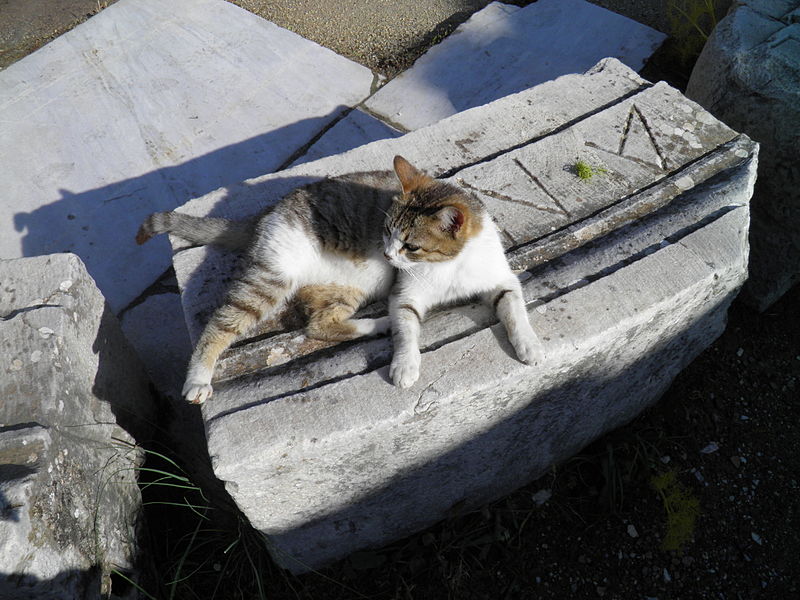
REMNANT OF GIANTS: Biblical Cats Again. With reference to my post On cat domestication yesterday, Deane Galbraith reminds us that he once argued that the lilith-creature in Isaiah 34:14 could be a cat. I see that I noted that post back in December of 2015. I usually check my own archive for related posts, but I guess I forgot this time.

Deane doesn't refer to any secondary literature, so I assume this is his otherwise unpublished idea. But he makes a plausible circumstantial case that lilit (לילית) in Isaiah could refer to some type of cat.

That said, it is a creature that dwells in ruins, which would apply more naturally to a wild cat then a domesticated cat — especially in antiquity when there was no archaeological tourism. Okay, I cannot rule out that Lilith in Isaiah was a cat. But I need more evidence before I'm willing to backtrack on my statement yesterday that the Hebrew Bible never mentions domesticated cats.

Past PaleoJudaica posts on Lilith are here and many links.


Photo credit: Wikimedia Commons.

Visit PaleoJudaica daily for the latest news on ancient Judaism and its world.

Inheritance, terumah, and the transgendered in the Talmud

THIS WEEK'S DAF YOMI COLUMN BY ADAM KIRSCH IN TABLET: How a Cucumber Decides Whether a Son Inherits Over a Donkey. With surprising analogous thinking, ancient Talmudic sages tackled very modern questions—by accident or foresight, depending on how liberal your views—of transgender rights, the rights of unborn fetuses, women’s rights, and wealth distribution.
This week, in chapter nine of Tractate Bava Batra, we saw an example of how the laws of teruma ["heave offering"] can serve the rabbis to elucidate a very different area of halachah. Chapter Nine continues the discussion of the laws of inheritance, addressing the status of bequests promised to a child born posthumously. The Mishna in Bava Batra 140b imagines a situation in which a dying man who is an expectant father bequeaths money to his unborn child, saying, “If my wife gives birth to a male, the offspring shall receive a gift of 100 dinars,” or “If my wife gives birth to a female the offspring shall receive 200 dinars.” The law is that these are binding bequests, and once the children are born they receive the designated amount from the estate.

This is clear enough, but the rabbis identify two possible ambiguities. What if the wife gives birth to twins, a boy and a girl? In this case, both children are given the promised sum, 100 dinars for the boy and 200 for the girl. And what if the child is born neither male nor female? What if it is a tumtum, the legal term for a person whose sex organs are concealed and is thus of indeterminate gender?
He does come back to the terumah part and it does involve cucumbers.

There's more on the tumtum here.

Earlier Daf Yomi columns are noted here and links.

Visit PaleoJudaica daily for the latest news on ancient Judaism and its world.

T. Gad

READING ACTS: Testament of Gad.

I have noted previous posts in Phil Long's blog series on the Old Testament Pseudepigrapha here and links. The series has recently focused on the Greek Testaments of the Twelve Patriarchs. Cross-file under Old Testament Pseudepigrapha Watch.

Visit PaleoJudaica daily for the latest news on ancient Judaism and its world.

Tuesday, June 20, 2017

On cat domestication

ARCHAEOLOGY MAGAZINE: DNA Study Reveals Tale of Cat Domestication.
Most house cats alive today descend from cats that can be traced back to Turkey, Lebanon, Syria, Iraq, Israel, Jordan, Saudi Arabia, and Egypt.
I think it is interesting that Israel is on the list. Here's a fun fact for you. Although the Hebrew Bible and the New Testament do mention dogs from time to time, generally disparagingly, they never once mention domestic cats. Sure, there are references to lions and other big cats, but not domesticated ones. The word "cat" never even appears.

Cats are mentioned in the Old Testament Apocrypha in the Letter of Jeremiah 22.

Offhand, I can't think of any references to domesticated cats in any Old Testament Pseudepigrapha or New Testament Apocrypha. But I don't have comprehensive concordances for these and there may be references that I don't remember. If you find any, drop me a note.

UPDATE (21 June): A cat in Isaiah? Maybe.

Visit PaleoJudaica daily for the latest news on ancient Judaism and its world.

The Forging Antiquity Project

EVANGELICAL TEXTUAL CRITICISM BLOG: Forging Antiquity Website and Blog (Tommy Wasserman). With information on the Macquarie University/Heidelberg University project. I have already noted the Markers of Authenticity Blog back at the end of 2016.

Also, the post has full details about some SBL sessions in November which deal with the problems of forgeries and unprovenanced artifacts.

Visit PaleoJudaica daily for the latest news on ancient Judaism and its world.

T. Naphtali

READING ACTS: Testament of Naphtali (Phil Long). As I have mentioned before, there is a medieval Hebrew version of the Greek Testament of Naphtali which perhaps shares a Jewish Second-Temple-era source with the Greek text.

In the second volume of Old Testament Pseudepigrapha: More Noncanonical Scriptures (MOTP2) we hope to gather all the ancient and medieval Hebrew material that is possibly related to the Greek Testament of Naphtali.

Earlier posts in Phil Long's blog series on the Old Testament Pseudepigrapha are noted here and links. His recent posts have been on the Greek Testaments of the Twelve Patriarchs. Cross-file under Old Testament Pseudepigrapha Watch.

Visit PaleoJudaica daily for the latest news on ancient Judaism and its world.

Melville's Gnostic apocryphon?

THE ANXIOUS BENCH: Alternative Scriptures: Melville’s “Lost Gnostic Poem.” (Philip Jenkins). Melville's poem wasn't lost. He gave it that title.

Were the Albigenses descended from the ancient Gnostics? Who knows? Some people thought so and Melville hints at the idea in his poem.

Earlier posts in Professor Jenkins's series on "alternative scriptures" are noted here and links.

Visit PaleoJudaica daily for the latest news on ancient Judaism and its world.

Monday, June 19, 2017

"Persepolis Administrative Archives"

BIBLIOGRAPHICA IRANICA: Persepolis Administrative Archives. Notice of a new article in the Encyclopædia Iranica, online edition, 2017. Looks like a useful overview and bibliography.

For past posts on the Persepolis Fortification Archive and its its complex and contentious political history start here and here and follow the links. It is not directly relevant to ancient Judaism, but it provides us with background information on scribal practice and Aramaic in Iran in the Persian Period.

Visit PaleoJudaica daily for the latest news on ancient Judaism and its world.

News on Rabbi Steinsaltz's recovery

UPDATE: RABBI STEINSALTZ LAUNCHES NEW ENGLISH TRANSLATION OF TORAH (Jeremy Sharon, Jerusalem Post). The new translation of the Torah is noteworthy, but so is this:
Steinsaltz himself did not travel to the event since he is still recovering from a severe stroke he suffered in December 2016, although he has partially returned to work of late, and has begun authoring new articles.

The rabbi is perhaps best known for his monumental translation and elucidation of the Talmud, but has also authored more than 60 books on Jewish thought, life and mysticism and is an Israel Prize laureate.
Continued good wishes for his recovery.

For background on Rabbi Steinsaltz and his work, especially his Hebrew and English translations of the Talmud, saee here and links.

Visit PaleoJudaica daily for the latest news on ancient Judaism and its world.

Translation of the Dialogue of Simon and Theophilus

ALIN SUCIU: Guest Post: Anthony Alcock – Disputation between Simon a Jew and Theophilus a Christian. A translation of the Latin text with a very brief introduction. Roger Pearse notes the post and gives additional background information.

Visit PaleoJudaica daily for the latest news on ancient Judaism and its world.

Chiesa, Filologia storica della Bibbia ebraica

EVANGELICAL TEXTUAL CRITICISM BLOG: Chiesa’s Historical Philology of the Hebrew Bible (Peter Gurry). It's good to know about these things. I hope there will be an English translation someday.

Visit PaleoJudaica daily for the latest news on ancient Judaism and its world.

Sunday, June 18, 2017

Review of Coşkun and McAuley (eds.), Seleukid Royal Women

BRYN MAYR CLASSICAL REVIEW: Altay Coşkun, Alex McAuley (ed.), Seleukid Royal Women: Creation, Representation and Distortion of Hellenistic Queenship in the Seleukid Empire. Historia Einzelschriften, 240. Stuttgart: Franz Steiner Verlag, 2016. Pp. 322. ISBN 9783515112956. €62.00. Reviewed by Branko F. van Oppen de Ruiter, Allard Pierson Museum, University of Amsterdam (b.f.vanoppen@uva.nl).
This collection brings together a selection of papers on Seleucid queenship delivered at the fourth “Seleucid Study Day” workshop held at McGill University, Montreal, on February 20-23, 2013. Apart from a preface, prologue and introduction, the volume’s twelve chapters are divided into three parts: (1.) the first generation of queens, i.e., Apame and Stratonice I; (2.) the representation of royal women, i.e., Laodice I, Cleopatra Tryphaena, and female portraiture; and (3.) queenship on the periphery of the empire. In all, sixteen authors (eight of whom are from Canada) have contributed to the publication, which additionally comes with a substantial bibliography (31 pp.), three indices (13 pp.) and four genealogies.
The Book of Daniel has a lot of interest in the Diadochoi (the generals that succeeded Alexander the Great) and their royal lines. Two of the women who feature in the book under review, Laodice I and Berenice II Berenice Phernophoros, were involved in the events of Daniel 11:6-9. Like the other people in that chapter, they are not named.

CORRECTION (7 January 2019): Berenice II of the Ptolemaic dynasty is not mentioned in the Bible. Berenice Phernophorus was an (unnumbered) queen in the Seleucid dynasty. She is the Berenice who is mentioned in Daniel 11. Sorry for the confusion.

Visit PaleoJudaica daily for the latest news on ancient Judaism and its world.

Menē Inc. weighed in the balance?

ARAMAIC WATCH: (Digital Journal).
TORONTO, ONTARIO--(Marketwired - June 15, 2017) - Goldmoney Inc. (TSX:XAU) ("Goldmoney"), a precious metal financial service and technology company, today announced its investment in Menē Inc. ("Menē"), a newly formed direct-to-consumer fine jewelry venture. Menē will manufacture and retail timeless 24 karat gold jewelry online through an innovative first-to-market user experience and transparent pricing model.

[...]
Naturally the Aramaic word caught my eye. The press release goes on to explain the name:
Menē - The Name

Menē ("meh-ney") is an ancient Aramaic word with a deep meaning that links jewelry, gold, money, and savings. A "Menē", reflecting 567 grams of pure gold, is the first written word for "money" as codified in the Code of Hammurabi approximately 4,000 years ago. For much of written history, humans exchanged value by pricing goods and services in units of "menē", which provided a predefined measurement of gold. Those units were often ultimately settled as pure 24 karat jewelry that could be readily exchanged. This ancient tradition, though often misunderstood by economists, is alive and well in the East where pure gold jewelry powers a savings economy in which jewelry is bought, sold, exchanged, and borrowed against as an asset that maintains its purchasing power.
Yes it is an old word for a unit of weight and the information about the Code of Hammurapi is interesting. But to modern people the word is best know from the biblical phrase "Mene Mene Tekel Upharsin" in the story of the writing on the wall in Daniel 5. It was the text of the writing and its (somewhat esoteric) interpretation was "You have been weighed in the balance and found wanting." The "you" was the kingdom of Babylon, which fell to the Persians that night. (See here especially, but also here and here.)

Now Menē Inc. sounds like a nice company and I wish them well. But I wonder if they fully thought through the implications of their name. Given what even minimally biblically literate people will hear in their heads when they encounter it, it is not what I would have chosen for my brand.

But that's just me. I hope I'm wrong and that Menē is successful.

Visit PaleoJudaica daily for the latest news on ancient Judaism and its world.

DeConick on Czachesz, Cognitive Science and the New Testament

THE FORBIDDEN GOSPELS BLOG: Book Note: Cognitive Science and the New Testament (István Czachesz). April DeConick reviews an important new textbook. The application of cognitive psychology to the study of the ancient past is a relatively new approach. It has contributed much to our understanding already and it shows great promise.

Visit PaleoJudaica daily for the latest news on ancient Judaism and its world.

Phoenician textual criticism

PHOENICIAN WATCH (SORT OF): Phoenix: A New Hotbed of Textual Criticism (Peter Gurry, Evangelical Textual Criticism Blog). And that is a good thing. Congratulations to Peter and his colleagues at Phoenix Seminary.

Visit PaleoJudaica daily for the latest news on ancient Judaism and its world.

Omarkhali, The Yezidi Religious Textual Tradition

BIBLIOGRAPHIA IRANICA: Yezidi Religious Textual Tradition. Notice of a new book: Omarkhali, Khanna. 2017. The Yezidi Religious Textual Tradition: From Oral to Written. Categories, Transmission, Scripturalisation and Canonisation of the Yezidi Oral Religious Texts with Samples of Oral and Written Religious Texts and with Audio and Video Samples on CD-ROM. (Studies in Oriental Religions 72). Wiesbaden: Harrassowitz Verlag.

Cross-file under Yazidi Watch. Earlier work on the Yazidis by Khanna Omarkhali has been noted here. For past PaleoJudaica posts on the Yazidis, their Gnosticism-themed religion, and their tragic fate in the hands of ISIS, start here and follow the many links.

Visit PaleoJudaica daily for the latest news on ancient Judaism and its world.