One may be skeptical of whether Jesus spoke about his death in advance. Or one may be skeptical of the capacity of religious experiences to turn a failed messiah into one vindicated by God. Neither seems inherently more preferable or more critical than the other.That sounds about right. For some of my own thoughts concerning the historical Jesus, see here and here and links. As for this question, I would say that Jesus may well have seen his death coming while he was still alive and given his disciples some perspective on it. But if not, he could just as well have done so (within the ancient social construction of reality) after his death as their shamanic mentor spirit.
Saturday, April 16, 2016
Did Jesus see his death coming?
JAMES MCGRATH: Philippians 2 and the Historical Jesus (Exploring Our Matrix).


Jesus and intel
THE ASOR BLOG: Jesus as a Security Risk: Intelligence and Repression in the Roman Empire (Rose Mary Sheldon).
Requires free registration to read the essay in full.
Intelligence personnel tend to have a view of events that differs from historians, even other people in government, and certainly from the general public. They are often accused of being realpolitikers or just plain cynical. Although crude jokes are made about the lack of morality in the intel game (the world’s second oldest profession — with far fewer morals than the first, etc.), the fact is that these are men and women serving their country. Their goal is to keep their own country safe, or in a colonial situation, to keep control of their country’s possessions. Insurgencies are their worst nightmare. They have to provide intelligence to decision-makers in a timely manner in what may turn out to be life and death situations. Like historians they never have as much evidence as they would like, but unlike historians they don’t get to ruminate on issues for a long time with 20-20 hindsight.I would like to discuss some of the assumptions about messianism in first-century Judaism and about the historical Jesus, but nevertheless an interesting perspective.
[...]
Requires free registration to read the essay in full.
Kessel and Pinggéra, A Bibliography of Syriac Ascetic and Mystical Literature
SYRIAC WATCH: Gregory Kessel's and Karl Pinggéra's book, A Bibliography of Syriac Ascetic and Mystical Literature (Peeters, 2011) is now available for free as a PDF scan on Academia.edu. For you, special deal!
Giants built Stonehenge?
ASKING THE IMPORTANT QUESTIONS: Did Satanic Giants Build Stonehenge? (Brian Tashman, Right Wing Watch). The Nephilim built Stonehenge? That's a new one, at least to me. It seems that the watchers myth is alive and well.
This one is really for Remnant of Giants. Over to Deane.
This one is really for Remnant of Giants. Over to Deane.
The historicity of the Exodus story
PASSOVER IS COMING: Were Hebrews Ever Slaves in Ancient Egypt? Yes. Ancient Egypt had intimate relations with Canaan, and most of the Semitic peoples migrating there would have been Canaanite. But not all. (Philippe Bohstrom, Haaretz). At best the main headline is misleading and at worst it is simply wrong. I don't hold the author responsible for that: he has a quite nuanced discussion of the evidence. But this is a not unusual example of a headline asserting something rather different than the article it heads, with the full knowledge that a lot more people will see the headline than click on it, let alone read the full article carefully.
This sums up the situation pretty well, although that indirect evidence is pretty indirect:
This sums up the situation pretty well, although that indirect evidence is pretty indirect:
There is no direct evidence that people worshipping Yahweh sojourned in ancient Egypt, let alone during the time the Exodus is believed to have happened. There is indirect evidence that at least some did. What's for sure is that thousands of years ago, Egypt was crawling with Semitic-speaking peoples.From there we move on to the usual suspects: Amorites (speakers of early Northwest Semitic dialects) in Egypt, the Hyksos, Josephus and Manetho, Akhenaten, some questionable exegesis of Egyptian texts such as the Admonitions of Ipuwer, the argument from silence (the ancient Egyptians suppressed unflattering stories), and so on. None of it adds up to an Israelite sojourn in Egypt or an Exodus with ten plagues, or anything like. That said, it is not implausible that some vague memory of the Hyksos is behind the Exodus story, but if so, it is very vague. The conclusion is pretty reasonable:
At the end of the day it the story of the Exodus is all matter of faith. This article does not aspire to prove the historicity of the Passover Haggadah, or that the Land of Israel was promised to slaves coming out of Egypt. It just proves that there were historical figures and events that could have inspired the Exodus account. So as we lift our cups and recite the “The coming out of Egypt,” let us think about the story that has captured the imagination for millennia and remember that sometimes, truth is stranger then fiction; and think back on Aper-el, a Hebrew slave who did not disappear in the mud along with the Yahweh-worshiping nomads who settled in Egypt.If you want to read the whole article, do it now before it goes behind the subscription wall. Also, a free registration with Haaretz will allow you to read a limited number of premium articles each month.
Friday, April 15, 2016
Review of Panayotakis et al. (eds.), Holy Men and Charlatans in the Ancient Novel
BRYN MAYR CLASSICAL REVIEW:
Stelios Panayotakis, Gareth Schmeling, Michael Paschalis (ed.), Holy Men and Charlatans in the Ancient Novel. Ancient Narrative. Supplementum, 19. Eelde; Groningen: Barkhuis; Groningen University Library, 2015. Pp. xii, 211. ISBN 9789491431906. €85.00.
Reviewed by Donald Lateiner, Ohio Wesleyan University (dglatein@owu.edu)
Preview
[Authors and titles are listed at the end.]1
Is there an objective difference between the two categories of the title, or was the mordant Morton Smith right when, in Jesus the Magician (rev. New York 1981), he asked why some, many, or most of Jesus’ contemporaries considered this eastern miracle worker (thaumaturge) a magician, or a charlatan, rather than ‘son of god’?
[...]
There were giants in Jericho in those days?
OR AT LEAST BIG GUYS: The (tall) Goliath Family of First-Century Jericho (Deane Galbraith, Remnant of Giants).
MOOC on the Talmud
ONLINE COURSE: The Talmud: A Methodological Introduction Northwestern University.
HT AJR.
About this CourseThe instructor is Barry Scott Wimpfheimer.
The Talmud is one of the richest and most complicated works of literature the world has ever known. Since being composed around 1500 years ago it has inspired not only religious reverence but significant intellectual engagement. In this course learners will be introduced to the unique characteristics of this text and the challenges that inhere in studying it while studying a chapter of the Talmud. Students of the course can expect to develop an appreciation for how the Talmud works and why it continues to inspire religious and intellectual devotion. They will be challenged to employ critical reading skills and to analyze legal and historical concepts.
Subtitles available in English
8 weeks of study, 1-2 hours/week
HT AJR.
Sex crimes law in HB
ASOR BLOG: Sex Crimes in the Laws of the Hebrew Bible [PODCAST] (Kaitlynn Anderson).
In a recent special Near Eastern Archaeology issue on crime and punishment in the Bible and the Near East, Dr. Bruce Wells authored the article, “Sex Crimes in the Laws of the Hebrew Bible.” I had the opportunity to speak with Dr. Wells about what constituted as a sex crime according to the Hebrew Bible all those years ago. Although biblical texts identify a range of sexual behavior as illicit, adultery is the only sexual act addressed in the law collections as a crime. Some scholars have argued that the treatment of adultery in biblical law is better and more favorable toward women than that found in the cuneiform law collections; others have argued precisely the opposite. What is more likely is that biblical law is largely in keeping with how ancient Near Eastern societies other than Israel and Judah handled adultery and should not necessarily be evaluated as either better or worse from a modern perspective.
Coptic Studies awards
ALIN SUCIU: IACS Awards for Academic Excellence 2016: Deadline Extended.
Since earlier notices appear to have escaped the attention of many of our members, the IACS Board has decided to extend the deadline for submitting candidacies for the IACS Awards for Academic Excellence until the middle of May. Therefore, competition is still open for awards to be given at the Eleventh International Congress of Coptic Studies, to be held in Claremont, California (U.S.A.), 25–30 July 2016. Again the IACS will award two prizes, one for the best M.A. thesis and a second one for the best Ph.D. dissertation, both written in the field of Coptic studies. Winners will receive a certificate and an amount of € 2,000 (Ph.D.) or an amount of € 1,000 (M.A.).Follow the link for further particulars. The deadline for submission is 15 May 2016. Cross-file under Coptic Watch.
[...]
Thursday, April 14, 2016
DSS: the leftover bits
EIBERT TIGCHELAAR: A Provisional List of Unprovenanced, Twenty-First Century, Dead Sea Scrolls-like Fragments. A list of those Dead Sea Scrolls-like Fragments that Surfaced since 2002, together with a short introduction (Academia.edu). Currently available only to specialists for discussion (I have registered), but I hope Professor Tigchelaar will make the list public when he is finished refining it.
More on the Gospel of Barnabas
NEW TESTAMENT APOCRYPHA WATCH: The Gospel of Barnabas a Late Medieval Gospel Forgery: How We Know? (Ronald V. Huggins). This looks like it is taken from a PowerPoint presentation: lots of pretty pictures to go with the interesting content.
Past posts on the Gospel of Barnabas are collected here. This long-since debunked medieval forgery remains of interest because of persistent rumors (which started here) that an ancient Aramaic copy of it has been discovered in Turkey. Like pretty much all the other outlandish claims about this apocryphon, it isn't so. The text is from a Syriac translation of the Gospel of Matthew and the manuscript itself claims to have been copied in the year 1500, but it may be more recent still.
Past posts on the Gospel of Barnabas are collected here. This long-since debunked medieval forgery remains of interest because of persistent rumors (which started here) that an ancient Aramaic copy of it has been discovered in Turkey. Like pretty much all the other outlandish claims about this apocryphon, it isn't so. The text is from a Syriac translation of the Gospel of Matthew and the manuscript itself claims to have been copied in the year 1500, but it may be more recent still.
Report: those hexagrams at Elephantine are ancient
ICONOGRAPHY OR ANCIENT GRAFFITI? Dispelling rumors, Egypt says stars at ancient temple not new, not Jewish. Engraved six-pointed shapes found at Elephantine date to late antiquity, are not Stars of David (Ilan Ben Zion, Times of Israel).
Egypt’s Antiquities Authority said in an Arabic statement last week that the stone, discovered by Swiss archaeologists in 1985, was determined to have been inscribed at some point between the 1st and 6th century CE. Further studies are needed to better pinpoint the date of the stars’ inscription, the ministry said.This is still not very lucid. How do the archaeologists know when the symbols were inscribed? Does saying that the hexagrams were "not Stars of David" mean that they weren't Jewish symbols or (correctly) that the Jewish symbol (which did exist in late antiquity) was not at that time called a Star of David or associated with David? If they aren't Jewish symbols, what are they? Native Egyptian? But anyhow, my musings in this post don't seem too far off so far. Additional background is here.
The report noted that six-pointed stars didn’t appear in Coptic artifacts during that period, nor did they appear in Islamic iconography until the 8th century CE. Nasr Salama, director of Aswan antiquities with the ministry, insisted in a telephone conversation with The Times of Israel that, contrary to media reports, the designs were not Stars of David, but six-pointed stars.
More on the ancient Judean literacy study
CANDIDA MOSS: Does This Ancient Handwriting Prove the Bible’s Age? A new study of 100 letters written on clay pottery shows early literacy in ancient Israel—but can it really prove when the Bible was composed?. A brief, sensible, evaluation of the claims of the study.
The original story was noted here. Other recent blog responses include:
Peter Gurry: Handwriting Analysis and Dating the Bible (ETC).
Deane Galbraith: Judah’s military correspondence from ca. 600 BCE: Evidence of widespread literacy but not evidence of the Bible (Remnant of Giants).
As some of the writers above have pointed out, the Arad ostraca are documentary (administrative) texts, not literary texts. It would be helpful to collect and discuss the pre-exilic epigraphic literary texts in this context. Simon Parker's book, Stories in Scripture and Inscriptions: Comparative Studies on Narratives in Northwest Semitic Inscriptions and the Hebrew Bible (OUP, 1997) is also relevant, if now a little dated. And the priestly-blessing silver amulets from Ketef Hinnom (see immediately preceding post) are arguably also from the late seventh/early six centuries BCE and are much more relevant to the question of the composition of the biblical texts, not least because they actually contain a text found in the Bible.
I wrote the above last night and was about to press "send" this morning, when I came across this very important blog post by Christopher Rollston: The Tel Aviv University PNAS Study: Some Methodological Musings. He writes on the basis of his technical expertise, but still quite accessibly. Two excerpts:
In the end it’s sad that the results of this study have been so overstated. The ostraca provide intriguing information about life and literacy in the ancient world. There’s even a reference to Greek mercenaries in Palestine before 586 BCE. Technologically speaking, it stands at the cutting edge of the digital humanities and pioneers an exciting area of research. But the debate is far from settled, and if an argument for the dating of the Torah is what you’re looking for, you’re better off reading Rollston, Schniedewind and Sanders.That sounds about right.
The original story was noted here. Other recent blog responses include:
Peter Gurry: Handwriting Analysis and Dating the Bible (ETC).
Deane Galbraith: Judah’s military correspondence from ca. 600 BCE: Evidence of widespread literacy but not evidence of the Bible (Remnant of Giants).
As some of the writers above have pointed out, the Arad ostraca are documentary (administrative) texts, not literary texts. It would be helpful to collect and discuss the pre-exilic epigraphic literary texts in this context. Simon Parker's book, Stories in Scripture and Inscriptions: Comparative Studies on Narratives in Northwest Semitic Inscriptions and the Hebrew Bible (OUP, 1997) is also relevant, if now a little dated. And the priestly-blessing silver amulets from Ketef Hinnom (see immediately preceding post) are arguably also from the late seventh/early six centuries BCE and are much more relevant to the question of the composition of the biblical texts, not least because they actually contain a text found in the Bible.
I wrote the above last night and was about to press "send" this morning, when I came across this very important blog post by Christopher Rollston: The Tel Aviv University PNAS Study: Some Methodological Musings. He writes on the basis of his technical expertise, but still quite accessibly. Two excerpts:
But most importantly, to reiterate, I am contending that the epigraphic evidence at hand demonstrates rather nicely that there were educated scribes in Israel and Judah by the late 9th and early 8th centuries BCE and that these scribes were capable of writing fine historical and literary texts. Thus, in sum, as for the PNAS article, I would say (with some good-natured humor and a turn of phrase), “I see your 600 and raise you 200” (i.e., to ca. 800 BCE).And his conclusion:
So, in sum, the Tel Aviv Epigraphic Project is scintillating. The technology and talent that the authors of this PNAS article bring to the table is unmatched anywhere in the world. But the sociological conclusions about the “proliferation of literacy” in Judah is not something that can be posited on the basis of this study. The methodology is stunningly important, but I would wish to see more caution regarding the conclusions.
Review of Smoak, The Priestly Blessing in Inscription and Scripture
ANCIENT JEW REVIEW: Smoak, The Priestly Blessing in Inscription and Scripture (Yael Landman Wermuth).
Smoak, Jeremy D. The Priestly Blessing in Inscription and Scripture: The Early History of Numbers 6:24-26. Oxford: Oxford University Press, 2016.The book was noted as forthcoming here. And follow the link there for much background on the Ketef Hinnom silver amulets.
Jeremy Smoak’s The Priestly Blessing in Inscription and Scripture: The Early History of Numbers 6:24-26 sheds new light on the origins and diverse functions of the Priestly Blessing. Whereas scholars have written extensively about the blessing’s history and uses in early Judaism and Christianity, a dearth of extrabiblical evidence has precluded an understanding of its history during the Iron Age, including its functions in ancient Israelite and Judahite religious practice; the relationship between these functions and the description of the blessing in the book of Numbers; and the blessing’s connection to blessing inscriptions from the epigraphic records of ancient Israel and Judah. The discovery of two silver Iron Age amulets at Ketef Hinnom in Jerusalem, of which the West Semitic Research Project at USC provided new photographs and translations in 2004, allows Smoak to fill this gap in his monograph.
[...]
Wednesday, April 13, 2016
Repairs to proceed on Church of Holy Sepulchre
ECUMENICAL AGREEMENT: Decades on, historic accord reached on renovation of Jerusalem's Holy Sepulcher Church (Peter Kenny, ECUMENICAL NEWS).
The Church of the Holy Sepulcher is one of Christianity's best known places of worship which is said to house the tomb of Jesus in Jerusalem, but it is rather run down in parts.This issue has been quiet for some years, but past posts on it (etc.) are here, here, here, here, here, here, and here. I'm glad to see that some sort of agreement seems to have been reached. The Church of the Holy Sepulchre (Sepulcher) is built over a number of first-century rock-cut tombs, so it is at least possible that it really is the site of the tomb of Jesus.
The church is run as a consortium consisting of Custodia Terrae Sanctae, a Franciscan order that represents the Catholic Church; the Greek Orthodox Patriarchate; and the Armenian Patriarchate, who do not always agree and Coptic, Ethiopian and Syriac Orthodox churches also have a say.
The agreement assigns each part of the building, every floor tile, door, window and corridor, to a specific church, and any alternation, addition or repair requires all three churches to agree.
The church is located in the Christian Quarter of the Old City of Jerusalem.
After decades of wrangling, however, within two months, the Church of the Holy Sepulcher will begin its first major renovation since Israel was established in 1948, the Israeli newspaper Haaretz reports.
[...]
Retrieval of looted sculpture associated with Herod
LOOTING THWARTED: Three Palestinians arrested smuggling statue of King Herod's lover to Israel. The 12-centimeter high statue confiscated by the PA is a sculpture of King Herod's lover valued at nearly a million dollars (MAAYAN GROISMAN, Jerusalem Post).
The article doesn't quite come out and say that the statue of "Herod's lover" was a statue of Mariamne. Unless it was labeled with a name, I'm not sure how one could be sure who it was, but I await clarification.
The 12-centimeter high statue confiscated by the PA is a sculpture of King Herod's lover valued at nearly a million dollars.Although her being his true love did not stop Herod from having her and (later) her sons executed.
Born in 74 BCE in Idumea, south of Judea, King Herod reigned in Judea for 33 years, during which he reconstructed the Second Temple. He had ten wives, but his true love was Mariamne, the last princess of the Hasmoneans, who were Herod's biggest enemy.
The article doesn't quite come out and say that the statue of "Herod's lover" was a statue of Mariamne. Unless it was labeled with a name, I'm not sure how one could be sure who it was, but I await clarification.
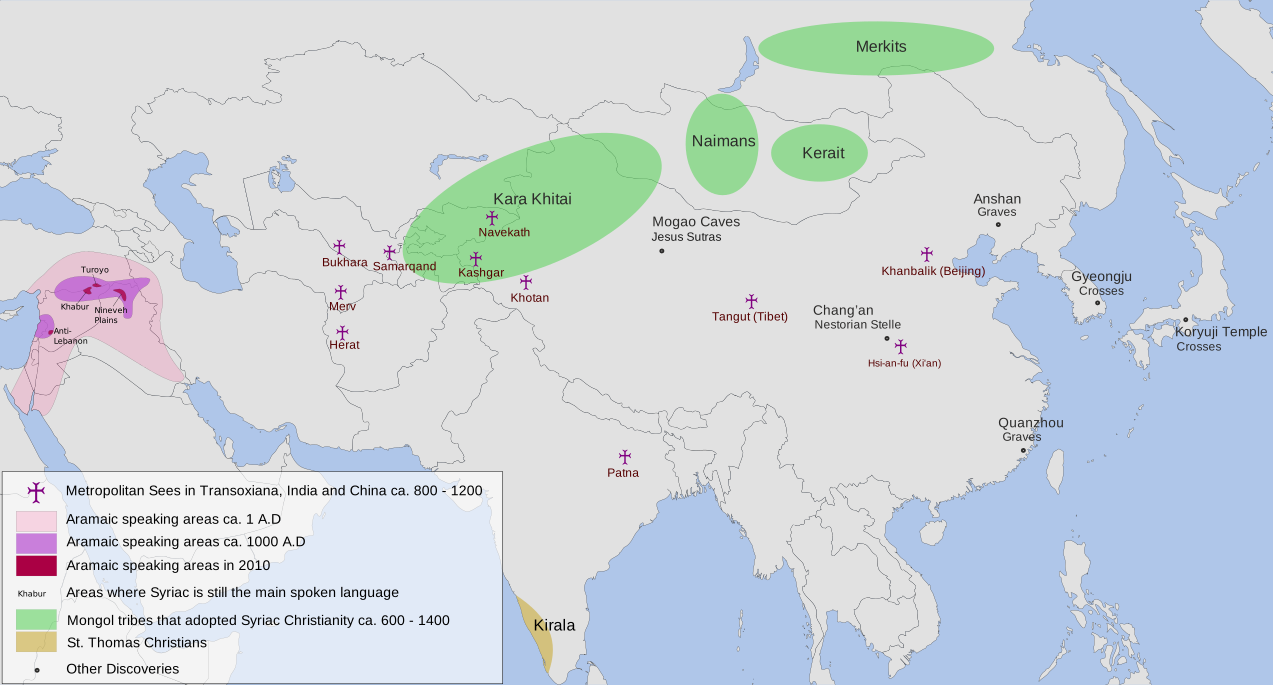
Map of the spread of Syriac
SYRIAC WATCH: A map that follows the spread of Syriac as a language and in terms of Syriac Christianity. (Wikimedia Commons). From Sarah Bond via AJR.
Geniza collection to sojourn at Princeton
JTS LIBRARY RENOVATION: Princeton to temporarily house Geniza Collection of ancient Hebrew and Arabic documents.
The Jewish Theological Seminary of America's renowned Geniza Collection will be housed temporarily in the Princeton University Library while JTS, located in New York City, rebuilds its library.Background on the current renovation of the JTS Library is here and links. And there are endless past posts on the Cairo Geniza. See here, here, here, here, here, here, and links
[...]
Honoring the late Marvin Meyer
MEMORIAL FESTSCHRIFT: April 18 reception planned for new book honoring the late Professor Marvin Meyer (Chapman University). Marv Meyer was a noted specialist in ancient Gnosticism and ancient magic. His death in 2012 was noted here (with the idea of a memorial volume already being raised) and here and links.
Subscribe to:
Posts (Atom)