Saturday, August 19, 2006


ARAMAIC WATCH -- An Assyrian town in Turkey is profiled by Eurasianet:
ASSYRIANS EXPERIENCE SLOW CULTURAL REVIVAL IN SOUTHEASTERN TURKEY
Yigal Schleifer 8/18/06
Filled with honey-colored stone homes with exquisite relief carvings, Midyat, located in southeast Turkey, is one of the country’s most beautiful ancient towns. It is also one of its most haunted.
Once almost exclusively populated by Assyrian Christians � an ancient sect that traces its roots back to the earliest days of Christianity and that still uses Aramaic, the language spoken during the time of Jesus, for its liturgy � the town is now almost completely devoid of its original inhabitants.
Caught up in the violence that resulted from the separatist war that was fought in the area in the 1980’s and 90’s between the Kurdistan Workers’ Party (PKK) and Turkish security forces, Assyrians from Midyat and several other towns and villages in the area fled to Europe, particularly Germany and Sweden, leaving their ancestral homeland behind.
Some 30-40,000 Assyrians lived in the area around Midyat, known as the Tur Abdin Plateau, 40 years ago. Nobody is sure what the population is today, although in Midyat only 100 Christian families remain.
Still, there are signs of Assyrian life throughout the region. ...
PEOPLE HAVE BEEN SENDING ME REFERENCES to the new documentary "The Exodus Decoded" by Simcha Jacobovici. I gather it's airing tomorrow in the USA. I have commented on Jacobovici in a similar context here. He has also been involved with the James Ossuary controversy. My experience is that such documentaries are predictably dire and the Washington Post article I've linked to above gives me no reason to think otherwise in this case. If it shows in Britain, I don't intend to waste my time on it.
DEFENDING THE DEVIL:
What the Devil? Prince of Darkness Is Misunderstood, Says UCLA ProfessorThe article summarizes Kelly's exegesis of biblical passages in detail. One can debate some of it, but he's basically correct and what he says won't be new or controversial to biblical scholars. But I don't see that it follows that "If Satan isn't really in opposition to God and he isn't really evil, then that means the fight between good and evil isn't an authentic part of Christianity." One certainly doesn't get that impression from, say, the book of Revelation. Or Paul, for that matter. It would be more fair to say that the traditional picture of Satan is the product of postbiblical eisegesis of biblical texts. Of course, that's true of a great many traditional ideas in both Christianity and Judaism.
(PhysOrg)
He's not the enemy of God, his name really isn't Lucifer and he isn't even evil. And as far as leading Adam and Eve astray, that was a bad rap stemming from a case of mistaken identity.
"There's little or no evidence in the Bible for most of the characteristics and deeds commonly attributed to Satan," insists a UCLA professor with four decades in what he describes as "the devil business."
In "Satan: A Biography" (Cambridge Press), Henry Ansgar Kelly puts forth the most comprehensive case ever made for sympathy for the devil, arguing that the Bible actually provides a kinder, gentler version of the infamous antagonist than typically thought.
"A strict reading of the Bible shows Satan to be less like Darth Vader and more and more like an overzealous prosecutor," said Kelly, a UCLA professor emeritus of English and the former director of the university's Center for Medieval and Renaissance Studies. "He's not so much the proud and angry figure who turns away from God as [he is] a Joseph McCarthy or J. Edgar Hoover. Satan's basic intention is to uncover wrongdoing and treachery, however overzealous and unscrupulous the means. But he's still part of God's administration."
[...]
ROBERT ALTER lists his top five books on the Bible for the Opinion Journal. Not surprisingly, his emphasis is on literary criticism.
Friday, August 18, 2006
SYRIAC INSCRIPTIONS DESTROYED IN IRAQ? Roger Pearse, at the Thoughts on Antiquity blog, notes a 2004 report on ChaldoAssyrian Churches In Iraq (PDF file) by the Assyrian Academic Society, which mentions:
This certainly sounds like a very serious situation. At the link above, Roger has more information on the fate of some manuscripts from this monastery.
... Rabban Hormizd, the ancient stone monastery outside Alqosh on the Nineveh plain which was bombed so severely that many of its magnificent epigraphic memorials, dating from a hundred centuries ago, have been shattered. These memorials were some of the most precious classical Syriac stone carvings in the world. They lie in a makeshift museum in Alqosh in desperate need of restoration.The claim is that the Kurds are responsible for the destruction. No date is given, although the rest of the report gives dates for other acts of destruction mostly in the 1970s and 1980s. Obviously, the "hundred centuries" is a wild exaggeration; no writing of any kind has been proved to have existed anything like that early and Syriac is the Edessan dialect of Aramaic from late antiquity. But the point remains. A footnote adds:
An appeal to the US National Endowment for the Humanities (NEH) for funding to preserve rare Syriac materials under the special funds for Iraq allocated by Congress has been refused on the grounds that these materials are of a religious nature and not held at “public” institutions.The report continues:
Some of the edifices listed below, now turned to rubble, had considerable historic value due to their antiquity and continuous use by the members of the several indigenous Christian denominations in Iraq that have historically made up the ChaldoAssyrians. Readings of historical geographies, as well as the colophons of Syriac manuscripts, provide clues to the early dates of some of these religious buildings even when foundation or reconstruction inscriptions lie under rubble.There is more on the site of Rabban Hormiz Monastery on p. 19, with a photograph of a Syriac epitaph from the early 17th century.
In the rush to destroy these churches, manuscripts of considerable antiquity may also have been destroyed. The history of the destruction needs to be collected from oral sources so that the whereabouts of the precious manuscripts may be retrieved. This is part of the history of Iraq and a witness to its diversity, no matter what forces of ethnic uniformity may arise.
This certainly sounds like a very serious situation. At the link above, Roger has more information on the fate of some manuscripts from this monastery.
HERE'S SOME BACKGROUND TO THE FUNDRAISING for upgrades to the San Diego Natural History Museum in advance of their 2007 Dead Sea Scrolls exhibition. I have lots of memories of visiting this museum when I was a kid and I'm looking forward to seeing its new incarnation at the Scrolls exhibit.
DAY-CAMP ARCHAEOLOGY:
These Campers Get a Chance to Grab a Shovel and Really 'Dig the Past'In Philadelphia, that is, at a simulated archaeological dig.
August 17, 2006 - Bryan Schwartzman (Jewish Exponent)
Jacob Fischer and Jordan Baum were both hunched over the dirt, intensely examining the ground for hidden artifacts. The excavation had already proved fruitful; the pair of 11-year-olds had uncovered part of an oil lamp, bones (not real ones, Jordan pointed out), shards of pottery and tiles marked with ancient Hebrew script.
Other campers had managed to find charcoal from when the Romans burned down the home of a Jewish family nearly 2,000 years ago.
Not bad for a morning at Ramah Day Camp in Elkins Park.
Thursday, August 17, 2006
ARAMAIC IN THE UAE? This Gulf News article on archaeology in the UAE (via the Agade list) has an interesting aside. It begins:
Sharjah treasures its prehistoric linksIt goes on to discuss excavations in Sharjah and then the Archaeological Museum and its displays. Then we read:
By Mariam M. Al Serkal, Staff Reporter
The UAE has a long history that was shaped over the centuries by the waters of the Arabian Gulf and the sands towards Rub Al Khali, also known as the Empty Quarter.
Little archaeological research was conducted in the Arabian Peninsula before World War II and only the remains in Yemen and Bahrain were studied. The first excavations in the UAE originally began in the late 1950s, when a Danish team of archaeologists investigated sites at Al Ain Oasis.
In 1992, a local archaeological team from the Directorate of Antiquities in Sharjah launched its first excavation in Khor Kalba and other parts of the emirate that are currently displayed in the new Archaeological Museum, which was inaugurated in May 1997 by His Highness Dr Shaikh Sultan Bin Mohammad Al Qasimi, Supreme Council Member and Ruler of Sharjah.
The fourth stage covers the period from 300 BC-611 AD, where models of burial methods and housing units are on display.This makes it sound as though there are Aramaic inscriptions in the museum and therefore that there were speakers of Aramaic in the region in antiquity. The Museum website has more details:
Exhibits include samples of weapons used at the time, such as arrow heads, spears, daggers and ornamentation items.
This period marks the appearance of writing in the region, which is represented in the Southern Musnad calligraphy and Aramiac writings that are on display.
Also on display in the hall that covers this period are several ornamentation materials in use during the period. It records the beginning of the appearance of writing in the area represented in the Southern Musnad Calligraphy (Southern Arabian writing found mainly in the Kingdoms of Yemen and used by the people of North-Eastern Arabia) and some Aramaic writings which were in practice in Maleeha, a district of Sharjah, and finally replaced the Southern Arabian writing which apparently disappeared at the advent of Christianity.The page goes on to say that Maleeha was a port, so presumably Aramaic-speaking traders could have traveled through it. Or is this rather a reference to an Aramaic-inspired alphabet in which an Arabian dialect was written? I don't know the ancient history or philology of the region. Can anyone clarify?
Wednesday, August 16, 2006
THERE'S A VIDEO that goes with yesterday's New York Times article on the Dead Sea Scrolls. It's titled "A New Dead Sea Challenge" and is narrated by science reporter John Noble Wilford. It raises some of the main issues that have been advanced to challenge the Essene hypothesis. One small correction: it was Eliezer Sukenik who first advanced the Essene hypothesis, not Roland de Vaux.
(Heads up, reader Andrew Blumberg.)
(Heads up, reader Andrew Blumberg.)
THE SAN DIEGO NATURAL HISTORY MUSEUM is being upgraded to accommodate its upcoming Dead Sea Scrolls exhibition, according to the San Diego Business Journal:
Legal Help Opens Door to Scrolls
The San Diego Natural History Museum has secured $1.3 million in bond financing to buy special climate and ventilation systems to protect the fabled Dead Sea Scrolls — a major exhibit scheduled to be unveiled in 2007.
[...]
THE ARCHAEOLOGICAL AND ENVIRONMENTAL DAMAGE of the Israeli-Hezbollah war is summarized in an article by Mike Di Paola in Bloomberg News. I don't see much of anything new in it, but it collects most of the relevant information in one place.
By the way, I think most people who talk about the "Rapture" place it before the battle of Armageddon.
By the way, I think most people who talk about the "Rapture" place it before the battle of Armageddon.
Tuesday, August 15, 2006
PSEUDEPIGRAPHA AND APOCRYPHA WATCH: Today is the Feast of the Assumption of the Blessed Virgin Mary, which has inspired Tempo in the Philippines to publish a brief piece on assumptions (i.e., translations live into heaven) in ancient Jewish and Christian literature. Excerpt:
At the time of Jesus, Jews thought that friends of God became members of the heavenly court when they finished their work. The Hebrew Scriptures describe how holy people were “taken up” by God into heaven. One example is Elijah who rode to heaven in a chariot of fire (2Kgs2). Jewish narratives described the assumption of Moses, Isaiah and other prophets. The Jews believed that holy people are protected by the power of the Almighty. ...The pseudepigrapha alluded to are the Martyrdom and Ascension of Isaiah and the Assumption/Testament of Moses (although the surviving Latin fragment doesn't extend to an assumption of Moses and may not actually have included one). Technically speaking, Isaiah wasn't assumed, since he returned to earth and died there. But Enoch, who isn't mentioned, was. There's a large ancient literature on the assumption of Mary, starting in the fourth or fifth century. A number of the texts are collected by Stephen J. Shoemaker at his Early Traditions of the Virgin Mary's Dormition (Dormitio Mariae) website.
Belief in the assumption of the Virgin Mary is attested in a number of books written after the year 300 AD. These books describe the death of Mary under various circumstances. Some claim that Mary was raised after three days, others that her body was taken up to heaven during the funeral procession. Other books claim that Mary’s tomb was opened and found to be empty. These writings claim that Mary died anywhere from three to 50 years after the death of Jesus.
THE DEAD SEA SCROLLS feature in a New York Times article ("Archaeologists Challenge Link Between Dead Sea Scrolls and Ancient Sect") on the recent challenge to the Essene hypothesis by two archaeologists who have been excavating Qumran. Excerpt:
Chris Weimer has also commented on the article.
UPDATE (16 August): More here.
But two Israeli archaeologists who have excavated the site on and off for more than 10 years now assert that Qumran had nothing to do with the Essenes or a monastery or the scrolls. It had been a pottery factory.The article is based on a Biblical Archaeology Review article ("Qumran—The Pottery Factory") which is behind their subscription wall. The NYT piece also discusses the theory of Norman Golb and concludes as follows:
The archaeologists, Yizhak Magen and Yuval Peleg of the Israel Antiquities Authority, reported in a book and a related magazine article that their extensive excavations turned up pottery kilns, whole vessels, production rejects and thousands of clay fragments. Derelict water reservoirs held thick deposits of fine potters’ clay.
Dr. Magen and Dr. Peleg said that, indeed, the elaborate water system at Qumran appeared to be designed to bring the clay-laced water into the site for the purposes of the pottery industry. No other site in the region has been found to have such a water system.
By the time the Romans destroyed Qumran in A.D. 68 in the Jewish revolt, the archaeologists concluded, the settlement had been a center of the pottery industry for at least a century. Before that, the site apparently was an outpost in a chain of fortresses along the Israelites’ eastern frontier.
Despite the rising tide of revisionist thinking, other scholars of the Dead Sea scrolls continue to defend the Essene hypothesis, though with some modifications and diminishing conviction.This is neither accurate nor fair. The Essene hypothesis is still the most widely held position and continues to be refined (notably, in recent years, by the work of Gabriele Boccaccini). Certainly a good many Qumran specialists continue to hold it with no particular lessening of conviction.
Chris Weimer has also commented on the article.
UPDATE (16 August): More here.
TEMPLE MOUNT WATCH: Hershel Shanks e-mails to alert me to a piece about the "Destruction of the Temple Mount" on the BAS website. It opens:
Muslim building projects on the Temple Mount and the expansion of a Muslim cemetery alongside the Mount have led to significant damage to the site in recent years and have created an unsightly hodge-podge of repairs and construction.and proceeds to summarize the worrisome recent history of the site. It's not clear exactly when the article was written (a date on the page would be helpful), but the latest reference is to the summer of 2005. It also contains some good photos of the area.
Monday, August 14, 2006
UPDATES: As promised, I've posted updates with reader comments and corrections to recent posts on Yohanan ben Zakkai, the Tomb of the Kings in Jerusalem, articles on the Temple Mount, and Vindolanda. Thanks, as always, for the feedback.
TED WAITT, the man who funded the restoration and preservation of the Gospel of Judas, is interviewed by Copley News Service. He gives some interesting background information on the negotiations. He seems well informed about the practical issues, although less so about the historical ones. His understanding of the origins of the canonical four gospels and the apocryphal gospels is pretty mixed up:
It's disappointing to see Waitt holding and passing on these misunderstandings, but he did do a lot of good by helping to save the Gospel of Judas and he deserves plently of credit for that.
Imagine this. Let's say you died about 2,000 years ago, and your friends told their stories about you to their children and friends for approximately 100 years after you died. And then someone decides to write these stories down. And then they get translated from one language into another. And there's as many as 30 different versions written down. And someone picks just four as the only ones anyone should see, renounces the others, and all this happens approximately 150 years after you die.The four gospels are generally agreed to have been written 40-80 years after the crucifixion, and we have them in their original language (Greek). They are not the best of historical sources, but such information as we have about the historical Jesus comes almost entirely from them. Other gospels (some surviving only in translation) continued to be produced from the later end of this time range and for centuries thereafter, but those that survive are not of historical value for the first century. The possible exception is The Gospel of Thomas. It is the only one with a serious claim to contain early material that could go back to Jesus himself, and it itself may be quite early, but both of these issues are stridently debated by specialists.
Would you expect them to all be the same? Would you be happy with just those four that some person who didn't know you selected? Maybe, maybe not. But what about the other 26 versions of events? Maybe they were true, maybe not. Maybe they had other things in them that actually happened or that were important to you. No one really knows for sure. But odds are, there's something in the 26 that you might have supported, and maybe something from the four that you might not have. The key is in understanding the general tone and intentions of your life in all of them, and making some important observations from that.
It's disappointing to see Waitt holding and passing on these misunderstandings, but he did do a lot of good by helping to save the Gospel of Judas and he deserves plently of credit for that.
Sunday, August 13, 2006
VINDOLANDA was a minor Roman fortress community from the late first century CE into the 400s. Early in its history (roughly the 20s of the second century), Hadrian's Wall was built about a mile north of it. For those stumbling onto this entry and wondering what it's doing in a blog on ancient Judaism, I visited the site last week with my family and I'm posting some photos and reflections, including some thoughts relating to ancient Judaism.
The earlier fort was made of wood, the later of stone. This photo shows a reproduction on the site of buildings from both periods:

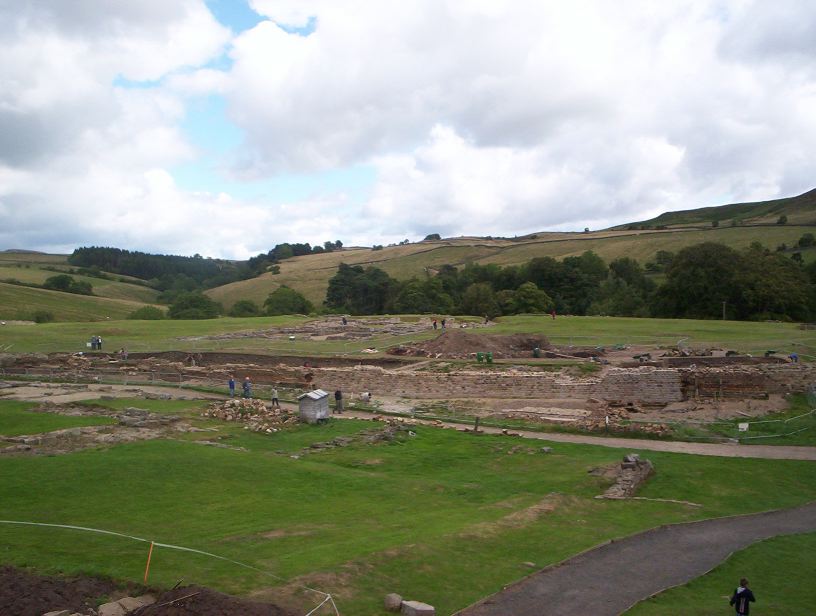
And here is a picture of part of the ongoing excavation on the site, taken from the stone tower in the first photo. This area is from the later period, with stone buildings:

Below is a Roman bathhouse from the early (pre-Hadrianic, epigraphically rich) period.
Despite its minor status as a Roman fort, Vindolanda is extraordinarily important for the epigraphic discoveries that have poured out of it since the early 1970s. Hundreds (thousands?) of thin wooden writing tablets have been recovered from the earliest strata. These inscribed tablets survived with writing intact (recoverable through infra-red photography) because these early layers (late first and early second century) were leveled, covered over with clay and then new sod, and built over. This sealed the early strata into what quickly became an anerobic environment that arrested the decomposition of organic matter until the excavators rediscovered it. You can read in detail about the epigraphic remains from Vindolanda here. My favorite is the birthday party invitation to Lepidina, the wife of the commander of the fort. Lepidina's family, who were real people, are the main characters in the Minimus books and the birthday of her friend is recounted in the first one. The Vindolanda texts were voted the number one treasure of the British Museum, and rightly so. They are as important for the early history of Britain and the history of the Roman Empire as the Dead Sea Scrolls are for early Judaism. The content of the Vindolanda tablets and the Dead Sea Scrolls are quite different and each leaves us with important gaps. The Vindolanda tablets are documentary texts (administrative texts, personal letters, etc.) which tell us about day to day life of individuals and about the running of the fort, but which contain almost no literary texts (just a few classical quotations). We are left knowing that they read, but longing to know the contents of their library. The Dead Sea Scrolls preserve the library (or a collection of the libraries) of a first-century Jewish sectarian group, but they include almost no documentary texts. We are thus left knowing all about what literary works they read, but longing to know about who the people in the group were and what their daily lives were like. (The later Judean Desert texts from the period of the Bar Kokhba Revolt -- about a generation after the Vindolanda texts -- are mostly documentary texts, with some literary texts mixed in. But these were not left by the Qumran sectarians and still leave us in the dark about them.)
Despite the gaps, we are extraordinarily lucky to have both the Vindolanda texts and the Dead Sea Scrolls. And in the future, with more luck, it's possible that some of those gaps will be filled in.
Also, while we were in the vicinity, we visited Hadrian's Wall, near the Roman Army Museum. We stayed at a B&B in Haltwhistle. This was at a nice farmhouse built in the ealy 19th century, which is reputed to have been made of stones from the Wall.

And here is a picture of the view from the Wall, looking southeast.

I've also posted another picture of the Wall here. You can click on any of the photos to get a larger image.
UPDATE (14 August): Peter Head e-mails:
I use "inscribe" to mean to write on something and "inscription" as something with writing on it. Likewise, I use 'epigraphic" to mean pertaining to ancient inscriptions. Therefore, texts written in ink on ancient surfaces are inscriptions and are of interest to the epigrapher. I don't have a Webster's in my office, but my American Heritage Dictionary agrees with these usages. This is the normal terminology for Northwest Semitic epigrapy (e.g., ink-inscribed ostraca are described as inscriptions and studied by epigraphers). Maybe Classical epigraphers use the terms differently. And there's some wiggle-room, since ancient scrolls generally aren't called inscriptions, although I suppose that technically they are. But I stand by my usage above.
The earlier fort was made of wood, the later of stone. This photo shows a reproduction on the site of buildings from both periods:

And here is a picture of part of the ongoing excavation on the site, taken from the stone tower in the first photo. This area is from the later period, with stone buildings:
Below is a Roman bathhouse from the early (pre-Hadrianic, epigraphically rich) period.

Despite its minor status as a Roman fort, Vindolanda is extraordinarily important for the epigraphic discoveries that have poured out of it since the early 1970s. Hundreds (thousands?) of thin wooden writing tablets have been recovered from the earliest strata. These inscribed tablets survived with writing intact (recoverable through infra-red photography) because these early layers (late first and early second century) were leveled, covered over with clay and then new sod, and built over. This sealed the early strata into what quickly became an anerobic environment that arrested the decomposition of organic matter until the excavators rediscovered it. You can read in detail about the epigraphic remains from Vindolanda here. My favorite is the birthday party invitation to Lepidina, the wife of the commander of the fort. Lepidina's family, who were real people, are the main characters in the Minimus books and the birthday of her friend is recounted in the first one. The Vindolanda texts were voted the number one treasure of the British Museum, and rightly so. They are as important for the early history of Britain and the history of the Roman Empire as the Dead Sea Scrolls are for early Judaism. The content of the Vindolanda tablets and the Dead Sea Scrolls are quite different and each leaves us with important gaps. The Vindolanda tablets are documentary texts (administrative texts, personal letters, etc.) which tell us about day to day life of individuals and about the running of the fort, but which contain almost no literary texts (just a few classical quotations). We are left knowing that they read, but longing to know the contents of their library. The Dead Sea Scrolls preserve the library (or a collection of the libraries) of a first-century Jewish sectarian group, but they include almost no documentary texts. We are thus left knowing all about what literary works they read, but longing to know about who the people in the group were and what their daily lives were like. (The later Judean Desert texts from the period of the Bar Kokhba Revolt -- about a generation after the Vindolanda texts -- are mostly documentary texts, with some literary texts mixed in. But these were not left by the Qumran sectarians and still leave us in the dark about them.)
Despite the gaps, we are extraordinarily lucky to have both the Vindolanda texts and the Dead Sea Scrolls. And in the future, with more luck, it's possible that some of those gaps will be filled in.
Also, while we were in the vicinity, we visited Hadrian's Wall, near the Roman Army Museum. We stayed at a B&B in Haltwhistle. This was at a nice farmhouse built in the ealy 19th century, which is reputed to have been made of stones from the Wall.
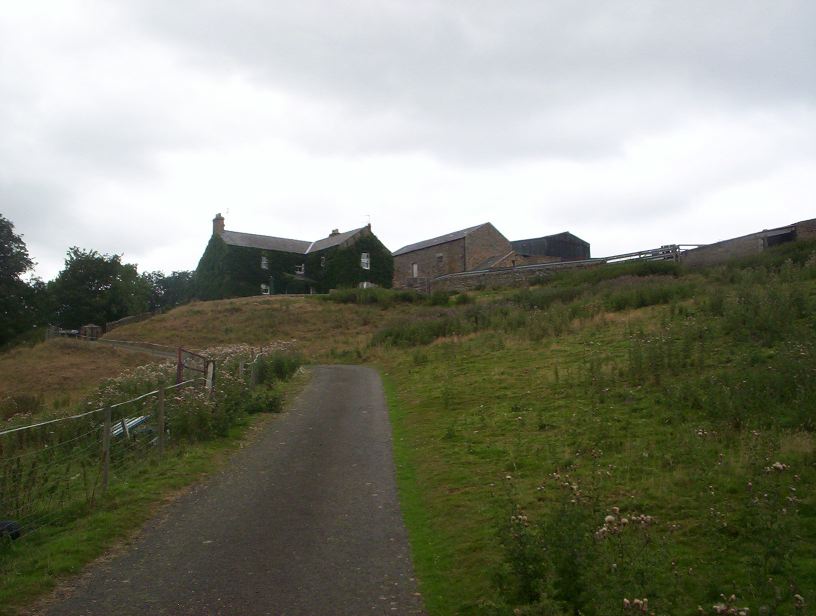
And here is a picture of the view from the Wall, looking southeast.

I've also posted another picture of the Wall here. You can click on any of the photos to get a larger image.
UPDATE (14 August): Peter Head e-mails:
I would respectfully suggest that it is not accurate to describe the Vindolanda tablets as "inscribed tablets" and therefore as "epigraphic" discoveries. They are predominantly written by pen in ink on the wood as discussed at the Vindolanda on-line site: "it is also misleading to categorise them, as is usually done, as 'incised' rather than `written' material." (http://vindolanda.csad.ox.ac.uk/tablets/TVI-2-1.shtml)Yes, they are mostly written in ink. It is the carbon ink that makes the writing stand out under infra-red light, as I noted above. It's the same with the Dead Sea Scrolls.
[in a broader discussion]
Thanks for the photos
I use "inscribe" to mean to write on something and "inscription" as something with writing on it. Likewise, I use 'epigraphic" to mean pertaining to ancient inscriptions. Therefore, texts written in ink on ancient surfaces are inscriptions and are of interest to the epigrapher. I don't have a Webster's in my office, but my American Heritage Dictionary agrees with these usages. This is the normal terminology for Northwest Semitic epigrapy (e.g., ink-inscribed ostraca are described as inscriptions and studied by epigraphers). Maybe Classical epigraphers use the terms differently. And there's some wiggle-room, since ancient scrolls generally aren't called inscriptions, although I suppose that technically they are. But I stand by my usage above.
HAPPY 90th BIRTHDAY to George E. Mendenhall:
George E. Mendenhall, Prof. Emeritus, Univ. of Michigan. Dept. of(From Herbert B. Huffmon on the Agade List.)
Near Eastern Studies, celebrates his 90th birthday, August 13,
2006, with the publication of his latest book,
Our Misunderstood Bible:
# Paperback: 64 pages
# Publisher: BookSurge Publishing (July 5, 2006)
# Language: English
# ISBN: 1419637223
List Price: $10.99
Book Description
Our Misunderstood Bible is a selection of some of the most
interesting and abused passages, and an examination of how they
came to be and how they evolved over time.
THE DAUGHTERS OF RASHI are the subject of a new novel by Maggie Anton, the first of a projected trilogy.
Subscribe to:
Posts (Atom)