Sunday, March 20, 2005

GEZA VERMES'S THE PASSION is reviewed by the London Times ("Religion: The Passion by Geza Vermes"). It concludes:
The central tension that Vermes highlights is that between history and faith. How can a historical document also be the basis of a religion? The Gospels try to square the circle by both recording events and shaping them to determine readers� response. While absolute objectivity may be impossible, this biased approach has left them increasingly scorned in our secular age. Which, Vermes states, is a loss.

To get into this beguiling book, you will need first to overlook a rather clumsy play by the publisher for the same audience who saw Mel Gibson�s The Passion of the Christ. The subtitle of the book and its glossy jacket ape the feel of �book of the film� editions. But once you are inside the pages, you realise it is the polar opposite of Gibson�s muddled literalism and gore. This is subtle, teasing and erudite stuff. It may be ultimately inconclusive, as of course it has to be, but it will give Easter a whole new dimension for all but the most closed of minds.

Vermes always has an interesting perspective, built both upon critical sifting of the material in the Gospels and on placing the sifted material in its ancient historical, philological, and geographic context.

If you're in Britain, you can get the book at a discount through the Times. See the bottom of the article.

Saturday, March 19, 2005

NON SEQUITUR OF THE WEEK: Performance artist Sandra Bernhard in her current show, Everything Bad and Beautiful: "'Let me tell you,' she said, of Madonna pushing Kabbalah on Britney, 'that girl is a brilliant Aramaic scholar. When she read a portion of the "Canterbury Tales," I wept.'
THE QUMRAMICA BLOG now has last week's material fully posted. There are essay abstracts and seminar summaries for seminars on the Qumran calendrical texts and the Songs of the Sabbath Sacrifice.
TEMPLE MOUNT WATCH: The proposed mass protest of Jews on the Temple Mount on 10 April is getting rather different coverage in different places. In MichNew.com:
GOD-FEARING JEWS STAGE TEMPLE MOUNT TAKEOVER
By J. Grant Swank, Jr.
MichNews.com
Mar 18, 2005

"'We must conquer the Temple Mount to abort the withdrawal plan. If 50,000 people go to the Temple Mount, our Father in heaven will see and the (Israeli) institutions will not be able to remain indifferent,' said one of the takeover planners."

Israeli Prime Minister Ariel Sharon plans to oust Jews from their Gaza Strip homes starting July 20. Then Strip is the Palestinian Authority's. Jewish police guards will yank "fellow" Jews from their dwellings. To go where? To motels and hotels. And what about their furniture? In warehouses somewhere. Sound bizarre? Yes. And it's also illogical and unjust.

Therefore, devout Jews are rehearsing today how to take over the Temple Mount in order to draw attention to their righteous indignation against the Sharon agenda. The devout Jews' scheme of course also sets up conflict potential with Muslims throughout Israel, particularly in Jerusalem. A Jewish civil war could result. A war between Jew and Arab could erupt.

[...]

Then there are these new details:
American Jews likewise are boarding planes to join in on the mob scene in Israel. Professionals such as doctors, teachers, lawyers are planning on moving into vacated dwellings in the Strip as well as lining the avenues and beaches in order to prevent Jewish police guards from ousting Jews from their houses.

"According to the report, extremist Jews will hold a 'dress rehearsal' on the Temple Mount, or the Jerusalem mosques complex, the third holiest site for Muslims, in three weeks time.

"Dozens of police reinforcements were deployed near the compound last month, fearing possible attacks by Jewish extremists, who might try to sabotage the Prime Minister's Gaza plan."

Then in TurkishPress.com (from APF and Turkish Press) we read:
Threats against Al-Aqsa mosque are "ticking bombs": Imam
Published: 3/18/2005

JERUSALEM - The imam of Jerusalem's Al Aqsa mosque on Friday warned that threats by Jewish extremists against the sacred complex were "ticking bombs" and said the Israeli government must take responsibility for containing the threat.

[...]

On Wednesday, Israel private television screened a video showing far right-Jewish extremists, including rabbis, discussing ways of occupying the site in a bid to sabotage Israel's planned withdrawal from Gaza.

"We must conquer the Temple Mount to abort the withdrawal plan. If 50,000 people go to the Temple Mount, our Father in heaven will see and the (Israeli) institutions will not be able to remain indifferent," said one participant.

In response, Palestinian prime minister Ahmed Qorei warned of the dire consequences which would result from any such move and called on Israel to act decisively..

"We warn that the region will explode if there is any attack against Al-Aqsa," he told reporters in the West Bank town of Ramallah.

[...]

The one thing I think both sides have right is that this plan could lead to an eruption of violence. I hope we're not watching a disaster in the making. I call on everyone involved to keep this peaceful.
THE IRAQI ASSYRIANS and their political situation get favorable coverage in a Reuters article:
Iraq's Assyrians Seek Voice in New Government
Fri Mar 18, 2005 05:08 PM ET

UNITED NATIONS (Reuters) - Supporters of Iraq's minority Assyrians urged the United Nations and the European Union on Friday to pressure Baghdad to give Assyrians more humanitarian aid and a voice in the new Iraqi government.

"Iraq was liberated to have freedom for everybody, not just the Shi'ites, Kurds and Sunnis," Andy Darmoo, who heads the "Save the Assyrians" campaign told a news conference at U.N. headquarters.

Iraq's Assyrians are Christians and speak Aramaic, the language of Christ. There are an estimated 1 million to 1.5 million Assyrians living in Iraq, most of them in the north.

They are the target of a "quiet campaign of ethnic cleansing," according to Darmoo, who left Iraq in 1965 and now lives in Kent, England.

[...]

The Washington Post also carries the article. Keep that spotlight right there!

Friday, March 18, 2005

WHY THE JEWS REJECTED JESUS: The Turning Point in Western History is the title of a new book by David Klinghoffer. It was reviewed yesterday for the A.P.:
Author looks at 'Why Jews Rejected Jesus'
FAITH

By RICHARD N. OSTLING
Associated Press Writer

During the Lenten season of 2004 there was considerable fury over Mel Gibson's film "The Passion of the Christ" and its depiction of Jewish leaders conspiring to hand Jesus over to the Romans for crucifixion.

A year later, just in time for Good Friday of 2005, a book by Jewish writer David Klinghoffer says of course that's what the Jewish authorities did: "Why the Jews Rejected Jesus: The Turning Point in Western History" (Doubleday).

He bases that not only on the New Testament -- whose history he distrusts to a fair extent -- but on the Talmud, Judaism's authoritative compilation of Bible commentary and rabbinic law, and later Jewish sages such as Maimonides.

[...]

Klinghoffer already published some of his ideas on Jesus in the Talmud in January and I have commented on them here. It seems he also delves a bit into counterfactual history, for which Jesus and the rise of Christianity have been popular subjects.
TEMPLE MOUNT WATCH: Still more on the plans of the Revava group to swarm the Temple Mount on 10 April. The BBC now has a story on it and it includes a response from the Palestinian Authority:
Palestinian Prime Minister Ahmed Qurei has appealed to Israel to stop any action against the compound.

"We warn that the region will explode if there is any attack against al-Aqsa," Mr Qurei told reporters.
THE PROFESSION OF "SCRIBE" is profiled in the Jerusalem Post:
Written by hand
By BEREL WEIN

One of the most honored professions in Jewish life is being a scribe or sofer.
[...]

The scribe writes the Torah, the parchments inserted into the boxes of teffilin and the parchment inserted within the mezuzot affixed to the doorposts of Jewish homes and premises. Thus, a scribe is usually called a sofer stam - the word stam being the acronym for sefer torah, teffilin and mezuzot.

Scribes are also employed to write gittin - bills of divorce, which must be written individually, by hand, for each particular case. A scribe writes with a quill made from the feather of a fowl and uses ink specially prepared for the task. His work is exacting, time-consuming and painstaking. No mistakes are allowed and in today's technologically advanced world, there are special computer driven programs that check the work of the sofer for accuracy and correctness.

[...]

Lots of interesting information here and worth reading in full.

Thursday, March 17, 2005

TEMPLE MOUNT WATCH: More on the plans of the Revava group to swarm the Temple Mount on 10 April. Ha'aretz has an article today with this news:
10,000 rightists plan to visit Temple Mt.
Right-wing extremists have announced a campaign under which they are seeking to bring some 10,000 people to the Temple Mount on the eve of the Hebrew month of Nissan. The police have no intention of allowing the plans to be put into practice.

Police usually allow Jews to visit the Temple Mount in groups of a few dozen individuals, with Jewish prayer sessions banned at the site, in keeping with a government decision from 1967. The High Court of Justice has rejected numerous petitions against this decision.

[...]

Also, the Jerusalem Post has a short article on the planned protest which refers to "tens of thousands" of people rather than 10,000. But it appears that the Arutz Sheva headline " Channel 2 Claims 100,000 Jews Plan Temple Mount Protest" is a mistake, since the article refers to only 10,000. It looks to me as though 10,000 is the number that is actually being used.
LEONARD GREENSPOON has an essay on the problem of translating the sacrificial terms in Leviticus in the Forward this week ("PORTION: Translations And Transliterations - Leviticus 1:1-5:26"). He advocates a radical solution:
In my opinion, all readers, and especially Jewish readers � for whom these chapters should retain a lively relevance as they did for talmudic rabbis (most of whom, like us, lived after the fall of the Jerusalem Temple, and the end of its sacrificial system) � are best served by transliterating these terms rather than translating them: Thus, we would have in chapter one, "olah"; in chapter two, "a minchah offering/gift", and in chapter three, "an offering of shelamim" (Fox anticipates this with his "slaughter-offering of shalom"). To my mind, this is the best way to alert readers to the fact that, at this point, they need to take some extra time to consider both the nature and purpose of these rituals.

In the best of all worlds, this approach would lead all readers to go look up these offerings and learn something about them. But in our world I fear it would just make Leviticus a more intimidating book than it already is to lay people. But it would be an interesting experiment.
THE SBL FORUM for March is devoted to forgeries. Here's a list of the articles. I don't have time to read them right now, but they look very interesting. I may comment on some of them later.

The Antiquities Market, Sensationalized Textual Data, and Modern Forgeries: Introduction to the Problem and Synopsis of the 2004 Israeli Indictment
by Christopher A. Rollston
and Andrew G. Vaughn

The Forgery Indictments and BAR: Learning From Hindsight
by Edward M. Cook

The Crisis of Modern Epigraphic Forgeries and the Antiquities Market: A Palaeographer Reflects on the Problem and Proposes Protocols for the Field [1]
by Christopher A. Rollston

The Probability of Forgeries: Reflections on a Statistical Analysis
by Andrew G. Vaughn
and Carolyn Pillers Dobler

The Jerusalem Syndrome in Biblical Archaeology [1]
by Yuval Goren

The Saga of the Yonan Codex
by Bruce M. Metzger

Epilogue: Methodological Musings From The Field
by Andrew G. Vaughn
and Christopher A. Rollston

Access to my blog accounts has been somewhere between spotty and nonexistent for some time. I hope the situation improves soon, but meanwhile I'll try to fill in the backlog as time and dodgy Blogger software allow.

Wednesday, March 16, 2005

SEPTUAGINT ESSAY: Jennifer Dines of Cambridge University has a short essay on the Septuagint posted at the Bible and Interpretation website:
The Septuagint: Greek Scriptures for
Greek-speaking Jews and Christians:
Some Current Research


There are fascinating implications here for how the Bible was used and interpreted in the third to first centuries BCE, but the work is difficult and delicate and scholars often come to different conclusions. This is not surprising since they have been researching these questions piecemeal for at least the last hundred years, often starting from differing premises.

The essay goes through some current issues in Septuagint research and links to the websites of a couple of relevant projects.
TEMPLE MOUNT WATCH: WorldNetDaily has an article on the plan of the Revava group to bring thousands of Jews to the Temple Mount on 10 April.
10,000 Jews to ascend
Temple Mount

Group seeks to reclaim
Israeli control of holy site

Posted: March 16, 2005
1:00 a.m. Eastern

By Aaron Klein
� 2005 WorldNetDaily.com

JERUSALEM -- A grassroots Jewish organization plans to bring 10,000 Jews next month to the heavily restricted Temple Mount to spark Israeli dialogue about reclaiming the holy site from its Muslim custodians.

"The Temple Mount is the single holiest place in the world for Jews. It's about time the Israeli government restores it to the Jewish people, where it belongs," David Ha'ivri, chairman of Revava, the group orchestrating the gathering, told WND.

The visit, scheduled for April 10, would be the largest Jewish presence at the Temple Mount since the ancient Temple period, said Haivri.

[...]

This is a messy situation. I have no sympathy with the whole "third temple" agenda, for reasons I've explained before (see first link above). But again, this group has a right to assemble peaceably and they say that is their intention. It's not clear whether the event will happen at all, since the police say they have not made any decisions yet. If it does, I just hope it all stays peaceable.

Tuesday, March 15, 2005

THE JOURNAL OF NEAR EASTERN STUDIES has a new issue out (64.1, January 2005). It includes a couple of book reviews of interest:
Zipora Talshir, I Esdras: A Text Critical Commentary (Ralph W. Klein)
59
PDF OF BOOK REVIEW (41 kB)


Bernard A. Taylor, X Congress of the International Organization for Septuagint and Cognate Studies: Oslo, 1998 (Ralph W. Klein)
60
PDF OF BOOK REVIEW (35 kB)

Click on the links to download the PDF files. I think a paid personal or institutional subscription may be required for access, but I'm not sure.
THE PASSION BY GEZA VERMES is reviewed by Karen Armstrong in the London Times:
The Passion by Geza Vermes
reviewed by KAREN ARMSTRONG
Not the Gospel truth
THE PASSION
By Geza Vermes
Penguin, �6.99; 130pp
ISBN 0 141 02132 2
Buy the book

The patient, scholarly work of Geza Vermes has performed an invaluable service by placing the career of Jesus in its original Jewish setting. Now he has turned his attention to the Gospel accounts of Jesus�s Crucifixion. Christians believe that Jesus, God incarnate, died on the Cross to save them from the sin of Adam in an act of supreme love. Yet the story has inspired shameful atrocities, because the Gospels place the blame squarely on the Jewish people. After the reading of the Passion on Good Friday, crowds of worshippers regularly stormed into the Jewish districts, looting and killing, to take revenge.

[...]

Naturally, Mel Gibson's movie also figures in the discussion.

(Via Bible and Interpretation News.)
THE ARTICLE ON CODEX SINAITICUS from the Dallas Morning News has been reprinted by Christianity Today [correction: Christian Today - see update] with errors intact. I would have expected them to have a clue and add some corrections.

UPDATE: Oops! Peter Head e-mails:
It is "Christian Today" - a UK based Christian news agency (it is too easily confusable I think, perhaps deliberately so). Not to excuse poor journalism.

I did email the author with the following list:


Dear Eunice,

It is a pity for Christian Today to publish such an un-informed article on Codex Sinaiticus:

E.G.:
Sinaiticus was originally produced on high-grade papyrus
WRONG: parchment/vellum = animal skins

written between the 1st and 4th centuries A.D.,
WRONG: written in the fourth century

The Codex was produced as the Greek version of the principal Jewish and Christian scriptures to match Greek heritage.
UNKNOWABLE CONCLUSION


The Codex has a very special significance in Theology because the texts were written so soon after the life of Jesus, therefore it is the largest and longest-surviving Biblical manuscript in existence, including both the Old and New Testaments.
WRONG: many earlier fragments, individual books and smaller collections of Biblical books in Greek survive. Sinaiticus is 300 years after the life of Jesus. It is neither the largest Biblical manuscript in existence nor the longest-surviving (Codex Vaticanus is more complete in the OT and on most accounts older).

In addition, it contains two Christian texts written by the Shepherd of Hermas and Apostle Barnabas at around 65 A.D.
WRONG: Both Hermes and Barnabas (Not actually by the apostle) are mid-second century compositions. CHECK ANY REFERENCE BOOK!

However, since then, the texts were divided when visitors bribed and deceived monks into letting certain sections be removed for further examination in Russia, Britain and Germany, according to the Dallas Morning News.
WRONG: DMN gives only the Orthodox side of a complex issue (we might expect such from Dallas I suppose).

By comparing the texts in the world's oldest Bible with the prevalent interpreted Bible in modern language, the team of top experts and scholars involving in the project will be able to trace back and research how and more importantly, why changes were made to the original version of the Bible.
NONSENSE: this doesn't make any sense as a research method. Nor is it widely accepted that Sinaiticus is 'the world's oldest Bible'

Thanks, Peter, for the correction and my apologies to Christianity Today.

Also, on the Textual Criticism list Peter notes the following more accurate but still overstated press release from the British Library.

Monday, March 14, 2005

A NEW HISTORY AND ARCHAEOLOGY CENTER IN ISRAEL is under discussion in the Knesset:
MKs back memorial day for `father of voluntary transfer'
By Dalia Shehori
(Ha'aretz)

Under a bill endorsed by 50 MKs, the state would set up a Rehavam Ze'evi Heritage Institute to receive the same resources as those allocated to the Yitzhak Rabin Heritage Institute. The bill would also dedicate a annual day of mourning for the memory of the man who put the concept of "transfer" on the public agenda.

[...]

Former tourism minister Ze'evi, who founded the Moledet Party, was killed by members of the Popular Front for the Liberation of Palestine in Jerusalem in 2001.

The bill was introduced by National Union MK Aryeh Eldad to perpetuate the work and heritage of Rehavam Ze'evi through the establishment "of a Rehavam Ze'evi center for the study of the history, geography and archaeology of the Land of Israel," with an emphasis on "the vision, work and heritage of Rehavam Ze'vi."

There are fractious politics behind all this, which I know little about and don't want to get mixed up in. But another Ha'aretz article today, "A requiem for Gandhi," has a detailed analysis of the political context.

The concluding paragraph of the article pulled me up short:
Yahad MK Yossi Sarid, on the other hand, said there was no reason to establish "a monument to a racist theory."

I didn't know that there was an Israeli political party called "Yahad." This word means "together" but it was also used by the Qumran sectarians in the idiosyncratic sense of "community" as a title for their own group. The Yahad party seems unaware of the earlier usage. It is a leftist social democratic party that would not exactly look on the Qumran sectarians as their ideological forebearers. Here is the Wikipedia article on "Yachad" and here is the party's own basic covenant.
A NEW TYNDALE TECH E-MAIL was distributed by David Instone-Brewer a while ago and is now up on his website. This one is on Rabbinics and Jewish Research. Many of the resources for ancient Judaism have been noted at one time or another already on PaleoJudaica and lots are in my links page, but it's useful to have them all collected on this page as well. When I get around to it, I'll add the remaining relevant links to my page.

Sunday, March 13, 2005

THERE'S MORE ON HERCULANEUM and the proposed excavation to try to recover more carbonized scrolls in the Art Newspaper ("British scholars call for the excavation of the Villa of the Pa[p]yri"). In this week's Explorator (link not yet available) David Meadows points to this two-part article. One writer is Martin Bailey, otherwise unidentified, and the other is Andrew Wallace-Hadrill, who "is director of the British School at Rome and also of the Herculaneum Conservation Project." The excavation project seems more tentative here than I had thought. Bailey writes:
Outside funding for Herculaneum has already come from David Packard, whose family helped set up the Hewlett-Packard computer company. At present Mr Packard wants money to be devoted to preserving what has been found, rather than spent on new excavations. His US-based Packard Humanities Institute is backing the Herculaneum Conservation Project, which has already spent $2 million. Mr Packard says that �when the Italians decide it is time to resume excavation at the Villa of the Papyri, our foundation expects to be in a position to offer appropriate financial support��but �for the present, conservation is the responsible priority.�

Wallace-Hadrill confirms this in his contribution, taking very much the line that further excavation is desirable and should be thought about but is not in any way urgent:
It is right that it look at every aspect of the problem in a far-sighted way before leaping to conclusions. In terms of urgency, the unexcavated part of the villa stands in no danger.

Equally, in terms of urgency, the already excavated portions of the same site stand in great danger. The only responsible way forward is that embraced by the Superintendency, the Packard Humanities Institute, and the international world of archaeology: of saving and recording what we have while there is still time, and planning ahead to ensure that any future excavations will not add to an existing crisis.

The emphasis in this article is different from the London Times piece of 13 February titled "Millionaire to fund dig for lost Roman library" (noted here on PaleoJudaica). This article seemed to say that there was no conflict between excavation and conservation and that Mr. Packer was ready to fund both. As I look over it again that does seem to be the message. But the Art Newspaper has Packard and the director of Packard's conservation project putting much more emphasis on conservation and seems to indicate that there are no actual plans for excavation in the foreseeable future. I'm not sure why the tones of the articles are so different. Was the Times just being selective and overly enthusiastic in its presentation? Does anyone have more information?
THE HADRIAN MOVIE - yet another pastsploitation flick. David Meadows has some info over at Rogue Classicism. I wonder how significantly the Bar Kokhba revolt will figure in it.
THE CODEX SINAITICUS digitalization project has come to the attention of the media and, as usual, they are garbling the story. Ed Cook has details over at Ralph.
AMIR DRORI, former director of the Israel Antiquities Authority, has died.
Commander of Golani Brigade during Yom Kippur War dies
By Haaretz Service

Israel Defense Forces reserve Major General Amir Drori, who was the commander of the Golani Brigade during the 1973 Yom Kippur war, died on Saturday during a trip in the Negev Desert.

[...]

Since his release from the IDF, Drori has served as the director of the Antiquities and Archaeological Authority.

May his memory be for a blessing.

Saturday, March 12, 2005

AMEN.
TEMPLE MOUNT WATCH: More Jewish-Temple denial, this time from the Palestine Chronicle. The Temple Mount Faithful are also making things interesting.
Jewish Settlers Plan to Storm Al-Aqsa Mosque
Friday, March 11 2005 @ 08:51 AM EST

"Extremist Jewish groups, which rally for the construction of the 'Temple Mount', are expected to join the storming, according to Israeli press sources.."

By Samer Khuwayera

NABLUS, West Bank - Extremist Jewish settlers are planning to storm Al-Aqsa Mosque, Islam's third holiest place, by next April, according to Al-Aqsa Institution for Reconstruction of Islamic Sanctities.

Leaders of Jewish settlers have declared some 10,000 settlers are planning to storm the holy mosque in a bid to perform Jewish �religious rituals� in the holy place, they claim to be the site of �Temple Mount�.

Leaflets are being distributed by Jewish settlers to urge Jews to join the storming of the Islamic holy site on April 10.

Extremist Jewish groups, which rally for the construction of the "Temple Mount", are expected to join the storming, according to Israeli press sources.

The campaign patron, David Hebrew from the Tfwah settlement in the West Bank city of Nablus, claimed that his campaign aimed at fostering what he termed �spiritual relations� with �Temple Mount� by performing the Jewish religious rituals within the holy mosque.

�Through this campaign, we are trying to bring some 10,000 Jews into the mosque,� he told Israel�s Channel 7.

The extremist Jewish settler pressed for opening up all entrances of Al-Aqsa Mosque before the Jewish people, claiming that Al-Aqsa belongs to Jewish people, not to Muslims.

I can't find complete verification of this story. Neither "David Hebrew" (which doesn't sound like a real name to me) nor "tfwah" (or "tfwa") show up anywhere on Google except this in this article. I can locate no mention of a David Hebrew on the Temple Mount Faithful website (see below). Can anyone in Israel confirm that there is such a settlement in Nablus or that someone named David Hebrew was interviewed on Israel's Channel 7 about these matters?

What I can verify is that the Temple Mount Faithful is planning (or at least hoping), not to "storm" the Temple Mount, but to assemble there on 10 April to perform a Passover sacrifice on an altar they say is already there.

Now let me be quite clear. I am strongly opposed to the objectives of the Temple Mount Faithful. (Links via Indy.media.ie.) I have no interest in their theological agenda but I object on archaeological and historical grounds. I don't want anybody interfering with or damaging the historical treasures that are already on the Temple Mount, including the mosques and the ancient archaeological strata of the site. Even if they decided that the site of the temple wasn't where the mosques are so that the mosques don't need to be moved, the thought of the damage that would be done to the archaeology of the site by building a third temple there makes me ill.

All that said, I do respect the right of these people to free speech and peaceable assembly, no matter how much I oppose their agenda. There is sometimes a fine line between these rights and incitement and I leave it to the Israeli government to decide where that line is. I'm glad I don't have to make that decision.

Israel claims Al-Aqsa Mosque was built on the so-called Temple Mount, an allegation refuted by scores of world historians.

This is a variation on a stock Temple-denial sentence we have seen repeatedly before. My comments previously apply as well here.

The article concludes:
Archeologists have also warned that ongoing Israeli excavations weakened the foundations of the mosque, cautioning it would not stand a powerful earthquake.

A part of the road leading to one of the mosque�s main gates collapsed in February, 2004, due to the destructive Israeli digging work.

Israeli soldiers also attempted in June, 2004, to storm the mosque�s prayer hall (Al-Musallah Al-Marwani) and ended by force restoration works that were underway there.

The first paragraph is a bit rich, given the massive destruction wreaked upon the Temple Mount by the WAQF. For a rather different take on the collapse mentioned in the second paragraph, go here. Note also that illicit digging by the WAQF is considered "restoration."

For my take on how the Temple Mount should be treated, see here.

UPDATE: "Manuscript Boy" e-mails:
I would have to check the posters all over Jerusalem to make sure, but
I think the name is David Ivri. Tafwah is surely Kfar Tapuach. And they plan to bring thousands up to the Temple Mount before Passover. It seems to be a different group from the Temple Mount Faithful.

I should have thought to Google "David Ivri." The name does exist, but the only references I can find are to a former air force commander, evidently not the man in question. In any case, the basic elements of the story look to be correct.

UPDATE: Manuscript Boy e-mailed again with the website of the group. The English version is http://www.revava.org/index.php. There's a Hebrew version as well, of course. David Ha'ivri is one of the named leaders of the group.
SEXY APOCRYPHA? Well, I'm glad someone thinks so, even though the movie Constantine doesn't seem to rise to that level. Columnist Giles Coren reviews the movie for the London Times. You may want to skip the first half, which consists of self-indulgent Coren blather. But the second half, when he actually gets to the film, is kind of funny.
So imagine my delight when I heard he [Keanu Reeves] was to take the title role in Constantine. After Colin Farrell as Alexander the Great and Brad Pitt as Achilles, what could be more natural than Keanu as the man who converted Rome? Only Keanu could give credence to the story of the Emperor who saw a vision of the Cross before the Battle at the Milvian Bridge, built a new capital on the Bosphorus and laid the foundations of Christendom. In hoc signo vinces, duuuude.

When I got to the cinema, though, the posters were not promising. It was Keanu, back in his Matrix-period black coat, toting a silver machinegun in the shape of a cross. Under him, the legend: �The wager between Heaven and Hell is on Earth.� Um, like, I totally know that, dude. Are we talking Job, here? Or the temptation of Christ, maybe? Or the sort of sexy apocrypha that Milton worked up into Paradise Lost? The Bible is full of bets. They�re always the Devil�s idea, admittedly, but God just can�t seem to say no if the odds look half tasty. He�s a regular Sky Masterson, is the Lord.

[...]

As ever in Hollywood movies, leather-bound books are used to show that it�s all very old and mysterious. Nothing freaks out the Yanks more than a book. The genre here is legal-thriller meets classy historical adventure, as succinctly indicated when, mystified by the arrival of the wrong kind of zombie (a �soldier-demon�, I believe it is) Keanu yells to Rachel Weisz, in that gurgling wheeze of his: �Check the scrolls, see if there�s any precedents!�
[...]

Be warned, however, that the end of the review seems to have a major spoiler in it.

Friday, March 11, 2005

A BYZANTINE-ERA SYNAGOGUE IN JERICHO HAS BEEN DESTROYED BY VANDALS according to Arutz Sheva:
Arabs Destroy Ancient Jericho Synagogue
17:04 Mar 10, '05 / 29 Adar 5765

(IsraelNN.com) The ancient synagogue in Jericho, known as the �Shalom Al Yisrael� (Peace on Israel) synagogue has been destroyed by Arab vandals, says the former head of the yeshiva that studied there until the start of the Oslo War.

[...]
ON THE QUMRANICA BLOG I have posted the abstract of this week's essay on 4QMMT, a summary of the seminar discussion, and some links on the Songs of the Sabbath Sacrifice. The latter is one of our topics next week. Do have a look.

Also: Blogger has been suffering numerous server errors recently, which has led to annoyances such as stuttered posts and posting lost during publishing. It also makes it very hard sometimes to correct typos. Apologies in advance for any problems.

Thursday, March 10, 2005

TEMPLE MOUNT WATCH:
No relinquishing Western Wall, poll finds
By Nadav Shragai (Ha'aretz)

Ninety-one percent of the Jewish public would be unwilling to give up Israeli control of the Western Wall, 46 percent would agree to joint Israeli-Palestinian control, or sole Palestinian control, with regard to the Temple Mount, according to a poll to be aired tonight on a program on the Knesset television channel.

[...]
SOME HEBREW MATTERS:

Ed Cook relays Dave@GracePages's request for a recommendation for a grammar of biblical Hebrew. I can't be of much help, because I've never found one I really liked. I've used Lamdin and Seow long ago. Both are excellent grammars, but they overwhelm a beginner with too much information. Currently I use Martin's revision of Davidson's Introductory Hebrew Grammar. It's fine for the first semester. The level is right for first-year students, the explanations are generally good, and the exercises are helpful. The problem is that it crams all the derived stems, regular and irregular, into three chapters in the last fifth of the book, which again can overwhelm the students unless those chapters are stretched out quite a bit with supplemental material. I see that a number of people are recommending Kittel, Hoffer, and Wright. It seems to be out of print in the U.K., but maybe I should have a look at it anyhow.

Joe Cathey calls for a new chrestomathy of Hebrew and even suggests my name as a possible author. Thanks for the vote of confidence, but I have far too many other projects in progress right now. Also, I have to say I'm skeptical whether there's a market for a chrestomathy of biblical Hebrew. With BHS readily available, it's just too easy for a lecturer to assign passages straight from it, creating a personalized chrestomathy on the fly so to speak. There is also a good chapter by chapter listing of less frequently used biblical Hebrew vocabularly in Armstrong, Busby, and Carr's A Reader's Hebrew-English Lexicon of the Old Testament , so rapid reading of any part of the Bible is easy to assign too. It's true that sometimes annotations of difficult passages would be helpful, but such issues are often covered in class and I'm not sure that that annotations alone would create a sufficient market. Not that I'd be sorry to be proved wrong.

If instead you were to think of a chrestomathy involving (vocalized?) Qumran, Bar Kokba, and rabbinic Hebrew alongside biblical Hebrew, you might be able to demonstrate a greater need, but I think the market would be smaller too.

Wednesday, March 09, 2005

JACOBY'S FRAGMENTE DER GRIECHISCHEN HISTORIKER is being republished online in a new edition by Brill. David Meadows has the story. Excerpt from the announcement from Ian Worthington, the editor-in-chief of the project:
BNJ [Brill's New Jacoby] will appear online at the rate of 80-100 authors per year (approximately half of this number appearing every six months) beginning in January 2006. Each author will be subject to peer review and revision before publication. The advantage of online publication is that authors will be published as soon as all revision stages are complete, rather than having to wait years before appearing with others (in a numerical sequence) in a hard copy volume. When all 856 authors are online, in approximately ten years' time, hard copy volumes will be produced.

FGrH includes a number of Hellenistic Jewish authors and other related authors such as Berossus.

UPDATE: Sorry for the multiplication of this post. Blogger has been acting up a lot lately and after posting two or three copies of this in the afternoon, it refused to let me make any changes until now (11:00 pm).
MORE ANTIQUITIES-LOOTING ARRESTS IN ISRAEL:
Construction workers held for antiquities theft
By ETGAR LEFKOVITS

Eight Palestinian construction workers illegally
employed at a building site in Modi'in were under
arrest for carrying out antiquities theft at a nearby archaeological site, Israel's Antiquities Authority announced Tuesday.

The eight suspects were caught "red-handed" just after midnight Tuesday morning after a chase through a second temple period underground compound at the site, the head of the Antiquities Authority's anti-theft division Amir Ganor said.

[...]

Although this seems like good news, the conclusion of the article is discouraging:
Despite the overall drop in violence in Israel, the number of antiquities theft has risen more than 50 percent in the last year alone.

In 2004 there were 314 reported cases of antiquities theft, compared to less than 200 in 2003.

The phenomenon of antiquities theft has taken on gold rush dimensions, with an antiquities site now plundered every day on average.
ALAN SEGAL'S BOOK ON THE AFTERLIFE is reviewed in the National Catholic Reporter. Excerpt:
Alan F. Segal, professor of religion and Jewish studies at Barnard College, Columbia University, claims that even though the afterlife is beyond the purview of science, belief in life after death is older than the existence of Homo sapiens if ancient Neanderthal burial studies can be trusted.

This book is an extensive social history that traces the development and comparative cultural impact of a religious idea.

The author has studied the development of religious belief over 5,000 years of human history. He has mined rich insights about the afterlife from research into many ancient Near Eastern mythologies, rites and rituals. More recently, he has investigated the subject in Islam and compared life-after-death beliefs in the three great Abrahamic faith traditions.

Tuesday, March 08, 2005

MORE ON THE HERPES AND CIRCUMCISION STORY: The Commentator, Yeshiva University's student newspaper, covers it in the article "'Metzitzah Be Peh': The Dangers of a Custom Intended to Heal" by Ryan Nadel. It has with lots of new details about the controversy over the practice of metzitzah be peh, including an interview with Rabbi Dr. Moshe Tendler who contributed to the Pediatrics article that called for changes in the practice. The piece concludes:
Even though Rabbi Tendler's position of performing oral suction using a sterile instrument instead of direct oral contact has firm halachic support, Rabbi Yosef Shalom Elyashiv has publicly stated that, unlike AIDS, herpes does not pose a real threat to the baby and therefore the custom of direct oral suction is permitted. Rabbi Tendler pointed out that although Rabbi Elyashiv permits using an instrument to perform oral suction when there is a concern that the mohel might contract AIDS from the baby, which has never occurred, Rabbi Elyashiv does not allow an instrument to be used to protect the baby from herpes, a substantive and documented concern.

Monday, March 07, 2005

THE CODEX SINAITICUS is being digitally photographed. This is an unusually complicated project, because the leaves of the manuscript reside in four different countries. The Harvard Gazette reports on the work of a Widener Library photographer who is part of the team working on the project:
From vellum to pixels
David Remington offers expertise in project to digitize Codex Sinaiticus

By Paula Carter
Harvard College Library Communications

The Codex Sinaiticus is the earliest manuscript of the complete New Testament and the earliest and best witness, according to Bible scholars, for several books of the Hebrew Scriptures (Old Testament). Dating from the middle of the fourth century, the manuscript was originally written by hand on vellum (calfskin or sheepskin). Now, having endured into the 21st century, it will soon be replicated in pixels. Four institutions currently hold leaves from the Codex - the British Library, Leipzig University Library in Germany, National Library of Russia, and St. Catherine's Monastery in Egypt - and they have come together to create a digital reunification of the Codex Sinaiticus that will be published and placed on CD-ROM.

David Remington, collections reformatting photographer in the Digital Imaging and Photography Group in Widener Library, is serving on the Codex Sinaiticus Technical Standards Working Party, composed of representatives from each institution and digital imaging specialists. The international team's goal is to create a scholarly edition of the Codex and as exact a replication as possible.

[...]

This article via the Bible and Interpretation website. It's over a year old, but I haven't seen it before. The story has also received lots of attention on the Textual Criticism list in the last several days, starting when Jim West pointed to a German article about the project. Dave Washburn also noted the Harvard Gazette article and a brief notice on the SBL website. I wonder if Dirk Jongkind is involved.

One quibble regarding the Harvard Gazette article: Sinaiticus is "the earliest and best witness ... for several books of the Hebrew Scriptures (Old Testament)" in the Greek version, the Septuagint. The Dead Sea Scrolls are much earlier and cover almost all of the Hebrew Bible, albeit only in fragments.
ARCHAEOLOGY MAGAZINE has just published its March-April issue. As usual, there are lots of goodies. Note the following in particular:

"Forgery Fallout" (full text of brief interview with Eric Meyers)

Sandra Scham, "The Lost Goddess of Israel" (abstract)
"CARTHAGINIAN?" This brief ContactMusic.com, UK article gives a slightly longer version of the Vin Diesel quote about his forthcoming Hannibal movie:
DIESEL FOLLOWS GIBSON'S FOREIGN AND ANCIENT EXAMPLE

VIN DIESEL is following MEL GIBSON's example and employing ancient and little-known languages for his upcoming HANNIBAL THE CONQUEROR epic.

Gibson caused a sensation with his THE PASSION OF THE CHRIST movie last year (04) when he used ancient Aramaic in his biblical drama, and now Diesel will use JESUS' tongue as well as Iberian and Carthaginian to tell the story of the Carthaginian general.

He explains, "I'm going to make it a non-English multi-lingual film that represents the many languages that Hannibal employed in his army.

"So it will be Aramaic for Rome, Iberian for Spain, there will be some Carthaginian or some Maltese and it will represent all these different languages.

[...]

By Carthaginian I take him to mean Punic (the north African dialect of Phoenician). Reconstructing ancient Punic will be a much more challenging exercise than reconstructing first-century Jewish Aramaic. I will be following this story closely.

Sunday, March 06, 2005

WHAT WOULD JESUS DRIVE? Having seen this post by St. Andrews postgraduate Daniel Driver (who is also in my Dead Sea Scrolls course this semester), I made a suggestion to him about what the Jesus of the book of Revelation would drive. I see Daniel has posted on it here.
AN INDEX to scriptural citations in Charlesworth's two Old Testament Pseudepigrapha volumes is now downloadable in PDF format, produced by Kevin P. Edgecomb and available on his website. He writes:
One useful thing about this index is that it includes "both sides" of a citation. That is, if as in 1En 1.1 a citation is noted for PsSol 4.9, at PsSol 4.9 you will find a corresponding citation for 1En 1.1. This may or may not have been the case in the original OTP marginal notations. Imade certain to make it so in this index.

More introductory details can be found on the last page of the file (p. 178!). Looks extremely useful.

(Via Jim West's Biblical Theology blog.)
THE EBLA FORUM is an online forum on the Hebrew Bible and archaeology. The owner, Joel Ng, points to the following discussion threads as of possible interest to PaleoJudaica readers:

http://www.eblaforum.org/main/viewtopic.php?t=1099 ("From Manetho to Minimalism")
http://www.eblaforum.org/main/viewtopic.php?t=1118 ("Purity and Exile")
http://www.eblaforum.org/main/viewtopic.php?t=1170 ("Halpern's Hysteria")
http://www.eblaforum.org/main/viewtopic.php?t=1172 ("Was Goliath a Hoplite?")

There's also an associated blog, the Ebla Logs. This posting on it floats the interesting possiblity of a biblical studies blog carnival. That sounds good to me and I'll be happy to contribute posts and to host it now and again (the latter not any time soon though) - as long as someone else gets it started and does the overall organizational work. What do other bibliobloggers think?

Saturday, March 05, 2005

THE MOVIE CONSTANTINE is getting mixed reviews, but a lot of people seem to like it. Here's a pretty positive take (3 stars out of 4) from the Boston Herald:
Constantine

( R )

Damned good fun: Reeves scares up thrills in `Constantine'
Review by James Verniere
Friday, February 18, 2005

Move over, Hellboy.

In ``Constantine,'' Keanu Reeves, fresh from battling the evil machines of ``The Matrix,'' takes on demons from hell who have the power to enter our realm. It's a supernatural thriller for our terrorist-bedeviled times, if not a training film for the Department of Homeland Security.

Based on the Vertigo/DC Comics' ``Hellblazer'' series, the film, which is set in present-day Los Angeles, might be described as mysticism for headbangers. It's also a kind of B-movie follow-up to ``The Passion of the Christ'' insofar as some of it is in Latin, it's about redemption and is steeped in Roman Catholic beliefs, apocrypha, icons and rituals, beginning with that favorite Catholic horror movie staple, the exorcism.

[...]

It also has a female version of the angel Gabriel, played by Tilda Swinton.

It's interesting to note that there's even sympathetic interest in the movie in Baptist circles. Also, blogger Tim Bulkeley and his teenage son saw it and Tim thinks "it could provide the stimulus for lots of good theological discussion, and even an old-fashioned revivalist appeal to conversion." And there's already a spinoff video game.

Because of Rachel Weisz my professional interest in media and religion, I suppose I'll have to get around to seeing it.

UPDATE: Chuck Jones e-mails:
For another take on Constantine have a look at David Denby's review
in The New Yorker and in particular the final few sentences:


"..."Constantine" turns Catholic doctrine, ritual, and iconography
into schlock. God's warrior wins, but is that enough to justify the
tawdry, promiscuous borrowing? Will the trashy exploitation of
Catholicism in movies ever end? Imagine a Jewish version of the
spectacle-"Angel," starring Vin Diesel, in which God's messenger
stays Abraham's hand in mid-sacrifice and then earns His approval by
lowering himself into cursed pharaonic tombs with tied-together
prayer shawls. In a Hindu version-"Vishnu," with Nicolas Cage-Shiva
unleashes his snakes on the outskirts of Poughkeepsie and starts a
war between truck drivers and apple pickers. Somehow, I think these
projects might be shelved. Yet terrible movies like "The Exorcist"
and "The Passion of the Christ" and "Constantine" get made and become
enormously popular. I will leave the issue of blasphemy to experts.
But maybe some of the audience should wonder if they aren't
performing the Devil's work by sitting so quietly through movies that
turn wonders into garbage."

http://www.newyorker.com/critics/cinema/index.ssf?050307crci_cinema

Friday, March 04, 2005

THE BIBLIOBLOG BLOG IS BACK! An improved model too.
PHILO OF ALEXANDRIA is cited by Arutz Sheva in a call for passive resistance to Sharon's disengagement plan. David Meadows has the story over at Rogue Classicism.
A MANIFESTO FOR DEALING WITH THE FORGERY CRISIS has been published on the Bible and Interpretation website by Christopher Rollston and Heather Dana Davis Parker.
Responses to the Epigraphic Forgery Crisis:
Casting Down the Gauntlet to the Field
and to Museums


During recent years, the public has often been inundated with sensational stories of �new epigraphic discoveries�: the �Ya�akov Ossuary� (�James Ossuary�), the �Jehoash Inscription,� �the Moussaieff Ostraca,� and the �Ivory Pomegranate� are some of the most notable. Dominant voices have touted such epigraphs as being of great significance �for the field� and �for the faith.� Voices of caution and moderation (that note the absence of an archaeological pedigree and the potential of forgery) have been quelled with substantial success.

There's lots of interesting stuff here. Two points are especially important: "For this reason, the default position with regard to non-provenanced epigraphs should now be methodological doubt, regardless of the 'sensationalism' surrounding the epigraph." Then, "Moreover, museums and collections should begin to be even more intentional about addressing the problem by exhibiting forgeries and including discussions of the problems associated with non-provenanced artifacts." The Israel Museum is currently doing this with the Ivory Pomegranate and it's a good policy in general. Both of these seem to me to be eminently sensible policies.

And don't miss the notes, which have lots of interesting tidbits. For example, Rollston has another piece on the forgery crisis coming out in the March issue of the SBL Forum - any time now, I assume.

Thursday, March 03, 2005

THE QUMRANICA BLOG has been updated with the abstract of the first seminar paper (on the Hodayot) and a summary of the seminar discussion. Now that we're in the seminar phase of the course there will be abstracts and seminar summaries (usually two of each) posted each week of class.
MORE ON THE HERPES AND CIRCUMCISION STORY in the Forward. It seems that the practice suspected of causing the infection still has its defenders.
Following Baby's Death, Orthodox Group Urges Followers to Drop Disputed Ritual
By Eric J. Greenberg
March 4, 2005

In response to the death of a New York baby boy from herpes, the top union of Modern Orthodox rabbis is urging Jews to abandon the ancient ritual practice of suctioning the blood by mouth directly from the baby's penis during circumcision.

The Rabbinical Council of America, representing more than 1,000 rabbis, issued a policy statement this week arguing that instead of direct oral suction the tradition known as metzitzah be-peh could be fulfilled with the use of a tube. The statement came following the death of a New York baby from herpes, which officials suspect might have been transmitted from the mouth of a Hasidic mohel during the circumcision process.

[...]

RCA's statement is expected to upset Hasidic sects and other ultra-Orthodox communities. Leaders of these Orthodox camps have been vigorously defending the practice of direct oral suction since it came under attack last month ...

Government or religious attempts to ban the direct oral practice were denounced in a pointed February 18 editorial, by Rabbi Pinchos Lipschutz, editor and publisher of Yated Neeman, an ultra-Orthodox newspaper.

[...]
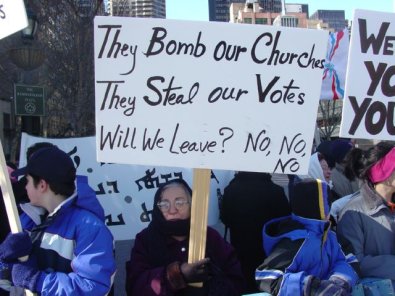
PROTEST IN ARAMAIC:
Update on the Assyrian Voter Lockout Protest At the UN

(AINA) -- The Assyrians (also known as Chaldeans and Syriacs) on the East Coast of the United States gathered to protest the voter lockout of Assyrians in the Iraq elections. The demonstration was held at the United Nations on February 19.

Nearly 100 mostly young people chanted, sang and prayed in Syriac for two hours behind a police barricade. They carried large banner signs in Assyrian (neo-Aramaic), English and in Chinese, all of which addressed the problem of the six towns east of Mosul which did not receive ballots despite two days (Jan 30 and 31) of waiting to vote. These are the same towns in which the candidates on Assyrian list (204) had campaigned for three days, and hundreds of thousands of votes for ChaldoAssyrian representation would have been cast had the people not been prevented from voting. As it was, because the voting did not take place, only enough votes were counted to seat one independent ChaldoAssyrian representative. Four other ChaldoAssyrians came in under the auspices of the leading Kurdish list and one, from Baghdad, gained a seat under the Allawi list.

[...]


The sign behind the woman wearing glasses is in Syriac, but I can't see enough of it to read it.

I hope these people get the attention they deserve.
WILLIAM DEVER gave a lecture in New Orleans in February which challenged the minimalists.
Scholar: Archaeology rebuffs effort to erase biblical Israel (Baptist Press News)
Mar 2, 2005
By Michael McCormack

NEW ORLEANS (BP)--Revisionist scholars in Europe are ignoring a wealth of archaeological evidence in seeking to discount and, ultimately, erase belief in the biblical Israel, noted archaeologist William Dever said at New Orleans Baptist Theological Seminary.

[...]

Though this postmodern movement seeks to sap the Bible of its historical significance and accuracy, Dever maintains that the archaeological evidence supports the biblical accounts of Israel and its kings. His presentation focused on structures he and other archaeologists have uncovered throughout the Holy Land that point to Solomon and the Solomonic Temple. He began with 1 Kings 9:15-16.

[...]

He includes lots of interesting details on the archaeology of Gezer, Hazor, and Megiddo. And it seems that Steven Ortiz, of the New Orleans Baptist Theological Seminary (and one of Dever's students) is hoping to reopen the Gezer excavation and to carbon date some material from it. The debate goes on ...

UPDATE: This piece is receiving lots of attention on the ANE list. (Start here.) Note in particular the comment of Niels Peter Lemche:
But think of a sentence in the summary of his New Orleans lecture like this: In fact, Dever said, they have recently argued that Hebrew is not a semitic language -- a garbled summary of an argument that biblical Hebrew may be a kind of artificial language, a kind of 'Mandarin' created for the purpose of writing biblical texts (like Qur'an Arabic is a bit different from other written Arabic, and even Homeric Greek different from other written Greek). However, the argument that it is not a semitic language and that the revisionists are claiming that is of course nonsense, and only show that Dever is a least not a properly educated biblical scholar, but exactly a biblical archaeologist. The sentence must be considered an obvious misprission.

My experience is that when the media portray a scholar as saying something strangely garbled, it's almost always the reporter who got it wrong, not the scholar. I would give Dever the benefit of the doubt here. Would he or someone who actually heard the lecture like to comment?

Wednesday, March 02, 2005

TECHNOLOGY WATCH: The "atomic paring-knife" laser. Cool.
'Atomic Paring Knife' Will Help Probe Ancient Civilizations

Newswise � Mississippi State researchers are acquiring a high-tech laser instrument described as an �atomic paring knife� that will be used, among other things, to probe the mysteries of ancient civilizations.

Hailed as the first such unit of its type in the Southeastern United States, the university�s Laser Ablation-Inductively Coupled Plasma-Mass Spectrometer will provide organizations across Mississippi�academic, non-profit and industrial�with unique capabilities for quantitative surface analysis and depth profiling.

[...]

�The new laser ablation (precise removal) system provides a rapid, non-destructive way of tracing pottery to its source,� Peacock, an environmental archaeologist, said.

Plodinec said the system uses a laser to gently scratch the sample surface, ejecting a small amount of material into plasma, where the atoms are separated by mass.

�The instrument provides a complete, rapid and accurate compositional analysis of almost any materials�stone, glass, ceramics, metals�with no sample preparation and minimal damage to the original sample,� said DIAL assistant research professor Adriana Giordana, who is coordinating the technological effort for the lab.

[...]

MSU will be using the instrument on local Native American artifacts, but the potential applications for other archaeological research are obvious.

(Via Archaeologica News.)

Tuesday, March 01, 2005

THE DAF YOMI CYCLE ENDS TODAY:
Everyone's on the same page (Ha'aretz)
By Yair Sheleg
They study 2,711 `daily pages' for seven and a half years, and start over again from the beginning the very next day. Today's the end of the 11th Daf Yomi cycle

For 10 years now Rabbi Pinhas (Paul) Lederman has been participating in the daf hayomi ("daily page") lesson in Jerusalem - a lesson in which a page of the Babylonian Talmud is studied every day in sequence, one two-sided page a day, 2,711 pages altogether. The lesson lasts for about an hour in the late morning, with some 20 people taking part, all of them pensioners.

[...]

More than 1,000 groups around the globe similar to Lederman's will study the last page of the Talmud today, for the 11th time since this project was started in 1923. The number of pages in the Talmud means that each cycle takes about seven and a half years. Ceremonies will be held internationally to mark this event tonight and tomorrow, with three of the biggest locations being at the Yad Eliyahu sports arena in Tel Aviv, at Madison Square Garden in New York, and for the first time since the Holocaust, in the city of Lublin in Poland, the city where the daily page project began. ...

Congratulations to all those who are finishing the cycle today, and best wishes for the next seven and a half years of study.
ART AND ANCIENT JUDAISM:
David Aronson: A Retrospective in Boston (Artdaily)

March 1, 2005

BOSTON, MA.- David Aronson: A Retrospective will showcase the life's work of David Aronson, an artist and teacher who has remained an influential force in the development of the arts in Boston for over fifty years. A leader in the nationally recognized Boston Expressionist group of the 1940s-1950s, Aronson has spent a lifetime producing monumental narrative works and has won international acclaim for his visual interpretation of themes from the Hebrew Talmud and Cabala.

Often using the ancient encaustic technique of painting with molten wax, Aronson's luminous paintings explore subjects derived from Old Testament, New Testament, and mystical religious and humanist themes. He brings these figures to life, animating them with a combination of fervor and wit. In the 1960s, when he was already a mature artist in his late thirties, Aronson began sculpting figures in bronze. This exhibition features the artist's early encaustics, bronze sculptures, as well as pastels, oil pastels, and oil paintings on canvas.

[...]

Unfortunately, the article doesn't include any images of his work.

Monday, February 28, 2005

A NEW JUDAIC STUDIES INSTITUTE is being founded at the University of Michigan:
U. of Mich. receives $20 million for Judaic studies institute (Detroit Free Press)

February 23, 2005, 9:36 AM

ANN ARBOR, Mich. (AP) -- The University of Michigan on Wednesday announced a $20 million gift to establish a Judaic studies institute.

[...]

The institute -- to be called the Frankel Institute for Advanced Judaic Studies -- will reside within Michigan's existing Frankel Center for Judaic Studies.

The new institute will bring 14 of the world's leading scholars from a variety of disciplines to Ann Arbor for an academic year to collaborate in advancing scholarly research on the history, culture, literature, and religion of the Jews from antiquity to the present.

[...]

This is welcome and exciting news.

(Via Paul Nikkel at Deinde.)

Sunday, February 27, 2005

NUMBER 11 OF HAVEL HAVELIM, "the weekly roundup of the best of the Jewish blogosphere," is now posted by Judith Weiss over at Kesher Talk. Havel Havelim is a Jewish "carnival of the vanities" (the Hebrew phrase means "vanity of vanities," from Qoheleth/Ecclesiastes 1:2). A post from PaleoJudaica is included this week.
IT'S A SMALL WORLD:
CIA blind to its shortcomings before 9/11, former spy says
14 years an agent, she now offers an insider's view in book


Matthew B. Stannard, [San Francisco] Chronicle Staff Writer

Melissa Boyle Mahle's first brush with the clandestine world of espionage was Fr�d�rique, a mysterious Frenchwoman who unexpectedly joined Mahle as a volunteer at an Israeli archaeological site in 1985 -- and then vanished, with an Israeli security team hot on her trail.

Fr�d�rique, Mahle eventually learned, was actually Christine Cabon, a French secret agent hiding in Israel after infiltrating Greenpeace New Zealand, where she collected information other agents used to bomb the Greenpeace ship Rainbow Warrior.

The encounter planted a seed in Mahle's psyche that eventually drew the UC Berkeley graduate into a career with the Central Intelligence Agency, specializing in the Middle East and counterterrorism. Fourteen years later, after witnessing the agency's response to Sept. 11 and leaving the agency on less than the best of terms, Mahle decided to put down her thoughts in writing.

[...]

I dug at the same site in 1985 and stayed in the room next door to the mysterious Fr�d�rique.

MORE: I've gotten out my 1985 diary and read the entries for the time I spent at Tel Dor that summer. It does mention the incident and adds that I never spoke to this woman, who was at the site for three weeks, and when I heard the Israeli Secret Service was looking for her it took me a while just to place who she was.

I probably met Melissa Boyle Mahle but I don't remember her. No Melissa is mentioned in my diary, and her picture doesn't look familiar. It was a big dig with lots of staff and volunteers and we probably just hung out with different people.

That event was not the only interesting political rumor at the site that year, but perhaps I shouldn't go into such things here. If you see me at a conference and want to buy me a beer, maybe I'll tell you more.
MORE ON THE DAN DAVID PRIZE:
Six named winners of Dan David Prize
By THE ASSOCIATED PRESS

PARIS, France

Tel Aviv University archeologist Prof. Israel Finkelstein was among the winners of the Dan David Prize for having made "outstanding" impact on their respective fields, the organization announced Friday.

The awards, in the categories of "past, present, and future time dimensions," go to nominees whose achievements have outstanding scientific, technological, cultural or social impact on the world, the organization said in a statement.

Each prize is worth $1 million. Israel Finkelstein shared the "past" prize with a British archaeologist.

[...]

The work of Finkelstein, a leading scholar in the archeology of the Levant, has "revolutionized the interpretation of Israel's history in the Bronze and Iron Ages," the organizations said.

The three scientists who shared the $1m. prize in the "future" category were specialists in materials science, including Robert Langer, professor of chemical and biomedical engineering at the Massachusetts Institute of Technology.

[...]
THE JAMES OSSUARY is the subject of a recent article in the Washington Post. I noted this on the 21st, but have only had time this morning to read it carefully, after a reprint came up on Google and reminded me of it.
Find or Forgery, Burial Box Is Open to Debate

By Guy Gugliotta and Samuel Sockol
Special to The Washington Post
Monday, February 21, 2005; Page A13

The first group of experts heralded it as one of archaeology's greatest discoveries, a burial box inscribed with the earliest reference to Jesus ever found. But after a closer look, another group of specialists debunked the find as an elaborate hoax.

Now Israeli authorities have indicted the box's owner as a serial forger. But far from putting the case of the "James Ossuary" to rest, the indictment has further polarized opposing sides in an increasingly vitriolic dispute.

Magazine editor Hershel Shanks, the most outspoken advocate of the box's possible authenticity, last week published an article in his Biblical Archaeology Review detailing mistakes in what he called a "badly bungled" investigation by the Israel Antiquities Authority.

The response was immediate. Antiquities Authority Deputy Director Uzi Dahari dismissed Shanks as "totally crazy" and his claims as "pathetic." Dahari denounced ossuary owner Oded Golan as a "scoundrel" and a career criminal who lives off the proceeds of doctored artifacts.

[...]

It goes on to rehearse the story, which by now is well known to PaleoJudaica readers. It sounds as though the latest comments of Hershel Shanks in the current Biblical Archaeology Review precipitated the piece. The article is mostly accurate as far as I can see. However, even if it were genuine, calling the ossuary "one of archaeology's greatest discoveries" seems to me a bit of a stretch. It would offer some confirmation that Jesus lived in the first century and had a brother named James (assuming the same Jesus and James are involved), but we do already know that. That would be exciting, but it wouldn't tell us anything new about biblical antiquity, let alone anything on the scale of, say, the Dead Sea Scrolls or the Ugaritic texts, each of which really is one of the greatests archaeological discoveries. I'm sure I've made this point before, but it bears repeating.

There's one other point to nitpick:
The District Court of Jerusalem indictment last December named Golan and four co-defendants in forgeries of items ranging from more than two dozen bullae -- clay relics used to seal documents from the time of King Solomon -- to the ossuary and the "Jehoash Inscription," an ancient tablet purported to be the 2,800-year-old instructions for maintaining the Jewish temple in Jerusalem.

No inscribed bullae from as early as the time of Solomon have ever been found, more's the pity.

Saturday, February 26, 2005

THE HISTORY CARNIVAL #3 is up. It's hosted by a different blog each time it runs. If you're not reading it, you may want to have a look. Ed Cook summarizes some of the posts. I too liked Paul Musgrave's "Linguae Non Francae." Add to that Tim Burke�s "Misrecognitions and Mythologies." It focuses on a recent Rastafarian "mass visitation" to Ethiopia, but deals generally with the difference between popular (mis)conceptions about a country and culture by outsiders vs. actual conditions in that country and culture. The rife modern popular misconceptions about the biblical world and about antiquity in general is directly comparable. He concludes:
More modestly, sometimes such images or constructed pasts simply contribute to a communicative disconnect, to a failure of potential. You can�t help but wonder if maybe the Rastafarians would learn something important if they looked for the real Selassie--perhaps in fact they would renew their faith in the Selassie they imagine by recognizing just how imaginary he is, by unshackling him from a real man who walked the Earth. Maybe you can�t find Ethiopia until you know you�re looking for something that has yet to exist, something that you have to make from nothing, something you have yet to gain rather than something you have already had and lost. Perhaps this is also not so modest a point, but instead the real source of dangerous consequences. Perhaps we should worry less about garden-variety stereotypes sprinkled through popular culture like gaudy ornaments of some barely-recalled past, and worry more about the fervid dreamers, who see a whole and coherent picture in their imagination and set out to compel the world to align itself with their vision.
THE EVANGELICAL TIMES, UK, is recycling a short article (retitled "Moses and Archaeology") on the Ketef Hinnom silver amulets which claims that the amulets prove that the five books of Moses, or at least the Priestly source, were in existence in the First Temple period. I've already pointed out the lapses in logic in an earlier post.
ISRAELI ARCHAEOLOGIST ISRAEL FINKELSTEIN is sharing a �522,000 "Dan David prize" with British archaeologist Graeme Barker. The prize has "past, present, and future time dimensions" and, of course, their share is for the "past" component.

Congratulations to both archaeologists, as well as to director Peter Brook, who won the "present" component. No word on the "future time dimension" winner.

Friday, February 25, 2005

TEMPLE MOUNT WATCH: More on the danger of an attack on the Temple Mount and its political implications:
'Temple Mount attack could foil pullout' (Jerusalem Post)
By YAAKOV KATZ

An attack on the Temple Mount has the potential to thwart the implementation of Prime Minister Ariel Sharon's Gaza Strip disengagement plan, Deputy Internal Security Minister Yaacov Edri warned Thursday.

Police, Edri said, have recently stepped up their presence on the Temple Mount out of fear that Jewish and Muslim extremists might perpetrate an attack, which, he warned, would create for Israel an unprecedented international crisis.

[...]

UPDATE (27 February): Rebecca Lesses comments.

Thursday, February 24, 2005

CULTURAL ICON WATCH: The Coptic "Gnostic" (?) text from Nag Hammadi with the title "Thunder, Perfect Mind" has been used as a short film/long commercial advertisment for the new Prada perfume at the Berlin Film Festival. Ed Cook has the story. (Ridley Scott, you may recall, directed the Alien movies.) As an aside, it seems that schoolboys in Ed's town are considerable more erudite than those in St. Andrews.

This is the New York Times article: "Scent of a Movie." Excerpt:
The Prada film, which strives to be simultaneously more and less commercial, casts the model Daria Werbowy as a beautifully accessorized bundle of contradictions. As she makes her way through the streets of Berlin, she sees herself coming and going at every turn in the faces of other women, some older, some quite a bit younger, some more wholesome and some actually Werbowy herself. In a particularly delicious moment, shot in the back of a taxi, an unseen driver ogles her in the rearview mirror, watching as she removes her winter coat only to put it back on inside out.

On a related note, I've always been struck by the similarity between "Thunder, Perfect Mind" (Ed points to this link) and Meredith Brooks's pop song "Bitch." Different messages, but perhaps tapping the same archetype.

UPDATE (25 February): Ed Cook explains "that the 'schoolboy' is one of the most brilliant beings in the world." And he has the links to prove it.

UPDATE (26 February): Mark Goodacre invokes "schoolboyish error." It's always very interesting to see which posts and which parts of those posts generate comments from other bloggers.

UPDATE (27 February): Tim Bulkeley at Sansblogue offers additional nuance to the schoolboy meme.

UPDATE (28 February): More from Mark Lieberman at the Language Log.
TEMPLE MOUNT WATCH: The security around the Temple Mount has been increased in response to danger of either Jewish or Arab attacks. The Jerusalem Post article doesn't say if the police have gotten their extra NIS 61 million of funding (see previous post).

Wednesday, February 23, 2005

TEMPLE MOUNT WATCH:
Police want NIS 61 million to counter Temple Mount threats
By Zvi Zrahiya, Haaretz Correspondent


The police is demanding an additional NIS 61 million to counter increasingly grave threats of an attack on the Temple Mount.

[...]

UPDATE (24 February): According to this A.P. article, that comes out to US $14 million, which also is what I get for today's rate from an online currency converter. That comes out to about �7,345,000 at the current rate.
THE PULSA DE-NURA CURSING RITE is in the news again:
Woman held for sending pulsa denura to Shaul Mofaz (Ha'aretz)
By Roni Singer


A Bat Yam woman known to have harassed media figures and politicians was also behind a letter that suggested a religious edict of execution against Defense Minister Shaul Mofaz, police have discovered.

The letter implied that religious authorities had issued a pulsa denura, a ruling allowing Jews to assassinate Mofaz over his support of the disengagement plan.

[...]

UPDATE: Reader Joshua Waxman e-mails:
the haaretz article excerpt you recently posted contains a glaring inaccuracy. the pulsa denura is NOT "a ruling allowing Jews to assassinate..." The ceremony, for those who believe in it, is a curse and a call for *God* to cause the untimely death of the person.

It is not a ruling allowing people to assasinate an individual. Perhaps the author confused this with din rodef, which is something else entirely. In other articles, they write that the pulsa denura was assosiated with the assassination of Rabin, so perhaps this is where the author gets the misconception.

True, although after the assassination of Rabin, some evidently took his murder to have resulted from the rite. Legally, enacting it against someone may count as incitement to murder. So the implications of the ritual are open to a range of interpretation. (Follow the first link above for more information.)

UPDATE: Bad link fixed.
A "SHARP RISE in thefts of antiquities in 2004" in Israel according to Ha'aretz:
According to [director of the robbery prevention unit, Amir] Ganor, the phenomenon of antiquities theft has taken on gold rush dimensions, with an antiquities site plundered every day on average.

The Antiquities Authority claims that a lenient punitive policy by the courts presents incentive for antiquities thieves. The Knesset recently increased the maximum punishment for damaging an antiquities site from three to five years, but Ganor says that the punishments meted out in the courts today rarely exceed a year in prison.

Tuesday, February 22, 2005

TEMPLE MOUNT WATCH: As noted previously, the newly established "monarchist" Sanhedrin has recently been showing an interest in the Temple Mount. In tongue-in-cheek response to my post, Dr. Andrew Jackson comments: "Hal Lindsey must be thrilled."

Well, he is. Now I'm not impressed by Hal Lindsey's biblical exegesis or his track record at predicting the future. But give him this: at least his third-temple scenario doesn't involve tearing down the mosques on the Temple Mount. Could be worse.

As I've said before, the Temple Mount is a terribly important archaeological site that is a crucial part of humanity's cultural heritage. I don't have a theological agenda for it, but I sure do have a historical and archaeological one. The damage the WAQF has already done to it is bad enough. There should be no more construction there of any kind. The only alteration to the site, if any at all, should be scientifically controlled archaeological excavation. Otherwise, leave the place as it is until we have the technology to do sophisticated non-intrusive and/or nondestructive scans to get at what's there.
BOOK REVIEW in the Bryn Mawr Classical Review:
Judith M. Lieu, Christian Identity in the Jewish and Graeco-Roman World. Oxford: Oxford University Press, 2004. Pp. x, 370. ISBN 0-19-926289-6. $99.00.

Reviewed by Tom Robinson, Religious Studies, The University of Lethbridge (robinson@uleth.ca)

Word count: 2066 words

Judith Lieu is one of the leading scholars in the field of Jewish and Christian identity in the Greco-Roman period, and this book is her latest contribution to the discussion. Those familiar with her work have come to expect a cautious, thorough and balanced analysis of the ancient literature and a firm grasp of the varied modern discussions of identity. That quality of scholarship marks the present work too. Although the primary focus is on Christian identity in the first two centuries, as suggested by the title, considerable attention is given to Jewish, as well as Greek and Roman perceptions of identity. The book will, without a doubt, become a key one in the discussion of early Christian identity, but its rich exploration into Jewish identity makes it a serious contribution to that field as well.

[...]

A thoughtful review about what sounds like an important book.

(Via Rogue Classicism.)

Monday, February 21, 2005

HANNIBAL, THE MOVIE, is coming, according to Eurweb.com:
THE DEAL WITH DIESEL�S �HANNIBAL�: Budget problems plague actor�s labor of love.

The director, Vin Diesel, is very proud of himself for cutting the budget down to $50 million.

Diesel, in theaters on March 4 with the family comedy �The Pacifier,� has also made the recent decision to direct as well as star in Hannibal as the young man from the ruling clans of the city of Carthage in North Africa who makes an oath of vengeance against Rome when they kill his father. Making the revenge his life�s goal, Hannibal becomes a general by the time he's in his mid-20s, and with an army of 100,000 who have his back, he sets out to bring Rome down, first by conquering Spain, and then by launching a surprise (and famous) attack on Italy by way of the Alps, with an array of forces that included war-trained elephants.

When I read the rest, I started to think that the whole article must be a satire. But a little Googling confirmed that director Vin Diesel is planning to make a Hannibal movie. And Eurweb.com does not appear to be a satire site. Could Diesel be serious in what follows?
�To make things even more exciting, I�m going to make it a non-English, multi-lingual film that represents the many languages that Hannibal employed in his army,� enthuses Diesel. And the point being, Hannibal united people of no common culture, language, or religion and proved that united, they can defy tyranny. Very interesting point of where we are in our world.�

Diesel said Gibson had given him advice on the use of multiple languages, which helped to illustrate �The Passion of the Christ.�

�He�s always been a role model of mine in this industry,� said the action star. It�ll be Aramaic for Rome, Iberian for Spain, it�ll be some, you know, Maltese version. And it will represent all these different languages. So that�s what�s happening with �Hannibal.��

If he thinks the language of Rome was Aramaic, he could do with some better advice. Still, the prospect of a movie with dialogue in Punic is pretty interesting. Some Northwest Semitist out there could make a bundle as a consultant.
FORGERY SCANDAL UPDATE: The Washington Post has an article ("Find or Forgery, Burial Box Is Open to Debate") this morning that recaps the story, instigated evidently by Hershel Shanks's latest comments in BAR. The trial begins on 17 May.

Heads-up Stephen Goranson on the ANE list.

Sunday, February 20, 2005

THE TEL DAN INSCRIPTION has been discussed a good bit lately on the ANE list and in the biblioblogosphere. I've been following the discussion but haven't had anything to add, since I've never done any serious work on this text. But if you're interested, Stephen Carlson has a summary post. Add to it Ed Cook's latest as well.
ON PUBLISHING UNPROVENANCED FINDS: Eric M. Meyers has an important essay on the Bible and Interpretation website.
Should Scholars Authenticate and Publish
Unprovenanced Finds?


Paper Presented in San Antonio, 2004


Today we know for certain that in addition to promoting illicit trade in antiquities the publishing of unauthenticated and unprovenanced material also has promoted an entire industry, namely the forgery business.

By Eric M. Meyers
Bernice and Morton Lerner Professor
Director of the Graduate Program in Religion
Duke University
February 2005

He concludes:
I believe what I have suggested, following ASOR�s original policy, adopted in 1992, is a step in the right direction. Let us put pressure where it belongs: on the departments and authorities that are in charge of protecting their national heritage. Let us at the same time push toward repatriation of the cuneiform record along the lines I have suggested. We all have to fight looting in every way possible, and we must prevent unethical dealers and collectors from taking advantage through legal loopholes to promote their own collections and the value of individual artifacts, thereby significantly enhancing their net worth. We should not take any steps, however, that will allow important and properly authenticated artifacts and inscribed materials from seeing the light of scholarly publication, albeit with the provisos I have noted. Surely any policy that impedes true enlightenment of the past through careful publication is one in need of some adjustments, either legal or ethical.

This seems to be the full text of the presentation I summarized in my report on the SBL forgery crisis session in November. It also seems to have been revised since the original presentation, but I'm not sure how much.

(Via Biblical Theology.)