It’s not often that the subject of the weekly Daf Yomi reading makes headlines in the blogosphere. But last week, the web—especially its Jewish corners—was buzzing over a bizarre photograph of an Orthodox Jewish man on an airplane, completely wrapped in a plastic bag. Many commenters on the photo assumed this had something to do with sexual purity or avoiding women, but in fact, as knowledgeable readers pointed out, it actually involved another taboo entirely.Earlier Daf Yomi columns are noted here, here, and links.
The man must have been a Kohen, a member of the priestly class, and Kohanim are prohibited from coming into contact with corpses. Passing over a cemetery—even, in this case, at 30,000 feet—qualifies as such a contact. By wrapping himself in plastic, the man in question must have been guarding himself against that kind of impurity or tumah. Since most Orthodox Jews, even Kohanim, do not regularly fly in plastic, it’s clear that the man in the photo was adopting a minority position about what’s required to avoid contamination. (I’d be glad to hear from knowledgeable commenters about the law on this issue.)
As it turned out, just this question—how a Kohen can travel through a cemetery—was addressed in the Talmud last week, in Eruvin 30b. ...
Tuesday, April 16, 2013
"Channeling" the Tannaim
THIS WEEK'S DAF YOMI COLUMN BY ADAM KIRSCH IN TABLET: Crossing the Line: By avoiding authoritative rulings in favor of nuanced debate with the ideas of the past, the Oral Law refuses to simplify.


Monday, April 15, 2013
OT Pseudepigrapha in the Biblioblogosphere
OLD TESTAMENT PSEUDEPIGRAPHA WATCH:
Philip Jenkins discusses the musical history of interpretation of the Sibylline Oracles: AS THE SIBYL SANG.
Lawrence Schiffman has a post on another important pseudepigraphon: Second Temple Period Rationales for the Torah’s Commandments: Book of Jubilees.
Philip Jenkins discusses the musical history of interpretation of the Sibylline Oracles: AS THE SIBYL SANG.
Lawrence Schiffman has a post on another important pseudepigraphon: Second Temple Period Rationales for the Torah’s Commandments: Book of Jubilees.
Sunday, April 14, 2013
BMCR reviews
RECENT REVIEW FROM BMCR:
Bryn Mawr Classical Review 2013.04.13
Mireille Hadas-Lebel, Philo of Alexandria: A Thinker in the Jewish Diaspora. Studies in Philo of Alexandria, 7. Leiden; Boston: Brill, 2012. Pp. 240. ISBN 9789004209480. $140.00.
Reviewed by Maren R. Niehoff, The Hebrew University of Jerusalem, Mt. Scopus (msmaren@mscc.huji.ac.il)
Preview
This guide to Philo’s life, thought and political activity is an important addition to Philonic scholarship, which has been flourishing and reaching out to other disciplines. While A. Kamesar has recently collected introductory essays on Philo by a team of international researchers, who highlight the status quaestionis in their respective fields,1 Hadas-Lebel singlehandedly offers a comprehensive study of Philo, lucidly outlining the different aspects of his personality without striving to provide an updated picture of Philonic research. She initially describes his historical context in Alexandria and then provides an analysis of his writings and thought, concluding with an overview of his influence among early Christians. Hadas-Lebel forcefully argues for a significant connection between Philo’s Diaspora setting and his thought: he cannot be subsumed within rabbinic Judaism, but is the main exponent of a form of Judaism that took Greek culture very seriously into account, while maintaining a strong and visible Jewish identity.
[...]
Bryn Mawr Classical Review 2013.04.23
J. Albert Harrill, Paul the Apostle: His Life and Legacy in Their Roman Context. New York: Cambridge University Press, 2012. Pp. xv, 207. ISBN 9780521757805. $24.99 (pb).
Reviewed by Paul B. Harvey, Jr., Pennsylvania State University (pbh1@psu.edu)
Preview
Harrill has published extensively on the socio-economic contexts (especially slavery) of Paul’s letters;1 here he offers a biographical sketch of Paul with a very welcome discussion of how and to what extent ancient authors appropriated Paul and his teachings. Harrill urges that Paul be reckoned among the “key figures” of ancient Mediterranean history. Few scholars acquainted with the modern study of early Christianity would, I think, quarrel with Harrill’s assessment of the apostle’s historical significance and influence. Indeed, many would surely agree with Bruce Chilton’s apothegm: without Paul, no Christianity.2
[...]
Saturday, April 13, 2013
Tsedaka and Sullivan, The Israelite Samaritan Version of the Torah
IN THE MAIL:
Benyamim Tsedaka and Sharon Sullivan et al. The Israelite Samaritan Version of the Torah: First English Translation Compared with the Masoretic Version (2013)A complimentary copy from Eerdmans. Some background on the project is here, here, and here.
Friday, April 12, 2013
Consensus
BIBLE AND INTERPRETATION: Against Consensus (Joel S. Baden). I note that the author criticizes scholars for appealing to consensus without giving specific references. Fair enough, but this essay itself speaks only in generalizations and does not give a single reference, opening itself to the criticism of debunking a straw man.
Via James McGrath, who also comments. There was a discussion about consensus among the biblioblogs in 2005, but most of the links are now gone. My thoughts are here and here.
UPDATE: Mark Goodacre's posts are now here and here. Mark also has reminded me of another brief post of mine in the thread.
Via James McGrath, who also comments. There was a discussion about consensus among the biblioblogs in 2005, but most of the links are now gone. My thoughts are here and here.
UPDATE: Mark Goodacre's posts are now here and here. Mark also has reminded me of another brief post of mine in the thread.
Pulsa deNura
THE PULSA DENURA RITE IS BACK IN THE NEWS: Wait…There Are Jewish Death Curses? Naftali Bennett just received one (Adam Chandler, Tablet).
Background here and links.
Background here and links.
DSS lecturer
IAN WERRETT: Saint Martin’s Society Of Fellows Welcomes Dead Sea Scrolls Scholar As Spring Colloquium Speaker. Ian wrote his doctoral thesis on ritual purity in the Dead Sea Scrolls under my supervision.
Review of Barbour, The Story of Israel in the Book of Qohelet
H-JUDAIC REVIEW:
Jennifer Barbour. The Story of Israel in the Book of Qohelet: Ecclesiastes as Cultural Memory. Oxford: Oxford University Press, 2012. xv + 225 pp. $135.00 (cloth), ISBN 978-0-19-965782-7.
Reviewed by Jennifer L. Koosed (Albright College)
Published on H-Judaic (April, 2013)
Commissioned by Jason Kalman
The History-Haunted Meditations of Qohelet
Jennie Barbour’s The Story of Israel in the Book of Qohelet provides a new perspective on the issue of history in Qohelet. The scholarly consensus has been that historical reference is completely absent from Qohelet, a book that does not seem to be interested in either the figures or the events of ancient Israel. Barbour challenges this consensus. She argues that “history haunts Ecclesiastes” (p. 3). Barbour is not, however, trying to revive some Jewish and Christian traditional exegesis which assumes Solomonic authorship and imposes an allegorical and historicizing interpretation on the book. Rather, Barbour proposes that the author of Qohelet (highly educated and literate) is drawing on a wealth of textual traditions and a deep cultural memory that has been shaped by the experience of the Babylonian destruction and exile. This experience, then, leaves its mark on Qohelet’s meditations as well.
[...]
Thursday, April 11, 2013
The Akitu Festival
FROM SETH LARKIN SANDERS ON FACEBOOK:
'Today (11 April 2013) at sunset is Babylonian New Year, Day 1 of the Month Nisannu of Year 2324 of the Seleucid Era, the beginning of the Akitu festival. It's now time for reading Enuma Elish and praying to Marduk' - Mathieu OssendrijverAs usual, best wishes to all those celebrating.
Lovecraftian ruin
OBVIOUSLY LEFT BY THE ELDER THINGS: Monumental Cone-Shaped Structure Found in Sea of Galilee. I hope the archaeologists don't go and stir up a Shoggoth.
I also hope no one responds to this blog post with a peer-reviewed article.
I also hope no one responds to this blog post with a peer-reviewed article.
Oldest Ethiopic manuscript of 1 Enoch
LOREN STUCKENBRUCK has been photographing the Oldest Known Text of Ethiopic Enoch (Anthony Le Donne).
A commenter asks about recent translations of 1 Enoch. My comment is in moderation, but meanwhile, the industry standard is George W. E. Nickelsburg and James C. Vanderkam, 1 Enoch: The Hermeneia Translation (Fortress, 2012). It is based on the magisterial two-volume Hermeneia commentary by the same authors:
George W. Nickelsburg 1 Enoch 1 (Fortress, 2001);
George W. E. Nickelsburg and James C. Vanderkam 1 Enoch 2: A Commentary on the Book of 1 Enoch, Chapters 37-82 (Fortress, 2011).
A commenter asks about recent translations of 1 Enoch. My comment is in moderation, but meanwhile, the industry standard is George W. E. Nickelsburg and James C. Vanderkam, 1 Enoch: The Hermeneia Translation (Fortress, 2012). It is based on the magisterial two-volume Hermeneia commentary by the same authors:
George W. Nickelsburg 1 Enoch 1 (Fortress, 2001);
George W. E. Nickelsburg and James C. Vanderkam 1 Enoch 2: A Commentary on the Book of 1 Enoch, Chapters 37-82 (Fortress, 2011).
New JHS articles
NEW ARTICLES have been posted at the online Journal of Hebrew Scriptures. Click on the link to download the pdf file of the article.
Robert REZETKO, “The Qumran Scrolls of the Book of Judges: Literary Formation, Textual Criticism, and Historical Linguistics”
Abstract: This is a pilot attempt to combine literary-critical, text-critical, and historical linguistic approaches in an analysis of selected linguistic variants between the MT and DSS with an application to the book of Judges. The result of this interdisciplinary exercise is that future research on the history of BH will have to contend more earnestly with the “fluidity” (or “changeability”) of language and the “non-directionality” (or “patternlessness”) of linguistic variants in biblical texts.
Jeremiah W. CATALDO, “Yahweh’s Breasts: Interpreting Haggai’s Temple through Melanie Klein’s Projective Identification Theory”
Abstract: Haggai’s emphasis on the temple is driven more by a concern for a defensive preservation of social-political identity than it is for the institutional restoration of the cult. As a heuristic device, Melanie Klein's theory on projective identification helps identify constructivist elements in Haggai that highlight postures of defensive preservation as legitimations of the Jerusalem temple as a shared object. Haggai’s vision of a “restored” society is based on his belief that the symbolic value of the temple is a necessary, constructive element in the creation or manifestation of that society and its corresponding identity.
Also, there are new reviews added to the review page.
Robert REZETKO, “The Qumran Scrolls of the Book of Judges: Literary Formation, Textual Criticism, and Historical Linguistics”
Abstract: This is a pilot attempt to combine literary-critical, text-critical, and historical linguistic approaches in an analysis of selected linguistic variants between the MT and DSS with an application to the book of Judges. The result of this interdisciplinary exercise is that future research on the history of BH will have to contend more earnestly with the “fluidity” (or “changeability”) of language and the “non-directionality” (or “patternlessness”) of linguistic variants in biblical texts.
Jeremiah W. CATALDO, “Yahweh’s Breasts: Interpreting Haggai’s Temple through Melanie Klein’s Projective Identification Theory”
Abstract: Haggai’s emphasis on the temple is driven more by a concern for a defensive preservation of social-political identity than it is for the institutional restoration of the cult. As a heuristic device, Melanie Klein's theory on projective identification helps identify constructivist elements in Haggai that highlight postures of defensive preservation as legitimations of the Jerusalem temple as a shared object. Haggai’s vision of a “restored” society is based on his belief that the symbolic value of the temple is a necessary, constructive element in the creation or manifestation of that society and its corresponding identity.
Also, there are new reviews added to the review page.
Do crosses walk, talk, and blog?
TWENTY-FIRST CENTURY PROBLEMS: Peer-reviewed article responding to a blog post: what is the etiquette? (Mark Goodacre).
I think the comment by Deane Galbraith is spot on.
I think the comment by Deane Galbraith is spot on.
Wednesday, April 10, 2013
Rollston on lab testing
CHRISTOPHER ROLLSTON: LABORATORY TESTING OF ANCIENT INSCRIPTIONS: METHODOLOGICAL REFLECTIONS.
Related recent item here.
In sum, the use of laboratory tests for inscriptions from the market is auspicious, but the labs conducting the tests must be vetted, protocols for the testing must be put in place in every case, and the results of the laboratory tests must be fully published so that they can be scrutinized as well. In short, there is much to be hopeful about, but methodological doubt must be maintained as well.Just in case you thought the results of lab testing were conclusive.
Related recent item here.
How much interpretation is too much?
THIS WEEK'S DAF YOMI COLUMN BY ADAM KIRSCH IN TABLET: Are Truffles Food? As our Talmud column returns, debates over Oral Law range from the existential to the mundane. Two topics from Tractate Eruvin in this one:
This numerical inflation reminded me of the saying chanted by the Israelites, in the First Book of Samuel, about Saul and David, comparing their greatness in battle: “Saul has slain his thousands, and David his tens of thousands.” In Talmudic times, Jewish manliness was no longer measured in Philistine corpses, but in legal creativity. Still, there is a point, Eruvin 13b teaches, beyond which a sage can become too intellectually advanced.
[...]
What kinds of food, the rabbis ask, are capable of creating an eruv? Any food or drink, the Mishnah says in Eruvin 26b, except for salt and water. The food does not even have to be a kind that the person in question can actually eat. A Nazirite, for instance, vows not to drink wine, but it is permissible to use wine to create an eruv for him. This might seem so plain as to require no further discussion. But, of course, there is one, because of a principle the Gemara goes on to explain. “We cannot learn from general rules,” Rabbi Yochanan says, because any rule might carry unstated exceptions.
[...]
Reflections on the Lod Mosaic
MORGAN MEIS: Artspotting: Lod Mosaic. "Sometimes a floor is just a floor."
Background here and links.
Background here and links.
Ancient mikveh in Jerusalem
DISCOVERY:
Mikve from era of Second Temple excavated in J'lem
By JPOST.COM STAFF
04/10/2013 10:42
In preparing to build a new highway near Jerusalem's Kiryat Menachem neighborhood, archeologists have discovered an ancient treasure.
An archeological excavation by the Israel Antiquities Authority prior to the construction of a new road in Jerusalem's Kiryat Menachem neighborhood has led to the discovery of an ancient mikve (ritual bath) from the era of the Second Temple.
Binyamin Storchen, who headed the excavation, said that many mikves have been discovered in recent years, but the water running through this particular ritual bath is "unique and unusual."
[...]
Tuesday, April 09, 2013
Authenticating the Gospel of Judas
TESTS:
By the way, what ever happened to those authentication tests on the Gospel of Jesus' Wife? You know, the ones being arranged by the entirely impartial and disinterested owner of the fragment? And the tests to authenticate the fake metal codices? The ones that were going to take three weeks back in April of 2011? But don't even get me started on that one.
UPDATE: On the question of whether the Gospel of Judas "casts Judas as a co-conspirator of Jesus, rather than a betrayer," see here and links. This was the view of the scholars that published the text, but it has been very much disputed since then.
UPDATE (10 April): Related post here.
Truth Behind Gospel of Judas Revealed in Ancient InksAn interesting story detailing the process of authenticating the Gospel of Judas. (HT David Meadows.) Here's an image gallery, also at LiveScience. More on the Gospel of Judas here with many links.
Stephanie Pappas, LiveScience Senior Writer
Date: 08 April 2013 Time: 11:30 AM ET
A long-lost gospel that casts Judas as a co-conspirator of Jesus, rather than a betrayer, was ruled most likely authentic in 2006. Now, scientists reveal they couldn't have made the call without a series of far more mundane documents, including Ancient Egyptian marriage licenses and property contracts.
[...]
By the way, what ever happened to those authentication tests on the Gospel of Jesus' Wife? You know, the ones being arranged by the entirely impartial and disinterested owner of the fragment? And the tests to authenticate the fake metal codices? The ones that were going to take three weeks back in April of 2011? But don't even get me started on that one.
UPDATE: On the question of whether the Gospel of Judas "casts Judas as a co-conspirator of Jesus, rather than a betrayer," see here and links. This was the view of the scholars that published the text, but it has been very much disputed since then.
UPDATE (10 April): Related post here.
Temple treasures in the Vatican?
REQUEST: Pope Francis, please inventory the spoils of Titus! (Rosie Rosenzweig, The Examiner).
Which brings us to the present with Pope Francis advocating a “poor church for poor people;” this caused a flurry among Catholic writers to interpret this. Dr. William Oddie, former editor of the Catholic Herald immediately asked: “Should Pope Francis sell off the Vatican’s art collection and give the money to the poor? The answer is an emphatic ‘No’!” It’s not the paintings that would be a gesture to Jews curious to know if the Vatican archives still house the spoils of Titus from the Holy Temple. In 1996, Israel’s Minister of Religious Affairs, based on research at the University of Florence, Shimon Shetreet asked Pope John Paul II to help locate the menorah described in the Bible and depicted in Titus Arch. At another time, Israeli President Moshe Katzav asked the Vatican to inventory a list of Judaica and Temple treasures held there.The idea that the Vatican might have some of the Temple treasures in its archives has been around for a while and I have explained here why I don't think it's likely. For Sean Kingsley's theory that they are in a monastery in the Holy Land see here and links. According to the legends in the external tractate Massekhet Kelim, the treasures are hidden in various sites in Palestine and Babylon. It is possible that the Copper Scroll is a list of Temple treasures hidden in Palestine in advance of the Great Revolt in 70 CE, but if so, most of the hiding places have probably been plundered and the treasures dispersed long since. I don't think the Temple treasures are at the bottom of any sea, but I would be surprised if any substantial portion of them remains collected at any one place today.
Presently, the heirs of owners contesting many art treasures stolen by the Nazis, join the posse of many museums in Iraq and Iran seeking museum missing treasures stolen during their country’s various invasions. It would be a grand gesture of good will to the Vatican’s “elder brothers” to research the archives for the Temple treasures. And then, if found, would it make the Vatican’s archives that much poorer, to return these ritual items to the country where they were made? Of course it may be that the Vatican treasury doesn’t contain Titus’ spoils from the sacking of the Temple as Edward Gibbon suggests, and that these treasures may be somewhere at the bottom of the Mediterranean Sea.
Monday, April 08, 2013
Herod in the CSM
THE HEROD THE GREAT EXHIBITION IN THE ISRAEL MUSEUM is reviewed in the Christian Science Monitor: In the Holy Land's columns, frescoes, and desert palaces, Herod the Great lives on: King Herod is best known to Christians for trying to kill the infant Jesus. But he also left his mark with stunning architectural achievements, as seen in a new exhibit at the Israel Museum.
Nothing much new in the article, but it looks like a good overview. Background on Herod and on the exhibition is here and links.
Nothing much new in the article, but it looks like a good overview. Background on Herod and on the exhibition is here and links.
Saturday, April 06, 2013
Friday, April 05, 2013
Byzantine-era wine press etc.
HERE IS THE CHURCH, HERE IS THE STEEPLE ... Discoveries at Hamei Yoav: A 1,500 year old wine press and a ceramic model of a church.

photograph: Clara Amit, courtesy of the Israel Antiquities Authority
JERUSALEM.- A settlement from the Byzantine period in which an impressive wine press and a ceramic model of a church were preserved was exposed in salvage excavations the Israel Antiquities Authority conducted near Hamei Yoav prior to the construction of an events garden by the Shevet Ahim group, led by the Yifrah Brothers.The link is to (and the quote from) an article at ArtDaily. The original IAA press release (from which the photo comes) is here (HT Joseph Lauer). Follow the links for more photos of the site.
[...]
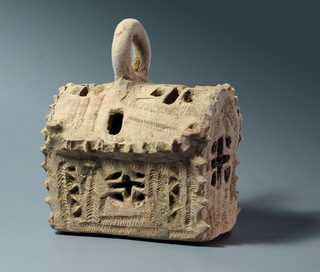
photograph: Clara Amit, courtesy of the Israel Antiquities Authority
DSS crowds in Cincinnati
POPULAR: Cincinnati Museum Center: Some Dead Sea Scrolls exhibit times extended to accommodate crowds.
Exhibitions of the Dead Sea Scrolls are generally very successful.
Background on this one is here and links.
Exhibitions of the Dead Sea Scrolls are generally very successful.
Background on this one is here and links.
Thursday, April 04, 2013
Forthcoming: Encyclopedia of Hebrew Language and Linguistics
COMING SOON FROM BRILL:
Encyclopedia of Hebrew Language and LinguisticsAnd for you, special deal: a pre-publication price of only 850 Euros! (This is in the e-mail announcement, but I don't see it on the web page.)
The Hebrew language has one of the longest attested histories of any of the world’s languages, with records of its use from antiquity until modern times. Although it ceased to be a spoken language by the 2nd century C.E., Hebrew continued to be used and to develop in the form of a literary and liturgical language until its revival as a vernacular in the 20th century.
In a four volume set, complete with index, the Encyclopedia of Hebrew Language and Linguistics offers a systematic and comprehensive treatment of all aspects of the history and study of the Hebrew language from its earliest attested form to the present day. The encyclopedia contains overview articles that provide a readable synopsis of current knowledge of the major periods and varieties of the Hebrew language as well as thematically-organized entries which provide further information on individual topics, such as the Hebrew of various sources (texts, manuscripts, inscriptions, reading traditions), major grammatical features (phonology, morphology, and syntax), lexicon, script and paleography, theoretical linguistic approaches, and so forth. With over 950 entries and approximately 400 contributing scholars, the Encyclopedia of Hebrew Language and Linguistics is the authoritative reference work for students and researchers in the fields of Hebrew linguistics, general linguistics, Biblical studies, Hebrew and Jewish literature, and related fields.
Fighting in Palmyra
TEMPLE OF BAAL: Syria's ancient oasis city of Palmyra threatened in fighting.
(Reuters) - The millenia-old oasis city of Palmyra is being damaged in clashes between Syrian President Bashar al-Assad's forces and rebels fighting for his overthrow in the midst of the precious archaeological site, a resident said on Wednesday.Background here.
Wednesday, April 03, 2013
Rollston on unprovenanced inscriptions
THE ASOR BLOG: Using Inscriptions from the Antiquities Market: Polarized Positions and Pragmatic Proposals (Christopher A. Rollston). I agree with his conclusions and would put it perhaps a little more aggressively: unprovenanced inscriptions should be regarded as forgeries in the absence of strong positive evidence to the contrary. I have some related thoughts here and links.
Criticism of the Lod Mosaic exhibition
THE DAILY PENNSYLVANIAN: Professors critique Penn Museum's ‘Lod Mosaic’ exhibit: The professors submitted a statement to the museum director with their concerns.
Limited information is known about the history of the Lod Mosaic, but a number of Penn faculty have voiced concern that the piece is presented without any archaeological context. “We don’t want to celebrate a master work in isolation,” said Professor of Roman architecture Lothar Haselberger, who initiated the conversation on how the mosaic is presented.Via Joseph I. Lauer. Background on the exhibition and the mosaic is here with many links.
“Nothing is conveyed to the public that [the mosaic] is more than a carpet,” Haselberger said, referencing the fact that mosaics like the “Lod Mosaic” were popular in this time period as floor decorations in many buildings.
“This is an exhibit that really focuses on the meticulous conservation by the Israel Antiquities Authority of a dazzling Roman mosaic that was found during highway construction,” said Brian Rose, Curator-in-Charge of the Mediterranean Section at the Penn Museum.
More on Herod the Great
BIBLE HISTORY DAILY: Herod the Great: Friend of the Romans and Parthians?Jason M. Schlude explores how King Herod manipulated his position between two regional powers.
Background on Herod and the current exhibition about him at the Israel Museum is here, leading to many links.
Background on Herod and the current exhibition about him at the Israel Museum is here, leading to many links.
Shanks, Christianity & Rabbinic Judaism
OUT IN A SECOND EDITION, FROM BAS:
Christianity & Rabbinic Judaism 2nd EditionFollow the link for TOC and ordering information.
Christianity and Rabbinic Judaism
A Parallel History of their Origins and Early Development
Edited by Hershel Shanks
ITEM: 7H192 Hardcover
ISBN 978-1-935335-52-8
A unique look at two of the world’s great religions
This newly revised parallel history of Judaism and Christianity presents the first six centuries in the development of both religions in one understandable volume. This unprecedented book takes readers from the middle of the first century—when a distinction between Judaism and Christianity first became apparent—to theArab conquest. This book begins where its companion volume, Ancient Israel, ends.
The first edition appeared more than two decadesago and has since become a standard text book and reference work for undergraduate, graduate and Bible study courses across the country. The book’s editor and contributing authors have now written a completely updated and revised edition that incorporates the most important finds andi nsights from the past two decades of archaeological, historical and biblical research.
More than 65 images enhance the text, many illustrating the most dramatic and importantf inds discovered in the Holy Land and elsewhere in recent decades. It also includes, for the first time, informative maps detailing the many sites and regions where the shared histories of these two world religions unfolded
Macaskill, The Slavonic Texts of 2 Enoch
NOW PUBLISHED BY BRILL:
The Slavonic Texts of 2 EnochSome background here. Cross-file under "Old Testament Pseudepigrapha Watch."
In The Slavonic Texts of 2 Enoch, Grant Macaskill publishes the manuscript evidence for this important pseudepigraphon in a format that, for the first time, allows synoptic comparison of the variants encountered. With the long and short recensions represented on facing pages, and variants listed against two exemplars (J and A), readers will be able to weigh the textual and linguistic evidence in a way that has previously been hindered by the available publications of 2 Enoch. The book also includes an introductory discussion of the manuscripts and the problems associated with text-critical work on them, and a translation of the neglected manuscript B, with notes on the significance of its readings for the reconstruction of an ur-text.
Tuesday, April 02, 2013
Shroud of Turin latest
THERE'S AN APP FOR THAT: Shroud 2.0: A High-Tech Look at One of Christianity’s Most Important Artifacts.
Background on the Shroud of Turin is here and links.
Background on the Shroud of Turin is here and links.
Ancient synagogue damaged but not destroyed
JOBAR SYNAGOGUE:
Ancient Syrian synagogue hit by looting, shellingA similar report comes from the AP: Historic synagogue in Damascus damaged, looted. It sounds as though JTA got ahead of itself when it reported yesterday that the synagogue was destroyed. So the current status is that the news is bad, but not nearly as bad as was initially reported. I hope the current report is the one that is accurate.
BEIRUT | Mon Apr 1, 2013 6:10pm BST
(Reuters) - Theft and shelling have damaged a 2,000 year-old synagogue in Damascus, one of the oldest in the world, Syrian government and opposition activist sources said on Monday.
Syria's historic monuments have increasingly become a casualty of the civil war has killed more than 70,000 people. Parts of Aleppo's medieval stone-vaulted souk have been reduced to rubble, and many ancient markets, mosques and churches across the country are threatened with destruction.
The damage has so far been light at the Jobar Synagogue, built in honour of the biblical prophet Elijah, according to Mamoun Abdulkarim, the head of Syria's antiquities department.
"Local community officials say the place's sanctity has been violated and there were thefts but I cannot verify the nature of the thefts without investigation," Abdulkarim told Reuters by telephone.
"Four months earlier they (Jewish authorities) tried to go in and were prevented from entering due to the presence of fighters."
He said that authorities believed looters have mostly stolen gold chandeliers and icons dating back 70 to 100 years.
But Abdulkarim said he doubted that thousands of priceless manuscripts had been stolen from the synagogue as most of them, including Torahs in filigreed silver cases, had already been moved to the synagogue inside Damascus's Old City, a UNESCO world heritage site.
[...]
Monday, April 01, 2013
The Walking Dead
EASTER THOUGHTS FROM JARED CALAWAY: Creepiest Part of Jesus' Death and Resurrection in the Gospels.
Matthew 27:52-53 is an odd passage that leaves many loose ends and open questions. Why does it say "many bodies" as though the souls might be elsewhere, leaving ... zombies? What were the reactions of the hapless folk in the Holy City when confronted by these reanimated bodies? Joy at seeing lost loved ones again? Terror? Confusion? Baseball bats? What happened to these bodies? Did they have souls and settle in and rejoin society for an extra lifetime? Did they go back to their graves after a while and climb back in? Were they all slain again by the living? Or did they shuffle off into the wilderness to prey on passers by?
The implications of the passage arising from an intertextual reading with the zombie apocalypse have been noted before, and I have commented on them here.
Matthew 27:52-53 is an odd passage that leaves many loose ends and open questions. Why does it say "many bodies" as though the souls might be elsewhere, leaving ... zombies? What were the reactions of the hapless folk in the Holy City when confronted by these reanimated bodies? Joy at seeing lost loved ones again? Terror? Confusion? Baseball bats? What happened to these bodies? Did they have souls and settle in and rejoin society for an extra lifetime? Did they go back to their graves after a while and climb back in? Were they all slain again by the living? Or did they shuffle off into the wilderness to prey on passers by?
The implications of the passage arising from an intertextual reading with the zombie apocalypse have been noted before, and I have commented on them here.
Bar Kokhba
I BLOG, YOU DECIDE: Bar Kochba and Pesach: Zionist Hero or Rabbinical Rogue? (Times of Israel).
Ancient synagogue destroyed
REPORT: Historic Damascus synagogue looted and destroyed: Assad forces and rebels trade blame for destruction of 2,000-year-old Jobar shul, Syria’s holiest Jewish site (JTA).
UPDATE (2 April): It looks as though the report was not accurate: current accounts from Reuters and the AP say the synagogue has been damaged but not destroyed.
The synagogue is said to be built on the site where the prophet Elijah concealed himself from persecution and anointed his successor, Elisha, as a prophet. It had been damaged earlier this month by mortars reportedly fired by Syrian government forces.Assuming the report is accurate, this is yet another tragedy in the disaster that is currently Syria.
The rebels said the Syrian government looted the synagogue before burning it to the ground, Israel Radio reported Sunday.
The government said the rebels burned the synagogue and that so-called Zionist agents stole its historic religious items in an operation that had been planned for several weeks, the Arabic Al-Manar Television reported, citing the Arabic Syria Truth website.
The news came as Jews around the world marked the final days of Passover, the festival of freedom.
One of the oldest synagogues in the world, the shul was partially destroyed by Syrian government shelling four weeks ago, according to a video posted to YouTube.
UPDATE (2 April): It looks as though the report was not accurate: current accounts from Reuters and the AP say the synagogue has been damaged but not destroyed.
Sunday, March 31, 2013
Shroud of Turin
'TIS THE SEASON: New experiments on Shroud [of Turin] show it’s not medieval (Vatican Insider).
It's dismaying to see how readily this has been taken up by the media and blogs. Here's a helpful rule of thumb: stories timed for Easter about how the Shroud of Turin turns out to be ancient after all are likely to have some problems with them. Steve Caruso has a blog post that sums up the problems with this one: "New experiments on [the Shroud of Turin] show it’s not medieval" -- What?? (the Aramaic Blog).
Briefly, if your multiple scientific test results give you a (95% certain!) 1500-year range, maybe rather than averaging them you should start thinking about whether your samples are contaminated or incorrectly provenanced. Perhaps not coincidentally, the Archbishop of Turin (who as the official custodian of the Shroud would have every reason to welcome the conclusion) doubts that the samples are actually from the Shroud and dismisses the results.
Background on the Shroud of Turin and the endless less-than-securely-founded theories about it is here and just keep following those links back.
It's dismaying to see how readily this has been taken up by the media and blogs. Here's a helpful rule of thumb: stories timed for Easter about how the Shroud of Turin turns out to be ancient after all are likely to have some problems with them. Steve Caruso has a blog post that sums up the problems with this one: "New experiments on [the Shroud of Turin] show it’s not medieval" -- What?? (the Aramaic Blog).
Briefly, if your multiple scientific test results give you a (95% certain!) 1500-year range, maybe rather than averaging them you should start thinking about whether your samples are contaminated or incorrectly provenanced. Perhaps not coincidentally, the Archbishop of Turin (who as the official custodian of the Shroud would have every reason to welcome the conclusion) doubts that the samples are actually from the Shroud and dismisses the results.
Background on the Shroud of Turin and the endless less-than-securely-founded theories about it is here and just keep following those links back.
Easter
HAPPY EASTER to all those celebrating!
New Testament resurrection narratives are noted here, although for some reason I neglected to mention 1 Corinthians 15:1-8. I see that in the same post I also linked to the resurrection narrative in the Gospel of Peter. All the links in that post have rotted, but you can find a live link to the Gospel of Peter here.
New Testament resurrection narratives are noted here, although for some reason I neglected to mention 1 Corinthians 15:1-8. I see that in the same post I also linked to the resurrection narrative in the Gospel of Peter. All the links in that post have rotted, but you can find a live link to the Gospel of Peter here.
Ultimate monster battle
BETTER THAN GODZILLA VS. KING KONG: Leviathan vs. Behemoth ( Jared Calaway).
Saturday, March 30, 2013
Syriac tattoo
ARAMAIC WATCH: Here's a nice Syriac tattoo for Steve Caruso. But I bet this one doesn't have errors in it.
Other tattoos in ancient languages, some quite unfortunate, are noted here and links.
Other tattoos in ancient languages, some quite unfortunate, are noted here and links.
Joseph Aviram
MEMORIES:
Israel's archeological triumphs through the eyes of a man who was always there
Joseph Aviram, 97, brought Ben-Gurion one of the Dead Sea Scrolls and took Yigael Yadin up to Masada in the 1960s.
By Nir Hasson | Mar.29, 2013 | 9:59 AM (Haaretz)
In the world of Israeli archaeology, Joseph Aviram is the man who was there. He was there when Alexander Zaid [a founder of Hashomer, a Jewish defense organization] arrived on horseback to show a group of students the Beit She'arim excavations in the 1930s. He organized the first professional Jewish digs in the 1940s. He brought David Ben-Gurion one of the Dead Sea Scrolls that was found in the Judean Desert in the 1950s, and he took Yigael Yadin up to Masada in the 1960s.
Aviram, who is 97, probably holds the record for successive employment at the same place of work. For 70 years he has been with the Israel Exploration Society (previously known as the Society for the Reclamation of Antiquities ). Next month, the IES will celebrate its centenary, an achievement matched only by a handful of institutions in Israel.
[...]
Friday, March 29, 2013
Karaite and Samaritan Passover
OTHER PASSOVER TRADITIONS: Samaritans, Karaites take Passover back to its ancient roots (judy lash balint at Jweekly.com).
More on Karaite Passover here and links, and more on Samaritan Passover here and links.
More on Karaite Passover here and links, and more on Samaritan Passover here and links.
Good Friday
TODAY IS GOOD FRIDAY. Best wishes to all observing it. References to the Passion of Jesus in the New Testament are gathered here (but the links have rotted). And for something different, here is the account of the Passion and Resurrection in the apocryphal Gospel of Peter.
No Israel Prize
THERE MUST BE AN INTERESTING STORY BEHIND THIS: No Israel Prize for Archeology This Year (Arutz Sheva).
The prize will not be given because the prize committee attempted to award it to two candidates, in violation of ministry rules which state that each prize may be given to only one winner.
Review of Klawans, Josephus and the Theologies of Ancient Judaism
BOOK REVIEW ON H-JUDAIC:
Jonathan Klawans. Josephus and the Theologies of Ancient Judaism. Oxford: Oxford University Press, 2013. 400 pp. $74.00 (cloth), ISBN 978-0-19-992861-3.
Reviewed by Kenneth Atkinson (University of Northern Iowa)
Published on H-Judaic (March, 2013)
Commissioned by Jason Kalman
Rethinking Flavius Josephus as a Witness to Early Jewish Theologies
Jonathan Klawans’s monograph is a welcome addition to the increasing body of literature devoted to the works of the first-century CE Jewish-Roman historian Flavius Josephus. Well known for his work in the history of Jewish law and ritual, Klawans in this book attempts to put Josephus closer to the center of all studies of ancient Judaism. His book focuses on Josephus’s descriptions of the three major Jewish religious movements (the Pharisees, the Sadducees, and the Essenes) to understand the theologies of ancient Judaism. He proposes that ancient Jewish religious disputes revolved primarily around matters of ritual law, including disagreements over the calendar, and purity practices. Through his examination of Josephus, Klawans challenges the widespread belief that Judaism was shattered by the cumulative events of 70 CE and 135 CE (First and Second Jewish Revolts). For Klawans, Josephus demonstrates that much of the vitality associated with rabbinic Judaism existed in the first century CE, and that there is no evidence that the three major Jewish movements disappeared after the 70 CE Roman destruction of the Jerusalem temple.
[...]
Thursday, March 28, 2013
Rollston on the Cyrus Cylinder
CHRISTOPHER ROLLSTON: Nebuchadnezzar’s Destruction of Jerusalem, The Cyrus Cylinder, and the Building of the Second Temple.
Background here with many links.
Background here with many links.
Vermes on crucifixion
GEZA VERMES: Was Crucifixion a Jewish Penalty? (Standpoint Magazine).
The doctoral dissertation by Gunnar Samuelsson discussed in the article is noted here and links.
Tangentially related (via crucifixion—'tis the season) from Bible History Daily: The Staurogram: The earliest images of Jesus on the cross. I noted a lecture by Larry Hurtado on the subject (as well as his book) in 2007, here.
The doctoral dissertation by Gunnar Samuelsson discussed in the article is noted here and links.
Tangentially related (via crucifixion—'tis the season) from Bible History Daily: The Staurogram: The earliest images of Jesus on the cross. I noted a lecture by Larry Hurtado on the subject (as well as his book) in 2007, here.
Job at University of Edinburgh
A CHANCELLOR'S FELLOWSHIP at the University of Edinburgh is available with the School of Divinity and is open to a specialty in biblical studies.
(HT Timothy Lim on Facebook.)
UPDATE (29 March): Further particulars here.
(HT Timothy Lim on Facebook.)
UPDATE (29 March): Further particulars here.
Wednesday, March 27, 2013
Egyptian blogger latest
EGYPTIAN BLOGGER ALAA is once again being pursued by the Egyptian authorities, this time apparently for comments left on his blog: Egyptian blogger accused of violence released (AP). The new bosses don't seem to like him much better than the old bosses. I give the AP credit for keeping a close eye on the situation.
Did I mention that the world is watching?
Background here, here, here, here, here, and here, with many links, going back to the Mubarak regime in 2005.
Did I mention that the world is watching?
Background here, here, here, here, here, and here, with many links, going back to the Mubarak regime in 2005.
The Talmud Diet?
JONATHAN K. CRANE, IN The Talmud and Other Diet Books (NYT), proposes a Talmudic solution to the obesity epidemic:
Physiology of emotions aside, the approach, whether Talmudic or not, of pushing away from the table before you're stuffed is generally pretty effective.
That said, there may well be an element of making the best of a bad job in the Talmud's advice. Scarcity of resources, including food, was the norm in the brutal world of antiquity.
Among these old arguments is the novel idea of eating less than what fills one’s belly. The Talmud teaches that people should eat enough to fill a third of their stomachs, drink enough to fill another third, and leave a third empty. (A hadith in the Islamic tradition also teaches this.) Rashi, a medieval French rabbi, interpreted the Talmud to mean that the final empty third is necessary so that the body can metabolize emotions. If one ate until one’s belly was completely full, there’d be no room left to manage one’s emotions and one would burst asunder.Typically, no reference is given. I trust that some alert PaleoJudaica reader can provide one.
However absurd this may seem to us today, it made physiological sense in the premodern world as the emotions were considered physical things that, like food and drink, were metabolized by the body. A body stuffed with food and drink is full only of biology; it leaves no room for biography, for what makes us human.
Physiology of emotions aside, the approach, whether Talmudic or not, of pushing away from the table before you're stuffed is generally pretty effective.
That said, there may well be an element of making the best of a bad job in the Talmud's advice. Scarcity of resources, including food, was the norm in the brutal world of antiquity.
DSS Decalogue
THE QUMRAN TEXT OF THE TEN COMMANDMENTS IN DEUTERONOMY is going on display at the end of the week in the Dead Sea Scrolls exhibition at the Cincinnati Museum Center: EXCLUSIVE: Ancient document to go on display: Dead Sea Scroll features the Ten Commandments (cincinnati.com).
Background here and links.
The tightly guarded Ten Commandments scroll – one of the most important of the approximately 900 ancient Dead Sea Scrolls still in existence – will be on display from Friday through April 14 at the Cincinnati Museum Center.
That will add considerable star power to the last 17 days of the blockbuster exhibit “Dead Sea Scrolls: Life and Faith in Ancient Times,” which also has 10 other scroll fragments from Israel on display.
[...]
Background here and links.
Herod exhibition review
THE HEROD THE GREAT EXHIBITION is reviewed by Amotz Asa-El in the WSJ: Shards of a Reputation. Excerpt:
One Herod biographer, Hebrew University's Abraham Schalit, wrote in 1960 that the king's successors "were weaklings," and that the spiritual elite, the Pharisees, "were too introverted to appreciate all that was useful about the great king's legacy." And the university's current authority on this era, Daniel Schwartz, says Herod's "balancing act" between Rome and Judea reflected his belief that Rome was "here to stay," and that it fostered peace, tolerance and prosperity. That is why Herod built both Jerusalem and Caesarea, "in effect giving the country two capitals and positing a separation of religion from state," Mr. Schwartz said.More on Herod and the exhibition here and links.
Yes, none of this justifies Herod's violence. But, then again, confronting Rome brought even more violence.
For its part, the Israel Museum avoids judging Herod. "Our role is merely to look at history through artifacts," says Director James Snyder. Thanks to this well-crafted exhibition, judging Herod's place in history becomes even more challenging than it already was.
Tuesday, March 26, 2013
Textual uniformity and diversity in the NT, Qur'an, etc.
LARRY HURTADO: Textual Criticism, the New Testament, and the Qur’an.
As Hurtado notes, the New Testament also reached a high level of textual uniformity in time, but no one seems to have had any interest in suppressing the earlier manuscripts that preserved a greater diversity.
As to results, Small repeatedly notes that the Qur’an manuscripts exhibit a remarkable stability in the text across many centuries, from the earliest to the latest. In general terms, not much more than orthographic variants (vowel differences in the consonantal script) and other minor variants are found. There are occasional copyist mistakes, but no major differences involving whole clauses or sentences. This accords with traditional, popular Muslim beliefs/claims about the stability of the text of the Qur’an.The development of the Masoretic Text of the Hebrew Bible is similar: the surviving manuscripts show a remarkable textual uniformity, but earlier, pre-Masoretic evidence from the Dead Sea Scrolls and the Septuagint shows that an earlier textual diversity had to be suppressed to achieve the uniformity of the MT. This appears to be a fairly common pattern as texts achieve a greater or lesser level of canonicity or authority. In my work on the Hekhalot Literature it has become clear that the later manuscripts of the complete major texts (albeit themselves often highly corrupt) come from a tradition edited into uniformity by the Haside Ashkenaz in the thirteenth century. The earlier fragments of these texts from the Cairo Geniza show considerably more textual diversity.
But Small also notes that the other evidence (especially palimpsests and reports from early centuries) suggest strongly that there was, in the earliest period, a considerably greater diversity in the text of the Qur’an than is reflected in the extant manuscripts studied. Moreover, as is widely accepted, in the late 7th century, disturbed by the diversity in the text of the Qur’an, the Caliph Uthman organized a standardization of the consontantal text (early Arabic, like ancient Hebrew, was a consonantal aphabet with no written vowels), suppressing variant versions.
As Hurtado notes, the New Testament also reached a high level of textual uniformity in time, but no one seems to have had any interest in suppressing the earlier manuscripts that preserved a greater diversity.
Yannai and Passover
THE TALMUD BLOG: Some Notes on Yannai and Pesach: Between Exegesis and Received Traditions (Yitz Landes).
Metatron coming to Supernatural
ARCHANGEL METATRON WATCH: ‘Supernatural’ Season 8 Spoilers: What Famous Angel Is on Its Way?
SpoilerTV reports that ‘Supernatural’s’ producers have begun casting the role of one of the most famed angels of all, that of the “Metatron,” to appear in the final three episodes of the season, and potentially recur into the ninth. The character is described as an older angel, the scribe of God and one present before the time of Adam and Eve. To Dean’s would-be delight no doubt, Metatron is seen as a cross between Obi-Wan Kenobi and ‘The Usual Suspect’ character Verbal Kint/Keyser Söze.
Monday, March 25, 2013
Groningen scholarship
THE UNIVERSITY OF GRONINGEN, Faculty of Theology and Religious Studies, has just announced a new scholarship: Qumran Institute presents the Florentino García Martínez Research Master Scholarship.
(HT Mladen Popovic.)
(HT Mladen Popovic.)
Sunday, March 24, 2013
Tenth anniversary
HAPPY TENTH BLOGIVERSARY TO PALEOJUDAICA!
I began this blog on Monday, 24 March, 2003. The first two posts are here and here.
Most years (last year I was busy and couldn't be bothered), I have put up a retrospective anniversary post. You can find links to all of them in the eighth anniversary post.
For the history and significance of "Biblioblogging" over the last decade, see my 2005 SBL Forum article Assimilated to the Blogosphere: Blogging Ancient Judaism (Blogger reformatting has killed most of the links. Thanks, Blogger!); my 2005 SBL paper, Enter the Bibliobloggers; and my 2010 SBL paper, What Just Happened.
Here are a few of my favorite posts over the last couple of years.
2012-13 (year 10)
I began this blog on Monday, 24 March, 2003. The first two posts are here and here.
Most years (last year I was busy and couldn't be bothered), I have put up a retrospective anniversary post. You can find links to all of them in the eighth anniversary post.
For the history and significance of "Biblioblogging" over the last decade, see my 2005 SBL Forum article Assimilated to the Blogosphere: Blogging Ancient Judaism (Blogger reformatting has killed most of the links. Thanks, Blogger!); my 2005 SBL paper, Enter the Bibliobloggers; and my 2010 SBL paper, What Just Happened.
Here are a few of my favorite posts over the last couple of years.
2012-13 (year 10)
- The Economist on the fake metal codices (and follow the links!)
- Lecture on Hekhalot translation
- SBL 2012 (with a link to my 2012 SBL paper, "The Ninety-four Books of Ezra and the Angelic Revelations of John Dee")
- Frank Moore Cross, 1921-2012
- Is Christopher Rollston being "disciplined" for a HuffPo essay?
- A Coptic gospel that mentions Jesus' wife?
- Search engine referrals
- Off to the Colloquium Biblicum Lovaniense
- The Samaritans in Der Spiegel
- A Syriac apocryphal gospel manuscript in Turkey?
- Afghan manuscripts update (follow the many links back for this interesting story)
- Off to California (with a link to my 2011 SBL paper, "Ritual Praxis in Ancient Jewish and Christian Mysticism")
- The Legend of the Ten Martyrs
- Enoch Seminar: Response to Najman
- At the Biblioteca Ambrosiana
- Quotations from Lost Books in the Hebrew Bible
- News on the More Old Testament Pseudepigrapha Project (Yeah, I know the book isn't published yet. Soon, I hope.)
- Popular culture, Metatron, Talmud, science fiction, Gnosticism ...
- Davila on "The Golb Affair"
- Ezekiel plates—and a legend of the Temple treasures
Obama at Petra
PRESIDENTIAL TOUR: Barack Obama tours ancient 'lost' city of Petra (The Telegraph).

No sign of the Holy Grail.

No sign of the Holy Grail.
The New New Testament
GOOFY HEADLINE OF THE WEEK: Dead Sea Scrolls part of pastor's 'New New Testament' (Deseret News).
Er, no. The Dead Sea Scrolls don't contain any New Testament texts, even noncanonical ones. What the article is trying to say is that this book includes translations of Coptic Gnostic Christian scriptures from the Nag Hammadi Library (in Egypt) among the canonical New Testament books. These are definitely not Jewish Hebrew and Aramaic scriptures etc. from the Dead Sea region. The Amazon page for the book has more information on the book and the project. It seems a little gimmicky to me, but I'm always happy to see the noncanonical scriptures get more attention.
Er, no. The Dead Sea Scrolls don't contain any New Testament texts, even noncanonical ones. What the article is trying to say is that this book includes translations of Coptic Gnostic Christian scriptures from the Nag Hammadi Library (in Egypt) among the canonical New Testament books. These are definitely not Jewish Hebrew and Aramaic scriptures etc. from the Dead Sea region. The Amazon page for the book has more information on the book and the project. It seems a little gimmicky to me, but I'm always happy to see the noncanonical scriptures get more attention.
Saturday, March 23, 2013
Edmonds, Rastafari
IN THE MAIL: A complimentary copy from OUP:
Ennis B. Edmonds, Rastafari: A Very Short Introduction (OUP, 2012)Not sure how I ended up on the list to get this book, but it looks interesting. Past posts on the subject are here, here, and here.
Friday, March 22, 2013
Shape-shifting Jesus again
MICHAEL HEISER weighs in at PaleoBabble on the shape-shifting Jesus apocryphon:
Shape-Shifting Jesus: On the Sins of Marketers and Media.
I think Michael is a little too hard on this article. Notably, he asserts incorrectly that in the apocryphal text Jesus is not a shape shifter, but he cites an irrelevant passage in the section on Jesus' dinner with Pilate, while ignoring the quoted passage about shape-shifting Jesus:
Shape-Shifting Jesus: On the Sins of Marketers and Media.
I think Michael is a little too hard on this article. Notably, he asserts incorrectly that in the apocryphal text Jesus is not a shape shifter, but he cites an irrelevant passage in the section on Jesus' dinner with Pilate, while ignoring the quoted passage about shape-shifting Jesus:
"Then the Jews said to Judas: How shall we arrest him (Jesus), for he does not have a single shape but his appearance changes. Sometimes he is ruddy, sometimes he is white, sometimes he is red, sometimes he is wheat coloured, sometimes he is pallid like ascetics, sometimes he is a youth, sometimes an old man ..."Background here.
Moss, The Myth of Persecution
JAMES MCGRATH reviews Candida Moss's new book (which I have not yet seen), The Myth of Persecution: How Early Christians Invented a Story of Martyrdom.
Thursday, March 21, 2013
Obama in Israel
SOME HIGHLIGHTS SO FAR of President Obama's visit to Israel:
Obama visits Israel Museum, Dead Sea Scrolls (Jerusalem Post)
Obama Tells Inspiring Talmudic Carob Tree Story (Arutz Sheva)
Obama affirms Israel's ancient biblical roots (AP)
And perhaps not unconnected with the above:
Obama faces Palestinian anger (iolnews)
Obama visits Israel Museum, Dead Sea Scrolls (Jerusalem Post)
Obama Tells Inspiring Talmudic Carob Tree Story (Arutz Sheva)
Obama affirms Israel's ancient biblical roots (AP)
And perhaps not unconnected with the above:
Obama faces Palestinian anger (iolnews)
Worthless Mysteries
ASSIMILATED TO THE BLOGOSPHERE (haven't had one of these for a while): Worthless Mysteries (Jack Collins).
Exploring the Bible and other ancient literature from a secular—not to mention irreverent—point of view, with an emphasis on Enochic and apocalyptic traditions.(Via Deane Galbraith at Remants of Giants.
Also, rants about the academic job market.
The title of the blog, taken from the First Book of Enoch, refers to the teachings given to humanity by fallen angels, and reflects the joy I take in studying things that are utterly irrelevant.
Herod exhibition again
POLITICS: King Herod, Long Reviled, Finds New Love Among Jewish Settlers:
Interest in Historical Villian Boosts Claim to West Bank (The Forward). Regarding the proposed alternative handling of the exhibition at the end of the essay, I will start thinking about trusting the Palestinian Authority with artifacts important for Jewish history when they start acknowledging that there was a Jewish Temple on the Temple Mount in antiquity.
I have a post that deals with Herod's ethnic background here.
Background on the Herod the Great exhibition is here and links.
Interest in Historical Villian Boosts Claim to West Bank (The Forward). Regarding the proposed alternative handling of the exhibition at the end of the essay, I will start thinking about trusting the Palestinian Authority with artifacts important for Jewish history when they start acknowledging that there was a Jewish Temple on the Temple Mount in antiquity.
I have a post that deals with Herod's ethnic background here.
Background on the Herod the Great exhibition is here and links.
Wednesday, March 20, 2013
On to Eruvin
THIS WEEK'S DAF YOMI COLUMN BY ADAM KIRSCH IN TABLET MAGAZINE: Navigating the Talmud’s Alleys: The range of problems and the variety of answers in the study of Oral Law lead to new pathways of reasoning.
When I first heard about eruvs as a teenager, I regarded them a little indignantly. If the point of Shabbat is to rest from labor, to rejoice in prohibitions, why invent legal fictions to allow you to get around those prohibitions? Isn’t the eruv contrary to the very spirit of Shabbat? Now, after being immersed in the Talmud for half a year, I’ve begun to understand the more flexible imagination that the rabbis brought to these problems. For them, it was not a question of enjoying a holiday from reality, but of finding a way to obey very specific divine laws while still carrying out the necessary business of life. Precisely because they take the letter of the law seriously, they want to know the exact boundaries of that law—what it allows and disallows, and how to tell the difference.Earlier Daf Yomi columns are noted here and links, as well as here and here.
Geniza songs of David
NEW BOOK FROM BRILL:
As for the Geniza songs of David, I am inclined to see them as works of late antiquity, around the time of the early piyyutim, but I'm not dogmatic about it.
Cross-file under "Old Testament Pseudepigrapha Watch."
The Genizah PsalmsThese apocryphal songs of David are also translated (by G. W. Lorein and E. van Staalduine-Sulman) in Old Testament Pseudepigrapha: More Canonical Scriptures volume one (the first volume of texts produced by the More Old Testament Pseudepigrapha Project). Did I mention you can pre-order the latter volume at Amazon at a discount? For you, special deal!
A Study of MS 798 of the Antonin Collection. Cambridge Genizah Studies Series
David Stec
The Genizah Psalms (MS 798 of the Antonin Collection) is a Hebrew document of messianic character, apparently presenting itself as the work of David. It is taken by some to date to the time of the second temple, and to be approximately contemporary with some of the literature of Qumran, while others regard it as a medieval composition. From the point of view of a classical hebraist, David M. Stec explores how this text relates to classical Hebrew literature as a whole and considers how viable it is to regard it as a genuine constituent of that body of literature. He presents an edition of the Hebrew text and English translation, together with an introduction, commentary and analysis of language.
As for the Geniza songs of David, I am inclined to see them as works of late antiquity, around the time of the early piyyutim, but I'm not dogmatic about it.
Cross-file under "Old Testament Pseudepigrapha Watch."
ASOR fundraiser update
FOR YOU, SPECIAL DEAL: Support Archaeology Students.
Haven’t given to ASOR’s March Fellowship Madness yet? We are giving away a copy of The Photographs of the American Palestine Exploration Society (AASOR v. 66) by Rachel Hallote, Felicity Cobbing, and Jeffrey Spurr to one of the donors to our fellowship fundraising drive!Details at the link. Background here.
[...]
Tuesday, March 19, 2013
Aramaic Facebook
ARAMAIC WATCH: Update Your Facebook Status — In Ancient Aramaic! (Haaretz via The Forward).
Hello, Forward editors, Aramaic is not a Canaanite Tongue (let alone a "Canaanite Toungue"). It is a Northwest Semitic language, but it lacks the "Canaanite shift," the systematic change of original long a to long o. You should know these things.
Hello, Forward editors, Aramaic is not a Canaanite Tongue (let alone a "Canaanite Toungue"). It is a Northwest Semitic language, but it lacks the "Canaanite shift," the systematic change of original long a to long o. You should know these things.
Obama and the Dead Sea Scrolls
POLITICS:
A visit to view the Dead Sea Scrolls at the Israel Museum is being interpreted as a presidential acknowledgement of the ancient Jewish connection to the land, and the laying of a wreath at the grave of Theodor Herzl, the father of Zionism, is also considered symbolically significant. (The Guardian)UPDATE: From Eugene Kontorovich at the Volokh Conspiracy: More on the Politics of the Scrolls.
Monday, March 18, 2013
The Golb case—it's not over
DEVELOPMENTS IN THE IDENTITY-THEFT CASE involving Raphael Golb and the Dead Sea Scrolls:
First, last week New York's highest court agreed to hear Golb's appeal. Second, also last week, two bloggers received e-mails from Lawrence Schiffman's lawyer demanding that they remove blog posts that have dealt with the case. The relevant discussion is in the following posts.
By prominent legal blogger Eugene Volokh at The Volokh Conspiracy:
Prof. Lawrence Schiffman’s Lawyer Demands Removal of Post Containing the Text of a Court Opinion
New York’s Highest Court Agrees to Hear the Golb (Dead Sea Scrolls) E-Mail Impersonation Case
By another legal blogger, Scott H. Greenfield, at the Simple Justice blog:
Schiffman, Meet Streisand (Update!!! x4)
Blogger Ken White at Popehat has also involved himself and added some commentary and information:
Barbra? Barbra Streisand? Never Heard of Her. Now, Back To My Threat.
I have blogged extensively on the case (start here and just keep following the links back) but I have not been involved in this particular blog-related situation, except to e-mail Professor Schiffman to ask if he wanted to comment on it for PaleoJudaica. In view of the current status of the case, he was advised not to do so.
UPDATE (19 March): Dead link now fixed. Sorry about that. Also, related, another Blogospheric reaction, this one from techdirt: The Internet Is For Baseless Legal Threats: Popehat, Greenfield And Volokh Triple-Streisand Edition!
First, last week New York's highest court agreed to hear Golb's appeal. Second, also last week, two bloggers received e-mails from Lawrence Schiffman's lawyer demanding that they remove blog posts that have dealt with the case. The relevant discussion is in the following posts.
By prominent legal blogger Eugene Volokh at The Volokh Conspiracy:
Prof. Lawrence Schiffman’s Lawyer Demands Removal of Post Containing the Text of a Court Opinion
New York’s Highest Court Agrees to Hear the Golb (Dead Sea Scrolls) E-Mail Impersonation Case
By another legal blogger, Scott H. Greenfield, at the Simple Justice blog:
Schiffman, Meet Streisand (Update!!! x4)
Blogger Ken White at Popehat has also involved himself and added some commentary and information:
Barbra? Barbra Streisand? Never Heard of Her. Now, Back To My Threat.
I have blogged extensively on the case (start here and just keep following the links back) but I have not been involved in this particular blog-related situation, except to e-mail Professor Schiffman to ask if he wanted to comment on it for PaleoJudaica. In view of the current status of the case, he was advised not to do so.
UPDATE (19 March): Dead link now fixed. Sorry about that. Also, related, another Blogospheric reaction, this one from techdirt: The Internet Is For Baseless Legal Threats: Popehat, Greenfield And Volokh Triple-Streisand Edition!
Friday, March 15, 2013
Aramaic Peter Rabbit
ARAMAIC WATCH (UPDATE): The Tale of Peter Rabbit - In Galilean Aramaic (Steve Caruso).
Background here. Related item here.
Background here. Related item here.
Female angels?
ASKING THE IMPORTANT QUESTIONS: Why didn’t the female angels have sex with man? Deane Galbraith says that "the answer is simple: there are no female angels. In early Jewish literature, all angels are male." This is probably correct in terms of the specific question, but it is technically incorrect. There were female angels: the four Hayyot ("living creatures" or "beasts") of Ezekiel chapter 1 are grammatically female. But their gender identity, of course, looks kind of complicated, plus it seems unlikely that mortal men would find them attractive in that way.
That Assyrian Dalek
ASKING THE IMPORTANT QUESTIONS: If Sennacherib had at least one Dalek and he couldn't take Jerusalem, does that mean that God sent the Doctor to help king Hezekiah? (James McGrath—of course).
Thursday, March 14, 2013
Satlow (ed.), The Gift in Antiquity
NEW BOOK:
(Via the Talmud Blog on Facebook.)
The Gift in AntiquityFollow the link for the TOC.
Michael Satlow
ISBN: 978-1-4443-5024-1
Hardcover
272 pages
March 2013, Wiley-Blackwell
(Via the Talmud Blog on Facebook.)
The Bible and soap
ASKING THE IMPORTANT QUESTIONS: Why Does the Bible Have No Recipe for Soap?
Two thoughts come to mind. First, I don't know much about the history of soap, but I kind of doubt that it was in widespread use in ancient Israel or in the ancient world in general. Even in the nineteenth century, Mark Twain had trouble finding it in Europe. (Things are better there now.)
Second, there are lots of things the Bible doesn't include but which must have been well known in ancient Israelite society. For example, the book of Leviticus tells us about sacrificial rites, but includes nothing about the prayers, songs, and music that must have accompanied them and which are alluded to elsewhere (e.g., 1 Chronicles 25).
UPDATE (15 March): I have received a number of responses to this one. For the early history of soap, see here (with the usual caveats about Wikipedia). Also, Gerald Rosenberg points to Jeremiah 2:22, which may refer to a couple of early types of detergent. I suppose the reference to a "fuller" in Mark 9:3 could be relevant as well, since the job involved cleaning wool. But I can't find any evidence for hygienic hand soap as early as the biblical period.
Two thoughts come to mind. First, I don't know much about the history of soap, but I kind of doubt that it was in widespread use in ancient Israel or in the ancient world in general. Even in the nineteenth century, Mark Twain had trouble finding it in Europe. (Things are better there now.)
Second, there are lots of things the Bible doesn't include but which must have been well known in ancient Israelite society. For example, the book of Leviticus tells us about sacrificial rites, but includes nothing about the prayers, songs, and music that must have accompanied them and which are alluded to elsewhere (e.g., 1 Chronicles 25).
UPDATE (15 March): I have received a number of responses to this one. For the early history of soap, see here (with the usual caveats about Wikipedia). Also, Gerald Rosenberg points to Jeremiah 2:22, which may refer to a couple of early types of detergent. I suppose the reference to a "fuller" in Mark 9:3 could be relevant as well, since the job involved cleaning wool. But I can't find any evidence for hygienic hand soap as early as the biblical period.
Wednesday, March 13, 2013
Shape-shifting Jesus
T-INFINITY? Shape-Shifting Jesus Described in Ancient Egyptian Text (Owen Jarus, LiveScience).
(HT Steve Caruso.)
A newly deciphered Egyptian text, dating back almost 1,200 years, tells part of the crucifixion story of Jesus with apocryphal plot twists, some of which have never been seen before.An interesting little text, presented with a refreshing lack of hype. Shape-shifting Jesus is even more fun than flying Jesus. For more shape-shifting miracles, see the Legend of the Ten Martyrs in the Hekhalot Rabbati.
Written in the Coptic language, the ancient text tells of Pontius Pilate, the judge who authorized Jesus' crucifixion, having dinner with Jesus before his crucifixion and offering to sacrifice his own son in the place of Jesus. It also explains why Judas used a kiss, specifically, to betray Jesus — because Jesus had the ability to change shape, according to the text — and it puts the day of the arrest of Jesus on Tuesday evening rather than Thursday evening, something that contravenes the Easter timeline.
The discovery of the text doesn't mean these events happened, but rather that some people living at the time appear to have believed in them, said Roelof van den Broek, of Utrecht University in the Netherlands, who published the translation in the book "Pseudo-Cyril of Jerusalem on the Life and the Passion of Christ"(Brill, 2013).
[...]
(HT Steve Caruso.)
Monday's child is ...
THIS WEEK'S DAF YOMI COLUMN BY ADAM KIRSCH IN TABLET MAGAZINE: Written in the Stars (Or Not): To overcome fated lives, the Talmud’s rabbis argued, perform virtuous acts according to Torah.
Most often, when Jews use the phrase mazel tov, they simply mean “congratulations”—it’s the kind of thing you say when you hear about someone getting married or having a baby. Literally, however, mazel tov means “good fortune,” as in “may you have good fortune.” Still more literally, I learned in this week’s Daf Yomi reading, mazal means a constellation, and wishing someone a good mazal means hoping that the stars will be in their favor. In other words, mazel tov is a relic of astrology, the belief that the orientation of the stars can affect human destiny. As such, it seems to pose a significant challenge to the basic Jewish idea that God and God alone rules the universe. Should Jews believe in mazal?According to the system of Rabbi Yehoshua ben Levi, I am either "completely for the best or completely for the worst." I blog, you decide.
This issue came up as part of a long digression in the final chapter of Tractate Shabbat. ...
Cyrus Cylinder latest
TWO MORE ARTICLES ON THE CYRUS CYLINDER are pretty good.
Cyrus Cylinder: How a Persian monarch inspired Jefferson (BBC)
The Cyrus Cylinder: Its Significance for Today (Payvand Iran News).
Both are factually accurate overall. The second plays up Cyrus's virtues more than I would. It should also have made clear that the letter attributed to Cyrus by Josephus (in Antiquities Book 11—see chapter two of this online translation for the passage in context) is a much later expansion of the letter referred to briefly in Ezra 6 // 1 Esdras 6.
Background here and links.
Cyrus Cylinder: How a Persian monarch inspired Jefferson (BBC)
The Cyrus Cylinder: Its Significance for Today (Payvand Iran News).
Both are factually accurate overall. The second plays up Cyrus's virtues more than I would. It should also have made clear that the letter attributed to Cyrus by Josephus (in Antiquities Book 11—see chapter two of this online translation for the passage in context) is a much later expansion of the letter referred to briefly in Ezra 6 // 1 Esdras 6.
Background here and links.
Tuesday, March 12, 2013
The brutal world of antiquity
NASTY, BRUTISH, AND SHORT: Even governors in Pharaonic Egypt died in their 20s.
If you are sometimes tempted to feel nostalgic about life in antiquity, these article will help cure that. Relate thoughts here and here.
afrol News, 9 March - Researchers have analysed more than 200 mummies from ancient Egypt, finding that even high dignitaries were poorly nourished and had infectious diseases. The typical governor in Pharaonic Egypt died before he was 30 years old.And, to add insult to injury, they also had heart disease: Mummies With Heart Disease Show That Clogged Arteries Aren't Just Modern Ailment.
Anthropologists and archaeologists from the Spanish universities of Granada and Jaén have analysed more than 200 mummies and skeletons from the Necropolis Qubbet el-Hawa in the Egyptian region of Aswan. They were surprised to see how early in life these men in leading positions had died and what they had died of.
"The ancient Egyptians did not live in such good conditions and were not surrounded by such opulence as was thought up to now," the Spanish researchers write. Rather, they "suffered from hunger and malnutrition, a whole range of infectious diseases and an extremely high infant mortality rate," the analyses had shown.
[...]
People have long debated whether clogged arteries and heart disease resulted from the fat and sugar-laden modern diet or an inevitable vagary of aging. There's no doubt that westernized diets have worsened diabetes, obesity and chronic disease, but whether a more primitive diet could completely eliminate those scourges was debatable.I suspect the ancient lifestyle created plenty of opportunities for arterial inflammation through chronic infections and the like, so I wouldn't be too complacent about our modern diet. (But I am not a doctor and that is not medical advice.)
[...]
If you are sometimes tempted to feel nostalgic about life in antiquity, these article will help cure that. Relate thoughts here and here.
Locusts update
BIBLICAL PLAGUES AREN'T WHAT THEY USED TO BE: Locusts Invade Israel but More of a Tourist Site than a Plague.
Background here and here.
Background here and here.
St. Matthew's skull in Scotland?
DO THEY NOW? Rosslyn Chapel was built to protect the skull of St Matthew, researchers claim.
Needless to say (I trust), if there is anything to this idea at all, it is vanishingly unlikelty that the skull in question had anything to do with the actual apostle Matthew. But Rosslyn Chapel is really cool and I encourage you to visit it if you happen to be in Scotland. Preferably in warmer weather than on my trip several years ago, noted here.
Needless to say (I trust), if there is anything to this idea at all, it is vanishingly unlikelty that the skull in question had anything to do with the actual apostle Matthew. But Rosslyn Chapel is really cool and I encourage you to visit it if you happen to be in Scotland. Preferably in warmer weather than on my trip several years ago, noted here.
Interview with Jon D. Levenson
MARGINALIA: Jon D. Levenson Talks to Charles Halton about Abrahamic Religions.
Which Abrahamic tradition? Jon Levenson’s Inheriting AbrahamGood stuff.
Abrahamic religions. We’ve all heard the phrase and many of us use it. It implies a touchpoint between three of the world’s “great” religions — a common ancestor that supposedly binds together 3.5 billion Jews, Christians, and Muslims the world over. Except that, as Jon D. Levenson explains in Inheriting Abraham: The Legacy of the Patriarch in Judaism, Christianity, and Islam, these traditions view the patriarch in very different ways.
Monday, March 11, 2013
Collins on DSS controversies
JOHN J. COLLINS: The eternal disputes of the Dead Sea Scrolls
In the beginning, there was a fierce fight over ownership. More than five decades later, controversies endure. (LA Times).
As noted in the article, Professor Collins has a new book out: The Dead Sea Scrolls: A Biography, on which see here and here.
For more on the discovery of the Dead Sea Scrolls and the early negotiations about them, see here. For more on John Allegro, see here and here. For more on the Raphael Golb case, see here and links and also here and links.
In the beginning, there was a fierce fight over ownership. More than five decades later, controversies endure. (LA Times).
As noted in the article, Professor Collins has a new book out: The Dead Sea Scrolls: A Biography, on which see here and here.
For more on the discovery of the Dead Sea Scrolls and the early negotiations about them, see here. For more on John Allegro, see here and here. For more on the Raphael Golb case, see here and links and also here and links.
Cyrus Cylinder hype
CNN: Ancient blueprint for Mideast peace tours U.S. Five-city tour began Saturday in Washington.
A headline often does not reflect the article accurately, but unfortunately this one does.
1. Become a Middle Eastern dictator.
2. Conquer the countries around you and set up an empire.
3. Refrain from inflicting atrocities on those you subjugate if they surrender promptly and then pay whatever tribute you demand.
4. Then do a few nice things for them.
5. Make much of point 4 in your propaganda.
This actually was being an enlightened ruler in antiquity, but I don't think of it as a political model for today's world.
Background here with many links. Additional commentary on the Cyrus Cylinder and human rights etc. can be found by following the links at this post.
A headline often does not reflect the article accurately, but unfortunately this one does.
WASHINGTON (CNN) —An ancient Persian symbol of freedom, tolerance and coexistence has joined documents like the Declaration of Independence, the Bill of Rights and the Emancipation Proclamation in Washington.Both headline and article are over the top. The "blueprint for Mideast peace" or "model to run a multifaith, multifaceted, diverse society" consists of the following:
[...]
"The Cyrus Cylinder sets up a model to run a multifaith, multifaceted, diverse society, leaving a model of the Middle East as a unit and what it could ideally be," said Neil MacGregor, director of the British Museum, in a recent TED Talk.
[...]
1. Become a Middle Eastern dictator.
2. Conquer the countries around you and set up an empire.
3. Refrain from inflicting atrocities on those you subjugate if they surrender promptly and then pay whatever tribute you demand.
4. Then do a few nice things for them.
5. Make much of point 4 in your propaganda.
This actually was being an enlightened ruler in antiquity, but I don't think of it as a political model for today's world.
Background here with many links. Additional commentary on the Cyrus Cylinder and human rights etc. can be found by following the links at this post.
Sunday, March 10, 2013
Update on Secret Scriptures Revealed
TONY BURKE: Secret Scriptures Revealed: Thoughts on Writing for Non-Specialists, Part 4.
Background here and links.
Background here and links.
Hurtado on Mark
ASKING THE IMPORTANT QUESTIONS: Why did the Gospel of Mark Survive? (Larry Hurtado).
Saturday, March 09, 2013
Klawans promoted
CONGRATULATIONS TO JONATHAN KLAWANS: Full Professorships Awarded to 17 Faculty (BU Today).
Jonathan Klawans, CAS professor of religion
A leading scholar on ancient Judaism, Klawans has taught courses on subjects ranging from the Hebrew Bible to the Dead Sea Scrolls to ancient Jewish history. His most recent book is Josephus and the Theologies of Ancient Judaism.
Friday, March 08, 2013
Leviticus: video game, Talmud, and tattoos
CAN'T MAKE IT UP: Leviticus, the Video Game.
The book of Leviticus (in the context of a rather weird Talmudic discussion) also comes up in an article about how Drew Barrymore is having her tattoos removed in order to convert to Judaism for her new husband: The Tattoo: Stil Taboo?
Titled Leviticus!, the game, as its title suggests, is both irreverent and deeply faithful to the source text—all that business about doves and cows and purity is right there in the book. But whereas Leviticus is too thick with rules to make for a very compelling read, it’s perfect when played.Obviously.
This insight came to the game’s creator, Sarah Lefton, in shul. It was Yom Kippur, and she was davening but feeling not only hungry but burned out. Leafing through the machzor, she stumbled across a reading from Leviticus 16, detailing the high priest’s obligations on Judaism’s holiest day. Lefton—the executive director of G-dcast, a nonprofit that produces animated shorts of biblical texts designed as educational tools—read on, fascinated. It didn’t take long for the epiphany to hit her.
“The whole book is a series of rules,” she said. “It’s all about how the priest should do this but shouldn’t do that, and if he did something a certain way, something will happen, and if he didn’t, it won’t. It’s just a bunch of rules with rewards and punishment, and that’s what games are.”
The book of Leviticus (in the context of a rather weird Talmudic discussion) also comes up in an article about how Drew Barrymore is having her tattoos removed in order to convert to Judaism for her new husband: The Tattoo: Stil Taboo?
The Talmud (Sanhedrin 103b) records a bizarre dispute about a tattoo that King Jehoiakim of Judah had on his male organ. Interpreting the “abominations … found upon him” (II Chron. 36:8) as a tattoo, one rabbi averred that it consisted of the name of a pagan deity, while another rabbi disagreed, stating that in fact it was the name of God that had been inked there.And while we're on the subject of tattoos, note this recent post on an unfortunate Aramaic one, as well as this post, which collects references to tattoos in ancient languages, many of which did not turn out well.
Another Talmudic passage (Makkot 21a) indicates that the dispute about Jeoiakim’s tattoo may hinge upon the interpretation of Leviticus 19:38 (“You shall not … make any tattoo marks on yourselves: I am the Lord”). According to the first rabbi (echoed many centuries later by Maimonides), the Jewish aversion to tattoos is part of its age-old polemic against idolatry, contravening God’s declaration that “I am the Lord,” especially when paying explicit homage to a foreign god. In the view of the second sage, however, the biblical ban on tattoos is non-rational, rooted in divine fiat. As such, the most egregious type of tattoo, the most audacious rebellion against Jewish tradition, is specifically one that contains God’s name.
2.8 petabytes
I REMEMBER WHEN A GIGABYTE WAS A LOT: Good Lord! Vatican Needs 2.8PB Of Hard Disk Space To Digitize 40 Million Pages Of Ancient Manuscripts.
More on this and other manuscript digitization projects here and links.
More on this and other manuscript digitization projects here and links.
Thursday, March 07, 2013
Aramaic-tattoo pirates beware
STEVE CARUSO: Aramaic Tattoo Troubles: An Email I Wrote. It will be interesting to hear whether he got his ten bucks.
UPDATE (8 March): Much more on tattoos here.
UPDATE (8 March): Much more on tattoos here.
Cyrus cylinder latest
THE CYRUS CYLINDER AGAIN: A King's Manifesto (WSJ). With some thoughts on Thomas Jefferson. Looks like a pretty balanced treatment.
Background here and links.
Background here and links.
Subscribe to:
Posts (Atom)