Wednesday, July 31, 2013

Talmud stuff

SEVERAL ITEMS PERTAINING TO THE TALMUD have accrued while I was away. First, Adam Kirsch has published two new Daf Yomi columns in Tablet.

In the Shadow of the Divine, Reaping Unintended Benefits at the Edges of the Law. Daf Yomi: A closer look at the Holy of Holies provides a fascinating illustration of how the rabbis of the Talmud read the Bible.
The Mishnah says that, as long as it is permitted to eat the chametz—that is, until the sixth hour of the day before Passover—it can also be sold to a non-Jew. After that point, when eating it is prohibited, “its benefit is forbidden,” so that one cannot even “fire an oven or stove with it.” This seemingly simple rule gives rise to a very long and complicated discussion in the Gemara. Why, the rabbis ask, does the Mishnah extend the ban on chametz from eating it to all forms of benefiting from it? What is the biblical basis for this law? After all, in Exodus 13:3 God tells Moses: “Remember this day, in which you came out from Egypt, out of the house of bondage; for by strength of hand the Lord brought you out from this place; there shall no leavened bread be eaten.” How does “eaten” get interpreted to mean “used in any way”?

The reason, we learn, comes from a general rule of biblical interpretation, attributed to Abahu: “Wherever it is stated one shall not eat, or you shall not eat, both a prohibition against eating and a prohibition against benefit are indicated, unless Scripture specifies otherwise.” For the next several pages, other Amoraim cite a number of biblical verses meant either to support or to challenge Abahu’s rule. In the process, they offer a fascinating illustration of how the rabbis of the Talmud read the Bible.
The Talmud, in Seeking To Eliminate Ambiguity, Maps the Invisible Onto the Visible. Daf Yomi: Much of the rabbinical ingenuity is devoted to figuring out how to draw clear lines in murky situations.
The Talmud’s need to fix the status of rice, to decide whether it belongs in the category of chametz or not, is one example of an impulse we saw at work several times in this week’s Daf Yomi reading: the need to eliminate ambiguities. The rabbis are deeply uneasy with what we now call “liminal states”—moments of uncertainty and transition, when it’s impossible to say exactly what something is or what category it belongs to. In our multicultural, postmodern society, liminality is usually prized: American Jews in particular glory in it, refusing to let one term of their identity constrain the other. But for the rabbis, in the words of the old song, it’s gotta be this or that: tamei or tahor, permitted or forbidden. Much of the Talmud’s ingenuity is devoted to figuring out how to draw clear lines in murky situations.
Second, Episode Two of BBC Radio 4's series The Story of the Talmud is now online.

Third, at Exploring Our Matrix, James McGrath relays some Talmudic Humor, with (of course) commentary.

Tuesday, July 30, 2013

BNTC registration closes tomorrow!

REGISTRATION FOR THE 2013 MEETING OF THE BRITISH NEW TESTAMENT CONFERENCE in St. Andrews (29-31 August) at the standard rate is still open and you can book online here. Registration closes tomorrow, on 31 July, so why not register now?

Law, When God Spoke Greek

ASKING THE IMPORTANT QUESTIONS: Why should we care about the Septuagint? (OUP Blog). A profile of T. Michael Law's When God Spoke Greek: The Septuagint and the Making of the Christian Bible. For an interview with Law, go here.

I have a huge blogging backlog, but more pressing backlogs of work have to take precedence. I will try to catch up this week.

Monday, July 29, 2013

Enoch Seminar, Camaldoli, La Verna, and Rome

THE SEVENTH ENOCH SEMINAR was very successful. The subject was the Enochic literature and the Synoptic Gospels. By the end of the conference there was a pretty broad consensus that at least some of the writers of the Synoptics knew some of the Enochic literature. I had thought so anyway before I came, and a good many other attenders had as well, but more thought so at the end than at the beginning.

Aside from that generalization, I'm not going to talk in detail about the conference. If you want to join, you can read the current drafts of the papers at the Enoch Seminar website. And note the past posts on the Second Enoch Seminar (links are dead, sorry), the Fifth Enoch Seminar (with links), and the Sixth Enoch Seminar (with links).

But I do want to share some historical varia with you from this trip. Click on the images to enlarge them.


The Enoch Seminar met in and stayed at the guest house of the Monastery of Camaldoli in the mountains of Tuscany.


This was the view from the window of my room at sunrise.


On a day trip we visited the Hermitage of Camaldoli, which in 2012 had celebrated the 1000-year anniversary of its founding. (Apparently historians say the founding was actually closer to 1025 but, hey, who's counting?) This is the church at the Hermitage.


Here's the ceiling of a side room of the church, which is decorated with the four cherubim in 1930s Art Deco style.


On the same day trip we visited the Monastery of La Verna, founded by St. Francis of Assisi. They are celebrating the 800th anniversary of its founding this year. Above is a view of the Basilica.


Here is the cloak St. Francis was wearing when he received the stigmata.

Regular readers may remember that in 2013 the University of St. Andrews is celebrating the 600th anniversary of its founding, an anniversary of which we are justly very proud. But I have to admit that visiting Camaldoli and La Verna kind of made me feel like a newb.

That takes us to Friday. Onward then to Rome. I am grateful to my friend Ally, on whom I descended at the weekend, demanding to be shown all of the antiquities in Rome in one day. We didn't quite make it to all of them, but we did all right. She trekked with me through the area all around the Roman Forum and the Colosseum, sharing her extensive local knowledge.


The Roman Forum.


The Colosseum.

The highlight of my Rome trip was a visit to the Arch of Titus.

Here's Ally standing next to the Arch.


And here's a close-up of the relief to the right of her, which shows the triumphal Roman procession carrying the spoils plundered from the Jerusalem Temple after the defeat of the Jewish Revolt in 70 CE. The golden menora is especially visible. Josephus witnessed the scene and described it in the Jewish War. Earlier PaleoJudaica posts involving the Arch of Titus are here, here, here, and here. Some posts on the looted Temple menorah and associated artifacts are here, here, here, and links.

Sunday, July 28, 2013

Heading back

EXCELLENT ENOCH SEMINAR, followed by a whirlwind tour of antiquities in Rome. I'm heading to the airport now to return to Scotland. Photos and trip commentary to follow in due course.

Cats revisited

REVISITING AN IMPORTANT QUESTION: More on Semitic cats (Rebecca Lesses at Mystical Politics). John Huenhergard has an article out on Semitic words for "cat." Cool.

Background here.

Saturday, July 27, 2013

The downside of the Golem legend

GOLEM WATCH: Jeremy Rosen is not amused by the Golem legend: The Golem Disease: The super hero myth is dangerous because it is an excuse for inaction and fantasy. Excerpt:
But by publicizing and even glamorizing Golems, Dybbuks, evil spirits of the night, and mad kabbalists who could curse and perform miracles, these writers were able to make the association that played into the hands of our enemies and still does to this very day. It’s like depicting American culture through the prism of an era in which Americans murdered the so-called witches of Salem. But it also serves another purpose.

We are a culture that perpetuates the myth of Superman, Batman, Ironman, Captain Marvel, and all those comic book heroes, now Hollywood blockbusters, that tell us that some extremely powerful spirit can come to our rescue and remove evil and restore order. This is every child’s dream of overcoming adults, or every adult’s dream of overcoming whatever or whoever it is that either stands in his way, threatens him, or simply lives better than he does. It is dangerous because it is an excuse for inaction and fantasy. It is a justification for refusing to come to terms with a challenge because some sort of miraculous intervention will solve all our problems. It is like expecting the Messiah to com and sort out our personal problems.
Legitimate concerns, although I'm not sure anyone takes the Golem stories that seriously.

Much more on the Golem legend here and many links.

Friday, July 26, 2013

BNTC 2013: registration closes in 5 days

REGISTRATION FOR THE 2013 MEETING OF THE BRITISH NEW TESTAMENT CONFERENCE in St. Andrews (29-31 August) at the standard rate is still open and you can book online here. Registration closes in five days, on 31 July, so why not register now?

Ancient beer and ale

I'LL DRINK TO THAT: A Toast to Our Fermented Past: Case Studies in the Experimental Archaeology of Alcoholic Beverages (ASOR Blog).

More on resurrecting ancient beer here.

Wednesday, July 24, 2013

Levinson, A More Perfect Torah

NEW BOOK FROM EISENBRAUNS:
A More Perfect Torah
At the Intersection of Philology and Hermeneutics in Deuteronomy and the Temple Scroll


by Bernard M. Levinson
Critical Studies in the Hebrew Bible - CSHB 1
Create a standing order for this series

Eisenbrauns, 2013

Description

The historical-critical method that characterizes academic biblical studies too often remains separate from approaches that stress the history of interpretation, which are employed more frequently in the area of Second Temple or Dead Sea Scrolls research. Inaugurating the new Eisenbrauns series, Critical Studies in the Hebrew Bible, A More Perfect Torah explores a series of test-cases in which the two methods mutually reinforce one another. The volume brings together two studies that investigate the relationship between the composition history of the biblical text and its reception history at Qumran and in rabbinic literature.

The Temple Scroll is more than the blueprint for a more perfect Temple. It also represents the attempt to create a more perfect Torah. Its techniques for doing so are the focus of part 1, entitled “Revelation Regained: The Hermeneutics of KI and 'IM in the Temple Scroll.” This study illuminates the techniques for marking conditional clauses in ancient Near Eastern literature, biblical law, and the Dead Sea Scrolls. It also draws new attention to the relationship between the Temple Scroll’s use of conditionals and the manuscript’s carefully organized spacing system for marking paragraphs. Syntax serves as a technique, no less than pseudepigraphy, to advance the Temple Scroll’s claim to be a direct divine revelation.

Part 2 is entitled “Reception History as a Window into Composition History: Deuteronomy’s Law of Vows as Reflected in Qoheleth and the Temple Scroll.” The law of vows in Deut 23:22-24 is difficult in both its syntax and its legal content. The difficulty is resolved once it is recognized that the law contains an interpolation that disrupts the original coherence of the law. The reception history of the law of vows in Numbers 20, Qoh 5:4–7, 11QTemple 53:11–14, and Sipre Deuteronomy confirms the hypothesis of an interpolation. Seen in this new light, the history of interpretation offers a window into the composition history of the biblical text.

The volume shows the significance of syntax and historical linguistics for understanding how ancient scribes established claims of religious and textual authority. Appendixes on the use of conditionals in biblical law and the Dead Sea Scrolls provide resources for further research.

Detecting expertise

LARRY HURTADO: Expertise and How to Detect It. Some good advice. James McGrath has additional comments in his post on Larry Hurtado on Expertise. See also my posts on consensus.

Tuesday, July 23, 2013

In praise of M. R. James

PHILIP JENKINS: JAMES THE GREAT. Lots of interesting information about James's work, some of which I did not know. I have collected a number of posts on Montague Rhodes James here and links.

Monday, July 22, 2013

Secret scriptures galore!

TONY BURKE:
More Secret Scriptures: John and the Young Bishop of Ephesus

In celebration of the release of my new book, Secret Scriptures Revealed: A New Introduction to the Christian Apocrypha, I am running a series of posts on texts that could not be included in the book due to space considerations (so many texts, so little room). The first of these is a story about the apostle John transmitted by Clement of Alexandria in his Quis dives salvetur (42.1-15). ...
Tony has three more posts (at Apocryphicity) on this topic as well:

More Secret Scriptures 2: Letters from Jesus to Peter and Paul

More Secret Scriptures 3: The Apocryphal Apocalypses of John

More Secret Scriptures 4: The Martyrdom of Pilate and the Lament of the Virgin

And related: Hugoye article on Syriac Infancy Gospel of Thomas now available.

Also, congratulations to Tony on the recent publication of the above-mentioned book: Secret Scriptures Revealed: A New Introduction to the Christian Apocrypha.
Throughout history, Christians have expressed their faith through story. They created texts featuring important early Christian figures - like Jesus, Peter, Paul, Mary Magdalene, and Judas - to express their relationships to God and to the world around them. Some of these texts are found in today's New Testament, but there is a wide assortment of other texts that are not included in the Bible. This book offers readers a guide to the Christian Apocrypha, beginning with a description of scholars' efforts to recover and reconstruct the texts, followed by examinations of a number of key texts. It responds to a number of misconceptions and common questions about the Apocrypha and finishes with a discussion of the enduring value of the Christian Apocrypha.

Sunday, July 21, 2013

Arrived

IN CAMALDOLI after many misadventures that at least included Italian ice cream. Blogging on my iPod Touch with a very slow connection. My seminar is first thing in the morning, so off to bed now.

BNTC 2013: registration closes in 10 days

REGISTRATION FOR THE 2013 MEETING OF THE BRITISH NEW TESTAMENT CONFERENCE in St. Andrews (29-31 August) at the standard rate is still open and you can book online here. Registration closes in ten days, on 31 July, so why not register now?

7th Enoch Seminar

I'M OFF TO ITALY to attend the Seventh Enoch Seminar in Camaldoli and then for a bit of a holiday in Rome. As usual, I have pre-posted something for each day I am away and will blog as time and internet connections permit during the trip.

I am not going to give you my entire seminar handout, which summarizes a lot of work that I may publish in due course. But here is the first part, which gives you an outline of where I wish to take the discussion.
ROLES OF ANGELS AND DEMONS IN 1 ENOCH AND THE SYNOPTIC GOSPELS*

1. Texts for Discussion
We will look closely at the following texts from the Synoptic Gospels with a view toward deciding whether they have been influenced by or (regardless of direct influence) they are illuminated by the traditions in 1 Enoch. Please read them and think about them in advance of the seminar.
  • The Gerasene demoniac (Gadarene demoniacs)
    Mk 5:1-20 (//Matt 8:28-34; Luke 8:26-39)
  • Angels and marriage
    Mk 12:18-27 esp. v. 25 (//Mt 22:23-33, esp. v. 30; Luke 20:27-40, esp. vv. 34-36)
  • The eschatological punishment of angels
    Matt 25:31-46, esp. v. 41(M) (cf. Matt 13:36-43, esp. 41-42 [M])
  • Satan falls like lightning from heaven
    Luke 10:17-20 (L)
  • The process of possession
    Matt 12:43-45//Luke 11:24-26 (Q)
  • The (arch)angel Gabriel
    Luke 1:5-38
Any texts from 1 Enoch are fair game to bring into the discussion, but the following may be of particular interest.
  • The fall of the watchers: BW 6:1-8:4; 15:2-7; 16:2-3; 19:1
  • The spirits of the giants: BW 10:9-10, 15; 15:8-9, 11-12; 16:1
  • Satan: Par 53:3; 54:6
  • The punishment of the watchers: Par 46:1-6; 48:10; 54:3-6; 55:4; 56:1-4
  • The (arch)angel Gabriel: BW 9:1; 10:9-10; 20:7; 32:5-6; Par 40:2, 6, 9; 54:6; 71:8-9, 13; EDV 88:1-3; 87:2-4; 90:21
*Abbreviations: BW: The Book of the Watchers, 1 Enoch 1-36; Par: The Book of Parables, 1 Enoch 37-71; BL: The Book of the Luminaries, 1 Enoch 72-82; EDV: Enoch's Dream Visions, 1 Enoch 83-90; EE: The Epistle of Enoch, 1 Enoch 92:1-5, 93:11-105:2; AW: The Apocalypse of Weeks, 1 Enoch 93:1-10, 91:11-17; BN: The Birth of Noah, 1 Enoch 106-107; FBN: A Final Book by Enoch, 1 Enoch 108. There are no references to angels or evil spirits in A Narrative Bridge, 1 Enoch 91:1-10, 18-19. M stands for special Matthew material and L for special Luke material.

More McGrath on the Mandaeans

JAMES MCGRATH has a few additional recent posts up on the Mandaeans (Mandeans):

Society for Mandaean Studies
Discovering the Mandaeans
Mandaeism in Antiquity and the Antiquity of Mandaeism

More here.

Cross-file under "Aramaic Watch."

Saturday, July 20, 2013

Boustan et al., Hekhalot Literature in Context

NEW BOOK FROM MOHR SIEBECK:
Hekhalot Literature in Context
Between Byzantium and Babylonia
Ed. by Ra'anan Boustan, Martha Himmelfarb and Peter Schäfer

Over the past 30 years, scholars of early Jewish mysticism have, with increasing confidence, located the initial formation of Hekhalot literature in Byzantine Palestine and Sasanian or early Islamic Babylonia (ca. 500–900 C.E.), rather than at the time of the Mishnah, Tosefta, early Midrashim, or Palestinian Talmud (ca. 100–400 C.E.). This advance has primarily been achieved through major gains in our understanding of the dynamic and highly flexible processes of composition, redaction, and transmission that produced the Hekhalot texts as we know them today. These gains have been coupled with greater appreciation of the complex relationships between Hekhalot writings and the variegated Jewish literary culture of late antiquity, both within and beyond the boundaries of the rabbinic movement. Yet important questions remain regarding the specific cultural contexts and institutional settings out of which the various strands of Hekhalot literature emerged as well as the multiple trajectories of use and appropriation they subsequently travelled. In the present volume, an international team of experts explores—from a variety of disciplinary perspectives (e.g. linguistics, ritual and gender studies, intellectual history)—the literary formation, cultural meanings, religious functions, and textual transmission of Hekhalot literature.
This looks terrific. Follow the link for ToC and order information.

Noted earlier as forthcoming here.

The Synod of Diamper

PHILIP JENKINS: DIAMPER: UPROOTING THE ANCIENT CHURCH. In Kerala in 1599: a bonfire of the vanities of Syriac Christian apocrypha worthy of Savonarola himself.

Philip also has another post on the biblical canon of these Indian Christians in 1599: CORRECTIONS AND ERRORS.

Friday, July 19, 2013

Palace of David at Khirbet Qeiyafa?

BIBLE PLACES BLOG: Claim: Palace of David Discovered in the Foothills of Judah. This story is outside my area of expertise and tangential to the interests of PaleoJudaica, so I have not commented on it so far. But Todd Bolen sums up the current state of the discussion well.

Earlier posts on the numerous stories coming from Khirbet Qeiyafa can be found here and here, with many links.

The Yavneh Yam inscription

A HEBREW OSTRACON: Ancient email: Letter on pottery fragment dates back 2,600 years: It could have been an email to the boss about an unfair manager, but this letter on a pottery fragment from Metzad Hashavyahu dates back to the time of King Josiah. (Mike Rogoff, Haaretz). Excerpt:
The voices of history are typically those of rulers, generals and court historians. The little guy is seldom heard. This ostracon, as an inscribed potsherd is called, was discovered in 1960, in the excavation of a 7th-century BCE Judean fort on the southern Mediterranean shore between Jaffa and Ashdod; and the plaint in this makeshift ceramic notepad could as well have been a desperate email.

The location seems to have been at the port town of Yavneh-Yam, during the reign of the biblical king Josiah. Scholars are divided, however, as to who controlled the garrison: the king in Jerusalem or the pharaoh reasserting Egyptian power along the coastal plain.
Actually, I think formal complaints against an employer of this type usually still come in hard copy. But be that as it may, this is a nice profile of one of the most interesting Iron Age Hebrew ostraca ever to be uncovered, one that may allude to a biblical law.

Thursday, July 18, 2013

Deir al-Surian library renovated

FINALLY, SOME GOOD NEWS FROM EGYPT:
New building for ancient desert library
Coptic monastery of Deir al-Surian in Egyptian desert was established in the sixth century


By Martin Bailey. Conservation, Issue 248, July-August 2013 (The Art Newspaper)
Published online: 17 July 2013

One of the world’s earliest libraries—well over a millennium old—finally has its first dedicated building. The Coptic monastery of Deir al-Surian (the monastery of the Syrians), in the Egyptian desert, was established in the sixth century and some of its manuscripts were collected by its abbot during a trip to Baghdad in AD927.

The new building opened in May, in a two-storey structure nestling within the monastery’s tenth-century walls. It includes a reading room, a small display area, conservation facilities and a basement store, all of which are secure and maintain proper environmental conditions.

Although some of the collection was acquired by the Vatican Library in the 18th century and more went to the British Museum’s library in the 19th century, 1,000 bound manuscripts and 1,500 manuscript fragments remain at Deir al-Surian. These texts are in Coptic, Syriac, Ethiopic and Arabic. They include the earliest dated Christian literary manuscript (AD411), the earliest dated Biblical manuscript (AD459) and the earliest dated Gospel manuscript (AD510). Some of these texts were discovered in 1998 in rubble underneath a wooden floor.

[...]
Specialists are also cataloging the contents of the library.

This is very good news. I have been following the story of the Deir al-Surian monastery library since 2006, when efforts to renovate it began. Despite all the upheavals in Egypt, the new building is done and in use. Background here and follow the links back to 2006.

Boston DSS exhibit

REVIEW: Dead Sea Scrolls put in context at Boston Museum of Science exhibit (Sarah Earle, Concord Monitor).

Background here and links.

The Story of the Talmud, part 1

BBC RADIO 4: The Story of the Talmud (Episode 1 of 2).
In the first of two programmes, Rabbi Naftali Brawer delves into one of the greatest books ever written holding the key to unlocking Jewish thinking and history. Traveling to Jerusalem, he gains rare access to one of the world's leading ultra-orthodox yeshivas - the Mir. Here he finds young men who will study these ancient Hebrew and Aramaic texts, full time, for anything up to 30 or 40 years. They explain how arguing and debate are the ways to understand the ancient wisdom of the rabbis that have contributed to the Talmud though the ages and still telling you everything you need to know to be a Jew today. The Talmud is not about the arrival but the journey and it's less about about finding answers than discovering what the questions are.

Tracing the history of the Talmud, Rabbi Naftali heads to the Galilee to the archaeological site of Beit She'arim, the remains of an ancient city, where shortly after the destruction of the 2nd Temple, the first words of this book were written down. He discovers that the Talmud was an audacious project defying one of the key Jewish laws which forbade writing down the Oral Laws of Moses. Its creation was deemed necessary in order to preserve Jewish culture and practice which, at this time, was facing extinction.

Rabbi Naftali meets some of the greatest Jewish minds and scholars in the world today: Rabbi Adin Steinsaltz, described by Time Magazine as a 'one in a millennium scholar', who has published his own edition of the Talmud; Gila Fine - one of the growing number of female orthodox academics working with the Talmud.

The programme ends with a moving story from leading Talmudic scholar and holocaust survivor, David Weiss Halivni, who explains how the Talmud sustained him in the concentration camps.

Wednesday, July 17, 2013

Temple Institute and (possible) Temple beams

TEMPLE MOUNT WATCH: Tisha B'Av has generated a number of Jewish Temple-related items.

First, JTA has an article on the Temple Insitute: Holy work or troublemaking? Laying the groundwork for a Third Temple in Jerusalem. Excerpt:
“Our goal is to fulfill the commandment of ‘They shall make a Temple for me and I will dwell among them,’ ” [Rabbi Chaim] Richman says, quoting Exodus. “The basis of a Torah life is action.”

Following the Second Temple’s destruction in 70 C.E., most rabbis adopted the position that Jewish law prohibits reconstructing the Holy Temple prior to the age of messianic redemption, or that the law is too ambiguous and that the messiah must come first.

The Temple Institute takes a different position.

“There are no Jewish legal barriers” to rebuilding the temple, Richman says, only political ones.

The institute isn’t shy about advocating what many see as a radical goal: replacing the mosque at the Dome of the Rock with a new Jewish Holy Temple. A painting in the institute’s exhibition depicts this scenario, with the city’s light rail line taking residents to the Temple Mount. The Temple Institute is dedicated to laying the groundwork for this vision.

The organization has formulated a program for where the temple will stand and what its vessels will look like, aided by 20 men who study Temple law full-time. The products of this research — 40 ritual objects — are on display in Plexiglas cases at the institute’s headquarters in the Old City.
Related: Tisha B'Av Temple Video Gains 35,000 Views (Arutz Sheva).

My understanding is that the Temple Institute advocates the rebuilding of the Temple when the Messiah comes, which is not made clear in the JTA article. For more on the Institute and my own views regarding its goals, see here and links. Related more recent thoughts are here.

Also, at the Israel's History: A Picture a Day blog: A Tisha B'Av Special: Are These the Beams of the Temple? Is this the Gift from King Hiram of Sidon to King Solomon? New, 85-year-old photos of some of the beams from the IAA. (HT Dorothy Lobel King. Background here.)

Tuesday, July 16, 2013

Degrees of impurity in the Talmud's construction of reality

THIS WEEK'S DAF YOMI COLUMN BY ADAM KIRSCH IN TABLET: Appreciating the Talmud’s Sublime Devotion to Torah for Its Own Sake: Daf Yomi: For the rabbis, trivial—even outdated or immaterial—problems can provide the best thought experiments.
The detail and precision of the arguments are even more impressive when you remember that the whole subject was doubly abstract. Not only was tumah an invisible, incorporeal status, a pure concept; it was a concept that applied only in the Temple, where it affected the status of the priests and the sacrifices. But by the time the Talmud was edited, around 500 C.E., the Temple had been gone for 400 years—as much time as separates us today from Shakespeare. For the Amoraim, there were no sacrifices to perform, and in Babylonia, where they lived, there was no requirement to tithe crops at all.

Yet the rabbis devoted as much intellectual force to getting tumah right as if it were still a matter of life and death, and they write about the sacrifices as if they might be called on to perform one tomorrow. The law, for them, existed in a virtual realm, immune from time and change. This devotion to Torah for its own sake is, for me, one of the most foreign things about the Talmud—and one of the most sublime.
Earlier Daf Yomi columns are noted here and links.

Oldest lunar calendar?

THE ENOCHIANS WOULD DISAPPROVE: World’s ‘oldest lunar calendar’ discovered in Scotland.

Then again, basing anything on the sun in Scotland is an iffy proposition.

Monday, July 15, 2013

Schiffman interview

PROFESSOR LAWRENCE SCHIFFMAN is interviewed by Chabad.org:
What Are the Dead Sea Scrolls?
Professor Lawrence Schiffman discusses the Qumran Scrolls
.

Tisha B'Av 2013

TISHA B'AV (THE NINTH OF AV) begins this evening at sundown. An easy fast to all observing it.

Saving Neo-Aramaic

ARAMAIC WATCH: The last of the Aramaic speakers: In a race against time, a team of elite scholars work together to record the final remnants of a rich linguistic history ( Miriam Shaviv, Times of Israel). A wide-ranging article on attempts to preserve the Neo-Aramaic dialects while there are still speakers alive. Hard to excerpt (read it all) but here's a taste:
For most people, that there are any native speakers of Aramaic left at all will come as a surprise. In fact there are half-a-million, and Khan is one of a tiny band of researchers trying to document their speech. But it is a race against time. The most fluent speakers are all beyond retirement age, and the language is expected to die within a generation.

“The final voices are with us for another 10 years, but will be silent very soon,” says [Cantabrigian linguist Geoffrey] Khan.
Background here. Tangentially related post here.

Sunday, July 14, 2013

Review of Collins, The Dead Sea Scrolls – A Biography

BOOK REVIEW by Rabbi John Rosove at JewishJournal.com: “The Dead Sea Scrolls – A Biography” – Book Review and Recommendation.
he author has studied the more than 900 scrolls (some of them little more than fragments) for more than three decades. He tells the fascinating story of the discovery of the scrolls in 1947 by a Bedouin shepherd looking for his lost goat, reviews all the theories about the small community at Qumran near the Dead Sea whose nearby caves kept the scrolls preserved for 2000 years, and describes the bitter battles swirling among Christian and western scholars since the scrolls were first discovered.
More on Professor Collins and his new book here and links.

Saturday, July 13, 2013

"Cat" and the Ur-language?

ASKING THE IMPORTANT QUESTIONS: What are the different names for "cat" in different languages? (Rebecca Lesses)

Hebrew, Aramaic, Syriac, Arabic, and Assyrian are involved. Not to mention that putative Ur-language.

AramaicNT.org Giveaway

FOR YOU, SPECIAL DEAL: AramaicNT.org Giveaway. Steve Caruso is giving away some cool pewter ישוע pendants (if you're into that sort of thing) in exchange for your writing something witty and worthwhile about Aramaic. Follow the link for details.

Friday, July 12, 2013

ISBL aftermath

YOU'RE WELCOME. Biblical conference boosts local economy by £1.7m.

Schrodinger's hametz?

THIS WEEK'S DAF YOMI COLUMN BY ADAM KIRSCH IN TABLET: Math Lessons and Quantum Physics in Studies of Rabbinic Stringency and Leniency: Daf Yomi: For generations, Talmudic training has meant exercising the mind in logical thinking, not just learning laws.
The comparison of the Talmud with quantum physics may sound far-fetched, but the truth is that this whole stretch of Tractate Pesachim could be put directly into a math textbook. It is a reminder that Talmudic training, for many generations of Jewish students, was a way of training the mind in logical thinking as well as learning a body of laws.
Earlier Daf Yomi columns are noted here and links.

Slavonic pseudepigrapha and medieval Gnosticism?

PHILIP JENKINS: Dan Brown, Eat Your Heart Out (Real Clear Religion). It's nice to see the Old Testament Pseudepigrapha gettting some wider attention. That said, I remain to be convinced that any of the Slavonic pseudepigrapha listed in the article go back to the Second Temple period. The best case can be made for 2 Enoch (on which see here) although, as the article hints, if there is an early Jewish core, it probably has been developed subsequently in ways we don't understand well. A lot of people seem to think that the Apocalypse of Abraham is early and Jewish, and it may be, but we should be cautious about assuming that its long and convoluted transmission has delivered it to us in pristine condition. But whatever their origin, some of these texts are pretty old, and the suggestion that some of the ideas in them contributed to medieval revivals of Gnosticism is worth exploring.

Philip has more on the subject in his blog post THE SLAVONIC SCRIPTURES. I have lots of posts on Slavonic pseudepigrapha and related matters as well. Start here and work your way back.

Thursday, July 11, 2013

Rollston on the new Jerusalem inscription

CHRISTOPHER ROLLSTON: The Decipherment of the New ‘Incised Jerusalem Pithos’.

He says the script is of the 11th century BCE, not the tenth (and therefore it is older than the time of David and Solomon). He also reads the letters slightly differently than in that Hebrew University press release (or the IEJ article), with the result that the inscription refers to a "pot" or a "cauldron." Well, that does make sense.

Background here.

UPDATE (12 July): James McGrath has collected blog discussions of the text at: Fragments Discovered in Israel, among them Gershon Galil's rather different reconstruction (also here). I agree with George Athas that the latter involves an unsatisfying amount of reconstruction.

In the same post, James notes the now well publicized discovery of a fragment of an Egyptian sphinx at Hazor. It is really outside the interests of PaleoJudaica, but you can read more about it there if you want to.

Conference reports

THIS SUMMER IS FULL OF CONFERENCES, not least, and most recently, the International Society of Biblical Literature meeting here in St. Andrews, which finished up as I was composing this post. As I just mentioned, it was highly successful: with 850 delegates it was large for an ISBL meeting and it was also, as far as I can ascertain, the largest conference ever held in St. Andrews. Congratulations to Professor Kristin De Troyer, who organized everything flawlessly, to Dr Beth Tracy, who with Kristin omnipresently oversaw everything, and to the many postgraduate assistants and other University staff who helped make it happen. The ISBL this year was one of the events tied to the celebrations of the six-hundredth anniversary of the founding of the University of St. Andrews. The upcoming British New Testament Conference is as well.

I haven't yet encountered any blog reports on the ISBL, but I'm sure they will be coming. Meanwhile, here are some reports on other recent conferences.

Egil Asprem has some posts on the European Society for the Study of Western Esotericism (ESSWE) Conference in Gothenburg, Sweden: Getting ready for ESSWE4: interdisciplinary panels, international networking, magickal musick – and the transhuman apocalypse, The biggest esotericism conference yet – ESSWE4 and the schizophrenic life of academics, and ESSWE4 round-up – reviews and impressions from across the esosphere. The last post links to other blog reactions to the conference.

Larry Hurtado on the Peter Conference: Edinburgh 2013.

James McGrath on the The ARAM conference on the Mandaeans in Oxford: Conference Papers (ARAM Conference on the Mandaeans, Morning Session, 8 July 2013); A New Dictionary of Mandaic; Proceedings from Previous ARAM Conferences on the Mandaeans; Mandaean Banquet; Female Figures in Mandaean Religious Art; Comparison and Collation of Mandaean Texts; Pihta and Polemic in the Mandaean Canonical Prayerbook; and The End of the 2013 ARAM Conference on the Mandaeans.

If you have published a blog report on a conference relevant to PaleoJudaica and you would like me to consider linking to it, do drop me a note.

Pesah and weasels

LAST WEEK'S DAF YOMI COLUMN BY ADAM KIRSCH IN TABLET: The Talmud’s Abstractions Live in Concrete Examples About Candles and Weasels:Daf Yomi: In textual analysis, the rabbis found biblical bases for customs and rituals that lacked them.

When I lecture on the Mishnah to my students (very few of whom are Jewish) one of the key points I try to convey is that the debates in the Mishnah are among people who agreed on almost everything. The things the rabbis discuss are thus frequently not what we might have expected. The example I use is the tractate Pesahim, from the title of which we would expect a discussion of the basic rules for Passover: the date, the biblical background, the prohibition of hametz (leaven), the foods eaten and how they are prepared, etc. But the rabbis and their readers already knew and agreed on all that, so they turned to the points of detail on which they disagreed. Then I read aloud m. Pesahim 1.1-2, which opens the tractate with a discussion of how many rows of a wine vault need to be searched for hametz and whether one needs to worry about whether a weasel has dragged hametz into the house. Somehow the weasel really gets my point across.

Earlier Daf Yomi columns are noted here and links. I'm now catching up on blogging after a distracting, but very successful, week of ISBL. I'll get to this week's column as soon as I can.

Turfan Fragments set to music

HIEROI LOGOI: Morton Feldman’s “Turfan Fragments”.

The Turfan fragments are best known to PaleoJudaica readers as one of the sources for the Book of Giants.

Wednesday, July 10, 2013

Near Temple Mount: Tenth century BCE "Canaanite" (or something) inscription excavated

IAA HEBREW UNIVERSITY PRESS RELEASE (via Joseph I. Lauer):
Inscription From the Time of Kings David & Solomon
Found Near Southern Wall of Temple Mount
in Hebrew University Excavations


This jar fragment bearing an inscription in the Canaanite language was unearthed near Jerusalem’s Temple Mount by Hebrew University archaeologist Dr. Eilat Mazar. Dated to the tenth century BCE, it is the earliest alphabetical written text ever uncovered in the city. (Photo courtesy of Dr. Eilat Mazar; photographed by Noga Cohen-Aloro.)

Jerusalem, July 10, 2013 — Working near the Temple Mount in Jerusalem, Hebrew University of Jerusalem archaeologist Dr. Eilat Mazar has unearthed the earliest alphabetical written text ever uncovered in the city.

The inscription is engraved on a large pithos, a neckless ceramic jar found with six others at the Ophel excavation site. According to Dr. Mazar, the inscription, in the Canaanite language, is the only one of its kind discovered in Jerusalem and an important addition to the city’s history.

Dated to the tenth century BCE, the artifact predates by two hundred and fifty years the earliest known Hebrew inscription from Jerusalem, which is from the period of King Hezekiah at the end of the eighth century BCE.

A third-generation archaeologist working at the Hebrew University’s Institute of Archaeology, Dr. Mazar directs archaeological excavations on the summit of the City of David and at the southern wall of the Temple Mount.

The discovery will be announced in a paper by Dr. Mazar, Prof. Shmuel Ahituv of Ben-Gurion University of the Negev, and Dr. David Ben-Shlomo of the Hebrew University, following their extensive research on the artifact. Prof. Ahituv studied the inscription and Dr. Ben-Shlomo studied the composition of the ceramic materials. The paper, "An Inscribed Pithos From the Ophel," appears in the Israel Exploration Journal 63/1 (2013).

Hebrew University of Jerusalem archaeologist Dr. Eilat Mazar displays a jar fragment unearthed near Jerusalem’s Temple Mount bearing an inscription in the Canaanite language. Dated to the tenth century BCE, it is the earliest alphabetical written text ever uncovered in the city. (Photo courtesy of Dr. Eilat Mazar; photographed by Oria Tadmor.)

The inscription was engraved near the edge of the jar before it was fired, and only a fragment of it has been found, along with fragments of six large jars of the same type. The fragments were used to stabilize the earth fill under the second floor of the building they were discovered in, which dates to the Early Iron IIA period (10th century BCE). An analysis of the jars’ clay composition indicates that they are all of a similar make, and probably originate in the central hill country near Jerusalem.

According to Prof. Ahituv, the inscription is not complete and probably wound around the jar’s shoulder, while the remaining portion is just the end of the inscription and one letter from the beginning. The inscription is engraved in a proto-Canaanite / early Canaanite script of the eleventh-to-tenth centuries BCE, which pre-dates the Israelite rule and the prevalence of Hebrew script.

Reading from left to right, the text contains a combination of letters approximately 2.5 cm tall, which translate to m, q, p, h, n, (possibly) l, and n. Since this combination of letters has no meaning in known west-Semitic languages, the inscription's meaning is unknown.

The archaeologists suspect the inscription specifies the jar’s contents or the name of its owner. Because the inscription is not in Hebrew, it is likely to have been written by one of the non-Israeli residents of Jerusalem, perhaps Jebusites, who were part of the city population in the time of Kings David and Solomon.

Excavations at the site are conducted in collaboration with the Israel Antiquities Authority, the Israel Nature and Parks Authority, and the East Jerusalem Development Company. The site is in the national park surrounding the walls of Jerusalem’s Old City, near the southern wall of the Temple Mount compound. The Israel Antiquities Authority maintains the excavation site as a national park open to the public.

The excavations are made possible through a generous donation by Daniel Mintz and Meredith Berkman of New York. Participants in the dig include Israeli students and workers, along with students or alumni of Herbert W. Armstrong College sent to Jerusalem from Edmond, Oklahoma to participate in the excavation.

For more information:

Dov Smith
Hebrew University Foreign Press Liaison
02-5882844 / 054-8820860 (+ 972-54-8820860)
dovs@savion.huji.ac.il
It would have been nice if it had read lmlk šlmh, but I'll take it anyway.

Cross-file under "Temple Mount Watch."

UPDATE: George Athas has some preliminary thoughts: A New Ceramic Inscription from Jerusalem (10th century BC?)

UPDATE (12 July): More here.

Review of Isaac and Shahar (eds.), Judaea-Palaestina, Babylon and Rome: Jews in Antiquity

IN THE TALMUD BLOG: Rabbinic Spiritual Capital: A Review of ‘Judaea-Palaestina, Babylon and Rome: Jews in Antiquity’.

Tuesday, July 09, 2013

Coptic Nicaean gnomes

ALIN SUCIU: Guest Post: Alistair C. Stewart – The “Gnomes” of the Council of Nicaea. Not to be confused with the Elves of the Council of Elrond.

(Very sorry. Just couldn't resist. Looks like an interesting text.)

Law interview

T. MICHAEL LAW is interviewed by Peter Enns about his new book When God Spoke Greek: The Septuagint and the Making of the Christian Bible: Here’s Something about the Bible of the First Christians I Bet Many of You Didn’t Know (you’re welcome).

Monday, July 08, 2013

BNTC 2013 - last day of special deal!

REGISTRATION FOR THE 2013 MEETING OF THE BRITISH NEW TESTAMENT CONFERENCE in St. Andrews (29-31 August) is still open and you can book online here.

Early-bird registration closes today. After that the price goes up substantially, so why not register now? Even if you are here in St. Andrews and distracted by ISBL, don't let this opportunity slip by. For you, special deal!

Alter interview

ROBERT ALTER is interviewed in the Jewish Ledger about his translation of the Hebrew Bible: Conversation with… Dr. Robert Alter. Excerpt:
Every great work of literature – and there’s much great writing in the biblical Hebrew – has a mastery of means in its own language. It’s not only the kind of perfect word choice and subtle shifts from one level of the language to another, but also the rhythms, the lengths of words, etc. When you’re translating, you can’t possibly get all of those, while all the different features come together in perfect harmony in the original language. In most cases, you decide what’s less important and you sacrifice something: maybe you don’t focus on the order of the words in order to achieve some other effect of the original that’s important; maybe I can get the rhythm of the language but not quite the English equivalents that have the exact same resonance as the original.
Too true.

Background here with many links.

Sunday, July 07, 2013

"Complete list of biblioblogs"

HERE IS A "COMPLETE LIST OF BIBLIOBLOGS" as of June 2013. Members of the top 50 and the top 20 (PaleoJudaica is in the latter) are also indicated. The total is 184, with 329 "related," for a grand total of 513.

ISBL 2013 is here.

THE 2013 INTERNATIONAL MEETING OF THE SOCIETY OF BIBLICAL LITERATURE begins today, here at the University of St. Andrews.

Note also that the program book for the 2013 SBL meeting in Baltimore in November is now available here.

Between ISBL and the MOTP page proofs I shall be very busy in the coming week and blogging will not be a high priority. But I have pre-posted something for each of the next several days and I will add what I can as time permits, so do keep coming back as usual.

Saturday, July 06, 2013

BNTC 2013: special deal ending soon - really this time!

REGISTRATION FOR THE 2013 MEETING OF THE BRITISH NEW TESTAMENT CONFERENCE in St. Andrews (29-31 August) is still open and you can book online here.

Early-bird registration is open only until Monday, 8 July, i.e., tomorrow. After that the price goes up substantially, so why not register now? For you, special deal!

Boustan et al. (eds.), Envisioning Judaism

NEW BOOK FROM MOHR SIEBECK:
Envisioning Judaism
Studies in Honor of Peter Schäfer on the Occasion of his Seventieth Birthday
Ed. by Ra'anan S. Boustan, Klaus Herrmann, Reimund Leicht, Annette Y. Reed and Giuseppe Veltri, with the collaboration of Alex Ramos


This volume offers an extensive collection of cutting-edge articles in Jewish studies and related areas that celebrate Peter Schäfer and take their lead from his groundbreaking scholarship. Among the topics addressed are Jewish material culture in the Graeco-Roman world; the evolution of rabbinic literature and thought; the appropriate methods for producing editions of pre-modern texts; gender, embodiment, and the nature of the divine; Jewish representations of Jesus; and the reception of Hebrew sources by Christian scholars in the early modern period. The collection lays particular emphasis on the dynamics of continuity and change in Jewish society, culture, and religion in the ancient Mediterranean world, from the Second Temple period to the rise of Islam. It also traces how in the course of the medieval and early modern periods Jews, Christians, and Muslims came to participate in—and contest—shared literary, intellectual, and religious traditions. The contributions to this Festschrift transcend the entrenched divisions that too often fracture scholarly dialogue among specialists. Its broad scope reflects the startling breadth of Schäfer’s own research interests as well as the lasting impact of his contributions to the academic study of Jewish literature and history, which have made visible the inner diversity of Judaism and stressed the essential place of Jewish studies within the humanities.
It's actually two volumes. Follow the link for ToC and ordering information.

Friday, July 05, 2013

Using lasers to read the DSS?

TECHNOLOGY WATCH:
Duke University discovers that laser can be used to examine art without causing damage

(Washington Post)

The pump-probe laser system provides a three-dimensional view of any part of a painting without taking a chip. Researchers can zoom in and out, like looking at a layer cake, and separate colors to see what was originally on the canvas.

Warren explained that the pump-probe laser uses two laser pulses of different colors and varies the delay between the pulses. The first one “pumps” the pigment and the second one “probes” what happened to the energy deposited by the first one.

[...]

While the laser system isn’t yet optimal, it is attracting attention from other conservationists, including those who care for the Dead Sea Scrolls, Warren said. They want to know if the pump-probe can let them read what’s in scrolls that are too fragile to unwind. ...
Like I just said, non-invasive scanning rules.

Bit by bit, a letter at a time, whatever it takes. Until we're done.

Israeli politician: Hey, let's build a third Temple on the Temple Mount.

TEMPLE MOUNT WATCH: Minister calls for third Temple to be built: Potentially explosive statement by Jewish Home’s Uri Ariel breaks taboo against damaging status quo on Temple Mount (Times of Israel).
We’ve built many little, little temples,” Ariel said, referring to synagogues, “but we need to build a real Temple on the Temple Mount.”
This is really quite unhelpful. The comment was made at an archaeological conference, but no context from the speech is given for the quotation and it may have seemed less rash in its full context, but these days letting that sound bite loose at all was rash.

As I keep saying, no building or excavation on the Temple Mount unless and until it can be done using non-invasive and non-destructive scanning technologies. Which I am inclined to think may not be all that far in the future.

More Cyril and Methodius celebrations

THE PARTY JUST KEEPS GOING:
Czech President Zeman attends Cyril and Methodius celebrations

vydáno: 04.07.2013, 19:46 | aktualizace: 04.07.2013 19:48

Velehrad - Czech President Milos Zeman today arrived for the Velehrad pilgrimage site hosting one of the biggest church events in the country, the Days of Good Will People, within the celebrations of arrival of Saint Cyril and Saint Methodius to Great Moravia kingdom in the 9th century.

Thousands of pilgrims celebrate the 1150th anniversary of the arrival of Cyril and Methodius, Christian missionaries from the 9th century.

Zeman laid flowers at the altar in the Basilica of Ascension of Virgin Mary and Saint Cyril and Saint Methodius.
Background on the 1150th anniversary of the invention of the Slavonic alphabet (and why it matters to PaleoJudaica) is here and here and follow the links back.

Thursday, July 04, 2013

Bet Qama Mosaic on display

THE RECENTLY RECOVERED ANCIENT MOSAIC AT KIBBUTZ BET QAMA (BEIT KAMA) is open to the public for viewing, without charge, today, July 4th. For you, special deal.

More on this mosaic and others in Israel here and links.

Roman base in Galilee

ALL YOUR BASE ARE BELONG TO US:
Israeli archaeologists uncover base of 6th Roman Legion in Galilee
Legion camp served as a type of headquarters for managing Rome's military. From there, 3,500 soldiers ruled over the Galilee and part of Samaria 1,800 years ago.

By Eli Ashkenazi | Jul.03, 2013 | 6:09 PM | 2

Israeli archaeologists have found ruins they believe are the site of one of the two Roman legions based in the country between 120 and 300 C.E.

Israel Antiquities Authority archaeologist Yotam Tepper had long suspected that the site in the Galilee was the base of the Legio Sexta Ferrata, the 6th Roman Legion, also known as the Ironclad Legion. The other legion in the country was the 10th, based in Jerusalem.

Over the past week, an expedition led by Tepper and archaeologist Matthew Adams found the base of a battery or wall, a moat surrounding the camp, water pipes, a covered sewage channel, coins and tiles. The legion's symbol adorned a broken shingle.

The site sits between two other historical gems: Tel Megiddo, the ancient fortified city that has been named a UNESCO World Heritage site, and the oldest known Christian house of worship, which was discovered around seven and a half years ago about a kilometer south.

[...]
More on the Meggido church here and links.

Finding the base took some effort:
Excavations and surveys over the years found the locations of the Jewish village Othnai in the Megiddo Prison compound, and the Roman-Byzantine city of Maximianopolis near Kibbutz Megiddo. To find the legion camp, Tepper conducted field surveys and relied on surveys from the past.

“I even went to the homes of local people, who poured me out old coins from old tin cans," he says. "In people's gardens, we found archaeological artifacts bearing various inscriptions.”

Slowly he put together the puzzle: aqueducts, burial grounds and the ruins of a civilian settlement at the edge of the camp. There were also remnants of ancient roads and a milestone marking the two-mile mark from the camp. All this helped Tepper conclude that the legion's camp lay under a hill.
Satellite photography and ground-radar scanning were involved as well.

4th of July

HAPPY INDEPENDENCE DAY to all American readers!

Wednesday, July 03, 2013

8 Jewish archaeological discoveries

NBC NEWS: 8 Jewish archaeological discoveries. There are some good ones.

I'm pretty sure that that Leviticus fragment is the one mentioned here and links. For the Khirbet Qeiyafa inscription, see here and links. More on the wall that some have connected with the wall of Nehemiah here and links. Endless links on Herod's possible tomb are here. Posts on the ancient Jerusalem tunnels are collected at the end of this post. And more on revisionist understandings of the fall of Masada can be found here, here, and links.

Lesses on Lilith etc.

REBECCA LESSES: Lilith, women, and magic.

Hurtado on Oxyrhynchus

LARRY HURTADO: New Oxyrhynchus Manuscripts. A possible fragment of an early noncanonical gospel, a Christian amulet, and fragments of what may be the earliest Septuagint Psalms scroll.

UPDATE: Larry has a follow-up post: The Divine Name and Greek Translation.

ARAM conference

JAMES MCGRATH: Final Program for the ARAM Conference on the Mandaeans. It starts next week in Oxford.

Tuesday, July 02, 2013

A Jewish Temple in Egypt

YES, AT ELEPHANTINE: Was there a Jewish temple in ancient Egypt? (Stephen Gabriel Rosenberg, Jerusalem Post).
THIS WAS the story and the European expeditions were desperate to find the temple, but after WWI they lost interest and it was not till 1967 that another expedition was mounted. This was not to search for the temple, but to record all the pagan temples that had been built at this important site in southern Egypt.

They recorded many Egyptian temples of various periods but, after many years, also found what they called “the Aramaic village.” This was a series of mud-brick houses, in ruins, that were lined up along two sides of a central site with a fine plaster surface, and a small building paved in fine tiles.

Luckily, Hebrew University professor Bezalel Porten had published his plan of the Jewish colony houses, based on the papyrus documents, and the German team recognized that what they had found were the Jewish houses around the temple site, all as Porten had predicted from the documents.

The temple itself was small, in fact only half of it remained, but it had a fine tile floor in two layers, indicating that the first had been destroyed and then replaced. It stood in a courtyard of fine plasterwork, while the houses only had crude mud floors. So this was the temple, and the papyri were true.

The final discovery was only made in 1997, but it indicated a small Jewish temple in southern Egypt, built to serve a Jewish colony that acted as garrison to defend the southern approach to the rich country of Egypt.
Hmmm ... I wonder where they got the idea for a Jewish temple?

Much more on the Judean colony at Elephantine and their Aramaic papyri here and links. More on the excavation of the Elephantine temple here. The latter link also discusses the other ancient Jewish temple in Egypt, the one in Leontopolis, which is known so far only from literary references. See also here.

DSS at BOMS

AT THE BOSTON MUSEUM OF SCIENCE: Dead Sea Scrolls Come Into Public View (Jeanne Timmons, Valley News). More of an orientation article than a review of the exhibition.

Background here and here and links.

Monday, July 01, 2013

Donaldson, The Last Dark

IN THE MAIL:
Stephen R. Donaldson, The Last Dark: The climax of the entire Thomas Covenant Chronicles (Putnam, October 2013)
A pre-publication copy very kindly sent to me by the author.

I have a copy of the last Thomas Covenant book. And you don't.

BNTC 2013 - special deal extended!

DUE TO A TECHNICAL GLITCH over the weekend, a number of people were unable to register for the 2013 meeting of the British New Testament Conference in St. Andrews (29-31 August). We have therefore extended the deadline for the less expensive early bird registration to Monday, 8 July. After that, the price goes up substantially. You can book online here. So if you have delayed registering, now's your chance. For you, special deal!

DSS Passion

THE DEAD SEA SCROLLS: A Long History of Passion, Controversy (Jeanne Timmons, Valley News). A pretty good summary of some of the Dead Sea Scrolls controversies.

More at the links on Frank Moore Cross, John Strugnell, and the criticisms of the original team for their tardiness in publication. Full disclosure: I was one of Cross's students who did doctoral research on his lot of Scrolls in the 1908s. My dissertation on unpublished manuscripts of Genesis and Exodus from Cave 4 was published in DJD 12. Much more on the Raphael Golb case (which is now under appeal) here and here and links.

Green Collection research

AT BAYLOR: Ancient Manuscripts Research. This project involves students working with materials from the Green Collection and sounds very worthwhile. Some background on the Green Collection is here and links.

Sunday, June 30, 2013

Dohrmann and Reed (eds.) Jews, Christians, and the Roman Empire

NEW BOOK FROM THE UNIVERSITY OF PENNSYLVANIA PRESS:
Jews, Christians, and the Roman Empire
The Poetics of Power in Late Antiquity

Natalie B. Dohrmann and Annette Yoshiko Reed, Editors

456 pages | 6 x 9 | 12 illus.
Cloth Sep 2013 | ISBN 978-0-8122-4533-2 | $69.95s | £45.50 | Add to cart
Ebook Sep 2013 | ISBN 978-0-8122-0857-3 | $69.95s | £45.50 | About | Add to cart
A volume in the Jewish Culture and Contexts series
View table of contents and excerpt

"Jews, Christians, and the Roman Empire, beginning with the editors' fundamental historiographical and programmatic essay, is the most important collection of studies on Jews in late antiquity I have ever seen. In fact, it is essential reading for all students of late antiquity. Especially admirable is the book's implicit argument that late antiquity was constituted not by a single seismic shift, but by the slow accretion of small changes over time."—Seth Schwartz, Columbia University

In histories of ancient Jews and Judaism, the Roman Empire looms large. For all the attention to the Jewish Revolt and other conflicts, however, there has been less concern for situating Jews within Roman imperial contexts; just as Jews are frequently dismissed as atypical by scholars of Roman history, so Rome remains invisible in many studies of rabbinic and other Jewish sources written under Roman rule.

Jews, Christians, and the Roman Empire brings Jewish perspectives to bear on longstanding debates concerning Romanization, Christianization, and late antiquity. Focusing on the third to sixth centuries, it draws together specialists in Jewish and Christian history, law, literature, poetry, and art. Perspectives from rabbinic and patristic sources are juxtaposed with evidence from piyyutim, documentary papyri, and synagogue and church mosaics. Through these case studies, contributors highlight paradoxes, subtleties, and ironies of Romanness and imperial power.
Follow the link for ToC, ordering information, etc.

Saturday, June 29, 2013

Laderman, Images of Cosmology in Jewish and Byzantine Art

NEW BOOK FROM BRILL:
Images of Cosmology in Jewish and Byzantine Art
God’s Blueprint of Creation


Shulamit Laderman, Schechter Institute of Jewish Studies

Does the design of the Tabernacle in the wilderness correspond to God’s blueprint of Creation? The Christian Topography, a sixth-century Byzantine Christian work, presents such a cosmology. Its theory is based on the “pattern” revealed to Moses on Mount Sinai when he was told to build the Tabernacle and its implements “after their pattern, which is being shown thee on the Mount.” (Exod. 25: 40). The book demonstrates, through texts and images, the motifs that link the Tabernacle and Creation. It traces the long chain of transmission that connects the Jewish and Christian traditions from Syria and ancient Israel to France and Spain from the first through the fourteenth century, revealing new models of interaction between Judaism and Christianity.

Friday, June 28, 2013

BNTC 2013 - last weekend of special deal

REGISTRATION FOR THE 2013 MEETING OF THE BRITISH NEW TESTAMENT CONFERENCE in St. Andrews (29-31 August) is still open and you can book online here.

Early-bird registration is open only until 30 June, i.e., this Sunday. After that the price goes up substantially, so why not register now? For you, special deal!

Sapiential Deuterocanonica

OLD TESTAMENT APOCRYPHA WATCH: Philip Jenkins: FROM THE MOUTH OF THE MOST HIGH.
I recently suggested that we should pay much more attention to the Deuterocanonical books that are no longer found in most Protestant Bibles. Partly this is because of their artistic and cultural influence, but their religious significance is immense.

Two substantial “Second Canon” books in particular demand our attention, namely Wisdom (“the Wisdom of Solomon” and Sirach (Ecclesiasticus). Together with the canonical books of Proverbs and Ecclesiastes, they are major components of the once-vast wisdom literature of the ancient Jewish world, which reached its height in the last two centuries before the Christian era.

[...]

Yadin anniversary

YIGAEL YADIN died 29 years ago today: This day in Jewish history / An archaeologist who brought Israel's history to life, dies: Yigael Yadin helped acquire the Dead Sea Scrolls, identified the historical significance of Masada, and made Israelis feel connected to their ancient history (David B. Green, Haaretz).

UPDATE: Dead link now fixed. Sorry about that.

Pots in a cistern

IAA PRESS RELEASE:
Two Thousand Year Old Evidence of the Siege in Jerusalem (June 2013)

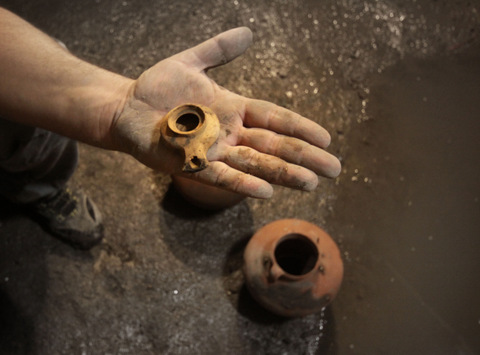
Three complete cooking pots and a small ceramic oil lamp were uncovered inside a small cistern in a drainage channel that runs from the Shiloah Pool in the City of David to Robinson’s Arch


Photograph of the finds in the cistern: Vladimir Naykhin.

The artifacts will be exhibited in a study conference on the City of David organized by the Megalim Institute, which will be held this coming Thursday, July 4, at Ramat Rahel

Recently a small cistern belonging to a building was exposed in an archaeological excavation the Israel Antiquities Authority is conducting near the Western Wall, in the vicinity of Robinson’s Arch in the Jerusalem Archaeological Park. Inside the cistern were three intact cooking pots and a small ceramic oil lamp that date to the time of the Great Revolt.
The vessels were discovered inside the drainage channel that was exposed in its entirety from the Shiloah Pool in the City of David to the beginning of Robinson’s Arch.

According to Eli Shukron, excavation director on behalf of the Israel Antiquities Authority, “This is the first time we are able to connect archaeological finds with the famine that occurred during the siege of Jerusalem at the time of the Great Revolt. The complete cooking pots and ceramic oil lamp indicate that the people went down into the cistern where they secretly ate the food that was contained in the pots, without anyone seeing them, and this is consistent with the account provided by Josephus”.

In his book The Jewish War Josephus describes the Roman siege of Jerusalem and in its wake the dire hunger that prevailed in the blockaded city.

In his dramatic description of the famine in Jerusalem he tells about the Jewish rebels who sought food in the homes of their fellow Jews in the city. These, Josephus said, concealed the food they possessed for fear it would be stolen by the rebels and they ate it in hidden places in their homes.

“As the famine grew worse, the frenzy of the partisans increased with it….For as nowhere was there corn to be seen, men broke into the houses and ransacked them. If they found some they maltreated the occupants for saying there was none; if they did not, they suspected them of having hidden it more carefully and tortured them.”
“Many secretly exchanged their possessions for one measure of corn-wheat if they happened to be rich, barley if they were poor. They shut themselves up in the darkest corners of the their houses, where some through extreme hunger ate their grain as it was, others made bread, necessity and fear being their only guides. Nowhere was a table laid…” (Josephus The Jewish War. Translated by G.A. Williamson 1959. P. 290).

The artifacts will be on display in a study conference on the City of David organized by the Megalim Institute which will take place this coming Thursday, July 4. For details about the conference visit the institute’s website at www.cityofdavid.org.il
That's quite a lot of narrative to get out of some pots in a cistern and an anecdote by Josephus, but maybe.

Thursday, June 27, 2013

Jacobus et al. (eds.), Studies on Magic and Divination in the Biblical World

NEW BOOK FROM GORGIAS PRESS:
Studies on Magic and Divination in the Biblical World
Edited by Helen R. Jacobus, Anne Katrine de Hemmer Gudme & Philippe Guillaume


Title: Studies on Magic and Divination in the Biblical World
Series: Biblical Intersections 11
Availability: In Print
Publisher: Gorgias Press

Availability: In Print
Publication Date: 5/2013
Language: English
Format: Hardback, Black, 6 x 9 in
Pages: 330

This collection of essays by participants in the Magic and Divination in the Biblical World research group of the European Association of Biblical Studies represents a wide ranging, analytical, and often unconventional approach to a relatively neglected area within Biblical Studies. These original articles by new and established scholars include Mesopotamian demonology, Akkadian literary influences, exorcism, healing, calendars, astrology, bibliomancy, dreams, ritual magic, priestly divination, prophecy, magic in the Christian Apocrypha and the New Testament, magic in rabbinic literature, and Jewish Aramaic magic bowls.
Follow the link for TOC etc. and ordering information. This and other Gorgias titles are 30% off until the end of this month. For you, special deal.

Forgotten Palmyra inscription

ROGER PEARSE: A Christian inscription from Palmyra dated 135 AD? Could be. Those two marks framing the last line certainly aren't text-speak kissy x's. I wonder what Larry Hurtado would say about them.

Cross-file under "Aramaic Watch." More on Palmyra and its inscriptions here and links.

When prophecy fails

MARK GOODACRE: The joy of failed predictions. Mark's track record for being ahead of the times with technology is exemplary, but he seems happy enough to have made one wrong call. It's nice of him also to flag one of my prophecies from the same era which seems to be holding up pretty well. That said, the mainstream media is still pretty resistant to correction, but I think we're even making slow progress on that front.

Wednesday, June 26, 2013

God in a cake box

A GROOM'S WEDDING CAKE: The Ark of the Covenant … in Cake Form!

What have the Romans ever done for us?

IAA PRESS RELEASE:
Greetings from the Roman Empire! A Section of an 1,800 Year Old Road was Exposed in Jerusalem (June 2013)

According to the excavation director on behalf of the Israel Antiquities Authority, “This is the first time we have encountered such a finely preserved section of the road in Jerusalem”.


Photographic credit: Assaf Peretz, courtesy of the Israel Antiquities Authority

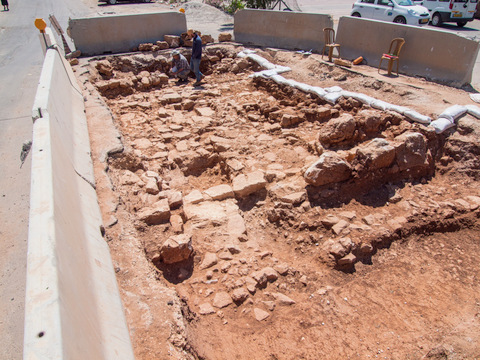
An ancient road leading from Yafo to Jerusalem, which dates to the Roman period (second–fourth centuries CE), was exposed this past fortnight in the Beit Hanina neighborhood in northern Jerusalem. The road remains were revealed in an archaeological excavation the IAA conducted in Beit Hanina prior to the installation of a drainage pipe by the Moriah Company.

The wide road (c. 8 m) was bounded on both sides by curbstones. The road itself was built of large flat stones fitted to each other so as to create a comfortable surface for walking. Some of the pavers were very badly worn, indicating the extensive use that was made of the road, and over the years the road also underwent a series of repairs.

According to David Yeger, excavation director on behalf of the Israel Antiquities Authority, “Several segments of the road were previously excavated by research expeditions of the IAA, but such a finely preserved section of the road has not been discovered in the city of Jerusalem until now”.
“The Romans attached great importance to the roads in the empire. They invested large sums of money and utilized the most advanced technological aids of the period in order to crisscross the empire with roads. These served the government, military, economy and public by providing an efficient and safe means of passage. Way stations and roadside inns were built along the roads, as well fortresses in order to protect the travelers. The construction and maintenance of the roads was assigned to military units, but civilians also participated in the work as part of the compulsory labor imposed on them by the authorities.”

The road section discovered in the IAA excavations in Beit Hanina is part of the imperial network of roads that led to Jerusalem from the coastal plain. We know about these roads from both historical sources and archaeological excavations. Two main arteries led from Yafo to Jerusalem during the Roman period. One is the road that passes through Bet Horon and the other runs via Shaar HaGai. This particular segment belongs to the Bet Horon road. The road began in Yafo and passed through Lod where it split it two different directions: one to Shaar HaGai and the other by way of Modiin along the route of what is today Highway 443 to Bet Horon. From there the road continued eastward as far as Bir Nabala and turned south to Kefar Shmuel where it merged with the highlands road that led to the Old City of Jerusalem.

In some places we can see that the modern Bir Nabala road was paved just a few centimeters above the route of the ancient road, which indicates that until a few decades ago the ancient road in this region was visible and was used.

More on reviving Aramaic

ARAMAIC WATCH: The Ben Yehudas of Aramaic: The one-time lingua franca of the Fertile Crescent is spoken by only 400,000 people around the world today. But efforts are being made, especially in one village in the Galilee, to ensure that Aramaic does not go quietly into the night (Dorit Shilo, Haaretz).
Shady Khallul and his brother Amir have been working for years to revive the holy language of Aramaean Christians in Israel and to bring it back into everyday use. Their model, Shady says, is none other than Eliezer Ben Yehuda, father of the contemporary Hebrew language renaissance.

"If you, the Jews, were able to revive Hebrew and turn it into a modern language, why can't we?" he asks. "Last year we received permission from the Education Ministry to teach Aramaic in first and second grades at the school in Jish, and we had to draft a curriculum from scratch. Amir wrote the textbooks and I traveled around the world to buy dictionaries and grammar books so that we could translate and adapt them for use in Israel. I brought most of the teaching material from Sweden, and the dictionaries from France. Most Aramaic books today are printed in Lebanon, but we have no way of bringing them in from there."

Unlike biblical Aramaic, written in Hebrew letters, the modern dialect - the Western variant of which is called Syriac - is written in another ancient script, which resembles a melding of the Hebrew and Arabic alphabets. Like Hebrew, the language comprises 22 characters and is written right to left. Each of Aramaic's two principle dialects - Western and Eastern - has its own alphabet. Both, however, share a classical written alphabet, Estrangela, reserved for prayers and religious texts.

The challenge before the Aramaeans in Israel, who use the Western dialect, is twofold: On the one hand they must teach their children to speak the language and persuade them to use it in their everyday lives, with family, friends and at school, and on the other hand teach them to read and write in the two alphabets (the Western and the Estrangela).
More on the Maronite revival of Aramaic in Jish here and links.