Morover / Dig they must (Haaretz)
Wednesday midday, Megiddo Prison
"I found it is all mosaic floor," Yehuda Batir says in his broken Hebrew. He is 25, born in Uzbekistan, has been in Israel only two and a half years and is already serving time in Megiddo Prison for domestic violence. Now he is working there as part of a "rescue dig" organized by the Israel Antiquities Authority (IAA), which is uncovering what turned out to be a mosaic of perhaps the oldest church ever found anywhere, dating back to the fourth century C.E.
"First I found corner," Batir continues. "I go, dig with hoe, saw here a little, 10 centimeters, and I think to myself there is something here. There was plaster, shards, no pictures. After that I saw fish and I know it is Christian."
[...]
Saturday, December 17, 2005
MORE ON THE MEGIDDO "CHURCH" EXCAVATION, including interviews with the prisoners who are doing the digging:


THE TWO ANCHORS FROM THE DEAD SEA are now on display in the Israel Museum:
The article has detailed information on the materials and construction of both anchors. The Madaba Map mosaic and a lot of ancient coins are on display with the anchor.
Dead Sea anchors were carefully designed
By MEIR RONNEN (Jerusalem
Two remarkably well-preserved wooden anchors more than two millennia old, discovered recently on the shores of the Dead Sea, are now on view opposite the book shop at the Israel Museum, on loan from the Israel Antiquities Authority.
[...]
The first anchor, approximately 2,500 years old, was found where the Ein Gedi harbor was once located, and may have been used by the Jews of biblical Ein Gedi. The later anchor, some 2,000 years old, was constructed according to the best Roman technology and probably belonged to a large craft used by one of the rulers of Judea. As the sea recedes further, we may yet get to see the ship to which this anchor belonged.
[...]
The article has detailed information on the materials and construction of both anchors. The Madaba Map mosaic and a lot of ancient coins are on display with the anchor.
Friday, December 16, 2005
MORE JEWISH-TEMPLE DENIAL, this time from the International Press Center, Palestine. A reader alerts me to the article "Israel Funds Construction Acts beneath Al Aqsa Mosque at the Cost of NIS 68 Million." The relevant passage reads:
My emphasis. I've posted on the tunnel excavation here and here, and here. The recent attempts to change the name of the Western Wall to the "Buraq Wall" (at the same time claiming that it is a Muslim-era artifact rather than a wall of the Herodian Temple Platform) have been noted here and here. Pointing out the constant repetition of this nonsense gets monotonous, but I don't think it should be ignored.
The construction works are planned to be financed by several ministries; phased over five-year period. These include propping up what is called as "Heshmonaem Tunnel" - a tunnel that passes under Al-Aqsa mosque - and building a befitting infrastructure for it, in addition to air-conditioning installation; restoration works of Al-Buraq wall, setting up additional arrival halls to receive the tourists who come to visit Al-Buraq square; constructing a heritage centre - dedicated to show a fabricated heritage that might will help them to deceive the foreign visitors into believing Jerusalem as a historical place of the Jews; building a police station; carrying out a marketing project to encourage the Jewish soldiers and students visit the Islamic holy square of Al-Buraq along with Al-Aqsa mosque.
Also, an Israeli government statement mentioned that Al-Buraq wall which is allegedly called by the Israelis as the "Wailing wall" would be part and parcel of the Jewish religious and historical heritage.
My emphasis. I've posted on the tunnel excavation here and here, and here. The recent attempts to change the name of the Western Wall to the "Buraq Wall" (at the same time claiming that it is a Muslim-era artifact rather than a wall of the Herodian Temple Platform) have been noted here and here. Pointing out the constant repetition of this nonsense gets monotonous, but I don't think it should be ignored.
Thursday, December 15, 2005
MORE SAD NEWS: I am sorry to note the death today of Israeli archaeologist Ruth Amiran, mentioned by Victor Avigdor Hurowitz on the ANE list.
IN THE MAIL -- my review copy of the long awaited 1-2 Samuel DJD volume has arrived:
Frank Moore Cross et al., Qumran Cave 4 XII: 1-2 Samuel (Discoveries in the Judaean Desert 17; Oxford: Clarendon, 2005)
DEFINITIONS OF "APOCALYPTIC" (WRITINGS) AND THE GENRE "APOCALYPSE" are collected by Alan S. Bandy over at Café Apocalypsis. Looks useful.
ANOTHER CELEBRATION of the 1600th anniversary of the invention of the Armenian alphabet:
Harvard University held a conference in honor of the anniversary in October.
Armenians Celebrate Their Letters
By JEFFREY GETTLEMAN (New York Times
Published: December 13, 2005
IT'S not every day you are invited to a 1,600th birthday party, let alone one for an alphabet.
But last week, that's exactly what brought more than 200 people to a parking lot in New Milford, N.J., across the street from a CVS and a karate studio, where they huddled together in a shivering herd, clapping their mittens and whispering prayers in frosty breath to the Armenian alphabet, created in the fifth century.
The Hovnanian School, a private day school that teaches the Armenian language, held the party and celebrated the occasion by unveiling an alphabet mural. ...
Linguists say the Armenian alphabet is one of the oldest in the world that is still in use. It has proved remarkably durable, surviving a carousel of empires, vast migrations and even genocide. Armenia is a small country with a big diaspora, and its language is valued as the glue that has held the community together. Today's 38 letters vary little from the original 36, which were first brushed by an Armenian monk around A.D. 405 in order to translate the Bible.
[...]
Harvard University held a conference in honor of the anniversary in October.
THE DEAD SEA SCROLLS are coming to Seattle in 2006:
And the Seattle Post Intelligencer has more:
And there's still more from the Seattle Times:
This article also tells how the exhibition was arranged.
Pacific Science Center to Present Dead Sea Scrolls
SEATTLE--(BUSINESS WIRE)--Dec. 14, 2005--Pacific Science Center today announced the upcoming West Coast premiere of Discovering the Dead Sea Scrolls, opening September 23, 2006.
This major new exhibition will feature 10 of the Dead Sea scrolls, including four scrolls never before seen by the public. Also included is a collection of artifacts from the ancient settlement of Qumran near the Dead Sea, along with interactive exhibits on the science behind the excavation, conservation, and interpretation of the scrolls.
[...]
And the Seattle Post Intelligencer has more:
Tickets go on sale today for the first show of Dead Sea Scrolls in the Northwest, which will open Sept. 23 at the Pacific Science Center. Bryce Seidl, the center's president and chief executive officer, said at a news conference Wednesday he hoped 250,000 people would attend during the 105-day run.
The exhibit will feature 10 scrolls and scroll fragments. Some are biblical in nature and others are what is being called "sectarian." The biblical scrolls and fragments, which represent the earliest versions of the Hebrew Bible, or Old Testament, concern the books of Genesis, Exodus, Isaiah, Ezekiel and Psalms. A handful of facsimiles on various subjects, including the book of Deuteronomy, will also be shown.
In addition, the show will include a collection of artifacts -- mostly pottery, wooden bowls and coins -- from Qumran, the area of the Judean desert where the scrolls were found, as well as displays of the technology involved in the discovery of the scrolls, their preservation and interpretation.
And there's still more from the Seattle Times:
Among the 10 scrolls or scroll fragments to be shown in Seattle is a text that relates the fourth to sixth days of the biblical creation story, with God dividing the light from darkness and creating humankind. Another parchment describes God speaking to Moses through a burning bush. Neither scroll has been exhibited before.
The exhibit also will include manuscripts that describe life in the Middle East shortly before the birth of Jesus Christ. One is a list of rules that spell out behavior and customs among a sect that inhabited the Judean desert where the scrolls were found in 1947. Spitting on the floor was frowned upon, latrines were supposed to be a certain distance from houses, and men were exhorted to use only their left hands when urinating.
This article also tells how the exhibition was arranged.
Wednesday, December 14, 2005
THIS IS KIND OF FREUDIAN, but I guess the Shrine of the Book does look like one. And it was for a good cause.
ROBERT ISRAEL AUMANN, recent winner of the Nobel Prize in Economics, has also published on game theory and the Talmud. See his articles "On the Matter of the Man with Three Wives" [PDF file] (Paper 46, updated and revised [I think from a 1985 original - JRD] for the Rabbinic public), Moriah 22, 3-4, Tevet 5759 (January 1999): 98-107 (in Hebrew) and "Risk Aversion in The Talmud," Economic Theory 21 (2003): 233-239. (From his full list of publications here.)
Tuesday, December 13, 2005
FEMALE SCRIBES aren't any easier to find than female bibliobloggers, but Aviel Barclay-Rothschild is one (a scribe, that is), and she also has a blog: Netivat Sofrut: diary of a Soferet. I have no idea if she would want to be known as a biblioblogger, but she certainly talks about the Bible and also posts samples of her own biblical scrolls. She has a post on medieval female scribes here.
(Via Manuscript Boy, who has more on female scribes at Hagahot. He also has some good thoughts on the limits of the contribution of manuscripts to scholarship. Read the comments too.)
(Via Manuscript Boy, who has more on female scribes at Hagahot. He also has some good thoughts on the limits of the contribution of manuscripts to scholarship. Read the comments too.)
M. R. JAMES was a remarkably prolific and varied writer. He was a major contributor to the field of biblical apocrypha and pseudepigrapha in the late nineteenth and early twentieth centuries. He also wrote and published good ghost stories. Now Rick Brannan has run across another James work that is new to me:
This is republished online in Project Gutenburg's "plain vanilla text" format. The book appears to be a collection of stories from various Old Testament pseudepigrapha retold for children. Here's the table of contents:
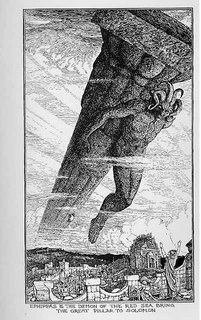
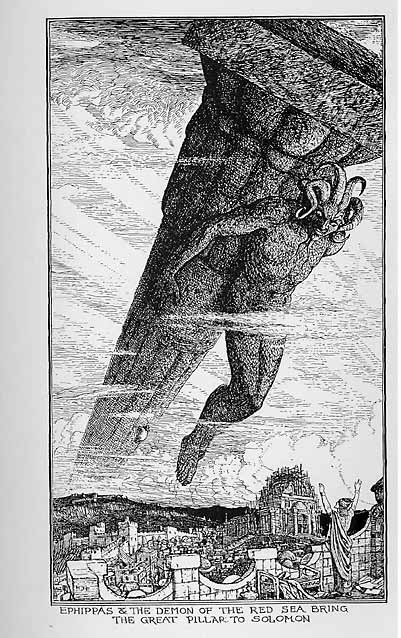
There's also a zip file with the full text of the book, page by page (the image quality is not great), and all of the illustrations. Here, for example, is "EPHIPPAS AND THE DEMON OF THE RED SEA BRING THE GREAT PLLLAR TO SOLOMON," a scene from the Testament of Solomon chapter 24:
Cool stuff. You can also read James's ghost stories online (again, through Project Gutenburg) here and here. And another seminal work of his is also online: The Lost Apocrypha of the Old Testament (noted here on PaleoJudaica a while ago). And see the first link in this post for still more. Plus Ed Cook has more yet in this Ralph post from some time ago.
Old Testament Legends: Being Stories Out of Some of the Less-Known Apocryphal Books of the Old Testament
This is republished online in Project Gutenburg's "plain vanilla text" format. The book appears to be a collection of stories from various Old Testament pseudepigrapha retold for children. Here's the table of contents:
ADAM
THE DEATH OF ADAM AND EVE
ABRAHAM
THE STORY OF ASENETH, JOSEPH'S WIFE
JOB
SOLOMON AND THE DEMONS
THE STORY OF EBEDMELECH THE ETHIOPIAN, AND OF THE DEATH OF JEREMIAH
AHIKAR
There's also a zip file with the full text of the book, page by page (the image quality is not great), and all of the illustrations. Here, for example, is "EPHIPPAS AND THE DEMON OF THE RED SEA BRING THE GREAT PLLLAR TO SOLOMON," a scene from the Testament of Solomon chapter 24:
Cool stuff. You can also read James's ghost stories online (again, through Project Gutenburg) here and here. And another seminal work of his is also online: The Lost Apocrypha of the Old Testament (noted here on PaleoJudaica a while ago). And see the first link in this post for still more. Plus Ed Cook has more yet in this Ralph post from some time ago.
Monday, December 12, 2005
I'VE UPDATED Saturday's Paul Mirecki post yesterday and this morning, and will continue to do so for a while as the situation develops.
ASSIMILATED TO THE BLOGOSPHERE: Here's a fairly new Brazilian blog, Observatório Bíblico, run by Professor Airton José da Silva. Welcome!
RABBINICS CONFERENCE: The Institute for the Study of Rabbinic Thought at Robert M. Beren College, Beit Morasha of Jerusalem, is holding its Eighth International Conference on Rabbinic Thought on Monday – Thursday, December 26-29, 2005. It will take place at the Kiryat Moriah Campus, 3 Ha'Askan, Jerusalem. Email: hazal@bmj.org.il; website: http://www.bmj.org.il. The program is as follows:
Monday, December 26th
9:30 Chaim Milikowsky (Bar-Ilan U.), Chair
Prof. Benjamin Ish-Shalom (Rector, Beit Morasha), Greetings
Prof. Moshe D. Herr (Hebrew U.), A Hundred Years of the Study of Rabbinic Thought: Problems, Achievements, Challenges
Prof. Rabbi David Weiss-Halivni (Columbia U.), Talmudic Research and the Breaking of the Vessels
12:00 Prof. Shlomo Naeh (Hebrew U.), Chair
Prof. Menahem Kahana (Hebrew U.), Numerological Consideration in the Study of Rabbinic Literature
Rabbi Dr. Benjamin Lau (Beit Morasha), On the Possibility of Biographical Study of Rabbinic Literature
14:00 Prof. Leib Moscowitz (Bar-Ilan U.), Chair
Rabbi Prof. Daniel Sperber (Bar-Ilan U.), Fundamental Ethical Values in Halakha
Dr. Cana Werman (Ben-Gurion U.), Contemplations on the development of Halakha
Rabbi Dr. Yehuda Brandes (Beit Morasha), Aggadic and Halakhic Representations of Levirate Marriage
Tuesday, December 27th
10:00 Prof. Jonah Frankel (Hebrew U.), Chair
Dr. Alon Goshen-Gottstein (Beit Morasha), The Two-Powers Polemic: The Textual Evidence
Prof. Yaakov Elman (Yeshiva U.), Theological Dialogue in Amoraic Babylonia
Prof. Steven Fine (Yeshiva U.), Jewish and Samaritan Houses of Study and Synagogues in Late Antiquity
12:45
Prof. Aharon Shemesh (Bar-Ilan U.), Punishment in Qumran and the Beginnings of Midrash
Ms. Avital C. Hochstein and Prof. Hanna Safrai (Hartman Inst.), Inclusion and Exclusion of Women in Halakhic Midrash of the Type “Ein Li Ela”
Dr. Noam Zohar (Bar-Ilan U.), From the Biblical Mishpatim to Mishnah Tractate Nezikin: Two conceptual Schemes -- One Adopted, One Rejected
20:00
Gala Evening in honor of Rabbi Dr. Yehuda Brandes's book, Applied Aggada
At Heikhal Shlomo, 58 King George St., Jerusalem
Wednesday, December 28th
9:30
Prof. Avigdor Shinnan (Hebrew U.), The Sources of Rabbi Akiba’s Wealth in the Aggada
Dr. Joshua Levinson (Hebrew U.), Stories of Confrontation Stories between Rabbis and Witches
Dr. Reuven Kipperwasser, “A King who Invited Guests” Parables
12:00
Prof. Menahem Fish (Tel-Aviv U.), Religious Polemics and the Prayer Controversy
Dr. Uri Erlich (Ben-Gurion U.), Prayer in Rabbinic Literature: A Developing Database
Prof. Shamma Friedman (Bar-Ilan U.), Innovation and Progress of The Saul Lieberman Institute’s Database of Textual Witnesses: Images of Fragments
Thursday, December 29th
10:00 Prof. Albert Baumgarten (Bar-Ilan U.), Chair
Prof. Marc Hirshman (Hebrew U.), Concepts of the Election of Israel in Rabbinic Thought
Ms. Yifat Monnickendam (Bar-Ilan U.), The Polemic over Resurrection of the Dead in Rabbinic Thought and the Church Fathers
Prof. Harry Fox (U. of Toronto), Socio-Linguistics as Identification of Status in Rabbinic Thought
13:00
Prof. Yair Lorberboim (Bar-Ilan U.), Holiness and Imitatio Dei in Tanaitic Thought
Rabbi Dr. Oded Yisraeli (Ben-Gurion U.), The Zohar of the Aggada
Sunday, December 11, 2005
I AM VERY SORRY TO NOTE the death today of Professor Hayim Tadmor, reported on the ANE list by Victor Avigdor Hurowitz. May his memory be for a blessing.
EILAT MAZAR has published an article on her monumental building in Jerusalem in Biblical Archaeology Review. It is available online, downloadable as a PDF file:
(Via Explorator 8.33.)
Did I Find King David's Palace?
(Via Explorator 8.33.)
ANTIQUITIES AS ASSESTS TO BE SEIZED? American victims of a Hamas terrorist attack in Israel are trying to seize Iranian antiquities in American museums to pay for the judgment they won against Iran. I don't object to the principle these people are trying to establish (i.e., seizing external assets of states that support terrorism in order to compensate the victims), but I think antiquities should be off limits.
Saturday, December 10, 2005
A NEW ARAMAIC FRAGMENT OF TOBIT has surfaced in the Schøyen Collection. Ed Cook has an analysis over at Ralph. He says he's confident it's genuine.
REGARDING PAUL MIRECKI: I've been following this situation closely, but haven't said anything about it yet, partly because I've been busy, partly because it's tangential to my usual topics, and partly because the situation has been changing so fast and I've been taking notes and thinking about it. But here are my thoughts at present.
The basic story is that Paul Mirecki, Professor of Religion at the University of Kansas, has been heavily criticized for insulting e-mail comments he made about creationists and fundamentalists in connection with a course on creationism and "intelligent design." It seems that this was a private e-mail that someone then circulated approvingly. He also made intemperate comments about Catholics, Fundamentalist Zionists, etc. on a discussion board for the KU Society of Open-Minded Atheists and Agnostics. He ended up withdrawing the course, then earlier this week he reported that he was stopped on the road and beaten up by two men driving a pickup truck who specifically mentioned the controversy. Then, late in the week, he resigned as chair of the Department of Religion. Now he has hired a lawyer. There's also summary article from today here.
To start with, I think what he wrote (and he has acknowledged that he wrote it and has apologized) was unpleasant, unconstructive, and unfair. But, frankly, I've heard worse from some Democrats about President Bush and some Republicans about President Clinton, and in both cases the comments have been made in public and with no thought that anyone could be offended. Free speech includes free speech that other people don't like, or it's not worth much. Whether he should have canceled the course (and I'm sorry that, for whatever reason, it isn't going forward) or resigned as department chair are things best sorted out between him and his department.
It looks as though he spoke (i.e., wrote) too freely because he was under the impression that he was writing something in private, although he posted his e-mail comments on an archived list that seems to have been accessible to the public. One private message -- the one that started the controversy -- was also circulated by someone else. But however they were made public, this reinforces the principle that you should never put something in an e-mail if you don't want it to be read by pretty much everyone in the world.
The beating, of course, is appalling, and I can't say I'm encouraged to hear a number of people just saying they don't believe it happened. This article has a picture of the bruises, which look to me to have been administered with considerable enthusiasm. Are we really supposed to believe that he battered himself and then involved the media and the police just to get media sympathy? If that were true it would be quite reprehensible -- and also weird -- but people who make the claim had better back it up with some serious evidence or they could end up looking pretty bad themselves. I'm taking Mirecki at his word unless someone offers me strong evidence to do otherwise.
As for the wider issues that started the whole controversy, rude comments aside, Mirecki is right that creationism is not a viable scientific theory and "intelligent design" is a very weak philosophical argument. And it is perfectly legitimate to teach a class that explains why. Creationism is nonsense and flies in the face of both scientific method and the actual evidence. "Intelligent design" is a superficially plausible attempt to cast doubt on evolution and bring creationism in again through the back door, but its arguments simply don't hold up to anyone who knows anything about serious metaphysics or scientific cosmology. For example, the "fine-tuned universe" argument is based on the assumption that all of reality is contained in the visible universe, but there are plenty of reasons to doubt that this is the case. We don't even know the actual size of the universe we're in: all we can see is in our own past-light cone, which may be a very small part of the whole. The many-worlds theory of quantum physics holds that there are an infinite number of parallel universes. There are good physical arguments (involving both quantum computation and the "two-slit experiment") in favor of it and a fair number of physicists accept it. Moreover, the Big Bang itself may be just a small eddy in an infinite quantum-fluctuating vacuum. In other words, the fact that the parameters of our universe are set to many decimal places to produce life may just be an extremely unlikely coincidence that nevertheless is unremarkable among the infinity of other possibilities that are realized elsewhere. And once you grant that such a coincidence has to happen somewhere, it's no surprise that we find ourselves in a universe of the sort that produces intelligent life. Where else are we going to find ourselves? (The technical term for this general point is the "weak anthropic principle.") And so on.*
Back to Mirecki: the reaction of elements of the Kansas legislature to these events has been disappointing:
I've taught courses on Judaism, Asian religions (Hinduism, Buddhism, Chinese religions, Shinto, etc.), Islam, and early Christianity. Sorry, but it's pretty hard to believe in all of them, and any attempt to do so would fail to take any of them seriously on their own terms. One can teach about religious beliefs and practices accurately and fairly without believing in them. I imagine this was just a poorly thought-out, off-the-cuff comment, but the Balkanization it implies is chilling. If Kansas legislators are going to pressure universities to allow only adherents to teach a religion, and that only from an insider's faith perspective, Kansas has a problem.
Likewise, the zero tolerance of "any intolerance" of any kind is ill considered. Personally, I'm intolerant of, say, cannibalism, al-Qaeda, clitorectomies, Nazis, and Aztec human sacrifice, and I don't see why anyone should try to be tolerant of them in class, online, or elsewhere. I don't think Rep. Landwehr would disagree, but while she's criticizing Mirecki, she needs to think more carefully about statements she herself is making in public as an elected public official.
Professor Mirecki made some mistakes and has paid more for them than he ought to have. But that doesn't justify teaching creationism in public schools or using the incident to interfere with the academic freedom of professors of religion in Kansas. I hope that cooler heads speak up more about this and that they prevail in the long run.
*Just to be clear, I have nothing in principle against people making arguments for the existence of God from metaphysics or scientific cosmology. Theologians have been advancing these for a long time and continue to do so, joined by the occasional physicist. Some of what they've done is quite interesting, although I doubt that a great many people have been converted to theism via that route. But these theologians and scientists operate on a more sophisticated level than the proponents of "intelligent design" and -- crucially -- they don't promote their positions as alternatives to evolutionary theory. I have no problem with these arguments being studied in university courses, but these should be courses on theology and science or on the philosophy of religion (both of which would quickly reduce the "intelligent design" arguments to mincemeat), and not science courses.
BIBLIOGRAPHY:
David Deutsch, The Fabric of Reality (London: Penguin, 1997).
UPDATE: I suppose Rep. Landwehr could have been saying just that atheists and agnostics shouldn't teach religion rather than that only people who believe in a religion should teach it, which is how I first took her statement. But this is no better, pretty much for the reasons I've already given. It's possible to teach a religion at the university level fairly and accurately without believing in that religion or any religion. And if my second interpretation is what she meant, its both discriminatory and unconstitutional. Whatever she meant, it was out of line.
UPDATE (11 December): Rebecca Lesses comments.
UPDATE (12 December): More good commentary from Rebecca here. She also notes this article, in which Mirecki says that he was forced to resign as department chair.
UPDATE (13 December): The University of Kansas begs to differ: "KU: Mirecki left leadership post voluntarily".
UPDATE (22 December): Note this post on Loren Rosson's blog, The Busybody. In the comments I interact with an anonymous commenter and offer some corrections and expansions of this post. Also, the Religion Department of the University of Kansas now has a new acting chair.
The basic story is that Paul Mirecki, Professor of Religion at the University of Kansas, has been heavily criticized for insulting e-mail comments he made about creationists and fundamentalists in connection with a course on creationism and "intelligent design." It seems that this was a private e-mail that someone then circulated approvingly. He also made intemperate comments about Catholics, Fundamentalist Zionists, etc. on a discussion board for the KU Society of Open-Minded Atheists and Agnostics. He ended up withdrawing the course, then earlier this week he reported that he was stopped on the road and beaten up by two men driving a pickup truck who specifically mentioned the controversy. Then, late in the week, he resigned as chair of the Department of Religion. Now he has hired a lawyer. There's also summary article from today here.
To start with, I think what he wrote (and he has acknowledged that he wrote it and has apologized) was unpleasant, unconstructive, and unfair. But, frankly, I've heard worse from some Democrats about President Bush and some Republicans about President Clinton, and in both cases the comments have been made in public and with no thought that anyone could be offended. Free speech includes free speech that other people don't like, or it's not worth much. Whether he should have canceled the course (and I'm sorry that, for whatever reason, it isn't going forward) or resigned as department chair are things best sorted out between him and his department.
It looks as though he spoke (i.e., wrote) too freely because he was under the impression that he was writing something in private, although he posted his e-mail comments on an archived list that seems to have been accessible to the public. One private message -- the one that started the controversy -- was also circulated by someone else. But however they were made public, this reinforces the principle that you should never put something in an e-mail if you don't want it to be read by pretty much everyone in the world.
The beating, of course, is appalling, and I can't say I'm encouraged to hear a number of people just saying they don't believe it happened. This article has a picture of the bruises, which look to me to have been administered with considerable enthusiasm. Are we really supposed to believe that he battered himself and then involved the media and the police just to get media sympathy? If that were true it would be quite reprehensible -- and also weird -- but people who make the claim had better back it up with some serious evidence or they could end up looking pretty bad themselves. I'm taking Mirecki at his word unless someone offers me strong evidence to do otherwise.
As for the wider issues that started the whole controversy, rude comments aside, Mirecki is right that creationism is not a viable scientific theory and "intelligent design" is a very weak philosophical argument. And it is perfectly legitimate to teach a class that explains why. Creationism is nonsense and flies in the face of both scientific method and the actual evidence. "Intelligent design" is a superficially plausible attempt to cast doubt on evolution and bring creationism in again through the back door, but its arguments simply don't hold up to anyone who knows anything about serious metaphysics or scientific cosmology. For example, the "fine-tuned universe" argument is based on the assumption that all of reality is contained in the visible universe, but there are plenty of reasons to doubt that this is the case. We don't even know the actual size of the universe we're in: all we can see is in our own past-light cone, which may be a very small part of the whole. The many-worlds theory of quantum physics holds that there are an infinite number of parallel universes. There are good physical arguments (involving both quantum computation and the "two-slit experiment") in favor of it and a fair number of physicists accept it. Moreover, the Big Bang itself may be just a small eddy in an infinite quantum-fluctuating vacuum. In other words, the fact that the parameters of our universe are set to many decimal places to produce life may just be an extremely unlikely coincidence that nevertheless is unremarkable among the infinity of other possibilities that are realized elsewhere. And once you grant that such a coincidence has to happen somewhere, it's no surprise that we find ourselves in a universe of the sort that produces intelligent life. Where else are we going to find ourselves? (The technical term for this general point is the "weak anthropic principle.") And so on.*
Back to Mirecki: the reaction of elements of the Kansas legislature to these events has been disappointing:
The university’s action wasn’t enough for conservative lawmakers, who said they want to know whether professors teaching other courses are letting their biases get in the way.
“This may show a bigger problem than just Professor Mirecki,” said Rep. Brenda Landwehr, a Wichita Republican. “It may show we’re not providing fair and balanced opportunities to our students.”
Landwehr has called for hearings when the Legislature resumes next month. She said she wants to know whether professors are exhibiting any intolerance, whether it’s religious, political or any other kind.
Landwehr also questioned whether Mirecki should be allowed to teach religious studies courses.
“It’s hard to teach religion if you don’t believe in it,” she said.
I've taught courses on Judaism, Asian religions (Hinduism, Buddhism, Chinese religions, Shinto, etc.), Islam, and early Christianity. Sorry, but it's pretty hard to believe in all of them, and any attempt to do so would fail to take any of them seriously on their own terms. One can teach about religious beliefs and practices accurately and fairly without believing in them. I imagine this was just a poorly thought-out, off-the-cuff comment, but the Balkanization it implies is chilling. If Kansas legislators are going to pressure universities to allow only adherents to teach a religion, and that only from an insider's faith perspective, Kansas has a problem.
Likewise, the zero tolerance of "any intolerance" of any kind is ill considered. Personally, I'm intolerant of, say, cannibalism, al-Qaeda, clitorectomies, Nazis, and Aztec human sacrifice, and I don't see why anyone should try to be tolerant of them in class, online, or elsewhere. I don't think Rep. Landwehr would disagree, but while she's criticizing Mirecki, she needs to think more carefully about statements she herself is making in public as an elected public official.
Professor Mirecki made some mistakes and has paid more for them than he ought to have. But that doesn't justify teaching creationism in public schools or using the incident to interfere with the academic freedom of professors of religion in Kansas. I hope that cooler heads speak up more about this and that they prevail in the long run.
*Just to be clear, I have nothing in principle against people making arguments for the existence of God from metaphysics or scientific cosmology. Theologians have been advancing these for a long time and continue to do so, joined by the occasional physicist. Some of what they've done is quite interesting, although I doubt that a great many people have been converted to theism via that route. But these theologians and scientists operate on a more sophisticated level than the proponents of "intelligent design" and -- crucially -- they don't promote their positions as alternatives to evolutionary theory. I have no problem with these arguments being studied in university courses, but these should be courses on theology and science or on the philosophy of religion (both of which would quickly reduce the "intelligent design" arguments to mincemeat), and not science courses.
BIBLIOGRAPHY:
David Deutsch, The Fabric of Reality (London: Penguin, 1997).
UPDATE: I suppose Rep. Landwehr could have been saying just that atheists and agnostics shouldn't teach religion rather than that only people who believe in a religion should teach it, which is how I first took her statement. But this is no better, pretty much for the reasons I've already given. It's possible to teach a religion at the university level fairly and accurately without believing in that religion or any religion. And if my second interpretation is what she meant, its both discriminatory and unconstitutional. Whatever she meant, it was out of line.
UPDATE (11 December): Rebecca Lesses comments.
UPDATE (12 December): More good commentary from Rebecca here. She also notes this article, in which Mirecki says that he was forced to resign as department chair.
UPDATE (13 December): The University of Kansas begs to differ: "KU: Mirecki left leadership post voluntarily".
UPDATE (22 December): Note this post on Loren Rosson's blog, The Busybody. In the comments I interact with an anonymous commenter and offer some corrections and expansions of this post. Also, the Religion Department of the University of Kansas now has a new acting chair.
Subscribe to:
Posts (Atom)