Wednesday, July 20, 2005

WISH LIST OF LOST BOOKS: Michael Pahl writes:
I've often thought what a boon it would be to New Testament scholarship if we could have a copy of Papias' "Expositions of the Logia of the Lord." Given Papias' desire for living tradition over against written record, it could provide tremendously valuable insights into the nature of the oral Jesus tradition at the beginning of the second century and perhaps shed more light on that oral tradition back into the first century. I was just reminded of this today, and this led me to think about this more broadly: Out of all the lost documents related to early Christianity--those mentioned by early Christians but no longer extant, those for which we have fragments or quotations but not whole manuscripts--which would I most wish to be discovered?

After giving his list he adds:
Anyone else have a similar wishlist? If we hurry, we may get it off in time for Christmas... :-)

This is a subject near and dear to my heart, since the More Old Testament Pseudepigrapha Project on which my colleague Richard Bauckham and I are working, aims to include a list of all Old Testament pseudepigrapha mentioned in surviving literature from antiquity to the present, whether or not the works survive themselves. So here is my preliminary list of now lost or highly fragmentary ancient pseudepigrapha of which I would like to have complete manuscripts in their original languages.

The Stichometry of Nicephorus mentions:
  • The Testament of Moses
  • The Assumption of Moses
  • Eldad and Modad
  • Of the Prophet Elias
  • Of the Prophet Sophonais
  • Of Zacharias the father of John
  • Pseudepigrapha of Baruch, Ambacum (Habakkuk), Ezekiel, and Daniel

The List of the Sixty Books mentions some of these and also (some overlap?):
  • Adam
  • Lamech
  • Vision of Esaias
  • Apocalypse of Sophonias
  • Apocalypse of Zacharias

The Gelasian Decree mentions in addition (again, possibly some overlap with above?):
  • The book, concerning the daughters of Adam, of Leptogenesis
  • The book which is called the Penitence of Adam
  • The book concerning the giant named Ogias who is stated by the heretics to have fought with a dragon after the Flood
  • The book which is called the Penitence of Jannes and Mambres
  • The Writing which is called the Interdiction (or Contradiction) of Solomon

We have bits of some of these, but none (or at least very few) of them complete. Add to them the Aramaic Book of Giants (see also here) and the Nazarene Apocryphon of Jeremiah in Hebrew, mentioned by Jerome.

That's all I can think of off the top of my head (with the help of M. R. James's The Lost Apocrypha of the Old Testament). If I've missed some lost Old Testament pseudepigrapha known only by title or small fragment, drop me a note and let me know.

Incidentally, some very good news about our More Old Testament Pseudepigrapha Project is going to be announced soon. Watch this space.

Also, blogging may be light for a while. The page proofs for my book, The Provenance of the Pseudepigrapha: Jewish, Christian, or Other? have arrived, thanks to a remarkably quick production on Brill's part. I was just getting started on them this afternoon when I got a call from the Journal for the Study of the Pseudepigrapha asking if they could e-mail me the proofs for my 27,000-word article, "(How) Can We Tell If a Greek Apocryphon or Pseudepigraphon Has Been Translated from Hebrew or Aramaic?" and would I be able to manage a turnaround by Monday. (The narrow window is due to a technical glitch that is no one's fault and it can't be helped.) This is good news, since it means that the article should be out next month and the book in the fall. But it also does mean that I'm going to be pretty busy reading proofs and supervising the book indexing for some time. Bear with me.

UPDATE: Michael Turton and Stephen Carlson post their wish lists. And Jim West posts his.

UPDATE (21 July): Ken Ristau posts his wish list.

UPDATE (22 July): Manuscript Boy posts his medieval wish list. But one of his wished-for books is in the future.

UPDATE (24 July): Justin Dombrowski posts his wish list of five. I also especially covet his first two.

UPDATE (25 July): Christopher Heard weighs in at Higgaion. I've thought of some more, which I'll try to post presently.

LATER: Lost treatises of the first-century Jewish philosopher Philo of Alexandria: three books missing from Questions and Answers on Exodus, one book from Drunkenness, and three books from Dreams. We also lack That Every Fool is a Slave (the companion piece to Good Person), two books On Covenants, a treatise On Rewards, the lives of Isaac and Jacob, perhaps a companion piece to Contempl. Life, and the promised sequel to Eternity (assuming it was written). There are also references to a treatise On Piety, although it has also been suggested that this is another name for Virtues. (The treatise names are from the SBL Handbook.) A number of Philo's treatises also survive only in Armenian translation, and I would like the Greek originals of those too, please.

I should perhaps also note the "external books" forbidden by R. Akiva in the Mishnah (Sanhedrin 10.1), although these are to be read at your own risk! Then there's also the passage in Mishnah Pesahim 4.9 (some manuscripts) which refers to a "book of healings" suppressed by King Hezekiah. Not that there was such a book in Hezekiah's time, but it's possible that a pseudepigraphon with that description was circulating in the Tannaitic period.

UPDATE: Ellen Birnbaum, Philo scholar, e-mails to say she approves of my list of lost Philonica. She adds:
Years ago, Hanan Eshel mentioned to me as a great desideratum the history of the Jewish war against Rome by Justus of Tiberias. (Though this is [probably] non-biblical, I thought I'd mention it anyway.)

In Against Apion, Josephus cites several sources that would illuminate our knowledge about attitudes of non-Jews towards Jews, and there are also the fragmentary Acts of the Alexandrian Martyrs (CPJ 2: nos. 154-59). Though your criteria for inclusion may be Bible-related works, some of these (esp. counter-accounts of the Exodus) may fall into that category in a perverse sort of way!

UPDATE (26 July): Reader Eric Rowe e-mails:
FWIW, at the top of my wish list would be Origen's Hexapla, partly for the (albeit possibly few) new readings, but mainly for its sheer importance.

Indeed. Also, on the H-Judaic list, Michael Stone is looking for the Book of Noah in rabbinic and later literature:
First, any references in Rabbinic or later texts to a book, testament or other document attributed to Noah. I am, of course, familiar with Sefer Noah in Jellineck, Bet HaMidrash.

If he finds any references, I hope he will share them with the list.

Also, Joe Cathey points to excerpts from a classical article on the Book of Giants by W. B. Henning which is now online. It discusses the story of Ogias the giant.

UPDATE: Brandon Wason has some suggestions over at Novum Testamentum.

UPDATE (5 August): Speaking of ancient lost books, many of these books might as well be lost for all people know about them, but thanks to new funding for the MOTP project, you should be able to read them soon.

UPDATE (30 December 2006): I've added to my lost books wish list here and here. See also here and here.
I HOPE THIS STORY gets as much attention as Silwan and Babylon have:
Developers and purists erase Mecca's history

By Laith Abou-Ragheb

MECCA, Saudi Arabia (Reuters) - Some of Islam's historic sites in Mecca, possibly including a home of the Prophet Mohammad, are under threat from Saudi real estate developers and Wahhabi Muslims who view them as promoting idolatry.

Sami Angawi, an expert on the region's Islamic architecture, said 1,400-year-old buildings from the early Islamic period risk being demolished to make way for high rise towers for Muslims flocking to perform the annual pilgrimage to Islam's holiest city.

"We are witnessing now the last few moments of the history of Mecca," Angawi told Reuters. "Its layers of history are being bulldozed for a parking lot," he added.

[...]

I have nothing against commercial development and better housing in Mecca, but they should not come at the expense of the city's historic architecture.
JOE CATHEY has published "A Short Note on Recent Forgeries" at the Bible and Interpretation website, in which he calls for "a marriage between chemical/geological and epigraphical/palaeographical analysis" of inscriptions. I think he's right.
NEWS ABOUT THE JOURNAL HENOCH: I've been meaning to mention this, but Mark Goodacre has beaten me to it.
AGAIN?
Report: Russian nationalists ask court to probe Jewish leaders
By The Associated Press


MOSCOW - A group of Russian nationalists has asked a Moscow court to order an investigation of Jewish leaders over the abridged halakhic guide Kitzur Shulhan Arukh, an ancient text that the nationalists say incites hatred, a news agency reported Tuesday.

The reported request was the latest move in a months-long campaign aimed at banning Jewish organizations in Russia, an effort that has raised fears of a resurgence of anti-Semitism and questions about the government's commitment to fighting racism.

[...]

More details here. These guys are persistent, aren't they? It appears that anti-Semitism is all too alive and well in Russia.
MORE ON THE NEW UNESCO WORLD HERITAGE SITES IN ISRAEL: YNetNews has some information on the process of choosing the sites:
Preserving world's biblical heritage

Israel hopes UNESCO selection of ancient archeological areas as world heritage sites will encourage international tourism
By Tamar Treblisi Hadad
IS THE ISRAEL MUSEUM NEGLECTING THE BIBLE? Suzanne F. Singer of Biblical Archaeology Review expresses some concerns in the Jerusalem Post ("Dont sell the Bible short"):
Here's what worries me. Museum deputy director, Dor Lin, says in the supplement that next year changes will occur in the archaeology exhibits. "Every artifact will be a piece in the archaeological puzzle that influenced man." My concern is that in the service of what is perceived as greater universalism, meant to entice people for whom the Bible is not important, the Israel Museum is embarking in a direction that is neither good for attracting more visitors nor fulfilling its potential as the only national museum prepared to tell the story of the Jewish people in its land.

Focusing strictly on marketing, it's a mistake to conclude that secular people from all over the world who come to the museum will not be fascinated to discover that places and events in the Bible can be linked, even if with uncertainties, to sites and artifacts in Israel. And needless to add, the many Christian visitors as well as Jews who already care about their Bibles – both Hebrew Bible and New Testament – will be eager to discover connections they can see in the land.

I don't have any particular view about what the Museum is doing, but I agree that it is a mistake to assume that secular people aren't interested in biblical subjects. No matter where I go or whom I talk with, when I mention that I work on the Dead Sea Scrolls, people are always interested.

Tuesday, July 19, 2005

WELCOME to the 150,000th visitor to increment PaleoJudaica's counter! The visit came at 11:11:08 PM GMT from a Google referral that leaves me pretty sure I know who the visitor was. I won't mention a name, but the service provider is in Connecticut. Drop me a note if you want to confirm who you are.

For comparison, it took from 24 March 2003 to 7 May 2004 to get the first 50,000 visitors; then to 1 February 2005 to get the next 50,000. And now less than six months more for the next 50K. That's progress!
CONSENSUS AGAIN: Mark Goodacre has a post that collects links to the discussion so far and then he adds his own comments. I agree with nearly everything he says (and his point 1 fills out nicely the point I made briefly in my first post in reply to Michael's original fourth point). But I do want to nuance Mark's reply to Joe Weaks's defense of the necessity of trusting the consensus in areas on which we are not experts:
That's a useful corrective, but I don't feel so negative. Our field is not that huge. It only feels that way because of the increasing specialisation. And this is all a good reason for post graduate students to become minor experts in as many topics as possible. After all, one has to teach across a range of subjects; some intensive course work on a given topic can persuade one of how to approach a consensus well.

In the nature of things we're stuck with increasing specialization for the foreseeable future and the only way to work around it is to keep an eye on what other people are doing and start from the consensus position, if there is one, when moving outside one's immediate research specialty either for teaching or research. We've even reached the point of specializations within specializations. It used to be that Qumran studies was a subfield of biblical studies. Now it is not only an independent field, it's one that itself contains various subfields. I can't form an expert opinion on every question in Qumran studies even though it's one of my areas of specialization. I don't have expertise at all on the archaeology and even for the texts I don't have time to do the necessary intensive study of each text to have off-the-cuff fully-informed opinions about all the problems associated with it. I just try to look at some of the secondary literature and to focus on specific problems when my research requires it. When I teach -- even honours seminars on Qumran, let alone introductory Bible classes -- I rely very frequently on consensus positions rather than my own intensive research. I expect Mark does the same. If not, my hat is off to him.

UPDATE: In an update to the same post, Mark replies, "Actually, I research everything I teach on in infinite detail and that's why I never sleep." Oh, okay. I thought he never slept because of all the blogging.

Seriously, read his whole update, which has some good advice on how to stay on top of your field. Let me add that you should be sure not to miss the beer (yes, and whiskey) drinking after the conference seminars. It may impair your judgment, but it's a good opportunity to hear experts summarize what they're thinking about current issues in the field.

Just noticed I had forgotten to link to Mark's post above. Now remedied.
A CUNEIFORM INSCRIPTION FROM SIDON:
Archaelogists [sic] discover link to Lebanon's commercial past

By Mohammed Zaatari
[Lebanon] Daily Star staff
Saturday, July 16, 2005

SIDON: Archaeologists at the "Freres" excavation site near the fortress in Sidon have unearthed a plate that holds exciting clues to Lebanon's linguistic and commercial past.

Archaeology expert and field supervisor Dr. Claude Serhal announced the discovery of a small plate with cuneiform writing dating back to the fourth century B.C. She said it is the first discovery of its kind in Sidon and the third in Lebanon. The writing proves that cuneiform was used in Sidon for trade operations, contracts, and correspondence.

According to preliminary studies by the British experts, the clay plate was made locally. It is five centimeters long and three centimeters wide and has writing on both sides. Deciphering has not yet been completed.

[...]

This is very interesting. It's unusual to find cuneiform in this region at all, and especially this late, since it was dying out in the fourth century BCE. I wonder what it says.

(Via Archaeologica News.)

Monday, July 18, 2005

DEAD SEA DISCOVERIES has a new issue out (12.2, 2005). Here's the table of contents:
Articles

4QPseudo-Daniela–b (4Q243–4Q244) and the Book of Daniel
pp. 101-133(33)
Author: DiTommaso, Lorenzo

New Fragments from Qumran: 4QGenf, 4QIsab, 4Q226, 8QGen, and XQpapEnoch
pp. 134-157(24)
Authors: Eshel, Esther; Eshel, Hanan

Were the Priests all the Same? Qumranic Halakhah in Comparison with Sadducean Halakhah
pp. 158-188(31)
Author: Regev, Eyal

Gen 24:14 and Marital Law in 4Q271 3: Exegetical Aspects and Implications
pp. 189-204(16)
Author: Rothstein, David

Reconstructing and Reading 4Q416 2 ii 21: Comments on Menahem Kister's Proposal
pp. 205-211(7)
Author: Wold, Benjamin G.

Book Reviews

Also, I think I missed an earlier issue last year (11.3, 2004). Table of contents:
Articles

Reading Wisdom at Qumran: 4QInstruction and the Hodayot
pp. 263-288(26)
Author: Matthew J. Goff

More on the Qumran Roundel as an Equatorial Sundial
pp. 289-292(4)
Author: George M. Hollenback

Did John the Baptist Eat like a Former Essene? Locust-eating in the Ancient Near East and at Qumran
pp. 293-314(22)
Author: James A. Kelhoffer

Methodological Problems in Reconstructing History from Rule Texts Found at Qumran
pp. 315-335(21)
Author: Sarianna Metso

The Temple Scroll Courts Governed by Precise Times
pp. 336-358(23)
Author: Barbara Thiering

Reply to Dong-Hyuk Kim's Paper on "Tov's Qumran Orthography"
pp. 359-360(2)
Author: Emmanuel Tov

Books in Debate

Books in Debate
pp. 361-372(12)

Book Reviews

Requires a paid personal or institutional subscription to access.
ANOTHER LOOTING ARREST IN ISRAEL:
Hundreds of stolen relics found in northern home
By ETGAR LEFKOVITS (Jerusalem Post)

Hundreds of ancient artifacts believed to have been stolen from scores of archaeological sites across the country have been found in the home of an Israeli-Arab in northern Israel, Israel's Antiquities Authority announced Sunday.

The antiquities, including coins, jewelry, and makeup utensils, have been impounded by police, said Amir Ganor, head of the Authority's anti-theft division.

[...]

There have been a number of looting arrests lately, which seems like a good sign.

Sunday, July 17, 2005

THE NEW LEVITICUS SCROLL gets some thoughtful commentary in the biblioblogosphere. As noted by a number of others, Tyler Williams has a thorough analysis of photographs of two fragments. Ed Cook has some scattered thoughts. Both Tyler and Ed think the scroll is probably genuine, but Joe Weaks counsels caution. I would be cautious too. The question is, would it be cost-effective to go to the trouble of making a convincing forgery of some scroll fragments in return for $3,000? I'm not sure. The seller was asking for $20,000, which may mean he was expecting to get much more that $3,000. Would a forger and an allied middleman make (or think they would make) a good enough profit on this if it were a scam? I'm not quite willing to rule it out. It looks as though a lot of Hebrew seals and ostraca were forged (at least there are way too many of them around to be accounted for by genuine chance discoveries). How much money and efffort does it take to forge a seal, bulla, or ostracon, and how much would it take to forge such scroll fragments? How much did a forged seal or ostracon sell for? Those are the sort of question we should be asking.

I think Ed is wrong on one point:
This scroll is not very sexy (c'mon — Leviticus?), and therefore it is probably authentic. A fake scroll would have mentioned Jesus or Paul and been offered for sale to the Israel Museum for $5 million, after a breathless article touting its importance had been published in BAR. But I'm glad they're doing tests on this one.

Anything to do with the Bible is sexy and any biblical manuscript at all is very sexy. The potential market for forgeries isn't limited to Christians, and Leviticus is a foundational document for Judaism. And it might seem like a better strategy for a forger to make a quick, smaller profit on fragments of a biblical book than risk more attention and more vigorous reprisals from a faked blockbuster.

I hope the scroll is genuine, but I'm keeping an open mind right now. I do know that Hanan Eshel would not be easily fooled, so if this scroll is a forgery, it's a very good one. We'll see.

UPDATE: In an update to the same blog post, Ed Cook grants my point about the sexiness of Leviticus and adds the following:
I am wondering, though, if ancient animal skin suitable for forgery can be easily found. Other forgeries on stone, ceramic, or papyrus are less easily detectable since uninscribed ancient pieces of these materials are common. But truly ancient animal skin suitable for forgery must be rare (but I speak under correction). I agree that we should be cautious.

Agreed about the ancient animal skin, but do we know yet that the skin is ancient? It doesn't sound as though the fragments were authenticated before the sale. The seller has the money. Can he be traced if it turns out to be modern leather? How difficult is it to make modern leather look ancient?

If the leather does turn out to be ancient, I'd say it's extremely likely that the scroll is authentic. I truly hope that I'm just being a pessimist and that the tests will show this to be the case.

Ed continues:
Speaking of unauthenticated scrolls, whatever happened to the so-called "Angel Scroll"?

I e-mail Stephen Pfann in March to ask if there was any news. I did not receive a reply.

UPDATE (19 July): On the g-Megillot list Joe Zias comments on the precedent being set by paying the looter for the fragment. He is not pleased.

Also, and I just knew this was going to happen, Google is now referring people to PaleoJudaica via the search term "sexy."
A GILGAMESH PLAY AT UCLA:
UCLA Live Announces Theatre Festival Lineup (Backstage.com)

By Nicole Kristal

UCLA Live will present six compelling works at its Fourth International Theatre Festival, to take place October through December on the UCLA campus, including Los Angeles-based Ntare Guma Mbaho Mwine's one-man show about a military man in Uganda infected with AIDS, French actor Isabelle Huppert's take on Sarah Kane's 4.48 Psychosis, and Polish theatre company Song of the Goat performing a work based on The Epic of Gilgamesh. The festival is the only of its kind in Los Angeles.

[...]

The next play in the festival, Chronicles: A Lamentation, makes its West Coast debut at the festival. Described by [UCLA Performing Arts Director David] Sefton as possessing a faintly religious or ritualistic quality, the internationally award-winning piece is based on the ancient Sumerian poem, The Epic of Gilgamesh, and is presented by Polish theatre company Song of the Goat. Sefton booked the play after seeing the performance last summer in Edinburgh. "It's virtually impossible to describe. You could just as easily put it on the dance series. Its use of text is the way a lot of dance companies would use text. It's extremely physical," said Sefton.

The play also features a number of ethnic traditions, including numbers sung in Albanian and Greek, as well as dialogue in ancient Aramaic. "You're not meant to understand the actual spoken and sung language. It's more about the sense it conveys," said Sefton, who described the mood of the play as "wistful."

[...]

Actually, the Epic of Gilgamesh is written in Akkadian, although it is indeed based on Sumerian sources.

Albanian, Aramaic, Akkadian, Sumerian, what's the difference? Right?
NEW WORLD HERITAGE SITES IN ISRAEL: 17 have been added to UNESCO'S list this week.
The inscribed sites in Israel included three tells - prehistoric mounds that conceal layers of ancient settlement - from more than 200 such sites in Israel. Megiddo, Hazor and Beersheba all contain archeological evidence of cities with biblical significance.

Four towns along the ancient incense route were also added to the list: Haluza, Mamshit, Avdat and Shivta, along with their associated fortresses and agricultural landscapes. All are located in the Negev.

Saturday, July 16, 2005

THE KEBRA NEGAST has been novelized. The novel's author, Anna Morgan, has an article from the National Post reprinted in the Sudan Tribune. Excerpt:
It was over 20 years ago that I wandered into the Ethiopian Church in Jerusalem and became interested in the connections between Ethiopia and Israel. The incredible history of two ancient kingdoms -- both known for their tremendous achievements -- intrigued me.

My interest led me many years later to the Israel Association of Ethiopian Jewry, where I met Shula Mola, one of the Beyta Yisrael. The story she told me formed the basis of my recent work of historical fiction, Daughters of the Ark.

The book begins in ancient times, when King Solomon ruled over the Israelites and Makeda, the Queen of Sheba, governed over the Ethiopian Axumite kingdom. However, the second and third parts of the novel take place in modern times.

As I wrote the book and travelled back and forth to Ethiopia, I couldn't help but wonder how a place with such a rich cultural heritage had become so poor --how a country that had once attracted immigrants was now a place that so many people were so anxious to leave.

Legends abound as to how Jews arrived in Ethiopia in the first place. Some look to an Ethiopian cultural narrative called the Kebra Negast for answers. That epic tale attributes the Jewish presence in Ethiopia to Makeda, the Queen of Sheba, who made a trip from Axum, the centre of ancient Ethiopia's great civilization, to Jerusalem, the capital of the Israelite Kingdom in 961 BCE.

Friday, July 15, 2005

A NEW DEAD SEA SCROLL! Small Hebrew fragments of Leviticus from a cave used during the Bar Kokhba Revolt (132-135 CE), discovered by the Bedouin and bought by Hanan Eshel.

(Via Biblical Theology.)

UPDATE (16 July): MSNBC has more details and a photograph. This is exciting news, assuming the scroll turns out to be genuine.
MORE ON CONSENSUS: Ken Ristau at Anduril weighs in with "Bibliobloggers debate the meaning of consensus." He corrects a typo in my previous post (thanks, Ken) and dowdifies Mark Goodacre. As for his statement, "There is a general consensus among experts and non-experts that beer impairs judgment," if that's true, then judging by its annual conference, the British New Testament Society is in big trouble. And the Society of Biblical Literature isn't in great shape either.

UPDATE (16 July): Christopher Heard weighs in over at Higgaion.

UPDATE (18 July): a member of the British New Testament Society e-mails to point out that a reference to whiskey would be appropriate as well. Indeed.
MORE ARAMAIC PHILOLOGY from Ed Cook, who gives us another good instalment in his series of posts critiquing Maurice Casey's Aramaic retroversions of Mark's Greek.
NEWS FROM SINAI:
Save central Sinai (Al Ahram)

There are few locations in Egypt where evidence of Ancient Egyptian, Semitic and Nabataean culture overlap. Sinai's varied heritage should be given due consideration, says Jill Kamil

The Supreme Council of Antiquities has launched an LE10 million project to upgrade the temple of Serabit Al-Khadem and the nearby turquoise mines in Sinai for what is loosely called "safari tourism". The vagueness of the term is disquieting. "Safari" suggests excursions, either by camel caravan or four-wheel drive; "tourism" brings to mind paved roads and a visitors' centre; while upgrading a temple leads one to suspect an attempt at reconstruction -- a difficult and totally unnecessary exercise.

At this early stage, Al-Ahram Weekly appeals to the project planners to give serious consideration to minimum intervention in the Ancient Egyptian temple, limited intrusion on the environment, and to consider taking advantage of this unique opportunity to present the divergent and overlapping cultures of central Sinai.

Few places on earth have played so decisive a role in the history of mighty nations as this triangular peninsula that juts into the northern end of the Red Sea. Before the construction of the Suez Canal it provided a land-bridge to western Asia. As such it saw the passage, along the "Way of Horus", of the Pharaohs' armies to and from the Levant, the Assyrian hordes, the Persian army of Cambyses, Alexander the Great with his mercenaries, Antiochus and the Roman legions, the Arab army of 'Amr, Crusaders, and Ottoman Turks.

[...]

The article continues with a very good overview of the history and legend associated with the Sinai peninsula. Worth a read.
ANOTHER DEAD SEA SCROLLS EXHIBIT is coming to the USA next year, this one in Seattle.
Dead Sea Scrolls set for Seattle exhibition next year

By Sandi Doughton

Seattle Times staff reporter

A portion of the Dead Sea Scrolls, considered the most important archaeological find of the 20th century, is coming to Seattle next year.

At least 10 of the ancient manuscripts will be on display at the Pacific Science Center for three months beginning in September 2006. The exhibit also will include scores of artifacts, from ink wells and coins to leather sandals, that illuminate life in the Middle East shortly before the dawn of Christianity.

"We'll tell a story, based on these historical documents and artifacts, about life 2,000 years ago," said Bryce Seidl, president and CEO of the Pacific Science Center.

[...]

The Pacific Science Center still needs to raise quite a lot of money to bring in the Scrolls. The exibit goes to San Diego after Seattle.

(Heads up, Rick Brannan.)
FROM THE DEPARTMENT OF COSMIC SYNCHRONICITIES: There are news articles today about two present-day replicas of the Tabernacle, one in Timnah Park, near Eilat, and the other in Arkansas.

Thursday, July 14, 2005

EARLIER POSTS from today and yesterday have been updated. Do have a look.
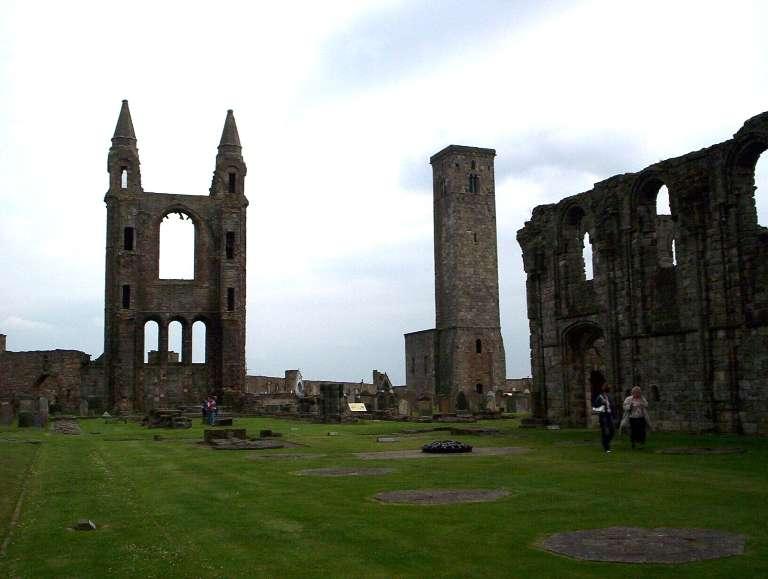
THE BRITISH OPEN started today in St. Andrews. I'm not a golfing fan, so I seized the opportunity to visit other attractions in the town while hardly anyone else was at them. I took my son and his friend to visit the ruins of the castle first. The weather was cloudy but dry and reasonably warm.


The castle has underground mines and counter-mines, left over from a sixteenth century siege, which we also explored thoroughly.

The picture above was taken from the top of St. Rule's Tower, which we climbed from within after lunch:


This is a twelfth century tower on the Cathedral grounds. St. Rule's Tower is the building in the middle. The Cathedral too is in ruins: there are spires on the left side of the Tower and one wall is on the right. The spires are also visible in the lower right part of the castle photo above.

Here's a picture of St. Andrews which I also took from atop the Tower:


The Cathedral grounds are in the foreground. The clock tower on the right-hand street is at the University Chapel on North Street. The street on the left side is South Street. St. Mary's College is a couple blocks up and on the left-hand side of South Street. The golfing is taking place in the vicinity of the West Sands, to the far right and out beyond the town.

Thanks to all of you who have sent me things today for PaleoJudaica. I'll get to them as soon as I can. As you can see, I've been having a life today.
LOOTING ARRESTS:
3 Palestinians nabbed for antiquities theft
By ETGAR LEFKOVITS (Jerusalem Post)

Three Palestinians wanted for a series of antiquities thefts over the last five years are under arrest, Israel's Antiquities Authority announced Tuesday.

The three Palestinian men, from the West Bank village of Beit Ula, were caught red-handed over the weekend plundering antiquities dating back to the Hellenistic, Roman and Byzantine periods during a night-time Antiquities Authority raid at an archaeological site in the West Bank, said Amir Ganor the head of the Authority's anti-theft division.

[...]

Any progress in the fight against antiquities looting is always welcome, but the situation is still very serious. The article concludes with the now standard Jerusalem Post paragraphs telling how looting has increased by more than 50% in the last year and "has taken on gold-rush dimensions."

(Via Bible and Interpretation News.)

UPDATE: Jim West e-mails to note the discussion of this article on the Biblical Studies list.

Wednesday, July 13, 2005

"WHAT IS CONSENSUS?" asks Michael Pahl. Here's my take. This is longer than I intended and I could probably keep going, but I do want to do some other things this evening. Feedback and criticisms welcome, as always. Drop me an e-mail or post on your blog in response.
First, consensus is a very slippery notion. What is consensus? I wouldn't think it's unanimity, at least not in dealing with such large and diverse groups of people. And it's certainly not simple majority. So what is it? 70%? 80%? Can 90+% safely be considered consensus?

I take consensus to mean that more people think so than not, but not everyone thinks so. Call it 51%-99%.
Second, who gets to be part of the polling sample? Only those working within a particular historical or theological perspective or methodological paradigm? All those who have published scholarly monographs on the subject? All scholars who have studied the subject in depth, whether they've published on it or not? And who determines what makes a "scholar" or appropriate authority on the subject?

I think most people measure consensus on the basis of published work in scholarly monographs and collections of essays, articles in peer-review journals, etc. I would weigh this more heavily than what a scholar thinks but hasn't published, since publication in itself requires more work and more commitment than just studying. When one refers in a publication to a consensus about something, normally a footnote follows with specific references to previous publications. Someone is a "'scholar' or appropriate authority" if he or she publishes monographs with publishers respected in the field or articles in relevant peer-review journals. Scholarly conversation has been going on for many, many years. "Scholars" and "authorities" are people who are familiar with this conversation; who have the necessary training (languages, knowledge of primary sources, methods of a field, etc.) for their opinions to be worth something; and who carry on the conversation in the venues that have developed to continue it. The process is far from perfect, but it works pretty well. And I don't know what one could replace it with which would work better.
Third, how does one actually go about doing the polling to assess consensus? One can meticulously search through all relevant literature on the subject and record opinions in a table (which is sometimes done on specific issues), but this then leads to some of the questions in the previous point, and one often quickly realizes that individual scholarly perspectives on any given issue are too complex to fit neatly into a simplistic table or scale.

So don't be simplistic. Read carefully and widely, particularly the published work of people who disagree with you, and be able to summarize the views of people you read with nuance and accuracy. It's hard work.
Finally, even if one can get past the previous questions, what does consensus prove? The consensus in 1976 on Paul's perspective on the Torah and his understanding of "justification by faith" was pretty strong, I would guess, until Ed Sanders provoked a Kuhnian paradigm shift with his Paul and Palestinian Judaism the following year. Now there is as much variegation in perspective on these issues as some of Sanders' respondents have claimed was evident in the nomism and soteriology of first century Judaism. Did the consensus prior to Sanders' book make that so-called "Lutheran" view correct? Does the lack of consensus since mean that no one has any real grasp of any of the issues?

The consensus is the thing you need to improve on if you want to advance the state of the question -- which is what scholarly research is all about. No one should pretend that a consensus is the final word. It's the starting point for your research. Apply new evidence or new methods or better reasoning to give us a better understanding of the problem. People who challenge Sanders's work don't want to go back to what was before it, they want to show that the problems are more complicated than he realized.

It's like hauling dirt up a hill so that you gradually make the hill higher so that everyone can see farther from its summit. (I like this analogy better than the one about standing on the shoulders of giants. Most people who came before us were not giants in comparison to the rest of us. But there were an awful lot of them and collectively they, each standing on the shoulders of those who came before, do constitute a kind of giant.)

Stipulated: a consensus can be an improvement on previous, wrong answers, and still turn out ultimately to be wrong itself. Newtonian physics was a vast improvement over anything that came before it and is still useful for virtually all everyday purposes today. But special and general relativity and quantum physics have shown that it is actually pretty much entirely wrong. Oh, and relativity theory and quantum physics both fit all the experimental data but are mutually incompatible, so one or both of them must be pretty much wrong too.

Stipulated: there are problems that are intractable with current evidence and on which we spin our wheels. Some of these are the questions we would most like to be able to answer. But there are plenty of problems on which we've made good progress too.

Some currently intractable problems, it seems to me, are the authorship of Joseph and Aseneth; the decipherment of Linear A; the origins of the Temple Scroll; and (to think big) the historical Jesus and the historical Josiah. Some will disagree with me about one or the other of these, but they won't be able to point to a consensus on what the answer is. Often (generally?) the problem in such cases is that we just don't have enough information to narrow down the possibilities very far.

Some random examples of problems on which we've made good, sometimes extraordinary, progress: the relative sequence and absolute dating of ancient ceramic typology in Palestine; the decipherment of ancient Egyptian, various languages in cuneiform (Akkadian, Sumerian, Hittite), Ugaritic, Phoenician, Nabatean, Palmyrene, etc.; the recovery of the previously almost entirely lost history of much of the ancient Near East from c. 2500 BCE to c. 500 BCE; and the basic decipherment of the Dead Sea Scrolls.

If there isn't a clear consensus, your mission, should you choose to accept it, is to find an answer that is more persuasive than the ones currently available, and that then becomes a consensus.

Until someone else improves on it.

UPDATE (14 July): Jim West replied to Michael Pahl here. (I really don't think things are as bad as all that.) Michael comments further with reference to my post here. (I don't see the difficulty with a "consensus on consensus." It's rare for people to agree unanimously on anything, but that doesn't mean we can't keep groping our way in the general direction of the truth. Let us steer between the Scylla of overconfidence in our own theories and the Charybdis of nihilism.) And Ed Cook and Mark Goodacre have thoughtful posts responding in detail to some of the issues that have been raised.

UPDATE (15 July): More here.
ON THE HISTORICITY OF THE GOSPELS: Mark Goodacre comments on Bishop Tom Wright's claim that there is a scholarly consensus that the canonical Gospels were written no later than fifty years after the time of Jesus and are dependent on earlier traditions that included substantial eyewitness testimony. Mark rightly takes issue with Wright's claim about the date and he wants to qualify the business about eyewitness testimony. But let's assume that Wright is correct on both counts. I am skeptical about how much bearing this has on the historicity of the Gospel accounts, which is the point he is getting at. Fifty years is a very long time, longer than the average life span of the period; eyewitness testimony is notoriously unreliable even in court cases; and the contemporary followers of charismatic intermediaries typically think those figures have miraculous powers and a direct channel to the divine (there is a substantial secondary literature on the anthropology of magico-religious practitioners). If I may take the liberty of quoting myself on this issue:
Gershom Scholem's book Sabbetai Sevi: The Mystical Messiah (Princeton, N.J.: Princeton University Press, 1973) provides an important cautionary tale for anyone interested in the problem of the historical Jesus. We have a great deal of information about Sabbetai -- who was born in Smyrna in 1626 and grew up to become a manic-depressive with delusions of grandeur -- and the messianic movement that emerged around him in 1665, including much eyewitness testimony and many primary documents written by the major players. When in 1666 he was given the choice of conversion to Islam or execution, he chose the former, and lived until 1676. Strangely, a good many of his followers continued to believe in him, reasoning that only the true messiah would dare to commit apostasy. The movement survived underground in various forms for generations, and for all I know may still exist today.

Scholem's analysis of this material shows that the reinventing of a messianic figure can take place not only immediately after his death but even during his lifetime. The farther removed geographically from the man himself the less interest the movement had in anything to do with the (contemporaneous) "historical" Sabbetai. Miracle stories arose within weeks of the events, sometimes sooner (pp. 480-81, 538-39, 557-64, 592-93). Indeed, before and during Sabbetai's arrest and imprisonment in Constantinople, letters and word-of-mouth gossip from that very city reported that he had raised the dead, healed lepers, passed through the locked doors of his prison, consorted with angels, and called up a pillar of fire (pp. 417-18, 535-36, 605). Within a few years after his death, a legend had arisen of his burial in a cave by the sea and the finding of the empty tomb guarded by a dragon three days later. His followers believed that he hadn't really died, but had experienced an "occultation" into the celestial realm, from which he would return gloriously in due course (pp. 919-20, 922-25).

Gross distortion of the life and message of a charismatic intermediary need not take time. It can arise full blown during the lifetime of the figure, while the true teachings and actions of the actual person are ignored. It can assimilate any and all facts to the contrary by either suppressing them or reinterpreting them. It can present us with a miraculous legendary divine being within no time to speak of after the lifetime of the figure.

From "Melchizedek, the 'Youth,' and Jesus," in The Dead Sea Scrolls as Background to Postbiblical Judaism and Early Christianity: Papers from a Conference at St. Andrews in 2001 (ed. James R. Davila; STDJ 46; Leiden: Brill, 2003), 248-74, quote from pp. 267-68, n. 32.

UPDATE: The next post is related.

UPDATE (14 July): Reader "Sarah" e-mails:
Another good example, with respect to the gospel traditions themselves, may well be Papias. What scraps remain of his voluminous work show that he entertained some rather outlandish stories about Jesus and the apostles (particularly the episodes about the death of Judas Iscariot and "remarkable" and "amazing" events involving the disciples and those raised by Christ). Interestingly, Papias wrote directly from oral tradition (such as things he learned directly from the daughters of "Philip the Apostle") about a century from the death of Jesus, and less than a
century after the age of the apostles. The loss of Papias' work is especially tragic, not in shedding light on the "historical Jesus", but in its potential in taking the obscure world of early Christian storytelling a little bit out of the shadows.

It is heartbreaking to think of how many ancient sources have been lost over the centuries.

UPDATE (24 July): Much more on lost ancient sources here.
THE RACIAL AND RELIGIOUS HATRED BILL, which makes incitement to religious hatred a crime, has passed on its third reading in the House of Commons. I have explained in detail here why it is a very bad idea. The only hope now is that the House of Lords will decline to pass it.
TAX EXEMPT? This is the first time I've heard of this place.
Holy Land exempt from property tax

The religious-themed park wins the break given churches and museums, a judge rules.


By Mark Schlueb
[Sun] Sentinel Staff Writer
Posted July 12 2005

The Holy Land Experience may seem like just another theme park, with its $30 admission charge, $5 parking fee and souvenir shops.

But, ending a four-year legal battle, a judge has ruled that the religious-themed attraction deserves the same tax-exempt status given to churches and museums. The ruling spares its owner from paying a delinquent property-tax bill that would have climbed to more than $1 million by the end of the year.

[...]

Modeled after ancient Jerusalem, Holy Land's attractions include a life-sized walled gate and re-creations of Herod's Temple and courtyard, Jesus' garden tomb, a street market with artisans' workshops, a Bedouin tent and the caves where the Dead Sea Scrolls were discovered. It also boasts the Scriptorium, which houses the largest private collection of biblical texts and artifacts in the country.

From the start, The Holy Land Experience was controversial. Local rabbis greeted it with trepidation, given its parent company's stated mission of converting Jews to Christianity. And the owner's decision to prohibit charismatic and Pentecostal Christians from working there prompted picketing early on.

[...]

I assume the re-creation of Herod's Temple and courtyard is not life-sized.
A DEAD SEA SCROLLS EXHIBIT is in the works for the Milwaukee Public Museum in 2007, but some funding is still needed.

Tuesday, July 12, 2005

CONFERENCE ON PAGAN MONOTHEISM: Peter Van Nuffelen e-mails the following call for papers:
University of Exeter
Department of Classics and Ancient History

Pagan Monotheism in the Roman Empire (1st-4th cent. AD)
Conference at Exeter, 17-20 July 2006


The publication of the volume Pagan Monotheism in Late Antiquity (eds. P. Athanassiadi – M. Frede, Oxford, 1999), in which pagan monotheism was presented as a major religious force in Late Antiquity, has led to an extensive debate on the definition and role of pagan monotheism in Late Antique society.

As part of an AHRB-funded research project concerned with the cultural and intellectual context of pagan monotheism in the Roman empire, directed by Professor Stephen Mitchell, the Department of Classics and Ancient History at the University of Exeter is staging a conference in July 2006. The aim is to examine pagan monotheism as a religious phenomenon and to place it in its social, political and cultural context. The focus will both be on philosophical and literary texts, and on the evidence derived from epigraphy, archaeology and material culture. The conference will also examine the various strands of monotheistic ideas and practices, and the way that these interact with other diverse religious developments in the Roman empire up to the fourth century.

The conference will address six themes:
  • questions of definition and terminology

  • archaeology, epigraphy, and material culture

  • the intellectual basis of pagan monotheism

  • monotheism, politics and social order

  • monotheism and religious pluralism

  • interaction among pagans, Christians and Jews

We invite papers of about 20 minutes in length, which address one of these issues. We welcome in particular contributions which offer new evidence for pagan monotheism and related phenomena, as well as detailed analyses of the contexts in which pagan monotheism must be seen. Please send proposals for papers (length 200 words) by 30 September 2005. Conference booking will begin in October 2005. It is expected that the cost of accommodation (3 nights, full-board) will be in the range £200-250.

More information can be found on the website: http://www.ex.ac.uk/classics/news/index.htm

For further information, please contact Dr Peter van Nuffelen, Department of Classics and Ancient History, University of Exeter, Queen’s Building, Exeter EX4 4QH; p.e.r.van-nuffelen@ex.ac.uk
COULD HAVE BEEN SAN DIEGO:


A gorgeous, hot -- almost too hot, beach afternoon at Kingsbarns. The fog started to roll in after 4:00, but it does that on San Diego beaches too. You don't see weather like this here very often.
PRETTY QUIET IN THE NEWS, but here are couple of stories. Jim West notes an Arutz Sheva report of First and Second Temple period archaeological finds in the western Galilee, including a late Second-Temple-period village in which a ring inscribed with Hebrew names was found. Even discounting the political slant of the article, the discoveries sound very interesting and I look forward to hearing more.

Also (a bit off topic), there's been a potentially explosive find of hidden treasure in Tel Aviv.

The weather in St. Andrews has been uncharacteristically summery this July and it is beautiful and sunny yet again today. This is too good a chance to miss: forget work and forget blogging, we're going to the beach.

Monday, July 11, 2005

HEBREW TEST:

בראשית ברא אלהים את השמים ואת הארץ

UPDATE: This Hebrew has held up fine through a couple of updates. If it stays for another posting or two, I'll tell what I did this time to fix the Unicode fonts glitch.

UPDATE (10 July): This post was originally put up on the 9th, but I'm moving it to the top for a while. The Hebrew is still there after a new posting and a couple of updates, so it seems to be stable now.

If you have a problem with non-Roman language fonts, try this: go to the Blogger dashboard, click on the "Settings" menu, then click on the "Formatting" link. The "Encoding" field should be set to "Universal (Unicode UTF-8)." For some reason, mine had been set to one of the "Western" options. I don't know how it got that way, but the result seems to have been to reset everthing on the main page to a Western font every time something new was published.

The world is now safe for language fonts on PaleoJudaica.

UPDATE (12 July): Another biblioblogger conquers Unicode. Well done, Phil.
THE TALMUD AS HYPERTEXT: This idea is not new, but it comes up twice in online articles today.

First, the Global Politician has an article, "The Future of the Book," which discusses "e-books" in relation to other ancient and modern written media. The reference to the Talmud comes up here:
E-books, counter their opponents, have changed little beyond format and medium. Audio books are more revolutionary than e-books because they no longer use visual symbols. Consider the scrolling protocols - lateral and vertical. The papyrus, the broadsheet newspaper, and the computer screen are three examples of the vertical kind. The e-book, the microfilm, the vellum, and the print book are instances of the lateral scroll. Nothing new here.

E-books are a throwback to the days of the papyrus. The text is placed on one side of a series of connected "leaves". Parchment, by comparison, was multi-paged, easily browseable, and printed on both sides of the leaf. It led to a revolution in publishing and, ultimately, to the print book. All these advances are now being reversed by the e-book, bemoan the antagonists.

The truth, as always, is somewhere in mid-ground between derision and fawning.

The e-book retains one innovation of the parchment - the hypertext. Early Jewish and Christian texts as well as Roman legal scholarship were inscribed or, later, printed, with numerous inter-textual links. The Talmud, for instance, comprises a main text (the Mishna) surrounded by references to scholarly interpretations (exegesis).

Second, Michael Frawley has an essay in KPCNews (Indiana): "A ‘words and pictures man’ looks at Web design," in which the Talmud-as-hypertext meme also appears:
The print analogs continue. We talk about "pages," but the pages don't really exist, do they? Of course not. It's just content served up on a monitor, dredged up from various files. We think of hypertext linking (all of those links you click on) as being something brand new and specific to the technology of the Web -- but they're not. Hypertext is simply a way of organizing and retrieving massive amounts of information, and you don't exactly need a computer to do that. The ancient Jewish Talmud, with its maze-like layers of texts and notes, is an early example.

The Talmud: ahead of its time.
CYRUS KAR has been released from detention in Iraq:
U.S. Releases Filmmaker Detained in Iraq

By FRANK GRIFFITHS
The Associated Press
Sunday, July 10, 2005; 11:46 PM

BAGHDAD, Iraq -- An aspiring Iranian-American filmmaker who has been detained by the U.S. military for nearly two months without being charged was released Sunday, officials said.

Cyrus Kar, 44, of Los Angeles, was taken into custody May 17 near Balad when potential bomb parts were found in a taxi in which he was riding. His family had filed a lawsuit accusing the federal government of violating his civil rights and holding him after the FBI cleared him of suspicion.

[...]

With help from independent director-producer Philippe Diaz, Kar began working on a documentary about the Persian king Cyrus the Great. He shot of footage at archaeological sites in Afghanistan and Iran, according to his family and Diaz.

He was visiting Iraq to film in and around the ancient city of Babylon, one of Cyrus the Great's conquests, according to his family.

[...]

(Via the IraqCrisis list.)

Sunday, July 10, 2005

CONFERENCE ON JEWISH NAMES: Joseph I. Lauer e-mails:
I was asked by Prof. Aaron Demsky to post the following announcement/program concerning The Seventh International Conference on Jewish Names at The 14th World Congress of Jewish Studies, to be held July 31-August 1, 2005, at The Hebrew University, Mount Scopus Campus, Jerusalem, Israel.

Dr. Demsky is Director, The Project for the Study of Jewish Names, Department of Jewish History, Bar-Ilan University, Ramat-Gan 52900 Israel.

He may be reached by phone at 972-2-9931-878 (home) or fax at 972-9932-208 (home).

His e-mail address is: demskya@mail.biu.ac.il

Joseph I. Lauer
Brooklyn, New York

The Seventh International Conference on Jewish Names
at The 14th World Congress of Jewish Studies

July 31-August 1, 2005
The Hebrew University Mount Scopus Campus
Jerusalem, Israel

Program

520 Antiquity
Chairperson: Yigal Levin
Sunday (31 July 2005) 11:30 - 13:30 Room: 2720
Yael Avrahami (E)
Giving Names to the Newborn in the Hebrew Bible
Siam Bhayro (E)
The Angel Name Shemihazah
Joel S. Burnett (E)
Divine Absence in Biblical Personal Names
Hananel Mack (H)
"Mehetav`el, daughter of Matred, daughter of Me- zahav" (Genesis 36: 39)

521 Toponymy
Chairperson: Yoel Elitzur
Sunday (31 July 2005) 15:00 - 17:00 Room: 2720
Yehuda Ziv (H)
The Israel Government Names Committee - Modus Operandi
Lea Mazor (H)
"Might" and "Strength" in Israeli Place Names during the First Years of
Statehood - Biblical and Ideological Aspects
Ronny Reich (H)
On the Names "Gihon" and "Shiloah"
Yossi Spanier (H)
"From the Sole of the Foot unto the Head": The Usage of the Names of Body
Parts in Geographic Description in the Bible

522 Hebrew Literature
Chairperson: Boris Kotlerman
Sunday (31 July 2005) 17:30 - 19:30 Room: 2720
Ephraim Hazan (H)
The Personal Name as a Linguistic and Stylistic Factor in Jewish Medieval
Poetry from Spain
Juliette Hassine (H)
"Sol-Hatsadique" - Onomastic Characteristics in the Creation of a Cultural
Heroine
Lea Garfinkel (H)
The Artist as a Creator: Endowing Names in Literary Works
Sara Friedman (H)
Names and Naming in Hebrew Literary Translation

523 Between East and West
Chairperson:
Monday (1 Aug 2005) 09:00 - 11:00 Room: 2720
Bracha Yaniv (H)
"Perlsticker" and "Goldsticker": Some Specialist Surnames in Tailoring
Reuven Enoch (H)
Hebrew Names in the Speech of Georgian Jews
Chana Tolmas (E)
Occupational Names of Bukharan Jews in the Modern Period
Zofia Abramowicz (E)
Jewish Names in Bialystok

524 Contemporary
Chairperson: Meir Bar-Ilan
Monday (1 Aug 2005) 11:30 - 13:30 Room: 2720
Jean-Pierre Stroweis (E)
Name Changes during the British Mandate
Michael Falk (E)
The Days of the Week as Jewish Surnames
Ofra Malka Birnboim (H)
Jewish Israeli Identity according to Proper Names of Settlers in Samaria
Aviel Kranzler (H)
Israeliness and Jewishness- Israeli Names versus Jewish Names

525 The Last Millennium
Chairperson: Refael Yankelvitch
Monday (1 Aug 2005) 15:00 - 17:00 Room: 2720
Yisrael Rozenson (H)
Geographic Names in Jewish Sources from the Period of the Crusades
Elinoar Bareket (H)
Jewish Personal Names in Fatimid Egypt during the 11th Century
Yaakov Lattes (H)
Social Stratification and Topography according the Names Contained in the
Register of Jewish Community of Rome
Yosef Rivlin (H)
Double Given Names among Ashkenazic Jewry

526 The Essence of Jewish Names:
Chairperson: Aaron Demsky
Monday (1 Aug 2005) 17:30 - 19:30 Room: Auditorium

Aharon Appelfeld (H)
My Family Names

Panel Discussion: Onomastics and Jewish Studies (E)
Discussants:
Ariel Toaff
James L. Kugel
Shalom Rozenberg

Saturday, July 09, 2005

EARLY DIASPORA SYNAGOGUES are the subject of a blog post by Philip Harland.
"PAUL AND QUMRAN" -- This is a 1998 essay by N. T. Wright, published originally in Bible Review and recently posted on Wright's website. Noted by Mark Goodacre and Bible and Interpretation News.
NEPHILIM IN THE NEWS:
Is Human Cloning Really A New Biomedical Breakthrough?
Human cloning in the laboratory is inevitable and will bring with it disastrous consequences, according to Matthew Omaye Ajiake, author of Nephilim: The First Human Clones. Ajiake makes a case for the existence of human clones in Old Testament times i...

Distribution Source : PRWeb

Date : Thursday, July 07, 2005

(PRWEB) July 7, 2005 -- In 1996, Dolly the sheep became the first surviving mammal known to be conceived by laboratory cloning. Other animals since Dolly, including horses and cattle, have been created using this method. The biotechnology used to create a human clone is essentially the same as that used to clone animals.

Human cloning in the laboratory is inevitable and will bring with it disastrous consequences, according to Matthew Omaye Ajiake, author of Nephilim: The First Human Clones.

Ajiake makes a case for the existence of human clones in Old Testament times in the form of the Nephilim, descendants of Cain, one of the sons of Adam. The Nephilim were referred to as "giants" and "the fallen ones" � unnatural and grotesque creatures.

[...]

Well, I'm glad that's cleared up.

Friday, July 08, 2005

THE SBL FORUM for July has articles on "Bible museums, theme parks, etc., that you might (or might not) choose to visit." Note in particular the one by Ben Su on "The Ancient Biblical Manuscript Center" which definitely should be in the "choose to" category. The Forum also has obituaries for Nahum Sarna and Paul Ricoeur.

(Via Bible and Interpretation News.)
A THIRD-CENTURY C.E. MOSAIC IN PALMYRA (SYRIA) shows a scene from classical mythology that "experts" say may have served as inspiration for the legend of the slaying of the dragon by St. George, England's patron saint:
Mosaic inspired image of England's favourite saint
By Norman Hammond, Archaeology Correspondent (Times of London)

THE earliest known template for the image of St George slaying the dragon has been found in Syria, archaeologists believe.

A mosaic floor dating from approximately AD260 depicting the figure who became the patron saint of England has been found in the city of Palmyra in the Syrian desert. Experts say that the portrait is one of the finest classical mosaics yet uncovered and may even be the source of the St George legend.

George was reputedly a Roman soldier, martyred in Palestine some 1,700 years ago. The mosaic shows Bellerophon, a hero in Greek mythology, killing a chimera, and it was found in what appears to have been a dining room in Palmyra.

[...]

It's a bit of a stretch between Bellerophon slaying the chimera and St. George slaying the dragon, but the mosaic is still cool. Follow the link for a picture.

(Via Archaeologica News.)
TIME-TRAVEL WATCH: Physicist Amos Ori at the Israel Institute of Technology in Haifa has proposed a model for "A New Class of Time Machine" whose "core would consist of a toroidal vacuum embedded in sphere of normal matter." This is good news, because other time machine proposals require exotic matter and other exceedingly hard-to-come-by items. Bring it on!
TEMPLE MOUNT WATCH: Ed Morrisey of the Captain's Quarters has an interesting story which reports that one Michael Sanders, who has an idiosyncratic theory about the location of the First Temple (that it was south of the Temple Mount in the City of David on the Gihon Spring rather than on the Temple Mount itself), e-mailed Newsweek a "Background Only" message to the effect that prominent Israeli archaeologist David Ussishkin thinks that the Jerusalem of the Solomonic period did not extend as far north as the Temple Mount, and therefore he implicitly supports Sanders's idea. Despite the clear "Background Only" subject header, a Newsweek representative e-mailed Professor Usshiskin about it and mentioned Michael Sanders as the source.

Three comments:

1. Captain Ed has a reputation for reliability and since he says that he verified the essentials of the story with Newsweek, I take it to be accurate.

2. If so, I would be cautious about telling Newsweek anything I didn't want my name attached to in public. But read also the comments to Captain Ed's post, some of which defend Newsweek and give advice on how such things should be approached. Glenn Reynolds also has advice.

3. Regarding the theory itself, I am not an archaeologist and will defer to any professional archaeologists specializing in Israel who want to comment. Evidently the claim is that Professor Ussishkin thinks something about the bounds of tenth-century BCE Jerusalem, not anything in particular about Sanders's theory about the Temple. Regarding the latter, I have to say I have a hard time imagining that a significant piece of monumental architecture like a Solomonic temple stood on the spot indicated and no one has noticed any trace of it since. And I'm not impressed with Sander's website. He gives no indication that he has any specialist training in archaeology or the history of Israel and his theory keeps some extremely wild company on the site (speculations about the locations of Sodom and Gomorrah, the Garden of Eden, and the Ark of the Covenant -- things that are not of great concern to real archaeologists, to put it mildly). I am not impressed by his critical faculties, nor am I willing to take his word for what Professor Ussishkin thinks or the implications thereof. Too bad Captain Ed doesn't report on any reply by Ussishkin to Juliet Chung. (She is perhaps taking Sanders a little too literally about Ussishkin supporting Sanders's theory. Any support seems to be indirect at best.)

I haven't seen the Biblical Archaeology Review article Sanders alludes to in his e-mail. Can someone tell me if Ussishkin in fact say this about the boundaries of Solomonic Jerusalem and, if so, whether he discuss the implications for Solomon's Temple?

NOTE (same day): I've fiddled some with this post since it was published to make sure I'm understanding and presenting the issues correctly.

(Heads up, Michael Safrin.)

Thursday, July 07, 2005

LUBAVITCHER MESSIANISM and its connections with anti-disengagement activism in Israel are explored in a long Jerusalem Post article:
The messianic temptation
By MATI WAGNER

'Long live our master, our rebbe, the king messiah forever," shouted hundreds of Chabad hassidim at the end of the evening prayer in the courtyard outside Beit Menachem, the main synagogue in Kfar Chabad, the town across the road from Ben-Gurion Airport, which serves as the Lubavitch movement's Israeli headquarters.

Inside the synagogue, a bulky TV perched on a cabinet showed old videos of the movement's revered sage, Rabbi Menachem Mendel Schneerson, who died in 1994.

[...]

Messianists, known as mashichistim, also believe that the dissemination of the idea that Schneerson is the messiah helps prepare the world for the messianic era.

"The rebbe said that learning and teaching about the days of redemption help bring it closer," says [Rabbi Yigal] Pizam. "Understanding the concept that the rebbe is mashiach helps prepare a Jew for the messianic era, which is coming any minute now. Knowing that he is the mashiach makes the idea of redemption that much more real and, therefore, brings it closer."

Yet in addition to the evening's decidedly messianic message, there was another theme: "We express our protest against the government's dangerous policies in the Holy Land," read the flyer advertising the rally.

[...]

Unlike mashichistim, mainstream Chabadniks acknowledge the death of the rebbe, although many do not rule out the possibility that he could still be the rebbe once he is resurrected. But more importantly, unlike the mashichistim, mainstream Chabadniks tend to avoid talking about Schneerson's role in end-of-days redemption unless asked directly.

Aggressive Greater Israel activism seems to go hand in hand with rigorous messianism: mashichistim tend to be the same men in black suits and hats blocking roads, passing out anti-disengagement flyers and attending demonstrations. The way they see it, strong messianic beliefs go together with taking the disengagement struggle to the streets.

[...]

(Via Bible and Interpretation News.)
FALSE ALARM IN EDINBURGH:
Scottish police lower alert
07/07/2005 21:25 - (News 24, South Africa)

Gleneagles - Police on Thursday lowered their alert around a shopping area of the Scottish capital of Edinburgh after determining that a suspect package was harmless, police said.

Police had evacuated an area of Princes Street, a shopping district in the shadow of Edinburgh Castle, after a suspect package was found on a bus, a spokesperson said.

She said a bomb disposal squad had carried out a controlled explosion and found no sign the package contained any explosives.

[...]

Oddly, although both the Scotsman and the BBC have the story, they have not yet posted anything about the package being harmless. In any case, the police are right to be taking no chances. With the British Open coming to St. Andrews next week, we need to be especially vigilant. And get on with the show.
APOCRYPHA NOW! No, not that Apocrypha. Film apocrypha. Here's a cinematic apocryphon that seems relevant:
Ben-Hur (1959)

The Legend: A stuntman was killed during the shooting of the famous chariot race sequence. The shot was left in the final cut over the protests of the stuntman's widow.

The Facts: No stuntmen died during the filming of the 1959 version of Ben-Hur. One stuntman was injured in a spectacular mishap during the chariot race, and that shot was left in the film, to the protestations of no one. This legend may have originated in rumors that surrounded the shooting of Fred Niblo's earlier 1926 version of Ben-Hur, during which at least one stuntman was indeed killed in an accident.

I had only heard the "legend" version of this story.
"INTEREST" OR "USURY"? How should the biblical terms be translated? Also in the Forward, Philologos has the story.
THE LOGIC OF IMPURITY: In the Forward, Professor David Kraemer has some interesting reflections on the theory behind the biblical system of ritual impurity. I'm not sure whether I buy his interpretation or not.
CYBER-ARCHAEOLOGY: I would have noticed the news much earlier today, but it chanced I took the day off and spent the morning at home helping my son and his friend dissect an old MacIntoshPlus computer excavated from our garage. They marveled at the primitive technology used by the ancients.


This is the first photo I've posted using Blogger's new image-uploading facility. I'm impressed: it's easy to use and they provide 300 megabytes of free space. Well done.

EXPLOSIONS IN LONDON: There have been seven explosions, six in the the London Underground and one on a bus. Happened about three and a half hours ago. According to the BBC (to which I'm listening at the moment) at least 95 casualties reported in the Royal Hospital, some serious and critical. Two confirmed dead. Rescue operations in progress, many more casualties likely. They're saying the attacks are not on the same scale as Bali or Madrid and were designed to shut down London transportation. I have no idea whether that evaluation will bear up. Looks like a coordinated terrorist attack timed alongside the G8 meetings. Early claims of Al Qaeda responsibility, but BBC saying we should keep an open mind for now on who did it. The Prime Minister just addressed the nation, but had little info. Ongoing updates on the TV networks and the Command Post. My heart goes out to the victims.

UPDATE: The police seem to be revising the number of explosions down to four. I'm not going to continue blogging this; you all have access to better sources for this than me. In the spirit of not permitting terrorist scum to disrupt our lives, blogging on ancient Judaism etc. will continue now as normally.

Wednesday, July 06, 2005

DAF YOMI BLOGGING: Over at Mystical Politics, Rebecca Lesses points to three blogs that follow and comment on the Daf Yomi cycle.
"CYRUS-THE-GREAT" FILMMAKER in detention in Iraq:
U.S. Holds Filmmaker in Iraq
* Family drafts suit to free L.A. man working on a Cyrus the Great project. Pentagon plans hearing to determine if director is a security threat.

By Henry Weinstein, [Los Angeles] Times Staff Writer

Cyrus Kar's family says he left his Los Feliz apartment for Iraq to make a documentary film about a Persian king who wrote the world's first charter of human rights. But now they fear he may never get home.

On May 17, Kar was stopped at a Baghdad checkpoint in a taxi allegedly packed with a common component for improvised explosive devices, according to a Defense Department spokesman. Since then, he has been in U.S. military detention outside Baghdad.

[...]

About three years ago, Kar became interested in the history of ancient Persia, particularly the story of King Cyrus the Great, founder of Persia. He went to Iraq, over his family's objections, to film near Baghdad. He also filmed in Iran, Tajikistan, Turkey and Afghanistan and consulted with scholars.

David Stronach, professor of Near Eastern archeology at UC Berkeley, has signed a sworn declaration to be filed with the [family's federal] lawsuit, stating that he has known Kar for more than two years and has "assisted him in making his documentary" about Cyrus the Great, whom he described as "one of history's most extraordinary figures."

Stronach said Cyrus "is mentioned many times in the Bible, not least because he liberated the captive Jewish community in Babylon � an event that allowed the Jews to return to Jerusalem, rebuild the temple, and arguably, provide the conditions that permitted the birth of Christianity.

"It is impossible to tell the story of Cyrus without bringing in the subject of Babylon, his latest and greatest conquest, and one which had quite exceptional consequences. It is therefore unsurprising to me that Cyrus Kar thought it essential to go to Babylon � in present-day Iraq � to finish filming his documentary."

[...]

It's always difficult to judge such situations without access to all the information. But this one doesn't sound good.

Tuesday, July 05, 2005

ED COOK reports a recent telephone conversation with Hershel Shanks, editor of Biblical Archaeology Review, about the problem of unprovenanced antiquities. Me, I still can't suggest any solution better than the one Joe Zias came up with on the ANE list in January (sorry, all the ANE links seem to have gone dead): flood the market with first-rate fakes so that no dealer or collector will trust the genuineness of any unprovenanced artifact and looters will give up and turn to more profitable lines of work. If you have a better idea, speak up!

UPDATE (6 July): No one has pointed out the main objection to Joe's proposal -- that it would be illegal. Let me clarify that I mean that if there is any campaign of forgeries to undermine the antiquities market, it should be coordinated with the authorities (IAA, police, etc.). It would, after all, save them a lot of trouble in the long run.
VIGILIAE CHRISTIANAE has a recent issue (59.2, 2005) with an article of interest:
"Content Divine Infinity in Gregory of Nyssa and Philo of Alexandria"
pp. 152-177
Author: Geljon, Albert-Kees

Requires a paid personal or institutional subscription to access.
JEWISH STUDIES, AN INTERNET JOURNAL (JSIJ) has published several articles in this year's volume 4. For some reason these are listed on the page for forthcoming articles rather than the page for current articles. I haven't been keeping up as they've been posted, so here are abstracts of three that are of interest:
Judith Hauptman, "The Tosefta as a Commentary on an Early Mishnah" (English)

Recent scholarship has demonstrated that much of the Tosefta precedes the Mishnah and serves as its basis. However, this raises a fundamental question: how could the Tosefta have been a source of the Mishnah, if the Tosefta is essentially a wide-ranging commentary on and supplement to the Mishnah, as evidenced by the fact that numerous passages in the Tosefta make no sense on their own, and can only be understood when read together with the text on which they comment?

The author suggests that while the Tosefta often comments on a Mishnah, this was not *our* Mishnah, but rather some other, organized, older collection of tannaitic teachings. Numerous examples are adduced to prove this point, thereby providing evidence for the existence of a version of the Mishnah which preceded our Mishnah, which was used and modified by the redactor of our Mishnah.

Amram Tropper,"Yohanan ben Zakkai, Amicus Caesaris: A Jewish Hero in Rabbinic Eyes" (English)

In the foundation myth of Yavneh, Rabban Yohanan ben Zakkai flees besieged Jerusalem, surrenders to the Romans, predicts Vespasian�s promotion to emperor and is subsequently granted Yavneh as a new center for the rabbinic movement. This rabbinic story risks portraying Rabban Yohanan ben Zakkai as a deserter, perhaps even as a traitor and it is puzzling that the rabbis would have depicted one of the most important sages of the formative period in rabbinic Judaism in such a potentially damaging fashion. Indeed, the nationalistic atmosphere that reigned in Judea during the late first and early second centuries would probably have discouraged contemporary rabbis from portraying a rabbinic hero in this manner, and accordingly, there is not even a hint of the escape story in tannaitic literature. I suggest, however, that later rabbis were comfortable depicting Rabban Yohanan ben Zakkai in this potentially unflattering manner because of the precedent set by Jeremiah. Jeremiah�s experiences during the destruction of the First Temple, as narrated in the Bible, resemble those of Rabban Yohanan ben Zakkai at the end of the Second Temple period, and it seems that the rabbis typologically depicted Rabban Yohanan ben Zakkai as the Jeremiah of the Second Temple.

Ronit Shoshany, "Rabbi Elazar ben Shimeon and the Thieves�A Story of Sin and Atonement" (Hebrew)

The story of R. Elazar and the thieves consists of two parts. The first part describes R. Elazar�s service under Roman rule as a thief-catcher (Bavli, Bava Metzi�a 83b). The story is interrupted by a sequence of short stories, concluding with the story of R. Yohanan and Resh Lakish (84a). This interruption is apparently an intentional editorial one, aimed at encouraging the reader to compare the stories of R. Elazar and R. Yohanan. There are several similar motifs, but there is an important difference between the two stories: R. Yohanan mourns for the dead Resh Lakish, but does not repent for having caused his death by his cruel behavior, whereas R. Elazar deeply repents of his misconduct. This repentance and self-punishment is described in the second part of the story (84b). In this article, I present a close reading of the two parts of the story of R. Elazar, and a detailed comparison between this story and that of R. Yohanan. I argue that the main theme of R. Elazar�s story is his sincere repentance and atonement, which eventually enables acknowledgment of his righteousness by readers of the story.

The full texts can be downloaded in Word or PDF format.

Monday, July 04, 2005

FONT MACBLEG: Can anyone out there explain to me -- as usual, in simple terms suitable for an idiot -- how to configure a blogspot blog to display Hebrew and Greek fonts? I can view them fine on other blogs, but haven't figured out how to embed them in blog posts myself. Perhaps the problem is that I'm using a Macintosh system (OS X 10.3.5 if it matters). I have already configured the International Input Menu to include Hebrew and Greek fonts and I can type these fonts with TextEdit. Any help would be much appreciated.

UPDATE: ?????? ??? ????? ?? ????? ??? ????

Problem solved. My thanks to Tyler F. Williams for sending me the solution. In case you're interested, this is his e-mail:
One thing I noticed about your blog is that you do not have a meta tag indicating what character set you want your page to be displayed in (so I imagine it is assuming ASCII or something like that).

Try including the following meta tag in the <*head> section of your blog template:

<*meta http-equiv="content-type" content="text/html;charset=utf-8">

This will set your page to be able to display Unicode fonts (that is what the utf-8 indicates)

I have added an asterisk at the beginning of both tags so they show up. I have no idea why that meta tag wasn't there. Does everybody else just know to add these things?

The Hebrew font used above is from David Instone-Brewer's Tyndale Unicode Font Kit for Macs, available from the Tyndale House Fonts for Biblical Studies page.

UPDATE (5 July): Oh oh ... publishing a new post seems to have wiped the Hebrew from this one. Does anyone have any suggestions on what to do now?

UPDATE (6 July): I may have figured out the problem. Let's see if the Hebrew stays this time.
THE CITY OF ASHDOD is profiled in the Jerusalem Post. It was rebuilt on its current site only in 1957, but it goes back to the biblical period and even was home to some of our friends the giants.
HAPPY INDEPENDENCE DAY to American readers!

UPDATE: I finally broke down and turned on the space heater in my office. Think of me today while you're sunning on the beach, attending your picnic, and enjoying your Fourth of July barbecue.

UPDATE: Cold enough to turn on the heat in the morning, warm enough for a hay fever attack -- this is just wrong!

Sunday, July 03, 2005

WATERSTONE'S UPDATE: Regular readers will recall my fulminations in January about Waterstone's bookstore's firing of Joe Gordon in Edinburgh for blog posts that criticized the company. I hadn't heard the result of his appeal until a short time ago and only yesterday did I have time to track down the details. In case you haven't heard, Joe's situation was resolved satisfactorily for all concerned. The publicity caught the attention of the Forbidden Planet book chain, they liked what they heard about Joe, and in February they hired him as a manager and the maintainer of their new blog. Meanwhile, the wheels of the appeal ground slowly until, in April, the case was resolved in Joe's favor. He was offered reinstatement, but since he now had a better and better-paying job elsewhere, "an amicable settlement was achieved in place of reinstatement" (which I take to mean that Waterstone's coughed up some monetary compensation). I haven't been in the vicinity of a Waterstone's for quite some time, but when I am again I will no longer be avoiding it (although between Amazon and the newish St. Andrews Ottakars, my book needs are pretty well served).

Lessons:

For bloggers: don't criticize your employer on your blog unless you have a durn good reason and you understand that you may have to deal with the consequences. There may be rare cases in which such criticism is justified, but a blog is not the place for grumbling about the pointy-haired boss.

For employers: if an employee says something intemperate on a blog, try to solve the problem with a private word to the blogger. Most people have sense enough to take down an unreasonable post if it's pointed out to them (Joe would have). And don't even think of firing the employee unless you can show that all reasonable steps short of that have been taken first.

Belated congratulations to both Joe Gordon and Waterstone's for coming to terms on this and getting it behind them.
BLOG WATCH: Jim West blogs on a seal inscription mentioning a Hananel whom Giovanni Garbini thinks was an Ammonite king of Jerusalem in the 7th century BCE. News to me. [LATER: More here.] Joe Cathey blogs on a new edition of Von Rad's The Problem of the Hexateuch and Other Essays, editied by K. C. Hanson. And Phil Harland picks up on my post "Giants, Aliens, and Josephus" from last month and discusses "Aliens, Fallen Angels, and Heaven's Gate."

UPDATE: Note also Michael Homan's entries on his archaeological work this season at Zeitah in Israel. Start here and keep moving forward. Note this one in particular. (I think there may be one or two earlier relevant posts, but I can't get Michael's archive to work.) Ron Tappy and I dug at the same time at Ashkelon when we were both lowly postgraduates, and I have fond memories of the Ashkelon beach.