Monday, February 20, 2006

ANOTHER ARTICLE on the Dead Sea Scrolls exhibition in Charlotte, this one in Fayetteville Online. Despite the unpromising first line, it's a good piece with accurate content:
Unrolling The Dead Sea Scrolls

By Michael Futch
Staff writer


If you think the Rolling Stones are old, just consider the Dead Sea Scrolls.

Those writings pre-date Jesus of Nazareth.

They are the oldest known manuscripts of any books of the Bible. Most of the manuscripts are made of leather or papyrus, with some written as early as 200 B.C. That’s 1,000 years older than the earliest, existing Biblical texts we had before the discovery of the scrolls between 1947 and 1956 in caves on the northwestern shores of the Dead Sea.

[...]

Also, according to WSOCtv news, two choral compositions inspired by the Dead Sea Scrolls are to be performed at Discovery Place next month.
THE COPTIC GOSPEL OF JUDAS is featured in a Time Magazine article that tries way too hard to sound hip. But the factual content looks correct.
A Kiss for Judas
A long-lost 2nd century "Gospel" may portray Jesus' betrayer as closer to a hero than a heel

By DAVID VAN BIEMA

Posted Sunday, Feb. 19, 2006
It could be a passion story as co-written by Mick (Sympathy for the Devil) Jagger and The Matrix's mess-with-your-metaphysics Wachowski brothers: Judas Iscariot, vilified in the Gospels as Jesus' great betrayer, was not merely an Apostle--he was perhaps Christ's closest confidant. Technically speaking, he did drop a dime on Jesus. But there were extenuating circumstances, some having to do with the belief that the God of the Old Testament was not the ultimate God, that this world is not what it seems and ... well, for a full explanation, you'll just have to see the movie.

Er, rather, see the 31-page papyrus tractate.
And here's an interesting tidbit:
[Mario] Roberty [director of the Maecenas Foundation, which apparently owns the manuscript] is cagier regarding its content, to which Geographic owns rights. Photos of six pages supposedly from the tractate were sent several years ago to Charles Hedrick, a scholar with Missouri State University who has attempted to translate and analyze them. But Roberty claims Hedrick's efforts are flawed in that the first four pages actually hail from a different tract bound in the same leather cover.
Hedrick had four pages from another text and thought they were from the Gospel of Judas? That's news to me.
THE ANTI-DEFAMATION LEAGUE has called for a pause in the excavations for the Jerusalem Museum of Tolerance:
ADL: Pause work on Museum of Tolerance, site of Muslim graves
By Haaretz Service

The Anti-Defamation League Sunday urged a temporary cessation in the construction of Museum of Tolerance, pending resolution of a dispute over Muslim graves recently discovered at the building site in central Jerusalem.

"We encourage a temporary cessation of construction until the issue is resolved in a respectful way acceptable to all parties. To do less would weaken the foundation upon which a museum of tolerance stands."

[...]

Sunday, February 19, 2006

PROFESSOR EMERITUS ROBERT WILSON (a.k.a. "R McL Wilson" a.k.a. "Robin") was in fine form for yesterday's celebration of his 90th birthday. There were speakers in the afternoon, a drinks reception, and a buffet dinner followed by more reminiscences and a toast. You can click on all the photos below to see larger versions of the images. [This was originally posted on Sunday at 7:47 am, but I'm keeping it at the top of the page for a while.]

The afternoon opened with a brief introduction by Professor Richard Bauckham (see third photo down). He noted, among other things, that Professor Wilson's first article was published in 1952, his first book in 1958, and his most recent book at the end of 2005.


His comments were followed by Professor Einar Thomassen (above) of the University of Bergen, Norway, one of Professor Wilson's doctoral students in the 1980s. He spoke on Professor Wilson's half-century of contributions to the study of Gnosticism. (I understand that some of these presentations may be published someday, so, although I did take extensive notes, I'll keep my summaries brief.) Robin Wilson's contribution included building bridges between the German and British approaches, both by translating (and updating) many important German works and by integrating the German study of Gnosis as a widespread pre-Christian worldview and the British study of Gnosticism as a second-century Christian heresy, and by pointing out that the two are not the same thing. He did early work on the independence of elements of the Gospel of Thomas from the canonical Gospels and he raised concerns about the use of the term "Gnosticism" in 1955, decades before these problems became widely recognized.
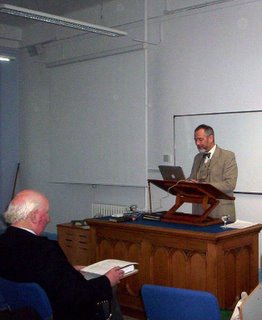

Dr. Bill Telford (Universities of Newcastle and Durham) spoke about the early history of the Society for New Testament Study (Studiorum Novi Testamenti Societas) and the important contributions to it by the University of St. Andrews and St. Mary's College and by Robin Wilson in particular. The Society was conceived in the 1930s but its founding was delayed by World War II and the first meeting was not until 1947. (More details here.) Its first president was Professor George Duncan of St. Mary's College [CORRECTION: Principal Duncan was the second president; the first was J. De Zwaan]. Professor Matthew Black and Professor Wilson were also heavily involved for many years. Both served as president of the society and as editors of the journal New Testament Studies and the NTS Supplement monograph series. Professor Paddy Best published the second volume in the series -- his monograph The Temptation and the Passion.
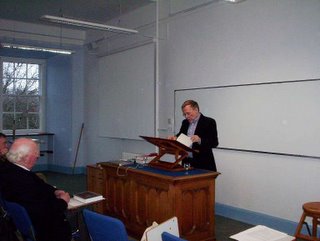

Richard Bauckham then spoke again briefly about Professor Wilson's scholarly contribution, including his editorship of the translation from German of two editions of the two large volumes of New Testament Apocrypha (which were carefully compared to the original-language texts as well and thus were an original contribution as well as a translation) and his most recent commentary on Colossians and Philemon.
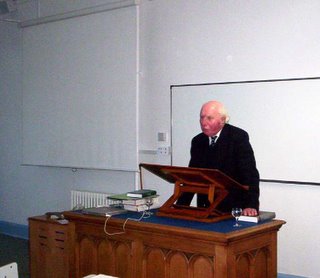

Professor Wilson spoke next, first graciously thanking the speakers and those attending, some of whom came from a considerable distance, then reminiscing about his career, which has spanned the space between fountain pens (ballpoints hadn't been invented) and online publications. He appears nevertheless to have fully mastered e-mail and to have used it vigorously to keep the editors of his recent book in line.

He also spoke about his two supervisors when he was a student; William Manson of Edinburgh and W. L. Knox of Cambridge. Manson suggested Diaspora Judaism, syncretism, and the origins of Gnosticism as one possible topic of doctoral research and both Knox and Wilson liked the idea, so he went with it, timing his graduation in 1945 to coincide most fortuitously with the discovery of the Coptic Gnostic library from Nag Hammadi.

He also told of a College Dinner in which the president of the College Society (in the traditional staff roast) proposed running a model railway called the Wilson Special -- Gnostic passengers only.

He concluded that he looks back with great satisfaction at what many of his students (some of whom were present) have gone on to achieve.

The reception followed.
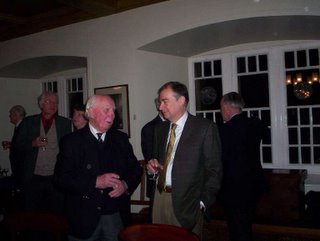

Here Professor Wilson speaks with Ron Piper, Professor of Christian Origins and Vice Principal of Teaching.

I had a conversation with Professor Wilson during the reception in which we both cheerfully dissed The Da Vinci Code. He also commented wryly that the best way to get scholarly recognition was to publish something that's almost right but is just wrong enough to make people want to argue with you. (A persistent theme during the speeches was Robin Wilson's meticulous scholarship and his humility, so he didn't learn this from experience.)
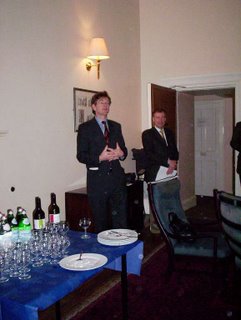

Professor David Parker (above left) of the University of Birmingham spoke after dinner of his time here as a student 30 years ago. My favorite bit was when he told of the shelf on Professor Wilson's bookcase reserved for works he considered ridiculous. Alas, no examples were given.
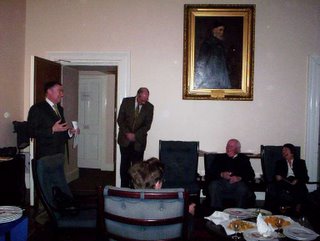

Finally, Ron Piper recounted some memories of his early days as a lecturer at St. Mary's College. He arrived in 1980 and Robin Wilson retired in 1983, so they overlapped by three years. He focused on Robin's absolute dedication to New Testament studies, his loyalty to St. Mary's, his willingness to spend time with people, and his gentleness. He concluded with a toast to Robin.
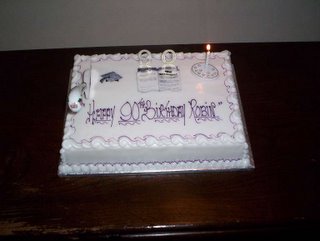

Then the cake was produced.
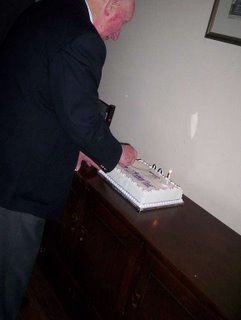

And cut.

Happy Birthday Robin, and many happy returns!

UPDATE (3 December 2007): I've corrected a detail above. Also, Bill Telford's paper is available here.
DAILY HEBREW BLOG: For some reason I seem not to have mentioned the Daily Hebrew Blog yet. This is a blog by H. H. Hardy which has been running since late October of 2005. Its purpose is as follows:
The goal of DailyHebrew.com is to encourage daily reading of sacred Hebrew texts.


Introduction

After devoting long hours to learning the basics of Hebrew grammar most students, pastors and teachers fail to continue reading the Hebrew Bible. Eventually, their knowledge atrophies for lack of use. The purpose of DailyHebrew.com is to remedy this ubiquitous problem by providing the reader a manageable daily Hebrew reading (4-8 verses) along with lexical and syntactical assistance.

DailyHebrew.com is committed to helping students at all levels read biblical Hebrew. The blog is arranged so that a reader can spend a few minutes a day or week reading Hebrew texts. Beginners should start with the first verse or two of each translation, Intermediate learners should attempt the entire passage using the vocabulary listed by line (words which occur less than 50 times in the MT are listed in parentheses with their BDB reference page) and Advanced scholars will be able to translate using minimal vocabulary helps.

Typically, students spend the majority of their time memorizing vocabulary, reading grammars and studying paradigms. Though these pursuits are well intended and needed initially, one will not learn Hebrew until committing to a regular reading regiment. But, you say, 4-8 verses a day is not very much reading. Actually, averaging 8 verses a day one can read the entire Torah (~6000 verses) in only two years and the entire Hebrew Bible in ten years.
1200 VISITORS viewed the Dead Sea Scrolls exhibition at Discovery Place in Charlotte on Friday, the opening day. They expect 3400 more over the weekend and hope for 200,000 total.
Scrolls awe, amaze visitors
Power of ancient texts unites diverse group on exhibit's opening day

KEN GARFIELD
Religion Editor (Charlotte Observer)

Proof of the power of the Dead Sea Scrolls to bring people together came Friday on opening day of the much-anticipated exhibit at Discovery Place.

Among the first to admire the sacred artifacts were 41 senior citizens from Plantation Estates in Matthews, a family from Charlotte and a Nigerian doctor who lives in Huntersville -- a diverse group united for this one morning at least by their faith, fascination and feelings.

[...]
THE ISRAELI SUPREME COURT shall be ruling soon on the building of the Simon Wiesenthal Museum of Tolerance over a Muslim cemetery. The Jerusalem Post has a long article. The political situation looks quite messy and less than straightforward.
Ruling expected on Tolerance Museum construction
By ELANA BROWNSTEIN AND AMIR MIZROCH

The High Court of Justice is slated to hand down its decision in the coming days on whether the Los Angeles-based Simon Wiesenthal Center (SWC) may continue building its planned Center for Human Dignity, Museum of Tolerance Jerusalem complex following public protests and two petitions by Israeli Arabs.

Wednesday, the court heard the petitions by the Al Aqsa Company for the Development of Waqf (Muslim religious trust) sites and by the Nazareth-based Karameh Human Rights Organization, representing three prominent Jerusalem families who say their ancestors are among those buried in the ancient cemetery.

The $150 million complex off Jerusalem's Rehov Hillel, designed by prominent American architect Frank Gehry, would include a museum, conference and education centers, a library and a theater, all dedicated to promoting tolerance in Israel and abroad, the SWC says. If work continues as planned the museum is expected to open by 2008.

The SWC said it had been told by the government and the Jerusalem Municipality five years ago that the threedunam plot was not defined as a cemetery, but as "public open space" and gave it the necessary permits to build on the site. It said the government based its decision on a 1964 Sharia Religious Court [the highest Muslim court in Israel] ruling that allegedly nullified the sanctity of the graveyard and permitted use of the land.

Rabbi Marvin Hier, the dean and founder of SWC, quoted the ruling as declaring "The cemetery's sanctity has ceased to exist in it and it is permitted to do whatever is permitted in any other land which was never a cemetery." The 1964 document was included in the SWC response to the petition.

The petitioners, however, have rejected the government's position. "We adhere to our legitimate right to protect the Ma'amam Allah graveyard and all other Muslim cemeteries," said Irkima al-Sabri, the Grand Mufti of Jerusalem, West Bank and Gaza Strip.

According to Karameh's lawyer Durgham Saif, "You cannot build a museum of tolerance on the bones of other people. It is immoral and illegal."

[...]

Read it all.
COPTIC GOSPEL OF JUDAS WATCH: The Winston-Salem Journal has a well-researched article on this, which, for example, actually interviews the Vatican official it quotes.
'Gospel' is stirring up a debate about Judas

By Stacy Meichtry
RELIGION NEWS SERVICE

The first translation of an ancient, self-proclaimed "Gospel of Judas" will be published in late April, bringing to light what some scholars believe are the writings of an early Christian sect suppressed for supporting Jesus Christ's infamous betrayer.

If authentic, the manuscript could add to the understanding of Gnosticism, an unorthodox Christian theology denounced by the early church. The Roman Catholic Church is aware of the manuscript, which a Vatican historian calls "religious fantasy."

[...]

Monsignor Walter Brandmuller, the president of the Vatican's Committee for Historical Science, called it "a product of religious fantasy."

In an interview, he said that the manuscript would not have any impact on church teaching.

"We welcome the (manuscript) like we welcome the critical study of any text of ancient literature," Brandmuller said.

He said that despite some reports to the contrary, the drive to improve Judas' reputation does not have the support of the Vatican.

"There is no campaign, no movement for the rehabilitation of the traitor of Jesus," Brandmuller said.

[...]

The article also describes some of the contents of the Gospel of Judas, which is scheduled to be published at Easter.

Incidentally, as far as I know, the Times of London article remains uncorrected and unclarified. But I stopped checking after a couple of weeks.

I've reconstructed this post, which is one of the ones lost yesterday.

Saturday, February 18, 2006

MYSTERIOUS VANISHING POST[S!]: Yesterday evening I put up an "in the mail" post to note the arrival of my new iBook. (It was actually a replacement for a defective one that had arrived a week before. It took one long phone conversation on Saturday morning and a work-week's turnaround to get the new machine, which isn't too bad. The new machine is up and running and I'm fiddling with details to get it just so.) For some reason that post never appeared in the list of posts on my Blogger dashboard and it disappeared from the blog sometime the next morning. Most peculiar; I've never had anything like that happen before.

Also, I got back a while ago from the Wilson birthday celebration, which went very well. I have lots of notes and photos (I slipped away a few times to my office to download the latter onto the iBook so I could make sure they looked okay). My long post on the celebration is almost ready, but I'm going to sleep on it and put it up in the morning. Watch this space.

UPDATE: Yikes! Two more posts from this morning have just vanished! Very strange. Is anyone else having problems with Blogger?

Friday, February 17, 2006

MAARAV, A Journal for the Study of the Northwest Semitic Languages and Literatures has a new issue out. I reproduce the annoucement as distributed on the Agade list:
From: "Christopher A. Rollston" rollstonc@esr.edu
===============================================

MAARAV 11.2 (2004) has now appeared.

TABLE of CONTENTS for MAARAV 11.2

Mark S. Smith
Review Article of The Religions of Ancient Israel: A Synthesis of Parallactic Approaches (Ziony Zevit) 145-218

Anne Marie Kitz
The Curse Behind the Plague of Boils 219-232

Bruce Zuckerman
Shading the Difference: A Perspective on Epigraphic Perspectives of the Kheleifeh Jar Stamp Impressions 233-252

InscriptiFact Announcement 253-254

_________________

MAARAV 12:1-2 (2005) will be a special double-issue, consisting of articles based on a "law and society in the ANE" conference that occurred at Bar Ilan University (among the contributors are Bernard Levinson, Raymond Westbrook, Karen Radner, Sophie Lafont, etc). This volume is expected to appear during the early summer.

_________________

MAARAV 13:1 (2006) is now full, and should appear at some point during the summer, immediately after MAARAV 12:1-2 appears.

_________________

We intend to be "caught up" by the end of the calendar year and I believe that this is feasible.

For subscription information, see www.maarav.com
TEN DEAD SEA SCROLLS have arrived in Charlotte, North Carolina:
Dead Sea Scrolls arrive in Charlotte
Updated: 2/16/2006 8:21 PM
By: Adam Shub, News 14 Carolina

CHARLOTTE, N.C. -- After months of anticipation, the Dead Sea Scrolls have finally arrived in Charlotte.

Starting Friday and ending May 29, 10 of the 2,000-year-old documents will be on display at Discovery Place. Museum officials said it will be a once-in-a-lifetime experience.

"Several of the scrolls in this particular collection have never before traveled outside Israel," John Mackay, president of Discovery Place, said at a news conference Thursday. "This particular exhibition has never before been seen in any other city in the world."

[...]
The scrolls have been getting good local coverage and I'm sure the exhibition will be a success.

One correction:
The Dead Sea Scrolls are the oldest surviving manuscripts of the Old Testament. Archeologists found more than 900 fragments in the late 1940s.

[...]

The 10 fragments will be displayed in individual glass cases. Beside each of them will be the corresponding translation of its Hebrew passage.
That's 900 manuscripts (in tens of thousands of fragments!) and 10 manuscripts.

Thursday, February 16, 2006

JIM VANDERKAM'S 60th birthday is being honored by the University of Notre Dame with a symposium next month. Here's the program, which was sent to me by Notre Dame postgraduate Sam Thomas. (Registration is already closed.) Congratulations, Jim!
Reading Between the Lines:
Scripture and Community in the Dead Scrolls

A Symposium in Honor of James C. VanderKam

March 5-6, 2006
University of Notre Dame
McKenna Hall

Sunday, March 5

Afternoon Session

4:00pm “Whose Scripture? Whose Community? Reflections on the Dead Sea Scrolls Then and Now”
Rob Kugler – Lewis & Clark College

4:45 “The Unfinished Scroll: The End of the Temple Scroll”
Lawrence Schiffman – New York University

5:30 “Decoration, Debauchery and Destruction: Reflections on 1 Enoch 8 in Light of 4QEnb”
Kelley Coblentz Bautch – St. Edward’s University

Keynote Address – Introduction by Greg Sterling, University of Notre Dame

8:00 “A Holy House for Aaron: The Aims of the Yahad”
John J. Collins – Yale University

Monday, March 6

Graduate Student Session

8:30am “Scripts, Scrolls and Textual Communities: A New Model for Reading the Serekh Versions”
Alison Schofield – University of Denver

9:00 “The ‘Mystery’ Community: Raz in the Dead Sea Scrolls”
Sam Thomas – University of Notre Dame

9:30 “Geography as an Evaluative Tool in the Genesis Apocryphon”
Dan Machiela – University of Notre Dame

Late Morning Session

10:30 “What Happened to the Laws? The Treatment of Legal Material in 4QReworked Pentateuch”
Moshe Bernstein – Yeshiva University

11:15 “The Community of the Community Hymns”
Angela Kim – Duquesne University

11:45 “Pseudonymity and Exemplarity: The Case of 4Ezra”
Hindy Najman – University of Toronto

Afternoon Session

1:30 “Qumran Self-Identity and the Eschatological Restoration of Israel”
John Bergsma – Franciscan University of Steubenville

2:00 “Some Conceptions of Sin in the Dead Sea Scrolls and in the Book of Daniel”
Gary A. Anderson – University of Notre Dame

2:45 “Methodological Reflections on Determining Scriptural Status in First Century Judaism”
Eugene Ulrich – University of Notre Dame

3:15-3:30 Conclusion of Symposium
Dan Harlow – Calvin College
LEARNING TO READ MIDRASH by Simi Peters is reviewed by Joshua Sharf in Blogcritics.org.
HOWARD CARTER opened King Tut's Tomb on this day in 1923. You've probably already heard that another intact tomb has been discovered recently in the Valley of the Kings.
GENETIC TESTING is raising challenges for the Book of Mormon. The Los Angeles Times has a long article about it.
Bedrock of a Faith Is Jolted
• DNA tests contradict Mormon scripture. The church says the studies are being twisted to attack its beliefs.

By William Lobdell, Times Staff Writer

From the time he was a child in Peru, the Mormon Church instilled in Jose A. Loayza the conviction that he and millions of other Native Americans were descended from a lost tribe of Israel that reached the New World more than 2,000 years ago.

"We were taught all the blessings of that Hebrew lineage belonged to us and that we were special people," said Loayza, now a Salt Lake City attorney. "It not only made me feel special, but it gave me a sense of transcendental identity, an identity with God."

A few years ago, Loayza said, his faith was shaken and his identity stripped away by DNA evidence showing that the ancestors of American natives came from Asia, not the Middle East.

[...]

Critics want the church to admit its mistake and apologize to millions of Native Americans it converted. Church leaders have shown no inclination to do so. Indeed, they have dismissed as heresy any suggestion that Native American genetics undermine the Mormon creed.

Yet at the same time, the church has subtly promoted a fresh interpretation of the Book of Mormon intended to reconcile the DNA findings with the scriptures. This analysis is radically at odds with long-standing Mormon teachings.

[...]
ADOLFO ROITMAN, Curator of the Shrine of the Book, has given another public lecture, this one in Hartford, Connecticut.
Expert on the Dead Sea Scrolls speaks at Trinity College

By Tracy Hudak (Jewish Ledger)

HARTFORD - "The Dead Sea Scrolls are a real revolution in scholarship, and they changed everything we knew before about the origin of rabbinical Judaism, historical Judaism, and the early church," said Dr. Adolfo Roitman, curator and director of the Shrine of the Book, which houses the Dead Sea Scroll collection at the Israel Museum in Jerusalem.

Roitman gave a multi-media presentation about the discovery of the Dead Sea Scrolls and their significance for Judaism and Christianity during his Feb. 1 lecture at Trinity College in Hartford. His visit was sponsored by Trinity College's Jewish Studies Program.
The article is pretty good, but it contains this seemingly obligatory glitch:
"Before the discovery of the Dead Sea Scrolls and the Biblical manuscripts amongst them, all the Hebrew Biblical manuscripts in hands before Qumran, all of them came from different times. We didn't have ancient testimonies of the biblical texts," said Roitman. There is a Greek version of the Bible from the 4th century, C.E. But, he noted, these manuscripts were not written in Hebrew.

The Septuagint (LXX), the Greek translation, is much earlier than this. The Pentateuch was probably translated in Alexandria in the third century B.C.E., with the rest of the books following over the next couple of centuries. There were revisions of this Old Greek version published as well. It may be that Roitman referred to one of the major (more or less) complete LXX manuscripts, Codex Vaticanus or Codex Sinaiticus, which do date to the fourth century C.E., and the reporter misunderstood.
UPDATE ON THE MUSEUM OF TOLERANCE and the Muslim cemetery:
MKs slam Wiesenthal museum site
By ORLY HALPERN (Jerusalem Post)

Jewish MKs slammed the building of a museum for tolerance on a Muslim cemetery in downtown Jerusalem Wednesday, hours after the High Court of Justice held a hearing on whether to stop the construction of the $200 million building.

"Why, for God's sake, does a house of tolerance need to be built on a Muslim cemetery?" asked MK Reuven Rivlin, the Speaker of the Knesset, incredulously. "This goes against logic - there is a contradiction."

Rivlin was invited to join the Knesset Interior Committee hearing about the building of a Museum of Tolerance by the Simon Wiesenthal Center of Los Angeles on a Muslim cemetery. The Jerusalem Post revealed in December that Muslim graves were found on a section of the museum's planned Jerusalem site. The hearing was called for after it came to the attention of Muslim citizens.

[...]
The Supreme Court says it will make a ruling soon.

UPDATE: The Los Angeles Times has much more in "Wiesenthal's Jerusalem Excavation Ignites Furor."

Wednesday, February 15, 2006

IN THE MAIL:
Elisabeth Kendall, Media Arabic: An Essential Vocabulary (Edinburgh University Press, 2005)
Some light bedtime reading.
ANE R.I.P.

The ANE e-mail discussion list ceases operation tomorrow:
All ANE subscribers,

The voting members of the Oriental Institute have decided to withdraw
their support for the OI's continued hosting and management of the
ANE list. Therefore, all list activities will end at noon (CST)
February 16, 2006.

The on-line archive with old ANE posts will remain available for the time being. A date for the removal of the archive will be announced in advance on the ANE home page:

http://oi.uchicago.edu/OI/ANE/OI_ANE.html

We hope that the ANE community will be able to move their discourse from the ANE to one or several alternative list(s). Please note that for the privacy of the subscribed members to the ANE list, we will not distribute to any individual or organization our current email directory.

John Sanders
Magnus Widell

--
John C. Sanders, Head
Oriental Institute Computer Laboratory
1155 East 58th Street
Chicago, IL 60637
773-702-0989
jc-sanders@uchicago.edu
http://oi.uchicago.edu
(Via the Agade list.)

It's a pity that one of the oldest Internet institutions in the field is coming to an end, but it really is time. I finally unsubscribed from the ANE list a couple of weeks ago when I reached the point of deleting almost every message from the list and resenting the time I was wasting doing it. Many posts were good and thoughtful, but too many others were endless reinventions of the wheel and some of the replies to these were so rude, even when they were right, that it pained me to agree with them. My own experience with e-mail lists is that they have to be very firmly moderated or they end up being abused by a vocal minority, which is why I gave up running them (and is one of the reasons that I normally don't enable comments on this blog).

The Oriental Institute made the right decision and I wish them the best in their current and future online and offline projects. I wonder if they might consider starting a group blog and invite some key figures in the various fields of ancient Near Eastern studies to post to it? Just a thought.

UPDATE: That was fast! Stephen Carlson at Hypotyposes notes that Jeffrey Gibson has already set up a moderated ANE-2 list on Yahoo. At the moment the Agade list seems to be providing all the ANE news I need, but I'll keep an eye on the ANE-2 archive and I may join if the moderator keeps the quality high and the quantity low. If you do join, drop me a note and let me know what you think.

Tuesday, February 14, 2006

ASSIMILATED TO THE BLOGOSPHERE: Here are two new blogs that I note with considerable interest, both via Mark Goodacre (here and here).
Markus McDowell's Blog
Teaching, researching, and writing about the Second Temple period and early Christianity.

Reception of the Bible, by John Lyons of Bristol University


By the way, tomorrow is filled with meetings and a seminar. If I get to blogging at all, it will be in the afternoon or later.
SOME VALENTINE'S DAY APOCRYPHA: In "No Lover? No Problem," a Valentine's Day essay in the Columbia Spectator, Paul Barndt concludes with the following:
This year, just remember that though Valentine’s Day might be named after Valentinius—a second-century Gnostic theologian who emphasized the importance of marriage to the Christians—there are other kinds of love. Maybe even some lurking around the groups of single guys and single girls sitting together watching television.

Alas, it isn't so. Valentinus (not "Valentinius") was a second-century Christian heretic, founder of the Valentinian school of Gnosis. Heretics don't get to be saints and they don't get holidays named after them. St. Valentine's Day actually honors three saints by that name, one of whom was reportedly martyred on that day in the third century. The association with love seems to come from a medieval belief that birds start to pair on that day.

Happy Valentine's Day anyway!

Monday, February 13, 2006

DEAD SEA SCROLLS IN CHARLOTTE: Sunday's Charlotte Observer has two articles on the upcoming Dead Sea Scrolls exhibition at Discovery Place. The first:
From the Dead Sea to Charlotte
PETER ST. ONGE
This tells the story of the discovery of the scrolls in some detail and does a good job of it. My only quibbles are with this:
The scrolls contain previously unknown stories about biblical figures such as Abraham and Noah. Equally wondrous to many are the complete writings of every Old Testament book except Esther -- the only book of the Bible that neither explicitly nor allegorically refers to God. Some books are copied as many as 19 times, and scholars have marveled at the closeness of the texts to modern versions.

"The preservation of the Hebrew text is excellent," says Max Polley, professor emeritus of religion at Davidson College. "It's pretty remarkable that the accuracy is as fine as it is."

Says Flint: "This is very important. There are people who say the Bible has been changed and altered and tampered with. The Dead Sea Scrolls are very affirming. You can check it for yourself."

It's not correct to say that the Scrolls preserve "the complete writings of every Old Testament book except Esther." Most of the manuscripts are very fragmentary. Likewise, it's true that a few of the biblical manuscripts are essentially identical to the Masoretic Text, the traditional Hebrew text, and others have a text that is quite close to it. But there are other Qumran manuscripts, such as the recently fully published Samuel scrolls, which confirm what scholars already had known: that some books in the MT are riddled with copyists' errors, some (by no means all!) of which the Scrolls help to correct.

The second:
Touching our ancient past
Charlotte region eager to be thrilled by seeing real Dead Sea Scrolls

JAMES D. TABOR
Excerpt:
Archaeology is the material evidence of our human past. As an archaeologist, I have long observed and experienced the thrill that ancient discoveries cause in all of us. The look on the faces of my students as we uncover ancient ruins from the time of Jesus, or explore one of the caves where the scrolls were found, is unmistakable.

The effect stems from a combination of the hand, the head and the heart. Ancient things connect us, inform us and stir us emotionally, with a combination of thoughts and feelings that are truly fundamental to us as human beings.

But you don't have to be a field archaeologist to experience this phenomenon. Maybe you have held in your hand a letter or other object from your family several generations back, or stared for long moments at the signatures on our U.S. Constitution. These material things are able to strangely connect us to the past.

Foundation of this civilization

The Dead Sea Scrolls are like that for all of us, whether Jewish, Christian, Muslim or secular, for the Bible is fundamental to us all. The scrolls come to us from a time in history, the 1st century B.C. through the 1st century A.D., that forms the foundation of our Western civilization.

Also, there's an article in the Peoria Journal Star about a local lecture given by Professor Martin Abegg of Trinity Western University:
Scrolls invigorate Abegg's faith
Former Peorian speaks on Dead Sea Scrolls
In it he talks about the text of a manuscript containing Genesis 48:1-11. Incidentally, this is 4QGenf, which I edited in DJD 12. The MT text of Genesis is overall well preserved, although parts of Genesis have significant variants in the Greek translations (the LXX or Septuagint), some of which are probably original. By my count even this fragment, containing only part of a chapter, has seven, mostly minor, variants (ignoring spelling variants) from the MT.

Sunday, February 12, 2006

HAPPY 90TH BIRTHDAY to Robert McL Wilson, Professor of Biblical Criticism Emeritus at the University of St. Andrews and renowned specialist in Gnosticism and early Christianity! And congratulations also to Professor Wilson on the publication of his most recent book, Colossians And Philemon: A Critical And Exegetical Commentary, which came out on 30 December 2005 in the prestigious International Critical Commentary series.

The Divinity School of the University of St. Andrews will be hosting a day-long celebration in honor of Professor Wilson on Saturday, the 18th of February. Naturally, I intend to be there and to blog it. Watch this space!
TU B'SHEVAT, the "New Year for Trees," begins tonight at sundown.

Here's some more background, published today:
Tu B'Shevat shows tree as part of God, faith (Toronto Star)

Saturday, February 11, 2006

ENOCHIAN MAGIC figures in the season finale (link has spoilers) of Sea of Souls, a British television series about parapsychologists at a University in Glasgow. I just watched the episode. Enochian magic is only mentioned once, but it's presented as the centerpiece of the occult theme of the show. Paul McGann (who played the eighth Doctor Who in the 1996 movie) appears as a suitably intimidating Enochian magician.

I know very little about the modern occult and alchemical traditions, so I don't know if the presentation was accurate. On general principles I rather doubt it, and certainly a lot of other stuff was mixed in. But, that said, the mentions of Fulcanelli sounded correct, and the final interpretation of the sacrifice did seem to capture a central value of the system(s) as I understand it. A couple of years ago I posted some links on Enochian magic here. Please note the warning label if you are squeamish about such things.

The episode was credulous for my taste, but it made for an entertaining story.
TOLDOT: BIBLE AND HISTORY LIST COMMENTS is a new blog by Yitzhak Sapir. He gives its purpose as "To collect various notes and comments of mine regarding list posts on various Bible and Ancient Near East related lists." His first substantive post is on the odd spelling of a word in the Siloam Inscription, in which he interacts with some of what I've written on the same subject.

(Via Dr. Cathey's Blog.)

UPDATE (12 February): Bad link fixed and name corrected!
THE INTERNATIONAL INSTITUTE FOR JEWISH GENEALOGY has opened in Jerusalem and has an ambitious agenda:
Tracing the Jewish nation's family tree
By Amiram Barkat (Haaretz)

Is it possible to trace the family tree of the entire Jewish nation? The task of the world's first academic institute for studying Jewish genealogy will to try and answer this question.

The goals of the International Institute for Jewish Genealogy (IIJG), inaugurated in Jerusalem last month, include academic research into Jewish family names and granting masters degrees to genealogy researchers. The institute also hopes to expand the data base about Sephardi Jews.

[...]

Friday, February 10, 2006

THE BBC GETS IT. This is very encouraging:
Bloggers: an army of irregulars
By Paul Reynolds
World Affairs correspondent, BBC News website

For many in the "mainstream media", as bloggers call us, weblogs are at best a nuisance and at worst dangerous.

They are seen as the rantings and ravings either of the unbalanced or the tedious.

My experience over the past few months has led me to an opposite conclusion.

I regard the blogosphere as a source of criticism that must be listened to and as a source of information that can be used.

The mainstream media (MSM in the jargon) has to sit up and take notice and develop some policies to meet this challenge.

[...]

This bit in particular hits the nail on the head:
It is when the criticism is detailed and pointed that it can hit home.

And with the growth of blogs, such detailed criticism is being made more and more often as the sniper fire from the bloggers targets individual stories and interpretations.

If the MSM does not respond, it will suffer. The same is even truer of businesses, whose products can be disastrously damaged by web-based attacks.

If the criticism is fair it must be answered, directly to those making it. Remote, computer-generated responses are counter-productive.

And mistakes must be quickly corrected. If the criticism is unfair, then the MSM has to know about it early on and develop defensive tactics.

Definitely read it all. You might want to look also at my article "Assimilated to the Blogosphere," where I make some similar points. This confirms other indications I've had that the BBC is taking note of blogs.
CHARLOTTE is anticipating lots of visitors for the Dead Sea Scrolls exhibition:
Scrolls should boost local economy
2/9/2006 8:34 PM
By: Adam Shub, News 14 Carolina

CHARLOTTE, N.C. -- Some of the Dead Sea Scrolls will be displayed at Discovery Place next week, and the uptown museum has already sold 35,000 tickets for the exhibit.

The ancient manuscripts, the oldest-surviving writings from the Old Testament, will be showcased from Feb. 17 to May 29.

"We just put a very strong concerted effort out so that we could land it here in Charlotte,� said Joanie Philips, the museum�s director of major projects.

The effort should pay off.

Last year, the Scrolls brought 205,661 visitors to Mobile, Ala. -- 70 percent from out of town. The bottom line was an overall economic impact of $13.5 million.

[...]
CONTROVERSY OVER MUSEUM OF TOLERANCE EXCAVATION:
Israelis won't stop dig at Muslim cemetery
2/8/2006, 9:53 p.m. CT
By LAURIE COPANS
The Associated Press

JERUSALEM (AP) — A dispute over the fate of an ancient Muslim cemetery in Jerusalem threatened Wednesday to ignite tensions in Holy City as workers removed skeletons from the site despite Muslim pleas for the work to end.

Israeli developers and archaeologists are removing the tombs to make room for the Los Angeles-based Simon Wiesenthal Center to build a multi-million-dollar Museum of Tolerance, dedicated in part to promoting understanding among different religions. Muslims are incensed.

Mufti Ikrema Sabri, the senior Islamic cleric in Jerusalem, on Wednesday demanded that the dig stop at the site which until 1948 served as the main Muslim cemetery in Jerusalem.

I've been following this story for a while, but haven't posted it, since I couldn't figure what "ancient" meant in this context. To the press, it seems often to mean anything more than a couple hundred years old. But this comment puts it as far back as the time of Muhammad:
"There should be a complete cessation of work on the cemetery because it is sacred for the Muslims," Sabri told The Associated Press. The Waqf, the Muslim council in Jerusalem that Sabri oversees, was not consulted on the dig, he said. The cemetery was in use for 15 decades and friends of the Muslim Prophet Muhammad are buried there, Sabri said.

UPDATE: Archaeologist David Stacey e-mails to reproach me:
Jim, You really should not be so blase about the destruction of the Muslim cemetery in gan ha-azmaut (independence park) which was in use until 1948. The graves, around one corner of the Mamilla Pool, are reasonably well preserved, many with engraved inscriptions, and include a number from the Mameluk and Ottoman periods, in particular a mausoleum dated 1289 CE. These can be seen at
http://198.62.75.1/www1/ofm/sbf/escurs/Ger/15escursEn.html

The park also includes several second-temple Jewish cave-tombs, generally in poor condition (I helped excavate one many years ago [David adds in a second message: "the tomb I excavated was not, now that I think about it, in Independence Park itself but in the garden further south behind the King David Hotel. However there are second temple tombs in the Park"]). Imagine the furore that would break out if a well-preserved and previously unknown Jewish tomb complete with skeletons was discovered during construction work!

Fair enough, and thanks for the additional info. I had meant to add a request for more information to the end of the post and forgot to put it in. I didn't mean to imply that the site was only important if it was ancient in the technical sense; just that I try to keep my comments focused mostly on the archaeology of that period. There are lots of stories I am concerned about that don't end up on PaleoJudaica.

But I should have said more than I did. Bear with me: you may have noticed that posting has been light this week. It's the first week of classes and a very busy administrative time. And, to top it off, in the last few days I've had a massive hay fever attack (in February!) along with unpleasant side effects as I try new medications. (While I was writing this update, someone stopped by my office to show me another one to try.) In short, I've been struggling to post at all.

As to how responsibly this cemetery is being treated, there seems to be controversy, and I can't say I'm ready to take sides. There's plenty of salvage archaeology of Jewish sites too, and necessarily so. Is this site so important that the museum should be moved elsewhere? Maybe. Would someone like to e-mail me to argue that? But whatever the merits of the case, I will say that the decision to continue the excavations while waiting for the Supreme Court ruling doesn't seem to me to be good opening publicity for this museum.

UPDATE: David replies:
The cemetery was in use until 1948! The graves are perfectly visible although they show signs of lack of upkeep. It's not as if they weren't known about and only showed up after construction work began.

Well, okay, but some of the media reports make it sound more complicated. A Chicago Tribune article says:
he 3-acre construction site is on part of what was once the sprawling Mamilla Cemetery, the largest Muslim graveyard in Jerusalem. In continuous use from the 12th Century until 1927, the cemetery contained hundreds of graves, including the tombs of scores of eminent Muslims: scholars, judges, fighters and holy men.

But after burials were stopped at the cemetery, it fell into disuse, and large parts of it were used for other purposes.

In the late 1920s, the Palestinian leader and mufti of Jerusalem, Haj Amin al-Husseini, sanctioned the relocation of bones found during construction of a hotel built by the Supreme Muslim Council on former cemetery grounds.

A city park was built over much of the land in the 1960s, as well as schools and a hotel. In the 1980s a municipal parking lot was built in the area where the new museum is supposed to go up.

In its petition to the Israeli Supreme Court, the Al Aqsa Foundation, linked to the Islamic Movement, argues that under religious law, the sanctity of a Muslim cemetery is immutable and that it is forbidden to remove human remains or build on the area.

But expert opinions solicited by the Wiesenthal Center cite rulings by some prominent Muslim scholars permitting the use of abandoned cemetery land for farming or construction after the remains of the dead have decomposed, a period of more than 30 years.

Such a ruling obtained in 1964 enabled the construction of the park on most of the area of the Mamilla Cemetery, and similar rulings in 2001 allowed the clearing of cemeteries in Egypt for the construction of a ring road around Cairo, according to Shmuel Berkovitz, an Israeli attorney and expert on holy sites who submitted an opinion to the court.

And an Arutz Sheva article says the following:
The land for the project, which was purchased by the Simon Wiesenthal Center, was a parking lot at the time of the sale, and according to Center spokesperson Hagai Elias, was not a cemetery. Muslim leaders maintain that the parking lot itself was built above the remnants of the cemetery.

I am not qualified to evaluate these claims. I blog, you decide.

David also reports that the site was a well-known cruising spot where gay Jews and Arabs could meet each other, which I suppose would not make the political situation any less complicated.

UPDATE: David replies:
Its a while since I was in J'lem and it wd appear from the articles you quote that the building site is somewhat to the north of the main cruising ground. However if the 'parking lot' is the one I think it must be I seem to remember some graves still visible next to it.
No Jewish cememtery still in use in the 20th century would ever be built on. And when development was going on near Gan Sacher for a yehiva (on ?Sderot Ben Zvi?) which required clearing a rock face at least one second temple tomb which was found was left incongruously intact between two buildings set back into the rock face on either side of it.

Thursday, February 09, 2006

"THE HOUSES OF ANCIENT ISRAEL," an exhibit at the Harvard Semitic Museum, is in the news:
Harvard museum exhibit shows "The Houses of Ancient Israel"
By Nancy Rabinowitz
Thursday, February 9, 2006 (Daily News Transcript)

CAMBRIDGE -- The hands of time have been turned back to biblical days at Harvard University’s Semitic Museum, where curators have put together a replica of a house showing what life was like in ancient Israel.
"Even if you know nothing about ancient Israel, nothing about archaeology, nothing about the Bible, you walk in and you say ’oh, yeah, that’s a house,"’ said Joseph A. Greene, the museum’s assistant director.
"What’s different is how people live their lives -- what they eat, how they dress, where they sleep, what they do in the house," Greene said.


The exhibit, "The Houses of Ancient Israel: Domestic, Royal, Divine," focuses on everyday life around the year 700 B.C.

The exhibit has been showing since November of 2003.

Wednesday, February 08, 2006

A SEVENTH-CENTURY SYNAGOGUE appears to have been discovered by looters in Ramallah:
Mosaic thought to be from ancient West Bank synagogue confiscated from Palestinians

By LAURIE COPANS (Associated Press Writer)
Associated Press
02/07/2006


JERUSALEM - A mosaic seized from Palestinian antiquities thieves appears to have been cut from the floor of a previously unknown synagogue that dates back to the 7th century, an archaeologist said Tuesday.

If the ruins of the synagogue do exist, it would be a significant find because archaeologists know of few such Jewish sanctuaries from the period, when Muslims ruled the area, said Amir Ganor, an archaeologist who also serves as an investigator for an authority that prevents antiquities thefts.

The work of art has Jewish insignia, including the words in Hebrew for "Peace Unto Israel," part of a Jewish candelabra and palm branches, Ganor said. Tests have proven almost without a doubt that the mosaic is authentic and dates back to the 7th century, he said. Only a few more tests are needed to confirm its authenticity, Ganor said.

"This is a very significant find, because we know of only one synagogue from this period, in (the West Bank town of) Jericho," Ganor said.

[...]

Tuesday, February 07, 2006

MARY MAGDALENE is the subject of a substantial article in the current issue of the New Yorker. The article has been published online in full:
THE SAINTLY SINNER
The two-thousand-year obsession with Mary Magdalene.
by JOAN ACOCELLA
Issue of 2006-02-13 and 20
Posted 2006-02-06

The Catholic Church presumably has enough on its hands right now without worrying about popular fiction, but the Holy See cannot have failed to notice that Dan Brown’s “The Da Vinci Code,” a novel claiming that Jesus was married, has been on the Times best-seller list for almost three years. (Its message will soon spread more widely: the paperback is due out next month, and the movie version will be released in May.) Brown is by no means the first to have suggested that Christ had a sex life—Martin Luther said it—but the most notorious recent statement of the theory was a 1982 book, “Holy Blood, Holy Grail,” by Michael Baigent, Richard Leigh, and Henry Lincoln. “Holy Blood,” which was one of the main sources for “The Da Vinci Code,” proposes that after the Crucifixion Jesus’ wife, with at least one of their children, escaped to France, where their descendants married into the Merovingian dynasty and are still around today. Nobody knows this, though, because, according to the authors’ scenario, the truth has been kept under wraps for a thousand years by a secret society called the Priory of Sion. The book offers a fantastically elaborated conspiracy theory—involving Leonardo da Vinci, Isaac Newton, Victor Hugo, and Jean Cocteau (all “grand masters” of the Priory of Sion), plus Emma Calvé and various others—that cannot be briefly summarized, but the upshot is that the Priory may now be ready to go public with its story. The authors warn that the organization may intend to set up a theocratic United States of Europe, with a descendant of Jesus as its priest-king but with the actual business of government being handled by some other party—the Priory of Sion, for example.

And who is the woman who caused all this trouble? Who married Jesus and bore his offspring and thereby laid the foundation for the overthrow of post-Enlightenment culture? Mary Magdalene.

[...]

I don't have time to read it all right now, but there it is. I dare say Lesa Bellevie will be commenting on it over at the Magdalene Review blog.
1 ENOCH IN THE NEWS: Agony uncle Roger Schlueter of the Belleville News-Democrat replies to a reader's query about the Book of Enoch.
Book of Enoch is a juicy story about evil

Book of Enoch

is a juicy story

about evil

Q. I saw a TV program that mentioned a lost book of the Bible called "Enoch." I sent away for the lost books of the Bible, and it wasn't among them. It's supposed to be about life on Earth before the Flood.

-- Robert Rainbolt of Fairview Heights

A. If you want to get the tongues of biblical conspiracy theorists wagging, just mention the Book of Enoch. In no time, you'll get a juicy story that makes Dan Brown's "The Da Vinci Code" look almost tame by comparison.

[...]

Conspiracy theorists allege that the thought of angels mating with humans eventually appalled religious leaders, and they tried desperately to destroy every trace of the book. Because of that, the spirits of the dead Nephilim continue to haunt the Earth, and, without reading Enoch, mankind lacks the knowledge to resist them. At least one Web site (www.alienresistance.org) even drew parallels to "The X-Files" plot line.

Of course, mainstream religious leaders will tell you that while it may be an interesting piece of literature, the Book of Enoch was left out of the Bible because it was not divinely inspired. Either way, the book was pretty much forgotten until 1773, when Scottish explorer James Bruce discovered the book in Ethiopia, where it apparently is revered in the Ethiopic church. Copies also turned up among the Dead Sea Scrolls in the 1940s.

You should have no problem finding a copy. It's all over the Internet; just tell Google to search for the Book of Enoch. Or, head to Borders; they have a number of translations and histories, including those by R.H. Charles, Richard Laurence and Indus Khamit Cush.

If you're looking for a translation of 1 Enoch, there's a new one out which supersedes all others. Get it.
George W. E. Nickelsburg and James C. Vanderkam, 1 Enoch: A New Translation (Minneapolis, Minn: Fortress, 2004)

Monday, February 06, 2006

ASSIMLATED TO THE BLOGOSPHERE: The Tell es-Safi/Gath Archaeological Project, the source of the not-quite-Goliath inscriptions, has a new blog. It's called:
The Official and Unofficial Weblog of the Tell es-Safi/Gath Archaeological Project

(Via the Agade list.)
JOE CATHEY has published a very full research bibliography for the Tel Dan Inscription. It looks extremely useful, and the comments to the post have some supplements. This is a follow-up to his earlier post on The Top Five Archaeological Finds - For Hebrew Bible. Regarding the latter, I would rank the Dead Sea Scrolls as the most important archaeological find for the Hebrew Bible, since it gives us the earliest and some of the best manuscripts of the texts. But if we limit ourselves only to Iron Age finds, I think I would replace the Merneptah Inscription with the Lachish Ostraca and I would really like to fit the Arad Ostraca in there somewhere. But in any case, they all belong in the top ten.

UPDATE (7 February): Christopher Heard comments on Joe's post here and here. I should also have noted the Ugaritic texts (which I would put in second place, after the Dead Sea Scrolls) and the Ketef Hinnom silver amulet, which certainly belongs in the top ten as well. And add to them the Balaam Inscription from Deir 'Alla. I think that makes more than ten. Oh well.

Sunday, February 05, 2006

THE SECOND BIBLICAL STUDIES CARNIVAL has been posted by Tyler F. Williams on his Codex blog. Lots of good stuff.

Saturday, February 04, 2006

A REPLICA OF THE "VILLA OF THE PAPYRI" IN MALIBU? Yep. The UCLA Bruin has the story:
Classical Connections
After an extensive renovation, Getty Villa exhibits collection of ancient works, ties to UCLA

Excerpts:
Destroyed by the "pyroclastic flow" from the volcano, Herculaneum and the wealthy Roman villas for which it was known was buried by a mixture of hot ash, pumice, rock fragments and volcanic gas.

Located in the Bay of Naples, Herculaneum was a seaside resort used by wealthy Romans as an escape from hectic city life. For classicists, that meant that expensive pieces of art and libraries of papyrus were most likely buried underneath the hardened lava.

What workers found in 1752 was just that: a wealthy villa with an extraordinarily large library of charred scrolls of papyrus.

Called the Villa dei Papiri, the villa housed papyrus pieces that enthused classicists who were hoping to learn more about ancient literary works. The villa's high quality of preservation also inspired lovers of antiquity.

In fact, Getty Villa is a modern replica of the Villa dei Papiri in Herculaneum.

[...]

Aside from viewing the tangible items extracted from the Villa dei Papiri, Getty Villa visitors will be able to observe the Villa's influence in the architecture and layout of the actual museum.

Complete with grand garden columns and a picturesque pool, Getty Villa is not only a receptacle for ancient art, but a representation of it as well.

While much of the superstructure of the villa in Herculaneum remains unexposed, its general outlay is well-known, said Susan Downey, a UCLA classics and art history professor.

For that reason, it was a perfect model for duplication.

[...]
ANTIQUITIES LOOTING IN CHARLOTTE:
Thief Steals Piece Of Dead Sea Scrolls Exhibit

POSTED: 2:21 pm EST February 3, 2006 (WSOCTV.com)
UPDATED: 2:43 pm EST February 3, 2006

CHARLOTTE, N.C. -- An international artifact exhibit is opening soon in Uptown Charlotte, but a thief has already targeted the Dead Sea scrolls exhibit at Discovery Place.

The staff at Discovery Place said they never expected the theft. They said someone stole a tall, heavy and awkward Dead Sea scroll pot at about 10:30 p.m. Thursday.

[...]

Fortunately it was a replica, but still, this isn't good.
A CRITIQUE OF EDWARD SAID, reviewed by Oliver Miles, "a former British ambassador to Libya, Luxembourg and Greece":
The fossils bite back

Oliver Miles admires Robert Irwin's defence of orientalism against the denunciation of Edward Said, For Lust of Knowing

Saturday February 4, 2006
The Guardian

For Lust of Knowing: The Orientalists and their Enemies
Robert Irwin
409pp, Allen Lane, £25

Readable, learned, enthusiastic, this is three books in one: a polemic, a catalogue and a narrative. The polemic is a counterattack against the late Edward Said's denunciation of orientalism. Said, the doyen of Arab-American intellectuals, argued that orientalism - referring to the Middle East and India and largely ignoring China and Japan - was "a political doctrine willed over the Orient because the Orient was weaker than the West". For Said, orientalism was the lackey of imperialism and racism. Irwin stands for the orthodox view that it is what it claims to be - the study, as objective as possible, of eastern languages, history, culture and so on.

I must declare an interest. I am, like Irwin, a "living fossil", having been taught Latin and Greek the old way, a way "certainly much closer to that practised in the 17th and 18th centuries than to the system which prevails in the 21st century". From these disciplines I followed a well-trodden path to oriental studies, and I was the pupil of some of the orientalists sketched in his book. I owe them everything both as teachers and as friends, "mentors" to use one classical word that has been reborn in management-speak. Like Irwin I would be flattered if anyone wanted to call me an orientalist.

[...]

I'm not familiar enough with Said's work to have a strong opinion about it, but as far as the language training goes, I guess I count as a "living fossil" too.
AN ASSYRIAN (ARAMAIC) TEXTBOOK has been published in Armenian:
PRESENTATION OF AN ACADEMIC TEXTBOOK "CLASSICAL ASSYRIAN LANGUAGE" HELD IN YEREVAN

YEREVAN, February 3. /ARKA/. Presentation of an academic textbook "Classical Assyrian Language" was held in Yerevan. According to the author of the book, employee of the RA MFA, teacher of Semitic languages at the Department for Oriental Studies of Yerevan State University Armen Hakobyan, the textbook is for orientalists, linguists, historians, theologians and Assyrians, living in Armenia. According to him, this is the first textbook of Assyrian language published on the territory of the former USSR.

"Armenia has become the forth language in the world by means of which Assyrian may be taught", Hakobyan said. ...

Cool.

UPDATE: And the Armenian language itself gets a mention in ArmeniaNow.com:
“ARMENIAN DAY” CONGRESS IN INDIA: On January 28 a congress named “Armenian day” was organized in Kotayam city of Kerala state in India. About 150 University and religious representatives from many countries took part in the conference. The congress was organized by Research Institute after St. Yeprem and professor of Catholic University of Louven city in Belgium, a specialist of Armenian language and lecturer Andrea Schmidt. Doctor Jean Paul Deshler from Catholica Unio University in Switzerland spoke on the topic of “Armenian miniature paintings and Byzantium icons”. Those who spoke mentioned the importance of teaching ancient languages, especially Armenian.

Indeed.

Friday, February 03, 2006

APRIL DECONICK and her work on the Gospel of Thomas are profiled in a local Illinois newspaper.
ILLINOIS STYLE: Illinois Wesleyan professor studies apocryphal gospel
LORI ANN COX
The (Bloomington) Pantagraph

BLOOMINGTON, Ill. - In the Coptic Museum in an ancient neighborhood of Cairo, Egypt, April DeConick's academic pursuit reached a zenith.

A professor at Illinois Wesleyan University, DeConick had been fascinated with the Gospel of Thomas since her undergraduate days in Michigan.

Now she was leafing through text nearly 2,000 years old - a full, early Christian text of the Thomas book, which purports to be sayings of Jesus.

It wouldn't be all that illuminating for most; the copy's Egyptian Coptic language makes it impossible reading for most people. But DeConick knows Coptic - and even teaches it at Wesleyan.

[...]

DeConick believes oral tradition led to sayings of Jesus being unintentionally altered in ways that reflected the changing spiritual thought of early Christians. The copy of Thomas found in Egypt probably was translated from Syrian Christians because it reflects on their understanding of Jesus, she said.

Among her conclusions is that a crisis emerged among Christians in Syria because the apocalypse didn't happen. They had expected an imminent, epic battle with angels and demons, followed by the Second Coming of Christ and establishment of a new, holy kingdom.

Some of the sayings begin with the posing of questions by disciples about the Second Coming. These actually represent the questions posed by Syrian Christians, she said.

The crisis is resolved by addition of sayings in Thomas that introduce mysticism - that is, the internalizing of God. The idea of a new kingdom was collapsed into the idea of an experiential spiritualism. The new kingdom already had come, and it could be found within oneself.

Late last year, DeConick's "Recovering the Original Gospel of Thomas: A History of the Gospel and its Growth" was published as a scholarly work. Other scholars have undertaken similar work with the Gospels of Matthew, Mark, Luke and John. It causes a commotion among preachers and followers who teach that these books contain Jesus' exact words.

Generally not riots or death threats, though. (Okay, okay, I'll stop. I've made my point.)
It causes less stir when addressing the Gospel of Thomas, since Thomas isn't accepted as canonical by most churches.

[...]

Most churches? Is there a new one I haven't heard of that has added it to its canon? You never know.

Professor DeConick's book sounds very interesting. The Amazon link is here. She has also just published a new commentary and translation of the Gospel of Thomas. Both are a bit pricey for personal libraries (not that I'm in any position to criticize), but do make sure your local research library orders them.
THE RELUCTANT PARTING, a new book by Professor Julie Galambush, is reviewed by Richard Ostling of the Associated Press:
Scholar re-examines New Testament views of Jews

By: RICHARD N. OSTLING - Associated Press

Julie Galambush brings a rare background to the often delicate topic of Jewish-Christian relations and her special interest in the first-century split between the two faiths.

She was an American Baptist Churches minister and teacher at the Lutherans' St. Olaf College in Minnesota. Now a convert to Reform Judaism who belongs to a temple in Falls Church, Va., she teaches Bible at the College of William and Mary.

Galambush, naturally, doesn't believe in Jesus' divinity. But her main emphasis is that Christians misunderstand what their scriptural writers originally meant to say about Jews.

She develops that case in "The Reluctant Parting: How the New Testament's Jewish Writers Created a Christian Book" (HarperSanFrancisco). Her book originated with experimental classes on the New Testament she led at a Maryland synagogue.

[...]

Sounds interesting. And I'm happy to say that there are no reports of riots or death threats over this one.
YET ANOTHER REASON not to enable comments. And some of the comments to that post provide additional reasons, albeit of a somewhat less extreme nature.

Thursday, February 02, 2006

JAMES CHARLESWORTH will be a convocation speaker in Montana this spring:
James H. Charlesworth, Princeton�s George L. Collord Professor of New Testament Language and Literature, speaks at Rocky Mountain College's 2006 Spring Convocation. Dr. Charlesworth specializes in the Apocrypha and Pseudepigraphia of the Old and New Testaments, the Dead Sea Scrolls, Josephus, Jesus research, and the Gospel of John. As director of Princeton's Dead Sea Scrolls Project, he has worked on the computer-enhanced photographing and translating of the Qumran scrolls in order to make available for the first time both an accurate text and an English translation of these documents. At the convocation, RMC faculty and administrators march in full academic regalia. Students who have achieved top academic honors are recognized, and music is provided by the RMC music department. 11 a.m., Losekamp Hall.

(Cross file under "Pseudepigrapha Watch"; this is the third media mention in 2006.)
TEN DEAD SEA SCROLLS are coming to Discovery Place, in Charlotte, and the museum is gearing up. Here are some interesting details about the preparation:
"We quickly found out that we would have to build the whole exhibition from the ground up, every panel," said Joanie Philips, the museum's director of major projects.

The exhibit hall will be 11,000 square feet. It must be exactly the right climate so that the scrolls don't dry out.

"We had to redo all of our heating and air conditioning systems because we have to maintain a two-point difference in our humidity and temperature," Philips said Wednesday.

Ten authentic scrolls will be showcased in Charlotte. The cases that hold them will have the same lighting system that is used for the Declaration of Independence. Fiber-optic rays will minimize exposure.

"Every 30 seconds, those lights will cycle off for seven seconds to give a rest," Philips said. "You have to be very careful about showing those."
THE VIRTUAL TALMUD BLOG is a new addition to the Beliefnet website.
About Virtual Talmud:
In the spirit of the rabbinic tradition, Beliefnet has asked three rabbis to create a virtual Talmud, blogging on Judaism and the world today. Unlike the talmudic arguments of old, the interactivity of Virtual Talmud makes it possible for any member of our community to talk back to the learned teachers and to each other.

Meet our bloggers:
Rabbi Susan Grossman, a Conservative rabbi, is the rabbi of Beth Shalom Congregation in Columbia, Maryland. Rabbi Eliyahu Stern, an Orthodox rabbi, received rabbinic ordination and an M.A. in Talmud from Yeshiva University. Rabbi Joshua Waxman, a Reconstructionist rabbi, is the spiritual leader of Or Hadash: A Reconstructionist Congregation, located in Fort Washington, PA.

Wednesday, February 01, 2006

THE "TREE OF PARADISE: JEWISH MOSAICS FROM THE ROMAN EMPIRE" exhibition at the Brooklyn Museum in New York is covered in a Christian Science Monitor article:
Jewish life, portrayed in stone

By Christopher Andreae

This mosaic is from a group of floor mosaics unexpectedly discovered in 1883 in Tunisia. A French army captain, Ernest de Prudhomme, ordered his soldiers to make a garden in his backyard in Naro, the town now called Hammam Lif. Instead they unearthed what proved to be the remains of an ancient Jewish synagogue.

In 1905, some of the mosaics from this building were acquired by the Brooklyn Museum in New York. They are currently on display at the museum until June 4 in the exhibition, "Tree of Paradise: Jewish Mosaics From the Roman Empire." Their meaning is discussed in a new book by Edward Bleiberg, the museum's curator of Egyptian, classical, and ancient Middle Eastern art.

[...]
A WELL-DESERVED DEFEAT:
Shock double defeat for Government

Ministers were examining how they suffered a shock double defeat over plans to combat religious hatred.

Tony Blair was dealt his second and third Commons defeats since coming to power as MPs backed House of Lords objections to the Racial and Religious Hatred Bill.

And in a further embarrassment for the Prime Minister, it emerged he did not vote in the second division - which the Government lost by just one vote.

[...]

Peers had inflicted a series of defeats on the Bill in a bid to safeguard freedom of speech with an amendment restricting the new offence of inciting religious hatred to threatening words and behaviour rather than a wider definition also covering insults and abuse.

They also required the offence to be intentional, and specified that criticism, insult, abuse and ridicule of religion, belief or religious practice would not be an offence.

Ministers urged the Commons to reject the Lords' amendments and back a Government compromise instead. Home Office Minister Paul Goggins insisted that only those intending to "stir up hatred" would be caught under the Government's plans.

[...]

Home Secretary Charles Clarke quickly announced that the Government was bowing to the Commons' will, and that the Racial and Religious Hatred Bill would go for Royal Assent to become law as it stood.

I think the bill as it stands is unnecessary: direct threats and incitements to criminal acts (not thoughts!) are already illegal. It's probably also still subject to abuse by the Government once it becomes law. But it's a vast improvement over the original, on which I have commented in detail here.

UPDATE: On a not unrelated note, buy Danish! (Background here.) I like Carlsberg beer!

UPDATE (2 February): You can see the offending cartoons for yourself here. If such things bother you, don't click on the link. They're not much to my taste, and some are downright tasteless, but I object to them being censored. (Via the Penkill Papers.)
NEW ENOCHIANA -- Gabriele Boccaccini e-mails the follow to the Enoch Seminar:
The year 2005 has been a good year for Enochic Studies:

2005

(a) Four new Enoch books have been published:

Siam Bhayro
The Shemihazah and Asael Narrative in 1 Enoch 6-11: Introduction, Text, Translation and Commentary with Reference to Ancient Near Eastern and Biblical Antecedents
Munster: Ugaritic-Verlag, 2005

Gabriele Boccaccini, ed.
Enoch and Qumran Origins: New Light on a Forgotten Connection
Grand Rapids: Eerdmans, 2005

Andrei Orlov
The Enoch-Metatron Tradition
Tubingen: Mohr-Siebeck, 2005

Annette Yoshiro Reed
Fallen Angels and the History of Judaism and Christianity: The Reception of Enochic Literature
New York: Cambridge University Press, 2005

(b) Two volumes have been reissued:

Margaret Barker
The Lost Prophet: The Book of Enoch and Its Influence on Christianity 1988; repr. Sheffield: Phoenix, 2005

David Suter
Tradition and Composition in the Parables of Enoch
1979; Atlanta: Scholars, 2005

(c) Charles‚ book on Enoch has been translated into Spanish:

R. H. Charles
El libro de Enoc, el Profeta
Madrid: Edaf, 2005
HUGOYE: JOURNAL OF SYRIAC STUDIES has published a new issue (9.1; January 2006). Here's the table of contents:
Papers

A Sixteenth-Century Batrashil in the Metropolitan Museum of Art.
Jennifer L. Ball

Ecclesiastics and Ascetics: Finding Spiritual Authority in Fifth- and Sixth-Century Palestine.
Jennifer L. Hevelone-Harper, Gordon College

Possible historical traces in the Doctrina Addai.
Ilaria Ramelli, Catholic University of Milan

Publications and Book Reviews

Recent Books on Syriac Topics.
Sebastian P. Brock, Oxford University

Eugene F. Rogers, Jr., After the Spirit: A Constructive Pneumatology from Resources outside the Modern West.
Robert A. Kitchen, Knox-Metropolitan United Church

Joanna Weinberg, Azariah de' Rossi's Observations on the Syriac New Testament: A Critique of the Vulgate by a Sixteenth-century Jew.
P.J. Williams, University of Aberdeen

Announcement

Dorushe Graduate Student Conference for Syriac Studies at CUA, February 3-5, 2006.

Advertisements

Journal of Aramaic Studies

Beth Mardutho Amazon Associates

Journal of the Canadian Society of Syriac Studies

Gorgias Press

Tuesday, January 31, 2006

ANCIENT BURIAL CAVE DISCOVERY:
Boys find Second Temple burial cave near Beit Shemesh
By ETGAR LEFKOVITS (Jerusalem Post

In a scene out of the Hollywood Indiana Jones, three Israeli children stumbled upon an ancient Second Temple cave in the Beit Shemesh area filled with skeletons and ossuaries, Israel's Antiquities Authority announced Monday.

The boys, ages 11-13, who discovered the heretofore unknown cave during a scout's cave-hunt, were awarded a certificate of recognition for reporting their finds to the Antiquities Authority.

[...]

It sounds as though the cave may have been undisturbed since antiquity, which would make it an especialy important find. Well done, guys!
THE MASADA DATE SPROUT IS REPORTEDLY STILL THRIVING:
2,000-Year-Old Judean Date Seed Growing Successfully
18:07 Jan 30, '06 / 1 Shevat 5766
By Ezra HaLevi

A 2,000 year old date seed planted last Tu B’Shvat has sprouted and is over a foot tall. Being grown at Kibbutz Ketura in the Negev, it is the oldest seed to ever produce a viable young sapling.

[...]

As this year’s Tu B’Shvat (The 15th of the Jewish month of Shvat, the Jewish new year for trees) approaches, the young tree that sprouted from one of the three seeds now has five leaves (one was removed for scientific testing) and is 14 inches tall. [the cultivator Elain] Solowey has named it Metushelah (Methusaleh), after the 969-year-old grandfather of Noah, the oldest human being recorded in the Torah.

[...]

I say "reportedly" because something seems dodgy with this Arutz Sheva article. The most recent report before it, which I noted in November of 2005, said the sprout was nearly three feet tall (80 centimeters) and had already sprouted nine leaves. The information in yesterday's article thus seems out of date. But if there were any problems with the sprout, I imagine we would have heard of them, so I assume it's still okay.
HOW TO READ THE BIBLE, a new book by Marc Zvi Brettler, is covered in an NPR article that includes a long excerpt from the first chapter:
'How to Read the Bible' Through History

(Heads up, Ian Werrett.)

Monday, January 30, 2006

MORE ON THE LOS LUNAS INSCRIPTION: A reader informs me that this stone has been the subject of controversy for a while. You can read a page from the New Mexico State Land Office here which notes some entertainingly daft speculation. But it seems that Cyrus Gordon accepted this inscription as ancient, but he thought it was Samaritan and from the Byzantine era. (More on the inscription here.) (You may recall that Gordon also accepted a supposedly Phoenician inscription from Brazil as genuine, although it was rejected as a forgery by Phoenician specialist J. Friedrich and renowned epigrapher Frank Moore Cross Jr.)

Also, Professor James Tabor of the University of North Carolina at Charlotte has written that he is "tentatively convinced" that the Los Lunas inscription is ancient as well. I don't know of any Northwest Semitic epigraphers who agree, or of any peer-review publications supporting its genuineness. Count me as extremely skeptical, but it's not something I've put any time into, nor do I intend to.

If you're interested, here is the reference to Gordon's article. Our library doesn't carry this journal and I am not inclined to burn an interlibrary loan point for the piece.
Cyrus H. Gordon, "Diffusion of Near East Culture in Antiquity and in Byzantine Times," Orient 30-31 (1995): 69-81

Here is the bibliography on the Parahyba inscription from Brazil (all of it that I'm aware of, anyway). All but the last reference are from the journal Orientalia, vol. 37 (1968).
  • Cyrus H. Gordon, "The Authenticity of the Phoenician Text from Parahyba," pp 75-80
  • Gordon, "The Canaanite Text from Brazil," pp. 425-36
  • Gordon, "Reply to Professor Cross," pp. 461-63
  • J. Freidrich, "Die Unechtheit de phönizischen Inscrift aus Parhyba," pp. 421-24
  • Frank Moore Cross Jr., "The Phoenician Inscription from Brazil. A Nineteenth-Century Forgery," pp. 437-60
  • Cross, "Phoenicians in Brazil?" Biblical Archaeology Review, Jan/Feb 1979, pp. 36-43

UPDATE: Reader Duane Smith e-mails that Gordon also has a more popular treatment of the Parahyba inscription in Before Columbus, Links Between the Old World and Ancient America, 1971, pp. 120-126, which I have not seen.
IN THE MAIL: Well, actually, delivered by hand. Philip Esler is up from Bristol and today he gave me a copy of:
Philip F. Esler (ed)., Ancient Israel: The Old Testament In It's Social Context (Minneapolis: Fortress, 2005)

This is a volume of essays from this 2004 conference at St. Mary's College.

Another book from the St. Andrews School of Divinity. What can I say?
THE TARGUM LAMENTATIONS DOCTORAL THESIS by Christian Brady is now available online as a PDF document. Chris has info over at Targuman.
CAESAREA LAND DEVELOPERS are being challenged on archaeological grounds. (No pun intended.)
Caesarea residents prefer archeology to expansion
A local NPO objects to selling land in the area, which it says includes important archeological excavations.

Dalia Tal 29 Jan 06 12:08 (Globes, Israel)
A non-profit organization of 750 residents of Caesarea objects to the Caesarea Development Corporation’s plan to market land for building more houses in the town.

The residents claims that the Israel Antiquities Authority is conducting archeological excavations on the land that Caesarea Development plans to sell. These excavations have discovered a mosaic, an ancient cemetery, and ancient roads, among other things.

[...]

Sunday, January 29, 2006

HERE'S THE IAA RECOMMENDATION to move the Megiddo prison, in a press release on the IAA website:

Scientific Summary of the Authority's excavation at the Megiddo Prison and its recommendation for moving the prison.

The archaeological site at the Megiddo Police hill is identified as the Jewish village Kfar Othnai, mentioned in written sources. The camp of the Roman Legion VI Ferrata and a city named Maximianopolis, mentioned in historical sources, were erected next to it.

The Roman Period site represents a rare cultural grouping of Village-Camp-City in a limited geographical space, which is located near the biblical Tel Megiddo that is recognized by UNESCO as a World Heritage Site.

[...]

The Antiquities Authority recommends moving the prison and places utmost importance on preservation of the archeological assemblage uncovered in the excavations. This preference stems from the magnitude of these finds and their significance for culture and heritage not only of Israel, but for the whole world, and will enable the preservation and display of the site and the mosaic floor, in their original context, integrated with their environs.

(Via this week's Explorator [not yet posted]).
THE SAINT JOHN'S BIBLE, a modern illuminated Bible manuscript commissioned by St. John’s Abbey and St. John’s University in Collegeville, Minnesota, is scheduled to be finished in the summer of 2007. Pages are on display at the Joslyn Art Museum. It was also noted on PaleoJudaica (as "St. John's Bible") back in June of 2004.