Member of Ethiopian royalty to speak on legacy of dynastyThe legend of the origin of the Ethiopian royal dynasty is recounted in the Kebra Negast, the national epic of Ethiopia.
Prince thought to be `seed of Messiah'
By Gregory Lewis
South Florida Sun-Sentinel
Posted February 28 2006
The grandson of Ethiopian Emperor Haile Selassie I will speak at two South Florida universities this week.
His Imperial Highness Prince Ermias Sable-Selassie, president of the Ethiopian Crown Council, is one of the grandsons of the late Ethiopian emperor whom Rastafarians consider the Messiah.
The prince, 45, is a key spokesman for the Ethiopian Royal Family, now in exile.
[...]
Prince Ermias will speak today at Florida International University and on Thursday at the University of Miami. He will address "The Enduring Legacy of a Solomonic Dynasty in Ethiopia."
[...]
Tuesday, February 28, 2006
THE LINE OF MENELIK is alive and well and one member of it is lecturing in Florida:


LATE FOR CHRISTMAS, but timed to coincide with the publication of his latest book, this article in the Wisconsin State Journal interviews New Testament scholar John Dominic Crossan:
Lots of interesting thoughts in this one.
Vetting the Jesus parable
JAY RATH
For the State Journal
Contact Jay Rath at daybreak@madison.com.
Jesus was not born in Bethlehem.
There was no manger, no star, no Wise Men. Mary was not a virgin.
But that doesn't mean it's not all true.
John Dominic Crossan, often called the premier expert on the words and life of the historical Jesus, says the truth of the Christmas story is spiritual, not necessarily factual.
[...]
Crossan is professor emeritus of Biblical Studies at DePaul University in Chicago. He is the author of many books, including "Jesus: A Revolutionary Biography" and "The Historical Jesus." Tuesday will see publication of "The Last Week: A Day by Day Account of Jesus' Last Week in Jerusalem," written with Marcus J. Borg. Crossan's "Jesus and Paul" will be published next fall.
[...]
Lots of interesting thoughts in this one.
MORE DA VINCI CODE STUFF -- Beliefnet has a FAQ on relevant matters:
Ancient Christianity: Quick FactsThe questions are:
Answers to questions raised by 'The Da Vinci Code'
By Marcie Lenk
- Was Jesus Married?
Who was Mary Magdalene? - What is Gnosticism?
- Were there other gospels not included in the Christian Bible?
- Why were these gospels not included?
- What is the feminine divine in Christianity?
Monday, February 27, 2006
THE SBL PSEUDEPIGRAPHA SECTION will be devoting one of its sessions to issues raised in my book (see the ad to the right). Here's the call for papers:
Call For Papers: Up to four separate sessions will be sponsored in 2006. A thematic panel on 4 Ezra and a joint session with the new Religious Experience in Early Judaism & Christianity program unit have pre-arranged rosters of presenters. New paper proposals that treat methodological, historical, literary, or terminological issues surrounding the determination of the cultural provenance of parabiblical literature are especially encouraged, particularly those that interact with points raised in James R. Davila's recent *The Provenance of the Pseudepigrapha: Jewish, Christian, or Other?* (Leiden: Brill, 2005). New paper proposals devoted to the study of any aspect of Jewish pseudepigrapha are also welcome.The deadline is 1 March, so it's not too late to have a go at me!
HAYIM TADMOR receives a long obituary in The Independent:
Hayim Tadmor(Via the Agade list.)
Historian of the Bible and Ancient Near East who established an international centre of Assyriology
Published: 27 February 2006
Hayim Frumstein (Hayim Tadmor), Assyriologist: born Harbin, China 18 November 1923; Professor, Department of Assyriology, Hebrew University of Jerusalem 1971-93; married 1953 Miriam Skura (one son, one daughter); died Jerusalem 11 December 2005.
Hayim Tadmor was until his retirement in 1993 Professor of Assyriology at the Hebrew University of Jerusalem, the first holder of the post, in a department which he created. A man of enormously wide learning in bible and Ancient Near Eastern history, he stood in the first rank of Assyriologists of his day. Among his many publications, The Inscriptions of Tiglath-pileser III King of Assyria (1994) stands as a fitting memorial.
[...]
OPUS DEI STRIKES BACK -- WITH A BLOG!
I'm not making this up: A priest from Opus Dei has set up a blog to respond to The Da Vinci Code:
(Via Observatório Bíblico.)
I'm not making this up: A priest from Opus Dei has set up a blog to respond to The Da Vinci Code:
Da Vinci Code & Opus DeiThat strikes me as rather more constructive than, say, rioting and carrying around signs calling for people to be beheaded. But that's just me, I guess.
(Via Observatório Bíblico.)
ANCIENT MANUSCRIPTS (mostly fragments) have been recovered through a building project in an Egyptian monastery:
It's not clear what other works might be contained in the fragments. The library itself is a treasure trove of Coptic, Arabic, Ethiopic, and Syriac manuscripts and the cataloguing and conserving of them has only just begun. Sounds like a likely place to find some Old Testament pseudepigrapha manuscripts. I hope so, anyway.
(Via Evangelical Textual Criticism.)
Ancient Manuscripts Found In Egyptian Monastery
Martin Bailey for The Art Newspaper (reprinted in Forbes)
A cache of manuscripts up to 1,500 years old has been discovered in a Coptic monastery in the Western Desert of Egypt. The find was made at Deir al-Surian, the Monastery of the Syrians, which already has one of the richest ancient libraries in Christendom. Set in the desert sands and virtually cut off from the outside world until recently, Deir al-Surian traces its roots back to the earliest period of Christian monasticism. Established in the 6th century, it was soon occupied by monks from Syria and Mesopotamia and is currently home to 200 Egyptian Copts.
[...]
A single completed manuscript and hundreds of fragments were found when reconstruction work was undertaken on the ancient tower, which is probably well over a millennium old. The library had originally been established there, since it was the most protected part of the monastery, but the first floor collapsed around five centuries ago, and a new wooden floor was simply inserted above. Recently the rubble of the earlier floor was removed during renovations, and curator Father Bigoul found a complete manuscript, embedded in a section of disused water pipe. (It is unclear if it was hidden there for safekeeping or got there by accident.) The parchment text has now been identified by Professor Lucas van Rompay of Duke University as a 9th-century Book of the Holy Hierothos.
A painstaking sifting of the rubble removed from the ancient tower also led to the discovery of around 600 fragments of early manuscripts. The earliest one identified, from around 500 A.D., is a single page from a hagiographical text, and this has now been linked with a manuscript in Russia. ...
It's not clear what other works might be contained in the fragments. The library itself is a treasure trove of Coptic, Arabic, Ethiopic, and Syriac manuscripts and the cataloguing and conserving of them has only just begun. Sounds like a likely place to find some Old Testament pseudepigrapha manuscripts. I hope so, anyway.
(Via Evangelical Textual Criticism.)
Sunday, February 26, 2006
MORE ON THE DA VINCI CODE LAWSUIT, a story I noted briefly last October. The London Times has the latest in an article from yesterday:
It would be interesting to hear Stephen Carlson's take on this one.
Interestingly, the print version of the article, which I have on my desk, adds a sentence that seems to have been deleted from the online version: "Cynics suggest that the claim has arisen from the book's huge success, which has also increased sales of The Holy Blood and the Holy Grail." The cynical viewpoint has a certain logic to it. If they're sure the free publicity will increase the sales of their worthless book, the authors may not care whether they will or lose the case.
UPDATE (27 February): Stephen Carlson replies on his blog Hypotyposeis and in a comment on The Busybody blog. He confirms that this lawsuit arises from a peculiarity in British copyright law.
Incidentally (cross-file under "It's a Small World"), Stephen mentions a similar (and unsuccessful) American lawsuit over the 1975 movie The Hindenburg. It happens that I was in that movie; I played the cabin boy. (I'm afraid that, although I did have a few spoken lines, I didn't make it onto the cast list, so you'll just have to trust me on this one. Or rent the movie and look for the kid calling "Cablegram for Mr. Edward Douglas.")
The Times February 25, 2006Le me see if I have this straight. The author of a silly novel is being sued by the authors of a bogus "nonfiction" book because the author used their bogus ideas? It's true that rubbish writing is copyrighted, but rubbish ideas? I'm not a lawyer and I know even less about British copyright law that American, but I cannot see how this case can have any merit. Arrangements of words are copyrighted, but ideas (and one of Brown's characters even credits Baigent's and Leigh's book in the novel) are not. If you violate copyright when you cite someone else's work and use their ideas (but not their words) for your own work, then all scientists and scholars would be in trouble.
Author breaks code of silence
By Frances Gibb and Ben Hoyle
The reclusive writer of The Da Vinci Code is being forced to defend a copyright action that could scupper the release of a blockbuster film
THE fate of what is expected to be this year’s biggest film is hanging on the decision of a High Court judge.
The British release of The Da Vinci Code, due on May 19, could be delayed or even halted if a copyright claim by the authors of a non-fiction book, The Holy Blood and the Holy Grail, is upheld.
Michael Baigent and Richard Leigh, who co-wrote the book 22 years ago, claim breach of copyright on the ground that the “architecture” or complex structure of their book — its essential theory — was plagiarised in Dan Brown’s The Da Vinci Code.
And next week the reclusive multimillionaire author will step out of the shadows into a courtroom. At stake is the vast fortune he has made from his worldwide cult hit and the millions more he will make from the eagerly awaited film.
Brown will be in London to defend his blend of conspiracy theory, sinister secret societies and thrilling adventure from the ground-breaking copyright claim whose significance could far outstrip its estimated £10 million worth.
He will be the key defence witness in an action brought against Random House, the parent publishers. The claim has the potential to set a precedent in copyright law, over the extent to which one author can draw on another’s ideas.
If the judge upholds the claim, Baigent and Leigh could seek an injunction preventing further infringement, affecting further sales of the book and delaying release of the film. Alternatively they could seek a share of profits.
[...]
It would be interesting to hear Stephen Carlson's take on this one.
Interestingly, the print version of the article, which I have on my desk, adds a sentence that seems to have been deleted from the online version: "Cynics suggest that the claim has arisen from the book's huge success, which has also increased sales of The Holy Blood and the Holy Grail." The cynical viewpoint has a certain logic to it. If they're sure the free publicity will increase the sales of their worthless book, the authors may not care whether they will or lose the case.
UPDATE (27 February): Stephen Carlson replies on his blog Hypotyposeis and in a comment on The Busybody blog. He confirms that this lawsuit arises from a peculiarity in British copyright law.
Incidentally (cross-file under "It's a Small World"), Stephen mentions a similar (and unsuccessful) American lawsuit over the 1975 movie The Hindenburg. It happens that I was in that movie; I played the cabin boy. (I'm afraid that, although I did have a few spoken lines, I didn't make it onto the cast list, so you'll just have to trust me on this one. Or rent the movie and look for the kid calling "Cablegram for Mr. Edward Douglas.")
Saturday, February 25, 2006
COPTIC GOSPEL OF JUDAS WATCH: The Tertullian Project website has a huge page on The Coptic Gospel of Judas (Iscariot). It collects lots of articles and has some photos and a copy of at least part of the Hedrick transcription and translation. There's a great deal of information there, not all of which is necessarily accurate. Keep in mind, for example, that it's now being claimed that some of Hedrick's pages are from a different text in the same codex.
(Via the Spero Forum weblog.)
(Via the Spero Forum weblog.)
THE DA VINCI CODE is "dissected" once again, this time by Mark Shea in an interview in Catholic Online. It's shooting at fish in a barrel, but unfortunately it's still necessary, especially with the movie coming out. And this is worth repeating:
His book is so laughably bad, its claims so easily and demonstrably false, the whole thing so silly, that debunking takes on a rather gleeful quality -- which is, I think, only fitting. The best cure for "The Da Vinci Code" is, in the end, hearty gales of well-informed laughter.
BOOK REVIEW:
Unlocking secrets of the past
By JEREMY WIMPFHEIMER (Jerusalem Post)
Jerusalem Talmud
Schottenstein Edition Talmud Yerushalmi - Tractate Berachos vol. 1
Mesorah Publications
$34.99
For centuries, folios of the Jerusalem Talmud languished in the backs of libraries acquiring dust and being opened only by leading rabbinic sages and Talmudic scholars. Mesorah Publications, whose English and Hebrew translations and elucidations of the Babylonian Talmud have been credited with enabling Talmud study among the masses, is now embarking on a similar effort for a more complex text - the Jerusalem Talmud.
[...]
Indeed, for Talmudists and students all over the world, one cannot overestimate the impact the Artscroll series has had upon Talmudic scholarship. The completion of the English elucidation of the Babylonian Talmud in 2005 resulted in more than 70,000 people around the world relying on Artscroll for their Talmud Study.
[...]
THE ADL HAS CHANGED ITS MIND:
ADL withdraws call for halting construction of J'lem museum
By Haaretz Service
The Anti-Defamation League has withdrawn its call for halting construction on the Simon Wiesenthal Center's Museum of Tolerance in Jerusalem, saying the Wiesenthal Center was taking "adequate steps to deal respectfully" with Muslim graves discovered at the building site.
[...]
Friday, February 24, 2006
THREE BOOKS ON KABBALAH are reviewed in the Times Literary Supplement:
More than just a review, this is an essay on Kabbalah, its background, the history of modern scholarship on it, and the current state of the question. Merkavah mysticism and Hekhalot literature also get a mention:
Anyhow, this TLS piece is a very good brief introduction to Kabbalah. Read it all.
(Via the Agade list.)
Kabbala then and now
Jeremy Adler
Daniel C. Matt
THE ZOHAR
Pritzker edition
Volume One
500pp. 0 80474747 4.
Volume Two
496pp. 0 804 74868 3
Stanford University Press. $49.95 each; distributed in the UK by Eurospan. £29.95 each.
Arthur Green
A GUIDE TO THE ZOHAR
191pp. Stanford University Press. Paperback, $15.95.
0 8047 4908 6
Moshe Idel
KABBALAH AND EROS
371pp. Yale University Press. £25 (US $45).
0 300 10832 X
More than just a review, this is an essay on Kabbalah, its background, the history of modern scholarship on it, and the current state of the question. Merkavah mysticism and Hekhalot literature also get a mention:
This evocative, light-filled imagery and the vision of a heavenly throne in which it culminates gave rise to the most ancient form of Jewish mysticism, so-called merkabah or “throne” mysticism. The doctrine was apparently established by the period of the Second Temple, and the key documents concerning this journey of the soul stem from the period before the expansion of Islam: as in related traditions, upon performing sundry ascetic rites the mystic approaches the Divinity, in this case after a journey through His “seven Heavens” into the “seven palaces”, until he finally witnesses the manifestation of His glory on the “throne”. Unlike the literal truths in the Pentateuch, a text like Ezekiel that enshrines this mystery demands to be approached symbolically, a mode which could hardly differ more sharply from that required by the law. Thus, whereas the Talmudists interpret the Bible rationally, expounding the laws in a continuous dialectic by adducing other parts of the Bible as evidence, the mystics read the sacred Book the other way round: they begin with the visionary mode in Ezekiel and treat the earlier Books as symbolic. This enables them to search behind the literal truth.This is basically right, although it's hard be sure exactly when the key documents took the form(s) that we have now. Some of the material clearly goes back at least to the fourth century, and many of the key ideas to the Second Temple period. But the texts continued to be heavily edited well into the Middle Ages and some of the material -- it's hard to say how much -- must be medieval. We're only in the early stages of understanding the history of the texts and their transmission. (I'm thinking about such matters a lot right now, since I'm writing the "Merkavah Mysticism" article for the New International Dictionary of the Bible. I also gave them the "Enoch, Third Book of" article earlier this month.)
Anyhow, this TLS piece is a very good brief introduction to Kabbalah. Read it all.
(Via the Agade list.)
A CONFERENCE ON COPTIC STUDIES near Sohag, Egypt, is covered by Jill Kamil in Al Ahram:
Desert fathers in the limelight
The Third Symposium on Coptic Studies that took place at the White Monastery of St Shenoude west of Sohag early this month cast light on the life and times of an extraordinary Upper Egyptian monk, says Jill Kamil
Thursday, February 23, 2006
THE DEAD SEA SCROLLS EXHIBITION IN CHARLOTTE is getting lots of good (and well done) press, especially from the Charlotte Observer. Here's another article on how much of an impression the exhibit made on the reporter:
You'll be moved by its magnificence
RICHARD MASCHAL
rmaschal@charlotteobserver.com
What got me was the inkwell.
I was in "The Dead Sea Scrolls" exhibit at Discovery Place but not yet at the Scroll Gallery, drinking in the artifacts, photographs and text panels interpreting these ancient biblical fragments, how they were discovered and what they mean.
And here was this pottery piece from Jerusalem, an inkwell. Like the scrolls, it is about 2,000 years old and similar to inkwells from Qumran, the Dead Sea community where the scrolls were found about 60 years ago.
A spark jumped between me and this small artifact. I could see evidence of the human hand -- the one that made its nicely curved handle and the one that used it to ink a reed pen and perhaps copy Holy Scripture.
[...]
MORE ON THE DEAD SEA SCROLLS CONCERT:
3:18 pm | Dead Sea Scrolls inspire 2 concerts (Charlotte Observer)
"Sing unto him a new song," Psalm 33 says. Carolina Voices will obey the biblical command by premiering two choral pieces by Charlotte composers in a tribute to the Dead Sea Scrolls. The concerts March 3 and 5 will focus on the Psalms -- one of the biblical books most represented in the scrolls, subject of a just-opened show at Discovery Place. ...
SPEAKING OF THE DA VINCI CODE, Catholic Online reports on "DaVinciOutreach.com" being "[l]aunched as the One-Stop Shop for Resources and Commentators Responding to Controversial Book and Movie Attacking the Catholic Faith." Fine, but the article has this odd comment:
The general statement is true, but Mr. Pinto got his example backwards: the Dead Sea Scrolls are identified in the novel as Christian documents, whereas they are actually Jewish.
“A simple Google search would have revealed to Academy Award-Winning director Ron Howard the myriad of factual errors in The Da Vinci Code. For example, the Dead Sea Scrolls are identified in the novel as Jewish documents, not Christian, and Brown cites the Vatican eleven centuries before it even existed,” said Matthew Pinto, president of Ascension Press, which is spearheading this outreach.
The general statement is true, but Mr. Pinto got his example backwards: the Dead Sea Scrolls are identified in the novel as Christian documents, whereas they are actually Jewish.
THE ISRAELI SUPREME COURT HAS RULED on the Museum of Tolerance and the Muslim Cemetery. The building has been halted but the archaeological work will continue. Evidently the Court has also appointed a mediator to work out a long-term resolution. Arutz Sheva has published a response from the Simon Wiesenthal Center. Excerpt:
The Simon Wiesenthal Center welcomes the decision of the Supreme Court of Israel to appoint former Chief Justice Meir Shamgar as the mediator for a 30-day period to help facilitate a resolution regarding the remains found on the construction site of the Center For Human Dignity - Museum of Tolerance Jerusalem.
INDIANA JONES 4 is now at the top of both Lucas's and Spielberg's to-do list. Here's a website for the film, but it doesn't have a great deal of information yet.
AN AGREEMENT HAS BEEN REACHED by a number of Mediterranean countries on standards for the protection of ancient mosaics:
ARCHAEOLOGY:MEDITERRANEAN COUNTRIES PAPER ON MOSAIC PROTECTION
(AGI) - Ragusa, Feb. 22 - Mediterranean countries have written a "paper" on the protection of ancient mosaics, which characterise a common cultural heritage. The document will be drawn up in Modica (Ragusa), where the international conference has begun this morning under the aegis of Unesco and will finish tomorrow. Delegations are present from Egypt, Tunisia, Algeria, Israel, Jordan, Malta, France, Cyprus, and the Palestinian Authority and aims to reinforce cooperation in the field. ...
ALTERNATE HISTORY, The Da Vinci Code, the Muhammad cartoons, and caustic satire: David Aaronovich combines them all in an essay for the Times of London.
And so on. I thought the funniest bit was the final paragraph:
At least there's one journalist in Britain who has some guts.
'Whoever insults the one true Church deserves to be killed.' (News report)
David Aaronovitch
“EUROPE MUST LEARN to live in and with the world, not to dominate it, nor to assume it is superior or more virtuous. Any continent that has inflicted such brutality on the world over a period of 200 years has not too much to be proud of, and much to be modest and humble about.” Martin Jacques, The Guardian, on the cartoons row.
Meanwhile, in a parallel universe . . .
From a Reuters report, Rome, some time around now
The Vatican has protested in “the strongest possible terms” against the publication in paperback of Dan Brown’s bestselling novel, The Da Vinci Code. Cardinal Loopi, of the Office of the Defence of the Faith, condemned the book for defaming Catholicism and, in its suggestion that Jesus Christ was married, of heresy. “We demand that the book be destroyed and that the author be punished,” said Loopi, “otherwise we cannot be held responsible for how Catholics throughout the world may react.”
And so on. I thought the funniest bit was the final paragraph:
And finally, the good news . . .
From hiding, somewhere in Pakistan, Dan Brown apologises to the Judaeo-Christian world for the publication of The Da Vinci Code, promises to donate the proceeds from all his books to any charity nominated for the purpose by Opus Dei and undertakes to become a monk in a silent order at a monastery atop a high mountain in the Apennines.
At least there's one journalist in Britain who has some guts.
Wednesday, February 22, 2006
MILESTONES IN BIBLICAL STUDIES: Stephen C. Carlson shows the importance of February 21st for the field.
MORE ON THE COPTIC GOSPEL OF JUDAS: Beliefnet has published the same article that appeared last week in the Winston-Salem Journal, but a longer version with more information about the current state of the manuscript's authentication. The extra part at the end reads:
So it seems that the manuscript was in circulation as early as 1983 and that at least one specialist got to examine the actual codex and concluded it was genuine. But I'd like to see a thorough authentication that goes beyond a 30-minute examination and which confirms all its contents.
James Robinson, a retired professor of Coptic studies at Claremont Graduate University and general editor of the English edition of the Nag Hammadi Library, vouched for the document's authenticity based on his experience in trying to purchase the codex as early as 1983.
"I don't know of any scholar who thinks this is fake," said Robinson, who is not involved in the National Geographic project.
Although Robinson has never seen the manuscript firsthand, he arranged a meeting in 1983 between Stephen Emmel, a Coptic scholar at the University of Muenster in Germany, and John Pedrios, a Greek dealer who was negotiating the sale of the manuscript.
In a report filed after the meeting, Emmel said he was able to authenticate the codex as a genuine fourth- or fifth-century manuscript. But he said the 30-minute meeting ran too short for him to detect whether it contained the gospel.
Reached by phone in Cairo, Emmel confirmed his report but declined to say whether the manuscript he saw decades ago is the forthcoming gospel.
"I can say that the thought never crossed my mind that it was anything but a genuine Coptic papyrus codex from the fourth or fifth century," he said.
So it seems that the manuscript was in circulation as early as 1983 and that at least one specialist got to examine the actual codex and concluded it was genuine. But I'd like to see a thorough authentication that goes beyond a 30-minute examination and which confirms all its contents.
Tuesday, February 21, 2006
DANIEL DRIVER has moved. His old blog, Figured Out, is no longer active, but it has been replaced with his new one, DRD Blog. Be sure to change your bookmark or RSS feed.
THE DEAD SEA SCROLLS EXHIBITION in Charlotte has drawn a much larger crowd than was expected:
That's double the 4,600 they were hoping for in those three days. I'm not surprised -- the Scrolls seem to generate endless public interest.
The article also notes that Shalom Paul of the Hebrew University will be lecturing in Charlotte on the Scrolls later today.
Learn more about Dead Sea Scrolls
(Charlotte Observer)
Tickets will be sold at the door tonight for a lecture on the Dead Sea Scrolls -- the sacred objects explored in the exhibit that drew 9,200 people to Discovery Place in its first three days.
[...]
That's double the 4,600 they were hoping for in those three days. I'm not surprised -- the Scrolls seem to generate endless public interest.
The article also notes that Shalom Paul of the Hebrew University will be lecturing in Charlotte on the Scrolls later today.
ANCHORS AWASH: Israel Today has an article on the ancient wooden anchors found recently in the Dead Sea:
Ancient Aweigh
The discovery of two well-preserved anchors on the receding shoreline of the Dead Sea is just the beginning of several archaeological possibilities, a main one being to find if a boat was once attached to either of them. “It is wishful thinking, but I hope to find what it was connected to,” Gideon Hadas, archaeologist and discoverer of the anchors, told israel today.
[...]
REHABILITATING JEZEBEL?
'The Jezebel Letters'
Monday, February 20, 2006 (The Register-Mail, IL)
MONMOUTH - Eleanor Ferris Beach, a lecturer in Monmouth College's department of philosophy and religious studies, has written a book on Jezebel, the much-maligned Israelite queen.
Beach's "The Jezebel Letters" combines her biblical scholarship with a fictionalized first-person account of the biblical character. In the process, she transforms the stereotype of the conniving Jezebel into a more historically-based portrayal of a powerful, literate woman.
[...]
Monday, February 20, 2006
ANOTHER ARTICLE on the Dead Sea Scrolls exhibition in Charlotte, this one in Fayetteville Online. Despite the unpromising first line, it's a good piece with accurate content:
Also, according to WSOCtv news, two choral compositions inspired by the Dead Sea Scrolls are to be performed at Discovery Place next month.
Unrolling The Dead Sea Scrolls
By Michael Futch
Staff writer
If you think the Rolling Stones are old, just consider the Dead Sea Scrolls.
Those writings pre-date Jesus of Nazareth.
They are the oldest known manuscripts of any books of the Bible. Most of the manuscripts are made of leather or papyrus, with some written as early as 200 B.C. That’s 1,000 years older than the earliest, existing Biblical texts we had before the discovery of the scrolls between 1947 and 1956 in caves on the northwestern shores of the Dead Sea.
[...]
Also, according to WSOCtv news, two choral compositions inspired by the Dead Sea Scrolls are to be performed at Discovery Place next month.
THE COPTIC GOSPEL OF JUDAS is featured in a Time Magazine article that tries way too hard to sound hip. But the factual content looks correct.
A Kiss for JudasAnd here's an interesting tidbit:
A long-lost 2nd century "Gospel" may portray Jesus' betrayer as closer to a hero than a heel
By DAVID VAN BIEMA
Posted Sunday, Feb. 19, 2006
It could be a passion story as co-written by Mick (Sympathy for the Devil) Jagger and The Matrix's mess-with-your-metaphysics Wachowski brothers: Judas Iscariot, vilified in the Gospels as Jesus' great betrayer, was not merely an Apostle--he was perhaps Christ's closest confidant. Technically speaking, he did drop a dime on Jesus. But there were extenuating circumstances, some having to do with the belief that the God of the Old Testament was not the ultimate God, that this world is not what it seems and ... well, for a full explanation, you'll just have to see the movie.
Er, rather, see the 31-page papyrus tractate.
[Mario] Roberty [director of the Maecenas Foundation, which apparently owns the manuscript] is cagier regarding its content, to which Geographic owns rights. Photos of six pages supposedly from the tractate were sent several years ago to Charles Hedrick, a scholar with Missouri State University who has attempted to translate and analyze them. But Roberty claims Hedrick's efforts are flawed in that the first four pages actually hail from a different tract bound in the same leather cover.Hedrick had four pages from another text and thought they were from the Gospel of Judas? That's news to me.
THE ANTI-DEFAMATION LEAGUE has called for a pause in the excavations for the Jerusalem Museum of Tolerance:
ADL: Pause work on Museum of Tolerance, site of Muslim graves
By Haaretz Service
The Anti-Defamation League Sunday urged a temporary cessation in the construction of Museum of Tolerance, pending resolution of a dispute over Muslim graves recently discovered at the building site in central Jerusalem.
"We encourage a temporary cessation of construction until the issue is resolved in a respectful way acceptable to all parties. To do less would weaken the foundation upon which a museum of tolerance stands."
[...]
Sunday, February 19, 2006
PROFESSOR EMERITUS ROBERT WILSON (a.k.a. "R McL Wilson" a.k.a. "Robin") was in fine form for yesterday's celebration of his 90th birthday. There were speakers in the afternoon, a drinks reception, and a buffet dinner followed by more reminiscences and a toast. You can click on all the photos below to see larger versions of the images. [This was originally posted on Sunday at 7:47 am, but I'm keeping it at the top of the page for a while.]
The afternoon opened with a brief introduction by Professor Richard Bauckham (see third photo down). He noted, among other things, that Professor Wilson's first article was published in 1952, his first book in 1958, and his most recent book at the end of 2005.

His comments were followed by Professor Einar Thomassen (above) of the University of Bergen, Norway, one of Professor Wilson's doctoral students in the 1980s. He spoke on Professor Wilson's half-century of contributions to the study of Gnosticism. (I understand that some of these presentations may be published someday, so, although I did take extensive notes, I'll keep my summaries brief.) Robin Wilson's contribution included building bridges between the German and British approaches, both by translating (and updating) many important German works and by integrating the German study of Gnosis as a widespread pre-Christian worldview and the British study of Gnosticism as a second-century Christian heresy, and by pointing out that the two are not the same thing. He did early work on the independence of elements of the Gospel of Thomas from the canonical Gospels and he raised concerns about the use of the term "Gnosticism" in 1955, decades before these problems became widely recognized.
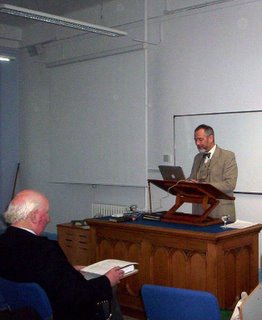
Dr. Bill Telford (Universities of Newcastle and Durham) spoke about the early history of the Society for New Testament Study (Studiorum Novi Testamenti Societas) and the important contributions to it by the University of St. Andrews and St. Mary's College and by Robin Wilson in particular. The Society was conceived in the 1930s but its founding was delayed by World War II and the first meeting was not until 1947. (More details here.) Its first president was Professor George Duncan of St. Mary's College [CORRECTION: Principal Duncan was the second president; the first was J. De Zwaan]. Professor Matthew Black and Professor Wilson were also heavily involved for many years. Both served as president of the society and as editors of the journal New Testament Studies and the NTS Supplement monograph series. Professor Paddy Best published the second volume in the series -- his monograph The Temptation and the Passion.
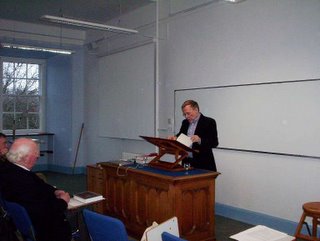
Richard Bauckham then spoke again briefly about Professor Wilson's scholarly contribution, including his editorship of the translation from German of two editions of the two large volumes of New Testament Apocrypha (which were carefully compared to the original-language texts as well and thus were an original contribution as well as a translation) and his most recent commentary on Colossians and Philemon.
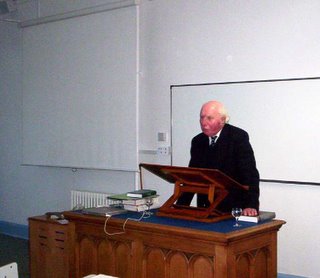
Professor Wilson spoke next, first graciously thanking the speakers and those attending, some of whom came from a considerable distance, then reminiscing about his career, which has spanned the space between fountain pens (ballpoints hadn't been invented) and online publications. He appears nevertheless to have fully mastered e-mail and to have used it vigorously to keep the editors of his recent book in line.
He also spoke about his two supervisors when he was a student; William Manson of Edinburgh and W. L. Knox of Cambridge. Manson suggested Diaspora Judaism, syncretism, and the origins of Gnosticism as one possible topic of doctoral research and both Knox and Wilson liked the idea, so he went with it, timing his graduation in 1945 to coincide most fortuitously with the discovery of the Coptic Gnostic library from Nag Hammadi.
He also told of a College Dinner in which the president of the College Society (in the traditional staff roast) proposed running a model railway called the Wilson Special -- Gnostic passengers only.
He concluded that he looks back with great satisfaction at what many of his students (some of whom were present) have gone on to achieve.
The reception followed.
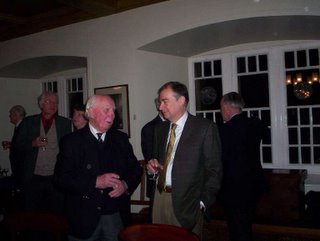
Here Professor Wilson speaks with Ron Piper, Professor of Christian Origins and Vice Principal of Teaching.
I had a conversation with Professor Wilson during the reception in which we both cheerfully dissed The Da Vinci Code. He also commented wryly that the best way to get scholarly recognition was to publish something that's almost right but is just wrong enough to make people want to argue with you. (A persistent theme during the speeches was Robin Wilson's meticulous scholarship and his humility, so he didn't learn this from experience.)
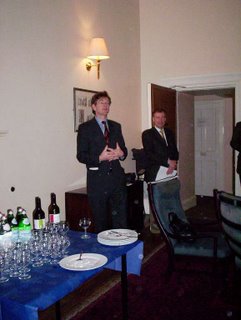
Professor David Parker (above left) of the University of Birmingham spoke after dinner of his time here as a student 30 years ago. My favorite bit was when he told of the shelf on Professor Wilson's bookcase reserved for works he considered ridiculous. Alas, no examples were given.
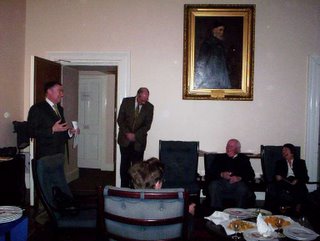
Finally, Ron Piper recounted some memories of his early days as a lecturer at St. Mary's College. He arrived in 1980 and Robin Wilson retired in 1983, so they overlapped by three years. He focused on Robin's absolute dedication to New Testament studies, his loyalty to St. Mary's, his willingness to spend time with people, and his gentleness. He concluded with a toast to Robin.
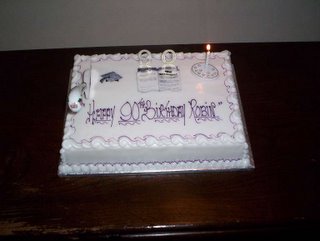
Then the cake was produced.
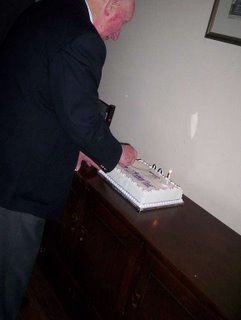
And cut.
Happy Birthday Robin, and many happy returns!
UPDATE (3 December 2007): I've corrected a detail above. Also, Bill Telford's paper is available here.
The afternoon opened with a brief introduction by Professor Richard Bauckham (see third photo down). He noted, among other things, that Professor Wilson's first article was published in 1952, his first book in 1958, and his most recent book at the end of 2005.

His comments were followed by Professor Einar Thomassen (above) of the University of Bergen, Norway, one of Professor Wilson's doctoral students in the 1980s. He spoke on Professor Wilson's half-century of contributions to the study of Gnosticism. (I understand that some of these presentations may be published someday, so, although I did take extensive notes, I'll keep my summaries brief.) Robin Wilson's contribution included building bridges between the German and British approaches, both by translating (and updating) many important German works and by integrating the German study of Gnosis as a widespread pre-Christian worldview and the British study of Gnosticism as a second-century Christian heresy, and by pointing out that the two are not the same thing. He did early work on the independence of elements of the Gospel of Thomas from the canonical Gospels and he raised concerns about the use of the term "Gnosticism" in 1955, decades before these problems became widely recognized.

Dr. Bill Telford (Universities of Newcastle and Durham) spoke about the early history of the Society for New Testament Study (Studiorum Novi Testamenti Societas) and the important contributions to it by the University of St. Andrews and St. Mary's College and by Robin Wilson in particular. The Society was conceived in the 1930s but its founding was delayed by World War II and the first meeting was not until 1947. (More details here.) Its first president was Professor George Duncan of St. Mary's College [CORRECTION: Principal Duncan was the second president; the first was J. De Zwaan]. Professor Matthew Black and Professor Wilson were also heavily involved for many years. Both served as president of the society and as editors of the journal New Testament Studies and the NTS Supplement monograph series. Professor Paddy Best published the second volume in the series -- his monograph The Temptation and the Passion.

Richard Bauckham then spoke again briefly about Professor Wilson's scholarly contribution, including his editorship of the translation from German of two editions of the two large volumes of New Testament Apocrypha (which were carefully compared to the original-language texts as well and thus were an original contribution as well as a translation) and his most recent commentary on Colossians and Philemon.

Professor Wilson spoke next, first graciously thanking the speakers and those attending, some of whom came from a considerable distance, then reminiscing about his career, which has spanned the space between fountain pens (ballpoints hadn't been invented) and online publications. He appears nevertheless to have fully mastered e-mail and to have used it vigorously to keep the editors of his recent book in line.
He also spoke about his two supervisors when he was a student; William Manson of Edinburgh and W. L. Knox of Cambridge. Manson suggested Diaspora Judaism, syncretism, and the origins of Gnosticism as one possible topic of doctoral research and both Knox and Wilson liked the idea, so he went with it, timing his graduation in 1945 to coincide most fortuitously with the discovery of the Coptic Gnostic library from Nag Hammadi.
He also told of a College Dinner in which the president of the College Society (in the traditional staff roast) proposed running a model railway called the Wilson Special -- Gnostic passengers only.
He concluded that he looks back with great satisfaction at what many of his students (some of whom were present) have gone on to achieve.
The reception followed.

Here Professor Wilson speaks with Ron Piper, Professor of Christian Origins and Vice Principal of Teaching.
I had a conversation with Professor Wilson during the reception in which we both cheerfully dissed The Da Vinci Code. He also commented wryly that the best way to get scholarly recognition was to publish something that's almost right but is just wrong enough to make people want to argue with you. (A persistent theme during the speeches was Robin Wilson's meticulous scholarship and his humility, so he didn't learn this from experience.)

Professor David Parker (above left) of the University of Birmingham spoke after dinner of his time here as a student 30 years ago. My favorite bit was when he told of the shelf on Professor Wilson's bookcase reserved for works he considered ridiculous. Alas, no examples were given.

Finally, Ron Piper recounted some memories of his early days as a lecturer at St. Mary's College. He arrived in 1980 and Robin Wilson retired in 1983, so they overlapped by three years. He focused on Robin's absolute dedication to New Testament studies, his loyalty to St. Mary's, his willingness to spend time with people, and his gentleness. He concluded with a toast to Robin.

Then the cake was produced.

And cut.
Happy Birthday Robin, and many happy returns!
UPDATE (3 December 2007): I've corrected a detail above. Also, Bill Telford's paper is available here.
DAILY HEBREW BLOG: For some reason I seem not to have mentioned the Daily Hebrew Blog yet. This is a blog by H. H. Hardy which has been running since late October of 2005. Its purpose is as follows:
The goal of DailyHebrew.com is to encourage daily reading of sacred Hebrew texts.
Introduction
After devoting long hours to learning the basics of Hebrew grammar most students, pastors and teachers fail to continue reading the Hebrew Bible. Eventually, their knowledge atrophies for lack of use. The purpose of DailyHebrew.com is to remedy this ubiquitous problem by providing the reader a manageable daily Hebrew reading (4-8 verses) along with lexical and syntactical assistance.
DailyHebrew.com is committed to helping students at all levels read biblical Hebrew. The blog is arranged so that a reader can spend a few minutes a day or week reading Hebrew texts. Beginners should start with the first verse or two of each translation, Intermediate learners should attempt the entire passage using the vocabulary listed by line (words which occur less than 50 times in the MT are listed in parentheses with their BDB reference page) and Advanced scholars will be able to translate using minimal vocabulary helps.
Typically, students spend the majority of their time memorizing vocabulary, reading grammars and studying paradigms. Though these pursuits are well intended and needed initially, one will not learn Hebrew until committing to a regular reading regiment. But, you say, 4-8 verses a day is not very much reading. Actually, averaging 8 verses a day one can read the entire Torah (~6000 verses) in only two years and the entire Hebrew Bible in ten years.
1200 VISITORS viewed the Dead Sea Scrolls exhibition at Discovery Place in Charlotte on Friday, the opening day. They expect 3400 more over the weekend and hope for 200,000 total.
Scrolls awe, amaze visitors
Power of ancient texts unites diverse group on exhibit's opening day
KEN GARFIELD
Religion Editor (Charlotte Observer)
Proof of the power of the Dead Sea Scrolls to bring people together came Friday on opening day of the much-anticipated exhibit at Discovery Place.
Among the first to admire the sacred artifacts were 41 senior citizens from Plantation Estates in Matthews, a family from Charlotte and a Nigerian doctor who lives in Huntersville -- a diverse group united for this one morning at least by their faith, fascination and feelings.
[...]
THE ISRAELI SUPREME COURT shall be ruling soon on the building of the Simon Wiesenthal Museum of Tolerance over a Muslim cemetery. The Jerusalem Post has a long article. The political situation looks quite messy and less than straightforward.
Read it all.
Ruling expected on Tolerance Museum construction
By ELANA BROWNSTEIN AND AMIR MIZROCH
The High Court of Justice is slated to hand down its decision in the coming days on whether the Los Angeles-based Simon Wiesenthal Center (SWC) may continue building its planned Center for Human Dignity, Museum of Tolerance Jerusalem complex following public protests and two petitions by Israeli Arabs.
Wednesday, the court heard the petitions by the Al Aqsa Company for the Development of Waqf (Muslim religious trust) sites and by the Nazareth-based Karameh Human Rights Organization, representing three prominent Jerusalem families who say their ancestors are among those buried in the ancient cemetery.
The $150 million complex off Jerusalem's Rehov Hillel, designed by prominent American architect Frank Gehry, would include a museum, conference and education centers, a library and a theater, all dedicated to promoting tolerance in Israel and abroad, the SWC says. If work continues as planned the museum is expected to open by 2008.
The SWC said it had been told by the government and the Jerusalem Municipality five years ago that the threedunam plot was not defined as a cemetery, but as "public open space" and gave it the necessary permits to build on the site. It said the government based its decision on a 1964 Sharia Religious Court [the highest Muslim court in Israel] ruling that allegedly nullified the sanctity of the graveyard and permitted use of the land.
Rabbi Marvin Hier, the dean and founder of SWC, quoted the ruling as declaring "The cemetery's sanctity has ceased to exist in it and it is permitted to do whatever is permitted in any other land which was never a cemetery." The 1964 document was included in the SWC response to the petition.
The petitioners, however, have rejected the government's position. "We adhere to our legitimate right to protect the Ma'amam Allah graveyard and all other Muslim cemeteries," said Irkima al-Sabri, the Grand Mufti of Jerusalem, West Bank and Gaza Strip.
According to Karameh's lawyer Durgham Saif, "You cannot build a museum of tolerance on the bones of other people. It is immoral and illegal."
[...]
Read it all.
COPTIC GOSPEL OF JUDAS WATCH: The Winston-Salem Journal has a well-researched article on this, which, for example, actually interviews the Vatican official it quotes.
The article also describes some of the contents of the Gospel of Judas, which is scheduled to be published at Easter.
Incidentally, as far as I know, the Times of London article remains uncorrected and unclarified. But I stopped checking after a couple of weeks.
I've reconstructed this post, which is one of the ones lost yesterday.
'Gospel' is stirring up a debate about Judas
By Stacy Meichtry
RELIGION NEWS SERVICE
The first translation of an ancient, self-proclaimed "Gospel of Judas" will be published in late April, bringing to light what some scholars believe are the writings of an early Christian sect suppressed for supporting Jesus Christ's infamous betrayer.
If authentic, the manuscript could add to the understanding of Gnosticism, an unorthodox Christian theology denounced by the early church. The Roman Catholic Church is aware of the manuscript, which a Vatican historian calls "religious fantasy."
[...]
Monsignor Walter Brandmuller, the president of the Vatican's Committee for Historical Science, called it "a product of religious fantasy."
In an interview, he said that the manuscript would not have any impact on church teaching.
"We welcome the (manuscript) like we welcome the critical study of any text of ancient literature," Brandmuller said.
He said that despite some reports to the contrary, the drive to improve Judas' reputation does not have the support of the Vatican.
"There is no campaign, no movement for the rehabilitation of the traitor of Jesus," Brandmuller said.
[...]
The article also describes some of the contents of the Gospel of Judas, which is scheduled to be published at Easter.
Incidentally, as far as I know, the Times of London article remains uncorrected and unclarified. But I stopped checking after a couple of weeks.
I've reconstructed this post, which is one of the ones lost yesterday.
Saturday, February 18, 2006
MYSTERIOUS VANISHING POST[S!]: Yesterday evening I put up an "in the mail" post to note the arrival of my new iBook. (It was actually a replacement for a defective one that had arrived a week before. It took one long phone conversation on Saturday morning and a work-week's turnaround to get the new machine, which isn't too bad. The new machine is up and running and I'm fiddling with details to get it just so.) For some reason that post never appeared in the list of posts on my Blogger dashboard and it disappeared from the blog sometime the next morning. Most peculiar; I've never had anything like that happen before.
Also, I got back a while ago from the Wilson birthday celebration, which went very well. I have lots of notes and photos (I slipped away a few times to my office to download the latter onto the iBook so I could make sure they looked okay). My long post on the celebration is almost ready, but I'm going to sleep on it and put it up in the morning. Watch this space.
UPDATE: Yikes! Two more posts from this morning have just vanished! Very strange. Is anyone else having problems with Blogger?
Friday, February 17, 2006
MAARAV, A Journal for the Study of the Northwest Semitic Languages and Literatures has a new issue out. I reproduce the annoucement as distributed on the Agade list:
From: "Christopher A. Rollston" rollstonc@esr.edu
===============================================
MAARAV 11.2 (2004) has now appeared.
TABLE of CONTENTS for MAARAV 11.2
Mark S. Smith
Review Article of The Religions of Ancient Israel: A Synthesis of Parallactic Approaches (Ziony Zevit) 145-218
Anne Marie Kitz
The Curse Behind the Plague of Boils 219-232
Bruce Zuckerman
Shading the Difference: A Perspective on Epigraphic Perspectives of the Kheleifeh Jar Stamp Impressions 233-252
InscriptiFact Announcement 253-254
_________________
MAARAV 12:1-2 (2005) will be a special double-issue, consisting of articles based on a "law and society in the ANE" conference that occurred at Bar Ilan University (among the contributors are Bernard Levinson, Raymond Westbrook, Karen Radner, Sophie Lafont, etc). This volume is expected to appear during the early summer.
_________________
MAARAV 13:1 (2006) is now full, and should appear at some point during the summer, immediately after MAARAV 12:1-2 appears.
_________________
We intend to be "caught up" by the end of the calendar year and I believe that this is feasible.
For subscription information, see www.maarav.com
TEN DEAD SEA SCROLLS have arrived in Charlotte, North Carolina:
One correction:
Dead Sea Scrolls arrive in CharlotteThe scrolls have been getting good local coverage and I'm sure the exhibition will be a success.
Updated: 2/16/2006 8:21 PM
By: Adam Shub, News 14 Carolina
CHARLOTTE, N.C. -- After months of anticipation, the Dead Sea Scrolls have finally arrived in Charlotte.
Starting Friday and ending May 29, 10 of the 2,000-year-old documents will be on display at Discovery Place. Museum officials said it will be a once-in-a-lifetime experience.
"Several of the scrolls in this particular collection have never before traveled outside Israel," John Mackay, president of Discovery Place, said at a news conference Thursday. "This particular exhibition has never before been seen in any other city in the world."
[...]
One correction:
The Dead Sea Scrolls are the oldest surviving manuscripts of the Old Testament. Archeologists found more than 900 fragments in the late 1940s.That's 900 manuscripts (in tens of thousands of fragments!) and 10 manuscripts.
[...]
The 10 fragments will be displayed in individual glass cases. Beside each of them will be the corresponding translation of its Hebrew passage.
Thursday, February 16, 2006
JIM VANDERKAM'S 60th birthday is being honored by the University of Notre Dame with a symposium next month. Here's the program, which was sent to me by Notre Dame postgraduate Sam Thomas. (Registration is already closed.) Congratulations, Jim!
Reading Between the Lines:
Scripture and Community in the Dead Scrolls
A Symposium in Honor of James C. VanderKam
March 5-6, 2006
University of Notre Dame
McKenna Hall
Sunday, March 5
Afternoon Session
4:00pm “Whose Scripture? Whose Community? Reflections on the Dead Sea Scrolls Then and Now”
Rob Kugler – Lewis & Clark College
4:45 “The Unfinished Scroll: The End of the Temple Scroll”
Lawrence Schiffman – New York University
5:30 “Decoration, Debauchery and Destruction: Reflections on 1 Enoch 8 in Light of 4QEnb”
Kelley Coblentz Bautch – St. Edward’s University
Keynote Address – Introduction by Greg Sterling, University of Notre Dame
8:00 “A Holy House for Aaron: The Aims of the Yahad”
John J. Collins – Yale University
Monday, March 6
Graduate Student Session
8:30am “Scripts, Scrolls and Textual Communities: A New Model for Reading the Serekh Versions”
Alison Schofield – University of Denver
9:00 “The ‘Mystery’ Community: Raz in the Dead Sea Scrolls”
Sam Thomas – University of Notre Dame
9:30 “Geography as an Evaluative Tool in the Genesis Apocryphon”
Dan Machiela – University of Notre Dame
Late Morning Session
10:30 “What Happened to the Laws? The Treatment of Legal Material in 4QReworked Pentateuch”
Moshe Bernstein – Yeshiva University
11:15 “The Community of the Community Hymns”
Angela Kim – Duquesne University
11:45 “Pseudonymity and Exemplarity: The Case of 4Ezra”
Hindy Najman – University of Toronto
Afternoon Session
1:30 “Qumran Self-Identity and the Eschatological Restoration of Israel”
John Bergsma – Franciscan University of Steubenville
2:00 “Some Conceptions of Sin in the Dead Sea Scrolls and in the Book of Daniel”
Gary A. Anderson – University of Notre Dame
2:45 “Methodological Reflections on Determining Scriptural Status in First Century Judaism”
Eugene Ulrich – University of Notre Dame
3:15-3:30 Conclusion of Symposium
Dan Harlow – Calvin College
HOWARD CARTER opened King Tut's Tomb on this day in 1923. You've probably already heard that another intact tomb has been discovered recently in the Valley of the Kings.
GENETIC TESTING is raising challenges for the Book of Mormon. The Los Angeles Times has a long article about it.
Bedrock of a Faith Is Jolted
• DNA tests contradict Mormon scripture. The church says the studies are being twisted to attack its beliefs.
By William Lobdell, Times Staff Writer
From the time he was a child in Peru, the Mormon Church instilled in Jose A. Loayza the conviction that he and millions of other Native Americans were descended from a lost tribe of Israel that reached the New World more than 2,000 years ago.
"We were taught all the blessings of that Hebrew lineage belonged to us and that we were special people," said Loayza, now a Salt Lake City attorney. "It not only made me feel special, but it gave me a sense of transcendental identity, an identity with God."
A few years ago, Loayza said, his faith was shaken and his identity stripped away by DNA evidence showing that the ancestors of American natives came from Asia, not the Middle East.
[...]
Critics want the church to admit its mistake and apologize to millions of Native Americans it converted. Church leaders have shown no inclination to do so. Indeed, they have dismissed as heresy any suggestion that Native American genetics undermine the Mormon creed.
Yet at the same time, the church has subtly promoted a fresh interpretation of the Book of Mormon intended to reconcile the DNA findings with the scriptures. This analysis is radically at odds with long-standing Mormon teachings.
[...]
ADOLFO ROITMAN, Curator of the Shrine of the Book, has given another public lecture, this one in Hartford, Connecticut.
The Septuagint (LXX), the Greek translation, is much earlier than this. The Pentateuch was probably translated in Alexandria in the third century B.C.E., with the rest of the books following over the next couple of centuries. There were revisions of this Old Greek version published as well. It may be that Roitman referred to one of the major (more or less) complete LXX manuscripts, Codex Vaticanus or Codex Sinaiticus, which do date to the fourth century C.E., and the reporter misunderstood.
Expert on the Dead Sea Scrolls speaks at Trinity CollegeThe article is pretty good, but it contains this seemingly obligatory glitch:
By Tracy Hudak (Jewish Ledger)
HARTFORD - "The Dead Sea Scrolls are a real revolution in scholarship, and they changed everything we knew before about the origin of rabbinical Judaism, historical Judaism, and the early church," said Dr. Adolfo Roitman, curator and director of the Shrine of the Book, which houses the Dead Sea Scroll collection at the Israel Museum in Jerusalem.
Roitman gave a multi-media presentation about the discovery of the Dead Sea Scrolls and their significance for Judaism and Christianity during his Feb. 1 lecture at Trinity College in Hartford. His visit was sponsored by Trinity College's Jewish Studies Program.
"Before the discovery of the Dead Sea Scrolls and the Biblical manuscripts amongst them, all the Hebrew Biblical manuscripts in hands before Qumran, all of them came from different times. We didn't have ancient testimonies of the biblical texts," said Roitman. There is a Greek version of the Bible from the 4th century, C.E. But, he noted, these manuscripts were not written in Hebrew.
The Septuagint (LXX), the Greek translation, is much earlier than this. The Pentateuch was probably translated in Alexandria in the third century B.C.E., with the rest of the books following over the next couple of centuries. There were revisions of this Old Greek version published as well. It may be that Roitman referred to one of the major (more or less) complete LXX manuscripts, Codex Vaticanus or Codex Sinaiticus, which do date to the fourth century C.E., and the reporter misunderstood.
UPDATE ON THE MUSEUM OF TOLERANCE and the Muslim cemetery:
UPDATE: The Los Angeles Times has much more in "Wiesenthal's Jerusalem Excavation Ignites Furor."
MKs slam Wiesenthal museum siteThe Supreme Court says it will make a ruling soon.
By ORLY HALPERN (Jerusalem Post)
Jewish MKs slammed the building of a museum for tolerance on a Muslim cemetery in downtown Jerusalem Wednesday, hours after the High Court of Justice held a hearing on whether to stop the construction of the $200 million building.
"Why, for God's sake, does a house of tolerance need to be built on a Muslim cemetery?" asked MK Reuven Rivlin, the Speaker of the Knesset, incredulously. "This goes against logic - there is a contradiction."
Rivlin was invited to join the Knesset Interior Committee hearing about the building of a Museum of Tolerance by the Simon Wiesenthal Center of Los Angeles on a Muslim cemetery. The Jerusalem Post revealed in December that Muslim graves were found on a section of the museum's planned Jerusalem site. The hearing was called for after it came to the attention of Muslim citizens.
[...]
UPDATE: The Los Angeles Times has much more in "Wiesenthal's Jerusalem Excavation Ignites Furor."
Wednesday, February 15, 2006
IN THE MAIL:
Elisabeth Kendall, Media Arabic: An Essential Vocabulary (Edinburgh University Press, 2005)Some light bedtime reading.
ANE R.I.P.
The ANE e-mail discussion list ceases operation tomorrow:
It's a pity that one of the oldest Internet institutions in the field is coming to an end, but it really is time. I finally unsubscribed from the ANE list a couple of weeks ago when I reached the point of deleting almost every message from the list and resenting the time I was wasting doing it. Many posts were good and thoughtful, but too many others were endless reinventions of the wheel and some of the replies to these were so rude, even when they were right, that it pained me to agree with them. My own experience with e-mail lists is that they have to be very firmly moderated or they end up being abused by a vocal minority, which is why I gave up running them (and is one of the reasons that I normally don't enable comments on this blog).
The Oriental Institute made the right decision and I wish them the best in their current and future online and offline projects. I wonder if they might consider starting a group blog and invite some key figures in the various fields of ancient Near Eastern studies to post to it? Just a thought.
UPDATE: That was fast! Stephen Carlson at Hypotyposes notes that Jeffrey Gibson has already set up a moderated ANE-2 list on Yahoo. At the moment the Agade list seems to be providing all the ANE news I need, but I'll keep an eye on the ANE-2 archive and I may join if the moderator keeps the quality high and the quantity low. If you do join, drop me a note and let me know what you think.
The ANE e-mail discussion list ceases operation tomorrow:
All ANE subscribers,(Via the Agade list.)
The voting members of the Oriental Institute have decided to withdraw
their support for the OI's continued hosting and management of the
ANE list. Therefore, all list activities will end at noon (CST)
February 16, 2006.
The on-line archive with old ANE posts will remain available for the time being. A date for the removal of the archive will be announced in advance on the ANE home page:
http://oi.uchicago.edu/OI/ANE/OI_ANE.html
We hope that the ANE community will be able to move their discourse from the ANE to one or several alternative list(s). Please note that for the privacy of the subscribed members to the ANE list, we will not distribute to any individual or organization our current email directory.
John Sanders
Magnus Widell
--
John C. Sanders, Head
Oriental Institute Computer Laboratory
1155 East 58th Street
Chicago, IL 60637
773-702-0989
jc-sanders@uchicago.edu
http://oi.uchicago.edu
It's a pity that one of the oldest Internet institutions in the field is coming to an end, but it really is time. I finally unsubscribed from the ANE list a couple of weeks ago when I reached the point of deleting almost every message from the list and resenting the time I was wasting doing it. Many posts were good and thoughtful, but too many others were endless reinventions of the wheel and some of the replies to these were so rude, even when they were right, that it pained me to agree with them. My own experience with e-mail lists is that they have to be very firmly moderated or they end up being abused by a vocal minority, which is why I gave up running them (and is one of the reasons that I normally don't enable comments on this blog).
The Oriental Institute made the right decision and I wish them the best in their current and future online and offline projects. I wonder if they might consider starting a group blog and invite some key figures in the various fields of ancient Near Eastern studies to post to it? Just a thought.
UPDATE: That was fast! Stephen Carlson at Hypotyposes notes that Jeffrey Gibson has already set up a moderated ANE-2 list on Yahoo. At the moment the Agade list seems to be providing all the ANE news I need, but I'll keep an eye on the ANE-2 archive and I may join if the moderator keeps the quality high and the quantity low. If you do join, drop me a note and let me know what you think.
Tuesday, February 14, 2006
ASSIMILATED TO THE BLOGOSPHERE: Here are two new blogs that I note with considerable interest, both via Mark Goodacre (here and here).
By the way, tomorrow is filled with meetings and a seminar. If I get to blogging at all, it will be in the afternoon or later.
Markus McDowell's Blog
Teaching, researching, and writing about the Second Temple period and early Christianity.
Reception of the Bible, by John Lyons of Bristol University
By the way, tomorrow is filled with meetings and a seminar. If I get to blogging at all, it will be in the afternoon or later.
SOME VALENTINE'S DAY APOCRYPHA: In "No Lover? No Problem," a Valentine's Day essay in the Columbia Spectator, Paul Barndt concludes with the following:
Alas, it isn't so. Valentinus (not "Valentinius") was a second-century Christian heretic, founder of the Valentinian school of Gnosis. Heretics don't get to be saints and they don't get holidays named after them. St. Valentine's Day actually honors three saints by that name, one of whom was reportedly martyred on that day in the third century. The association with love seems to come from a medieval belief that birds start to pair on that day.
Happy Valentine's Day anyway!
This year, just remember that though Valentine’s Day might be named after Valentinius—a second-century Gnostic theologian who emphasized the importance of marriage to the Christians—there are other kinds of love. Maybe even some lurking around the groups of single guys and single girls sitting together watching television.
Alas, it isn't so. Valentinus (not "Valentinius") was a second-century Christian heretic, founder of the Valentinian school of Gnosis. Heretics don't get to be saints and they don't get holidays named after them. St. Valentine's Day actually honors three saints by that name, one of whom was reportedly martyred on that day in the third century. The association with love seems to come from a medieval belief that birds start to pair on that day.
Happy Valentine's Day anyway!
Monday, February 13, 2006
DEAD SEA SCROLLS IN CHARLOTTE: Sunday's Charlotte Observer has two articles on the upcoming Dead Sea Scrolls exhibition at Discovery Place. The first:
It's not correct to say that the Scrolls preserve "the complete writings of every Old Testament book except Esther." Most of the manuscripts are very fragmentary. Likewise, it's true that a few of the biblical manuscripts are essentially identical to the Masoretic Text, the traditional Hebrew text, and others have a text that is quite close to it. But there are other Qumran manuscripts, such as the recently fully published Samuel scrolls, which confirm what scholars already had known: that some books in the MT are riddled with copyists' errors, some (by no means all!) of which the Scrolls help to correct.
The second:
Also, there's an article in the Peoria Journal Star about a local lecture given by Professor Martin Abegg of Trinity Western University:
From the Dead Sea to CharlotteThis tells the story of the discovery of the scrolls in some detail and does a good job of it. My only quibbles are with this:
PETER ST. ONGE
The scrolls contain previously unknown stories about biblical figures such as Abraham and Noah. Equally wondrous to many are the complete writings of every Old Testament book except Esther -- the only book of the Bible that neither explicitly nor allegorically refers to God. Some books are copied as many as 19 times, and scholars have marveled at the closeness of the texts to modern versions.
"The preservation of the Hebrew text is excellent," says Max Polley, professor emeritus of religion at Davidson College. "It's pretty remarkable that the accuracy is as fine as it is."
Says Flint: "This is very important. There are people who say the Bible has been changed and altered and tampered with. The Dead Sea Scrolls are very affirming. You can check it for yourself."
It's not correct to say that the Scrolls preserve "the complete writings of every Old Testament book except Esther." Most of the manuscripts are very fragmentary. Likewise, it's true that a few of the biblical manuscripts are essentially identical to the Masoretic Text, the traditional Hebrew text, and others have a text that is quite close to it. But there are other Qumran manuscripts, such as the recently fully published Samuel scrolls, which confirm what scholars already had known: that some books in the MT are riddled with copyists' errors, some (by no means all!) of which the Scrolls help to correct.
The second:
Touching our ancient pastExcerpt:
Charlotte region eager to be thrilled by seeing real Dead Sea Scrolls
JAMES D. TABOR
Archaeology is the material evidence of our human past. As an archaeologist, I have long observed and experienced the thrill that ancient discoveries cause in all of us. The look on the faces of my students as we uncover ancient ruins from the time of Jesus, or explore one of the caves where the scrolls were found, is unmistakable.
The effect stems from a combination of the hand, the head and the heart. Ancient things connect us, inform us and stir us emotionally, with a combination of thoughts and feelings that are truly fundamental to us as human beings.
But you don't have to be a field archaeologist to experience this phenomenon. Maybe you have held in your hand a letter or other object from your family several generations back, or stared for long moments at the signatures on our U.S. Constitution. These material things are able to strangely connect us to the past.
Foundation of this civilization
The Dead Sea Scrolls are like that for all of us, whether Jewish, Christian, Muslim or secular, for the Bible is fundamental to us all. The scrolls come to us from a time in history, the 1st century B.C. through the 1st century A.D., that forms the foundation of our Western civilization.
Also, there's an article in the Peoria Journal Star about a local lecture given by Professor Martin Abegg of Trinity Western University:
Scrolls invigorate Abegg's faithIn it he talks about the text of a manuscript containing Genesis 48:1-11. Incidentally, this is 4QGenf, which I edited in DJD 12. The MT text of Genesis is overall well preserved, although parts of Genesis have significant variants in the Greek translations (the LXX or Septuagint), some of which are probably original. By my count even this fragment, containing only part of a chapter, has seven, mostly minor, variants (ignoring spelling variants) from the MT.
Former Peorian speaks on Dead Sea Scrolls
Sunday, February 12, 2006
HAPPY 90TH BIRTHDAY to Robert McL Wilson, Professor of Biblical Criticism Emeritus at the University of St. Andrews and renowned specialist in Gnosticism and early Christianity! And congratulations also to Professor Wilson on the publication of his most recent book, Colossians And Philemon: A Critical And Exegetical Commentary, which came out on 30 December 2005 in the prestigious International Critical Commentary series.
The Divinity School of the University of St. Andrews will be hosting a day-long celebration in honor of Professor Wilson on Saturday, the 18th of February. Naturally, I intend to be there and to blog it. Watch this space!
The Divinity School of the University of St. Andrews will be hosting a day-long celebration in honor of Professor Wilson on Saturday, the 18th of February. Naturally, I intend to be there and to blog it. Watch this space!
TU B'SHEVAT, the "New Year for Trees," begins tonight at sundown.
Here's some more background, published today:
Here's some more background, published today:
Tu B'Shevat shows tree as part of God, faith (Toronto Star)
Saturday, February 11, 2006
ENOCHIAN MAGIC figures in the season finale (link has spoilers) of Sea of Souls, a British television series about parapsychologists at a University in Glasgow. I just watched the episode. Enochian magic is only mentioned once, but it's presented as the centerpiece of the occult theme of the show. Paul McGann (who played the eighth Doctor Who in the 1996 movie) appears as a suitably intimidating Enochian magician.
I know very little about the modern occult and alchemical traditions, so I don't know if the presentation was accurate. On general principles I rather doubt it, and certainly a lot of other stuff was mixed in. But, that said, the mentions of Fulcanelli sounded correct, and the final interpretation of the sacrifice did seem to capture a central value of the system(s) as I understand it. A couple of years ago I posted some links on Enochian magic here. Please note the warning label if you are squeamish about such things.
The episode was credulous for my taste, but it made for an entertaining story.
TOLDOT: BIBLE AND HISTORY LIST COMMENTS is a new blog by Yitzhak Sapir. He gives its purpose as "To collect various notes and comments of mine regarding list posts on various Bible and Ancient Near East related lists." His first substantive post is on the odd spelling of a word in the Siloam Inscription, in which he interacts with some of what I've written on the same subject.
(Via Dr. Cathey's Blog.)
UPDATE (12 February): Bad link fixed and name corrected!
(Via Dr. Cathey's Blog.)
UPDATE (12 February): Bad link fixed and name corrected!
THE INTERNATIONAL INSTITUTE FOR JEWISH GENEALOGY has opened in Jerusalem and has an ambitious agenda:
Tracing the Jewish nation's family tree
By Amiram Barkat (Haaretz)
Is it possible to trace the family tree of the entire Jewish nation? The task of the world's first academic institute for studying Jewish genealogy will to try and answer this question.
The goals of the International Institute for Jewish Genealogy (IIJG), inaugurated in Jerusalem last month, include academic research into Jewish family names and granting masters degrees to genealogy researchers. The institute also hopes to expand the data base about Sephardi Jews.
[...]
Friday, February 10, 2006
THE BBC GETS IT. This is very encouraging:
This bit in particular hits the nail on the head:
Definitely read it all. You might want to look also at my article "Assimilated to the Blogosphere," where I make some similar points. This confirms other indications I've had that the BBC is taking note of blogs.
Bloggers: an army of irregulars
By Paul Reynolds
World Affairs correspondent, BBC News website
For many in the "mainstream media", as bloggers call us, weblogs are at best a nuisance and at worst dangerous.
They are seen as the rantings and ravings either of the unbalanced or the tedious.
My experience over the past few months has led me to an opposite conclusion.
I regard the blogosphere as a source of criticism that must be listened to and as a source of information that can be used.
The mainstream media (MSM in the jargon) has to sit up and take notice and develop some policies to meet this challenge.
[...]
This bit in particular hits the nail on the head:
It is when the criticism is detailed and pointed that it can hit home.
And with the growth of blogs, such detailed criticism is being made more and more often as the sniper fire from the bloggers targets individual stories and interpretations.
If the MSM does not respond, it will suffer. The same is even truer of businesses, whose products can be disastrously damaged by web-based attacks.
If the criticism is fair it must be answered, directly to those making it. Remote, computer-generated responses are counter-productive.
And mistakes must be quickly corrected. If the criticism is unfair, then the MSM has to know about it early on and develop defensive tactics.
Definitely read it all. You might want to look also at my article "Assimilated to the Blogosphere," where I make some similar points. This confirms other indications I've had that the BBC is taking note of blogs.
CHARLOTTE is anticipating lots of visitors for the Dead Sea Scrolls exhibition:
Scrolls should boost local economy
2/9/2006 8:34 PM
By: Adam Shub, News 14 Carolina
CHARLOTTE, N.C. -- Some of the Dead Sea Scrolls will be displayed at Discovery Place next week, and the uptown museum has already sold 35,000 tickets for the exhibit.
The ancient manuscripts, the oldest-surviving writings from the Old Testament, will be showcased from Feb. 17 to May 29.
"We just put a very strong concerted effort out so that we could land it here in Charlotte,� said Joanie Philips, the museum�s director of major projects.
The effort should pay off.
Last year, the Scrolls brought 205,661 visitors to Mobile, Ala. -- 70 percent from out of town. The bottom line was an overall economic impact of $13.5 million.
[...]
CONTROVERSY OVER MUSEUM OF TOLERANCE EXCAVATION:
I've been following this story for a while, but haven't posted it, since I couldn't figure what "ancient" meant in this context. To the press, it seems often to mean anything more than a couple hundred years old. But this comment puts it as far back as the time of Muhammad:
UPDATE: Archaeologist David Stacey e-mails to reproach me:
Fair enough, and thanks for the additional info. I had meant to add a request for more information to the end of the post and forgot to put it in. I didn't mean to imply that the site was only important if it was ancient in the technical sense; just that I try to keep my comments focused mostly on the archaeology of that period. There are lots of stories I am concerned about that don't end up on PaleoJudaica.
But I should have said more than I did. Bear with me: you may have noticed that posting has been light this week. It's the first week of classes and a very busy administrative time. And, to top it off, in the last few days I've had a massive hay fever attack (in February!) along with unpleasant side effects as I try new medications. (While I was writing this update, someone stopped by my office to show me another one to try.) In short, I've been struggling to post at all.
As to how responsibly this cemetery is being treated, there seems to be controversy, and I can't say I'm ready to take sides. There's plenty of salvage archaeology of Jewish sites too, and necessarily so. Is this site so important that the museum should be moved elsewhere? Maybe. Would someone like to e-mail me to argue that? But whatever the merits of the case, I will say that the decision to continue the excavations while waiting for the Supreme Court ruling doesn't seem to me to be good opening publicity for this museum.
UPDATE: David replies:
Well, okay, but some of the media reports make it sound more complicated. A Chicago Tribune article says:
And an Arutz Sheva article says the following:
I am not qualified to evaluate these claims. I blog, you decide.
David also reports that the site was a well-known cruising spot where gay Jews and Arabs could meet each other, which I suppose would not make the political situation any less complicated.
UPDATE: David replies:
Israelis won't stop dig at Muslim cemetery
2/8/2006, 9:53 p.m. CT
By LAURIE COPANS
The Associated Press
JERUSALEM (AP) — A dispute over the fate of an ancient Muslim cemetery in Jerusalem threatened Wednesday to ignite tensions in Holy City as workers removed skeletons from the site despite Muslim pleas for the work to end.
Israeli developers and archaeologists are removing the tombs to make room for the Los Angeles-based Simon Wiesenthal Center to build a multi-million-dollar Museum of Tolerance, dedicated in part to promoting understanding among different religions. Muslims are incensed.
Mufti Ikrema Sabri, the senior Islamic cleric in Jerusalem, on Wednesday demanded that the dig stop at the site which until 1948 served as the main Muslim cemetery in Jerusalem.
I've been following this story for a while, but haven't posted it, since I couldn't figure what "ancient" meant in this context. To the press, it seems often to mean anything more than a couple hundred years old. But this comment puts it as far back as the time of Muhammad:
"There should be a complete cessation of work on the cemetery because it is sacred for the Muslims," Sabri told The Associated Press. The Waqf, the Muslim council in Jerusalem that Sabri oversees, was not consulted on the dig, he said. The cemetery was in use for 15 decades and friends of the Muslim Prophet Muhammad are buried there, Sabri said.
UPDATE: Archaeologist David Stacey e-mails to reproach me:
Jim, You really should not be so blase about the destruction of the Muslim cemetery in gan ha-azmaut (independence park) which was in use until 1948. The graves, around one corner of the Mamilla Pool, are reasonably well preserved, many with engraved inscriptions, and include a number from the Mameluk and Ottoman periods, in particular a mausoleum dated 1289 CE. These can be seen at
http://198.62.75.1/www1/ofm/sbf/escurs/Ger/15escursEn.html
The park also includes several second-temple Jewish cave-tombs, generally in poor condition (I helped excavate one many years ago [David adds in a second message: "the tomb I excavated was not, now that I think about it, in Independence Park itself but in the garden further south behind the King David Hotel. However there are second temple tombs in the Park"]). Imagine the furore that would break out if a well-preserved and previously unknown Jewish tomb complete with skeletons was discovered during construction work!
Fair enough, and thanks for the additional info. I had meant to add a request for more information to the end of the post and forgot to put it in. I didn't mean to imply that the site was only important if it was ancient in the technical sense; just that I try to keep my comments focused mostly on the archaeology of that period. There are lots of stories I am concerned about that don't end up on PaleoJudaica.
But I should have said more than I did. Bear with me: you may have noticed that posting has been light this week. It's the first week of classes and a very busy administrative time. And, to top it off, in the last few days I've had a massive hay fever attack (in February!) along with unpleasant side effects as I try new medications. (While I was writing this update, someone stopped by my office to show me another one to try.) In short, I've been struggling to post at all.
As to how responsibly this cemetery is being treated, there seems to be controversy, and I can't say I'm ready to take sides. There's plenty of salvage archaeology of Jewish sites too, and necessarily so. Is this site so important that the museum should be moved elsewhere? Maybe. Would someone like to e-mail me to argue that? But whatever the merits of the case, I will say that the decision to continue the excavations while waiting for the Supreme Court ruling doesn't seem to me to be good opening publicity for this museum.
UPDATE: David replies:
The cemetery was in use until 1948! The graves are perfectly visible although they show signs of lack of upkeep. It's not as if they weren't known about and only showed up after construction work began.
Well, okay, but some of the media reports make it sound more complicated. A Chicago Tribune article says:
he 3-acre construction site is on part of what was once the sprawling Mamilla Cemetery, the largest Muslim graveyard in Jerusalem. In continuous use from the 12th Century until 1927, the cemetery contained hundreds of graves, including the tombs of scores of eminent Muslims: scholars, judges, fighters and holy men.
But after burials were stopped at the cemetery, it fell into disuse, and large parts of it were used for other purposes.
In the late 1920s, the Palestinian leader and mufti of Jerusalem, Haj Amin al-Husseini, sanctioned the relocation of bones found during construction of a hotel built by the Supreme Muslim Council on former cemetery grounds.
A city park was built over much of the land in the 1960s, as well as schools and a hotel. In the 1980s a municipal parking lot was built in the area where the new museum is supposed to go up.
In its petition to the Israeli Supreme Court, the Al Aqsa Foundation, linked to the Islamic Movement, argues that under religious law, the sanctity of a Muslim cemetery is immutable and that it is forbidden to remove human remains or build on the area.
But expert opinions solicited by the Wiesenthal Center cite rulings by some prominent Muslim scholars permitting the use of abandoned cemetery land for farming or construction after the remains of the dead have decomposed, a period of more than 30 years.
Such a ruling obtained in 1964 enabled the construction of the park on most of the area of the Mamilla Cemetery, and similar rulings in 2001 allowed the clearing of cemeteries in Egypt for the construction of a ring road around Cairo, according to Shmuel Berkovitz, an Israeli attorney and expert on holy sites who submitted an opinion to the court.
And an Arutz Sheva article says the following:
The land for the project, which was purchased by the Simon Wiesenthal Center, was a parking lot at the time of the sale, and according to Center spokesperson Hagai Elias, was not a cemetery. Muslim leaders maintain that the parking lot itself was built above the remnants of the cemetery.
I am not qualified to evaluate these claims. I blog, you decide.
David also reports that the site was a well-known cruising spot where gay Jews and Arabs could meet each other, which I suppose would not make the political situation any less complicated.
UPDATE: David replies:
Its a while since I was in J'lem and it wd appear from the articles you quote that the building site is somewhat to the north of the main cruising ground. However if the 'parking lot' is the one I think it must be I seem to remember some graves still visible next to it.
No Jewish cememtery still in use in the 20th century would ever be built on. And when development was going on near Gan Sacher for a yehiva (on ?Sderot Ben Zvi?) which required clearing a rock face at least one second temple tomb which was found was left incongruously intact between two buildings set back into the rock face on either side of it.
Thursday, February 09, 2006
"THE HOUSES OF ANCIENT ISRAEL," an exhibit at the Harvard Semitic Museum, is in the news:
The exhibit has been showing since November of 2003.
Harvard museum exhibit shows "The Houses of Ancient Israel"
By Nancy Rabinowitz
Thursday, February 9, 2006 (Daily News Transcript)
CAMBRIDGE -- The hands of time have been turned back to biblical days at Harvard University’s Semitic Museum, where curators have put together a replica of a house showing what life was like in ancient Israel.
"Even if you know nothing about ancient Israel, nothing about archaeology, nothing about the Bible, you walk in and you say ’oh, yeah, that’s a house,"’ said Joseph A. Greene, the museum’s assistant director.
"What’s different is how people live their lives -- what they eat, how they dress, where they sleep, what they do in the house," Greene said.
The exhibit, "The Houses of Ancient Israel: Domestic, Royal, Divine," focuses on everyday life around the year 700 B.C.
The exhibit has been showing since November of 2003.
Wednesday, February 08, 2006
A SEVENTH-CENTURY SYNAGOGUE appears to have been discovered by looters in Ramallah:
Mosaic thought to be from ancient West Bank synagogue confiscated from Palestinians
By LAURIE COPANS (Associated Press Writer)
Associated Press
02/07/2006
JERUSALEM - A mosaic seized from Palestinian antiquities thieves appears to have been cut from the floor of a previously unknown synagogue that dates back to the 7th century, an archaeologist said Tuesday.
If the ruins of the synagogue do exist, it would be a significant find because archaeologists know of few such Jewish sanctuaries from the period, when Muslims ruled the area, said Amir Ganor, an archaeologist who also serves as an investigator for an authority that prevents antiquities thefts.
The work of art has Jewish insignia, including the words in Hebrew for "Peace Unto Israel," part of a Jewish candelabra and palm branches, Ganor said. Tests have proven almost without a doubt that the mosaic is authentic and dates back to the 7th century, he said. Only a few more tests are needed to confirm its authenticity, Ganor said.
"This is a very significant find, because we know of only one synagogue from this period, in (the West Bank town of) Jericho," Ganor said.
[...]
Tuesday, February 07, 2006
MARY MAGDALENE is the subject of a substantial article in the current issue of the New Yorker. The article has been published online in full:
I don't have time to read it all right now, but there it is. I dare say Lesa Bellevie will be commenting on it over at the Magdalene Review blog.
THE SAINTLY SINNER
The two-thousand-year obsession with Mary Magdalene.
by JOAN ACOCELLA
Issue of 2006-02-13 and 20
Posted 2006-02-06
The Catholic Church presumably has enough on its hands right now without worrying about popular fiction, but the Holy See cannot have failed to notice that Dan Brown’s “The Da Vinci Code,” a novel claiming that Jesus was married, has been on the Times best-seller list for almost three years. (Its message will soon spread more widely: the paperback is due out next month, and the movie version will be released in May.) Brown is by no means the first to have suggested that Christ had a sex life—Martin Luther said it—but the most notorious recent statement of the theory was a 1982 book, “Holy Blood, Holy Grail,” by Michael Baigent, Richard Leigh, and Henry Lincoln. “Holy Blood,” which was one of the main sources for “The Da Vinci Code,” proposes that after the Crucifixion Jesus’ wife, with at least one of their children, escaped to France, where their descendants married into the Merovingian dynasty and are still around today. Nobody knows this, though, because, according to the authors’ scenario, the truth has been kept under wraps for a thousand years by a secret society called the Priory of Sion. The book offers a fantastically elaborated conspiracy theory—involving Leonardo da Vinci, Isaac Newton, Victor Hugo, and Jean Cocteau (all “grand masters” of the Priory of Sion), plus Emma Calvé and various others—that cannot be briefly summarized, but the upshot is that the Priory may now be ready to go public with its story. The authors warn that the organization may intend to set up a theocratic United States of Europe, with a descendant of Jesus as its priest-king but with the actual business of government being handled by some other party—the Priory of Sion, for example.
And who is the woman who caused all this trouble? Who married Jesus and bore his offspring and thereby laid the foundation for the overthrow of post-Enlightenment culture? Mary Magdalene.
[...]
I don't have time to read it all right now, but there it is. I dare say Lesa Bellevie will be commenting on it over at the Magdalene Review blog.
1 ENOCH IN THE NEWS: Agony uncle Roger Schlueter of the Belleville News-Democrat replies to a reader's query about the Book of Enoch.
If you're looking for a translation of 1 Enoch, there's a new one out which supersedes all others. Get it.

Book of Enoch is a juicy story about evil
Book of Enoch
is a juicy story
about evil
Q. I saw a TV program that mentioned a lost book of the Bible called "Enoch." I sent away for the lost books of the Bible, and it wasn't among them. It's supposed to be about life on Earth before the Flood.
-- Robert Rainbolt of Fairview Heights
A. If you want to get the tongues of biblical conspiracy theorists wagging, just mention the Book of Enoch. In no time, you'll get a juicy story that makes Dan Brown's "The Da Vinci Code" look almost tame by comparison.
[...]
Conspiracy theorists allege that the thought of angels mating with humans eventually appalled religious leaders, and they tried desperately to destroy every trace of the book. Because of that, the spirits of the dead Nephilim continue to haunt the Earth, and, without reading Enoch, mankind lacks the knowledge to resist them. At least one Web site (www.alienresistance.org) even drew parallels to "The X-Files" plot line.
Of course, mainstream religious leaders will tell you that while it may be an interesting piece of literature, the Book of Enoch was left out of the Bible because it was not divinely inspired. Either way, the book was pretty much forgotten until 1773, when Scottish explorer James Bruce discovered the book in Ethiopia, where it apparently is revered in the Ethiopic church. Copies also turned up among the Dead Sea Scrolls in the 1940s.
You should have no problem finding a copy. It's all over the Internet; just tell Google to search for the Book of Enoch. Or, head to Borders; they have a number of translations and histories, including those by R.H. Charles, Richard Laurence and Indus Khamit Cush.
If you're looking for a translation of 1 Enoch, there's a new one out which supersedes all others. Get it.
George W. E. Nickelsburg and James C. Vanderkam, 1 Enoch: A New Translation (Minneapolis, Minn: Fortress, 2004)

Monday, February 06, 2006
ASSIMLATED TO THE BLOGOSPHERE: The Tell es-Safi/Gath Archaeological Project, the source of the not-quite-Goliath inscriptions, has a new blog. It's called:
(Via the Agade list.)
The Official and Unofficial Weblog of the Tell es-Safi/Gath Archaeological Project
(Via the Agade list.)
JOE CATHEY has published a very full research bibliography for the Tel Dan Inscription. It looks extremely useful, and the comments to the post have some supplements. This is a follow-up to his earlier post on The Top Five Archaeological Finds - For Hebrew Bible. Regarding the latter, I would rank the Dead Sea Scrolls as the most important archaeological find for the Hebrew Bible, since it gives us the earliest and some of the best manuscripts of the texts. But if we limit ourselves only to Iron Age finds, I think I would replace the Merneptah Inscription with the Lachish Ostraca and I would really like to fit the Arad Ostraca in there somewhere. But in any case, they all belong in the top ten.
UPDATE (7 February): Christopher Heard comments on Joe's post here and here. I should also have noted the Ugaritic texts (which I would put in second place, after the Dead Sea Scrolls) and the Ketef Hinnom silver amulet, which certainly belongs in the top ten as well. And add to them the Balaam Inscription from Deir 'Alla. I think that makes more than ten. Oh well.
UPDATE (7 February): Christopher Heard comments on Joe's post here and here. I should also have noted the Ugaritic texts (which I would put in second place, after the Dead Sea Scrolls) and the Ketef Hinnom silver amulet, which certainly belongs in the top ten as well. And add to them the Balaam Inscription from Deir 'Alla. I think that makes more than ten. Oh well.
Sunday, February 05, 2006
THE SECOND BIBLICAL STUDIES CARNIVAL has been posted by Tyler F. Williams on his Codex blog. Lots of good stuff.
Subscribe to:
Posts (Atom)