A PRELIMINARY PROGRAMME for the Secret Mark day-conference at York University in April has been posted by Tony Burke at Apocryphicity.
Background here.
Thursday, March 24, 2011
New excavation at Byblos
PHOENICIAN WATCH — a new excavation at Byblos is noted by the Lebanon Star: Ruins of Jbeil's Phoenician port to be uncovered.


PETA: Don't call animals 'it' in the Bible
CAN'T MAKE IT UP: PETA: Don't call animals 'it' in the Bible.
Aside from the grammatical problems, I don't see how anyone who has read the book of Leviticus can conclude that the biblical God has much concern for anti-speciesist inclusivity.
Aside from the grammatical problems, I don't see how anyone who has read the book of Leviticus can conclude that the biblical God has much concern for anti-speciesist inclusivity.
Wednesday, March 23, 2011
Conflict over Mount of Olives graves
CONFLICT IN JERUSALEM over the ancient and modern graves on the Mount of Olives: Desecration, attacks at ancient Jewish cemetery (AP).
Time Magazine on Asherah
TIME MAGAZINE takes note of Francesca Stravrakopoulou's BBC series: Fertility Goddess Asherah: Was 'God's Wife' Edited Out of the Bible? Fun stuff.
Background here.
Background here.
Funding antiquities in Israel
FUNDING ANTIQUITIES IN ISRAEL:
Milken Institute brainstorms funding for Israel heritage sitesThe plan seems mostly to involve ways of generating private funding. I hope some of the ideas are successful.
by Michele chabin, Contributing Writer (Jewish Journal)
Jerusalem — It’s one thing to unearth ancient artifacts, remnants of glorious past civilizations; it’s another thing to pay for their excavation, maintenance and conservation.
That’s long been the challenge for Israel — and other nations with historically deep roots — whose archaeological and other heritage sites far outnumber the financial means to support them.
The Milken Institute, a Santa Monica-based economic think tank, has come up with a plan to alleviate the problem. Its recent report, “Cultural Heritage as an Economic Development Resource in Israel,” says the kinds of start-up financing models used in the private economic sphere “could not only help preserve and protect” the country’s 30,000 identified archaeological sites, “but also provide local and national economic growth.”
[...]
Tuesday, March 22, 2011
Press release on those inscribed lead plates
THERE'S NOW A PRESS RELEASE on those inscribed lead plates:Sealed
Via James McGrath, who got it from Jim West.
The claim is that these are first-century Jewish-Christian documents, but nothing in the description seems to me to point compellingly to any Christian element. The suggestion that the Hebrew text is "in code" is possible (the Mt. Zion stone cup may be a precedent and there are Dead Sea Scrolls in code as well) but it's also convenient and may mean that the plates are just forgeries with gibberish text.
The first order of business is to secure the collection and get it to a safe place where it can be studied properly. The second is to subject it to a rigorous process of authentication, about which I have already commented here (dead link now fixed). If the texts prove to be genuine (I remain skeptical), that will be very exciting indeed.
Meanwhile, is it really quite necessary to make a documentary film about them right now? Sigh.
Stay tuned ...
UPDATE (30 March): More on the inscribed plates here, here, and here. Plus tangentially related posts here, here, and here
Via James McGrath, who got it from Jim West.
The claim is that these are first-century Jewish-Christian documents, but nothing in the description seems to me to point compellingly to any Christian element. The suggestion that the Hebrew text is "in code" is possible (the Mt. Zion stone cup may be a precedent and there are Dead Sea Scrolls in code as well) but it's also convenient and may mean that the plates are just forgeries with gibberish text.
The first order of business is to secure the collection and get it to a safe place where it can be studied properly. The second is to subject it to a rigorous process of authentication, about which I have already commented here (dead link now fixed). If the texts prove to be genuine (I remain skeptical), that will be very exciting indeed.
Meanwhile, is it really quite necessary to make a documentary film about them right now? Sigh.
Stay tuned ...
UPDATE (30 March): More on the inscribed plates here, here, and here. Plus tangentially related posts here, here, and here
Wayne Stiles on Casaerea
DR. WAYNE STILES: Sites and Insight: Caesarea’s Ancient Harbor and Palace.
Background on this new Jerusalem Post column is here.
Background on this new Jerusalem Post column is here.
More on Enoch game
MORE ON EL SHADDAI: ASCENSION OF THE METATRON at Remnant of Giants, a blog on the giants of the Bible and their reception: New Downloadable Video Game: You are Enoch and you must defeat the Fallen Angels.
Background here.
Background here.
Baylor KJB@400 conference and exhibition
KJB@400 WATCH: Baylor University is holding a conference and exhibition in honor of the 400th anniversary of the publication of the King James Bible:
Baylor also will host a free exhibition of more than 100 items — among them a Dead Sea Scroll, an illustrated Gutenberg Bible and a text handwritten by King Henry VIII about the sacraments — on loan from the Oklahoma-based Green Collection.Background on Codex Climaci Rescriptus is here.
The conference — “The King James Bible and the World It Made, 1611-2011” — will be hosted by Baylor’s Institute for Studies of Religion from Thursday, April 7, through Saturday, April 9, at George W. Truett Theological Seminary on the Baylor campus in Waco. The exhibition will run concurrently in the Hankamer Treasure Room at Baylor’s Armstrong Browning Library.
[...]
Visitors to the free exhibition may view 100 items on loan from the Green Collection, including early printings of the Bible, Hebrew scrolls and medieval manuscripts, said Dr. David Lyle Jeffrey, Distinguished Professor of Literature and the Humanities in Baylor’s Honors College, as well as a Distinguished Senior Fellow and Director of Manuscript Research in Scripture and Tradition at the Baylor Institute for Studies of Religion.
Among the items will be a Dead Sea Scroll containing Genesis 31; a Torah taken from a Jewish community in Spain during the Inquisition; and the so-called “Wicked Bible,” in which the printer made an error and left out the “not” in the commandment “Thou shalt not commit adultery,” Jeffrey said.
“There were unfortunate consequences for the printer — a big fine and some jail time,” he said.
Another remarkable item is the Codex Climaci Rescriptus, a manuscript of Scripture that dates from the sixth century. It was written on vellum in Palestinian Aramaic, the language spoken by Jesus. But Greek became the preferred translation, and because vellum — skin of calves, goats or lambs — was so costly, a writer re-used it, gently scraping away much of the Aramaic and writing a commentary in Greek atop the original script. But with a particular type of camera, a viewer can see through the overwritten text to the Aramaic beneath, he said. The commentary previously was kept in a library of St. Catherine’s Monastery in Sinai, Egypt, Jeffrey said.
[...]
Schneerson Library update
SCHNEERSON LIBRARY UPDATE:
No reasons to take Schneerson Library out of Russia - ShvydkoyThe Chabad-Lubavitch library in New York has been trying to acquire this library. Background here (second story in the post).
Moscow, March 22, Interfax - The Schneerson Library cannot be taken out to the United States from Russia, presidential envoy for international cultural cooperation Mikhail Shvydkoy told Interfax.
"The Schneerson collection is part of the Russian State Library's collection, which, in turn, is indivisible and cannot be subject to separation," he said.
[...]
Update on the inscribed metal plates
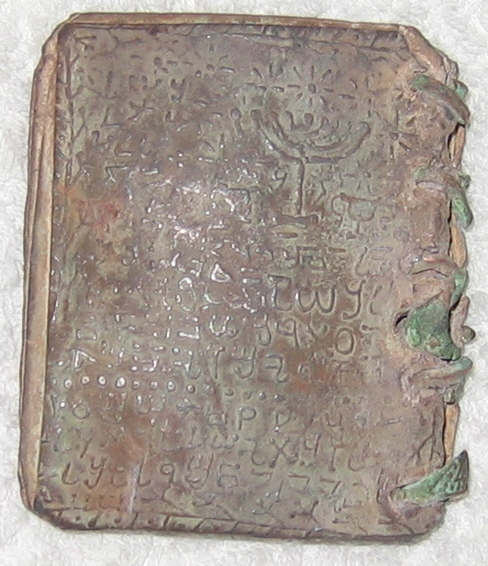
UPDATE ON THE INSCRIBED METAL PLATES: Reader Justin Kerk has referred me to a 2007 discussion on the Unicode mailing list of "Menorah- and Hebrew-inscribed lead plates of dubious provenance." These may be the plates currently in the news.
The Unicode list posts are here and here. There are two images, which can be downloaded here and here. Neither are particularly clear, although many letters and much of the decoration are visible. The text is written in the paleo-Hebrew script. The article linked to in this post has a photo of one codex of the newly reported metal plates, but it is terrible; I can't read any of the script or see any of the inscribed decorations clearly. Also, the binding is not visible. Nevertheless, it seems likely enough that the Unicode plates are from the same corpus.
We need the following for this supposed find to be shown to be a genuine collection of ancient books:
1. Publication in a scholarly journal of the metal analysis that shows the lead to be ancient.
2. Publication in a scholarly journal of the carbon-14 tests that show the associated leather to be ancient and of a comparable date to the lead.
Even if the antiquity of the materials is demonstrated, this proves nothing, since ancient materials are sometimes available on which to write fake inscriptions.
3. Publication of the location and details of the supposed discovery and analysis of the site by archaeologists.
4. Analysis of the patina of the script which demonstrates the writing to be ancient. If it is modern and unretouched, this will be obvious. If it has been retouched to seem ancient, this may or may not be detectable (see the controversy over the patina of the James Ossuary and the Jehoash inscription).
5. Full publication of all the texts with good photographs.
6. Analysis of the script by paleographers.
7. If things still look promising at this point, it will become worthwhile for philologists to take an interest and start trying to decipher the texts. So far, epigrapher Andre Lemaire has seen some of them and does not consider them genuine.
Inevitably, people will be now trying their hand at what is readable in the current photographs (if we assume they are from the same corpus). I don't have time to bother with this right now, but I would be interested in hearing what others come up with.
8. Analysis of the decorations by specialists in ancient iconography.
9. Publication of all of the above in peer-review journals and monographs.
There's probably more, but this is what I can think of off the top of my head.
So ... don't hold your breath; this will take some time. I repeat, I am very skeptical, but I would love to be proved wrong.
Additional background here (immediately preceding post).
UPDATE: Press release here.
The Unicode list posts are here and here. There are two images, which can be downloaded here and here. Neither are particularly clear, although many letters and much of the decoration are visible. The text is written in the paleo-Hebrew script. The article linked to in this post has a photo of one codex of the newly reported metal plates, but it is terrible; I can't read any of the script or see any of the inscribed decorations clearly. Also, the binding is not visible. Nevertheless, it seems likely enough that the Unicode plates are from the same corpus.

We need the following for this supposed find to be shown to be a genuine collection of ancient books:
1. Publication in a scholarly journal of the metal analysis that shows the lead to be ancient.
2. Publication in a scholarly journal of the carbon-14 tests that show the associated leather to be ancient and of a comparable date to the lead.
Even if the antiquity of the materials is demonstrated, this proves nothing, since ancient materials are sometimes available on which to write fake inscriptions.
3. Publication of the location and details of the supposed discovery and analysis of the site by archaeologists.
4. Analysis of the patina of the script which demonstrates the writing to be ancient. If it is modern and unretouched, this will be obvious. If it has been retouched to seem ancient, this may or may not be detectable (see the controversy over the patina of the James Ossuary and the Jehoash inscription).
5. Full publication of all the texts with good photographs.
6. Analysis of the script by paleographers.
7. If things still look promising at this point, it will become worthwhile for philologists to take an interest and start trying to decipher the texts. So far, epigrapher Andre Lemaire has seen some of them and does not consider them genuine.
Inevitably, people will be now trying their hand at what is readable in the current photographs (if we assume they are from the same corpus). I don't have time to bother with this right now, but I would be interested in hearing what others come up with.
8. Analysis of the decorations by specialists in ancient iconography.
9. Publication of all of the above in peer-review journals and monographs.
There's probably more, but this is what I can think of off the top of my head.
So ... don't hold your breath; this will take some time. I repeat, I am very skeptical, but I would love to be proved wrong.
Additional background here (immediately preceding post).
UPDATE: Press release here.
Monday, March 21, 2011
More on that cache of metal books
MORE ON THAT CACHE OF METAL BOOKS
The Daily Mail has picked up the story from Sunday's London Times:
The passage referred to in the "Apocryphal Book of Ezra" is 4 Ezra 14:38-48:
Background here, with what is probably a better description of the apparent contents of the plates.
UPDATE (22 March): More here (next post).
The Daily Mail has picked up the story from Sunday's London Times:
Are lead tablets discovered in a remote cave in Jordan the secret writings about the last years of Jesus?I saw the Times article in hard copy (it's behind a subscription wall online), but recycled the paper and don't have it now. Still, I'm sure it didn't say anything about the plates holding any "contemporary account of the last years of Jesus." This must be some silly misunderstanding by the Mail reporter. Otherwise, the piece looks like a reasonably faithful summary of the Times article.
By Daily Mail Reporter
Last updated at 3:54 PM on 21st March 2011
Artefacts discovered in a remote cave in Jordan could hold a contemporary account of the last years of Jesus.
The find of scrolls and 70 lead codices - tiny credit-card-sized volumes containing ancient Hebrew script talking of the Messiah and the Resurrection - has excited biblical scholars.
Much of the writing is in code, but experts have deciphered images, symbols and a few words and the texts could be 2,000 years old.
Some academics are sceptical about the discovery because there have been numerous hoaxes and sophisticated fakes produced over the years.
Many of the codices are sealed which suggests that they could be secret writings referred to in the apocryphal Book of Ezra - an appendage to some versions of the Bible.
Texts have been written on little sheets of lead bound together with wire.
The treasure trove was found five years ago by an Israeli Bedouin and may have been around since the 1st century, around the time of Jesus's crucifixion and Resurrection.
[...]
The passage referred to in the "Apocryphal Book of Ezra" is 4 Ezra 14:38-48:
[38] And on the next day, behold, a voice called me, saying, "Ezra, open your mouth and drink what I give you to drink."I'm not going to get excited about this supposed discovery until the texts have undergone and passed multiple authentication tests which have been published in peer-reviewed venues. Meanwhile, if the owners are serious about convincing scholars of their authenticity, let them post good photographs of all the plates online.
[39] Then I opened my mouth, and behold, a full cup was offered to me; it was full of something like water, but its color was like fire.
[40] And I took it and drank; and when I had drunk it, my heart poured forth understanding, and wisdom increased in my breast, for my spirit retained its memory;
[41] and my mouth was opened, and was no longer closed.
[42] And the Most High gave understanding to the five men, and by turns they wrote what was dictated, in characters which they did not know. They sat forty days, and wrote during the daytime, and ate their bread at night.
[43] As for me, I spoke in the daytime and was not silent at night.
[44] So during the forty days ninety-four books were written.
[45] And when the forty days were ended, the Most High spoke to me, saying, "Make public the twenty-four books that you wrote first and let the worthy and the unworthy read them;
[46] but keep the seventy that were written last, in order to give them to the wise among your people.
[47] For in them is the spring of understanding, the fountain of wisdom, and the river of knowledge."
[48] And I did so. (RSV)
Background here, with what is probably a better description of the apparent contents of the plates.
UPDATE (22 March): More here (next post).
News on Golb appeal
ROBERT CARGILL has news and commentary on Raphael Golb's appeal in the Dead Sea Scrolls identity-theft case. And Raphael Golb has posted the text of the appeal brief here.
Background here and here.
Background here and here.
JHS article: Bachmann, “The Book of The Watchers ..."
THE JOURNAL OF HEBREW SCRIPTURES has published a new article:
Veronika Bachmann, “The Book of The Watchers (1 Enoch 1-36): An Anti-Mosaic, Non-Mosaic, or Even Pro-Mosaic Writing?"To download the article directly as a PDF file, click here.
Abstract:
The Book of the Watchers (BW) is generally considered a non-Mosaic if not an anti-Mosaic writing. In more recent research, discussions on the meaning of such labels are ever so prevalent. Nevertheless, the positions do not move far beyond the common patterns of interpretation. The present paper explores the different presuppositions and arguments supporting the assumption of the non- or even anti-Mosaic character of the BW and proposes a reading beyond the antagonism “Enochic” versus “Mosaic.”
Sunday, March 20, 2011
Is there a link between indie music and Gnosticism?
ASKING THE IMPORTANT QUESTIONS: Is there a link between indie music and Gnosticism?
Wendy Fonarow, the Guardian's indie professor:
Wendy Fonarow, the Guardian's indie professor:
A single correspondence doesn't seem to be enough to suggest a generative theory. However, there could be something to the idea that the valorisation of esoteric knowledge could explain members of the indie community who pride themselves on knowing every chillwave release. So, perhaps Gnosticism is a sect of indie.Perhaps.
Oxyrhynchus papyri at About.com Ancient History
THE OXYRHYNCHUS PAPYRI are discussed in an About.com Ancient/Classical History blog post:
Via N.S. Gill, Oxyrhynchus and Lost Early Christian Documents.
Background here and (e.g.) here (follow the links).
Little-Known Artifacts Shed Light on Early ChristianityNothing new, but a convenient capsule summary of some recent material on the subject.
Oxyrhynchus Papyri Are Considered Top Early Christian Find
By Cynthia Astle, About.com Contributing Writer
Via N.S. Gill, Oxyrhynchus and Lost Early Christian Documents.
Background here and (e.g.) here (follow the links).
Iraq's Christians Want a Province of Their Own
CHALDO-ASSYRIAN/SYRIAC WATCH:
Iraq's Christians Want a Province of Their Own
Posted GMT 3-18-2011 3:1:7 (AINA)
For the first time ever, Christian leaders have formally demanded the creation of a province in the Ninawa Plain, east of Mosul.
No one can predict whether their demand will be met.
Some people are in favour, because it will encourage Christians to stay in the country, while others say that creating such a province will only isolate Christians from other Iraqis.
The demand came three weeks after the bloody attack on the "Our Lady of Deliverance" Church in Baghdad on 31 October 2010.
[...]
The Ninawa Plain, with an area of more than five thousand square kilometers, equal to both the regions of al-Muthanna and al-Qadisiyah in southern Iraq, is inhibited by more than half a million people.
The area consists of three districts: al-Hamdaniya, Sheekhan and Tallkeef. It is inhibited by a Christian majority, but there are also other ethnicities and followers of other religions such as the Yazidis, the Shabak and some Shiites, Turkmen and Arabs.
Christians living in this region speak the Syriac language. After 2003, the Iraqi government allowed the use of this language in most of the region's schools.
Christian parties and organisations have held two meetings: one in the city of Erbil in November 2010, and the second in the capital, Baghdad in January 2011.
The outcome was a memorandum to the presidencies of the republic, the parliament and the council of ministers, demanding the creation of a province for "Chaldo-Assyrian Syriac people" in the Ninawa Plain, and the establishment of autonomous rule for Christians in areas where they constitute a majority in the Kurdistan region of Iraq.
[...]
Saturday, March 19, 2011
EP report and the Mor Gabriel Monastery
MOR GABRIEL MONASTERY UPDATE: Hurriyet Daily News reports that the most recent European Parliament report on Turkey takes the Turkish Government to task for its treatment of this Syriac monastery:
Background here.
The 25th paragraph of the report reads that the EP “finds the Turkish Supreme Court [of Appeals] decision against Mor Gabriel Monastery, concerning a land dispute with villages and the Turkish Treasury, to be regrettable.”If Turkey is serious about wanting full membership in the EU, it needs to watch this sort of thing.
Background here.
BMCR Review: Bar-Kochva, The Image of the Jews in Greek Literature
BMCR REVIEW:
Bezalel Bar-Kochva, The Image of the Jews in Greek Literature: The Hellenistic Period. Hellenistic Culture and Society 51. Berkeley/Los Angeles/London: University of California Press, 2010. Pp. xiv, 606. ISBN 9780520253360. $95.00.UPDATE (10 July): More here.
Reviewed by Jed Wyrick, California State University, Chico (jwyrick@csuchico.edu)
Preview
This volume treats surviving passages about Jews written from 333 B.C.E. - 63 B.C.E. by Gentile Greek authors. It provides remarkable depth to materials that, as a result of the format of previous commentaries and compendia, are often read as discrete, de-contextualized artifacts. It also challenges the prevailing scholarly narrative about these passages, claiming that there was little early admiration of the Jews and no steady increase in its opposite in response to historical events.
One of this work’s virtues, its insistence that “no reference to the Jews in Hellenistic literature should be interpreted in isolation from its context” (p. 146), is closely tied to its principal flaw: its overconfident historical reconstruction of the context of each passage and frequent recourse to an argumentum ex silentio. The work also over-utilizes source criticism as a means to resolve difficulties in each passage rather than making reasonable efforts to consider these difficulties as the result of attempts by ancient historians and ethnographers to reconcile their esteemed sources with new information.
[...]
Friday, March 18, 2011
Arab protests over Jerusalem to be taken to The Hague?
TEMPLE MOUNT WATCH (ETC.): Arab protests over Jerusalem to be taken to The Hague?
Experts prepare to take Jerusalem case to The HagueThe City of David Project seems particularly to be at issue. The claims that Israelis are excavating under the Al Aqsa Mosque keep being repeated, but I have never seen them substantiated. See, for example, here. While, on the contrary, the Waqf's illicit digging on the Temple Mount is well established. See, for example, here.
By Taylor Luck (Jordan Times)
AMMAN - Arab experts on Wednesday took the first steps towards taking international legal action against Israel for ongoing excavations near the old city of Jerusalem.
[...]
Losing the "Lost Town"?
LOSING THE 'LOST TOWN'
A plan to build a vacation village on part of an archaeological site in the Negev has locals up in arms.
By Ran Shapira (Haaretz)
Excerpt:
A plan to build a vacation village on part of an archaeological site in the Negev has locals up in arms.
By Ran Shapira (Haaretz)
Excerpt:
Yehuda D. Nevo, an archaeologist from Midreshet Sde Boker who excavated the site in the 1980s, found dozens of structures made of local stone in the streambed. His findings indicate the settlement dates back to the late Byzantine period (the 6th century, C.E. ), and was populated by Arab nomads. In contrast to the surrounding society, which became Christian between the 4th and 6th centuries C.E., he believed the inhabitants here remained pagans, before converting in the 7th century to Islam.But the developers promise to preserve the ancient architecture.
Nevo, who died in 1994, attributed ritual significance to the site, but the Israel Antiquities Authority rejects his interpretation. "This was a Muslim farming settlement from the 7th and 8th centuries C.E.," says Yoram Haimi, the organization's archaeologist for the southern district.
New book: The RIng of Solomon
SOLOMON THE MAGICIAN and the Queen of Sheba figure in the new novel The Ring of Solomon by Bartimaeus.
Review of Soskice, The Sisters of Sinai
THE SISTERS OF SINAI by Janet Soskice, is reviewed by Rebecca Cook in Islands Weekly.com.
Haven't heard much about this book for a while. For more reviews go here and follow the links.
Haven't heard much about this book for a while. For more reviews go here and follow the links.
Harrak, Syriac and Garshuni Inscriptions of Iraq
NEW BOOK:
RECUEIL DES INSCRIPTIONS SYRIAQUES NOUVEAUTEOn the Hugoye list Françoise Briquel-Chatonnet posts an English translation of the description.
2 - Syriac and Garshuni Inscriptions of Iraq by HARRAK (A.). 2 vol. (17.5 x 23) : Texte de 735 p., album de 279 pl. photo., 2010, (2060 g) 150 Euros
BMCR Review: Kraft, Exploring the Scripturesque
BMCR BOOK REVIEW:
Robert A. Kraft, Exploring the Scripturesque: Jewish Texts and Their Christian Contexts. Supplements to the Journal for the Study of Judaism, 137. Leiden/Boston: Brill, 2009. Pp. ix, 313. ISBN $147.00. $9789004170100.
Reviewed by David Lincicum, Mansfield College, University of Oxford (david.lincicum@theology.ox.ac.uk)
Preview
Electronic versions of these essays available on Kraft’s homepage.
In this collection of previously published essays, Kraft presents a series of his most significant contributions to the methodological problems and possibilities of investigating Jewish texts that were transmitted, preserved, read and sometimes interpolated by Christian tradents. Part One examines ‘general context and methodology’ in five essays; the remainder of the book is devoted to specific studies of some texts from the so-called ‘pseudepigrapha’ (though Kraft wants to dispute the usefulness of the term), as well as particular problems in the Dialogue of Timothy and Aquila, Pliny the Elder, Philo of Alexandria and Flavius Josephus.
[...]
Thursday, March 17, 2011
Online Resources For Biblical Studies
JAMES MCGRATH lists some Online Resources For Biblical Studies, most of which I have not yet noted here.
Dead Sea Scrolls and Early Judaism Summer course at UCLA
ROBERT CARGILL is offering a UCLA Summer 2011 Course: Dead Sea Scrolls and Early Judaism.
Dura-Europos: Crossroads of Antiquity
THE DURA-EUROPOS: CROSSROADS OF ANTIQUITY exhibition at the McMullen Museum of Art at Boston College has an article devoted to it in Past Horizons: Adventures in Archaeology.
Background here. More on Dura Europos here.
Background here. More on Dura Europos here.
Wednesday, March 16, 2011
James of Edessa on the Old Testament Apocrypha
APOCRYPHA WATCH: Roger Pearse has a quotation from James of Edessa on the Old Testament Apocrypha.
More obituaries for Donny George
MORE OBITUARIES FOR DONNY GEORGE:
AFP: Donny George: Iraqi who fought to recover antiquities.Earlier obituaries/notices here and here.
The Telegraph: Donny George
Donny George, who died on March 11 aged 60, was an Iraqi archaeologist who, following the 2003 invasion, fought a brave battle to prevent looters ransacking the Iraq National Museum in Baghdad, then led efforts to recover thousands of stolen artefacts.
Libya's Cultural Gems in Danger
PHOENICIAN/PUNIC WATCH: Libya's Cultural Gems in Danger (Tourism-Review.com).
It started with Tunisia and spread all across the region. Overthrowing dictators seems to be on the agenda, and while civilians fight for their freedom, the cultural treasures of their countries are in danger.
Tuesday, March 15, 2011
Jeff W. Childers visits St. Catherine's Monastery
JEFF W. CHILDERS blogs an account of his visit to St. Catherine's Monastery in the Sinai to study Syriac manuscripts of Chrysostom's biblical commentaries: Out of Egypt.
(Via Tommy Wasserman at the Evangelical Textual Criticism blog.)
Some background on St. Catherine's can be found here and here.
(Via Tommy Wasserman at the Evangelical Textual Criticism blog.)
Some background on St. Catherine's can be found here and here.
NYT obituary for Donny George
AN OBITUARY FOR DONNY GEORGE in the NYT: Donny George, Protector of Iraq’s Ancient Riches, Dies at 60.
New book in Mandarin on ancient Jewish coins
A CHINESE CHEF has published a new book on ancient Jewish coins in Mandarin:
Chinese chef’s main course: Ancient Jewish coins
By SHULA KOPF (Jerusalem Post)
03/14/2011 22:24
Xu Long, head chef at Beijing’s Great Hall of the People, has literally written the book on Israeli coins.
One of the most passionate collectors of Israeli coins is the head chef in Beijing’s Great Hall of the People. When Xu Long isn’t cooking Peking duck for visiting heads of state, he devotes his time to researching the history of Jewish coins.
It took him 10 years of painstaking study, but last November Xu Long published a 575-page hard-back on the subject, Money of Ancient Judea and Israel.
Ironically, his book, which is in Mandarin, is one of the most wide-ranging on the subject in any language.
“His book starts with the first coins ever minted in Judea during the Persian period in the fourth century BCE and goes up to the Jerusalem of Gold 24-carat bullion coin launched last year by the Bank of Israel,” says Arthur Boxer, CEO of the Israel Coins and Medals Corporation (ICMC). “He explains the story behind each coin.”
[...]
A seismograph for ancient earthquakes
TECHNOLOGY WATCH: A seismograph for ancient earthquakes (Science Blog).
Prof. Shmuel Marco of Tel Aviv University’s Department of Geophysics and Planetary Sciences in the Raymond and Beverly Sackler Faculty of Exact Sciences and his colleagues have invented a new tool which he describes as a “fossil seismograph,” to help geophysicists and other researchers understand patterns of seismic activity in the past.
Inspired by a strange “wave” phenomenon he studied in disturbed sediment in the Dead Sea region, Prof. Marco says the new tool, developed with input from geologists and physicists, is relevant to areas where earthquakes affect bodies of water, like the West Coast of the United States. It also can help engineers understand what’s at risk when they plan new hydroelectric power plants. The new research was published in the journal Geology.
Kumran?
A TRAVEL PIECE ON QUMRAN is the first installment of a new column in the Jerusalem Post by Wayne Stiles. The column is standard media Qumran fare: substantially accurate but exaggerates the support for the Massoretic Text among the biblical Dead Sea Scrolls. But it's odd that a Jerusalem Post columnist thinks the English spelling of the site is "Kumran."
Monday, March 14, 2011
Old but interesting articles from AJBA
ROB BRADSHAW'S BIBLICAL ARCHAEOLOGY BLOG has been providing numerous links to pdf files of interesting articles from the Australian Journal of Biblical Archaeology from the late 60s and early 70s.
"Lost" Kuntillet Ajrud inscriptions found?
THAT "LOST" INSCRIPTION from Kuntillet Ajrud may not be lost any longer. Hershel Shanks discusses the Kuntillet Ajrud finds in the article "Another unexpected surprise from the Egyptian revolution" in the Jerusalem Post. It seems that they were among the Sinai artifacts turned over by the Israelis to the Egyptian Government in the 1979 peace agreement. Hershel reports:
Then on March 3, the Egyptian press reported that 30 truckloads of antiquities had been moved for safekeeping from the Qantara storage facilities to the Egyptian Museum in Cairo. Included were “Sinai artifacts that were retrieved from Israel following the signing of the Egypt-Israel peace treaty.”It is an inference that the Kuntillet Ajrud inscriptions are among these 30 truckloads of antiquities, but a reasonable one. I hope that they turn up and prove to be undamaged. And that they really are published this year.
So we now know where they are. Whether they will ever be exhibited in Egypt is another question. (Wouldn’t it be nice if they were lent for exhibition to an Israeli museum?) And what steps, if any, are being taken to conserve these fragile, faint and delicate drawings and inscriptions?
Sunday, March 13, 2011
Review of Halperin, Journal of a UFO Investigator
JOURNAL OF A UFO INVESTIGATOR, by David Halperin, is reviewed by Bill Eichenberger in the Pittsburgh Post Gazette. Excerpt:
To enjoy "Journal of a UFO Investigator" one must not only suspend disbelief; it helps to be open to the question: What is reality? Mr. Halperin's novel is as much a philosophic treatise as it is a voyage through fantastical worlds.Earlier reviews etc. here.
New book: Jesus and the Jewish Roots of the Eucharist
BRANT PITRE, author of the new book Jesus and the Jewish Roots of the Eucharist: Unlocking the Secrets of the Last Supper, is interviewed by the Catholic News Agency: New book connects the Eucharist with its Jewish roots.
Saturday, March 12, 2011
Metatron is Carlos Santana's guardian angel
ARCHANGEL METATRON WATCH: Metatron is Carlos Santana's guardian angel:
He laughs with a hearty chuckle when I suggest some of his ideas sound hopelessly flaky and he's a good sport when I ask him to tell me about his guardian angel, who goes by the excellent name of Metatron.(Grant Smithies, Stuff.co.nz)
"I think everyone on this planet has many voices inside their heads. Most of these voices scream at you and tell you you're a liar and full of shit and you'll never amount to anything, but behind all that there's always one voice that reminds you that you are significant and meaningful and worthy of love.
"Some people think I am crazy but I don't think this is strange. Policemen have their own patron saint, St Michael, to protect them. The healing angel is Raphael, and travellers have St Christopher. Everyone has something they believe. Some people believe in Mickey Mouse or Santa Clause but I believe in Metatron, along with Miles Davis, John Coltrane and Bob Marley. It's not a problem, man."
Friday, March 11, 2011
Edward Ullendorf, R.I.P.
EDWARD ULLENDORFF, R.I.P.
Edward {Ullendorff} Professor Emeritus of Semitic Languages and of Ethiopian Studies, SOAS, London University; Fellow of the British Academy and Foreign Fellow of the Accademia dei Lincei, Rome. Hon Fellow, SOAS; Hon Fellow, OCHJS. He died peacefully on 6th March 2011, much loved and loving husband of Dina for 67 years. Funeral private; no letters, no flowers, please, but donations if wished to the Oxford Centre for Hebrew Studies, Yarnton Manor, Oxford OX5 1PY. A Memorial Service to be announced later.Before going to SOAS, Professor Ullendorff was Reader in Semitic Languages at the University of St. Andrews. (There's more information on his career at his Wikipedia page here.) I met him once, briefly, I think at a Dead Sea Scrolls conference at Oxford in 1997. I remember we talked about A. M. Honeyman, another of my predecessors at St. Andrews.
Published in The Times on March 10, 2011
More on the Son of Man
MORE ON THE SON OF MAN: Larry Hurtado has a guest post from Dr. Paul Owen, the co-editor of Who is This Son of Man? (noted here). Owen's position sounds closer to mine than Hurtado's does. I have commented on Maurice Casey's use of Aramaic to reconstruct Gospel traditions here.
NPR on Knust, Unprotected Texts
NPR interviews Jennifer Wright Knust on her new book, Unprotected Texts: The Bible's Surprising Contradictions About Sex and Desire, and gives some excerpts from the book.
A recent book on the same topic by Michael David Coogan has been noted here and here.
A recent book on the same topic by Michael David Coogan has been noted here and here.
Hebrew at Sheffield language festival
LANGUAGE FESTIVAL:
Speaking up for Hebrew at language festivalThis is weird:
By Jessica Elgot, March 10, 2011 (The Jewish Chronicle)
Hebrew will be a prominent part of the UK's biggest language festival, starting today at Sheffield University.
Biblical Hebrew, Hebrew script and modern Ivrit are on offer for 40-minute sessions as part of 150 languages and dialects from Esperanto to Braille.
Jasmine Woods will teach ancient Hebrew and Israeli Yael Benn, 37, a psychology researcher at the university, will teach modern Hebrew and script.
[...]
Despite the presence of many Arabic dialects, including Palestinian, Hebrew has been classified as a "European" language by the festival's organisers.Yiddish will not be represented. No word on Aramaic.
HB/OT lectureship at Nottingham
JOB: Lecturer in Hebrew Bible/Old Testament at Nottingham University.
(Via the BNTS list.)
Applications are especially welcome from those whose interests lie in literary or theological approaches to the texts, or from those whose research is in the area of the Hebrew Bible and Second Temple Judaism.Closing date 4 April. Follow the link for additional details.
The successful candidate will be responsible for teaching Hebrew and Biblical Studies modules in Hebrew Bible/Old Testament, supervising postgraduate research and contributing to departmental administration.
Candidates will possess a PhD in the area of Hebrew Bible/Old Testament and will be able to demonstrate a good research record and potential in Hebrew Bible or Old Testament.
Informal enquiries may be addressed to Dr Karen Kilby, Head of Department, tel: +44 (0)115 951 5851 or email: karen.kilby@nottingham.ac.uk. Please note that applications sent directly to this email address will not be accepted.
(Via the BNTS list.)
Apocalyptic Science?
APOCALYPTIC SCIENCE? Seth Sanders has a post up at Serving the Word about next month's Conference on Ancient Jewish Sciences and the History of Knowledge.
Thursday, March 10, 2011
Sean W. Dever Memorial Prize 2011
SEAN W. DEVER MEMORIAL PRIZE 2011:
The William F. Albright Institute of Archaeological Research in Jerusalem is pleased to announce the winner of the tenth annual competition for the Sean W. Dever Memorial Prize. This award offers $650 for the best published article or paper presented at a conference by a Ph.D. candidate in Syro-Palestinian or Biblical Archaeology. Authors may be of any nationality but the article or paper must be in English.
This year’s winner is Helen R. Jacobus of the University of Manchester. Her paper is titled “4Q318: A Jewish Zodiac Calendar at Qumran.” It was presented, with a slightly different title, at a conference on the Dead Sea Scrolls at the University of Birmingham in 2007. It has since been published in The Dead Sea Scrolls: Texts and Contexts, ed. C. Hempel (Studies on the Texts of the Desert of Judah 90; Leiden: Brill, 2010), pp. 365-95.
The Sean W. Dever Prize was established in 2001 by Mrs. Norma Dever and Professor William G. Dever, in memory of their son Sean. This year, 2011, is the tenth anniversary of Sean’s passing.
(This is an e-mail by Beth Alpert Nakhai sent to the Agade list. A list of the recipients of the prize is here.)
Congratulations to Helen R. Jacobus.
The William F. Albright Institute of Archaeological Research in Jerusalem is pleased to announce the winner of the tenth annual competition for the Sean W. Dever Memorial Prize. This award offers $650 for the best published article or paper presented at a conference by a Ph.D. candidate in Syro-Palestinian or Biblical Archaeology. Authors may be of any nationality but the article or paper must be in English.
This year’s winner is Helen R. Jacobus of the University of Manchester. Her paper is titled “4Q318: A Jewish Zodiac Calendar at Qumran.” It was presented, with a slightly different title, at a conference on the Dead Sea Scrolls at the University of Birmingham in 2007. It has since been published in The Dead Sea Scrolls: Texts and Contexts, ed. C. Hempel (Studies on the Texts of the Desert of Judah 90; Leiden: Brill, 2010), pp. 365-95.
The Sean W. Dever Prize was established in 2001 by Mrs. Norma Dever and Professor William G. Dever, in memory of their son Sean. This year, 2011, is the tenth anniversary of Sean’s passing.
(This is an e-mail by Beth Alpert Nakhai sent to the Agade list. A list of the recipients of the prize is here.)
Congratulations to Helen R. Jacobus.
New book: Who is This Son of Man?
NEW BOOK: Who is This Son of Man?, noted by Larry Hurtado.
UPDATE: More from Larry: “The Son of Man”: Some Linguistic Observations.
I agree with his conclusions, although I would not rule out a direct connection with Daniel 7:13-14 in the mind of Jesus.
Another recent PaleoJudaica post involving Jesus and the Son of Man is here.
UPDATE (11 March): More here.
UPDATE (15 March): More here.
UPDATE: More from Larry: “The Son of Man”: Some Linguistic Observations.
I agree with his conclusions, although I would not rule out a direct connection with Daniel 7:13-14 in the mind of Jesus.
Another recent PaleoJudaica post involving Jesus and the Son of Man is here.
UPDATE (11 March): More here.
UPDATE (15 March): More here.
Wednesday, March 09, 2011
The 1 Enoch MS at the Remnant Trust
THE MANUSCRIPT OF 1 ENOCH held at the Remnant Trust is back in the news:
Winona Lake group collects historical documents public can touchThe interview seems to have suffered some garbling here. This is one of the oldest manuscripts of 1 Enoch, but there are others, some complete and some not. I don't know anything about the manuscript at Lake Tana. For earlier coverage of this story with more information and some comments by James VanderKam, go here.
March 06, 2011|By Kristin Bien (kbien@wsbt.com)
WINONA LAKE —
If you think rare books and ancient manuscripts are confined to museums, vaults and hollywood movies, you're mistaken. The Remnant Trust in Winona Lake has a growing collection of rare books and historical artifacts.
"We have cool stuff. We have cool books. We have stuff that nobody else has," says Kris Bex, The Remnant Trust president.
[...]
One of the Trust's rarest documents is a hand-written book from the mid-1400s.
"This is the Book of Enoch, which is one the lost books of the Bible," says Bex as he opens the book, "this is a manuscript in its original form. It is in a dialect of Ethiopian. And the only other complete manuscript of the Book of Enoch is in a temple on the island of Lake Tana in Ethiopia and there is only one monk who is allowed to even go in and see it."
[...]
Dura Europos and chemical warfare
DURA EUROPOS AND CHEMICAL WARFARE: This is an old story (noted by PaleoJudaica here a couple of years ago), but a new article by Simon James in the current issue of the American Journal of Archaeology has brought it back to the media's attention (e.g., here). The article:
Stratagems, Combat, and "Chemical Warfare" in the Siege Mines of Dura-EuroposMuch more on Dura Europos here and follow the links.
Simon James
Download PDF
The Sasanian Persian siege that destroyed Roman-held Dura-Europos, Syria, ca. 256 C.E. left some of the best evidence ever recovered for the nature and practices of ancient warfare. Perhaps the most dramatic of the archaeological deposits, excavated in the early 1930s, were those resulting from the mining duel around Tower 19 on the city’s western wall, during which at least 19 Roman soldiers and one Sasanian became entombed. Recent reanalysis of the excavation archive suggested that the mine evidence still held one unrecognized deadly secret: the Roman soldiers who perished there had not, as Robert du Mesnil du Buisson (the original excavator) believed, died by the sword or by fire but had been deliberately gassed by the Sasanian attackers. This article discusses the implications of this conclusion for our understanding of early Sasanian military capabilities and reviews the question of possible reexcavation in search of the casualties of Tower 19, whose remains were neither studied nor retained.
Scanning antiquity underfoot
TECHNOLOGY WATCH: Scanning antiquity underfoot (ScienceBlog). New technology to discover archaeological sites in Israel and elsewhere:
Reported recently in the journal Advances of Geosciences, Prof. Eppelbaum’s new tool gathers data from a number of sources — including radio transmitters used to communicate with nuclear submarines and detailed magnetic field observations — and applies an original algorithmic approach to the measurements to make sense of what lies below the earth’s surface at depths of up to several dozen yards. His tool can help people “see” meaningful objects, artefacts or civilizations — – and lay them out in a four-dimensional chart.
Completion of the Steinsaltz Talmud
THE COMPLETION OF THE STEINSALTZ TALMUD is covered with detailed background in The Forward: Man of the People of the Book: After 45 Years, Adin Steinsaltz Has Completed His Talmud Translation.
Excerpt:
Excerpt:
Reflecting on the past five decades, he said that one of the biggest challenges has been responding to the changing needs of those who study Talmud and coming up with a translation and commentary that satisfy the modern, curious mind. “The Talmud mentions a name or an object — what is it? This question possibly for my great-grandfather wasn’t a problem — It was a vessel or it was a tree or it was an animal, and that was enough. In our times, you won’t be pleased if you are only told it’s an animal.” Providing this kind of information took him to some pretty unlikely places for a Talmudist, including a long conversation he recalled with a top Israeli expert on fowl.Background here.
His second challenge, in the course of opening up the Talmud to the uninitiated, was to explain the various expressions that form the basis of Talmudic logic. In the past, commentators assumed that people had learned at heder the hermeneutical rules around which the text is structured. Today, one cannot assume, for example, that kal v’chomer, a rabbinic rule for drawing an inference from one case to another, is a meaningful concept to a Jewish reader of the Talmud.
A third challenge for Steinsaltz was to confront some of the ethical questions regarding the Talmud and its style that are specific to modern readers. One arises from the fact that the Talmud constantly tries to harmonize apparently divergent scholarly opinions. “Is this harmonization fair? That you push two people together when they are really not in agreement? It would be much easier to say, ‘Okay, they have two different opinions and let them go as they are.’ All the Talmud is a big attempt at harmonizing. So this is a question that possibly my great-grandfather didn’t ever think about.”
Tuesday, March 08, 2011
A tribute to Anson Rainey by Bill Schniedewind
A TRIBUTE TO ANSON RAINEY by Bill Schniedewind has been published an the SBL site: A Personal Reflection on the Life and Work of Anson F. Rainey (January 11, 1930–February 19, 2011). Bill reports that he is completing Professor Rainey's new edition of the Amarna letters, which is exciting news.
Via Bob Cargill at XKV8R.
More tributes to Anson Rainey here.
Via Bob Cargill at XKV8R.
More tributes to Anson Rainey here.
Historical marvels at Tel Dan
HISTORICAL MARVELS AT TEL DAN are noted briefly by Wayne Stiles in the Jerusalem Post. The ninth-century Aramaic Tell Dan inscription, which mentions "the house of David," gets star billing.
Aramaic or Assyrian Ikea instructions?
ARAMAIC OR ASSYRIAN IKEA INSTRUCTIONS? The final paragraph of this Guardian article:
UPDATE: Dorothy King e-mails to solve the mystery, which only arose from my careless reading of the article. An earlier paragraph in the article says:
British Museum buys Assyrian treasures cleaned by Agatha Christiesays the following:
The crime writer used face cream to restore the ivories discovered in the city of Nimrud by her archaeologist husband
Scholars are itching to get their hands on the ivories after the exhibition. Some of the pieces have notes on the back in ancient Aramaic, which appear to be the Ikea flatpack instructions of almost 3,000 years ago on how to assemble the furniture.Why ancient Aramaic? That doesn't make any sense to me; Assyrians in Nimrud in the seventh century would be writing in Assyrian (Akkadian), not Aramaic. Can anyone confirm what language these assembly notes are in?
UPDATE: Dorothy King e-mails to solve the mystery, which only arose from my careless reading of the article. An earlier paragraph in the article says:
The collection comprises almost 1,000 numbered items, as well 5,000 fragments or unnumbered pieces. These carved ivories, dating from the 9th-7th centuries BC, were mostly made in Syrian and Phoenician cities near the Mediterranean coast and were brought to Assyria as loot.These ivories must have been from Syria, where the assembly instructions would have indeed been in Aramaic.
Monday, March 07, 2011
Mughrabi Gate ramp renovations
TEMPLE MOUNT WATCH: Israel plans work at contested Jerusalem holy site. The site is the Mughrabi (Mugrabi) Gate ramp. Background here.
Did 'mummy's curse' kill Egyptian looters?
WORKS FOR ME: Did 'mummy's curse' kill Egyptian looters?
I'd like more verification before I actually believe this story, but it was too good not to note.
I'd like more verification before I actually believe this story, but it was too good not to note.
When Buffy met biblical studies
TWO OF MY FAVORITE THINGS: When 'Buffy' Met Biblical Studies. The connections with biblical studies are pretty tenuous, but the author, Ronald Helfrich, seems to be advocating a more traditional text-based approach to academic Buffy studies. That sounds all right to me.
Lawrence Schiffman at YU
LAWRENCE SCHIFFMAN is now at Yeshiva University: New Vice Provost Schiffman Advances Undergraduate Synergy, Ideology.
(HT, Joseph Lauer.)
Background here.
(HT, Joseph Lauer.)
Background here.
Review of Rose Williams, A Beginning Latin Christian Reader
BMCR REVIEW:
Rose Williams, A Beginning Latin Christian Reader: de bonis cogitationibus. Mundelein, IL: Bolchazy-Carducci Publishers, Inc., 2010. Pp. iv, 79. ISBN 9780865167506. $15.00 (pb).
Reviewed by Michael Klaassen, St. Timothy’s Classical Academy (michael.klaassen@st-timothys.ca)
Preview
Rose William’s “A Beginning Latin Reader, De Bonis Cogitationibus” is a much-needed book and a welcome addition to the field of elementary Latin readers, where good, simplified versions of biblical texts are in short supply. This book will serve a niche market, of course – Christian and “classical” schools, as well as the home-school crowd, who want biblical and ethical readings to back up their elementary study of Latin. Williams has explicitly designed the book as a companion to Waldo Sweet’s Artes Latinae, and as such its approach is not one that will appeal to all teachers of the language, particularly those who use the grammar-translation method.
[...]
Sunday, March 06, 2011
Ed Cook on stative and progressive
ED COOK gives us one of his interesting (but alas infrequent) philological posts over at Ralph the Sacred River: "Loving This Book": Stative and Progressive.
Francesca Stavrakopoulou on Asherah etc.
FRANCESCA STAVRAKOPOULOU educates the Daily Mail about Asherah and the (now lost!) Kuntillet Ajrud inscription: Why the BBC's new face of religion believes God had a WIFE.
Nice pictures—both of Francesca and the drawings on the potsherd. For some reason, though, most of the inscription (upper left, where her thumb is) is missing. Steve Wiggins posts a drawing that includes it here.
UPDATE (14 March): Not "lost" after all? More here.
Nice pictures—both of Francesca and the drawings on the potsherd. For some reason, though, most of the inscription (upper left, where her thumb is) is missing. Steve Wiggins posts a drawing that includes it here.
UPDATE (14 March): Not "lost" after all? More here.
New JSIJ article on midrashic reconstructions
JSIJ - JEWISH STUDIES: AN INTERNET JOURNAL has published a new article: Arnon Atzmon, Reconstructing the Original Midrash Based on Rabbinic Parallels: A New Paradigm for an Old Problem (in Hebrew). Click on the link to download as a pdf file.
Abstract
Modern scholarly reconstructions of rabbinic texts have tended to avoid the use of higher critical methods, because they are based on the indirect evidence provided by parallels in rabbinical literature. Indeed, they seldom use these methods in combination with the lower critical method, which is based on the study of direct textual witnesses. Rather, scholars engaged in textual reconstruction have adopted the lower critical method almost exclusively as their primary tool, arguing that reference to parallels in rabbinic literature is a speculative and problematic methodology. In this paper, I support the use of higher criticism for reconstruction of the original versions of rabbinic texts by demonstrating its usefulness in this framework. I propose distinguishing between two paradigms of textual reconstruction based on higher critical methods by presenting the results of midrashic reconstructions.
Saturday, March 05, 2011
On Sidon's archaeological heritage
PHOENICIAN WATCH:
Sidon's rich archeological heritage has yet to be fully uncovered
By Mohammed Zaatari
Daily Star staff
Friday, March 04, 2011
SIDON: The southern coastal city of Sidon has many archeological sites that still await discovery, according to report prepared by a Lebanese archeological association.
The report, prepared by Dr. Sami Farhat, a member of the Lebanese Association for Heritage and Archeological Studies, revealed that besides the famous Phoenician Eshmoun temple which lies at the northern entrance of Sidon, a temple to the goddess Astarte is located in the southern part of the city.
[...]
Friday, March 04, 2011
Ancient Kabbalistic metal books? I doubt it.
COUNT ME SKEPTICAL:
As for this:
UPDATE (22 March): More here and here.
Heavy metal secrets from a Mid-East caveThe IAA and epigrapher Andre Lemaire regard them to be forgeries, and apparently crude ones at that. But sure, go ahead and do more tests on them. It can't hurt. And post good photos of them online so epigraphers and textual specialists can evaluate them freely. I would be happy to be wrong, but the case so far does not sound promising.
Israel’s archaeological establishment believes they are a fake. But could a collection of metal books be an early example of Kabbalah?
By Simon Rocker, March 3, 2011 (The Jewish Chronicle)
Robert Feather is out to prove the sceptics wrong. A metallurgist with a passion for archaeology, he has been asked to help authenticate what he believes could be one of the most exciting religious discoveries since the Dead Sea Scrolls.
The West London Synagogue member has previously published a book on the Copper Scroll, the Dead Sea Scroll thought to hold clues about the location of buried Temple treasure.Now he is trying to establish the origins of a mysterious cache of metal books which could be linked to the Kabbalah.
The objects belong to Hassan Saeda, a Bedouin farmer in Galilee who says they have been in his family's possession since his great-grandfather found them in a cave in Jordan, a century ago.
His collection consists of more than 20 codices (early books), cast mostly in lead and containing cryptic messages in Hebrew and Greek along with symbols such as the menorah. In various places, the Hebrew letters appear to stand for Bar Kochba, leader of the second-century Judean revolt against the Romans; and the talmudic mystic Shimon bar Yochai, who hid from the Romans in a cave for 13 years.
[...]
As for this:
Institutions involved with antiquities tended to be "ultra-cautious", Mr Feather said, "because they have burned their fingers on previous occasions. A classic example is that of the Shapira strips."I know of no specialist who regards the Shapira texts as anything but forgeries. See the 2009 comments by blogger-epigrapher Christopher Rollston here and this refutation of Allegro's attempt to reopen the question in the 1960s (requires JSTOR access).
Moses Shapira was a 19th-century antique dealer in Jerusalem who acquired some leather strips which he thought were early biblical writings. "Initially they were hailed as one of the greatest historical finds of all time," he said. "Subsequently the British Museum dismissed them as forgeries, largely because the text differed from the biblical version of the time. Shapira was so distraught that he blew his brains out in a hotel in Amsterdam," he said.
"When the first of the Dead Sea Scrolls was discovered in 1947, similarities to the Shapira texts made scholars reassess their conclusions. It is now generally accepted that the Shapira strips were probably the oldest known version of Deuteronomy."
UPDATE (22 March): More here and here.
The Oxyrhynchus Papyri in BAR
THE OXYRHYNCHUS PAPYRY: The remarkable discovery you’ve probably never heard of — new article by Stephen J. Patterson in BAR. Excellent introductory treatment of the subject.
Thursday, March 03, 2011
New collection of inscriptions from Jerusalem
A NEW COLLECTION of inscriptions from Jerusalem:
Major Research Project Documents for First Time all Ancient Inscriptions from Jerusalem and Surrounding Area
(ArtDaily)
JERUSALEM.- The first installment of a major international research project gathering all the inscriptions ever found in Israel and the Palestinian Authority from the period of Alexander the Great (4th century C.E) until Mohammed (beginning of the 7th century A.D.) has recently appeared. The Corpus Inscriptionum Iudaeae/Palestine (CIIP), as the collection is called, will eventually encompass nine volumes, and promises to become one of the most important tools of research into this period. The first volume of the collection includes more than 700 inscriptions from Jerusalem and surrounding areas up until the destruction of the Second Temple.
[...]
Pope: Jewish people must never again be blamed for crucifixion
POPE: Jewish people must never again be blamed for crucifixion (Catholic Herald).
The Pope takes a significant step forward in furthering the cause of inter-religious dialogue by explicitly exonerating the Jewish people from all blame for the Crucifixion and death of Jesus.This ground was covered already by Vatican II in the 1960s, but apparently this is the first time a Pope has explicitly stated this position.
In his forthcoming book on Jesus, the Pope dedicates three pages to the famous passage in St Matthew’s Gospel in which “the Jews” demand the execution of Christ and shout to Pontius Pilate: “Let his blood be on us and on our children.”
He uses both scholarship and faith to explain that the mob does not represent the Jewish people, but sinful humanity in general.
Furthermore, he offers theological insights to say that the blood of Jesus is not used in the purposes of vengeance but is poured out to reconcile mankind to God.
Wednesday, March 02, 2011
Septuagint Summer School in Göttingen
SEPTUAGINT SUMMER SCHOOL is being offered this year in Göttingen by my St. Andrews colleague Professor Kristin De Troyer.
Biblioblogging regular features for February
THE BIBLICAL STUDIES CARNIVAL, the Biblioblog top 50, and the Biblioblog top 10 by vote have all been published for February. February, not March. Excuse my confusion.
Tuesday, March 01, 2011
Review of Boccaccini and Ibba, Enoch and the Mosaic Torah
BOOK REVIEW:
Gabriele Boccaccini, Giovanni Ibba, eds. Enoch and the Mosaic Torah: The Evidence of Jubilees. Grand Rapids: William B. Eerdmans, 2009. xxi + 474 pp. $55.00 (paper), ISBN 978-0-8028-6409-3.
Reviewed by Carla Sulzbach (McGill University)
Published on H-Judaic (February, 2011)
Commissioned by Jason KalmanConnections between Jubilees, 1 Enoch, and Qumran
The present volume contains the main papers of the Fourth Enoch Seminar, held in Camaldoli (Italy) in July 2007. Since its inception in 2001, every seminar has covered a specific aspect of or contact point with what has been coined “Enochic” Judaism. Although that notion is not without its critics, it is a useful term as a starting point for study and discussion, if only because the Enochic corpus is so large and interacts on so many levels with other Second Temple Jewish texts.
[...]
Tekhelet recovered?
TEKHELET RECOVERED?
UPDATE (2 February): A recent article in The Forward on the latter: Dyeing To Be Holy: Snails Make Tzitzit Blue Again. (HT Joseph Lauer and Gerald Rosenberg.)
Rediscovered, Ancient Color Is Reclaiming Israeli InterestAn earlier effort to recover tekhelet dye is also mentioned in the article and was noted here at PaleoJudaica in 2003.
By DINA KRAFT (NYT)
Published: February 27, 2011
RAMAT GAN, Israel — One of the mysteries that scholars have puzzled over for centuries is the exact shade of blue represented by “tekhelet,” which the Bible mentions as the color of ceremonial robes donned by high priests and ritual prayer tassels worn by the common Israelite.
Though scientists and scholars are still debating the exact shade of the ritual blue, the dye used is modeled after a 2,000-year-old textile, above, and is produced from sea snails found in Israeli waters.
What was known about tekhelet (pronounced t-CHELL-et) was that the Talmud said it was produced from the secretion of the sea snail, which is still found on Israeli beaches.
Traditional interpretations have characterized tekhelet as a pure blue, symbolic of the heavens so that Jews would remember God. Not so, according to an Israeli scholar who has a new analysis: tekhelet appears to have been closer to a bluish purple.
The scholar, Zvi C. Koren, a professor specializing in the analytical chemistry of ancient colorants, says he has identified the first known physical sample of tekhelet in a tiny, 2,000-year-old patch of dyed fabric recovered from Masada, King Herod’s Judean Desert fortress, later the site of a mass suicide by Jewish zealots after a long standoff against the Romans.
[...]
UPDATE (2 February): A recent article in The Forward on the latter: Dyeing To Be Holy: Snails Make Tzitzit Blue Again. (HT Joseph Lauer and Gerald Rosenberg.)
AWOL goodies
THE ANCIENT WORLD ONLINE (AWOL) BLOG currently has lots of goodies posted:
LSJ at TLG: The Liddell-Scott Jones Lexicon
I have an old edition of the LSJ as an app for my iPod Touch and I use it a lot (along with a similarly old edition of the Lewis and Short Latin lexicon). But this is the current, up-to-date edition and it's very useful to have it online.
Thesaurus Linguae Graecae (TLG®) Updates: Added to the TLG since early February 2010.
What's new in the E-CORPUS digital library
Arabic, Syriac, Georgian, and Hebrew manuscripts.
Mandaic Online: Mandaic.org: Mandaic and Neo-Mandaic Texts and Resource
LSJ at TLG: The Liddell-Scott Jones Lexicon
I have an old edition of the LSJ as an app for my iPod Touch and I use it a lot (along with a similarly old edition of the Lewis and Short Latin lexicon). But this is the current, up-to-date edition and it's very useful to have it online.
Thesaurus Linguae Graecae (TLG®) Updates: Added to the TLG since early February 2010.
What's new in the E-CORPUS digital library
Arabic, Syriac, Georgian, and Hebrew manuscripts.
Mandaic Online: Mandaic.org: Mandaic and Neo-Mandaic Texts and Resource
Monday, February 28, 2011
SBL and AAR back together
THE SOCIETY OF BIBLICAL LITERATURE and the American Academy of Religion have made up and are back together. April DeConick is happy. So am I.
Some background to the split is here.
Some background to the split is here.
James McGrath reviews Forged by Bart Ehrman
JAMES MCGRATH reviews Forged, by Bart Ehrman, over at Exploring Our Matrix.
Review of Dura Europos exhibit at McMullen Museum
THE DURA EUROPOS EXHIBITION at the McMullen Museum is reviewed in Wicked Local Dover:
Dura-Europos: A buried city unearthedI have already noted the exhibition here. Lots more links on Dura Europos are given here.
By Chris Bergeron
wickedlocal.com
Posted Feb 25, 2011 @ 10:01 AM
Around 165 A.D., Christians, Jews and pagans lived and worshiped side by side in a cosmopolitan city called Dura-Europos by the Euphrates River on the frontier of the Roman Empire.
Located in modern-day Syria, it housed a Roman military garrison of more than 10,000 soldiers and civilians whose lives reflected the hopes and dangers of those uncertain times.
A couple exchanged an engagement ring engraved with the word “Omonoia,” or “concord.” Soldiers dallied in a brothel adorned with a statue of Aphrodite, the goddess of love. A man named Tiro sold a 28-year-old female slave Math-Sin for 700 denari, worth about two years of unskilled labor.
Then sacked by invading Sasanians and abandoned in 256, the city lay covered by earth and lost for 16 centuries.
Through serendipity and determined archaeology, the city has come alive again through a remarkable exhibition at the McMullen Museum of Art at Boston College.
[...]
Sunday, February 27, 2011
Review of new translation of hymns of Zoroaster
BOOK REVIEW by Marion James in Today's Zaman:
‘The Hymns of Zoroaster’
[...]
The general assessment of Zoroaster in Western general knowledge often depicts him as an ancient oriental guru -- the pre-history forerunner of modern Indian holy men. In his new translation of the sacred texts of Zoroastrianism, Oxford Professor M.L. West challenges this thinking by stating that Zoroaster was “a revolutionary religious thinker and leader who appeared from nowhere in a remote region of Central Asia at the very dawn of Iranian history.”
[...]
What remains today of the teachings of Zoroaster? The hymns (Gathas) and a liturgy in seven chapters (Yasna Haptanhaiti) were mainly composed before the third century B.C. Of the 21 volumes, only 14 remain and some of those are fragments. These poems are composed in a very archaic language -- the obscure Older Avesta. The existing available translations differ widely from one another: West maintains that this is because many have been done by pure linguists who have paid little attention to the religious aspects of the pronouncements and ignored the beliefs and interpretations of modern-day Zoroastrians.
So, in a groundbreaking new work, he presents us with a new translation that is eminently readable. “Translation is challenging,” he says, as there are very few examples of Older Avestan available to us today. Moreover, “understanding the meaning is challenging.”
[...]
“The Hymns of Zoroaster: A New Translation of the Most Ancient Sacred Texts of Iran,” by M.L. West, published by IB Tauris (2010), 15 pounds in paperback ISBN: 978-184885505-2
Review of new translation of Arrian's Alexander
BOOK REVIEW in Hellenic News of America:
The Campaigns of Alexander: Anabasis Alexandrou
Paths of Glory
By STEVE COATES
THE LANDMARK ARRIAN
The Campaigns of Alexander: Anabasis Alexandrou
Translated by Pamela Mensch
Edited by James Romm
Illustrated. 503 pp. Pantheon Books. $40.
[...]
Arrian's great work on Alexander's electrifying campaigns of Asian conquest is now the subject of “The Landmark Arrian,” the most recent volume in the much-praised Landmark series of annotated editions of Greek historians, this one skillfully edited by James Romm, a professor of classics at Bard College, and supplemented with a panoply of maps, illustrations and background essays by leading Alexander scholars. The addition of Arrian to the Landmark list represents a departure of sorts. The previously featured historians — Thucydides, Herodotus and Xenophon — lived in the great era of Greek city-states in the fifth and fourth centuries B.C.; by and large, they did their work by recording their own experiences or information related to them by others.
By contrast, Arrian lived in a radically different world, as an ethnic Greek and a Roman citizen, a military commander and high public official under the emperors Trajan and Hadrian, as well as a philosopher and leading literary light of his day; as a historian, Arrian sets out to describe events that took place 400 years before his own lifetime, based on a wide variety of earlier historical accounts, all now lost, written with widely differing aims, from the fabulous to the propagandistic. In this sense, Arrian is closer to modern historians than to his more famous precursors, “a noble predecessor and even, perhaps, a little bit of a model,” as it's put in “The Landmark Arrian.”
[...]
No wonder “attempting to reconstruct the historical Alexander is almost as problematic as trying to reconstruct the historical Jesus,” as Paul Cartledge writes in this volume's introduction. ...
DSS lecture by Alex Jassen at Gustavus Adolphus
A DEAD SEA SCROLLS LECTURE is being given by Alex Jassen at Gustavus Adolphus College on 10 March.
Subscribe to:
Posts (Atom)