Monday, November 11, 2013
Second Yeshiva Univ. DSS Seminar
PROF. LAWRENCE H. SCHIFFMAN: Second Yeshiva University Dead Sea Scrolls Seminar. Coming on 20 November.


Sunday, November 10, 2013
The Gospel of Judas manuscript is going to Egypt
AHRAMONLINE: The gospel according to Judas: The only known copy of the Gospel of Judas, which casts an unorthodox light on events leading up to the Crucifixion, is returning to Egypt (Nevine El-Aref).
Be that as it may, I hope the manuscript will be safe. Things Coptic, not to speak of the Copts themselves, don't seem very safe in Egypt at present.
Some background on the Coptic Gospel of Judas is here and links.
The gospel of Jesus's favourite disciple, Judas, was on show yesterday in Washington's National Geographic Museum before its return to Egypt where it was found 30 years ago. The fragile codex -- made up of 13 papyrus leaves -- has been restored with a two-million-dollar fund from the National Geographic Society (NGS) and the Waitt Institute for Historical Discovery. Its most recent owners, the Basel-based Maecenas Foundation for Ancient Art (MFAA), will now hand the codex over to the Coptic Museum in Old Cairo.It is far from clear that this gospel presents Judas as Jesus' favorite disciple.
[...]
Be that as it may, I hope the manuscript will be safe. Things Coptic, not to speak of the Copts themselves, don't seem very safe in Egypt at present.
Some background on the Coptic Gospel of Judas is here and links.
Saturday, November 09, 2013
Freer manuscripts on display
EXHIBITION: Rare Early Biblical Manuscripts Return to View at Smithsonian's Freer Gallery. Manuscripts of books from the Greek Old and New Testaments.
More on the Freer Collection here, here, here, and here.
More on the Freer Collection here, here, here, and here.
Friday, November 08, 2013
Review of Cohn, The Memory of the Temple and the Making of the Rabbis
NEW REVIEW SERIES IN TABLET MAGAZINE: Rabbi Wolpe’s Picks: Unraveling a Mishnah Mystery: Introducing Rabbi David Wolpe’s new series on Jewish scholarship.
UPDATE: Bad link now fixed! Sorry about that.
Rabbi David Wolpe is the rabbi of Sinai Temple in Los Angeles and the author, most recently, of Why Faith Matters. In a new Scroll series, Wolpe will examine a work of Jewish scholarship, either contemporary or classic, which has relevance for modern Jewish life.Sounds about right to me.
[...]
The Memory of the Temple and the Making of the Rabbis, published in October 2012, contains within its title author Naftali S. Cohn’s thesis. Cohn writes that the rabbis created the Temple’s memory in a way that would serve their own authority. They forged links with the ancient court and rabbinic tradition not because it was exactly as the Temple had been, but because it was as they needed the Temple to be in order to claim continuity with the past and, therefore, sway over the present.
[...]
UPDATE: Bad link now fixed! Sorry about that.
Congratulations to Matti Friedman
AWARD FOR THE ALEPPO CODEX: TOI’s Matti Friedman wins prestigious literary award. ‘The Aleppo Codex,’ a true-life detective story about how the ancient Biblical manuscript was smuggled out of Syria, garners $100,000 Rohr Prize.
Friedman does good work and I cite him frequently — for example, here and here.
Background on the book is here and links.
Friedman does good work and I cite him frequently — for example, here and here.
Background on the book is here and links.
Thursday, November 07, 2013
Talmudic Temple lore
THIS WEEK'S DAF YOMI COLUMN BY ADAM KIRSCH IN TABLET: Reconstructing the Life of the Temple and Its All-Too-Human Denizens. In the Talmud’s descriptions of self-glorifying and self-enriching Temple priests, lessons for today’s public officials.
Imagine that 400 years from now, the United States has been destroyed and Washington, D.C., lies in ruins. Few documents survive to explain how America was once governed; all that posterity has to rely on is hearsay and oral tradition, passed down over the generations. People know, for instance, that there was once a vice president named Al Gore, but they don’t know when he lived or exactly why his name has been recorded, when other holders of the same office are forgotten. Some speculate that it is because Gore was the best of all vice presidents; others say that perhaps all vice presidents were named Gore, in honor of the first of their line.Earlier Daf Yomi columns are noted here and links.
This was roughly the situation of the rabbis when they tried to reconstruct the life of the Temple. ...
Wednesday, November 06, 2013
Scripture and Canon Symposium at St Andrews
TOMORROW: Day-Symposium on Authority, Revelation, Scripture, and Canon in
Ancient Israel and Early Judaism here at the Divinity School of the University of St Andrews. Click on the link to download the program as a pdf file.
Ancient Israel and Early Judaism here at the Divinity School of the University of St Andrews. Click on the link to download the program as a pdf file.
Cyrus Cylinder in L.A.
THE CYRUS CYLINDER is now on display at the Getty Villa in Los Angeles.
Much background on the Cyrus Cylinder is here and links.
Much background on the Cyrus Cylinder is here and links.
Iraqi Jewish Archive exhibition
THE TIMES OF ISRAEL: Rescued from Saddam, Iraqi Jewish archive finally on display. Some of the thousands of Jewish items recovered by US troops from a flooded Baghdad basement have been painstakingly restored for public display. But should they return to Iraq next year? (Ben Zehavi). Excerpts:
This week, a full decade after their discovery, two dozen items from the Iraqi Jewish Archive are on public display for the first time at the National Archives in an exhibition called, “Discovery and Recovery: Preserving Iraqi Jewish Heritage.”There's also a video and a link to a petition to keep the archive from returning to Iraq. Lots of background here and links.
Highlights of the exhibit include:
- A Hebrew Bible with Commentaries from 1568
- A Babylonian Talmud from 1793
- A Torah scroll fragment from Genesis
- A Zohar (book of mysticism) from 1815
- A Passover Haggadah from 1902 handwritten and decorated by an Iraqi Jewish youth
- An official 1918 letter to the chief rabbi regarding the allotment of sheep for Rosh Hashanah
- Materials from Baghdad Jewish schools, including exam grades and a letter to the College Entrance Exam Board in Princeton regarding SAT scores; and
- A lunar calendar in Hebrew and Arabic from 1972-73, one of the last examples of Hebrew items produced in Baghdad
[...]
Harold Rhode, an expert on Islamic affairs at the US Defense Department who led the discovery team in 2003, said he is “horrified” to think that the material will be returned to Baghdad.
“[These items] were stolen by the government of Iraq from the Jewish community,” he told The Jewish Week. Returning it, he said, “would be comparable to the US returning to the German government Jewish property that had been looted by the Nazis.”
Tuesday, November 05, 2013
BAS on critical texts of the Hebrew Bible
BIBLE HISTORY DAILY: Errors in the Masoretes’ “Original” Hebrew Manuscripts of the Bible? Why critical editions of the Bible—like Biblia Hebraica Quinta—are essential.
Not to mention critical editions of the biblical Qumran manuscripts, the Septuagint, and the other ancient versions. And even when we take all this evidence into account, the original text (insofar as we can speak of such a thing) often eludes us.
Not to mention critical editions of the biblical Qumran manuscripts, the Septuagint, and the other ancient versions. And even when we take all this evidence into account, the original text (insofar as we can speak of such a thing) often eludes us.
Biblical Studies Carnivals
RECENT BIBLICAL STUDIES CARNIVALS are piling up and it's time I listed them:
Chad Chambers at Cataclysmic: Biblical Studies Carnival: September 2013
Jim West at Zwinglius Revidivus: The October Carnival: The Minimalist Edition
Brian W. Davidson at LXXI: Biblioblog Carnival—October 2013
And Jim West has a call for an upcoming carnival: Call For Submissions: The Theological/ Biblical Studies Combo Carnival
Monday, November 04, 2013
Rollston on an old Hebrew forgery
SPEAKING OF FORGERIES: Chapters in the History of Modern Forgery: Professors Leopold Messerschmidt and Charles Torrey on a Hebrew Inscription (Rollston Epigraphy).
The Shapira forgeries raise their moldering heads again
THE TIME OF ISRAEL: In the footsteps of a master forger: In 1883, respected antiques dealer Moses Wilhelm Shapira claimed to possess ancient scrolls of Deuteronomy. The text differed slightly from the accepted version: It had an 11th Commandment (Aviva and Shmuel Bar-Am).
In the first place, no one would have been happier than Clermont-Ganneau to have Deuteronomy scrolls from the biblical period. I really can't imagine him rejecting a genuine epigraphic find of such importance, even if he was mad at Shapira about the Moabite forgeries.
But let's say I'm wrong and Clermont-Ganneau let his resentment get the better of him and made a mistake. The Shapira scrolls are lost, but we do have descriptions and some drawings (online, e.g., here, here, here, and here) and we've had well over a century to revisit the case. Scholars are not shy about finding mistakes in the work of previous scholars, and the evidence has been reevaluated any number of times. It would be quite a coup to vindicate the Shapira scrolls and show that they were real artifacts from antiquity, and modern epigraphers would have no reason to reject a persuasive case and every reason to welcome it. But epigraphers remain unpersuaded, which indicates that no such case has yet been made. Maybe someday one will be, but I'm not holding my breath.
Background and links to a couple of reevaluations and rejections by epigraphers here (bottom of post).
Six months after the most important archaeological discovery of its time was declared a fake, the man who offered it to the world ended his life with a bullet to the head. His tragic suicide left unsolved one of most fascinating puzzles of the era. Had it really been bogus? Or could Moses Wilhelm Shapira have brought to light the world’s oldest copy of Deuteronomy, only to have it rejected by a battery of experts?The jaunt is entertaning, with lots of interesting background material, but this article is another example of the tired old meme about the enterprising outsider who is denounced by the rigid and unimaginative academic establishment but who maybe, just maybe, is vindicated after all.
Follow the fortunes of this intriguing figure by taking an imaginary jaunt through the streets of Jerusalem (or a real trip, if you live in Israel). The route begins just inside Jaffa Gate at Christ Church, which was to become Shapira’s home-away-from-home.
[...]
In the first place, no one would have been happier than Clermont-Ganneau to have Deuteronomy scrolls from the biblical period. I really can't imagine him rejecting a genuine epigraphic find of such importance, even if he was mad at Shapira about the Moabite forgeries.
But let's say I'm wrong and Clermont-Ganneau let his resentment get the better of him and made a mistake. The Shapira scrolls are lost, but we do have descriptions and some drawings (online, e.g., here, here, here, and here) and we've had well over a century to revisit the case. Scholars are not shy about finding mistakes in the work of previous scholars, and the evidence has been reevaluated any number of times. It would be quite a coup to vindicate the Shapira scrolls and show that they were real artifacts from antiquity, and modern epigraphers would have no reason to reject a persuasive case and every reason to welcome it. But epigraphers remain unpersuaded, which indicates that no such case has yet been made. Maybe someday one will be, but I'm not holding my breath.

Background and links to a couple of reevaluations and rejections by epigraphers here (bottom of post).
Sunday, November 03, 2013
Saturday, November 02, 2013
Rylands Geniza website
AT THE UNIVERSITY OF MANCHESTER: The Rylands Geniza Collection.
Lots more on the Cairo Geniza here, here, here, here and here and links.
Lots more on the Cairo Geniza here, here, here, here and here and links.
Friday, November 01, 2013
OT/HB job at St Andrews
THREE-YEAR POST: Temporary Lecturer in Old Testament/Hebrew Bible
University of St Andrews -School of Divinity. I hear it's a great place.
University of St Andrews -School of Divinity. I hear it's a great place.
2 Baruch at Oxyrhynchus
LIV INGEBORG LIED: Verso.
For much more on the Oxyrhynchus papyri, see the immediately preceding post here.
Some posts on 2 Baruch, including photos of the Syriac manuscript (and of Liv and some other 2 Baruchians and Enochians), are here, here, here, and here.
This is a picture of the verso page of P. Oxy 3 403, a Greek papyrus fragment, possibly dating from the late fourth century ce, containing the oldest known fragment of 2 Bar. 12:1-13:2 and 13:11-14:2. The fragment was published by Bernard Grenfell and Arthur Hunt in 1903, but it has generally received far too little attention in scholarship. I am pretty sure that you have never seen this fragment before, and if you happen to have seen it reproduced in Grenfell and Hunt’s edition, you still have not seen the verso page: their list of plates shows only the recto.Follow the link to see the photo.
[...]
For much more on the Oxyrhynchus papyri, see the immediately preceding post here.
Some posts on 2 Baruch, including photos of the Syriac manuscript (and of Liv and some other 2 Baruchians and Enochians), are here, here, here, and here.
Justin Martyr's First Apology at Oxyrhynchus
BRICE C. JONES: New Discovery: The Earliest Manuscript of Justin Martyr (P.Oxy. 5129). Exciting news.
For Justin Martyr and why he is of interest to PaleoJudaica, see here.
Some posts on Oxyrhynchus and its papyri from the last few years are here, here, here, here, here, here, here, and here, and don't forget to follow those links.
UPDATE: One more Oxyrhuchus post here (above).
For Justin Martyr and why he is of interest to PaleoJudaica, see here.
Some posts on Oxyrhynchus and its papyri from the last few years are here, here, here, here, here, here, here, and here, and don't forget to follow those links.
UPDATE: One more Oxyrhuchus post here (above).
Thursday, October 31, 2013
Brand, Evil Within and Without
NOW PUBLISHED:
Miryam BrandNoted as forthcoming here.
Evil Within and Without
The Source of Sin and Its Nature as Portrayed in Second Temple Literature
1. Edition 2013
331 pages
ISBN 978-3-525-35407-0
Vandenhoeck & Ruprecht
Journal of Ancient Judaism. Supplements -
Miryam T. Brand explores how texts of the Second Temple period address the theological problem of the existence of sin and describe the source of human sin. By surveying the relevant Apocrypha, Pseudepigrapha, and Dead Sea Scrolls, as well as the works of Philo and (where relevant) Josephus, the study determines the extent to which texts’ presentation of sin is influenced by genre and sectarian identification and identifies central worldviews regarding sin in the Second Temple period. The analysis is divided into two parts; the first explores texts that reflect a conviction that the source of sin is an innate human inclination, and the second analyzes texts that depict sin as caused by demons. The author demonstrates that the genre or purpose of a text is frequently a determining factor in its representation of sin, particularly influencing the text’s portrayal of sin as the result of human inclination versus demonic influence and sin as a free choice or as predetermined fact. Second Temple authors and redactors chose representations of sin in accordance with their aims. Thus prayers, reflecting the experience of helplessness when encountering God, present the desire to sin as impossible to overcome without divine assistance. In contrast, covenantal texts (sectarian texts explaining the nature of the covenant) emphasize freedom of choice and the human ability to turn away from the desire to sin. Genre, however, is not the only determining factor regarding how sin is presented in these texts. Approaches to sin in sectarian texts frequently built upon already accepted ideas reflected in nonsectarian literature, adding aspects such as predestination, the periodization of evil, and a division of humanity into righteous members and evil nonmembers.
Intertextuality bibliography
JOSEPH KELLY: Intertextuality in Biblical Studies: A Core Bibliography .
There was some debate in a Facebook post on how "core" this bibliography is, but it's certainly a good place to start.
My doctoral student Sam Giere wrote a now-published thesis using intertextuality, so this is an area in which I have some interest: S.D. Giere, A New Glimpse of Day One: Intertextuality, History of Interpretation, and Genesis 1.1-5 (BZNW 172; de Gruyter, 2009).
Wednesday, October 30, 2013
EerdWord post on MOTP
OLD TESTAMENT PSEUDEPIGRAPHA WATCH: “Old Testament Pseudepigrapha” by James R. Davila. I have a blog post up at EerdWord about our new collection Old Testament Pseudepigrapha: More Noncanonical Scriptures, Volume 1.
I can't come up with much of a Talmud Day angle for this one, but a number of contributions to the volume, such as my translation of the Treatise of the Vessels and Helen Spurling's translation of Hebrew Visions of Hell and Paradise, deal with some Talmudic material.
Oh, and do order the book.
I can't come up with much of a Talmud Day angle for this one, but a number of contributions to the volume, such as my translation of the Treatise of the Vessels and Helen Spurling's translation of Hebrew Visions of Hell and Paradise, deal with some Talmudic material.
Oh, and do order the book.
Talmud Day: Review of Friedman, Studies in Tannaitic Literature (Heb.)
THE TALMUD BLOG: A Collector’s Item: Shamma Friedman’s Le-Toratam Shel Tannaim.
Shamma Friedman is the teacher not only of his students, but of everyone who has spent significant time with rabbinic sources. His work has made an indelible mark on Talmudic scholarship. This collection is not only evidence of this mark but a call for all of us to engage with his ideas again and use them to expand our horizons even further.(Yes, every day is Talmud Day at PaleoJudaica, but I had a backlog of Talmud-related posts, so here they are.)
Talmud Day: The BBC on the Talmud
ASKING THE IMPORTANT QUESTIONS: The Talmud: Why has a Jewish law book become so popular?
For the ArtScroll/Schottenstein Talmud, see here and links. For the iPad Talmud ap, see here. The 2005 and 2012 conclusions of the Daf Yomi cycle are noted at the links. At Tablet Magazine, Adam Kirsch has been writing a weekly column on the readings in the current Daf Yomi cycle. And you can find more on MK Calderon's Talmud lesson here.
The Talmud, the book of Jewish law, is one of the most challenging religious texts in the world. But it is being read in ever larger numbers, partly thanks to digital tools that make it easier to grasp, and growing interest from women - who see no reason why men should have it to themselves.A nice article from the BBC.
For the ArtScroll/Schottenstein Talmud, see here and links. For the iPad Talmud ap, see here. The 2005 and 2012 conclusions of the Daf Yomi cycle are noted at the links. At Tablet Magazine, Adam Kirsch has been writing a weekly column on the readings in the current Daf Yomi cycle. And you can find more on MK Calderon's Talmud lesson here.
Talmud Day: Those money-changers in the Temple
THIS WEEK'S DAF YOMI COLUMN BY ADAM KIRSCH IN TABLET: There Are Thieves in the Temple. Or Are They Sacred Messengers? Daf Yomi: The Talmud provides the Jewish version of well-known Christian gospel about money-changers.. Excerpt:
Earlier Daf Yomi columns are noted here and links.
Take, for instance, the story of Jesus throwing the money-changers out of the Temple. In Matthew 21:12, we read about how Jesus violently overturned the tables of the money-changers doing business on Temple grounds, rebuking them with the famous words: “It is written, my house shall be called a house of prayer, but you have made it a den of thieves.” This episode from the New Testament vividly frames the contest between Christianity and Judaism as a contrast of values—worldly Jews, obsessed with money and indifferent to holiness, are rebuked by Jesus, who cares only about purity of heart. It is such a famous story that I imagine many American Jews are familiar with it, even if they’ve never read the Gospels. But how many of us, I wonder, could explain what the money-changers were doing in the Temple in the first place? Were these people merely profiteers, defiling the Holy Temple, as we might assume—or were they actually serving a sacred purpose themselves? We know the Christian version of this story, but what is the Jewish version?I had a similar experience, back as an undergraduate, when I started working with the Mishnah (in the Danby translation) for a research project.
It is partly in order to be able to answer such questions that I have been reading Daf Yomi. The Talmud is a text much maligned in Western culture, both in its Christian and post-Christian phases. In English, the very word “talmudic” is pejorative, implying a needless and possibly corrupt complexity. Actually reading the Talmud, however, has allowed me to begin to understand why the rabbis thought and legislated as they did—to grasp the logic and the spirituality that guided their work. It helps me to see Judaism in its own historical terms instead of non-Jewish ones.
Earlier Daf Yomi columns are noted here and links.
Tuesday, October 29, 2013
Ken Johnson, Ancient Book of Enoch
BUYER BEWARE: Book review: Ken Johnson, “Ancient Book of Enoch” (reviewed by Mariano Grinbank in The Examiner). This 2012 ("AD") book seems to be a mixture of New Age mysticism and Christian Fundamentalist reaction to 1 Enoch. I wasn't aware of it until now but, especially thanks to this Examiner article, there is some danger that people will use it to learn about the book of Enoch, which would be a pity when there are far better resources available.
If you have come to this blog post through a search engine to find out more about the book of Enoch (1 Enoch), for heaven's sake, don't bother with Johnson's book. The place to start is with the recent translation of 1 Enoch by two of the top specialists in the field of Enochic studies. (Yes, there is a scholarly field of Enochic studies and many of the specialists meet every couple of years in the Enoch Seminar.) The translation is:
Cross-file under "Old Testament Pseudepigrapha Watch."
What Ken Johnson’s book Ancient Book of Enoch presents is some historical background, a translation of the entire Ethiopic Book of Enoch and concludes with points to ponder such as details about the Nephilim, “includes a previously unknown chapter from the Dead Sea Scrolls that actually explains how they did their genetic tampering” and actually offers, based on the premise that prophetic sections of Enoch are accurate, a chart whereby to ascertain the “window of time” of the Messiah Jesus’ return.The material quoted in the review is a wild mixture of accurate information, misunderstandings, and the book's author's own idiosyncratic theological reflections. The translation in the book is not familiar to me. It may be a paraphrase of the Charles translation, which was good in its day, a century ago, but is now very outdated.
If you have come to this blog post through a search engine to find out more about the book of Enoch (1 Enoch), for heaven's sake, don't bother with Johnson's book. The place to start is with the recent translation of 1 Enoch by two of the top specialists in the field of Enochic studies. (Yes, there is a scholarly field of Enochic studies and many of the specialists meet every couple of years in the Enoch Seminar.) The translation is:
George W. E. Nickelsburg and James C. VanderKam, 1 Enoch: The Hermeneia Translation (Minneapolis, Minn.: Fortress Press, 2012)It also has an excellent introduction. Beyond that, have a look at VanderKam's An Introduction to Early Judaism (Grand Rapids, Mich.: Eerdmans, 2001) for more on 1 Enoch, its historical and cultural background, and related literature. Then go from there with more work by serious scholars.
Cross-file under "Old Testament Pseudepigrapha Watch."
State Department on Iraqi Jewish archive
STILL GOING BACK TO IRAQ:
Background here with many links.
State Department Rebuffs Schumer On Iraqi Jewish ArtifactsEr ... Iraqi Jewish community?
10/25/13
Stewart Ain
Staff Writer
The Jewish Week
The State Department has rebuffed the request of Sen. Charles Schumer (D-NY) not to return to Iraq the treasure trove of Jewish artifacts found by American troops in Baghdad in 2003. Schumer said the items were “stolen” from the Iraqi Jewish community.
Under an agreement with the Bush administration at the time, the more than 2,700 artifacts – including partial Torah parchments and ancient prayer books –were to be returned to Iraq in 2014 after being restored and preserved by the National Archives in Washington.
In response to Schumer’s letter to Secretary of State John Kerry, a State Department spokesman, Pooja Jhunjhunwala, told The Jewish Week in an e-mail that the Department would abide by its August 2003 agreement with Iraq.
[...]
The State Department spokesman in his e-mail said the primary reason for bringing the artifacts to the United States was so that they could be “preserved, conserved, and restored for the benefit of the Iraqi Jewish community, as well as posterity.”
[...]
Background here with many links.
Review of Cohn and Millar, Handbook of Jewish Literature from Late Antiquity
BOOK REVIEW:
Eyal Ben-Eliyahu, Yehudah Cohn and Fergus Millar: Handbook of Jewish Literature from Late Antiquity, 135–700 ce . xxv, 162 pp. Oxford: Oxford University Press, for the British Academy, 2013. £25. ISBN 978 0 19 726522 2.Catherine Hezser (2013).
Bulletin of the School of Oriental and African Studies, Volume 76, Issue03, October 2013 pp 497-499
http://journals.cambridge.org/action/displayAbstract?aid=9035641
Looting indictments
JUST "GATHERING MEDICINAL PLANTS": Antiquities thieves who allegedly sneaked into Israel on donkeys to face indictment (Ben Hartman, Jerusalem Post)
The three men reportedly said in their defense that they were at the site gathering medicinal plants and not illegally digging in archeological sites.
In the coming days the Jerusalem District prosecutor's office plans to present an indictment against them the IAA said.
The IAA said Monday the three men, from Bethlehem and Kfar Nehilin snuck into Israel from the West Bank riding on donkeys through a mountainous area where the separation fence had still not been completed.
According to the IAA , the site where they were caught includes relics from the Hellenistic, Roman , and Byzantine eras.
Monday, October 28, 2013
Blog varia
NEWS YOU CAN USE, BIBLIOBLOGGER EDITION:
Alin Suciu: On Coptic Literary Fragments and the Principles of Editing Them. Editors of the Dead Sea Scrolls face some similar problems.
The Talmud Blog: Reading List. Some interesting-looking articles.
hmmlorientalia: Syro-Georgian trisagion. The concept of Syro-Georgian blows my mind.
Evangelical Textual Criticism: Blog Dinner SBL Baltimore 2013. Don't think I'll make it to this one. I usually scrounge food at the multitude of receptions on Sunday evening. But I hope it goes well.
Exploring Our Matrix: Jesus was NOT a Zombie. Oh no, no indeed. Some potentially relevant posts are collected here.
Okay, maybe I'm stretching the concept of "biblioblogger," but I believe in big tents.
Sunday, October 27, 2013
Review of Michalak, Angels and Warriors in Late Second Temple Jewish Literature
DIGLOTTING (KEVIN BROWN): Book Review: Angels and Warriors in Late Second Temple Jewish Literature. Excerpt:
(HT James McGrath on Facebook.)
What I learned from this book is the (somewhat previously neglected) literary presentations of militaristic and warlike functions of angelic beings. Michalak presents his study in such a way so as to show how the growth of militaristic angelology may be the result of an increasing focus on particular biblical motifs, e.g. the divine council and the Divine Warrior depiction of Yahweh. The increasing representation of angels as warriors should not come as a major surprise, however, when one takes into account the trend in the Second Temple period of angels adopting functions that were originally ascribed to Yahweh. Thus, Yahweh’s role as the Divine Warrior gradually shifts onto his heavenly retinue.I don't seem to have noted this Mohr Siebeck book. How on earth did I miss it?
(HT James McGrath on Facebook.)
Saturday, October 26, 2013
Finishing Tractate Pesach
THIS WEEK'S DAF YOMI COLUMN BY ADAM KIRSCH IN TABLET: On the Origin of Passover’s Four Questions and the Renewal of Miracles. The Talmud is not a literary text, yet its role in maintaining the continuity of Jewish history is undeniable. Excerpt:
The last pages of Pesachim, I find, are suffused with a kind of celebratory, homecoming feeling, as the rabbis finally bring the discussion around to the Passover Seder—something that, after 1,500 years, is still familiar to every practicing Jew. In fact, it is thanks to the Haggadah that most Jews know at least a little bit of the Mishnah, though they may not recognize it as such. Not until I started reading Daf Yomi did I realize that the Haggadah passages that begin “Rabban Gamliel used to say,” or similar phrases, are actually quotations from the Mishnah, following the standard pattern for attributing opinions to a sage.Earlier Daf Yomi columns are noted here and links.
Friday, October 25, 2013
More on Syriac Joseph and Aseneth
IS SYRIAC JOSEPH AND ASENETH A LOST GOSPEL? Mark Goodacre posts a note by Richard Bauckham on the possibility that Simcha Jacobovici and Barrie Wilson's announced "Lost Gospel" is none other than this: The Bride of God or the Lost Gospel of Joseph and Asyath, Richard Bauckham. Bauckham seems sympathetic to the possibility that Joseph and Aseneth (originally written in Greek) was intended as a Christian allegory and I would not rule this out either. But calling it a lost gospel, if that's what Jacobovici and Wilson are going to do, creates some genre confusion.
Bauckham has more to say in the comments section, where Goodacre also notes that the bibliography in his Joseph and Aseneth website has been updated.
Related recent post here.
Bauckham has more to say in the comments section, where Goodacre also notes that the bibliography in his Joseph and Aseneth website has been updated.
Related recent post here.
Zenon archive update
WHAT'S NEW IN PAPYROLOGY: Trismegistos update on the Zenon archive, a third-century B.C.E. collection of documentary texts written by Zenon son of Agreophon, many of them in Palestine.
Thursday, October 24, 2013
Curse Tablet excavated in Jerusalem
LIVESCIENCE: Ancient Magician's Curse Tablet Discovered in Jerusalem (Owen Jarus):
A lead curse tablet, dating back around 1,700 years and likely written by a magician, has been discovered in a collapsed Roman mansion in Jerusalem, archaeologists report.Another nice example of a real ancient inscribed lead tablet. Note that it has coherent text on it that can be translated reasonably readily. The wide-ranging cultural background is fascinating, but not untypical for magical traditions from late antiquity:
The mansion, which is being excavated by the Israel Antiquities Authority in the Givati Parking Lot, is located in what is known as the "City of David," an area that holds at least 6,000 years of human occupation. The mansion itself covers at least 2,000 square meters (about half an acre) and contains two large open courtyards adjacent to each other. It was in use between the late third century and A.D. 363, when it was destroyed in a series of earthquakes on May 18 or 19.
The text is written in Greek and, in it a woman named Kyrilla invokes the names of six gods to cast a curse on a man named Iennys, apparently over a legal case.
[...]
To obtain her goal Kyrilla combined elements from four religions, Robert Walter Daniel, of the Institut für Altertumskunde at the University of Cologne, told LiveScience in an email. Of six gods invoked, four of them are Greek (Hermes, Persephone, Pluto and Hecate), one is Babylonian (Ereschigal) and one, Abrasax, is Gnostic, a religion connected to early Christianity. Additionally, the text contains magic words such as "Iaoth" that have a Hebrew/Judaism origin.(HT reader Gerald Rosenberg. Cross-file under not a fake metal codex.)
A Coptic Genesis fragment
ALIN SUCIU: A Fragment from Genesis in Sahidic Sold at Christie’s. "As I already said, manuscripts in private hands are sometimes as good as lost."
Wednesday, October 23, 2013
Old Testament Pseudepigrapha: More Noncanonical Scriptures, Vol. 1
IN THE MAIL — AT LAST!
TOC and background information here.
UPDATE: Liv Ingeborg Lied has information on the upcoming SBL review session in Baltimore here.
Richard Bauckham, James R. Davila, Alexander Panayotov (eds.), Old Testament Pseudepigrapha: More Noncanonical Scriptures, Volume 1 (Eerdmans, 2013)

TOC and background information here.
UPDATE: Liv Ingeborg Lied has information on the upcoming SBL review session in Baltimore here.
Archaeology and the Bible again
ASKING THE IMPORTANT QUESTIONS: Has Archaeology Gone Overboard in Throwing Out the Bible? (Steven Collins, ASOR Blog).
A related recent post is here.
A related recent post is here.
Tuesday, October 22, 2013
Israel Forgery Trial appeal latest
THE AFTERMATH OF THE ISRAEL FORGERY TRIAL JUST GOES ON AND ON: Supreme Court says Israel cannot hold Jehoash Tablet but challenges antiquities trade (Matthew Kalman, Bible and Interpretation).
The ruling says that Golan can have the Jehoash Tablet back, but the really important element of the ruling is that the Israeli Supreme Court seems to be laying the groundwork for a sustained campaign against the antiquities trade:
On suspicion concerning the multitude of Iron Age Hebrew inscriptions, see here. I have very mixed feelings about the situation. I agree that unprovenanced artifacts create serious problems for archaeology and epigraphy and am on record saying that unprovenanced inscriptions should be regarded as fakes unless there is significant positive evidence for their authenticity. At the same time, adopting a zero tolerance stance toward the antiquities trade is likely only to create a thriving black market into which genuine antiquities disappear and never come to the attention of specialists.
For background on the Israel Forgery Trial, go here and follow the many years worth of links.
The ruling says that Golan can have the Jehoash Tablet back, but the really important element of the ruling is that the Israeli Supreme Court seems to be laying the groundwork for a sustained campaign against the antiquities trade:
In an 8,000-word ruling handed down on September 29, a panel of three Supreme Court Justices rejected Golan’s appeal against his conviction and sentence on three minor charges and used the opportunity to declare war on the antiquities market. Branding the trade in antiquities “damaging” and motivated by “avarice,” the ruling authored by Supreme Court Justice Daphne Barak-Erez depicts “a world of collectors exchanging treasures teeming with trembling hands and heart - often within the law, and sometimes without,” and notes with approval that “in most countries of the world there is a general ban on the trade in antiquities, because of their recognition as a national resource.” She further observed, that this "conception also serves as the basis for the antiquities law” in Israel.The issues are summarized pretty clearly near the end of the essay:
The ruling places the Supreme Court on a potential collision course with the Israel Museum and other major archaeological collections in the country, which all display items purchased from the market. Israel Museum curators and experts have described a complex and well-oiled procedure of verification and testing carried out in the museum laboratories to determine the significance and authenticity of items offered by dealers. Many of the Israel Museum’s most notable archaeological exhibits, including the Dead Sea Scrolls, royal seal impressions and coins were purchased on behalf of the museum from the antiquities market and not discovered in authorized archaeological excavations.
Barak-Erez excoriates the “loopholes” in the existing Antiquities Law, using the bully pulpit of Israel’s highest court, citing material not in evidence during the original trial, to propose a dramatic tightening of Israel’s antiquities trade. Her ruling should not be dismissed as the star-struck enthusiasm of an amateur touched by the magic of a rare antique treasure. Appointed to the Supreme Court in 2012 at the extraordinarily young age of 47, Barak-Erez is widely regarded as a legal genius, the leading Israeli juror of her generation and a future president of the court. If she has marked the antiquities trade as the target of a personal legal crusade, she has the authority and the stature to inspire extensive legal reform.
But Professor Aren Maeir of Bar-Ilan University, Director of the Tell es-Safi/Gath Archaeological Project, says the benefits of a general ban far outweigh the risks. “Illicit digs destroy archaeological sites,” he says, adding that the existence even of the regulated market fuels the robbery that is stripping antiquities from their context and greatly reducing their scientific value.This is a very complicated situation that Kalman lays out quite lucidly, so read it all.
“One of the main reasons you have to deal with many of the inscriptions that are found on the antiquities market with suspicion is because we’ve been excavating non-stop for the last 150 years. In controlled excavations, very few inscriptions have been found. All these astounding inscriptions always appear on the market. That’s what rings the warning bells,” says Maeir. “Also we know that when something is found in excavations, very soon after, all kind of things like it start appearing.”
But Golan says the Israeli market is not the problem – it’s simply not large enough to make a difference. The demand for Middle Eastern antiquities comes from abroad. Banning the trade in Israel will merely ensure the immediate exodus of any important items. Nor will an Israeli public awareness campaign about “picking” treasures resonate with Palestinians in the West Bank, where the vast majority of antiquities are found. Golan says the best way forward is for the authorities to work alongside the collectors in a joint effort to preserve the natural heritage and ensure the most important discoveries remain in Israel.
On suspicion concerning the multitude of Iron Age Hebrew inscriptions, see here. I have very mixed feelings about the situation. I agree that unprovenanced artifacts create serious problems for archaeology and epigraphy and am on record saying that unprovenanced inscriptions should be regarded as fakes unless there is significant positive evidence for their authenticity. At the same time, adopting a zero tolerance stance toward the antiquities trade is likely only to create a thriving black market into which genuine antiquities disappear and never come to the attention of specialists.
For background on the Israel Forgery Trial, go here and follow the many years worth of links.
Hugoye conference
SYRIAC WATCH:
Hugoye Symposium III: Colophons in the Syriac TraditionFollow the link for details.
Call for Papers
May 16-17, 2014
Hosted by
Beth Mardutho Research Library, Piscataway, N.J.
Rutgers University Libraries
Rutgers Department of African, Middle Eastern, and South Asian Languages and Literature
Rutgers Center for Middle Eastern Studies
Monday, October 21, 2013
Giants galore!
A MONSTER POST ON GIANTS: Giants in the Bible and Its Reception. A collection of many (all?) of the posts in the Renamnt of Giants blog.
As a bonus, there's a quote from Steven R. Donaldson's concluding Thomas Covenant novel, The Last Dark. It happens that most of the same passage is also quoted by Loren Rossen in his review of the latter at The Busybody. Well, it's a good quote.
As a bonus, there's a quote from Steven R. Donaldson's concluding Thomas Covenant novel, The Last Dark. It happens that most of the same passage is also quoted by Loren Rossen in his review of the latter at The Busybody. Well, it's a good quote.
Cuneiform inscriptions and Aramaic angels and giants
JONATHAN BEN-DOV has a very interesting article (unfortunately, requires subscription or registration) in Haaretz on the possible influence of Mesopotamian iconography in cuneiform inscriptions on ancient Jewish mythology about angels and giants: Turning to the angels to save Jewish mythology. Ancient Mesopotamian texts and images, although understandable to contemporary scholars, were entirely incomprehensible to readers in the Levant in Greek and Roman times. The creative imagination of those readers produced new mythologies in Aramaic, incorporating the ancient relics in a convoluted way. Excerpt:
(HT Joseph I. Lauer.)
A rare interpretation of such inscriptions was preserved in the Jewish literature of the Hellenistic period , opening a gateway to an entire world of mythology, sights and images.For more on the Watchers, the giants, the Book of Giants, and their Mesopotamian connections see this recent post and links. More on Erich von Däniken is here and links.
A relevant passage is found in the Book of Jubilees, a Jewish text from the mid-second century B.C.E. whose Hebrew source was found in fragmented form at Qumran, but which circulated in various translations in the ancient world:
“... and he called his name Kainan. And the son grew, and his father taught him writing, and he went to seek for himself a place where he might seize for himself a city. And he found a writing which former (generations) had carved on the rock, and he read what was thereon, and he transcribed it and sinned owing to it; for it contained the teaching of the Watchers in accordance with which they used to observe the omens of the sun and moon and stars in all the signs of heaven. (English translation by R.H. Charles, 1913)
The ancient, engraved images looked to the later observer like a vestige from the world of the Watchers (Aramaic: ‘irim), primordial angels who, according to popular mythology, descended to earth in hoary antiquity and bequeathed civilization to mankind. If you will, these are aliens, in a way resembling those recounted by Erich von Däniken in his pseudo-scientific book, “Chariots of the Gods.” In fact, Däniken’s idea − that extraterrestrial powers descended to earth and instructed mankind how to build the pyramids and other notable projects − mirrors various ancient mythologies like the one discussed in the present article.
Babylonian mythology already told of ancient sages who were half-man and half-fish who emerged from the sea and bequeathed civilization to mankind. This old myth was revived in new garb in Lebanon, Syria and the Land of Israel in the Hellenistic period. In its Jewish form, the myth bore a new aspect: the Watchers conveyed forbidden knowledge, brought to human beings in an original sin. The bearers of the knowledge in the present version were not ancient fish who emerged from the sea but the mysterious angels who descended from heaven.
A manual of divination
In the Apocryphal Book of Jubilees, we read a description of a stone inscription in an unclear language, which the writer understood as a manual of divination according to the sun, the moon and the stars. There is an amazing similarity between the fantastic description in the Book of Jubilees and actual stone inscriptions created by Babylonian kings, which have been preserved to this day in Jordan, Arabia and mainly Lebanon. The kings Nebuchanezzar and Nabonidus engraved their images on rock, and topped them with symbols of the sun, moon and stars − the protective deities of the neo-Babylonian dynasty. The scenes were accompanied by a long cuneiform text praising the king’s enterprises.
We, therefore, encounter a rare instance of coordination between a fantastic literary description and a material find that has survived to this day. In the absence of a chain of transmission, the explanation of the mysterious pictures etched in the rock was left to imagination. While the older traditions about the origin of knowledge persisted, they now found a new iconographic garb.
The Jewish writer of the Book of Jubilees considered the inscriptions vestiges from the time before the Flood, because he had no way of knowing that the inscriptions preceded him by about four centuries at most. The sun and moon appearing above the inscriptions are, as he understands them, the subjects of the scientific wisdom carved on the rock.
Accordingly, the giant figure engraved in the rock (originally either Nebuchadnezzar or Nabonidus) is no more than the “Watcher,” the primordial angel who descended from heaven and bequeathed wisdom to human beings.
(HT Joseph I. Lauer.)
Sunday, October 20, 2013
Fragments of ANE archive discovered
AN E-MAIL ARCHIVE, THAT IS: The Oriental Institute: Fragments for a History of an Institution | Old ANE Archive.
Zoroastrianism exhibition
IN THE BRITISH LIBRARY: New exhibition opens on Zoroastrianism. The Babylonian Talmud is (rightly) mentioned. On that, see related posts here and links.
Jenkins on The Cave of Treasures
THE ANXIOUS BENCH: THE CAVE OF TREASURES. A nice overview of this fascinating text.
Jenkins links to the old translation by E. A. Wallis Budge. A new translation by Alexander Toepel is coming out in Old Testament Pseudepigrapha: More Noncanonical Scriptures, vol. 1, a copy of which I expect to hold in my hands in a matter of days.
UPDATE (18 October): I don't know why this pre-post decided to manifest itself early, even with its future posting date intact. Chalk it up to time travel.
Saturday, October 19, 2013
Northwest Semitic epigraphy latest
ASOR BLOG: What’s New in Biblical Inscriptions? (George Athas). Quite a bit, it seems. But I'm not sure the word "biblical" is helpful in this context.
Report on Legio excavations
BAS PRESS RELEASE:
Legio Excavations Reveal the Camp of the Roman VIth Ferrata Legion in Israel
CONTACT: Noah Wiener
The Biblical Archaeology Society
Phone: 1.800-221-4644 ext. 241
Fax: 202-364-2636
E-mail: nwiener@bib-arch.org
FOR IMMEDIATE RELEASE
WASHINGTON, D.C. (October 18, 2013)—This summer, the Jezreel Valley Regional Project (JVRP) teamed up with Israeli archaeologist Yotam Tepper to expose a Roman camp just south of Tel Megiddo. The first archaeological investigation of a second-century C.E. Roman camp in the Eastern Empire uncovered remains from the legendary Roman VIth Ferrata Legion. In a free web-exclusive report, directors Matthew J. Adams, Jonathan David and Yotam Tepper share dramatic discoveries from the 2013 Legio excavations.
The legion was deployed during the reign of the Roman emperor Hadrian (117–138 C.E.), and it remained stationed in Judea through most of the third century C.E. Based in the Jezreel Valley near Tel Megiddo, the Sixth Ironclad Legion was well situated to control important centers of the local Jewish population. Surveys conducted by Yotam Tepper clarified the location of the military base, and in the summer of 2013 Tepper and the JVRP excavated part of the long-lost camp of the Legio VI Ferrata.
In a free, web-exclusive report, the directors describe discoveries from test trenches excavated over an area of 295 by 16.5 feet. Finds include defensive earthworks, a circumvallation rampart, barracks areas and artifacts including roof tiles stamped with the name of the Sixth Legion, coins and fragments of scale armor.
The excavation of a Roman military headquarters with clear ties to major political and cultural events in the formative years of Rabbinic Judaism and Christianity is exciting in itself, but Legio also provides a new window into the Roman military occupation of the eastern provinces. No military headquarters of this type for this particular period had yet been excavated in the entire Eastern Empire.
Legio and Tel Megiddo are identified with Biblical Har Megiddo, the gathering place for the armies before the Last Battle in the New Testament (Revelations 16:16), the origin of the modern term Armageddon. The Jezreel Valley Regional Project is only in its opening stages, but excavations at this theological and historical military gathering point have already yielded dramatic discoveries.
Click here to read the free online excavation report by Matthew J. Adams, Jonathan David and Yotam Tepper: www.biblicalarchaeology.org/legio
Friday, October 18, 2013
Fifth-century Jewish tombstone discovered in California —
— IN A MUSEUM.
Bit by bit, a letter at a time, whatever it takes. Until we're done.
(Via Joseph Lauer.)
UPDATE: Joe Lauer also circulated a couple of photographs of the tombstone, courtesy of Steven Fine. With Professor Fine's permission I post them here. For larger versions, click on the images.
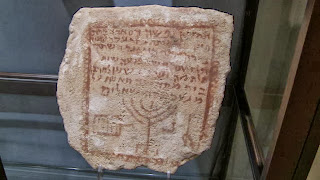

An Ancient Gift, An Unlikely FriendshipAs always with unprovenanced inscriptions, I would like to know more about the authentication process. But it does sound likely just from the story that this is a genuine ancient artifact.
10/15/13
Deena Yellin (The Jewish Week)
Steven Fine, a professor of Jewish history at Yeshiva University and director of the school’s Center for Israel Studies, figured an article he published last year in Biblical Archeology Review about ancient tombstones in the Holy Land, would resonate with other archeology buffs.
But he never imagined that “Tales From Tombstones” would move a reader to give him one of those rare relics.
The reader, Pastor Carl Morgan of Woodland, Calif., curator of the Woodland Museum of Biblical Archeology, sent Fine a photo of a limestone gravestone in his collection. Yes, said Fine – it was undoubtedly one of the stones about which he had written.
[...]
Thus began a beautiful and unlikely friendship between the East Coast students and the West Coast pastor. The students called Morgan on a regular basis seeking information about the stone’s measurements, design and other details.
Although it was worn, the students, with Fine’s help, were able to decipher the text. They dated the stone to 430 C.E. — some 360 years after the destruction of the Second Temple, and reconstruct the name on the stone to be ‘Sa’adah, daughter of Pi[nchas].”
“Here’s a Jewish woman we never knew of before in a place were there weren’t likely any rabbis,” says Fine. “When it comes to ancient history, every little scrap of anything is worth something. We try to squeeze as much as we can out of every scrap. Each stone is another brick in our knowledge about Jews in the talmudic period — you never know what connects to what until we have it all together.”
[...]
Bit by bit, a letter at a time, whatever it takes. Until we're done.
(Via Joseph Lauer.)
UPDATE: Joe Lauer also circulated a couple of photographs of the tombstone, courtesy of Steven Fine. With Professor Fine's permission I post them here. For larger versions, click on the images.


George Smith and Gilgamesh
A MOVING STORY: The tragic tale of George Smith and Gilgamesh
In 1873, the Telegraph funded a groundbreaking expedition. Now, a new book by Vybarr Cregan-Reid tells the story of what happened when George Smith rediscovered The Epic of Gilgamesh. (Vybarr Cregan-Reid, The Telegraph).
As regular readers know well, Gilgamesh resurfaced in Second Temple Judaism as a giant.
*X.301, Andrew George's Penguin translation, 1999.
In 1873, the Telegraph funded a groundbreaking expedition. Now, a new book by Vybarr Cregan-Reid tells the story of what happened when George Smith rediscovered The Epic of Gilgamesh. (Vybarr Cregan-Reid, The Telegraph).
Had he not died so young, Smith could have gone on to become the Darwin of archaeology. As it is, even the little work that he was able to do still refashioned the landscape of his own and other disciplines forever.Man is snapped off like a reed in a canebreak.*
As regular readers know well, Gilgamesh resurfaced in Second Temple Judaism as a giant.
*X.301, Andrew George's Penguin translation, 1999.
Thursday, October 17, 2013
Defining the gospel genre
ASKING THE IMPORTANT QUESTIONS: WHAT IS A GOSPEL? (Philip Jenkins). Not as easy to answer as you might think.
Postgraduate study at the University of British Columbia
FROM PROF. GREGG E. GARDNER:
Located in Vancouver, British Columbia - the 3rd best city in the world in which to live (Global Liveability Ranking – 2013), - the Department of Classical, Near Eastern and Religious Studies at the University of British Columbia offers students the unique opportunity to conduct graduate level research in the classical texts, archaeology, and history of the entire Mediterranean world.
In our department, students can take a spectrum of courses from Roman and Greek archaeology, literature and history to Near Eastern languages (we offer Coptic and Akkadian as well as Hieroglyphs) to Christianity, Islam and Judaism. We are a student-centred department which seeks to enrich and nourish all of our MA and PhD students as a deeply held principle.
CNERS offers MA-level programs in
Classics
Classical and Near Eastern Archaeology
Religious Studies
Ancient Culture, Religion and Ethnicity (a unique MA-level interdisciplinary program that draws on the unique synergy of our department’s faculty)
There are two programs at the PhD level:
PhD in Classics (with possible specializations in Classics, Ancient History and Classical and Near Eastern Archaeology)
PhD in Religious Studies
The department is looking for committed, self-motivated students and anticipates being able to offer up to four financial packages to well-qualified PhD applicants (with a completed MA) valued at approximately $25,000 per year for four years (contingent upon academic performance).
Typical support for incoming MA students is around $20,000 per year for two years (contingent upon academic performance).
In addition, there is money earmarked for student travel and research abroad. Funding is also available for qualified international students.
Recent PhD graduates are teaching in leading Canadian and international universities, and our MA students have gone on to study at outstanding universities such as McGill, Yale, UC-Berkeley, Stanford, and Oxford.
Our departmental website: http://cnrs.ubc.ca
Our graduate programs: http://cnrs.ubc.ca/for-graduates/graduate-programs/
We encourage students to contact our Director of Graduate Studies [ubccner-g-dgs@mail.ubc.ca] – or any of our faculty (all of whom are interested in supporting graduate students) with questions about our program, courses, and living in Vancouver.
The deadline for applications is December 15th for PhD programs and January 15th for MA programs.
To apply: https://www.grad.ubc.ca/prospective-students/application-admission/apply-online
Wednesday, October 16, 2013
“Hot feces in torn date baskets in your mouth, witches.”
THIS WEEK'S DAF YOMI COLUMN FROM ADAM KIRSCH IN TABLET: Magical Thinking, Superstition, and Incantations in Jewish Oral Law. By elevating witches and demons to the level of gods, Talmudic rabbis diminished religious thought.
Kirsch's mind is kind of blown by finding this sort of thing in the Talmud, although he does his best to accommodate it:
It's not as though these aspects of human consciousness can be ignored. They will get our attention one way or another and I am far from convinced that replacing the old supernatural paradigm with some widely used modern ones, notably Freudian Psychoanalysis, represents much of an advance. On the latter, see Karl Popper's critique, which can be found, for example, summarized by Bryan Magee in Popper (Modern Masters; London: Fontana, 1973), chapter 3.
Earlier Daf Yomi columns are noted here and links.
Kirsch's mind is kind of blown by finding this sort of thing in the Talmud, although he does his best to accommodate it:
The ease with which magic and witchcraft find a place in the Talmudic worldview is, to my mind, both illuminating and compromising. For it suggests that the Talmud’s general commitment to exact measurement and correct action—the need to find out exactly how to behave in order to please God, down to the order in which you put on your shoes in the morning—is itself a kind of magical thinking.Acceptance of the idea of the demonic (and angelic) supernatural is the norm for human societies and it is ours that is out of step with the rest of humanity. Not that we don't have good reason, but that supernatural idea does find a place for subterranean and often dark aspects of the human mind and gives them a coherent place in human society. There is a vast anthropological literature on this: off the top of my head, I. M. Lewis, Ecstatic Religion: An Anthropological Study of Spirit Possession and Shamanism (Harmondsworth, England: Penguin, 1971), comes to mind as an old classic.
For the rabbis, Jews are the protagonists of a cosmic drama in which their every slightest action will be either rewarded or punished. There is something ennobling about this, but when the same kind of scrutiny is attributed not just to God but to demons and witches, it begins to seem oppressive and even absurd. What’s more, it impugns the authority of the rabbis themselves. If we have to listen to the Sages when they tell us about the 39 melachot of Shabbat, aren’t we just as bound to listen to them when they tell us that a “sorb tree that is close to the city contains no less than 60 demons?” And if they are wrong about the demons, mightn’t they also be wrong about the melachot?
It's not as though these aspects of human consciousness can be ignored. They will get our attention one way or another and I am far from convinced that replacing the old supernatural paradigm with some widely used modern ones, notably Freudian Psychoanalysis, represents much of an advance. On the latter, see Karl Popper's critique, which can be found, for example, summarized by Bryan Magee in Popper (Modern Masters; London: Fontana, 1973), chapter 3.
Earlier Daf Yomi columns are noted here and links.
Syriac Seminar at the University of Iowa
ROBERT CARGILL: Announcing Spring 2014 Seminar in Syriac at the University of Iowa. An exciting course that will include readings from the Syriac version of Joseph and Aseneth. The Syriac text is the earliest extant version of this work, although it is a translation from Greek. Bob's post has also reminded me of Mark Goodacre's excellent Aseneth Home Page.
Cross-file under "Syriac Watch" and "Old Testament Pseudepigrapha Watch."
Cross-file under "Syriac Watch" and "Old Testament Pseudepigrapha Watch."
Tuesday, October 15, 2013
Underwater archaeology at Tel Dor
NEW MARITIME CIVILIZATIONS MA: Underwater archaeologists: Unlocking the mysteries of an age-old port. Who sailed from the harbor - or harbors - at Tel Dor? Haifa University students find clues on the Mediterranean floor (Alona Ferber, Haaretz). Excerpt:
It's cold. It's silent. It's murky. It's the bottom of the Mediterranean Sea and it's the hangout of choice for students of maritime archaeology, seeking clues to the dawn of modern man. Or in the case of participants on Haifa University’s new English MA in Maritime Civilizations, signs of a harbor at the ancient site of Tel Dor.I was as an assistant square supervisor at Tel Dor back in the 1980s, but that work was strictly above ground.
The Tel Dor expedition, some 30 kilometers south of Haifa, is a collaboration between Dr. Assaf Yasur-Landau and Dr. Ayelet Gilboa of the University of Haifa, and Prof. Ilan Sharon of the Hebrew University. Students of the new English-language program, which started its second year this fall, take part in underwater surveys of Tel Dor mostly in shallow waters but also at depths of up to 10 meters of water.
The documented history of Tel Dor begins in the the 13th century BCE and continues through to the Crusader era. Excavators are seeking evidence of the location of a harbor or harbors at the site that are documented in written sources.
During the Roman and later Crusader periods the harbor seems to have been in the town's northern bay– but earlier, during the Iron Age, and perhaps even in the Bronze Age, it seems to have been located in Tel Dor’s south bay. Researchers still don’t know for sure why the harbor moved.
Gold cuneiform tablet update
A MESSY CASE: Dispute over ancient gold tablet goes to US court (AP). The tablet was excavated by German archaeologists, looted from a German Museum in 1945, and bought by a Holocaust survivor. Now the museum wants it back, but the heirs of the late most recent owner want it to go to a Holocaust museum.
I have been following the case, which has had a number of twists and turns, for a while. Background here and links. There's a photograph here and more photos in this video from June 2012.
I have been following the case, which has had a number of twists and turns, for a while. Background here and links. There's a photograph here and more photos in this video from June 2012.
Monday, October 14, 2013
CSM on the Bible and archaeology
THE CHRISTIAN SCIENCE MONITOR has a couple of interesting articles by Christa Case Bryant on the Hebrew Bible and archaeology, with emphasis on the current debate between the "minimalists" and the "maximalists" regarding the historicity of the United Monarchy (Saul-David-Solomon).
What archaeology tells us about the Bible
A contentious dig in Israel delves into the kingdoms of David and Solomon, stirring a debate over the veracity of the biblical record. Excerpt:
In Jerusalem, the politics of digging up the past
As a nexus of religions, and archaeology, Jerusalem inspires intense fights over moving even a single 'grain of dirt.' Excerpt:
What archaeology tells us about the Bible
A contentious dig in Israel delves into the kingdoms of David and Solomon, stirring a debate over the veracity of the biblical record. Excerpt:
For the past 20 years, a battle has been waged with spades and scientific tracts over just how mighty David and the Israelites were. A string of archaeologists and Bible scholars, building on critical scholarship from the 1970s and '80s, has argued that David and his son Solomon were the product of a literary tradition that at best exaggerated their rule and perhaps fabricated their existence altogether.More on the archaeology and inscriptions of Khirbet Qeiyafa is here with many links.
For some, the finds at Qeiyafa have tilted the evidence against such skeptical views of the Bible. [Archaeologist Yosef] Garfinkel says his work here bolsters the argument for a regional government at the time of David – with fortified cities, central taxation, international trade, and distinct religious traditions in the Judean hills. He says it refutes the portrayal by other scholars of an agrarian society in which David was nothing more than a "Bedouin sheikh in a tent."
"Before us, there was no evidence of a kingdom of Judah in the 10th century [BC]," says Garfinkel. "And we have changed the picture."
But critics question his methods on the ground and his interpretations in scholarly journals.
The dispute transcends the simple meaning of ancient inscriptions found at Qeiyafa, or the accuracy of carbon-dating tests on olive pits. It highlights the whole dynamic between archaeology and the Bible – whether science can, in fact, help authenticate the Scriptures.
"If you are in the trenches of what's going on today, the battle for Qeiyafa looks very important," says Israel Finkelstein, an archaeologist at Tel Aviv University and one of Garfinkel's most prominent critics. "But if you are zooming out, you see that all this is another phase in a very long battle for the question of the historicity of the biblical text, for understanding the nature of the Bible, for understanding the cultural meaning of the Bible."
In Jerusalem, the politics of digging up the past
As a nexus of religions, and archaeology, Jerusalem inspires intense fights over moving even a single 'grain of dirt.' Excerpt:
While the debate over the extent of King David's realm has focused heavily on Khirbet Qeiyafa to the southwest, archaeological work in Jerusalem also offers evidence about David and the biblical record – but in an even more fraught environment. Gabriel Barkay, who has worked as an archaeologist in the city for decades, says that even moving a single "grain of dirt from one place to another is political."More on the Temple Mount Sifting Project is here, again with many, many links. More on the Palestinian Authority and its Jewish Temple denial is, for example, here and here and links.
"It is a boiling caldron, the stew of which is stirred up by so many spoons," says Dr. Barkay. He cites the Chief Rabbinate of Israel (the supreme spiritual authority for Jewish people in the country), the Greek Orthodox Patriarchate, UNESCO, the city of Jerusalem, the Israeli Antiquities Authority, the Ministry of Foreign Affairs, the Ministry of Religious Affairs, and the Vatican.
"The Temple Mount is the soul, heart, and spirit of Jewish history ... [and of events] in Islamic periods, also in medieval periods, and up to our day," says Barkay. "It is a focal point in the understanding of what goes on here. And the Temple Mount is a black hole in the archaeology of Jerusalem. It was never, ever excavated."
So it's perhaps not surprising that he fought a prolonged battle to reclaim hundreds of truckloads of dirt that he calls "saturated with the history of Jerusalem." In 1999, Palestinians began removing the material from the Muslim-controlled Temple Mount, or Haram al-Sharif, and dumping it in the Kidron Valley at night.
The Palestinians said they were simply trying to build an emergency exit at a mosque. But the dirt included material that archaeologists determined was from the First and Second Temple periods, vital to Jewish history, and the project expanded beyond what Israeli authorities were expecting. Five years later, Barkay managed to reclaim it and established the Temple Mount Sifting Project to find artifacts among the rubble.
Palestinian leaders have increasingly refrained from acknowledging the existence of a Jewish temple in Jerusalem – and some outright deny it. Meanwhile, those seeking to shore up the Jewish nation's ties to the city have largely ignored the legacy of centuries of Muslim presence as well as that of early ethnic groups such as the Canaanites, believed by some to be the ancestors of Palestinians.
Boustan et al., Hekhalot Literature in Context
IN THE MAIL:
More details here.
Ra'anan S. Boustan, Martha Himmelfarb, Peter Schafer (eds.), Hekhalot Literature in Context: Between Byzantium and Babylonia (TSAJ 153; Tübingen: Mohr Siebeck, 2013)A review copy from the Journal for the Study of Judaism.
More details here.
Sunday, October 13, 2013
Iraqi Jewish Archive debate heats up
THIS IS BECOMING A CONTENTIOUS ISSUE: Plan to ‘return’ Jewish artifacts to Iraq sparks outrage (dan pine, JWeekly.com). Excerpt:
Background with, for what it's worth, my own commentary on the situation is here and links.
The United States agreed to return the materials to Iraq in 2014 in exchange for a promise that the Iraqi antiquities ministry would take good care of them.But others disagree. No word on whether the U.S. Government is taking any notice of the objections.
But the Iraqi Jewish community in the United States is having no part of it.
In advance of the exhibition, Justice for Jews from Arab Countries (JJAC) and Jews Indigen-ous to the Middle East and Africa (JIMENA) have launched a campaign to prevent the archives from returning to Iraq where, they believe, the materials will either rot or be destroyed.
“The archives were looted by the Iraqi government from the Jewish community,” said Gina Waldman, executive dir-ector of the S.F.-based JIMENA. “We hope the U.S. government will bar the return of the archives to Iraq, and do everything possible to [reach] a mutually agreeable, fair and just agreement so that the Iraqis are encouraged to hand the archives to the rightful Jewish owners.”
Stanley Urman, executive vice president of JJAC, cites the legal principle “jus ex injuria non oritur,” which in international law means that a state cannot assert legal rights to property illegally obtained. “[The materials] were seized from Jewish institutions, schools and the community. There is no justification or logic in sending these Jewish archives back to Iraq, a place that has virtually no Jews, no interest in Jewish heritage and no accessibility to Jewish scholars.”
Background with, for what it's worth, my own commentary on the situation is here and links.
Saturday, October 12, 2013
More on the York Christian Apocrypha Symposium
PAY NO ATTENTION TO THE WOMAN BEHIND THE CURTAIN. She just makes everything work.
Sarah Veale: Behind the Ivory Curtain: Working on the York Christian Apocrypha Symposium. With links to symposium posts by organizer Tony Burke and by Mark Bilby. Student conference assistants are invaluable.
Background here and here and links.
Sarah Veale: Behind the Ivory Curtain: Working on the York Christian Apocrypha Symposium. With links to symposium posts by organizer Tony Burke and by Mark Bilby. Student conference assistants are invaluable.
Background here and here and links.
Hurtado on "Covert Christianity"
WHAT HAVE THE ROMANS DONE FOR US? Now there's some guy saying they invented Jesus. Larry Hurtado replies: FlimFlam of the Month: “Covert Christianity.”
Friday, October 11, 2013
"Not our egomaniac"
HAARETZ: Archaeological stunner: Not Herod's Tomb after all?
While attention is focused on a blockbuster exhibition purporting to display the tomb of Herod the Great, two archaeologists claim there's no way the egomaniac king was interred there.
UPDATE: Bad link now fixed. Sorry about that!
While attention is focused on a blockbuster exhibition purporting to display the tomb of Herod the Great, two archaeologists claim there's no way the egomaniac king was interred there.
Now, two archaeologists, Prof. Joseph Patrich and Benjamin Arubas, both from the Hebrew University of Jerusalem, are raising serious questions about the identification of the structure as the burial site of the king. They contend that there is no possibility that the mausoleum Netzer and his students uncovered could actually be the royal tomb in which Herod was interred after his death, in 4 B.C.E.There have always been doubts about the identification of the site as Herod's tomb, so it is not that much of a stunner. I have been putting caveats in my posts about the site for a long time, most recently here (leading to many links on the subject). But it is interesting to have archaeologists now actively offering a rebuttal.
The structure is not in keeping with Herod’s other construction projects or his personality, they say.
“I feel like the boy in ‘The Emperor’s New Clothes,’” says Patrich. “It's so obvious that it is surprising people can’t see it.”
The pair presented their main reservations yesterday at the seventh annual “Innovations in Archaeology in Jerusalem and the Surrounding Area” conference, organized by the Israel Antiquities Authority, the Hebrew University and Tel Aviv University.
UPDATE: Bad link now fixed. Sorry about that!
New blog on manuscripts
ASSIMILATED TO THE BLOGOSPHERE: Religion - Manuscripts - Media Culture (Liv Ingeborg Lied).
"I once promised myself that I would never start blogging."
"I once promised myself that I would never start blogging."
Masada in the news
TWO ITEMS PERTAINING TO MASADA:
First:
First:
An American in King Herod's CourtSecond: Dr. Jodi Magness to Present ‘Masada: Last Stronghold of the Jewish Resistance Against Rome.’ At the University of North Carolina, today.
By ARIEL DAVID (NYT)
Published: October 9, 2013
MASADA, Israel — This ancient fortress, towering above the lunar landscape on the shores of the Dead Sea, is many things to many people: natural treasure, archaeological wonder, national icon. For Eitan Campbell, Masada is all that and more — it is home.
Mr. Campbell started working at the site when he was 17 and never left. Forty-one years later, he is the director, after holding almost every job available — including sitting at the cashier’s window and driving an ambulance for tourists felled by the desert heat.
[...]
Did Melchizedek go Green?
PHILIP JENKINS: THE GREEN MAN AND THE KING OF SALEM. Is al-Khidr in the Qur'an a late reflex of the patriarch Melchizedek? Maybe. I have argued for something similar in the Hekhalot traditions about the Youth. See my "Melchizedek, the Youth, and Jesus" in The Dead Sea Scrolls as Background to Postbiblical Judaism and Early Christianity: Papers from a Conference at St. Andrews in 2001 (STDJ 46; Leiden: Brill, 2003) , 248-74.
Thursday, October 10, 2013
More on the Syriac Manichaean fragments
ALIN SUCIU: Guest Post: Nils Arne Pedersen & John Møller Larsen – Syriac-Manichaean fragments.
Background here and here. Related post on non-Syriac Manichaean (Manichean) manuscripts here.
Background here and here. Related post on non-Syriac Manichaean (Manichean) manuscripts here.
Wecker, The Golem and the Jinni
BOOK REVIEW: New fantasy novel draws on that old Jewish black magic.
When a female Golem from 19th century Poland and Jinni from Ancient Syria accidentally meet one another, all sorts of mayhem ensues (Renee Ghert-Zand, The Times of Israel).
I don't think golem creation would count as black magic, but I imagine the reviewer didn't write the headline. A couple of small excerpts:
Critics and the reading public alike have been captivated by Wecker’s creative narrative, which has two supernatural creatures from different historical eras and parts of the world arriving separately (the Golem by ship and the Jinni by copper flask) in New York in 1899. Eventually, the Golem from 19th century Poland and the Jinni from Ancient Syria accidentally meet one another. They bond and then separate after a terrifying incident, only to later reunite to fight a power bent on destroying them both.Earlier reviews noted here and link. And for many, many additional golem links, go here.
While readers may be familiar with the mythic Golem of Jewish lore, a clay figure brought to life by Kabbalistic charms, it is unlikely they have ever encountered one quite like the one in this novel. This is because the Golem conjured by Wecker’s imagination is female, and her name is Chava.
[..]
Although her novel’s two protagonists are drawn from myth, the idea for “The Golem and the Jinni” stems from Wecker’s real life. The 38-year-old Jewish author is married to an American man of Syrian descent whom she met in college. However, while most of the characters in Little Syria are Christian, Wecker’s husband’s family is of Muslim background.
Wednesday, October 09, 2013
Rabbinic Shabbat dinner etiquette etc.
THIS WEEK'S DAF YOMI COLUMN BY ADAM KIRSCH IN TABLET: When the Rabbis Got Together for Shabbat Dinner, Drama—and Law—Ensued. In the Talmud, examples of real-life rabbinic behavior and the intensely personal nature of lawmaking.
Even so, most of this week’s reading managed to stay far away from the concrete details of Passover. The mishna on Pesachim 99b begins with a brief sentence about eating on the day of the Seder: “On the eve of Passover, adjacent to mincha time, a person may not eat until dark.” These few words are the springboard for eight full pages of Gemara, in which the rabbis talk primarily not about Passover at all, but about Shabbat. In the process, the text gives several examples of real-life rabbinic behavior, dramatizing the intensely personal nature of Talmudic lawmaking.Earlier Daf Yomi columns are noted here and links.
Brooten on ancient Jewish and Christian women
BERNADETTE BROOTEN INTERVIEWED: Documents from Dead Sea Scrolls era show diversity of women’s roles (BrandeisNow).
Related posts at my old Qumranica blog here and here.
Related posts at my old Qumranica blog here and here.
Tuesday, October 08, 2013
"Methuselah" still going strong
THE DATE PALM grown from an ancient seed excavated at Masada is still alive and well: Ancient Date Palm Tree Flourishes Again (Popular Archaeology). Excerpt:
During excavations by the late Ehud Netzer in 1973 at the site of Herod the Great's fortified mountaintop palace at Masada in Israel, archeologists uncovered a cache of seeds stowed away in a clay jar about 2,000 years ago. For decades, the ancient seeds were stored in a drawer at Tel Aviv's Bar-Ilan University. But in 2005, in collaboration with the Louis L. Borick Natural Medicine Center at Hadassah Hospital in Jerusalem, botanical researcher Elaine Solowey received one of them for an experimental planting.Background here. Dr Solowey also recently had a similar success with growing the ancient Frankincense plant.
"When we asked if we could try and grow some of them, they said, 'You're mad,' but they gave us three seeds," she said. "Lotus seeds over 1,000 years old have been sprouted, and I realized that no one had done any similar work with dates, so why not give it our best shot -- and we were rewarded."*
Solowey planted a seed in a pot at Kibbutz Ketura in January, immediately after receiving them. Since then, it has sprouted into a seedling, produced its first blossom in 2011, and now flourishes as a young date palm. It has been nick-named "Methuselah", after the oldest person who ever lived, according to the biblical account.
Dead Sea Scrolls concert
IN BOSTON: In the caves of Qumran, with electronics (Jeremy Eichler, The Boston Globe).
Background on the Dead Sea Scrolls exhibition at the Boston Museum of Science is here and links.
... In their day, the scroll texts were most likely chanted out loud, writes the Brandeis scholar Marc Brettler in a program note for Saturday’s Dinosaur Annex concert, though he conceded we don’t have any idea how that chanting might have sounded.The story of Enoch was also the subject of an opera earlier this year.
At a guess, probably not much like the modern electro-acoustic soundscapes created by Eric Chasalow for his new work, “Where It Finds Nothing But the Wind,” a setting of selections from the scroll texts that received its premiere on Saturday’s concert. Chasalow, a Brandeis-based composer, freely admits he came to the Scrolls with no previous knowledge about their origins or content. His work also makes no claim to any informed guesswork about the sound world of ancient liturgical traditions. Brettler, who assisted Chasalow on his project, pointed out in a preconcert lecture that even the pronunciation of the texts themselves is speculative since they predate the creation of the system of vowels that inform the speaking of Hebrew and Aramaic today.
So what we have in Chasalow’s new work is a purely contemporary fantasy on these texts, scored for soprano, percussion, guitar, flute, and electronics. The texts used here were culled by Chasalow from across the different scrolls, and include biblical passages, texts from the Qumran Psalms scroll, and even an extraordinary passage from the Book of Enoch that describes “the sons of the sky” siring a race of evil giants with the “daughters of men.” Chasalow’s musical response is an ever-shifting kaleidoscope that moves seamlessly from tonal music to abstract electronic noise and back. ...
Background on the Dead Sea Scrolls exhibition at the Boston Museum of Science is here and links.
Monday, October 07, 2013
Iraqi Jewish achive latest
THEY WERE ALREADY STOLEN BEFORE THE AMERICANS GOT TO THEM: Iraqi Jewish Treasures Displayed in D.C. Before Being Shipped Back to … Iraq
In the chaos of the 2003 war, remnants of a once-thriving Jewish past were saved (or stolen?) by America. Where do they belong? (Lisa Leff, Tablet Mgazine).
Be that as it may, one question that is not raised in the article (and seems, as far as I can tell, not to be of much concern to international law), is where the archive will be safest and best cared for. I have been belaboring this concern with reference to this and related stories for a long time. It seems a shame that a political tug-of-war over who should get the archive overshadows that concern.
Background on the Iraqi Jewish archive is here with a decade's worth of links.
I am glad to hear about the digitization. For more such digitization projects, see the immediately preceding post and links.
In the chaos of the 2003 war, remnants of a once-thriving Jewish past were saved (or stolen?) by America. Where do they belong? (Lisa Leff, Tablet Mgazine).
In this sense, the exhibit sidesteps the question that has made the Iraqi Jewish archive such a hot topic in the Jewish press for the last 10 years: Should the United States honor its agreement to return these things to Iraq, or should they instead be sent to Israel, where most Iraqi Jews fled and many of their descendants still live? While international law may be clear—belligerent troops may not cart away the cultural treasures of a conquered nation—for many Jews, the law doesn’t seem to serve justice in this particular case.As the article makes clear, the Iraqi secret police confiscated the manuscripts after the Jewish owners were driven out of Iraq, which rather reduces the moral urgency of Iraq's claims to them.
On one level, this is a question of access. If these materials return to Iraq, it’s hard to imagine that Israeli scholars will be able to travel to Iraq to consult them. But this is a practical problem, to which American authorities are offering a technical solution. As part of the restoration process, NARA’s staff will be carefully digitizing every book and every document in the collection that cannot be found elsewhere. NARA’s Doris Hamburg promises that the rare materials will be made available for free on NARA’s website, and they will be word-searchable, with annotations by experts. Ironically, the massive digitization project that is intended to accompany the return of Jewish cultural treasures to Iraq will make the archive more widely and easily available to Jewish scholars from around the world than it would have been if NARA had kept the collection in Washington. Astoundingly, much of the Iraqi Jewish archive—once-secret trove hidden away by a police state, unknown and far from the public’s reach—is about to become one of the most easily accessible collections of Jewish materials in the world.
Be that as it may, one question that is not raised in the article (and seems, as far as I can tell, not to be of much concern to international law), is where the archive will be safest and best cared for. I have been belaboring this concern with reference to this and related stories for a long time. It seems a shame that a political tug-of-war over who should get the archive overshadows that concern.
Background on the Iraqi Jewish archive is here with a decade's worth of links.
I am glad to hear about the digitization. For more such digitization projects, see the immediately preceding post and links.
Digitizing Hebrew manuscripts
INL AND PALATINA: Rare Hebrew manuscripts to go online
Israel's National Library signs agreement with leading Italian collection to digitize about 1,600 documents dating to Middle Ages, including one of oldest existing copies of Mishna (AP).
Much more on Hebrew and other manuscript digitization projects here and links.
Israel's National Library signs agreement with leading Italian collection to digitize about 1,600 documents dating to Middle Ages, including one of oldest existing copies of Mishna (AP).
Much more on Hebrew and other manuscript digitization projects here and links.
Sunday, October 06, 2013
DSS at Boston Museum of Science
ASOR BLOG: An Afternoon at the Museum – The Dead Sea Scrolls (Kaitlynn Anderson).
Background here and links.
Background here and links.
Saturday, October 05, 2013
Calaway on 1 Maccabees
ASKING THE IMPORTANT QUESTIONS: Does 1 Maccabees Critique the Hasmoneans? (Jared Calaway).
Friday, October 04, 2013
Shai Secunda interviewed
THE BOOK OF DOCTRINES AND OPINIONS: An Interview with Dr. Shai Secunda about The Iranian Talmud (Alan Brill).
Background here.
Background here.
Dirk Smilde Scholarship
CALL FOR APPLICATIONS: Dirk Smilde Scholarship 2013-2014.
In addition to the Dirk Smilde Fellowship, the Qumran Institute of the Faculty of Theology and Religious Studies (University of Groningen) is delighted to present the Dirk Smilde Scholarship for excellent PhD students and postdocs in the fields of Hebrew Bible, early Judaism and Dead Sea Scrolls.The deadline is 31 October. Follow the link for application details. More on the Dirk Smilde Fellowship here.
The scholarship amounts to € 1,000 a month. Regarding the duration of the scholarship, we offer a range between a minimum of three and a maximum of six months. This should start January 2014 at the earliest and end July 2014 at the latest.
Simultaneously, the 2013-2014 Dirk Smilde Fellow Prof. Dr. Steve Mason (University of Aberdeen) will also reside at the Qumran Institute of the Faculty of Theology and Religious Studies from January to May 2014.
The proposed research should fit within the Qumran Institute’s research theme “Cultural Encounters in the Ancient World”.
Awards are made on academic merit, evaluated by an academic committee.
Subscribe to:
Posts (Atom)