Sunday, July 12, 2015

Aramaic death metal

ARAMAIC WATCH: KATAKLYSM: New Song 'Soul Destroyer' Available For Streaming (Blabbermouth.net).
Montreal-based death metallers KATAKLYSM will release new album, "Of Ghosts And Gods", on July 31 via Nuclear Blast. The cover artwork for the follow-up to "Waiting For The End To Come" was created by up-and-coming dark and macabre artist Art By Surtsey and can be seen below.

[...]

According to KATAKYSM [sic], the "cover art echoes a sinister artwork depicting the reality of humanity's beautifully disturbing existence and its impending death through the mortal and the everlasting. The background shows an ancient Incantation written in Aramaic."

[...]
I've been aware of this forthcoming album cover for some time, but until now none of the photos have been large enough for the incantation to be very visible. The photo in this article (follow the link above, bottom photo) is somewhat better, although I still cannot make out any connected sense. The upper image on the right shows a circular, spiralling text with a drawing in the middle, partially obscured by the bird's head, and another drawing at the top. The script looks like Syriac and the layout makes me think it is based on a Babylonian incantation bowl. (For comparison, see the image of a Syriac incantation bowl in the article linked to in the post immediately preceding this one.) Below this image is another inscription written in the square Hebrew script with a normal page layout. What little text I can make out does look like Aramaic. On the left is another spiral inscription with an image in the center, again probably based on an incantation bowl. The inscription is too blurred to read, but it is written in the square Hebrew script.

So I see three Aramaic inscriptions here rather than just one.

The streamed songs from the album are ... vigorous.

Death and black metal bands often draw on interesting ancient traditions. Relevant past posts are here, here (near the end), here, and here. And for lots more on Aramaic incantation bowls, see here and here and links.

Syriac Symposium at the Catholic University

SYRIAC WATCH: Catholic University exhibit highlights Syriac Christian traditions (ABBEY JAROMA, Catholic News Service).
WASHINGTON (CNS) — Sitting in the May Gallery in the John K. Mullen of Denver Memorial Library at The Catholic University of America in Washington, one can feel immersed in 19th-century Syriac Christian life.

Held every four years since 1991, the North American Syriac Symposium brings together university professors, graduate students and scholars from around the country and abroad to discuss topics related to the language, literature and cultural history of Syriac Christianity. Catholic University is the only university to host the symposium twice.

Aaron Butts, an assistant professor in the Department of Semitic and Egyptian Languages and Literatures, told Catholic News Service the university “has a huge collection” of artifacts from Msgr. Henri Hyvernat that makes it “a great place to have the conference. You have all these original artifacts that just add an element that if you had the conference at another university, you wouldn’t have.”

Those artifacts include manuscripts, photographs and an incantation bowl.

[...]
Sounds like a good symposium.
One item is an incantation bowl, which 19th-century Syriac Christians would use by writing a magic spell on the inside and then placing it in their doorway, believing that it would keep the evil spirits out. Such bowls were used in the same way in the Jewish tradition during the same time period.
I think there is an error here. Incantation bowls were produced and used in Babylonia in the fifth to seventh centuries CE. Although in recent years there has been some retro production of such bowls, I've never heard of one from the nineteenth century. Also, James A. Montgomery published an 11-line Syriac incantation bowl in 1918 which belonged to Hyvernat, and this appears to be it. Perhaps the mixup occurred because Hyvernat also has nineteenth-century Syriac manuscripts in his possession and all these artifacts are now in the Catholic University's collection. In any case, you can see a photo of the bowl at the first link above.

CORRECTION: There was a typo in the date given for Montgomery's publication. It is now corrected.

Reception of Zenobia in Islam

PALMYRA WATCH: Homage to Zenobia (Lawrence Wright, The New Yorker).
She was probably in her twenties when she took the throne, upon the death of her husband, King Odenathus, in 267 or 268. Acting as regent for her young son, she then led the army in a revolt against the Romans, conquering Egypt and parts of Asia Minor. By 271, she had gained control of a third of the Roman Empire. Gibbon sometimes portrays the warrior queen as a kind of well-schooled Roman society matron. “She was not ignorant of the Latin tongue,” he writes, “but possessed in equal perfection the Greek, the Syriac, and the Egyptian languages.” Palmyra’s abundant wall inscriptions are in Latin, Greek, and an Aramaic dialect, not Arabic. But to Arab historians, such as the ninth-century al-Tabari, Zenobia was a tribal queen of Arab, rather than Greek, descent, whose original name was Zaynab, or al-Zabba. Among Muslims, she is seen as a herald of the Islamic conquests that came four centuries later.

This view, popular within the current Syrian regime, which boasts Zenobia on its currency, also resonates within radical Islamic circles. Glen Bowersock, a professor emeritus at the Institute for Advanced Study, says, “I suspect ISIS believes Palmyra to be somehow a distinctively Arab place, where Zenobia stood up to the Roman emperor.” Indeed, ISIS fighters, after seizing Palmyra, released a video showing the temples and colonnades at the ruins, a UNESCO World Heritage site, intact. “Concerning the historical city, we will preserve it,” an ISIS commander, Abu Laith al-Saudi, told a Syrian radio station. “What we will do is pulverize the statues the miscreants used to pray to.” Fighters then set about sledgehammering statues and shrines.
Perhaps this is why ISIS has not (yet) destroyed the ruins of the ancient city.

Background on the history of Palmyra and its current situation is here and links. Past posts on Zenobia are here and links (although I've heard some skepticism on whether the destroyed statue was really of Zenobia).

Timuş, Cosmogonie et eschatologie

BIBLIOGRAPHIA IRANICA: Zoroastrian Cosmogony and Eschatology. New book: Timuş, Mihaela. 2015. Cosmogonie et eschatologie: articulations conceptuelles du système religieux zoroastrien. (Cahiers de Studia Iranica 54). Paris: Peeters Press. Follow the link for a description and ordering information.

Nabataean script

AHRAM ONLINE: Calligraphy tales at Art Corner in Zamalek. New exhibition featuring 14 artists brings a modern twist to the traditional art form of Arabic calligraphy (Hala Safwat).
During the last days of Ramadan, Zamalek's Art Corner Gallery is hosting a new exhibition that celebrates the rich history of Arabic calligraphy – with a modern twist.

'The Story of Arabic Calligraphy' features the work of fourteen artists who have been inspired by the Islamic and Arab heritage of calligraphic art. Their works draw on the elegant curves of the Arabic text in order to create new artistic pieces with a modern flavour.

[...]
This is a fascinating exhibition, but it is really outside the scope of PaleoJudaica. I mention it because the following in it caught my eye and may be of interest to readers:
A history of Arabic calligraphy

Arabic text developed from Nabataean script – a form of writing used by the Nabataeans, who lived in territory located in modern-day Jordan, north-western Saudi Arabia and the Sinai Peninsula, and centred on Petra.

Historians have demonstrated the connection between Nabataean script and Arabic, using archaeological evidence such as the Namara inscription from Syria in 328AD, which uses Nabataean script to write Arabic, and the Zabad inscription from Syria in 512AD which is in three languages, Greek, Syriac, and Arabic. In this inscription, the Arabic text is recognisable but shows Nabataean influence.

"Researchers have argued that Arabic text originated between the era of the Namara inscription and and Zabad inscription, and the Harran inscription (of 568 AD) is considered the era of Nabataean transition to the Arabic script," calligrapher Mounir El-Shaarani told Ahram Online.
If you are interested in the further history of Arabic calligraphy, keep reading. But Nabataean (Nabatean) epigraphy and Arabic calligraphy are not my areas, so I can't vouch for the specifics.

A couple of related recent posts are here and here. Cross-file under Aramaic Watch.

Saturday, July 11, 2015

Samiei, Ancient Persia in Western History

BIBLIOGRAPHIA IRANICA: Hellenism and the Achaemenid Empire. On a new book from I. B. Tauris.

Boyarin, A Traveling Homeland

NEW BOOK FROM THE UNIVERSITY OF PENNSYLVANIA PRESS:
A Traveling Homeland
The Babylonian Talmud as Diaspora

Daniel Boyarin


192 pages | 6 x 9
Cloth Jun 2015 | ISBN 978-0-8122-4724-4 | $24.95s | £16.50
Ebook Jun 2015 | ISBN 978-0-8122-9139-1 | $24.95s | £16.50
A volume in the Divinations: Rereading Late Ancient Religion series
View table of contents and excerpt

"After two decades of exciting debate, the theory of diaspora studies is now in gridlock and in need of new interventions. This is such an intervention—a strong and exhilarating book."—Khachig Tölölyan, Wesleyan University

"Daniel Boyarin demolishes the long-standing notion that diaspora was born out of despair and sorrow. A Traveling Homeland is a highly erudite, suggestive, and provocative study on the concept of diaspora, and the Jewish diaspora in particular."—Oded Irshai, The Hebrew University of Jerusalem

A word conventionally imbued with melancholy meanings, "diaspora" has been used variously to describe the cataclysmic historical event of displacement, the subsequent geographical scattering of peoples, or the conditions of alienation abroad and yearning for an ancestral home. But as Daniel Boyarin writes, diaspora may be more constructively construed as a form of cultural hybridity or a mode of analysis. In A Traveling Homeland, he makes the case that a shared homeland or past and traumatic dissociation are not necessary conditions for diaspora and that Jews carry their homeland with them in diaspora, in the form of textual, interpretive communities built around talmudic study.

For Boyarin, the Babylonian Talmud is a diasporist manifesto, a text that produces and defines the practices that constitute Jewish diasporic identity. Boyarin examines the ways the Babylonian Talmud imagines its own community and sense of homeland, and he shows how talmudic commentaries from the medieval and early modern periods also produce a doubled cultural identity. He links the ongoing productivity of this bifocal cultural vision to the nature of the book: as the physical text moved between different times and places, the methods of its study developed through contact with surrounding cultures. Ultimately, A Traveling Homeland envisions talmudic study as the center of a shared Jewish identity and a distinctive feature of the Jewish diaspora that defines it as a thing apart from other cultural migrations.

Jewish Palermo

A CAPSULE HISTORY: Rediscovering Jewish Palermo (by Irene Shaland and Bianca Del Bello, Special to The [Jewish] Chronicle).
Contrary to popular opinion, Sicily’s Jewish culture was not imported from Spain but came from Judea in antiquity as part of the Diaspora. Some sources date the arrival of the first Jewish settlers in Sicily to the destruction of Jerusalem’s Second Temple in 70 A.D. when Titus brought over 30,000 Jewish slaves to Rome, some of whom were later sent to the island of Sicily. Academics generally agree though that the Jewish presence in Italy began long before that. A sizable Jewish community was likely established in the southeastern part of Sicily in Siracusa during the Hellenistic Greek period. Encyclopedia Judaica quotes the record of the first known European Jewish poet Caecilius of Calacte moving to Rome from Sicily in 50 A.D., 20 years prior to Titus’ slaves. These records prove that the Sicilian Jewish community is the oldest in Europe.

The Phoenicians, a Semitic people, were the first to colonize Sicily in 800 B.C. They established a city-port they called Zis, now known as Palermo. They spoke a language similar to Hebrew and developed the first alphabet that was written like Hebrew. The Greeks came 100 years later, and 500 years later, the Romans. The Vandals came 500 years after the Romans, then the Arabs, the Normans, the Schwabians, the French and the Spanish. The last wave of invaders came after the unification of Italy in 1861. These were the “northern Italians,” as the locals call them.
I don't know anything about the history of Judaism in Sicily, so I'm just passing the article on to you. If a reader has any comments about its accuracy, just drop me a note. Cross-file under Phoenician Watch.

Lectures in Jerusalem

ABR LECTURE SERIES: Lee University Professors Present At Lecture Series In Israel (, The Chattanoogan).
Lee University’s Dr. Brian Peterson and Dr. William Simmons presented at the annual Associates for Biblical Research (ABR) lecture series in Jerusalem, Israel. This lecture series, focused on biblical archaeology, is associated with ABR’s ongoing work at Khirbet el-Maqatir, an archaeological dig where both Dr. Peterson and Simmons have worked.

Dr. Peterson presented a paper discussing first-century home construction techniques. The paper is due to be published this year in ABR’s quarterly journal, Bible and Spade.

“This presentation was rooted in my excavations at Khirbet el-Maqatir, which have given me insight into how houses in the central highlands of Israel were constructed during the time of Jesus,” said Dr. Peterson. “This work in turn may help us understand Jesus’ role as a ‘carpenter’ (Mark 6:3) living in the hills of the Galilee. Jesus may not have been a “woodworker” per se but rather a stone mason/craftsman.”

He also delivered a second paper on the ritual desecration of figurines at Hazor and Maqatir.

[...]

Dr. Simmons presented a paper titled “Jewish Conflict and the Roman Conquest of Israel” that examined the detrimental effects of internal Jewish factions on Israel’s security compared to the external threat of the Romans.

[...]

More on Susa

ANCIENT ORIGINS: The ancient city of Susa in Iran is a worldwide treasure (ROBIN WHITLOCK). This article, inspired by the recent naming of Susa as a UNESCO World Heritage Site, is not a bad overview of the history of the city. But it could nuance its discussion to clarify the legendary nature of the book of Daniel and of the tomb attributed to him in Susa.

More on that (traditional) Tomb of Daniel is here and here. And more on Susa (in relation to the book of Esther) is here.

Friday, July 10, 2015

Tefillin

YONA SABAR: Hebrew word of the week: Tefillin (Jewish Journal).

Eastman, The Ancient Martyrdom Accounts of Peter and Paul

NEW BOOK FROM THE SBL PRESS: Ohio Wesleyan professor’s book explores deaths of apostles Peter, Paul.
In a new book, an Ohio Wesleyan University professor, David L. Eastman, explores accounts of the deaths of the apostles Peter and Paul, including tales of attack dogs, a severed head lost and a showdown with a sorcerer.

The Ancient Martyrdom Accounts of Peter and Paul (Writings from the Greco-Roman World) has been published by Atlanta-based SBL Press.

[...]

British archaeologists to the rescue

THAT'S THE SPIRIT: Indiana Jones-style defenders to protect antiquities from ISIS (Eli Leon and News Agencies, Israel HaYom).
Footage of Islamic State group destroying ancient statues at the ruins of Palmyra sets the cultural preservation community into motion to protect historic sites throughout Syria and Iraq • Britain funds mission of archeologists to the region.
More details in the cited Daily Beast article by Nico Hines: Real-Life Indiana Jones Vs. ISIS.

More on ISIS's assault on the past is here and links.

Palmyra on the verge of being retaken?

PALMYRA WATCH: Syrian Regime Poised to Retake Ancient Palmyra. Syrian soldiers wage pitched battle against ISIS just kilometers from ancient city that was seized in May, can enter city 'at any moment.' (Arutz Sheva). We'll see. If this does happen, I hope it does not result in the ruins being blown to smithereens. And it sounds as though whatever happens, it isn't going to be easy for civilians in the city.

Background here and links.

More on that Israel Academy of Sciences and Humanities report

POLITICS: National Academy of Sciences criticizes politicization of Israeli archaeology. State’s links with right-wing Elad NGO come under fire in report; Elad: Report is biased against us (Nir Hasson, Haaretz).
In a comprehensive report on Israeli archaeology, the National Academy of Sciences criticizes the political use of archeology, the far-reaching cooperation between the right-wing Elad association and the Nature and Parks Authority, the prohibition on researching skeletons and the transformation of Israel into a center for illegal trade in antiquities.

The report, published last week and written by a committee headed by eminent archaeologist Prof. Yoram Tsafrir, is based on meetings with many office-holders who work in aspects of the field, including the curriculum in archeology departments, the state of research, Antiquities Authority digs, site preservation, looting, trade in antiquities and more. The reported lauded the high quality of Israeli archeological research and of teaching at the universities.

The only individual who refused to appear before the committee was the head of the right-wing Elad association, David Be’eri. Elad is involved in Jewish settlement in the Silwan neighborhood in East Jerusalem and operates the City of David National Park there, under an agreement it has with the Nature and Parks Authority. Under that agreement, for several years now a number of the most important and extensive archeological digs in the country have been carried out. The organization is also funding most of the excavations in the area of the park.

According to Elad offcials, Prof. Tsafrir – a Hebrew University professor emeritus who in the past petitioned the court against Elad because of its intention to build a residential neighborhood on top of the antiquities, is tainted with politicization. In light of Be’eri’s refusal to appear before the committee, representatives from organizations on the left that are attacking Elad and its connections with the state were not invited to appear before the committee either.

[...]
This story was mentioned in a post on another topic yesterday, but this article has much more information. Background on Elad is there and links. Professor Tsafrir has been mentioned before in PaleoJudaica posts here and here.

Thursday, July 09, 2015

Israel and West-Bank archaeology

POLITCS AND LAW: Israel cites boycotts, foreign relations in refusal to divulge West Bank archaeology info. Publishing archaeologists' names could endanger their professional future, says state to justify ignoring Freedom of Information Law. (Nir Hasson, Haaretz).
The State of Israel has argued in court in cannot comply with the Freedom of Information Law regarding the identities of archaeologists who excavate in the West Bank because doing so could endanger their professional future.

It also refused to give any information about what has become of artifacts excavated in the territories, for fear of “undermining the state’s foreign relations,” according to a brief filed with the Jerusalem District Court earlier this year.

The case began two years ago, when two left-wing organizations, Yesh Din and Emek Shaveh, filed a freedom of information request seeking data about digs in the West Bank.

For digs in Israel, the information they sought would be readily available through the Israel Antiquities Authority. But digs in the West Bank are under the authority of the Civil Administration, which refused to divulge most of the requested information. The organizations consequently petitioned the court against this refusal a year ago.

[...]

Meanwhile, the Israel Academy of Sciences and Humanities on Tuesday released a report on the state of Israeli archaeology that criticized the political use made of archeology, the close cooperation between the right-wing organization Elad and the Israel Nature and Parks Authority, and the ban on excavating human remains, imposed at the demand of the ultra-Orthodox. It also charged that Israel has become a center for illegal trade in antiquities.

[...]
More on Elad and Emek Shaveh here and here and links.

UPDATE (10 July): More on the abovementioned Israel Academy of Sciences and Humanities report here.

Digging at Huqoq

INTERVIEW: Archaeology student digs deeper (Melonie McLaurin, Your Daily Journal). With Austin Glock Andrews, a UNC Chapel Hill student-volunteer at the site.

Background on Huqoq, best known for its remarkably ancient mosaics, is here and links.

Pe-‛Ayin or ’Ayin-Pe? Details matter!

THE HEBREW ALPHABET: The Unusual Pe Preceding Ayin Order in the Acrostics of the Book of Eikhah (Mitchell First, Jewish Link of New Jersey). An interesting application of evidence from the Dead Sea Scrolls and ancient Hebrew/Canaanite inscriptions to an old crux interpretum in one of the Psalms.

There is more on the Tel Zayit abecedary inscription and related finds here and links.

Who reads the Bible in Israel?

BUT THAT MEANS 70% HAVE: Poll: 30% of Secular Israelis Have Never Read Tanach (Eliyahu Berkowitz, JPUpdates). I bet the percentage who have for religiously non-observant Britons and North Americans is lower.

The article has many additional interesting statistics about biblical literacy in Israel.

Demons, treasure, and tomb violaters in Jerusalem

FROM THE DEPARTMENT OF CREATIVE EXCUSES: Man Caught in Attempted Tomb Robbing: ‘I Wanted to Banish the Demon that Guards the Cave’ (Tazpit News Agency/The Jewish Press)
According to IAA spokesperson, during his preliminary investigation the family’s patriarch told investigators at the scene that he was in fact an exorcist by profession and a remover of curses. He explained that his sons alerted him to a presence of a demon guarding the cave.

“The man, claiming to be an exorcist admitted to his investigators that his purpose was to rob the burial cave of its potential treasure.” Rotstein told Tazpit. “However, he stated that he was so convinced that there would be a great treasure in the cave because a demon was guarding it and he came to banish the demon from the cave.”

The unit chief explained that it is a well-known phenomenon in the Arab population, even when discovering natural caves, to send in a “specialist” to clear it from evil spirits and demons.

He fought the book burners and won

JOHANNES REUCHLIN: The Renaissance Scholar Who Rescued The Talmud, Zohar and Other Books of Jewish Learning (Howard Zik, The Jewish Press).
It may, therefore, be said that in addition to saving the sacred books for Jews for future generations, Reuchlin opened the door to a revolution in the world of science by establishing a vital connection with productive ideas in Kabbalistic thought.
More on Isaac Newton's writings in relation to Judaism is here and links. Sadly, as we saw very recently, there are still people who want to burn the Talmud.

Wednesday, July 08, 2015

LXX prize

IOSCS: The John William Wevers Prize in Septuagint Studies.
The International Organization for Septuagint and Cognate Studies (IOSCS) offers an annual prize of $350 to be awarded to an outstanding paper in the field of Septuagint studies. The prize has been named in memory of John William Wevers to honor his many contributions to Septuagint studies.

[...]
For (academically) younger scholars only. The deadline for submission is 15 August. Follow the link for further particulars.

UNESCO vs. Israel

TEMPLE MOUNT WATCH: UNESCO set to condemn Israel for ‘endangering’ Jerusalem’s Old City. Foreign Ministry slams Arab-led resolution as ‘completely one-sided,’ says it ‘deliberately ignores’ Jewish and Christian ties to city (Times of Israel/AP).

The CNN piece mentioned in this article was noted here and here.

Roman camp discovered near Megiddo

EXCAVATION: In first, imperial Roman legionary camp uncovered near Megiddo. Archaeologists unearth remains of 2,000-year-old Galilee garrison of Sixth Legion Ferrata, where 5,000 men kept order at time of Bar Kochba Revolt — the only permanent Roman military camp ever discovered in region (ILAN BEN ZION, Times of Israel).
The number of Roman military camps of this type found in the eastern half of the Roman Empire “is zero,” said Matthew J. Adams, head of the Albright Institute and co-director of the dig: “Our entire understanding about Roman military architecture, and especially Roman legionary bases for this particular period… comes from the western empire — Germany, Britain and Gaul.”

St Mary's Church in Mosul reportedly destroyed

Mosul: Isis Blows Up Another Ancient Church in Iraq, 4 Children Killed Accidentally (Johnlee Varghese, International Business Times).
The Islamic State (Isis) militants accidentally killed four children while blowing up an ancient church in the Iraqi city of Mosul.

The historical St Mary's church was destroyed by the Isis on Monday, Kurdish news source - Rudaw reported.

The four Iraqi children were near the church and were killed in the explosion, Saeed Mamuzini, media officer of the Mosul branch of the Kurdistan Democratic Party (PDK), told Rudaw.

Mamuzin added that the church located in central Mosul was "thousands of years" old.

[...]
I cannot find any information on how old the Chaldean Catholic Church of the Virgin Mary in Mosul is (was?), but this article seems to indicate that there is a tradition that it is ancient.

More on ISIS's assault on the past is here and here and many links.

Jewish studies teaching fellowship at KCL

JOB: Teaching Fellow in Jewish Studies.
King’s College London is seeking an outstanding Teaching Fellow in Jewish Studies (0.4 FTE). This is a permanent post with a start date of 1st September 2015. The successful candidate will teach in the field of Jewish Studies with a particular focus on rabbinic literature. S/he will have a track record or potential as a researcher in the area of specialisation. Expertise in related areas, such as Jewish history and culture in Late Antiquity and the Middle Ages, Jewish-Christian or Jewish-Muslim relations, and Jewish Thought, will be welcome.

[...]
The search closes on 30 July. Follow the link for further particulars

Tuesday, July 07, 2015

Aramaic Studies on the Babylonian incantation bowls

BIBLIOGRAPHIA IRANICA: Studies on Aramaic Magic Bowls and Related Subjects. A special issue of the Journal Aramaic Studies.

Vows and teaching fees in the Talmud

THIS WEEK'S DAF YOMI COLUMN BY ADAM KIRSCH IN TABLET: Is It Fair To Charge Fees for Religious Education? This week’s Talmudic debate is centered on the perceived and real benefits of study, teaching, and sacrifice.
As summer rolls on, Jewish parents everywhere are getting ready for the annual tradition of writing tuition checks for Hebrew school or Jewish day school and the accompanying tradition of complaining about the high cost of Jewish education. But is it, in fact, permitted under Jewish law to charge for the teaching of Torah? This week’s Daf Yomi reading raised that interesting question, in connection with the core subject of Tractate Nedarim, the taking of vows. The most common form of vow-taking, the Talmud has shown over the last few weeks, is vowing to forbid a certain individual from “deriving benefit” from oneself—or vice versa, to refuse to derive benefit from a given person. This kind of one-on-one excommunication is frowned upon by the rabbis, since it involves God in what is usually just a personal dispute. But once such a vow is taken, the Talmud asks, what is its scope? What sorts of actions are defined as “benefits” in a legal sense?

[...]
Earlier Daf Yomi columns are noted here and links.

Jacobus on 4Q208-4Q209

THE BIBLE AND INTERPRETATION:
Reconstructing 4Q208–4Q209 as an Astronomical Artefact

It is probable that 4QZodiac Calendar may be a Jewish-Aramaic descendant of similar late Babylonian zodiacal calendar texts with which it bears close structural similarities.

See Also: Zodiac Calendars in the Dead Sea Scrolls and Their Reception (Brill Academic Pub, 2014).

By Helen R. Jacobus
Department of Hebrew and Jewish Studies
University College London
July 2015
Her book was noted earlier here. Related posts are here and here.

Eilat Mazar

PROFILE: Dr. Eilat Mazar: Biblical Archaeologist (Prof. Livia Bitton-Jackson, The Jewish Press).

Past posts on Dr. Mazar are here and here. She has been mentioned often at PaleoJudaica.

CNN and the Temple Mount

TEMPLE MOUNT WATCH: CNN is coming under severe criticism for including the Old City of Jerusalem (with mention of the Dome of the Rock) at the top of its list of endangered historical sites, while leaving out another obvious one. It does seem like an odd list.

Dome of Rock tops CNN list of sites on ‘verge of extinction'; no place for Palmyra. Jerusalem holy place at No. 1 on ‘Last chance to see’ list. Syrian city, whose iconic 2,000-year-old lion was smashed last week, misses out (Times of Israel/JTA).

CNN Claims Jerusalem’s Old City Endangered But Has No Room for Palmyra (Jonathan S. Tobin, Commentary Magazine).

Cross-file under Palmyra Watch. Background on the CNN story is here. Background on Palmyra is here and links.

Monday, July 06, 2015

Kurdistan's Jewish heritage

EDITORIAL: Kurdistan needs help to preserve its Jewish heritage. In present-day Kurdistan, the Jewish heritage and its stories are almost forgotten (JUDIT NEURINK, Jerusalem Post).
A main feature of the synagogue is the tomb of the biblical prophet Nahum, who correctly predicted the end of the Assyrian Empire – although his bones have for safety reasons been moved to a nearby church. Until the Fifties, Jews from all over the country would come here on a yearly pilgrimage during Shavuot. “He who has not made the pilgrimage to Nahum’s tomb has not yet known real pleasure,” the common saying was then.

Al Qosh now is a Christian town. Once it was a mixed town, where Christians and Jews lived in harmony, like in so many other places in Iraq. The key to the synagogue’s gate is now guarded by the son of an old Christian friend of the last rabbi, who was one of the last to leave in the early ‘50s, when after the creation of the State of Israel Jews were made to feel they were no longer welcome.

Yet Jews in Iraqi Kurdistan – where Al Qosh is situated from a geographic point of view, although politically it is part of the Iraqi government of Baghdad – were very much part of the fabric of the society. They were mainly farmers and craftsmen, living side by side with the Kurds, and in the process taking over many of their habits. Although intermarriage was not common, friendships were.
Background on the (traditional) Tomb of Nahum in Al Qosh is here and links. And more on Aramaic-speaking Jews in Kurdistan is here and links.

New World Heritage Sites

UNESCO has released a list of newly declared World Heritage Sites, some of which are of PaleoJudaic interest:

Ancient Jewish necropolis named World Heritage Site. UNESCO adds Beit She’arim’s Roman-era catacombs, where author of Mishnah is buried, to list of protected locales (Stuart Winer, Times of Israel).
The World Heritage List enshrined Beit She’arim because its catacombs contain a “treasury of artworks and inscriptions in Greek, Aramaic and Hebrew” and bear “a unique testimony to ancient Judaism under the leadership of Rabbi Judah the Patriarch, who is credited with Jewish renewal after 135 CE.”
Some past posts on Beit She'arim (Beit Shearim) are here, here, here, here, here, and links.

Susa, of Purim story fame, becomes World Heritage Site. Ancient city known in the Bible as Shushan is said to be where dramatic events in Scroll of Esther played out (Times of Israel/AFP).

A couple of past posts pertaining to Susa are here and here.

Jesus baptism site and France champagne hillsides get Unesco heritage tag (Jayalakshmi K, International Business Times)
The Jordanian site where Jesus was baptised is among many new places added to Unesco's heritage list.

"Bethany Beyond the Jordan" (Al-Maghtas), situated on the eastern bank of the River Jordan and 9kms north of the Dead Sea, encompasses Elijah's Hill and the area that houses remains of churches of Saint John who baptised Jesus of Nazareth.

The site features Roman and Byzantine remains including churches and chapels, a monastery, caves that have been used by hermits and pools in which baptisms were celebrated.

[...]
This is a possible site of the baptism of Jesus, but not the only possible one. Background here and links.

ISIS execution video in Palmyra

PALMYRA WATCH: IS video shows mass execution in Syria’s ancient Palmyra. Jihadist group releases footage of teenagers shooting government soldiers at the city’s Roman amphitheater (AFP). The story of the amphitheatre executions was first reported at the end of May.

A reminder that the barbarities of ISIS go far beyond the destruction of antiquities.

More background on Palmyra is here and links.

No reports of Talmud burning

NAZIS. I HATE THESE GUYS. London 'anti-Jewification' demo dwarfed by anti-fascist counter-protest. Lines of police keep two groups apart as neo-Nazis stage demonstration against Jewish neighbourhood watch group (Damien Gayle, The Guardian).

This story has taken various twists and turns, but I don't like to give these people any more media oxygen than absolutely necessary, so I haven't posted on them. You can read the article above, if you are curious. The only point of interest for PaleoJudaica is that there is no indication so far that the planned private Talmud burning ever took place. I hope the threat of it was just a ploy for attention.

Meanwhile, this revolting story reminded me of a post from some years ago which remains timely: The futility of book-burning.

CNN's 25 structures to see before they are destroyed

TEMPLE MOUNT WATCH: CNN lists Dome of the Rock among 'magnificent structures on the verge of extinction.' The Temple Mount structure makes the number one spot on the list of places to see before they are destroyed. (RO YEGER, Jerusalem Post). To be a bit more precise, the list begins with the Old City of Jerusalem and mentions the Dome of the Rock and has a photo of it. Petra and Pompeii are also on the list.

Sunday, July 05, 2015

Dissertation on Rabbinic agricultural spaces by John Mandsager

ANCIENT JEW REVIEW: Dissertation Spotlight: John Mandsager.
Mandsager, John. To Stake a Claim: The Making of Rabbinic Agricultural Spaces in the Roman Countryside. Ph.D. dissertation, Stanford University, 2014.
This dissertation spotlight column in AJR is a great idea. I hope we'll see more of them.

Review of Seland (ed.), Reading Philo

BRYN MAYR CLASSICAL REVIEW:
Torrey Seland (ed.), Reading Philo: A Handbook to Philo of Alexandria. Grand Rapids, MI; Cambridge: William B. Eerdmans Publishing Co., 2014. Pp. xvi, 345. ISBN 9780802870698. $45.00 (pb).

Reviewed by Sami Yli-Karjanmaa, University of Helsinki (sami.yli-karjanmaa@helsinki.fi)


Preview

“I’m afraid of him.” This comment about Philo by an established biblical scholar which I once heard in an international gathering is, I think, reflective of the reasons why Philo is still used so little in both biblical and classical studies. The “fear of getting him wrong,” so the scholar specified, is understandable given the large size of his corpus, the complexity of his allegories and the (largely unfounded) reputation of inconsistency. Given this state of affairs, every opportunity should be seized to make the Alexandrian exegete more accessible. My perception of this need informs this review: seasoned scholars who have yet to embark on the study of Philo differ little in this respect from the M.A. and Ph.D. students at whom Reading Philo is aimed. There are not too many handbooks on Philo, and additions are warmly welcome. They should have clarity, consistency and comprehensiveness as their aims.

[...]
There's more on the book here and here.

Axum

TRAVEL: Axum: Chronicles of Ethiopia’s long history (Adie Vanessa Offiong, Daily Trust). A nice, brief overview of the history of Axum (Aksum), which came up most recently in the story of the Ethiopian Sleeping Beauty, but has also featured in PaleoJudaica posts dealing with the Queen of Sheba, legends about the Ark of the Covenant, and other stories. Follow the latter link for specifics.

Review of Müller, Pakkala, and Romeny, Evidence of Editing and Pakkala, God’s Word Omitted

MARGINALIA REVIEW OF BOOKS: Signs of a New Age in the Study of the Formation of Biblical and Other Ancient Texts – By David M. Carr. David M. Carr on Reinhard Müller, Juha Pakkala, and Bas ter Haar Romeny’s Evidence of Editing and Juha Pakkala’s God’s Word Omitted.
Study of actual evidence of editing, then, may contribute to convergence between the different cultures of biblical scholarship in Europe and North America. Though Pakkala and (in Evidence of Editing) Müller and Romeny inveigh against North American colleagues for their skepticism about exact reconstruction of editorial layers, Pakkala himself uses documented examples of editing to argue for more such skepticism in God’s Word Omitted. Pakkala and colleagues remain more confident about literary reconstruction than most North American colleagues, including myself. Moreover, their assumptions about Israelite history remain quite different from scholars like myself, whose conclusions (my own characterized in some American discussions as “European”) Pakkala deems “rather conservative.” Nevertheless, a review of these two works shows both the importance of scholarly audience in framing an academic message, and the possibility that a body of data — in this case documented cases of literary growth — might undermine divides between scholarly cultures on what is methodologically possible and necessary.

Ahmadi, The Daēva cult in the Gāthās

BIBLIOGRAPHIA IRANICA: Ideological archaeology of Zoroastrianism. A note on a new book: Ahmadi, Amir. 2015. The Daēva cult in the Gāthās: An ideological archaeology of Zoroastrianism (Iranian Studies 24). New York, NY: Routledge. It addresses the origins of Zoroastrianism.

Saturday, July 04, 2015

Review of Zellentin, The Qur’an’s Legal Culture

MARGINALIA REVIEW OF BOOKS: The Ancient Origins of Qur’anic Laws – By Emran El-Badawi.
Are the origins of the Qur’an’s laws and rituals traceable to a single ancient community of Jewish-Christians? Although long debated, this controversial yet hugely important question receives the expert analysis of Holger Zellentin, The Qur’an’s Legal Culture: The Didascalia Apostolorum as a Point of Departure.
The review concludes:
The Qur’an’s Legal Culture is an elegant and exciting read on an otherwise dense and highly complex subject. Zellentin ties in qur’anic laws with Jewish customs and Christian texts. In doing so, he allows the reader to understand the Qur’an in textual rather than political terms, and to locate the text at the very center rather than the periphery of western civilization.

Have the Essenes been marginalized?

THE BIBLE AND INTERPRETATION:
On Jesus, the Essenes, and the Anxiety of Influence

By Simon J. Joseph
California Lutheran University
www.simonjjoseph.com
June 2015
A brief and evidently programmatic essay. Regarding this:
Although the work of The Enoch Seminar challenges and expands the definition of the “Essenic/Enochic” movement, it seems that today, with few notable exceptions, the “Essenes” continue to be marginalized in biblical scholarship – often demoted from being a powerful socio-political force within first-century Judaism to being the isolated, misanthropic, and ultra-legalistic recluses of “the Qumran community” or the literary-ideological fantasies of Josephus, Philo, and Pliny.
I am always pleased to see the Enoch Seminar getting good press, but I would like to see Professor Joseph's characterization of current Qumran scholarship, as well as his arguments for the positive case he assumes about the Essenes, argued in greater detail. It would have been helpful also if he had named some names and specific works. But presumably he does this in some of his own published work, which he highlights in the first paragraph of the essay.

Nordic PhD trip to Rome

LIV INGEBORG LIED: NNJCI excursion to Rome. A travel seminar on "Judaism and Christianity in Rome in the first millennium" for PhD students, organized by the Nordic PhD network NNJCI in October. Looks like fun.

Review of McKenzie et al., The Nabataean Temple at Khirbet et-Tannur, Jordan, vol. 1

BRYN MAYR CLASSICAL REVIEW:
Judith S. McKenzie et al. , The Nabataean Temple at Khirbet et-Tannur, Jordan. Volume 1: Architecture and Religion. Volume 2: Cultic Offerings, Vessels, and Other Specialist Reports. Final Report on Nelson Glueck's 1937 Excavation. Annual of the American Schools of Oriental Research, 67-68. Boston: American Schools of Oriental Research, in collaboration with Manar al-Athar, University of Oxford, 2013. Pp. xxvii, 340; xx, 329 . ISBN 9780897570350; 9780897570367. $89.95; $89.95.

Reviewed by Laïla Nehmé, CNRS–UMR8167, Paris (laila.nehme@cnrs.fr)


These two volumes form the long-awaited publication of the excavations undertaken at Khirbet et-Tannur, in southern Jordan, in 1937 by Nelson Glueck, then the director of the American School of Oriental Research in Jerusalem, supported by a team of archaeologists, architects, draftsmen and photographers. These excavations were never fully published because of the delay imposed by World War II and due to Glueck’s busy career, particularly, from 1947 onwards, as president of the Cincinnati Hebrew Union College.

[...]
Cross-file under Nabatean (Nabataean) Watch.

July 4th, 2015

HAPPY AMERICAN INDEPENDENCE DAY to all those celebrating!

Tangentially related: Hebrew word of the week: Artsot ha-brit (The United States) (Yona Sabar).

Friday, July 03, 2015

More destruction of Palmyra's antiquities? Plus Hatra news.

PALMYRA WATCH: Disturbing stories about a "smuggler" who was caught trying to make off with some Palmyrene statues. He was sentenced to whipping and the statues were destroyed. It is unclear whether they were ancient artifacts or replicas.

Islamic State militants hammer Roman-era statues to pieces. Images show militants publicly destroying ancient effigies in Syrian city of Palmyra as punishment for attempted smuggling (AFP).

A specific case: Effigy of Zenobia, ancient queen, among statues destroyed by IS (Times of Israel). More on Queen Zenobia here and links.

Also, Maamoun Abdelkarim, the Syrian antiquities director, appears to have confirmed a story I noted at the end of May: IS destroys iconic lion statue at Syria’s Palmyra museum. Irreplaceable Lion of al-Lat was 2,000 years old; brutal terror group also smashes other artifacts from Palmyra (AFP).

Related: UNESCO Head Warns Against 'Culture Cleansing' of Jihadists. UNESCO chief Irina Bokova calls for a campaign against ISIS "culture cleansing" (Arutz Sheva).
"I think the growing awareness that hard power will not be enough to defeat violent extremism is gaining ground. We need also soft power," Bokova said on Wednesday.

"Culture should be part of our response to violent extremism," she added.
I don't know what that means, but I hope it does some good. In any case, kudos to her for speaking out. And some related good news on Hatra: The Iraqi site of Hatra added to the List of World Heritage in Danger (UNESCO World Heritage Centre).

Background on Palmyra and ISIS's takeover of it, as well as their sustained assault on the past in the Middle East, is here and links. See also here and links. And more on Hatra is here and links.

ANE languages quiz

ASOR BLOG: Can you identify these Near Eastern languages? I got a perfect score, including the bonus question. But any other result would have been embarrassing.

More on Sacred Imaginations

ARAMAIC AND SYRIAC WATCH: Reimagining sacred music (Alison Hird, RFI).
As Christians come under attack in some parts of the Arab world, British musicians Sam Mills and Susheela Raman have pulled off an ambitious and important musical project Sacred Imaginations: new and ancient music from the near east. The performance is a reminder of how much religion owes to music and sends out a strong message of artistic unity beyond religious dogma.
This article has some new details about the program, plus this good news:
After three concerts in London, Paris and Berlin, [guitarist Sam] Mills says some of the music that's been created will now be recorded. “It's too strong for us to let go of it now."
Background here.

Tunisia's tourism under threat

PUNIC WATCH: Tunisia's growing tourist trade could suffer with terror attacks (Bart Jansen, USA Today). Most recently, the ghastly attack on tourists on a Tunisian beach. This is a good time to be reminded of the ancient treasures in Tunisia:
It is home to Carthage, a military and trade rival to ancient Rome, which ultimately salted its fields in punishment. Amid the series of Punic wars, Hannibal's army memorably rode elephants across the Alps to challenge Rome with battles up and down the

A statue underground, outside the Saint Louis Cathedral. (Photo: Sarah Lynch)
Roman ruins at Carthage include an amphitheater, remains of houses, columns and the Antonine Baths, a World Heritage Site of the United Nations Educational, Scientific and Cultural Organization (UNESCO).

Another Punic remnant is the city of Kerkouane, once a thriving metropolis known for its dyes and figurines, according to the country's tourism office. Artifacts at this other World Heritage Site include flasks, bones, jewelry and the sarcophagus of a female identified as the goddess Asarte.
Background on the situation in Tunisia is here and links.

Conference on the Psalms of Solomon

AN E-MAIL REGARDING AN UPCOMING CONFERENCE IN PARIS:
I am pleased to announced the second international meeting on the Psalms of Salomon.

the meeting will be held at the Centre Sevres, Paris, from 7th to 9th of July, 2015.

organizer: Patrick Pouchelle (patrick.pouchelle@gmail.com)

The program will be as follows:

Tuesday, July 7 3 pm to 5.30 pm

Mikael Winninge – (Umeå universitet, Sweden) “Critical Issues when Commenting on the Psalms of Solomon: Diachronic and Synchronic Reflections”

Rodney Werline – (Barton College, USA) “Applying Social Memory Theory to the Psalms of Solomon”

Angela Kim Harkins – (Marie Curie International Incoming Fellow, European Commission, University of Birmingham, UK) “The Instrumental Role of Emotion in the Reading and the Affective Reenactment of PsSol 8”

Wednesday, July 8, 10 am to noon

Eberhard Bons – (Université de Strasbourg, France) “PsSol 16:10 and its biblical and Hellenistic backgrounds”

Jan Joosten – (Oxford University, UK) “The textual basis of scriptural references in the Psalms of Solomon”

4 pm to 6 pm

Shani Tzoref – (Georg-August-Universität Göttingen, Germany, Israel Antiquities Authority, Israel), “The use of Scripture in the Psalms of Solomon”

Johanna Erzberger – (Institut catholique de Paris, France) “Changing contexts: PsSal 11 in the PsSal and its parallel in Bar 4:5-5:9”

Thursday, July 9, 10am to 12.15 am

G. Anthony Keddie – (The University of Texas at Austin, USA) “Poverty and Exploitation in the Psalms of Solomon and the Literature of Their Time”

Patrick Pouchelle – (Centre Sèvres, France) “The Psalms of Solomon and the Testament of Moses: may the latter shed light on the context of the former?”

Kenneth Atkinson – (University of Northern Iowa, USA) “Understanding the History, Theology, and Community of the Psalms of Solomon in Light of the Dead Sea Scrolls”

2 pm to 3 pm

Roundtable

With all best wishes

Patrick Pouchelle

Centre Sevres

The Book of Tobit

OLD TESTAMENT APOCRYPHA WATCH: VALERIE SCHULTZ: Lesser-known Book of Tobit still delivers a powerful message. A Catholic Bakersfield columnist notices the Book of Tobit.
The book of Tobit is worth reading for the adventure, as well as for the incarnational foreshadowing of God moving among us and guiding us in our lives. It can also make a claim to fame in popular culture in that the book of Tobit contains the only scriptural reference to the angel Raphael by name. Raphael is now considered a patron of travelers and healers because of his holy intercession in Tobit’s saga.

Thursday, July 02, 2015

Review of Schniedewind, A Social History of Hebrew

MARGINALIA REVIEW OF BOOKS: Present and Future of the Hebrew Past – By Aaron Koller.
In some cases, the search for relevance produces work that is overwrought and unfounded, but in others, new life is breathed into old texts through the application of novel methodologies and approaches. William Schniedewind’s A Social History of Hebrew: Its Origins through the Rabbinic Period is an excellent example of the latter. Drawing on sociolinguistics, in addition to historical linguistics and other tools of “old-fashioned philology,” Schniedewind sets out to write a social history of a dead language. He does not aim to describe the grammar of the language in full or to trace features of the morphology or syntax through the centuries. Instead, he wants to use language as a key to unlocking an ancient society.
I once heard Frank Moore Cross tell the apocryphal anecdote at the beginning of this review. Many years ago I presented an SBL paper that dealt with some of these questions: DIALECTOLOGY IN BIBLICAL HEBREW: A NORTH ISRAELITE DIALECT? SYNCHRONIC AND DIACHRONIC CONSIDERATIONS.

Dicken on Herod

THE BIBLE AND INTERPRETATION:
Composite “Herod” in Luke-Acts

The name “Herod” appears for three different Herodian rulers in Luke-Acts. The essay explores unique features of the Lukan depiction of two of these Herodian rulers at Luke 1:5 and Acts 12:1-23 in relation to the description of the rulers found in other ancient sources. Drawing upon these unique features and applying a text-oriented, narrative-critical interpretive strategy to Luke-Acts, this essay will explain the recurrence of this name in Luke-Acts as the amalgamation of three historical individuals into a composite character.

See also: Herod as a Composite Character in Luke-Acts. WUNT II. Tübingen: Mohr Siebeck, 2014.

By Frank Dicken
Assistant Professor of New Testament
Lincoln Christian University
June 2015
I noted the book here when it came out.

On the Oxyrhynchus papyri

POPULAR ARCHAEOLOGY: From the Sands of Egypt. A longish survey article by Michael Gordon. It was published in 2011, but Popular Archaeology has just released it from its subscription-only archive. For many past posts on the Oxyrhynchus papyri, see here and links, and also perhaps here.

An ancient mikveh under the floor

THE PERILS OF DIY: Ancient Ritual Bath Found Under Unsuspecting Family's Floorboards (Elizabeth Goldbaum, LiveScience).
A family recently discovered a large 2,000-year-old ritual bath underneath the floorboards of their Jerusalem home during a routine living room renovation, the Israel Antiquities Authority (IAA) announced today (July 1).

[...]
Two other articles about the discovery, both with lots of photos, are at the Daily Mail and Ynet News.

The Star of Bethlehem?

I RATHER DOUBT IT: ‘Star of Bethlehem’ shines again? (Stuart Winer, Times of Israel). The sub-heading says what we do know: "Jupiter and Venus line up for celestial conjunction in eye-catching heavenly display."
In Jerusalem, the two planets could clearly been seen hanging in the western sky and appeared as a double star although in reality the plants are hundreds of millions of kilometers apart.

According to Christian tradition, a bright star appeared in the sky signaling the birth of Jesus to the Three Wise Men and then leading them to his location in Bethlehem.

While there are several theories as to what might have inspired the legend, astronomers noted that in 3-2 BCE there was a similar conjunction of Jupiter and Venus to the one that shone down this week.
The current conjunction has been lining up for some time and I noted it last week, with a photo at sunset (fourth one down) as seen from northern Italy. Back in St. Andrews, I also went out late on the evening of the 30th, when the conjunction was at its closest. Luckily, the sky was clear, and I could see Venus with Jupiter just above it. It seems that at no point were the two planets overlapping such that they could be confused with a single, extraordinarily bright star.

That is not to say that it could not have happened 2000 years ago and led the Magi west. That remains a possibility, one of the several that I review in this post, where I also give my own view of the matter. Other past posts on the Star of Bethlehem are linked to there, and two more recent ones are here and here.

Wednesday, July 01, 2015

Van der Horst on the Greek Synagogal Prayers

THE BIBLE AND INTERPRETATION: The Bible and Ancient Philosophy in Greek Synagogal Prayers

The most fascinating aspect of these prayers, however, is that they testify to the existence of a vibrant Graeco-Jewish culture in the centuries after the destruction of the Second Temple in 70 CE. Although we cannot strictly prove that the philosophical elements were already present in the Jewish original (and were not from the hand of the Christian compiler), it is highly probable that these elements belonged to the Jewish Grundschrift. In that case we witness here a form of Jewish Hellenism, a culture that combines intense Jewish piety with openness towards Greek culture, especially its philosophical aspects.

See Also: Studies in Ancient Judaism and Early Christianity (Brill Academic Publishers; Lam edition, 2014).

By Pieter W. van der Horst
Professor emeritus
Utrecht University, The Netherlands
www.pietervanderhorst.com
June 2015

Ancient Near Eastern music live

ARAMAIC WATCH: Sacred Imaginations: New and Ancient Music from the Near East has just been performed in London and Paris, and is on tonight in Berlin. Peter Culshaw has a review of the London performance at The Arts Desk: Sacred Imaginations, Kings Place. Ambitious reimagining of early Christian music is a triumph. Excerpts:
The two singing revelations of the first half were the Russian five piece choir the Doros Male Vocal Ensemble, whose voices were moving in their rich spiritual power and the astonishing Abeer Nehme, who I had caught at the Fes Festival and raved about then. She also does do more popular material in her native Lebanon, but the beautiful Christian songs, sung in Aramaic, the language of Jesus, had the impression of plugging us into raw, intense early centuries of Christianity.

[...]

Susheela Raman’s singing also featured in the second half – her presence added some yang to the purity of Abeer Nehme’s yin – some dirt and a suggestion of more pagan, shamanistic elements that were incorporated into the early religion. Mary was no longer virginal. The highlights of this section were a Syriac hymn and a Gnostic text “Thunder Perfect Mind” and “Leatos”, a last rites song with the Greek singers and Raman with additional text by theosophist G R S Meade which had a filmic, end-of-days atmosphere and could and no doubt will be revved up to be even more apocalyptical in subsequent shows. Another spirited and moving number was “Sogandinium” an Aramaic hymn of the crucifixion where Raman was backed the Russian Doros singers to breathtaking effect.
More on Abeer Nehme is here, although unfortunately the link to the video has rotted. For more on Thunder, Perfect Mind, go here and follow the links. The latter has received much attention in recent years, most notably the Prada advert that used it. And a while ago I met someone who had lines of its Coptic text tattooed on his arm.

The Talmud as "Fossil"

THIS WEEK'S DAF YOMI COLUMN BY ADAM KIRSCH IN TABLET: The Talmud as Fossil Record of Ancient, Everday Jewish Life and Idioms. In this week’s ‘Daf Yomi’ study, why vows are hardly sacred, and why circumcision is the most glorious of rituals.
This week, the rabbis’ discussion of vowing revolved around a number of idioms that were apparently commonplace in vows. Like a fossil leaf in a stone, these pieces of everyday language are preserved in the Mishna, showing how our ancestors talked when they got mad 2,000 years ago. Today, people tend to use expressions like “I swear” or “I’ll be damned” thoughtlessly, not intending them to be actual vows or promises to God; and reading the Talmud, one gets the impression that Talmudic-era Jews were often no more serious in their vows. Why else would they resort to expressions of such obvious hyperbole? Under what circumstances, for instance, would it make sense for someone to vow “that he will not derive benefit from people who live on dry land”? As the rabbis point out, this category includes more or less everyone in the world.

Earlier Daf Yomi columns are noted here and links.

GJW meets NTS

AWOL: New Testament Studies, Volume 61 - Issue 03 - July 2015: Assessing the “Jesus' Wife” Papyrus. The new issue is also noted by Christian Askeland and Mark Goodacre. If you don't have a subscription to NTS, the shorter version is that the Gospel of Jesus' Wife is still a forgery. But it's good to have a detailed evaluation of the issues in a peer-review journal.

Background on the GJW is here and oh so many links.

The Talmud in Korea, revisited

BACK IN THE NEWS: How the Talmud Became a Best-Seller in South Korea (Ross Arbes, The New Yorker). I noted this story when it was last in the media back in 2011. This article is much longer and more comprehensive. It's difficult to excerpt and worth reading in full, but here's a taste:
When I asked Tokayer for an English translation of his book, he told me that none existed, so I bought a Korean Talmud and had it translated into English. There were many versions to choose from, but I selected a 2006 edition that was “very popular,” according to a clerk at a bookstore in Seoul. The title was simply “Talmud,” and the listed author was Marvin Tokayer. Reading it, I felt like the last player in a game of telephone. The book was organized thematically into seven chapters. It consisted mostly of parables, but there was other content as well: first-person narratives, questions posed to the reader (“If you were the king in this story, which of these characters would you pick for your successor?”), and lists of one-sentence aphorisms (“Not increasing your knowledge is the same as decreasing it”). Topics ran the gamut from business ethics to sex advice.

Most of the stories in the book had origins in the Talmud. Others came from derivative commentary that has since been absorbed into the Talmud canon. One story was a Jewish joke, first published in the nineteen-thirties, about the complicated and sometimes contradictory nature of rabbinical interpretation.

The stories and lessons that Tokayer had described to me, such as the one about adulterous sex dreams, were all there. Though sourced primarily from his first book about the Talmud, the stories were a best-of compilation from several of his books, he said, adding, “Whoever pirated that chose wisely.” Some errors had crept in: Rabbi Hillel moved to Israel at the age of forty, not twenty; Tokayer’s grandmother, not his grandfather, died in the Holocaust.

Tokayer could not believe that the book he had written nearly forty-five years earlier in Japan had achieved mainstream popularity in South Korea, that it was his book the Ambassador had been referring to on Israeli public television. But with every conversation I had and every bookstore I visited there, it became increasingly apparent that Rabbi Tokayer had unknowingly helped to create a movement thousands of miles away.

Tuesday, June 30, 2015

The Talmud on obeying secular governments

LAST WEEK'S DAF YOMI COLUMN BY ADAM KIRSCH IN TABLET: ‘The Law of the Kingdom Is the Law.’ This week’s ‘Daf Yomi’ Talmud study refutes the ‘dual loyalty’ charges against Jews.
Dina de’malkhuta dina: “The law of the kingdom is the law.” This Aramaic phrase is one of the most famous quotations from the Talmud, and one of the most consequential. It seems to refute, in just three words, the accusation that has been brought against the Jews again and again in the history of the Exile—the idea that Jews are loyal only to themselves, not to the governments they live under. This was the charge that Haman used to convince Ahasuerus to massacre the Jews of Persia, and it was the charge hurled against Alfred Dreyfus when he was framed for spying. In the form of complaints about “dual loyalty” to Israel, it continues to echo even in America today. After all, didn’t the Jews bring with them into Diaspora a set of books—the Talmud itself—which prescribes laws for every area of human life, from money to ritual and from sex to agriculture? How can they be bound simultaneously by those laws and by the laws of non-Jewish governments and societies, especially ones that were often hostile and predatory?

[...]

Earlier Daf Yomi columns are noted here and links.

The Coptic Patriarch on the Gospel of Barnabas

WELL IT'S CERTAINLY APOCRYPHAL: 'Gospel of Barnabas' That Claims Judas Was Crucified Instead of Jesus Is a 'Fake,' Says Coptic Patriarch Tawadros (STOYAN ZAIMOV, Christian Post).
Coptic Patriarch Tawadros II has said that the disputed "Gospel of Barnabas," a document that claims that Judas Iscariot was crucified in the place of Jesus, and that Christ predicted the coming of the prophet Muhammad, is a "fake" and the work of a "forger."

Fides News Agency reported on Friday that Tawadros said that the text, written in Syriac on animal hide, is "a book full of historical and geographical errors, the work of a forger."
Regular readers of PaleoJudaica are well aware that, first, the Gospel of Barnabas is a very late, perhaps early modern, apocryphon; and second, that the Syriac manuscript in question is not of the Gospel of Barnabas; and third, that the Syriac manuscript itself may be a modern forgery. Background here and links.

Latest on Isis and antiquities sites

SOME RECENT REPORTS INVOLVING ISIS:

ISIS to Turn Biblical Prophet Jonah's Tomb into a 'Fun Park' (A7/Jewish Voice). I can't imagine what their idea of a "fun park" would be. More on the (traditional) Tomb of Jonah (etc.) is here and links.

Islamic State Transforms Cathedral into 'Mosque of Jihadis' (Raymond Ibrahim, Middle East Forum).
The Islamic State posted notices around the captured city of Mosul announcing that the Syriac Orthodox Cathedral Church of St. Ephrem, seized a year ago, is to be become the "mosque of the mujahedeen," or "jihadis."

[...]
UN: Islamic State destruction of heritage sites a war crime (AP). Actually the resolution said "may amount to war crimes."

Save Palmyra From ISIS's Rampage (Razi Rumi, Huffington Post). That sounds like a good idea in principle, but the West needs to decide first just how much blood and treasure it is willing to expend if it wants to try to stop the carnage in the region, let along protect Palmyra. Some related reflections from a few years ago are here. Recent posts on ISIS's rampage through the antiquities of the Middle East are here, here, here, and here. And follow the various links for still more.

Palmyra - An oasis of cultural history (DW). A photo essay. Much more on Palmyra here and links. Cross-file this post under Palmyra Watch.

Joe Golem: Occult Detective

GOLEM WATCH: Exclusive: Mignola and Golden Resurrect Joe Golem for Dark Horse This November (Steven Fox, Paste). A new comic book mini-series about the title character in the novel Joe Golem and the Drowning City, a character who in turn is loosely inspired by the Golem legend.

There's lots more on the Golem legend and its many modern incarnations here and links.

Ghost letters resurrect Ben Sira

NOTES FROM THE QUAD: Ghost letters hold clue about long-lost ‘Ben Sira’ chapters (Yale University).
Scholarship around Ben Sira took a major leap forward in 1896 with the discovery in a Cairo synagogue of what were later proven to be authentic Ben Sira Hebrew manuscripts. Among them was so-called Ms A, which was hand-written by scribes around 1100 CE. Just one problem: The manuscript is missing its first folio page, which contains the first two chapters of the text and five verses of the third.

Has some of the missing page finally been discovered thanks to the realization that its letters rubbed off on a surviving page? [Dr. Eric D.] Reymond is convinced the answer is “yes,” and he is excited by the new possibilities this creates for getting a better grasp of what those first chapters contained.

“This gives us a window on the Hebrew text as it was written in antiquity, and sheds light on the history of Ben Sira’s text,” Reymond says. “Because the material is secondary, made up of interpolated verses, it cannot reflect what Ben Sira wrote himself, but rather reflects the ideas of the scribes who read and copied his book in antiquity and in the middle ages.
Bit by bit, a letter at a time, whatever it takes. Until we're done.

Monday, June 29, 2015

Back from the Eighth Enoch Seminar

THE EIGHTH ENOCH SEMINAR happened last week on 21-26 June at the Villa Cagnola in Gazzada, Italy, focusing on the subject of "Apocalypticism" and "Mysticism." There were many interesting papers and lots of good discussion. I got some good feedback on my paper, which I will incorporate into the published version.

On Tuesday we took the day to travel to Turin to the Egyptian Museum. And once there, how could we not stop to view the Shroud of Turin on (as it happened) the last day, perhaps for many years, on which it would be on display? We rounded off the day with a boat trip on Lake Maggiore. Click on the images below for a larger view of all but the first one.


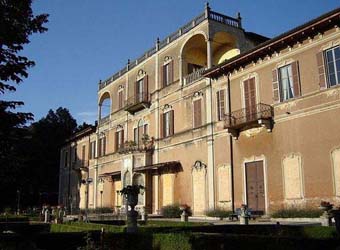
The Villa Cagnola.*


The view from in front of the Villa Cagnola. Those are the Alps.


The view of the garden in back. That's Lake Varese.


The same scene at sunset. The bright star is the planet Venus, approaching a rare conjunction with the planet Jupiter (just visible up and a little to the left).


At a certain point it was cool to erect faux ruins in your Italian garden. This tower was put up in the garden in the late nineteenth century to give the impression that it was all that remained of an ancient building such as a monastery.


The last session of the Seminar, which happened to be my paper. You can see me sitting in front of the screen on the right side.*


A column from one of the manuscripts of the Book of the Dead in the Egyptian Museum in Turin. That's the funerary god Anubis.


The Shroud of Turin. It looked just like in all the photos you've seen. Past posts on the Shroud of Turin are here and here and many links.

*Photos with asterisks are courtesy of Gabriele Boccaccini. The other photographs are my own.

Fourth-century mosaic excavated in Nazareth

AT THE CHURCH OF THE ANNUNCIATION: Early Christian Mosaic Floor Unearthed in Nazareth (Archaeology Magazine).

Mysterious dolphin sculpture

ARTIFACT: Mysterious 2,000-year-old marble dolphin surfaces near Gaza. Archaeologists think 16-inch-high statuette found in southern Israel may have been part of larger sculpture, wonder how it ended up in Byzantine floor (Ilan Ben Zion, Times of Israel). It kind of looks like a relic of the Lovecraftian elder gods.

Developments in Palmyra

PALMYRA WATCH: While I was away, there were some developments concerning the ruins of Palmyra, none of them good.

ISIS Terrorists Mine, Booby-Trap Ancient Palmyra, UNESCO Site (Hana Levi Julian, The Jewish Press).
It is not yet clear whether the terror organization is preparing the destroy the ancient ruins, or has planted the explosives in order to deter government forces from advancing towards the city.
IS destroys ancient Muslim mausoleums in Syria’s Palmyra Deeming venerated tombs ‘a return to paganism,’ jihadists blow them up, reportedly lay mines throughout ancient ruins (AFP/Times of Israel).

Background here and links.

The Church of the Loaves and Fishes

A STORY OF REVERSALS OF FORTUNE: A history of the Church of Loaves and Fishes: Burned down, again. Originally built in the 4th century, the ancient church was lost to time, rediscovered in the early 20th century and rebuilt – only to be badly damaged by fire last week (Elon Gilad, Haaretz). Excerpts:
On Wednesday night [i.e., a week ago Wednesday - JRD], the Church of the Multiplication of the Loaves and Fishes in Tabgha, on the shore of the Sea of Galilee, suffered serious damage that the police suspect was caused by arson: Hebrew graffiti found on the site read “False idols will be smashed.” The church was only 33 years old, but was built on the same site of the first church built to mark the spot more than 1600 years ago.

[...]

The gospels do not say exactly where this miracle happened, beyond Luke’s account that it was in “a desert place belonging to the city called Bethsaida.” We are not sure where Bethsaida was either. But during the first three centuries of the Common Era, a tradition developed among local early Christians that the rock formation by the side of the road on the northwestern corner of the Sea of Galilee was the site of the miracle.

First church, 4th century: Founded by the convert Josepos

In the middle of the 4th century CE, a small church was erected on the site, possibly by a convert named Josepos.

[...]

Second church, 5th century: The Egyptian custom

During the second half of the 5th century, a much larger Byzantine church was built on the site of the original church. The patron of the construction project was Martyrios, the Patriarch of Jerusalem.
Background on the heinous destruction of the church is here and links.

UPDATE: Thousands of Christians hold protest rally outside burned Galilee church (Peter Kenny, Ecumenical News).
Thousands of Christians have held a protest rally in the Galilee, near the historic church in northern Israel that was seriously damaged after a suspected arson attack which included anti-Christian sentiment scrawled in Hebrew on a wall.

The Church of the Multiplication in Tabgha was set on fire early on June 17 and the suspected hate crime drew fierce condemnation from Israeli leaders from major political parties, The Times of Israel reported.

[...]
Yes, the response of the Israeli government has been exemplary. I hope they catch the perpetrators soon.

On the Deuteronomistic History

ASKING THE IMPORTANT QUESTIONS: Who really wrote the biblical books of Kings and the prophets? The paean to King Josiah and exalted descriptions of the ancient Israelite empires beg the thought that he and his scribes lie behind the Deuteronomistic History (Elon Gilad, Haaretz). Excerpt:
Scholars have long rejected the idea that the Deuteronomistic History was written by the characters depicted in the story. Firstly, none were written in the first person, which is how witness accounts are generally written. If anything, they are written from the perspective of an all-knowing narrator writing from a vantage point well into the future.

In addition, had these books been written by different people over hundreds of years, we would expect quite a bit of variation in language and style from part to part (note the differences between Middle English and modern!).

Yet the bulk of these books are written in a uniform manner. That indicates they were written at about the same time, if not by the same person.

Take for example the phrase “to this day.” It is rare in the rest of the Bible, appearing only 13 times outside the Deuteronomistic History. But within, the phrase abounds (multiple times in each of Deuteronomy 6; Joshua 13; Samuel 11; Kings 13). This first of all suggests single authorship. It also attests that the author was not writing about contemporary events but events in the distant past.
This is a good account of the mainstream scholarly view about the origins of the Deuteronomistic History. There is, as the article observes, plenty of variation in the views held by specific scholars, but most would hold to something not far off from this. I have some more observations on the Deuteronomistic History here.

I am back from Italy and have a big backlog of stories to post on, and it will probably take me a few days to catch up. I'm working on a brief conference report, but I need to interchange the photos on my various incompatible devices before I can post it. Perhaps this evening.

Sunday, June 28, 2015

Of lead codices and lead coffins

FAKE METAL CODICES WATCH: Pondering Lead Sarcophagi and Codices … hmmmm. Over at Rogue Classicism, David Meadows has noted some intriguing parallels.

Background here and links.

Miller, The Name of God in Jewish Thought

FORTHCOMING FROM ROUTLEDGE:
The Name of God in Jewish Thought
A Philosophical Analysis of Mystical Traditions from Apocalyptic to Kabbalah


By Michael T Miller


Routledge – 2016 – 256 pages

Series: Routledge Jewish Studies Series

One of the most powerful traditions of the Jewish fascination with language is that of the Name. Indeed, the Jewish mystical tradition would seem a two millennia long meditation on the nature of name in relation to object, and how name mediates between subject and object. Even within the tide of the 20th century’s linguistic turn, the aspect most notable in – the almost entirely secular - Jewish philosophers is that of the personal name, here given pivotal importance in the articulation of human relationships and dialogue.

The Name of God in Jewish Thought examines the texts of Judaism pertaining to the Name of God, offering a philosophical analysis of these as a means of understanding the metaphysical role of the name generally, in terms of its relationship with identity. The book begins with the formation of rabbinic Judaism in Late Antiquity, travelling through the development of the motif into the Medieval Kabbalah, where the Name reaches its grandest and most systematic statement – and the one which has most helped to form the ideas of Jewish philosophers in the 20th and 21st Century. This investigation will highlight certain metaphysical ideas which have developed within Judaism from the Biblical sources, and which present a direct challenge to the paradigms of western philosophy. Thus a grander subtext is a criticism of the Greek metaphysics of being which the west has inherited, and which Jewish philosophers often subject to challenges of varying subtlety; it is these philosophers who often place a peculiar emphasis on the personal name, and this emphasis depends on the historical influence of the Jewish metaphysical tradition of the Name of God.

Providing a comprehensive description of historical aspects of Jewish Name-Theology, this book also offers new ways of thinking about subjectivity and ontology through its original approach to the nature of the name, combining philosophy with text-critical analysis. As such, it is an essential resource for students and scholars of Jewish Studies, Philosophy and Religion.