Wednesday, January 18, 2006

WHAT DO ELISHA and The Hitchhiker's Guide to the Galaxy have in common? See Chris Weimer's comment to this Gypsy Scholar post to find out.

Cross file under "Cosmic Synchronicities."

UPDATE (19 January): Chris e-mails:
I saw you had mentioned my note on the number 42 and Elisha. There's more - Judges reports 42000 "sibboleth" sayers slain, 42 of Ahab's descendents slain, and 42 plays a role in the Apocalypse of John. I wish I could find the article I was looking for. If I do, I'll let you know. All I remember is that the article had an allusion to "Hitchhiker's" in the title, something along the lines of "Life, the Universe"... Have you heard of the article?

No, I haven't, but perhaps one of PaleoJudaica's resourceful readers has.
UPDATE: This isn't it, but reader Colin Toffelmire notes a related article:
Laura Joffe “The Answer to the Meaning of Life, the Universe and the Elohistic Psalter” JSOT 27 (2002): 223-235.

UPDATE: Chris e-mails to thank Colin and writes:
Ah, yes, that was the article that I had in mind. If I may quote the relevant portions to you.

"It is therefore my suggestion that the Elohistic editing was motivated by the desire to link the names of God with the number 42—to alter them according to the number 42, possibly by reducing the instances of the divine name Yahweh in these Psalms to 42.4 The motivation for the redaction would have been magical or theurgic."

"In the Hebrew Bible, 42 is a number of disaster and ill-omen. 42,000 Ephraimites are slain for not being able to say 'shibboleth' in Judg. 12.6. In 2 Kgs 10.14, the 42 relatives of Ahaziah are killed by Jehu. The Chronicles parallel of this incident is instructive. While the Chronicler does not specify how many relatives were killed (2 Chron. 22.8), he does alter the age at which Ahaziah came to the throne from 22 years (2 Kgs 8.26) to 42 (2 Chron. 22.2)."

"Particularly relevant to my case is 2 Kgs 2.24. Here Elisha curses in the name of Yahweh the children who had been taunting him (ויקללם בשם יהוה). Two bears then come out of the wood and kill 42 of them. Note the artificial (providential?) nature of the number in this incident—rather than having 42 children taunt Elisha, 42 of a larger group are slain by bears who, presumably, can count. This instance incorporates the three elements which are central to my case: cursing, the name of Yahweh, and the number 42."

"Turning to the New Testament, Rev. 11.2 gives the period of rampage to be 42 months (or put differently, 1260 days in Rev. 11.3; 12.6). In Revelation 13, a beast with blasphemous names on its head (v. 1) spends a period of 42 months (v. 5) blaspheming against God and his name (v. 6). Thus while 42 clearly has a larger, diabolical tradition, we have in Rev. 13.1-5 a restatement of the triad: blaspheming, the name of God, and the number 42.

The number 42 resurfaces in Jewish tradition in the form of a 42-lettered name of God, which is well-attested from the Talmud to the present day."

Hmmm ... I'm still not sure what the ultimate question is.
IN THE MAIL:
Colette Sirat, Hebrew Manuscripts of the Middle Ages

David Noy (ed.), Jewish Inscriptions of Western Europe Volume 1, Italy (excluding the City of Rome), Spain and Gaul

David Noy (ed.), Jewish Inscriptions of Western Europe: Volume 2, The City of Rome

Keith Sidwell, Reading Medieval Latin

Kenneth Seeskin (ed.), The Cambridge Companion to Maimonides

Peter Adamson and Richard C. Taylor (eds.), The Cambridge Companion to Arabic Philosophy
TEMPLE MOUNT WATCH:
Study offers solutions for J'lem holy sites
By ETGAR LEFKOVITS (Jerusalem Post)

Israel and the Palestinians should allow the international community to supervise Jerusalem's Temple Mount and the city's other holy sites, a study carried out by a liberal Jerusalem think tank and released Tuesday said.

"The strong connection of members of all monotheistic religions to the city on the one hand, and the lack of trust between Israel and the Palestinian Authority on the other justifies some international intervention in overseeing the area, especially from the security
standpoint and with regard to preserving the holy sites," the study by the Jerusalem Institute for Israel Studies states.

[...]

However, some of the response has not been enthusiastic:
The study, which was widely criticized by Israeli politicians on both the right and left, notes that both sides may in fact perceive international sovereignty on the Temple Mount as a desecration and try to fight such a plan.

Jerusalem Mayor Uri Lupolianski called the proposal an "irresponsible political and populist plan" which has been rehashed during an election campaign.

He said that it was simply unacceptable that the most holy site in Judaism would fall under international control.

Ynet News has more on the proposal here and more on the negative reaction within Israel here.

Tuesday, January 17, 2006

A DOZEN DANGEROUS IDEAS IN BIBLICAL STUDIES: Loren Rosson lists them and comments on each over at The Busybody.
THERE'S AN M. R. JAMES ONLINE NEWS PAGE that amounts to a blog on James. And there's also a twice-yearly The Ghosts & Scholars M.R. James Newsletter posted on the same page. I found the site through a referral back to this blog.
MORE ON JUDAS: It appears that the move to rehabilitate Judas goes back at least a decade. Reader Maurice A. O'Sullivan alerts me to this review and collection of review-excerpts of William Klassen, Judas: Betrayer or Friend of Jesus?
PRAVDA MEANS "TRUTH":
"Ariel Sharon's disease caused with ancient Kaballistic curse"

With "Kabbalah" misspelled. Sigh.

The article isn't very good but, to be fair, it's not as bad as the headline implies.
LOST BOOKS WATCH: Chris Weimer has revived this theme and given us his top 10 list of lost works he'd like to see recovered. For my rather longer list (and links to many other lists) see here and here. And could Chris's "lost Jewish book of healings" be this one?

Monday, January 16, 2006

DR. ALEXANDER PANAYOTOV has just arrived in St. Andrews to take up his post as Leverhulme Research Fellow for the More Old Testament Pseudepigrapha Project. Welcome, Alex, and thanks once again to the Leverhulme Trust for their support! Project contributors should be hearing more from us soon.
EZEKIEL CONFERENCE:
Ben-Gurion University of the Negev, Beer-Sheva
Department of Bible, Archaeology and Ancient Near Eastern Studies
Is pleased to invite you to a one day conference on
THE WORD of the LORD to EZEKIEL THE PRIEST
Marking the appearance of
The Book of Ezekiel in the Miqra Le-Yisrael Commentary Series
By Professor Rimon Kasher
Which will take place on Tuesday, 2 Shevat, 5766 (31 January, 2006)
In Conference Hall A, Hayim Kreitman Building, Marcus Family Campus

Program

9:30-10:00 Reception
10:00-12:30 Morning Session Prof. Victor Hurowitz, Chairman

Greetings Professor Avishai Henik, Dean of the Faculty of Humanities and Social Sciences, Ben-Gurion University of the Negev

Awarding of Takeji Otsuki Fund scholarship to outstanding student

10:15-10:45 Mr. Shawn Selig Aster, Ben-Gurion University
The Glory of the Lord (Kevod YHWH) in the Book of Ezekiel and its Mesopotamian Background

10:45-11:15 Dr. Dalit Rom-Shiloni, Hebrew University and Hebrew Union
College
Shall you inherit the Land? Ezekiel as the Shaper of Exclusivist Ideology in the Early 6th Century BCE

11:15-11:30 Intermission

11:30-12:00 Dr. Baruch Schwartz, Hebrew University
Ezekiel and the Priestly Source Further Connections

12:00-12:30 Mr. Nebo Shimeon Vankin
The Book of Ezekiel and its Relationship to the Deuteronomic Legislation

12:30-14:00 Lunch Break

14:00-16:15 Afternoon Session, Dr. David Glatt-Gilead, Chairman

14:00-14:30 Prof. Mayer Gruber, Ben-Gurion University
The Language of the Book of Ezekiel in Light of Akkadian

14:30-15:00 Prof. (emeritus) Jacob Milgrom, University of California,
Berkley
The Unique Features of Ezekiels Temple From whence?

15:00-15:15 Intermission

15:15-15:45 Prof. Rimon Kasher, Bar-Ilan University
Ezekiel and Apocalypticism in Current Research

15:45-16:18 Prof. (Emeritus) Menahem Haran, Hebrew University
The Last Word

(From Victor Avigdor Hurowitz on the ANE List.)
HERE'S A REPORT on November's SBL conference in Philadelphia, published (apparently accidentally in two versions with editor's comments in between) in the local newspaper of Aberdeen South Dakota. The Old Testament pseudepigrapha and other early Jewish writings get good coverage:
One major approach is to study the biblical writings within the larger context of ancient Jewish and Christian literature. Many ancient Jewish and Christian writings were not accepted into the Bible, but still shed light on the beliefs and practices of various ancient communities, and on the biblical writings themselves.

Several groups study the Dead Sea Scrolls, ancient Jewish writings like 1 Enoch, 4 Ezra, the Psalms of Solomon, or the Ascension of Isaiah. Early Christian writings studied include the Acts of Peter, the Gospel of Mary, and the Infancy Gospel of Thomas. Several papers were devoted to the writings of two figures roughly contemporary with Jesus: the Jewish historian Josephus and the Jewish philosopher and biblical commentator Philo.

Many groups are focused on the relationship between Judaism and Christianity during the first few centuries of Christianity. I presented a paper on a fourth-century document that records a debate between Jews and Christians on whether certain Old Testament scriptures are prophecies of Jesus or refer to other historical events.

The author is Martin Albl, who teaches religious studies at Presentation College.
PLEASE TELL ME THIS IS A JOKE:
Welcome to Florida's biblical theme park

Neva Chonin (San Francisco Chronicle)

Sunday, January 15, 2006
01/15/2006

Karl Marx once famously stated that religion was the opiate of the masses. Karl never saw a theme park. And Karl probably never, in his wildest lumpen dreams, imagined a religious theme park.

Let us trace the genesis of Karl's worst nightmare. In the beginning, there was Disney World. Disney World begat Universal Studios. Christians looked upon these theme parks and saw that they were good. And so it was, in the year of our Lord 2001, that Universal Studios begat the Holy Land Experience, a Christian theme park built in the middle of an Orlando, Fla., wasteland described by park founder Marvin Rosenthal as being "full of snakes."

Maybe the reptiles were just lining up to audition for the Eden Serpent Chorale. Four years in the making, the Holy Land Experience is an exercise in simulacrum run wild. The 15-acre, $16 million park, which opened Monday, re- creates Palestine during the biblical era: Visitors pay their $17 admission fee, obtain Holy Land passports and pass through a life-size Jerusalem Gate. They are welcomed by caftan-wearing actors bleating on rams' horns. Moving along, they encounter Roman soldiers guarding the entrance to Herod's Temple, where they listen to songs about Rome's persecution of Christians.

[...]

I hope the Program Committee doesn't decide to hold the 2011 Society of Biblical Literature meeting there.

Sunday, January 15, 2006

THEY'RE BAAACK! The Bible and Interpretation news website has gone live again with the following essay:
The Reaction to the Bible in Paganism


Although pagan authors were aware of the LXX before the advent of Christianity, apparently the Christian apologists’ use of LXX texts to buttress their faith made the pagans look deeply into the LXX. They attacked LXX texts as part of their larger project of undermining Christianity. The pagans faded away, but some of their criticisms experienced a resurgence in modern biblical scholarship. Some of the questions they raised (e.g., monotheism and Christology) continue to play a role in Christianity’s dialogue with other world religions.


By John Granger Cook
LaGrange College, LaGrange, Georgia

It's good to see the site active again.
EDINBURGH SBL PAPER: I just got the good news that my paper proposal has been accepted by the Apocrypha and Pseudepigrapha Section of the upcoming International Society of Biblical Literature meeting in Edinburgh in July. Here's the abstract:
MORE JEWISH PSEUDEPIGRAPHA
James R. Davila, University of St. Andrews, U.K.

The More Old Testament Pseudepigrapha project at the University of St. Andrews (http://www.st-andrews.ac.uk/academic/divinity/MOTP/index-motp.html) has assembled an international team of scholars to translate a new collection of Old Testament Pseudepigrapha. The corpus of texts, which generally can be dated to c. 600 C.E. or earlier, includes more than sixty complete or nearly complete works and numerous fragments. These documents are not covered in the Charlesworth volumes, apart from a few for which we have important new manuscript evidence. The corpus includes pagan works, Jewish pseudepigrapha transmitted by Jews, Jewish pseudepigrapha transmitted by Christians, and pseudepigrapha composed by Christians.

This paper surveys and comments on the twenty or so texts that can be assigned to Jewish authorship with virtual certainty. Most of them survive in Hebrew or Aramaic and were transmitted in Jewish circles, but a collection of sermons is preserved only in Armenian. They include apocalyses of Elijah and Zerubbabel; a visionary text ascribed to Ezekiel; a prophecy attributed to Gad the Seer; magical treatises; a sapiential work; ancient Jewish sermons on biblical figures; a Hebrew prayer paralleled in the Slavonic Ladder of Jacob; a poetic text about David and Goliath; narratives about the giants, Noah, the patriarchs, the Maccabean revolt, and related midrashic material; and a text that claims to tell how and where the treasures of Solomon's Temple were hidden at the time of its destruction. Specialists will be familiar with some of these texts, but few will have studied all of them. By collecting translations of these documents with introductions, we aim to raise their profile among both scholars and nonspecialists.

Saturday, January 14, 2006

TECHNOLOGY WATCH - News from the DNA front:
3.5 million Ashkenazi Jews 'traced to four female ancestors'
By Donald Macintyre in Jerusalem (The Independent
Published: 14 January 2006

A total of 3.5 million Ashkenazi Jews are descended from just four "founding mothers" who lived in Europe at least 1,000 years ago, according to a study by Israeli geneticists.

The four women were part of a small group which founded the Ashkenazi community, established in Europe after migration from the Middle East, and was ultimately descended from Jews who migrated to Italy in the first and second centuries AD.

The discovery that the women are the ancestors of some 40 per cent of all eight million Ashkenazi, or European Jews, has been made possible by analysing the michrondrial DNA [mtDNA] component of the human genome. MtDNA is only transmitted through the female line.

[...]
MORE ON THE POST-REVOLT, POSSIBLY-JEWISH VILLAGE NEAR JERUSALEM:
Train to antiquity
By REUVEN ROSENFELDER (Jerusalem Post

An archaeological dig, about five kilometers north of the Old City, has uncovered a complete community that existed during the two generations between the destruction of the Second Temple in 70 CE and the Bar-Kochba Rebellion in 132 CE.

The dig is proceeding along a 360-meter stretch smack in the center island of Shu'afat Road, the main traffic artery from Jerusalem to Ramallah and farther north to Nablus (Schechem). Perhaps more importantly, and certainly more controversially, the artery is also the route of the future line No.1 of the Jerusalem Light Rail system.

This may cause some complications in the construction:
Caught between the significance of the find and the necessity of the Light Rail, the Israel Antiquities Authority will hold internal discussions to determine its stand regarding the findings, [Jon] Seligman[, archaeologist in charge of the Authority's Jerusalem Region,] said.

Spokespersons for the Light Rail enterprise do not seem concerned that the headline-generating archaeological find will affect their plans. Itsho Gur, speaking for both Moriah and CityPass, the concessionaire who won the government contract to operate the Light Rail, does not expect a delay in development works.

Here's some more information on what was found:
The abundance of lathe-turned stone vessels, which according to Halacha (Jewish religious law) do not take on impurity, is a sure sign of Jewish settlement and was often found in Jerusalem of the Second Temple era, she added.

Here, however, there is more, according to Sklar-Parnes, because this is a post-Destruction site. Eighteen ancient coins were found and sent for scientific examination. Almost all were from the period 70 to 132 CE. A few were from a slightly earlier period; none are later. A test of other objects pointed to similar dating, and ceramic finds showed stylistic features as yet unseen.

Senior archaeologist Avni backs Sklar-Parnes' position. "We know about the War of Destruction and the exile of Jews from inside the city, but what about neighboring areas? So far, there have been no finds. Now we have a defined period and specific Jewish elements."

It is not easy to determine the nature of this settlement, said Avni. Two Roman bathhouses were found during the dig, possibly serving soldiers of the Tenth Legion stationed not far away - so perhaps, for example, the settlement had a working relationship with the Romans.

No ritual baths, though.

And this is especially interesting:
Five ink-wells were found at the site, more than unearthed in Qumran, which is believed to have been home of the Dead Sea Sect, scribes of the famous scrolls.

Friday, January 13, 2006

THE COPTIC GOSPEL OF JUDAS is the subject of a somewhat muddled article in the Telegraph. The headline does not inspire confidence:
Forbidden gospel 'will show Judas was acting for God'

"Forbidden?" Well, maybe it was at some point. Certainly there would have been people in antiquity who wanted it to be. Indeed it was lost for a long time, presumably because its content doesn't square well with mainstream Christianity, but "forbidden" is a little melodramatic. But of greater concern, the rest of the headline in quotes implies misleadingly that the Gospel of Judas tells us something about the historical Judas and that theologians are taking it as an authority. To be fair, this is not just a sensational headline: the author, "Hilary Clarke, in Rome," actually does seem to think that this new gospel is being understood in this way:
Although the full details have not yet been made public, snippets discussed in academic circles say it will prove Judas was acting at the behest of God when he sold Jesus to the Romans for 30 pieces of silver.

No one in academic circles says any such thing. At most, that may be what the Gospel of Judas says, which tells us something interesting about nontraditional Christianity in the second to fourth centuries, but nothing about the historical Judas. And I've certainly not heard anyone who worries about such things suggest that the Gospel of Judas should be added to the New Testament canon or should have theological authority.
Its publication will raise fears among traditionalists that efforts may be made to rehabilitate a man whose name is synonymous with betrayal.

Sympathisers with Judas contend that had Jesus not been crucified, he would not have been subsequently resurrected to save humanity.

The first sentence seems to allude to recent efforts within the Catholic Church to rehabilitate Judas. I doubt very much that the Gospel of Judas will have much importance in this discussion (see below). Of course, it doesn't help when articles like this leave nonspecialists with the impression that scholars think that the Gospel of Judas is an eyewitness account by Judas:
Controversy also surrounds the origins of the text, which dates from the fourth century, with some scholars arguing that it was not written by Judas, but by a group of his supporters.

Again, no scholars are arguing that it was written by Judas. Some think that it may have been composed in Greek as early as the second century. I have my doubts even about that.

This sort of thing is irritating and one wonders how it happens. No one is actually quoted and the article speaks in generalities about "academics," "traditionalists," "sympathizers," and "scholars." Did the writer talk to anyone involved with the project or any expert on the apocryphal gospels? It doesn't sound like it. Is the piece based on a badly misread press release? I don't know.

But it is disappointing.

Another story about Judas is making the rounds and it seems to have influenced the Telegraph article. Here is the coverage in the Times of London:
Judas the Misunderstood

From Richard Owen, in Rome

Vatican moves to clear reviled disciple’s name

JUDAS ISCARIOT, the disciple who betrayed Jesus with a kiss, is to be given a makeover by Vatican scholars.

[...]

Now, a campaign led by Monsignor Walter Brandmuller, head of the Pontifical Committee for Historical Science, is aimed at persuading believers to look kindly at a man reviled for 2,000 years.

Mgr Brandmuller told fellow scholars it was time for a “re-reading” of the Judas story. He is supported by Vittorio Messori, a prominent Catholic writer close to both Pope Benedict XVI and the late John Paul II.

[...]

Some Bible experts say Judas was “a victim of a theological libel which helped to create anti Semitism” by forming an image of him as a “sinister villain” prepared to betray for money.

[...]

This move is based on historical, theological, and political considerations that have nothing to do with the Gospel of Judas and only weak potential links with it.
The move to clear Judas’s name coincides with plans to publish the alleged Gospel of Judas for the first time in English, German and French. Though not written by Judas, it is said to reflect the belief among early Christians — now gaining ground in the Vatican — that in betraying Christ Judas was fulfilling a divine mission, which led to the arrest and Crucifixion of Jesus and hence to man’s salvation.

Mgr Brandmuller said that he expected “no new historical evidence” from the supposed gospel, which had been excluded from the canon of accepted Scripture.

But it could “serve to reconstruct the events and context of Christ’s teachings as they were seen by the early Christians”. This included that Jesus had always preached “forgiveness for one’s enemies”.

On the one hand, the Gospel of Judas can be used to show that there is some ancient precedent for rehabilitating Judas. But on the other hand, invoking it could backfire:
Some Vatican scholars have expressed concern over the reconsideration of Judas. Monsignor Giovanni D’Ercole, a Vatican theologian, said it was “dangerous to re-evaulate Judas and muddy the Gospel accounts by reference to apocryphal writings. This can only create confusion in believers.”

I'm happy to sit this one out and watch. Should be an interesting discussion.

UPDATE: Times columnist Ben Macintyre argues the case for rehabilitating Judas. One small substantive point. Macintyre writes:
The chronological progression of the allegations is crucial. St Paul, the earliest Christian writer, never mentions Judas.

True, but incomplete and a little misleading. Here's what Paul says about the Last Supper in 1 Corinthians 11:23-26 (RSV):
23: For I received from the Lord what I also delivered to you, that the Lord Jesus on the night when he was betrayed (παρεδίδετο) took bread,
24: and when he had given thanks, he broke it, and said, "This is my body which is for you. Do this in remembrance of me."
25: In the same way also the cup, after supper, saying, "This cup is the new covenant in my blood. Do this, as often as you drink it, in remembrance of me."
26: For as often as you eat this bread and drink the cup, you proclaim the Lord's death until he comes.

Now Macintyre is quite right that the word translated "betrayed" in v. 23 can also just mean to be "handed over" (although his suggestion that Judas "may simply have been acting as a go-between" is not well founded and indeed flies in the face of everything in the tradition). But here we have to ask "handed over" to whom -- presumably the authorities who condemned him -- and, more critically, by whom? The implication of Paul's statement is that someone did the handing over. In other words, it not unreasonable to read Paul to be alluding to the tradition about Judas, although it's impossible to be sure.

UPDATE (20 January): The Vatican has denied the claims in the Times article.

Thursday, January 12, 2006

PHILOLOGOS ON GEMATRIA:
Numerology is the belief in the significance of numbers in non-mathematical contexts. (If I say two times 12 adds up to 24, that's arithmetic; but if I say that the 12 tribes and the 12 signs of the Zodiac add up to the cosmic mission of Israel, that's numerology.) The Hebrew word for numerology is gematria, an ancient rabbinic term that comes from Greek geometria (the measuring of the earth), from which also derives our English "geometry." Although it may seem odd to think of geometry as having to do with numbers, since it is the one part of most people's mathematical education that has nothing to do with them, this was not true of the ancient Greeks; having no knowledge of algebra, they used geometry to solve algebraic problems, thus introducing numbers into it.

The column gives lots of interesting examples.
THE PROPOSED HOLY LAND THEME PARK in Israel may be canceled due to Pat Robertson's comments about Ariel Sharon's stroke:
Israel May Scuttle Evangelical Complex
By ANTHONY WEISS (The Forward
January 13, 2006

The Israeli Tourism Ministry is threatening to block the Rev. Pat Robertson's plan for an evangelical center alongside the Sea of Galilee, after the televangelist suggested last week that Prime Minister Sharon's stroke was a punishment from God.

"We cannot do business with him after these words," ministry spokesman Ido Hartuv told the Forward. "We have to rethink the agreement with him."

The Tourism Ministry reportedly has been working with a group of investors, led by Robertson, who want to open a center on the shores of the Sea of Galilee, in the vicinity of a number of Christian holy sites. According to Hartuv, the Israeli government was prepared to offer the land for the center free of charge — until Robertson spoke out last week on his television program, "The 700 Club."

[...]

Can't say I blame them.

UPDATE (13 January): Robertson has apologized, but that's not getting him his place back on the theme park project. (Via Tzvee.blog.)

Wednesday, January 11, 2006

MORE ON THE DEAD SEA SCROLLS EXHIBIT coming to the Pacific Science Center in Washington.
Pacific Science Center to exhibit Dead Sea Scrolls
By Cathy Herholdt (Lynnwood Journal Newspapers, WA)
01/10/2006

Pacific Science Center representatives in December announced to an anticipative audience of media representatives, students and community leaders that it will host the West Coast premiere of Discovering the Dead Sea Scrolls, a new exhibition that will open on Sept. 23, 2006. The exhibit will feature four scrolls never before seen by the public and another making its first appearance outside Israel.

[...]

Transcripts of Genesis, Exodus, Ezekiel, and the War Rule, all found in Qumran Cave 4 off the northwestern shore of the Dead Sea between Jerusalem and Jericho in the 1950's, will make their public debut in the exhibition. Pacific Science Center is sponsoring the conservation of these manuscripts for their world premiere public viewing.

The exhibit will cost $1.8 million before the doors even open.

Preservation of the four scrolls by archivists from Jerusalem involves placing the documents between two layers of nearly invisible archival mesh, then inside glass cases that will never tip. The glass is then placed in padded cases for transportation. Humidity and temperature are controlled, and the scrolls must be kept out of the light for a certain number of hours each day. Visitors will enter darkened rooms to view the scrolls.

[...]

I'm not sure what "transcripts" means here. Evidently part of the exhibit consists of facsimiles of scrolls, but I'm pretty sure these four are the originals. Maybe the author of the article just meant to say "displays."

Tuesday, January 10, 2006

MY DANGEROUS IDEA: Inspired by a cool beginning-of-the-year collection of essays in The Edge, Loren Rosson has called for bibliobloggers to post "their one 'dangerous idea' for biblical studies." If you know me or read this blog frequently, mine won't be a great surprise. But here it is:
Many of the ancient texts used by New Testament scholars as sources for first-century Judaism as background material for the New Testament are actually either Christian compositions or were written long after the first century, or both, and insofar as reconstructions of early Judaism are based on them, those reconstructions are of dubious value.

In my new book The Provenance of the Pseudepigrapha: Jewish, Christian, or Other?, and elsewhere, I have argued that this should be our understanding of many Old Testament pseudepigrapha and perhaps even one or two Old Testament Apocrypha. I do not believe that a convincing case has been made for any book of Sibylline Oracles as Jewish, although there probably is Jewish material somewhere in them. Nor has a Jewish origin or early date been persuasively argued for the Testament of Job, Joseph and Aseneth, the Lives of the Prophets, the Testament of Abraham, the Story of Zosimus, Pseudo-Phocylides, the Life of Adam and Eve, or the Prayer of Manasseh. The Testaments of the Twelve Patriarchs draws on Jewish sources but is itself a Christian composition from well after the New Testament period. There are even some reasons to think that the Wisdom of Solomon in the Apocrypha could be a Christian composition.

As for rabbinic sources, even the earliest rabbinic collection, the Mishnah, was based on oral traditions and was only written down after 200 CE. The attribution of sayings to named (and therefore datable) sages is not reliable and cannot be used on its own to date a given saying. It is possible to show that some sayings are probably earlier than others on stratigraphic grounds and this in tandem with name attributions can allow us to isolate some early material. (In other words, if a group of sayings attributed to specific first-century sages can consistently be shown to be the basis of discussion for a group of sayings attributed to second century sages and not the other way around, there is a case for dating the first set of sayings in the first century.) In other cases, Mishnaic and Tannaitic ideas can be shown to be early because there are early parallels to them (but then the parallel already shows that the idea is early). But all this involves a lot of difficult spadework that isn't necessarily always done by people looking for New Testament background.

Related reflections here.
AN "ANTIQUITY IN ANTIQUITY" COLLOQUIUM at Princeton:
ANTIQUITY IN ANTIQUITY
JEWISH AND CHRISTIAN PASTS IN THE
GRECO-ROMAN WORLD
Workshop: October-December, 2005
• Colloquium: January 22-24, 2006
Princeton University

Introduction

For the fourth time in six years, the Department of Religion of Princeton University will host a workshop and colloquium on a special topic concerning religions and societies of late antiquity. This year’s project, entitled Antiquity in Antiquity: Jewish and Christian Pasts in the Greco-Roman World, will explore the themes of tradition construction and collective memory from the third century BCE to the seventh century CE. The workshop, which will be held during the second half of the fall 2005-6 semester, will feature presentations by doctoral students before a joint faculty-graduate student forum. The colloquium (January 22-24, 2006, at Princeton University) will feature papers by top faculty from both Princeton and other leading universities, representing the fields of religion, classics, history and archaeology. A small number of graduate students selected from our workshop will also be invited to present their papers at the colloquium.

Wish I could go.

(Via Gregg Gardner on Ioudaios-L.)

Monday, January 09, 2006

EDINBURGH SBL & FEMINIST CRITICISM: Professor Heather McKay, Membership Secretary of the Society for Old Testament Study, has sent out this message to SOTS members, which I reproduce here with her permission:

Session on Feminist Criticism's input to Biblical Studies at Edinburgh SBL

Dear colleague

I wonder if you can think of anyone (or yourself) to whom the following Call for Papers for the Edinburgh SBL would be interesting, and if you then would forward it to them urgently. I have just realised (with alarm!) that the deadline for proposals is this Saturday (14/1/06)! The conference dates are Sun 2/7 - Thu 6/7/06; I am the Program Unit Chair and would welcome some strong proposals and some publicity for the session as well.

Committee on the Status of Women in the Profession
Call For Papers: (Sur)Passing Biblical Scholars, Building on Feminist Criticism: Feminist biblical criticism has produced several waves of challenging criticism of biblical texts, with each producing its own eddies and ripples where it combines and recombines with other forms of critical activity. Papers that identify feminist sources and/or the enriching use of feminist approaches to create powerful new readings of biblical texts will be welcomed. This call is open to both male and female scholars alike.

Committee on the Status of Women in the Profession
IN THE MAIL: My review copy of Ra'anan S. Boustan, From Martyr to Mystic: Rabbinic Martyrology and the Making of Merkavah Mysticism (TSAJ 112; Tübingen: Mohr Siebeck, 2005).
ARIEL SHARON'S CURRENT COMA may highlight debates on how to reconcile ancient Jewish halakhah with modern medical technology. This A.P. article has some reflections:
In Israel, physicians typically defer to families or patients about whether the treatment should follow secular or religious codes.

Many rabbis follow a 1986 decision by Israel's chief rabbinate - the government's highest religious authority - that defines death as irreversible inactivity of major parts of the brain stem, which controls breathing, swallowing and other basic bodily functions.

The opinion is based on various Jewish texts including the Mishnah, an early source of rabbinical tradition, which establishes decapitation as an irrefutable sign of death. In the modern sense, the rabbis interpret a nonfunctioning brain stem as the same thing.

But others see the core of life in the heartbeat, which can occur even with a severely damaged brain stem and can continue with artificial respiration. Some rabbis cite ancient texts that say death occurs only when there is both no respiration and no "movement" in the body. They consider a heartbeat a life-signifying movement even if maintained through life-support and may counsel followers not to remove life support.

[...]

The issues are so delicate that it took six years for Israel's top rabbinical scholars, physicians and other experts to hammer out legislation to allow the terminally ill to refuse life support. It passed last month with one unique provision: the equipment could only be turned off by an automatic timer to avoid having a health care worker do it.
J. T. MILIK, 1922-2006. I regret to inform you that J. T. Milik, one of the original members of the Dead Sea Scrolls editorial team, passed away in Paris yesterday. Eileen Schuller and Eibert Tigchelaar have e-mailed with the information and to say that the funeral is on Wednesday.

Milik published a great deal, including some of the Bar Kokhba era material in DJD 2, the Copper Scroll in DJD 3, and the Qumran fragments of 1 Enoch and some of the Book of the Giants material in The Books of Enoch: Aramaic Fragments of Qumran Cave 4.

Another giant in the field has passed on. Requiescat in pace.

Sunday, January 08, 2006

MORE ON THE PARIS EXHIBITION: Reader Tommy Wasserman points me to the website for the Books of Words: Torah, Bible, Koran (Torah, Bible, Coran: Livres de parole) exhibition at http://expositions.bnf.fr/parole/index.htm. There's lots of interesting stuff. The only Dead Sea Scroll I can find is a fragment of Leviticus written in the paleo-Hebrew script. There is mention of a Samuel manuscript as well, but it doesn't seem to be pictured. Here is a polyglot Bible. Here are images of a couple of Jewish amulets. Here is an illustration of a Josephus manuscript depicting the construction of the Jerusalem Temple. Here are pages from a Coptic Gospel of John. Here are images of New Testament manuscripts in Syriac and Ethiopic. And here is a very early (7th century) manuscript of the Qur'an. (Click on the smaller photos to enlarge them and get more explanatory text.) And there's much more. If all this is in the exhibit, it's quite an impressive one.

UPDATE (9 January): There are several Qumran fragments here. Three of them look like they belong to the Leviticus scroll, but the one on the upper left is in the square script and must be from a different manuscript.

UPDATE: Speaking of Quranic manuscripts, here's a BBC article on what it says is the oldest surviving copy of the Qur'an, dating to 651 CE, only 19 years after the death of Muhammad. It is housed in a library in Uzbekistan.

(Via Archaeologica News.)

UPDATE (11 January): David Nishimura has more on that early Qur'an and related matters over at Cronaca.
THE COPTIC GOSPEL OF JUDAS is getting some more attention, thanks to John Dart's recent article. In yesterday's Time Herald, Jim Ketchum comments in an article entitled "New text may deepen Judas debate." He concludes:
Apparently, National Geographic plans to take the wraps off all this by Easter. Hopefully they have done enough homework to authenticate what they have.

If not, this could turn into another case similar to the purported Hitler diaries, the contents of which were judged to be bogus only after a German publication had invested great amounts of time, money and prestige into publishing them.

If this second-century text in fact is real, it will provide grist for theologians to debate for decades to come.

For the rest of us, this new 2,000-year-old story will be an interesting footnote that probably won't do much to change basic Christian beliefs.

Or do much to make over Judas' reputation.

It's always worthwhile to be skeptical of unprovenanced manuscripts, but a fake of this length and complexity would be awfully hard to pull off. But I am skeptical about the second century date. I'm not a Coptologist, but I'm suspicious about the way that texts in fourth and fifth-century Coptic manuscripts are often assumed to be translations of second-century Greek originals. We know that's the case with the Gospel of Thomas, because we have second-century Greek fragments of it. But we also know that Coptic borrowed a lot of Greek words as a matter of course. And I think a lot more homework needs to be done before we can be very confident of distinguishing Greek-translation Coptic from Coptic composed in a biblical style. Anyhow, we'll see.

I doubt that theologians will be very interested. The real importance of the Coptic Gospel of Judas is for the understanding of Jesus and his disciples in Coptic-speaking (and perhaps Greek-speaking) Christianity of roughly the second through fourth centuries CE. For specialists in Christianity of late antiquity, it is of great interest indeed. Plus, a popular audience will think it's cool because it's so countercultural.

UPDATE (17 January): More
A NUMEROLOGICAL NITPICK: This otherwise good Wichita Eagle article by Tom Schaefer on creation, evolution, and the Bible opens:
Raising cautions about science vs. religion

"In the beginning, God created the heavens and the earth." Ten English words. Six in Hebrew. The basics of creation.

No, it's seven words in Hebrew:

בראשית ברא אלהים את השמים ואת הארץ׃

Like God would neglect to put seven words in the first verse of the Bible!

Saturday, January 07, 2006

MORE RESEARCH ON PHOENICIAN HARBORS: A few months ago I noted this story on core samples taken at the harbor of Tyre. Now there's more:
Geoscience rediscovers Phoenicia's buried harbors
Space and Earth science : January 05, 2006 (Physorg.com)

The exact locations of Tyre and Sidon's ancient harbors, Phoenicia's two most important city-states, have attracted scholarly interest and debate for many centuries. New research reveals that the ancient basins lie buried beneath the medieval and modern city centers.

A network of sediment cores have been sunk into the cities' coastal deposits and studied using high-resolution geoscience techniques to elucidate how, where, and when Tyre and Sidon's harbors evolved since their Bronze Age foundations. In effect, ancient port basins are rich geological archives replete with information on human impacts, occupation histories, Holocene coastal evolution, and natural catastrophes.

[...]

(Via Archaeologica News.)

UPDATE: There's an article in Nature as well. (Via Rogue Classicism and the revived Mirabilis blog -- welcome back Christine!)
A SCRIPTURE EXHIBITION IN PARIS:
Exploring the holy scriptures
By Rebecca Assoun in Paris Updated: 06/Jan/2006 14:55
(European Jewish Press)

An exhibition in Paris explores 3,000 years of history through the scriptures of the three monotheistic religions. “Books of words: Torah, Koran, Bible” shows how despite their common base, Judaism, Christianity and Islam developed original and different relationships to the texts.

[...]

The exhibition aims to explain the relationship that Judaism, Christianity and Islam have to the Bible.

“We have gathered fragments of the Dead Sea Scrolls, Hebrew manuscripts celebrating the exit from Egypt, illustrated Bibles from the Middle Ages and the Renaissance, works by Gutenberg and Korans written in golden ink,” she added.

[...]

Around 100 documents reveal the story of these books that have been passed on through generations, from owner to owner and across continents. Visitors can also listen to the various accounts of creation.

[...]

I would like to hear more about those Dead Sea Scroll fragments.

UPDATE (8 January): Much more here.

Friday, January 06, 2006

I KNEW THIS WAS COMING:
Extremists boast they cursed Sharon
By YAAKOV KATZ (Jerusalem Post)

Far-right activists took credit Thursday for the severe deterioration in Ariel Sharon's health, claiming that a pulsa denura - Aramaic for "lashes of fire" - death curse they instigated against the prime minister in July was the real catalyst behind his current state of health.

"I take full responsibility for what happened," far-right activist Baruch Ben-Yosef, one of the participants at the July pulsa denura, told The Jerusalem Post. "Our pulsa denura kicked in. Nothing could kill Sharon and he said his ancestors lived until they over 100 years old but we got him with the pulsa denura."

[...]

You may recall that the pulsa-denura is a curse ceremony created about a century ago. There's more on its historical background here and here. See also here and here on recent events having to do with the cursing of Sharon.

It really isn't a great surprise that a 77-year-old man who was very overweight and who had one of the most stressful jobs on the planet had a stroke, and no death curses are required to explain it. Sigh.

Thursday, January 05, 2006

VOTING WITH COLORED BEADS didn't seem to me to be the best way to proceed, but it's a lot more constructive than this:
Did Jesus exist? Court to decide (CNN)

Wednesday, January 4, 2006; Posted: 1:35 p.m. EST (18:35 GMT)

ROME, Italy (Reuters) -- Forget the U.S. debate over intelligent design versus evolution.

An Italian court is tackling Jesus -- and whether the Roman Catholic Church may be breaking the law by teaching that he existed 2,000 years ago.

The case pits against each other two men in their 70s, who are from the same central Italian town and even went to the same seminary school in their teenage years.

The defendant, Enrico Righi, went on to become a priest writing for the parish newspaper. The plaintiff, Luigi Cascioli, became a vocal atheist who, after years of legal wrangling, is set to get his day in court later this month.

"I started this lawsuit because I wanted to deal the final blow against the Church, the bearer of obscurantism and regression," Cascioli told Reuters.

Cascioli says Righi, and by extension the whole Church, broke two Italian laws. The first is "Abuso di Credulita Popolare" (Abuse of Popular Belief) meant to protect people against being swindled or conned. The second crime, he says, is "Sostituzione di Persona," or impersonation.

[...]

I'm more skeptical about the Jesus traditions than a lot of people, but this is just silly -- so much so that I wonder if it's a hoax. But if it is, it sure has fooled a lot of news carriers.

Two comments. First, the case that Jesus existed and that we can know at least some things about him is quite strong and is not at issue among historical-Jesus specialists. Second, the whole discussion has no place in a court of law and -- assuming the case is real -- if the judge is responsible, he'll throw the case out as frivolous immediately. Otherwise the Italian court system is going to look pretty silly.

Cross file under "You Can't Make This Up."
A DOCUMENTARY on Aramaic-speaking Christians in the Middle East:
Film Review: The Last Assyrians (Les Derniers Assyriens)

By Sonia Nettnin (Scoop.co.nz)


"The Last Assyrians" (Les Derniers Assyriens) is an amazing documentary about the history of the Aramaic-speaking Christians from ancient Mesopotamia until their present-day existence in the Middle East.

For six years Director Robert Alaux researched and wrote this historic documentary. It is the first film that tells the complete history of the Assyrian Chaldean Syriac people. History overlooks how they suffered from massacres, hunger and starvation during the1915 genocide; and the international community has not protected these people in their homeland after decades of mass exodus. Despite their pain and suffering this indigenous Christian community, including the Diaspora seek justice, peace, prosperity, security, and solidarity in the Middle East.

[...]
LIMBO IN THE KABBALAH? Limbo is in limbo right now for the Catholic Church, but Philologos tells us that it had a place in Jewish mystical literature too:
In later kabbalistic literature, however, as well as in the Hasidic circles that were heavily influenced by it, "the world of tohu," conceived as an intermediate stage between the ultimate good of pure spirit and the ultimate evil of pure matter, became a term for a nebulous domain — not unlike the Christian Limbo, in which souls admitted to neither heaven nor hell wandered. The reason for having to lead such an existence had nothing to do with the absence of a rite of initiation like baptism. Rather, the problem was an even balance between the dead man's sins and merits, which left his soul in a no-man's land.
A FESTSCHRIFT FOR JAMES CHARLESWORTH is in the works:
Scholar of Dead Sea Scrolls to be honored by his students
By: David Campbell, Staff Writer 01/03/2006 (Princeton Packet)

Book to be published as tribute to Professor James H. Charlesworth of Princeton Theological Seminary

[...]

Professor James H. Charlesworth, the George L. Collord Professor of New Testament Language and Literature at Princeton Theological Seminary, is a leading expert on the scrolls.
The author and editor of many books, his other areas of research include the first-century Jewish historian Josephus, the Gospel of John, and the Apocrypha and Pseudepigrapha of the Old and New Testaments.
As seminary teacher and founder and longtime director of the Princeton Theological Seminary Dead Sea Scrolls Project, Professor Charlesworth has mentored generations of students who themselves have gone on to academic positions nationwide and around the world.
Now, 11 of his former students, all of whom worked with him on the Scrolls Project, have written essays for a forthcoming new book dedicated in his honor, "Qumran Studies: New Approaches, New Questions," to be published by William B. Eerdmans in the spring.

[...]

Congratulations to Professor Charlesworth!

(As an aside, note that this is the second Google News mention of the pseudepigrapha in the first week of this year. A trend? I hope so.)
MORE ON THE POST-REVOLT ANCIENT JEWISH (?) VILLAGE:
Ancient village discovery raises questions
SARA TOTH
Associated Press

JERUSALEM - Discovery of an ancient village just outside Jerusalem has brought into question one of the strongest images of biblical times - the wholesale flight of Jews running for their lives after the Roman destruction of the Jewish Temple in Jerusalem in 70 A.D.

Just beneath the main road leading north from Jerusalem, archaeologists have found the walls of houses in a well-planned community that existed after the temple's destruction. It might lead to rewriting the history books if it was really Jewish. But at least one expert isn't sure it was.

The discovery of stone vessels indicate Jews in the village continued to live by religious purity laws after 70 A.D., said Debbie Sklar-Parnes, of the Israel Antiquities Authority, who is overseeing the dig.

[...]

But Hebrew University historian Lee Levine questioned whether the village was actually Jewish.

"The evidence is a little mixed," Levine said. The presence of wine amphorae from Italy and the absence of ritual baths cast some doubt on the Jewishness of the village, he said.

[...]

The village ceased to be occupied around 132, when the Bar Kokhba revolt began, which is another argument in favor of its Jewishness. But it could take years more excavation to determine decisively whether it was a Jewish village or not.

UPDATE: By the way, this excavation was in the news a couple of years ago. See here and here. The latter link has a letter to PaleoJudaica from the excavator with some additional details about the site.

Wednesday, January 04, 2006

THE LIFE OF BRIAN has been voted the best comedy film ever in a poll by the British television Channel 4. I don't know if I would rate it the best, but it's awfully funny, reasonably in the top five anyway. I really think that one or two of the Pink Panther movies should have made it into the top ten.
TEMPLE MOUNT WATCH: The Grand Mufti of Jerusalem and the leader of the northern branch of the Islamic Movement of Israeli Arabs are claiming that Israel is digging under the Al-Aqsa Mosque and undermining it. Here's the Jerusalem Post article:
Israel denies Temple Mount excavation
By ETGAR LEFKOVITS

Israel dismissed as "blatant lies" and "preposterous and unfounded allegations" claims voiced by the top Muslim religious authority in Jerusalem and the firebrand leader of the Islamic Movement in Israel Tuesday that Israel built a synagogue and was trying to destroy a mosque on the Temple Mount by its recently-completed construction of a visitor's center near the Western Wall.

[...]

This UPI article has the clearest account of what is actually going on:
'Israel digging under Al-Aksa,' or not

By JOSHUA BRILLIANT

JERUSALEM, Jan. 3 (UPI) -- Muslim leaders Tuesday accused Israel of digging underneath Al Aksa Mosque in Jerusalem. The site, one of Islam's holiest, is in danger, they said.

Israeli officials categorically denied the claims and this reporter who visited the alleged underground site saw no evidence of a dig towards the mosque.

[...]

At a press conference in Jerusalem, Tuesday, the Al Aksa Foundation presented a file and discs containing pictures and a film of "Excavation being done underneath the Aksa Mosque."

Sheikh Mohammad Hussein, the Mosque's director, told the conference that the Israeli government has endorsed the excavation and that Israel is planning to destroy Al Aksa Mosque and replace it with the third Jewish temple. Ekrima Sa'eed Sabri, the Grand Mufti of Jerusalem and the Holy Land, declared the works violate Al Aksa's sanctity that stretches from the bottom of the land to the sky above it.

Here is the UPI reporter's account of the actual situation:
This reporter joined a small group of soldiers guided through part of the tunnels. The mockup described at the press conference as a model of the third temple was actually an artist's reconstruction of the Second Temple King Herod had built in 516 BC and the Romans destroyed in 70 CE. That is 568 years before the Muslims arrived. It was part of a talk on what happened on that mount.

The alleged tunnel was actually a glass-topped shaft showing how deep the wall goes.

After the tour this reporter went, unaccompanied, up to the northern edge of the tunnel. He saw a small dark dig behind a black-padlocked iron gate door but the works there seemed to support the overhead construction and lead north, along the ancient wall, not east towards the Temple Mount/al Aksa area.

The path skirted what emerged as cave. A climb to the entrance showed two ladders and an empty water bottle but no works leading across the wall. At another spot this reporter climbed over a barrier to a plank leading to a lower level but there, too, there was no signs of penetration eastwards.

An employee accompanied this reporter to a southern, closed section, where workers were replacing the floor tiles. Usually worshippers prayed there, facing the Western Wall. Through a hole in a door he saw part of the tunnel he had visited moments earlier and was convinced he had covered the entire length of the wall.

There's also a brief and not very informative AP article. And for more on the visitor's center and the tunnel excavation, see here and here. Also, this claim about tunnels undermining the Al-Aqsa Mosque have been around for a while.

UPDATE: This article from the Muslim News, UK, which gives a fair summary of the situation, has just popped up on Google. It is related to (a toned-down version of?) this piece on EgyptElection.com, which is attributed to Al-Jazeera. And the Journal of Turkish Weekly presents the Palestinian propaganda undiluted.

Tuesday, January 03, 2006

QUMRAN.NO seems to be a new Norwegian blog on Qumran by Anders Aschim, who already runs the Blix Blog. Welcome!
TWO JEWISH STUDIES POSTDOCS, each lasting three years, are being advertised by the Hebrew University in Jerusalem. The deadline is 26 January. Details here.

(Via Daniel Stoekl Ben Ezra on the g-Megillot list.)

Monday, January 02, 2006

PSEUDEPIGRAPHA WATCH: The first Google News reference in 2006 to the Old Testament pseudepigrapha comes from the InfoWorld blog. But ignore the "ongoing debate" link at the end of the paragraph. If you want know more about the pseudepigrapha, a better place to start is here. Incidentally, the process of determining biblical canons (there were more than one), was much more like the "open access" approach than the author seems to realize. There is much nonsense circulating about this issue. Here's a nice chart of Church Old Testament canons from Kevin Edgecomb. And this site looks like it has a lot of sensible material.
JEWS IN JERUSALEM after the Great Revolt?
Dig reveals first sign of Jewish life after Second Temple
By Amiram Barkat (Haaretz)

Recent archaeological excavations near the Shuafat refugee camp in northern Jerusalem indicate the existence of a Jewish community in Jerusalem after the destruction of the Second Temple in 70 C.E.

The findings - said to be the first indication of an active Jewish settlement in the area of Jerusalem after the city fell in 70 C.E. - contradict the common wisdom that no Jewish settlement survived the Roman destruction of the city. However, some Israeli archaeologists have argued that Jewish settlement revived and continued to exist even after the destruction.

[...]

By the way, I'm back in St. Andrews. I drove back via the rim road around the city and avoided the central part. Much easier.
THE TEMPLE MOUNT ANTIQUITIES OPERATION (i.e., the salvage operation by Gabriel Barkay on the material excavated by the Waqf)is the subject of an article in the Washington Times. Good general coverage of the story, but nothing new.
EVER WONDER where the term "Blogosphere" comes from? Now you know.

(Via Instapundit.)

Sunday, January 01, 2006

GIVE THE DEVIL HIS DUE: Phil Harland is teaching an undergraduate course on "The History of Satan" and he promises some blogging on the subject. One more thing to look forward to in 2006.
MORE DETAILS on the Ink and Blood Exhibition's move to Florida:
Museum exhibit traces Bible history

By MITCH STACY
Associated Press Writer

Written, assembled and translated over many centuries, the Holy Bible is the most printed and most read book in human history, influencing everything from art and music to politics and pop culture.

Regardless of whether its first scribes were touched by a divine hand as Christians believe, the Bible's evolution from ancient Hebrew text to the English language is a rich lesson in the history of civilizations, origins of the written word and the revolution of printing.

The tale is recounted in an exhibition opening at the Florida International Museum on Jan. 13 that boasts artifacts as rare and priceless as they come, among them bits of the Dead Sea Scrolls, a fragment of the Gospel of John dating to about 250 A.D., a 1455 Gutenberg Bible and a first edition of the King James version from 1611.

[...]

Apparently the "bits of the Dead Sea Scrolls" mentioned in the article are not much to look at. See the first link above.
ANCIENT VILLAGE near Jerusalem uncovered:
Remains of Second Temple era Jewish village discovered

By Itim (Haaretz)

Archaeologists have recently uncovered what they believe to be a large Jewish settlement dating back from the time of the Second Temple near the Shweifat Refugee Camp north of Jerusalem.

[...]
NEXT TIME I decide to drive into Edinburgh on New Year's Eve day, someone please remind me that Princes Street will be closed because about a million people are going to be partying on it in a few hours, so it's best to plot a route that doesn't involve crossing it. But we did manage to circumvent it and we got here eventually. Again, best wishes for 2006.

Saturday, December 31, 2005

RALPHIES: Okay, I don't promise to do this every year, but this year I'll take Ed Cook up on his invitation to post some best-of-the-year opinions. These are all things that I have read or seen in 2005 and I make no pretense of being comprehensive or particularly objective.

We're heading to Edinburgh to spend New Year's Eve with friends, so this is likely to be my last post today.

BEST NONFICTION BOOK: Ray Kurzweil, The Singularity is Near: When Humans Transcend Biology. Kurzweil is a renowned inventor and AI specialist who has a good track record for predicting developments in the computer revolution over the last couple of decades. In this, his latest book, he extrapolates current technological trends, arguing that our knowledge is increasing doubly exponentially (i.e., it doubles in regular periods, with the periods themselves rapidly decreasing). He predicts miracles of genetic engineering in the next decade or two; nanotechnology, reversal of aging, and human-level computer intelligence (reverse-engineered from the human brain) by the late 2020s; cheap human-level computer intelligence -- costing about as much as a present-day PC -- in the 2030s, with "uploading" of wetware human minds not long after; and the "Singularity" in the mid-2040s. The term "Singularity" in this context was, I believe, coined by the science fiction writer and computer-science professor Vernor Vinge about 20 years ago. The Singularity is the point at which we present-day human beings can no longer understand the coming technological changes and therefore can no longer make useful extrapolations, but according to Kurzweil it will involve computation so powerful that producing trillions of interconnected human-level intelligences that operate millions of times faster than the human brain will be a trivially cheap matter.

Whether or not Kurzweil's whole scenario is right, it's hard to dispute that some of it is on the right track. Keep taking those vitamins. And get ready to grab the scruff of the tiger's neck and hold on tight, because we are going for a ride!

BEST FICTION BOOK: If you allow a book that I read in 2005 but which was actually published in 2004, then I choose Stephen R. Donaldson, The Runes of the Earth (Putnam). If Donaldson is not the best-ever writer of epic fantasy, he comes in only behind Tolkien and then only just. And he is more prolific and wider-ranging than Tolkien (also writing space opera and detective fiction). This is the seventh book of a projected ten in the Chronicles of Thomas Covenant, and it appeared more than twenty years after the immediately preceding volume in the series. It seems that after Donaldson published the first trilogy, his publisher kept badgering him to write a sequel. The plan Donaldson finally came up with was so audacious that it has taken him until now to tackle the third and last part of the series. Ten years have passed in our world and thousands in the Land, when Linden Avery is returned to it. This is quite similar to the scenario in books four through six, but it is an entirely new situation, and the book, which unfolds at a relentless pace, is very hard to put down. And, yes, Covenant figures in it, in more ways than one. This volume sets a very promising stage for the Last Chronicles of Thomas Covenant.

If you insist on a book actually published in 2005, then it would have to be Richard "make it personal" Morgan, Woken Furies (Orion). This is the third book about his anti-hero Takeshi Kovacs. In his future world human minds are contained in durable (but not indestructible) computerized "stacks" that fit into the spinal columns of interchangeable human bodies ("sleeves"). If your sleeve is killed, your stack can be retrieved and reloaded into another sleeve, but "real death" ("RD") is an ever-present danger, especially if you're not careful about your backup files. Kovacs is a former "Envoy," a kind of mental martial artist who can be beamed from world to world by a loose interstellar government to be loaded into military-grade sleeves to put down revolutions and the like. Altered Carbon was Morgan's first novel, also about Kovacs. Not only could I not put it down; when I finished it I prompted started it again from the beginning and read it through a second time. Woken Furies is of comparable quality. Morgan has a gift for creating a realistic future with believable slang. He also gets points in my book for something he did in real life. You may recall the story of blogger Joe Gordon, who was fired from the Waterstone's book chain about a year ago. Morgan wrote a public letter to the company to protest Gordon's firing. He didn't have to do that and he took a risk to criticize in public a major distributor of his own work. Thanks in part to him and other SF writers, plus about a million bloggers, the industrial tribunal went well and Gordon was offered his old job back, but he had found a better one and so accepted a settlement from Waterstone's instead.

BEST SCHOLARLY BOOK: Frank Moore Cross et al., Qumran Cave 4 XII: 1-2 Samuel (Discoveries in the Judean Desert 17; Oxford: Clarendon, 2005). I'm reviewing this for The JSNT Booklist, so I won't say too much here. This is the official edition of some of the text-critically most interesting biblical manuscripts from Qumran. It won the award for best work on biblical textual criticism of 2005 at the Evangelical Textual Criticism blog. Of course I think it was the only nomination, and I nominated it, but it still deserves it. (Full disclosure: Cross was my doctoral supervisor.) It surely also deserves the award for the longest-awaited text-critical work; more than half a century. I won't claim that I've read it all, but I've skimmed and spot-checked it pretty thoroughly and it upholds the high standards of the DJD series and it will be required reading for anyone working on the books of 1-2 Samuel for the foreseeable future.

BEST MOVIE: I'm with Ed on this one. Narnia: The Lion, the Witch, and the Wardrobe was the best film I saw in 2005, which is not to say that I saw many. But it was very good, far ahead of what was done to LOTR, and it left Star Wars III behind coughing in the dust. That the special effects were fantastic goes without saying (and Hollywood produces endless crap movies with great special effects). But the settings were right, the children looked and acted like the Pevensies, and the film condensed the story while consistently staying true to it. Georgie Henley (Lucy) was the best actor and did a terrific job for her age. Aslan comes in second, and he really did look just like a lion who could talk. And Tilda Swinton comes third, as a suitably evil White Witch. My only criticism was that the battle scene got a little cheesy.

BEST MUSIC: I'm sorry to say that I didn't listen to any new music in 2005.

In lieu of that, I give you the BEST TELEVISION MOMENT of 2005, at the end of "Bad Wolf," the penultimate episode of the 2005 season of Doctor Who:
DALEK: We have your associate! You will obey or she will be exterminated!
THE DOCTOR: No.
DALEK: Explain yourself!
THE DOCTOR: I said no.
DALEK: What is the meaning of this negative?
THE DOCTOR: It means no.
DALEK: But she will be destroyed!
THE DOCTOR: No! 'Cause this is what I'm going to do: I'm going to rescue her! I'm going to save Rose Tyler from the middle of the Dalek fleet, and then I'm going to save the Earth, and then, just to finish off, I'm going to wipe every last stinking Dalek out of the sky!
DALEK: But you have no weapons! No defenses! No plan!
THE DOCTOR: Yeah! And doesn't that scare you to death?
THE DOCTOR: Rose?
ROSE TYLER: Yes, Doctor?
THE DOCTOR: I'm coming to get you.

The Doctor switches off the communication link.



Happy New Year!

Friday, December 30, 2005

ARAMAIC WATCH: Zinda Magazine is an English "Periodical for the Assyrian & Syriac Speaking Communities." The current issue (24 December 2005) has information on Aramaic television stations in Iraq, Europe, and Australia. Excerpts:
(ZNDA: Arbil) After months of broadcasting test videos and images of a serene and quiet life in north Iraq, Ishtar TV will begin broadcasting its satellite television programs on Thursday, 22 December at 6 pm, Iraq time.

Equipped with the latest tools in audio-visual technology and digital programming, Ishtar TV is expected to technically produce the highest quality programs with a focus on the Assyrian, Syriac, and Chaldean audiences around the world. The programs will be produced in Syriac (Assyrian), Arabic, and Kurdish.

[...]

(ZNDA: Stockholm) A new satellite TV channel is planning to broadcast test images as early as March 2006. “Bahro Suryoyo TV” will be financially supported by various Syriac organizations in Europe. These include the Syriac federations in represented by the Syriac Universal Alliance. The Syrian Orthodox Church will also be producing programs and support the programming of the Bahro Suryoyo TV.

[...]

(ZNDA: Sydney) The first Assyrian worldwide television channel will be bringing its 24/7 programming to Australia's through PanGlobal TV.

PanAmSat on 19 December announced that AssyriaSat has signed a multi-year agreement with GlobeCast Australia to deliver its programming through PanGlobal TV, a joint marketing alliance between PanAmSat and GlobeCast Australia, to viewers throughout Australia. AssyriaSat will be carried on the Australia Beam of PanAmSat's PAS-8 Pacific Ocean Region satellite located at 166 degrees East Longitude. As a result of this transaction, PanGlobal TV will now offer 27 channels of multi-ethnic programming to the Australian subscribers of this Direct-to-Home platform (DTH).

[...]

I've already noted the last here.

(Via Robert Griffin on the Aramaic list.)
THE YEAR IN REVIEW: Here's some international news from 2005 relating to ancient Judaism, Judaism in academics, and one or two other matters. Most of the stories were noted in PaleoJudaica. A lot more happened, of course, some of it more interesting than the stories here, but they are taken from an article in the Connecticut Jewish Ledger.
JANUARY 2005

JERUSALEM -- A group of Jewish scholars attempts to recreate the ancient Sanhedrin tribunal in Jerusalem. According to the Jerusalem Post, the 71 Orthodox scholars who convened believe they can reconstitute the Second Temple-era Sanhedrin and that one of their members, Rabbi Yosef Dayan, could qualify as a Jewish monarch because he can trace his lineage to King David.

FEBRUARY 2005

NEW YORK -- The Artscroll publishing house completes its 73-volume translation of the Talmud, a $23 million project that took more than 15 years.

MARCH 2005

NEW YORK -- Tens of thousands of Jews gather in Madison Square Garden and other locations throughout the world to mark the end of the Daf Yomi, a seven-year cycle of Talmud study.

APRIL 2005

ROME -- Pope John Paul II, who made positive Jewish-Catholic relations a pillar of his papacy, dies at age 84. Cardinal Joseph Ratzinger of Germany is selected to succeed him.

LONDON -- Britain’s Association of University Teachers votes to boycott two Israeli universities over Israel’s treatment of the Palestinians. The boycott, which sparks outrage in the Jewish world, is overturned in May.

JUNE 2005

NEW YORK -- Rabbi Ismar Schorsch, the longtime chancellor of the Jewish Theological Seminary, the Conservative movement’s flagship institution, announces his retirement.

JULY 2005

MOSCOW -- The Reform movement announces a plan to translate the Plaut Modern Torah Commentary into Russian, which would be the first modern translation of the Torah into Russian.

JERUSALEM -- The Schechter Institute of Jewish Studies, the Jerusalem affiliate of the Conservative movement’s flagship institution, the Jewish Theological Seminary in New York City, receives official recognition as an Israeli academic institution.

AUGUST 2005

ROME -- Jewish catacombs under the ancient city of Rome thought to be copies of Christian sites are found to predate them by at least a century, suggesting that Christian burial practices may have been modeled on Jewish ones.

DECEMBER

JERUSALEM -- Hebrew University Prof. Robert Aumann was named co-winner of the 2005 Nobel Prize in economics.
SO YOU DISCOVER that the World-Wide Web is the Antichrist (WWW = vav vav vav = 666). How do you get the word out? Set up a website!

Thursday, December 29, 2005

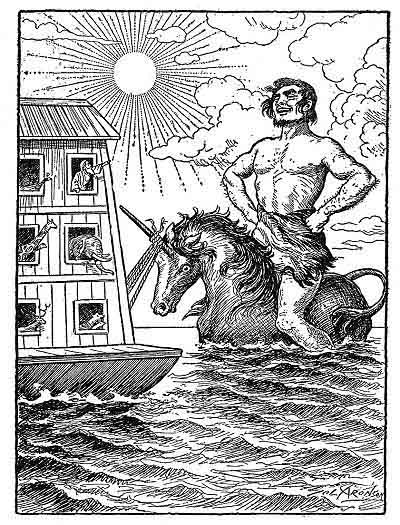
YOU'LL NOT SEE NOTHING LIKE THE MIGHTY OG: You may recall that early in December I posted on the biblical giant Og, who may appear also as an avenging spirit called "the mighty Og" in a Phoenician inscription from Byblos. Well, there's more. I had forgotten at the time that the Gelasian Decree mentions the lost Book concerning the giant named Ogias who is stated by the heretics to have fought with a dragon after the Flood, which I noted in my first lost books post. It may be that this story conflated the biblical Og with the story of the primordial giant and dragon-slayer Ohyah in the Book of Giants. This is the conclusion of W. B. Henning in an important, but now dated, article on "The Book of the Giants." M. R. James has also discussed the lost Book of Og(ias). Og is a legendary figure in the rabbinic literature too, in which we hear that he survived the Flood and was enslaved by Noah. See the online Jewish Encylopedia article on "Og" for details.

Joe Cathey is considering writing a short story about Og, and I hope he does, but he should be forewarned that it's already has been done. "Aunt Naomi" (Gertrude Landa) published a retelling of Og's story in 1919 as "The Giant of the Flood" in her Jewish Fairy Tales and Legends. It would make a good children's bedtime story. Of course all she had were the biblical and rabbinic legends, so there's ample scope for Joe to give us something that factors in the Book of Ogias and the Phoenician inscription.

As for me, I will be including some of this stuff in the More Old Testament Pseudepigrapha volume, in the listing of Lost Books and probably in the general introduction to the Book of Giants. And aside from MOTP, maybe there's scope for an article on Og too. We'll see.

Meanwhile, here's an illustration from Aunt Naomi's book which shows Og riding a unicorn during the Flood:


UPDATE (31 December): Joe Cathey reports that he is working on his Og story.

Wednesday, December 28, 2005

ARCHAEOLOGY MAGAZINE has a new issue out (January/February 2006). There's not much of relevance to ancient Judaism, but do note the review by Paul B. Harvey, Jr., of HBO's Rome. It concludes:
On balance, then, as a visualization of ancient Rome, "Rome" is certainly better than most of its genre, but lacks the dramatic tension of that classic series, "I, Claudius". We do not see here the political implausibilities of "Gladiator", but neither do we see a strictly accurate (or, in many instances, even convincing) portrayal of historical personalities. And as a dramatic series, "Rome" does not leave the viewer at the end of an episode eager to see what happens next. We already know.

Rome is showing in Britain right now and I've seen perhaps half of the episodes. The casting of the main characters is pretty good but, as usual with such things, the series makes a lot of stuff up.

Tuesday, December 27, 2005

TWO ANCIENT HISTORIANS have been elected to the Israel Academy of Sciences and the Humanities:
The new members are: Prof. Margalit Finkelberg, head of classical studies at Tel Aviv University. Born in Minsk in 1947, she came on aliya in 1975 and received her Ph.D. at the Hebrew University. She has an international reputation in the fields of literature and religion in ancient Greece.

Prof. Ya'acov Klein of the Hebrew language and Bible departments at Bar-Ilan University was born in Hungary in 1934. He came to Israel and developed into one of the world's leading experts in ancient Sumerian culture and Mesopotamian literature.

Congratulations to them both, and also to the two scientists elected at the same time.
SOME REFLECTIONS ON HANUKKA and the Hasmonean dynasty by Eli Kavon in the Jerusalem Post:
Did the Maccabees betray the Hanukka revolution?
By ELI KAVON

The events that comprise the story of Hanukka are among the most dramatic and stirring in human history. The uprising of a small band of Jewish guerrillas against a Hellenistic empire many centuries ago has inspired poets and politicians, Jews and Christians alike. The Hanukka story is certainly one of mankind's greatest, the tale of a downtrodden and persecuted people who fought against overwhelming odds and emerged victorious.

Yet, there is a history rarely explored concerning the events both before and after the successful rebellion of the Maccabees against the evil Seleucid king Antiochus IV.

[...]
DAVID PATTERSON, founder of the Oxford Centre for Hebrew and Jewish Studies, died on 10 December. The Jerusalem Post has an obituary.
To paraphrase the ancient Roman, David Patterson found Hebrew and Jewish studies in Europe after World War II largely scorched earth and burned brick, yet he imparted a marble quality to their heartening revival at the Oxford Centre.

There's also a brief obituary from the NYT published in the Indiana Star and the Independent has one too, but it's behind a subscription wall.

May his memory be for a blessing.

Monday, December 26, 2005

MORE ON MODI'IN: An article in Haaretz discusses candidates for the ancient city:
The Hasmoneans were here - maybe
By Ran Shapira

In late 1995, not far from the city of Modi'in, whose construction had begun a short time earlier, several excavated burial caves were found. The find aroused tremendous excitement initially, mainly because on one of the ossuaries an engraved inscription was interpreted to read "Hasmonean." Had they found a burial plot belonging to the family of the Hasmoneans?

When the discovery was announced, the archaeologist digging there, Shimon Riklin, explained that this was not the grave built by Simon the son of Mattathias the Priest for his father and his brothers, which is described in the Book of Maccabees I. The use of ossuraies - stone containers for secondary burial, in which the bones of the dead who had been removed from their original burial place were placed - began in the second half of the first century BCE, more than a century after the beginning of the Hasmonean Revolt. However, the discovery reinforced the theory that the town of Modi'in, where the revolt broke out in 167 BCE, lay not far from the burial caves, in the area of the present-day Arab village of Midya.

A short time later, the excitement died down. A thorough examination made it clear that the word "Hasmonean" was not engraved on the ossuary. ...

In the decade that has passed, two prominent candidates have joined the steadily lengthening list of locations that have been proposed as the site of ancient Modi'in. The most recent is Khirbet Umm al-Umdan, a site revealed in salvage digs conducted in 2001 by Alexander Onn and Shlomit Wexler-Bdolah of the Israel Antiquities Authority (IAA) in the area of the city of Modi'in, on a hill north of the road that connects it with Latrun.


[...]

Dr. Shimon Gibson, who conducted the excavations on behalf of the IAA in the area of modern Modi'in in the mid-1990s, when the momentum of construction and development in the area began, actually believes that he has a more worthy candidate. That would be Titura Hill, an archaeological site in the heart of modern Modi'in. In his opinion, one day we will discover that Titura Hill is a site of national importance. At the second Modi'in Conference - a one-day seminar scheduled to take place in the city tomorrow - Wexler-Bdolah and Gibson will present their reasons for identifying each of the sites with the ancient settlement.

[...]

(Via Joseph I. Lauer on the ANE list.)
ZOHAR TRANSLATION WATCH: Reader Carl Kinbar e-mails:
Just in case you hadn't checked out the website for the Pritzker Zohar in some time (at http://www.sup.org/zohar/index.cgi ), there have been some additions. Beyond posting (1) the Aramaic text in PDF for each volume they are now also making available (2) a PDF indicating emendations by underlining, and (3) a "user friendly" version, also with emendations underlined, indicating the corresponding page numbers in the translation, and Biblical verse citations. Very useful.

So it is. For more on Daniel Matt's ongoing translation of the Zohar, see here.

Sunday, December 25, 2005

ARAMAIC CHRISTMAS CELEBRATIONS IN MA'ALOULA (MAALOULA), SYRIA:
Maaloulians begin festivities to commemorate the birth of Jesus at dusk on Dec. 9 with special chants. This marks the beginning of a 15-day fast during which no meat and no dairy products are consumed. On Christmas Eve, which is usually bitterly cold, there is a complete fast to represent Christ's sacrifice, followed by an evening feast at which presents are given to all the village children, followed by a night of praying and dancing.
Christmas is one of the most treasured times for Rana Wehbe, who greets visitors to Ma'aloula's Byzantine Convent of St. Serge and St. Bacchus.

And this is interesting:
Locals such as Wehbe and the village's mayor, Azar Sikris Barkil, are convinced that they could have spoken with the Al Masih as the Messiah is known in Aramaic. The convent's superior, Father Toufik Eid, who is from Lebanon, is not so sure.
"The difficulty with saying that Jesus would understand this is that every language evolves and this one has had 2,000 years to evolve," said Father Eid. "We believe that Jesus spoke Aramaic, but he also spoke Hebrew, and possibly Greek and Latin."
The Aramaic spoken by Jesus in Mel Gibson's controversial film The Passion of the Christ, was written by a Catholic priest and academic from California.
Nobody in Ma'aloula has apparently seen the film. However, those who had seen brief clips from it said that they could not understand any of what was said to be Aramaic.

Actually, Al Masih is Arabic for "the Messiah." For more on Ma'aloula, go here.
MERRY CHRISTMAS (THIS MORNING) AND HAPPY HANUKKAH (AT SUNSET) to all those celebrating them!

(Cross file under "Cosmic Synchronicities," of which 2005 has had more than its share.)