Thursday, September 21, 2006

SYRIAC ANNOUNCEMENTS:
The Journal of the Canadian Society for Syriac Studies 6 (2006) just appeared, containing the following articles:

-Adil al-Jadir, "Numbers and Dating Formulae in the Old Syriac Inscriptions"
-Muriel Debié, "L’héritage de la chronique d’Eusèbe dans l’historiographie syriaque"
-Richard Burgess, "A Chronological Prolegomenon to Reconstructing Eusebius’ Chronici canones: The Evidence of Ps-Dionysius (the Zuqnin Chronicle)"
-Geoffrey Greatrex, "Pseudo-Zachariah of Mytilene: the context and nature of his work"
-Jan van Ginkel, "Michael the Syrian and his Sources: Reflections on the Methodology of Michael the Great as a Historiographer and its Implications for Modern Historians"
-Witold Witakowski, "The Ecclesiastical Chronicle of Gregory Bar‘Ebroyo"

* * * * *
Members of the CSSS: Your copy will be mailed to you in October.
Join the CSSS and you will receive a free copy of its Journal: US$50.00 per year.
Cost per copy (including mailing):
Individuals: US$35.00
Institutions: US$50.00

To order the Journal of the CSSS, write to:
Canadian Society for Syriac Studies Inc.
Department of Near and Middle Eastern Civilizations
University of Toronto
4 Bancroft Avenue
Toronto, Ontario, Canada
M5S 1C1

OR

E-mail: csss@chass.utoronto.ca
(From the Hugoye list.)

Also, a call for papers:
Call for Papers

Syriac Studies Symposium V


Syriac as a Bridge Culture
Toronto, Ontario Canada June 25-27, 2007


The (North American) Syriac Studies Symposium gathers scholars, researchers, graduate students, and interested public from all over the world for a three day conference on Syriac studies. Symposium V will take place in Canada for the first time, following four successive symposia in the United States: Providence RI (1991), Washington DC (1995), Notre Dame IN (1999), and Princeton NJ (2003).
Preference will be given to papers or sessions that directly deal with the main theme: The role of Syriac in bridging antiquity with the medieval Near East, ancient Greece with the Islamic civilizations, Christianity with the Far East, etc., in literature, translations, art, architecture and any other relevant field. Other proposals in the areas of Syriac literature, Biblical versions, history, art, archaeology, and theology are also welcome.
As in the past conferences, the Syriac Studies Symposium will jointly convene with the International Forum on Syriac Computing. This forum aims to give those working on computational projects in Syriac the opportunity to share information. Papers on all aspects of Syriac computing are welcomed, including: databases (lexical, bibliographical, catalogues), word processing, fonts, desktop publishing, critical editions, computer aided learning/teaching, software and systems.
Please submit a title and a 250 word abstract if you wish to present a (20 minute) paper. If you wish to propose a session, indicate its theme and participants, and enclose copies of abstracts for the papers. Send your abstract or proposal electronically at the following e-mail, csss@chass.utoronto.ca. The registration form will be mailed to you in the fall.

Address questions concerning papers or sessions:
For Syriac Symposium V to the Canadian Society for Syriac Studies at csss@chass.utoronto.ca.
For the International Forum on Syriac Computing to Dr. George Kiraz: gak@bethmardutho.org.
(Again, posted on the Hugoye list.)
THE DEAD SEA SCROLLS EXHIBITION IN SEATTLE gets a thoughtful but positive review by Janet I. Tu in the Seattle Times:
Dead Sea Scrolls exhibit tells stories from then and now

By Janet I. Tu

Seattle Times staff reporter

To best appreciate the Pacific Science Center's Dead Sea Scrolls exhibit, it helps to know or read about their background and religious significance beforehand.

The exhibit, which opened for a media preview Wednesday morning, is not a display of visual grandeur on the King Tut scale. Instead, the 10 scrolls on display are small and in dimly lit cases — the limited lighting necessary to preserve these ancient manuscripts.

It's the stories behind the scrolls — and the stories they tell — that are the most interesting.

[...]

Wednesday, September 20, 2006

SATAN has been getting a lot of attention lately. The latest contribution is "Angel FAQs: The Fall of Satan" by William D. Webber on Beliefnet.
THE DEAD SEA SCROLLS are also the subject of a long article in the Seattle Post Intelligencer. I've read it over quickly and it looks good. Here's the conclusion:
The legacy of the scrolls

The Dead Sea Scrolls caused re-examination of ancient texts, leading to about 100 minor revisions, such as a word substitution, and margin notes in English translations. As research continues, that total will likely triple or quadruple, Abegg said.

"Despite the fact that there are some variations in the texts from the Qumran, the content of the Bible and its wordings are virtually the same," Schiffman said. "Its eternal message remains the same throughout the ages."

The Dead Sea Scrolls also illuminate the centuries between the Old Testament and New Testament.

Before the scrolls were discovered, Nickelsburg said, Jews largely derived their history from the fourth century B.C. to the first century A.D. from the writings of the Jewish historian Flavius Josephus and the Jewish philosopher and exegete, Philo of Alexandria.

"The Qumran writings are contemporary witnesses to that history, composed by the people who were living it. In them modern Jews may find aspects of their heritage to embrace and eschew," he said.

The scrolls' many parallels with the New Testament show today's Christians that "the earliest Christianity was, in fact, a Jewish messianic movement, and a better appreciation of the specific ways in which the early church both incorporated and distanced itself from aspects of its Jewish heritage," Nickelsburg said

Put another way, Abegg said, "the scrolls allow us to see that Christianity is much more Jewish than we had allowed, and they show us a Judaism that was much more varied than we had previously known. As you can imagine, there has been a major rewriting of books to account for this perspective."

That's plenty to ponder for scholars and believers and even skeptics, anyone curious about the cache of writings hidden in pottery jars in caves for two millennia.

Viewers of the scrolls may gain "a sense that something is special here -- some treasure, some ancient wisdom," Abegg said. "It may change their lives. Who knows?"
UPDATE: The same source also has an article on the exhibition that has generated all this interest:
Once restricted to scholars, scrolls on view for anyone

By MARY ANDOM
P-I REPORTER

Shrouded in mystery, the Dead Sea Scrolls remained hidden from the world; only a select few had seen them until 1991, when the first photos of them were published.

Now, 2,000 years after their creation, the scrolls are getting a breath of fresh air. An exhibit titled Discovering the Dead Sea Scrolls will make its West Coast premiere Saturday at the Pacific Science Center. The exhibit will feature 10 of the Dead Sea Scrolls, with four scrolls never before seen by the public.

[...]

A self-guided audio tour will transport visitors back in time; the exhibit, which begins with contemporary Israel, works it way back to the 1947 discovery, with a replica of the cave in which they were found, and eventually leads to the Dead Sea Scrolls.

In addition, the show will include pottery, coins and leather sandals discovered near the archaeological site. These artifacts shed a light on the lives of the people living there then.

The Gallery of the Scrolls will feature 10 original scrolls with the earliest versions of the Hebrew Bible -- the books of Genesis, Exodus, Isaiah, Ezekiel and Psalms -- on display. A handful of facsimiles on various subjects, including the book of Deuteronomy, also will be shown.

The Pacific Science Center wanted visitors to get a sense of the intricate and difficult task of trying to reconstruct the 50,000 pieces of scrolls, so they dumped 50 1,000-piece jigsaw puzzles into a tank. Some of the pieces are damaged and contain debris.

"Try to imagine piecing the puzzle of the scrolls, with no puzzle top as a guide," Johns said.

[...]
I've been using this same puzzle analogy for many years. I hope I can find a photo of this tank.

UPDATE: Tangentially related, the techniques used to restore the Archimedes palimpsest are now being applied to a fragile, 700-year-old Hindu philosophical manuscript:
The project led by P.R. Mukund and Roger Easton, professors at Rochester Institute of Technology, will digitally preserve the original Hindu writings known as the Sarvamoola granthas attributed to scholar Shri Madvacharya (1238-1317). The collection of 36 works contains commentaries written in Sanskrit on sacred Hindu scriptures and conveys the scholar's Dvaita philosophy of the meaning of life and the role of God.

The document is difficult to handle and to read, the result of centuries of inappropriate storage techniques, botched preservation efforts and degradation due to improper handling. Each leaf of the manuscript measures 26 inches long and two inches wide, and is bound together with braided cord threaded through two holes. Heavy wooden covers sandwich the 340 palm leaves, cracked and chipped at the edges. Time and a misguided application of oil have aged the palm leaves dark brown, obscuring the Sanskrit writings.

"It is literally crumbling to dust," says Mukund, the Gleason Professor of Electrical Engineering at RIT.

According to Mukund, 15 percent of the manuscript is missing.

"The book will never be opened again unless there is a compelling reason to do so," Mukund says. "Because every time they do, they lose some. After this, there won't be a need to open the book."

[...]
LECTURES ON THE DEAD SEA SCROLLS in Seattle this autumn are listed here. Looks like an excellent lineup.

Tuesday, September 19, 2006

THE TEXAS FREEDOM NETWORK is not happy with the way the Bible is being taught in public schools in Texas:
More and more public schools are taking on the sensitive issue of whether to offer courses about the Bible. Such courses can be an excellent way to help students understand the unique importance of the Bible in history and literature. As this new report from the TFN Education Fund shows, however, teaching the Bible in Texas public schools is currently fraught with problems. Reading, Writing and Religion: Teaching the Bible in Texas Public Schools reveals that, with a few notable exceptions, the Bible courses currently taught in Texas public schools often fail to meet even minimal academic standards for teacher qualifications, curriculum and academic rigor; promote one faith perspective over all others; and push an ideological agenda.
The report was written by Professor Mark A. Chancey, whose important work on the ancient Galilee has been noted on PaleoJudaica here and here. His earlier thoughts on the teaching of the Bible in public schools are noted here.
THE ANCIENT SITES OF LEBANON, it now seems, did sustain some damage during the war:
Lebanon World Heritage Sites Need Repair

By AURELIE TOULEMONDE, Associated Press Writer

Monday, September 18, 2006

(09-18) 10:57 PDT PARIS, France (AP) --

Three UNESCO World Heritage sites in Lebanon, including some of the Middle East's most significant ancient ruins, are in urgent need of repairs after a month of fighting between Israel and Hezbollah, the U.N. agency said Monday.

In one case, frescos in a Roman-era tomb in Tyre were shaken to the ground when a building 500 feet away was bombed, said U.N. experts, who visited Lebanon and reported on their findings. Some of the paintings were destroyed.

In the ancient Phoenician city of Byblos, ruins were stained by an oil spill. In Baalbek, another Phoenician city which has some of the finest examples of imperial Roman architecture temples may have suffered structural damage, the experts said.

[...]
The article also says that some of the ruins of medieval and ancient Byblos were contaminated by the oil spill and the cleanup will be a long and involved process.

More details here. And the BBC reports that UNESCO is appealing for funds for the repairs and cleanup.

Monday, September 18, 2006

FUNDS HAVE RUN OUT for the excavation of the Megiddo "church":
Money runs out for excavating oldest church
The Christian altar found at the Megiddo Prison dates to the third of fourth century
CE.
Ron Paz 17 Sep 06 12:25 (Globes)
The tourist development venture at a Christian altar found at the Megiddo Prison, considered the world’s oldest church dating to the third of fourth century CE, has been halted because of a lack of money. The Israel Antiquities Authority financed the excavations and preservation of the site for years, but says it can no longer bear the cost.

[...]
I've discussed this find earlier here, here, here here, and here.

(Via the Agade list.)

Sunday, September 17, 2006

GORGIAS PRESS is profiled by Linda Carlson for the Publisher's Marketing Association:
Ancient Languages, Modern Strategies for Success: The Gorgias Growth Story
A few excerpts:
“Gorgias wasn’t born of a business plan, but out of our passion for exotic languages and the determination to disseminate them to the general public,” says Christine Altinis-Kiraz. She and husband George Kiraz took advantage of the high-tech implosion to follow a dream—building a business that publishes books on Arabic, Islamic, Jewish, and Syriac studies, archaeology, the Near East, the Middle East, classics, history, and religion.

They called it Gorgias, Christine explains, because they wanted a name from classics (Gorgias was a Sophist philosopher and rhetorician credited with transplanting rhetoric to Greece), and they liked the fact that this one sounded a little like George’s name.

[...]

Like many other PMA members who want to build a catalog quickly, George did reprints. He selected a dozen titles from the collection of antique books he had started as a teenager and secured reprint rights. “Even in the book antiquarian market, it took me years to find these titles myself—but they were still very important both to scholars and to general readers interested in Syriac and the ancient Near East,” he explains.

[...]

Two technologies made Gorgias viable at the outset: email and print-on-demand. Email made marketing almost cost-free. Even with list-rental payments, the cost was thousands of dollars less with email than it would have been with graphic design, printing, labeling, and postage.

The big advantage, however, was print-on-demand. As Christine points out, “POD enabled us to build a backlist quickly, without high production and inventory costs, and to publish titles that would have been rejected by our competitors because of their highly specialized nature.” But, she cautions, POD is not cost-effective for every book. “It makes sense if the publisher has a limited budget, if the readership is a small niche market, and if the books can be priced higher than trade books.”

[...]

Luck—in the person of Mel Gibson—also played an important role in Gorgias’s early success. The 2004 release in Aramaic of Gibson’s movie, The Passion of the Christ, created awareness of Syriac, a dialect of Aramaic, and generated an unexpected number of sales for the publisher.
(Via the Hugoye list, which is also a Kiraz production.)
BOOK REVIEW IN BMCR:
Mark A. Chancey, Greco-Roman Culture and the Galilee of Jesus. Society for New Testament Studies Monograph Series, 134. Cambridge: Cambridge University Press, 2006. Pp. 304. ISBN 0-521-84647-1. $90.00.

Reviewed by Thomas J. Kraus, Hilpoltstein (t.j.kraus@web.de)
Conclusion:
C. succeeds in challenging the overstating of a Greek setting for first century Galilee (and Palestine). His references to numismatic, epigraphic, and architectural evidence are compelling. They can serve as a role model for further studies in that field and direction. However, one may be skeptical about C.'s interpretation of Hengel's work (cf. C.'s introduction), which itself may be an overstatement. Furthermore, C. often rejects suggestions by others, who did not offer adequate archeological findings as evidence. That can turn out as tricky and deceitful. History is a discipline that can't help doing without filling gaps and bridging lacks of evidence from archeological artifacts now and then; and it can't do without suggestions and imaginative hypotheses. Some of C.'s reflections will need further discussion. Some others will need to be challenged in order to prove whether they can stand plausible counterarguments or not. Leaving these points of criticism aside, C. presents many essential and interesting details about first, second, and third century Galilee. With this volume C. brings his readers one more step closer to the environment in which Jesus lived and taught, the days in which the writings of the New Testament were written, and the impact Hellenism and Romanization actually had. Further studies will prove whether C.'s archeological evidence can really serve as a foundation for judgments on 'Greco-Roman Culture and the Galilee of Jesus'.
(Via the Agade list.)
A PHOTO GALLERY OF DEAD SEA SCROLLS appears today in the Seattle Times, associated with the upcoming exhibition. I was the editor of #3, the Genesis manuscript.

Saturday, September 16, 2006

SBL FORUM: My coverage of the SBL Forum has been spotty, mostly just due to lack of time. But there are invariably worthwhile articles in its monthly updates and you should check it regularly. Here are a couple of interesting pieces:

Biblical Research Findings for the Public
by John Dart

John Dart is a journalist who has been producing excellent coverage of biblical scholarship for many years.

A Recently Discovered Irish Book of Psalms in its Setting
by Martin McNamara

Martin McNamara is a top expert in Irish biblical traditions and this is an excellent piece on the Bog Psalter. Incidentally, we have a number of pseudepigrapha in Old Irish in the More Old Testament Project. McNamara has provided us with some info and may be futher involved.

Also, Leonard Greenspoon is asking about the Wikipedia experiences of SBL Forum readers.

There's more, so have a look at the site.
THE INTERNATIONAL ORGANIZATION FOR THE STUDY OF THE OLD TESTAMENT has issued a call for papers for its July 2007 meeting in Slovenia. This will be in tandem with meetings of related societies on Targumic studies, the Septuagiant and cognate studies, Qumran studies, and Masoretic studies.

Eibert Tigchelaar has e-mailed a call for papers from the IOQS, which I reproduce here:
International Organization for Qumran Studies
Sixth Meeting
LJUBLJANA, SLOVENIA
July 16–18, 2007

Call for Papers


The topic of this 6th IOQS Meeting is:
Qumran Cave 1 Revisited:
Reconsidering the Cave 1 Texts Sixty Years after Their Discovery


Previous meetings of the IOQS have been dedicated to the history of the community (Founding meeting Groningen in 1989), on special groups of texts — texts newly published (Paris 1992), legal texts (Cambridge 1995), sapiential, liturgical and poetical texts (Oslo 1998), apocryphal, pseudepigraphical and parabiblical texts (Basel 2001) — and recently, in the fifth meeting at Groningen in 2004, on the topic of identity forming of the group or groups represented in the Scrolls.

Now, in the sixth meeting of the IOQS, sixty years after the discovery of Cave 1, and after fifteen years of scholarly focus on newly published texts from Cave 4, it seems fitting to revisit the Cave 1 texts. Textually, this goes for the new editing and revisions of editions of texts from Cave 1. Historically and ideologically other issues are to be broached. For example, how should one consider the Cave 1 texts in the light of all the now known materials from the other caves? Or, to what extent do new hypotheses or changing paradigms on the Dead Sea Scrolls and the community/ies that authored them invite us to reevaluate or reinterpret those Cave 1 texts. All contributions, whether from a literary, historical, social sciences, or other kind of approach, are equally welcome.

Following the established tradition of the IOQS meetings, the papers that are directly related to the topic of the meeting will be published in a corresponding volume of the STDJ series, but participants working on other topics in the field of Qumran studies are encouraged as well to present their own particular research.

DATE
The sixth meeting of the IOQS will be held from July 16-18, 2007 in conjunction with the XIXth Congress of IOSOT, the International Organization for the Study of the Old Testament, and other specialized congresses (IOTS, IOSCS, IOMS), to be held from 12th to 20th July 2007 in Ljubljana, Slovenia. All information on these congresses, registration, accommodation, etc. can be found now or later on http://www.iosot2007.si.

PAPER PROPOSALS
If you are interested in participating and presenting a paper, please send your proposal (title and/or subject of paper) to Dr. Eibert Tigchelaar, etigchelaar@fsu.edu.

Please forward this call for papers to any student or scholar you think may be interested.


AN EIGHT-FOOT REPLICA OF THE GEZER CALENDAR IN KANSAS?
Leawood moves ahead with Gezer Park

(Kansas City Jewish Chronicle)

[...]

Leawood's Gezer Park, named in honor of the suburb's Sister-City relationship with the Gezer Region of Israel, is getting closer to becoming a reality. The park's design should be completed soon, and construction could begin as early as this fall. The park will be located on the east side of Mission Road at 133rd Street and was approved by the city in December 2004.
Scott Lambers, Leawood city administrator, said he hopes construction will be complete by late 2007 or early 2008.

[...]

Lambers and Leawood Mayor Peggy Dunn took pictures of the future parkland to show Gezer officials when they visited Israel in September 2005.
In her state of the city address earlier this year, Mayor Dunn said the Leawood delegation was "overwhelmed by the genuine hospitality we received and the strong bonds of friendship that were formed with the mayor, council members and the gracious people in the Gezer Region."
During her speech, Dunn reported that the Gezer Regional Council is giving Leawood an 8-foot sculpture replica of the ancient Gezer calendar tablet to be placed in the park. The tablet contains an agricultural calendar that has been dated to 1,000 B.C.E. and is considered the first harvest record. It will be placed near the park's entryway.

[...]
You can see a photo of the original Gezer Calendar here.
THE FROM ABRAHAM TO JESUS EXHIBITION (noted already here) has opened in Atlanta:
Exhibit takes visitors on tour through biblical times
GREG BLUESTEIN
Associated Press

ATLANTA - It blends biblical stories with historic artifacts, taking visitors on a walk through the birth of Judaism and Christianity. But organizers say what makes "From Abraham to Jesus" stand out the most is that it doesn't do it in a preachy way.

The exhibit, which opened a national tour in Atlanta on Friday, guides visitors through biblical stories with more than 300 artifacts, videos, paintings and an audio tour voiced by an archaeologist with a sense of humor.

[...]

On display will be a portion of the famed Dead Sea Scrolls, as well as what researchers believe to be a box that held the remains of a son of Simon the Cyrene, who, according to the gospels of Matthew, Mark and Luke, carried the cross for Jesus on his way to Calvary.

The artifacts, on loan from Israel's Hebrew University, join pottery pieces, coins, tools and other relics that date as far back as 5,000 years. Perhaps the most unique piece is a fragment of the Dead Sea Scrolls, the first that's ever come to the U.S., said Kathleen Miller, an assistant editor with the Biblical Archaeological Review. "I wouldn't say it's a coup, it's just the first time you can see it here," she said.

[...]
That bit about it being the first Dead Sea Scroll to come to the U.S. is, of course, nonsense, and Kathleen Miller has clearly been misunderstood by the reporter. The exhibition website says "It will be the first visit to this country of the Isaiah Scroll," and doubtless that is what she said. I'm not sure which Isaiah scroll it is; there are a number of them.

Friday, September 15, 2006

BAD NEWS FOR IRAQ'S ANTIQUITIES. On the Iraqcrisis list Chuck Jones notes the following from the Times of London :
Fears for ancient treasures with Shia radical in charge

From Ned Parker in Baghdad

IRAQ’S archaeological riches face a dangerous new threat following the appointment of a minister from a radical Islamic party to run the department responsible for antiquities.

Within months qualified staff have been purged from their posts, archaeologists have been threatened by gunmen and some of Mesopotamia’s ancient sites have been left open to looters. There are fears that Iraq may lose many of its Sumerian and Babylonian treasures for ever.

“We are really worried that Iraq’s history is going to be destroyed and vandalised because of a group of lunatics,” one former member of the State Board of Antiquities and Heritage told The Times. He was referring to followers of the Shia Muslim militia leader Hojatoleslam Moqtadr al-Sadr, whose movement has secured a number of Cabinet posts in government, including the Ministry of Tourism, responsible for antiquities.

Liwa Sumaysim, the new Minister of Tourism, is a dentist whose wife is a member of parliament and a relative of al-Sadr. He has been accused of squeezing out experts and appointing religious fundamentalists to key posts. He denies these allegations.

[...]
Donny George sums up the situation and it sounds grim:
The board was founded in 1923, three years before Gertrude Bell, the British colonial officer and Arabic scholar, established the National Museum of Iraq. Since then Iraqi archaeologists have been regarded widely as the foremost scholars in their field throughout the Middle East.

But the expertise is vanishing. Donny George, the former president of the board, resigned this summer and fled to Syria, where he has raised the alarm. Before he left, Dr George said that he had sealed the National Museum with thick concrete walls to protect the exhibits from the anarchy in Baghdad.

“I can no longer work with these people who have come in with the new ministry. They have no knowledge of archaeology, no knowledge of antiquities, nothing,” he said.

“They are only interested in Islamic sites and not Iraq’s earlier heritage,” added Dr George, a Christian. He accused the Sadrists of pressuring the board to cut its ties with museums and cultural institutions around the world, as well as to sever its links with the coalition forces — relations deemed essential to help to protect sites and prevent troops from going to areas where they could destroy artefacts.
Read it all -- and weep. I hope that diplomatic and media attention may put pressure on the Iraqi government and lead to a change. I don't have time to try to organize a petition or a letter writing campaign (our presessional week starts this weekend), but I hope someone on the Iraqcrisis list will take it up.
A LOOTED ARAMAIC INCANTATION BOWL AND AN ARABIC MANUSCRIPT have been returned to the Iraqi Government:
Looted artefacts returned
By Richard Beeston, Diplomatic Editor (Times of London)

COMMANDER Sue Wilkinson of Scotland Yard returned two stolen artefacts yesterday to Hoshyar Zebari, the Iraqi Foreign Minister, and Salah al-Shaikhly, the Iraqi Ambassador to Britain.

The items were part of a haul of looted antiquities that were smuggled out of the country and put up for sale on the international art market.

[...]
There's a small photo of the incantation bowl, too small for the script to be readable.

UPDATE: More coverage from the A.P. via the International Herald Tribune:
Artifacts stolen in Iraq are returned to country's ambassador in London
The Associated Press

Published: September 14, 2006
LONDON An ancient manuscript that was stolen from Iraq nearly 30 years ago was returned Thursday to the country's ambassador in London.

The manuscript, written in 1013 by Arab physician Ar-Razi, was one of the oldest books of the AwQaf library in Mosul, northern Iraq. It is worth an estimated 250,000 pounds (€370,758, US$427,130).

It was stolen from the library in 1977, and remained missing until a man attempted to sell it to a London auction house in 2003. The Metropolitan Police's specialist Arts and Antiques Unit was alerted, and an investigation began in August 2003.

Although a man was later arrested, there was not enough evidence to prosecute him. However, the man chose to give up the manuscript and since then, officers have been working with the Iraqi authorities to return it.

[...]
The Aramaic bowl is also discussed. And the BBC has an article on both artifacts as well:
Stolen Iraqi artefact returned
Met detectives have returned a valuable Iraqi manuscript worth £250,000 after it was stolen almost 30 years ago.
Here's what it says about the bowl:
A second artefact was also returned - an ancient Aramaic incantation bowl believed to have been illegally looted from an unknown area of Iraq and worth about £1,000 to £2,000.
THE STATE OF LEBANON'S HISTORICAL SITES is surveyed by Nevine El-Aref in Al Ahram:
Ancient Phoenicia under threat
Nevine El-Aref looks at the UNESCO's efforts to rescue Lebanon's historical sites following the Israeli-Hizbullah ceasefire

Like other countries of the Middle East, Lebanon has a heritage almost as old as the earliest evidence of mankind. Its geographic position as a crossroads linking the Mediterranean Basin with the great Asian hinterland has conferred on it a cosmopolitan character and a multicultural legacy.

At different periods of its history Lebanon has come under the domination of foreign rulers, including Assyrians, Babylonians, Persians, Greeks, Romans, Arabs, Ottomans and French. Moreover, its mountainous terrain has provided it with a certain protective isolation, enabling it to survive with an identity all of its own.

[...]

However, although both Lebanon and Israel have signed the 1954 Hague Convention on the Protection of Cultural Property in the Event of Armed Conflict and the 1972 Paris Convention concerning the Protection of World Cultural Heritage, Tyre and Baalbek were recently subjected to rigorous Israeli bombardments during the recent conflict in Lebanon. Fortunately no damage occurred, but the bombardments which targeted adjacent areas provided a real threat.

[...]

Matsuura set up a special meeting of UNESCO's Middle East Task Force to discuss the crisis and issued an urgent call to protect heritage sites in both countries of conflict, emphasising that the heritage site of Tyre was under threat.

Following the ceasefire, an archaeological mission is inspecting historical sites in Baalbek and Tyre as well as Byblos, which was affected by the oil spill from a power station hit in an Israeli attack in mid-July. The mission will adopt a plan to determine how to help recovery efforts.

[...]
The article also includes historical profiles of Baalbek and Tyre.

Thursday, September 14, 2006

GREEK GEEKS are here and here. Plus, Abbott and Costello learn Hebrew here.
THE INK AND BLOOD EXHIBITION is coming to Idaho:
DEAD SEA SCROLLS COMING TO IDAHO FALLS
Tuesday Sep 12, 2006 (KPVI-TV, ID)

A highly anticipated exhibit is on its way to the area and it features fragments of the famous Dead Sea Scrolls.

The exhibit called "Ink and Blood, Sacred Treasures of the Bible" has never been west of the Mississippi, but it's coming to the Museum of Idaho early next year.

[...]

Wednesday, September 13, 2006

N. T. WRIGHT ASKS:
Can We Trust the Gospels?
None of the Gnostic texts--or any other recently unearthed find--can trump the four canonical gospels.
By N.T. Wright
The key question for studying Jesus is: Can we trust the gospels? I am referring to the four books which are known by the names of Matthew, Mark, Luke, and John, and which are found in the "canon" of the New Testament--that is, the collection of books that the church, from early on, recognized as authentic and authoritative (hence the often-used phrase "the canonical gospels") ....
His answer to the question is a qualified yes, for which there is indeed a reasonable case.

He discusses the Gospel of Thomas as the prime contender for being a an additional useful source for the historical Jesus:
Take the best known, and one of the longest, of the Nag Hammadi documents: a collection of supposed sayings of Jesus known as the Gospel of Thomas. This is the book which, it has often been suggested, could and should be treated as at least equal, and quite possibly superior, to the canonical gospels as a historical source for Jesus himself. The version of Thomas we now have, like most of the Nag Hammadi material, is written in Coptic, a language spoken in Egypt at the time. But it has been demonstrated that Thomas is a translation from Syriac, a language quite like the Aramaic that Jesus must have spoken (though he pretty certainly spoke Greek as well, just as many people in today's world speak English as a second language). But the Syriac traditions that Thomas embodies can be dated, quite reliably, not to the first century at all, but to the second half of the second century. That is over a hundred years after Jesus's own day--in other words, seventy to a hundred years after the time when the four canonical gospels were in widespread use across the early church.
I'm not sure whose view he is citing here; I know there was work in the 1970s and 80s by Helmut Koester and others arguing for a Syrian provenance for the Gospel of Thomas and for all I know they're right. And it seems that April DeConick argues for a Syriac stage in the transmission of Thomas in her recent book. (Her book hasn't arrived in our library, so I haven't been able to read it yet.) But I have to say I'm very skeptical in principle of our ability to say that Thomas was composed (or transmitted) specifically in Syriac. (Syriac is the dialect of Eastern Aramaic that was spoken in Edessa and which later became an important church language.) It is possible that Thomas was composed originally in some form of Aramaic, although I'm skeptical that we have the data to establish even that. What we have is one complete Coptic manuscript from the fourth century and three very (very) fragmentary Greek manuscripts from around 200, and it's pretty clear that the Coptic must be a translation of the Greek. It would be very difficult to establish with any philological rigor on the basis mainly of one manuscript in a secondary translation, that the original was in a Semitic language, let alone Aramaic rather than Hebrew. But to suggest that it's been demonstrated that Thomas was written in one particular dialect of Aramaic rather than another goes well beyond what one could reasonably hope to establish on philological grounds. I have more on this problem of establishing that a Greek text was translated from Hebrew or Aramaic here (requires paid subscription to access) or here (an earlier and shorter draft, but free).

Wright continues:
What's more, despite efforts to prove the opposite, the sayings of Jesus as they appear in Thomas show clear indications that they are not as original as the parallel material (where it exists) in the canonical gospels. Sayings have, in many cases, been quietly doctored in Thomas to express a very different viewpoint. For instance, when Jesus says, in Matthew, Mark, and Luke, "Render to Caesar the things that are Caesar's, and to God the things that are God's;" the saying in Thomas has an extra phrase at the end: "and to me the things that are mine." What is going on here? In the worldview represented by Thomas, the word "God" denotes a second-rate kind of deity who made the present wicked world, the world from which Jesus has come to rescue people. Thomas and most of the other Nag Hammadi documents represent a worldview known as "Gnosticism,' in which the present world is a dark, evil place from which we need to be rescued by "gnosis," a special knowledge of hidden truth--a world quite different from the Jewish world of Jesus and the four canonical gospels.
I think what really needs to be said here is that this is one understanding of Thomas, but other experts on it (such as DeConick and Koester) place it much earlier, well within the time frame of the four Gospels and Q (if we want to accept Q). I can't see any particular "Gnosticism," as Wright defines it, in Thomas, and his example isn't especially compelling. Certainly such ideas are much more visible in other works from the Nag Hammadi Library. And I'm not a specialist in Jesus sayings, but for what my opinion is worth, I would say that Thomas has one or two noncanonical sayings that could well go back to Jesus (e.g., the Parable of the Assassin, #98) and some of the canonical parables in Thomas do look to me as if they preserve a more primitive version than in the canonical gospels (e.g., the Parable of the Vineyard, #65). In any case, the range of specialist views is considerably wider than Wright indicates here.

Wright concludes:
This doesn't mean, of course, that everything the gospels say is thereby automatically validated. Assessing their historical worth can be done, if at all, only by the kind of painstaking historical work which I and others have attempted at some length but for which there is no room in a book of the present kind. I simply record it as my conviction that the four canonical gospels, broadly speaking, present a portrait of Jesus of Nazareth which is firmly grounded in real history. As the late historian John Roberts, author of a monumental History of the World (1980), sums it up, "the gospels need not be rejected; much more inadequate evidence about far more intractable subjects has often to be employed [in writing history]." The portrait of Jesus we find in the canonical gospels makes sense within the world of Palestine in the 20s and 30s of the first century. Above all, it makes coherent sense in itself. The Jesus who emerges is thoroughly believable as a figure of history, even though the more we look at him, the more we feel once more that we may be staring into the sun.
Well, maybe. But see also my and Mark Goodacre's more skeptical comments (also in response to Wright) here.

UPDATE (14 September): Mark Goodacre has lots of good comments here. And, just to clarify, I don't dispute that Thomas has redacted some Jesus sayings for its own purposes. I just think that some of the material (not necessarily all) looks to have been transmitted independently of the Synoptic Gospels and some of it may give us new or better information about what Jesus said.

Tuesday, September 12, 2006

THIS IS TOO WEIRD:
Couple's passions enflamed by Gibson film
11.09.06

For devout Christians Michael and Patricia Watson it should have been the perfect end to a perfect night.

But when they sat down to watch Mel Gibson's controversial film The Passion of the Christ it almost ended their marriage.

The couple began to row about the contents of the Hollywood blockbuster after a theological discussion grew increasingly heated.

The extraordinary argument ended when Mr Watson tried to strangle his wife - only releasing his grip when she appealed to his religious beliefs. She begged: "I'm anointed by God, you know that, Michael. Do not touch God's anointed."

[...]
Way too weird.
JEWISH TOMBSTONES IN YEMEN II:
Tombstones bearing Hebrew inscriptions in Aden (Part 2)
A. Klein-Franke

The study of tombstone inscriptions from Aden provides us with more than just a possible time horizon for the presence of the Jews in southern Arabia. The letter forms used in the inscriptions are an important asset for Hebrew palaeography. A number of inscriptions use some of the oldest known styles of Hebrew characters. Furthermore, a few epitaphs from the same cemetery and seemingly from the same period exhibit styles of letters that are either inconsistent or completely different.

[...]
Part I is noted here. This installment deals mostly with early modern inscriptions.

Monday, September 11, 2006

UNESCO is sending representatives to Lebanon to check on the state of cultural heritage sites there:
UNESCO sends experts to carry out technical assessment of the effects of the war on Lebanon’s cultural heritage
Friday, September 8, 2006

The Director-General of UNESCO, Koïchiro Matsuura, today announced that the Organization will send a mission of experts, from September 10 to 16, to assess the potential damage caused to cultural sites in the recent conflict in Lebanon.

The mission will, among other things, visit UNESCO's World Heritage sites of Tyre, Baalbek and Byblos. Tyre and Baalbek, first built by the Phoenicians grew over the centuries and retain, to this day, some of the finest examples of Imperial Roman architecture at its zenith. The experts will analyze the structural soundness of the monuments on these sites and their state of conservation.

Byblos, north of Beirut, bears testimony to the earliest stages of the Phoenician civilization and early urban organization in the Mediterranean world. It has been affected by the oil spill caused by a leak from a coastal power plant bombarded in July. The experts will assess the potential damage of the oil spill to the ancient Port.

The experts are also expected to visit cultural heritage sites in the south of Lebanon that are not inscribed on the World Heritage List, as has been requested by the Lebanese authorities.

[...]
Mr. Matsuura also says that the current information is that there was not significant damage of these sites, but they still want to have a look, and he expresses willingness to do the same in Israel.

(Via Chuck Jones on the Iraqcrisis list.)
JESUS IN JAPAN?
The Japanese Jesus trail

By Duncan Bartlett
BBC News, Japan

A Japanese legend claims that Jesus escaped Jerusalem and made his way to Aomori in Japan where he became a rice farmer. Christians say the story is nonsense. However, a monument there known as the Grave of Christ attracts curious visitors from all over the world.

The Grave of Christ has become an international tourist attraction
To reach the Grave of Christ or Kristo no Hakka as it is known locally, you need to head deep into the northern countryside of Japan, a place of paddy fields and apple orchards.

[...]

However the legend of Jesus the rice farmer does not stretch back very far. It only began in the 1930s with the discovery of what were claimed to be ancient Hebrew documents detailing Jesus' life and death in Japan.

Those documents have now mysteriously disappeared and the grave has never been excavated. ...
Why is it that all the really interesting ancient Hebrew documents always disappear mysteriously?

(In case a search-engine refers someone here who isn't used to my sarcasm, I'll speak more plainly. Jesus never went to Japan and there probably weren't any Hebrew documents. If they existed at all, which I very much doubt, they were fakes. I'm sure it's a fun story though.)
NEVER FORGET.

Sunday, September 10, 2006

AN EXHIBITION ON BIBLES BEFORE THE YEAR 1000 is coming to Washington D.C. next month:
Papyrus, Parchment & Posterity
At the Sackler, 'Bibles Before the Year 1000' to Trace Books' Evolution

By Jacqueline Trescott
Washington Post Staff Writer
Sunday, September 10, 2006; Page N11


Most of us take the form of the book for granted: A collection of sheets with writing on both sides bound along one side.

The story of how that form -- the codex -- became synonymous with the idea of a book is one of the threads that runs through one of the most unusual exhibitions coming to Washington this fall.

The show, which opens in October at the Smithsonian's Arthur M. Sackler Gallery, brings together scrolls, scraps of papyrus, bits of parchment and other curiosities, including a copy of the Gospels written in silver ink on purple parchment.

The various manuscripts -- including some of the rarest in the world -- are being displayed in an effort to trace the evolution of the Bible from a loose collection of texts into a codified volume.

"In the Beginning: Bibles Before the Year 1000" argues that when early Christian communities adopted the papyrus codex as the form of their Scriptures, it was "the most dramatic development in the history of the book."

The exhibit will also show how the various writings circulating in the first thousand years of the Christian era became encased in the form we know today as the Bible.

The show starts with a 1st-century scroll containing a text of Isaiah 2. There are many other papyrus and parchment fragments that are part of the evolution of the Bible.

The Sackler borrowed items from two dozen institutions around the world. Most of the manuscripts have never been seen outside the countries where they are stored. Even six manuscripts purchased in 1906 by Charles Lang Freer and given to the Smithsonian Institution are usually kept in storage vaults because of their fragile state. Two have never been exhibited and two have not been shown since 1978.

[...]
This is an extraordinary exhibit. It includes contributions from the Bodleian Library, the British Library, St. Catherine's Monastery, the Israel Museum, and other major institutions. The manuscripts on display will include material from the Dead Sea Scrolls, from the Aleppo Codex, from the Cairo Geniza, and from the Oxyrhynchus Papyri. And both the Greek and the Coptic manuscripts of the Gospel of Thomas will be included. Marvelous.

The exhibition website is here.

As usual, I have a couple corrections to point out. The Chester Beatty manuscript of Numbers and Deuteronomy (P963 -- displayed here) is of the second century C.E. and is thus a very early Greek manuscript of the books, but not the earliest copy per se: three fragmentary Greek manuscripts, Papyrus Fouad 266 (Deuteronomy, first century B.C.E.), John Rylands Library Papyrus Greek 458 (Deuteronomy, second or first century B.C.E.), and 4QLXXNum (first century B.C.E. or C.E), are earlier. And manuscripts of Numbers and Deuteronomy from the Dead Sea Scrolls are of a comparable early date. (I would have to look up the exact dates and I don't have the reference works handy at home. For the dates of the Greek manuscripts, see this article by Robert Kraft.)

To be fair, the WaPo article got the incorrect info from the exhbition website.

Second, as Tim Finney pointed out on the Textual Criticism list, "... I wouldn't have called Tischendorf and the monks of St Catherine's 'a group of excavators.'"

(Via Stephen Goranson on the Textual Criticism list.)

Saturday, September 09, 2006

TWO GENIZOT in the greater Kansas City area are the subject of an article in the Kansas City Jewish Chronicle. Excerpt:
According to the Encyclopedia Judaica, a genizah is a place for storing books or ritual objects that have become unusable. Genizot have been around for thousands of years. Often, they were simply rooms attached to synagogues.
In the Kansas City area, however, the two genizot are located in cemeteries - Kehilath Israel Blue Ridge Cemetery, at 1901 Blue Ridge Blvd. in Independence, Mo., and at Mount Carmel Cemetery, 5529 Ditzler St. in Kansas City, Mo.
Jim Jones, the caretaker at Mount Carmel, said that when Congregation Beth Shalom cleaned out the basement at the Wornall Road location in 2005, hundreds of prayer books were disposed of by putting them in the genizah.
"Anything that's tattered and old that the synagogue has, that's what I dispose of," Jones said.
Mount Carmel's genizah, dedicated in 1957, looks like a granite tombstone, except that it contains a chute that conveys items into a chamber below. Jones keeps the lid locked most of the time.
Despite the sentimental value some people attach to ritual garments, yarmulkes and tallitot are not considered shemot.
"We have had people say, 'Please bury my tallis, it's old.' But we still remove one of the fringes because you don't want to bury a functioning tallis," said Rabbi Herbert Mandl of Kehilath Israel Synagogue. "Ninety-nine percent (of what goes into the genizah) is books - anything with God's name in it: a Chumash, a prayer book, a Bible - not a novel or anything. Things like a lulav or an etrog are just thrown out. There's a thing in the Talmud that says specifically they are articles of use, and they can just be discarded."
The genizah at KI Blue Ridge Cemetery was built in 1971, Rabbi Mandl said, when the chapel was built. "It's a beautiful structure," he said. "I don't think anyone has anything quite like it in town."
There's even a picture of the one at KI Blue Ridge Cemetery.

Also, the article notes that there's now a mail-in Geniza service with a website at www.shaimos.org. Yet another wonder of modern technology.

As most readers will know, a vast number of extremely important ancient and medieval Jewish manuscripts were recovered a little over a century ago from the "Cairo Geniza," a large geniza in the Ben Ezra Synagogue in Old Cairo that was in use for a thousand years or so.
CONGRATULATIONS to Seth Schwartz and his bride Judith Margolin.
She is a daughter of Phyllis and Irwin Margolin of Ardsley, N.Y. Her father retired as a director of product research at the Revlon Research Center in Edison, N.J. Her mother is a professor of English at Monroe College in the Bronx.

The bridegroom, 47, is the Gerson D. Cohen professor at the Jewish Theological Seminary of America and a director of the graduate program in ancient Judaism. He graduated magna cum laude from Yeshiva and received a Ph.D. in ancient history from Columbia. He is the author of “Imperialism and Jewish Society: 200 B.C.E. to 640 C.E.” (Princeton University Press, 2001).
PETRA is the subject of a Travel piece in the New York Times. It's short on pictures, but you can find more of those over at BiblePlaces.com.

Friday, September 08, 2006

TWO NEW ARTICLES have been published by Jewish Studies, an Internet Journal (both downloadable here):
Rivka Raviv, "The Talmudic Formulation of the Prophecies of the Four Kingdoms in the Book of Daniel"

Abstract

The concept of four kingdoms is found in several prophecies in the Book of Daniel, and similar non-biblical traditions are shared by many cultures (Persian, Greek and Roman). Our article deals with the formulation of the concept of four kingdoms in classical rabbinic literature. First, we will investigate to what extent the rabbis’ discussion relates directly to the biblical concept and not to the extra-biblical concept of four kingdoms. Next, we will review areas in which the rabbis reformulated the biblical concept: by updating its interpretation according to historical changes, and identifying the fourth creature as a boar, which represents the Roman Empire; and by granting great significance to the concept and thus transforming it from a marginal biblical concept to a seminal rabbinical concept. At the same time, we will see how the concept of four kingdoms became a central motif in the interpretation of the entire Bible, grapple with the deterministic view that emerges from the prophecies in the Book of Daniel, and compare this view to the one commonly found in classical rabbinic literature.

Baruch Alster,"The ‘Forlorn Lady’ in the Interpretation of the Song of Songs

Abstract

This article discusses the idea, raised by a few traditional Jewish exegetes, that the female protagonist of the Song of Songs is a “forlorn lady” whose husband deserted her, and who is arguing with her friends (the “Daughters of Jerusalem”) over the chances of his return. After viewing the concept of the “forlorn lady” in opposition to other traditional narrative approaches to the Song, we introduce two major commentaries (Rashi and R. J.H. Altschuler) that interpret the Song according to this concept, and show how they develop the plot along these lines. We then attempt to explain why Peshat exegetes adopted this idea, which to many readers seems incompatible with the simple sense of the Song

Thursday, September 07, 2006

AN OBITUARY FOR TIKVA FRYMER-KENSKY has been published by the University of Chicago. Excerpt:
"She was unique. I don't know of another scholar in the world who combined as she did mastery of Assyriology with sustained attention to feminist readings in the service of biblical theology," said Divinity School Dean Richard Rosengarten. "Hers was a capacious intellect, and all her work was inflamed by her deep passion for the material both in its original context and in ours. This combination made her a remarkably compelling scholar and teacher, and one whose absence is deeply felt already."

Around the Divinity School, Frymer-Kensky was known for her warmth and also her staunch commitment to interreligious dialogue and understanding as well as for her scholarship. William Schweiker, Professor of Theological Ethics, recalled that Frymer-Kensky was committed to the full range of programs in the Divinity School, at home during Divinity School worship services, and that she loved working with the students in theology and ethics as well as the school's Christian ministerial students.
(Via the Agade list.)
A CHALDEAN FESTIVAL IN MICHIGAN:
Let the festivities begin

Chaldean Festival and Southfield’s Autumnfest take over Evergreen this weekend


By April Lehmbeck
C & G Staff Writer

SOUTHFIELD — Welcoming the autumn season is an annual tradition in the city, but this year there’s another reason to celebrate.

The Chaldean American Chamber of Commerce is hosting its first Chaldean Festival on the front lawn of the Southfield Civic Center.

“The festival is going to have a lot of free family entertainment. We expect to see thousands,” chamber Executive Director Martin Manna said, adding that they hope the two events that weekend will complement each other. “We’re proud of the relationship we’ve established with the city of Southfield.”

The Chaldean Festival will run from noon to 10 p.m. on Sept. 9 and 10.

The event is being held to celebrate the heritage of Chaldean-Americans, who are from Iraq, speak Aramaic and are Catholic. Activities will include music, food and shopping. Activities will be available for children, as well.

[...]
Some of the musicians will perform in Aramaic.
FIRST-CENTURY B.C.E. BURIAL CHAMBERS have been found by construction workers in Tel Aviv:
Ancient Burial Cave Found Under Tel Aviv School

September 6, 2006 7:30 a.m. EST

Ryan R. Jones - All Headline News Middle East Correspondent

Jerusalem, Israel (AHN) - Tel Aviv municipal workers doing routine street repairs last week stumbled upon a large ancient burial cave that extends under a nearby high school.

[...]
PAULA FREDRIKSEN is interviewed by Vision's David Hulme about Paul and Judaism. Much of the interview is given also on video. Excerpt:
DH Can you speak to the problem of anachronism and its effect on understanding Paul?

PF I’m a historian, and the most grave “original sin” for a historian is anachronism. What that means is that you lift something out of its historical context and put it in a different historical context, and so misinterpret it. If in addition we think of Paul as an orthodox Christian, we will only misinterpret him that much more. He’s living in a period where he’s not thinking in a Trinitarian manner. The idea of the Trinity hasn’t been conceived yet. His letters will have Jesus Christ in them; they will have God the Father in them; he will talk about the Spirit of God. Those are the textual origins that will be used to formulate the doctrine of the Trinity, but Paul’s not thinking in a Trinitarian way.

People reading Paul assume that he’s hostile to Judaism because he’s the “inventor” of Christianity. In fact, he’s still imagining himself as a Jew and he’s presenting Christianity in continuity with Judaism. The fact that Paul is such a huge figure for Christianity makes it almost impossible for us not to interpret him anachronistically when we look at him, because it’s so important that his message speak immediately to modern Christianity. If we allow ourselves to see how much his message actually cohered with first-century Judaism, then we have to relinquish an immediate connection between him and us, between this ancient Jewish messianic movement and the modern church.

Wednesday, September 06, 2006

THE DEAD SEA SCROLLS EXHIBITION at the Pacific Science Center in Seattle starts later this month:
Dead Sea Scroll exhibit offers abundant educational opportunities

By Sam Bennett (Lynnwood Journal Newspapers, WA)
09/05/2006

Pacific Science Center's new exhibit, "Discovering the Dead Sea Scrolls," is designed to enlighten, as well as attempt to set the record straight.

The exhibit, which runs Sept. 23 through Jan. 7, will attract international attention for unveiling four scrolls never seen by the public.

An important aspect of the exhibit will be it's educational component in the form of a series of lectures that coincide with the run dates.

[...]
I've already noted the exhibit here and here.

Tuesday, September 05, 2006

A BNTC ROUNDUP has been posted by Mark Goodacre. Mark calls for photographs. I took very few this time and the only one I'm inclined to publish is here. Maybe some of the others will oblige. I also have conference-related posts here, here, and here.

Many thanks to Sheffield University for hosting a very successful conference and to all the people involved in making it work. And thanks especially to Ela Nutu, who set me up with an Internet connection in my room and helped me sort out initial gremlins with it, and who seemed to be everywhere at once throughout the conference, making everything run smoothly.
GEORGE E. MENDENHALL is interviewed by OpEdNews about the origins of Israel and the Jewish people:
The Common Origin of and Split Between Arabs and Jews - An Interview with Professor George E. Mendenhall
Evidently this is only the first part of the interview and there is more coming.
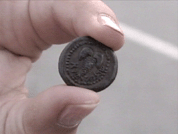
AN ANCIENT COIN seems to have been found in someone's grocery change in South Carolina. This according to WLTX.com:
Woman Finds Potentially Ancient Coin In Grocery Change


(Sumter) When the coins come out of the cash drawer, they all sound the same. And when Lynn Moore picked up her change and walked out of a Sumter Bi-Lo last November, she had no reason to believe her coins were any different.

Boy, was she wrong.

“It's definitely not a penny," said Lynn.

It wasn't until she emptied her change that she noticed.

“I threw it in a vase right next to my kitchen table," said Lynn. She continued, "I dumped it out into my hand and noticed that one coin was very odd looking."

For 10 months, she kept it to herself. Then, Ken Lyles saw it. Ken has collected and studied coins for 50 years, and says this one is definitely not American.

“My research on it would tell me that it (was made in) approximately 132 to 135 A.D."

Mr. Lyles says the shape, uneven edges, and weight of the coin means it definitely pre-dates modern mints. According to his reference books, the coin is from ancient Hebrew society.

[...]
I'm not a numismatist, but it sounds like Mr. Lyles thinks it's a coin from the Bar Kokhba Revolt. The photograph is dreadful. The letters look like they might be Hebrew, but I can't make out what the inscription says. Would any coin experts out there like to comment?

UPDATE (6 September): Ian Werrett wrote to suggest that the coin is a fake:
In particular, the dots around the border and the vine leaf are far too pronounced to be the genuine article. Furthermore, the edge of the coin, with its rounded edge that is free from any obvious dings or dents, has a very similar look to those coins that have been produced by modern companies in order to be sold as souvenirs in Jerusalem and elsewhere.
Then in a later message he found the coin on this website with a clear picture showing that the Hebrew script is modern. The web page owner, David Garstang, notes:
There is no question that these are NOT real ancient coins. The only question is whether they were created with intent to fool collectors or as some sort of commemorative token. I suspect the latter, because the script is such an obvious giveaway to anyone with much experience.

BEWARE!!! There are many of these coins (most in the lighter brass-colored metal) floating around, and they are turning up as "sucker bait" on web auction sites. One fellow asked me (and others) for help in authenticating one of these. I told him that, though I was not an expert, I knew it was not authentic. It then came up for auction, with the fellow claiming, you guessed it, "I know nothing about this coin, but someone says it might be a Bar Kochba".
Bottom line: it's a modern fake. It sounds as though copies of it are circulating widely.

Monday, September 04, 2006

GOOD PAPERS AT THE BNTC: I don't have the energy to summarize (even briefly) every paper I heard during the conference, but these struck me as particularly interesting. I enjoyed other papers as well, so no offense to those I don't mention.

James Harding, (title changed to something like the following) "Noah, Enoch and Mediatorial Polemics in Luke 17:22-37."
Follows recent proposals by VanderKam and Orlov that Enoch sees the Son of Man as his heavenly double in 1 Enoch 71. Proposes that in the Gospel of Luke (at least), Jesus regarded the Son of Man as his own heavenly double, as with Enoch in the Similitudes.

Jonathan Campbell, "Early Jewish Scriptures: Eight Theses."
I reproduce his eight theses from the handout with his permission, with one or two clarifications in square brackets:
  • (1) late Second Temple scripture was essentially bipartite [Mosaic and prophetic]
  • (2) presumed antiquity was the main desideratum for all scripture
  • (3) previously unknown scriptures were periodically '(re-)discovered'
  • (4) neither the Torah nor the Prophets constituted canons
  • (5) disputes sometimes arose about scriptural authority
  • (6) pseudepigraphy does not relate primarily to scripture's reception
    or pseudepigraphy pertains chiefly to the production of scripture
  • (7) the compositional-redactional production of scripture continued up to 100 CE [and beyond]
  • (8) geography and finance impacted on both scripture's production and reception


Peter Williams, "Farewell to the Prologue of John" (abstract here).
The prologue of the Gospel of John is uncontroversially taken today to consist of John 1:1-18. But Pete showed in a dazzling, graphics-rich presentation that the ancient manuscripts of and commentators on John did not divide the text up this way. Their paragraph markers and comment show that generally saw a strong break after verse 5, and weaker breaks in other spots, but no strong break after v. 18. So 1:1-18 was not widely accepted as a unit until the early modern perod.

Grant Macaskill,"Calendar and Polemics in 2 (Slavonic) Enoch."
The calendrical system described in 2 Enoch has suffered enormous corruption in the surviving medieval manuscripts, but it refers to an annual solar cycle of movement through "gates" over a period of 364 days. The text of the parallel lunar cycle of "gates" is extremely corrupt in the manuscripts but could possibly be reconstructed approximately along the lines of the Qumran/Jubilees year of twelve 30-day months with four intercalary days, one in each of the four seasons. But this is by no means certain.

UPDATE (5 September): Conference roundup info here.
THE UNDERWATER MUSEUM OF CAESAREA MARITIMA is reviewed by Michael Luongo for Bloomberg.com. Excerpt:
In mid-August, just two days after a cease-fire halted the war between Israel and Hezbollah, I went to see the ruins. A few days earlier, cafe customers could see missiles flying over Haifa, about 35 kilometers (22 miles) away, though no bombs landed in Caesarea. On the day I visited, the place was almost deserted when I dove off the pier and plunged into the Mediterranean with my underwater guide Natasha.

Sunken Remains

The brackish green sea was as warm as the desert air; it also was silty, with sand and sediment floating around us. As we went farther out, the pressure increased, the temperature decreased and the currents got stronger.

Soon we spotted huge concrete caissons that were the port's foundations, serving as walkways and the ground floor of warehouses. Some are still solid, while others have been broken apart by earthquakes or waves.

The tops of some caissons have cross forms hashing their surfaces, hollowed out remains of the long-gone wooden beams used to mold them in the open sea. A concrete mix, using volcanic ash from Mount Vesuvius, was poured into the wooden forms. Both the material and the method were innovations developed especially to create the port.
MORE ON THE LEBANESE OIL SPILL:
Lebanon's Coast Is Drowning in Oil
A spill caused by an Israeli airstrike has blackened popular beaches and threatens the economy and delicate ecosystems.

By Borzou Daragahi, [Los Angeles] Times Staff Writer
September 4, 2006

BEIRUT — The azure waters of the Mediterranean have long been a symbol of Lebanon's fun-loving character and proud maritime history. But the country's prized 135-mile coast has become its biggest environmental disaster.

Thick gobs of oil have clogged the coast's coral reefs. Sandy beaches have become black-stained no-go zones. Rocky fishermen's coves have become dark soups of crude. All are the result of Israeli airstrikes on seaside oil tanks in the first days of the war against Hezbollah.

Between 3 1/2 and 5 million gallons of oil have fouled more than half of the Lebanese coast, and the damage grows each day that the fractured central government fails to begin the cleanup. Scientists have compared it to the 1989 Exxon Valdez tanker, which ran aground in Prince William Sound, Alaska, dumping 11 million gallons of oil.
Byblos is not mentioned in this article, but it is surely still very much affected.
JEWISH TOMBSTONES IN YEMEN are the subject of an article ("Jewish Tombstones in Aden (Part 1)") by Professor Aviva Klein-Franke in the Yemen Times. Excerpt:
Discoveries of Hebrew epitaphs by travelers

Jacob Saphir was the first to copy Hebrew inscriptions in Aden’s ancient cemeteries and to publish ten of them. Looking for physical evidence supporting the legends of the Jews’ arrival in southern Arabia in biblical times, Saphir felt that he had made an important discovery. In his opinion the ages of the inscriptions which he had copied corresponded to the time referred to in the legends. The earlier dates among the inscriptions copied by Saphir fell between the first and the sixty-first year of the Contracts Calendar. Saphir believed that these dates related to the third century BC. He also documented other epitaphs from the end of the first millennium CE and from the beginning of the second millennium CE. He noted that there were inscriptions written in different styles, despite the fact that those inscriptions gave closed dates and the epitaphs were found side by side in the same area. Saphir discovered a group of epitaphs from the twelfth and thirteenth centuries CE, which belonged to one family clan of H alfon, Bundar and Madmu n. According to Ben-Zvi and Goitein, Madmun in Hebrew means S emarya.

Saphir’s discoveries indicated that the cemetery was used by the community for many generations throughout the centuries and that individuals could own part of the cemetery for use by their families.

As a member of an Austrian scientific delegation, Heinrich David Mu¨ ller travelled to southern Arabia at the end of the nineteenth century. In 1889 Mu¨ ller brought to Vienna approximately 100 squeezes of Hebrew inscriptions. Among these was a group of inscriptions from Aden’s Jewish cemeteries. Most of them date to the years between 20 and 54 in the Calendar of the Contracts. Izhak Ben-Zvi travelled to Aden in January, 1950. He visited the ancient cemeteries, the local state archaeological museum and a private museum, belonging to Mr. Kaiky Muncherjee, an Indian merchant residing in Aden. Ben-Zvi claimed that there were hundreds of sepulchral slabs in the ancient cemeteries. The deeper he entered into the ancient cemetery the earlier were the dates on the epitaphs. He mentioned that many people had epitaphs in their homes and added that it would be difficult to estimate how many slabs with Hebrew inscriptions there were in total. All the inscriptions he examined were dated in relation to the Seleucid Era. For the first time, photographs of four of them were published.
There has been some controversy about the dating of the tombstones.

Sunday, September 03, 2006

HENRY ASGARD KELLY'S BOOK ON SATAN is discussed in the Chicago Tribune (reprinted in Dallas Morning News):
Satan: Father's little helper?

12:00 AM CDT on Saturday, September 2, 2006

By MANYA A. BRACHEAR Chicago Tribune

For centuries, popular culture has treated Satan as God's nemesis – an angel consumed by pride and cast out of heaven to run his own evil empire.

But Henry Ansgar Kelly says poor Satan has gotten a bad rap. For decades he has pleaded the devil's case, arguing that Satan is simply one of God's celestial agents with the dirty job of gauging humanity's virtue.

While that job has made Satan cynical and jaded over time, Dr. Kelly said, it doesn't make him the mastermind of evil.

"Christian tradition has laid a lot of blame on Satan for things they're causing themselves," said Dr. Kelly, 72, a former Jesuit exorcist and now a medieval scholar at the University of California, Los Angeles and author of three books about the devil. "I am pessimistic about human nature. I think we are totally capable of doing what we have done. You can blame it on psychosis if you want."

But you can't blame it on Satan, he said.

During a three-day "Satan Seminar" at Loyola University Chicago last month, Dr. Kelly – the author of Satan: A Biography (Cambridge University Press, $19.99) – preached his controversial gospel to an understandably tough crowd of biblical scholars.

[...]
For more on Kelly's book, see here.

Saturday, September 02, 2006

PRETTY QUIET in the media at the moment, as least as far as ancient Judaism goes, but here's an interesting article on female Torah scribes in St. Louis.

I'm heading back to St. Andrews now. It's been a good conference and I'll post some thoughts on it later.


Hi Mark! Wish you were here!
From Helen Ingram, Jim, and Catherine Smith (L to R).

UPDATE (10:15 pm) I'm back in St. Andrews. And happy third blogiversary to Mark's New Testament Gateway blog and David Meadows's Rogue Classicism.

Friday, September 01, 2006

BIBLICAL STUDIES CARNIVAL IX has been published by Stephen Carlson over at Hypotyposeis. This carnival is an increasingly important resource for keeping track of what's happening in the Biblioblogosphere and Stephen has produced an exemplary edition. Go have a look.
FROM THE BNTC BOOK DISPLAY: I don't want to have to carry too many extra books home on the train, but I couldn't resist these small volumes from SPCK at half price:
Margaret Barker, Temple Theology: An Introduction

R. H. Charles, The Book of Enoch (The 1917 edition, still in print.)

Kenneth Schenck, A Brief Guide to Philo
WE MISS YOU TOO, MARK. I've heard a number of people comment how odd it feels not to have Mark Goodacre around at this year's BNTC.
TIKVA FRYMER-KENSKY has passed away, I am sorry to report. The following details have been posted by Jack Sasson on the Agade List:
This very sad news came from Jeffrey Tigay jtigay@ccat.sas.upenn.edu:
=================================================

I am sorry to inform you that Tikvah Frymer-Kensky, a much-cherished and admired friend and member of the Biblical Colloquium, passed away this afternoon after a long illness which she fought valiantly until the end.

Her funeral will take place Sunday, I presume at her husband's synagogue in Wilmette, Illinois. I know that all who knew her join in condolences to her husband Rabbi Allan Kensky and their children Meira and Eytan.

*******************************

[This brief profile comes from http://divinity.uchicago.edu/faculty/frymer-kensky.shtml

Professor of Hebrew Bible and the History of Judaism in the
Divinity School; also in the Law School and the Committees on the
Ancient Mediterranean World and Jewish Studies
M.A., Ph.D. (Yale University)

Tikva Frymer-Kensky’s areas of specialization include Assyriology
and Sumerology, biblical studies, Jewish studies, and women and
religion. Her most recent books are Reading the Women of the
Bible, which received a Koret Jewish Book Award in 2002 and a
National Jewish Book Award in 2003; In the Wake of the Goddesses:
Women, Culture and the Biblical Transformation of Pagan Myth; and
Motherprayer: The Pregnant Woman’s Spiritual Companion. She is
also the English translator of From Jerusalem to the Edge of
Heaven by Ari Elon (Alma Dee, original Hebrew). ]
May her memory be for a blessing.

Thursday, August 31, 2006

NEW FUNDING FOR THE TIBERIAS DIG -- Haaretz reports:
Prime Minister Ehud Olmert yesterday pledged NIS 22 million in government funds for the archaeological park in Tiberias. The project centers on excavating the Roman theater built in the second and third centuries C.E. at the foot of Mount Berenice, remnants of which were discovered in 1990 by the Israel Antiquities Authority. Archaeologists were surprised by the find, since written sources contain no mention of this theater. City officials believe the theater, located 200 meters from the shore of Lake Kinneret, has major economic potential. Olmert's pledge came during a tour of Tiberias with Minister Shimon Peres. (Eli Ashkenazi)
BAALBEK UPDATE: The BAS site has new information (dated 30 August). It seems the Temple of Bacchus was not damaged after all, and that damage to the temple complex was very minor. But there was considerable damage elsewhwere to the old souk. Plus there are some new discoveries. Read it all.
I'M IN SHEFFIELD, blogging from the British New Testament Conference. I'm not presenting a paper this time, but I'm co-chairing the Seminar on NT & Second Temple Judaism and am also chairing one of the short paper sessions. The seminar programs and abstracts are available here and those for the short papers here. Main speakers are listed here. The organizers have kindly arranged Internet access for me, so blogging should continue through the conference (as time permits).

Wednesday, August 30, 2006

O TEMPORA! O MORES! In Slate, Emily Watson mourns the decline of traditional philology signaled by the success of the Loeb Classical Library series:
The series surivived, despite these shortfalls, because it was the only thing of its kind, and because many authors have been hard to find in any other current English translation. (I believe that the Loeb Plutarch offers the only complete translation into modern English of this essential classical author.) But where have the "ordinary amateurs" gone, you might well wonder? One could argue that they have taken over the academy. Just as scholars once feared, there has been a steady decline in hard-core classical philology—and thanks in part to that, the Loeb Library has lately thrived. Figures like the Oxbridge don in Robert Browning's "A Grammarian's Funeral"—who devotes his whole life to parsing the minutiae of ancient Greek while proclaiming, "What's time? Leave Now for dogs and apes!/ Man has Forever"—are ever rarer in modern classics departments. We no longer feel we have forever: The tenure clock stops for nobody. Increasingly alive to the fact that ancient literature is about something, not mere grammar, even professional classicists want to hurry ahead to the gist and skip the boring stuff. Many of us turn to Loebs because there just isn't time to study every particle of classical literature in the detail it might deserve. (That Browning's shuffling, dusty don would be unlikely to find a job today perhaps shouldn't make the profession entirely proud.)

[...]

Yet I admit a churlish part of me feels a tiny pang. I still wonder whether we really should be welcoming these splendid new translations with open arms. I, for one, would be extremely wary of recommending a Loeb in an undergraduate class in which the students were expected to read the original Latin or Greek. The temptation to rely too heavily on the translation would be all the greater now that the translations are so much better than they used to be. That's perhaps why I enjoyed the 500th volume of the series, a splendid edition by D.R. Shackleton Bailey of Quintilian's Lesser Declamations, as much as I did. It is a reminder that the old Loeb style is not entirely dead, after all. Shackleton Bailey is a senior and rightly respected Latinist whose English shows little danger of keeping up with the times.
All this is true and is a matter for concern. But I have to say that students using published translations to help them prepare their own translations generally doesn't bother me. When I teach or have taught reading courses in ancient Greek, Hebrew, or Aramaic, I tell the students to use whatever translation they like, but that when I call on them I will ask them to defend their translation in detail on the basis of the grammar and vocabulary of the original text. And I do, both in class and on exams. Cribs can help with an initial understanding, but you either understand the grammar or you don't.

(Via Rogue Classicism.)
THE JOURNAL OF SEMITIC STUDIES has a new issue out (51.2, Autumn 2006). Here's the table of contents (articles only):
George Athas
Setting the Record Straight: What are we Making of the Tel Dan Inscription?
J Semitic Studies 2006 51: 241-256; doi:10.1093/jss/fgl001

Arne A. Ambros and Michael Jursa
No Flight of Peace, No Lover of Wisdom? A Reconsideration of Two Phrases in Phoenician and Punic
J Semitic Studies 2006 51: 257-265; doi:10.1093/jss/fgl002

David F. Graf and Salah Said
New Nabataean Funerary Inscriptions from Umm al-Jimal
J Semitic Studies 2006 51: 267-303; doi:10.1093/jss/fgl003

Adil Hamil Al-Jadir
A New Inscription from Hatra
J Semitic Studies 2006 51: 305-311; doi:10.1093/jss/fgl004
John F. Healey
A New Syriac Mosaic Inscription
J Semitic Studies 2006 51: 313-327; doi:10.1093/jss/fgl005

Na'ama Pat-El
Syntactical Aspects of Negation in Syriac
J Semitic Studies 2006 51: 329-348; doi:10.1093/jss/fgl006

Diana Dressel
Intisar al-Fadila aw Hadithat al-Ibna al-Isra'iliyya as an Adaptation of Nathan der Weise
J Semitic Studies 2006 51: 349-371; doi:10.1093/jss/fgl007
There are lots of interesting book reviews too.

Requires a paid personal or institutional subscription to access.

Tuesday, August 29, 2006

MANDAEANS CONFERENCE: From the Aram Society's forthcoming conferences page (via the Agade list).
• The Mandaeans, 8-10 July 2007 (Sydney University)

ARAM Society for Syro-Mesopotamian Studies is organising its Twenty Fourth International Conference on the theme of The Mandaeans, to held at Sydney University, 8-10 July 2007.

The conference will start on Sunday morning 8th July with a Mandaean baptism, and a special exhibition of Mandaean culture will be part of the opening ceremony. Scholarly papers will be presented on Monday and Tuesday 9-10 July, and each speaker's paper is limited to 30 minutes, with an additional 10 minutes for discussion.

If you wish to participate in the conference, please contact our Oxford address:

ARAM, the Oriental Institute, Oxford University, Pusey Lane, Oxford OX1 2LE, England. Tel. ++1865-514041. Fax ++1865-516824. E.Mail: aram@orinst.ox.ac.uk

All papers given at the conference will be considered for publication in a future edition of the ARAM Periodical, subject to editorial review.
Lots of other conferences on Aramaic-related subjects are also listed through 2012.
LEBANON'S MAJOR ANTIQUITIES SITES ARE UNSCATHED after the war, according to the National Geographic Society, which has brief reports and a photo gallery on six of them. There's this general statement:
But as fighting escalated after a Hezbollah raid into Israel on July 12, many people feared for Baalbek and Lebanon's other archaeological and cultural treasures. Now that a tentative cease-fire has been declared, experts returning to the country say that the sites—which have successfully survived decades of violence in the war-torn region—appear to have once again emerged unscathed.
This seems to contradict the report of damage to the Temple of Bacchus at Baalbek. I hope the new report is right, but we'll see. Regarding the Baalbek temples, the National Geographic report says:
During the recent conflict between Hezbollah and Israel, the temples were considered a Hezbollah stronghold, with militant fighters patrolling the ruins.
I trust we'll be hearing lots of condemnations of this blatant violation of the Hague Convention by Hezbollah.

Also, the report on Byblos does not mention the oil spill. I'm not sure why. Are the ruins back from the coast so they weren't affected? Still, I would think it merited a mention.

Monday, August 28, 2006

DONNY GEORGE, president of Iraq's State Board of Antiquities and Heritage has reportedly resigned and left the country.
Saviour of Iraq's antiquities flees to Syria

· Violence and Sadrists drive away archaeologist
· Looting fear as funds run out to pay protection force

Michael Howard in Irbil
Saturday August 26, 2006

Guardian


Iraq's most prominent archaeologist has resigned and fled the country, saying the dire security situation, an acute shortage of funds, and the interference of supporters of the radical Shia cleric Moqtada al-Sadr had made his position intolerable.

Donny George, who was president of the State Board of Antiquities and Heritage, achieved international recognition for his efforts to track down and recover the priceless antiquities looted from Iraq's National Museum in the mayhem that followed the fall of Baghdad in 2003.

But this week he revealed that he had resigned and was in hiding with his family in the Syrian capital Damascus. In an interview with the Art Newspaper, Dr George said Baghdad was now so dangerous that the National Museum, which houses a trove of Sumerian and Babylonian artefacts, had been sealed off by concrete walls to protect it from insurgent attacks and further looting.

[...]
(Again, via the Agade list.)
A TIMELY REVIEW:
Maria José Strazzulla, Ancient Lebanon: Monuments Past and Present. Los Angeles: J. Paul Getty Museum, 2006. Pp. 71; color ills. 80, map 1, site plans 4, color overlays 16. ISBN 88-8162-142-8. $29.95.

Reviewed by Michael Decker, University of South Florida
(BMCR, via the Agade list.)

Sunday, August 27, 2006

JADED THEA has a blog round-up of the Lebanon oil spill.
AN EXHIBIT OF "HOLY LAND ARTIFACTS" is coming to Atlanta and then moving around the USA:
Holy Land artifacts show in Atlanta

An exhibit of 340 sacred texts and artifacts from the Holy Land, the largest such show ever in the United States, will open in Atlanta on Aug. 15. "From Abraham to Jesus" will also tour 27 other cities, including Nashville.

The display includes the Isaiah Scroll, one of the Dead Sea Scrolls, and a box that some experts believe held the remains of Simon the Cyrene, who carried Jesus' cross.

[...]
The opening date should be September 15, not August. The exhibition's website is here.