Thursday, March 07, 2013
Locusts latest
GOOD NEWS AND BAD NEWS. The good news: Israel Escapes Locust Plague — For Now. The bad news: Rabbi warns locust-eaters: insects may not be kosher.


New Chaldean patriarch enthroned
CHALDO-ASSYRIAN WATCH: Iraqi Chaldeans enthrone new patriarch (AFP). The former patriarch also retired at age 85. With the Egyptian Copts also recently enthroning a new Pope, this is adding up to quite a turnover in these circles.
Cross-file under "Aramaic Watch."
Cross-file under "Aramaic Watch."
Wednesday, March 06, 2013
Forthcoming: Hekhalot Literature in Context
REBECCA LESSES: Hekhalot Literature in Context" to be published by Mohr Siebeck.
The papers from the "Hekhalot Literature in Context" conference, which was held at Princeton a couple of years ago, are going to be published this spring by Mohr Siebeck. I have a paper in this volume, "Women and Gender in the Hekhalot Literature."Follow the links for details.
Hekhalot Literature in Context: Between Byzantium and Babylonia
Edited by Ra'anan Boustan, Martha Himmelfarb and Peter Schäfer
Ancient compliance with rabbinic rulings
THIS WEEK'S DAF YOMI COLUMN by Adam Kirsh in Tablet Magazine: Leave the Jewish People Alone: Rabbis left enforcement of their Talmudic decrees to communal standards and voluntary commitment.
However, Rava bar Rav Chanan points out in a rare moment of empirical candor, “We see that people do these things, and we do not say anything to stop them.” Why is it that the rabbis, who have so many decrees to enforce, allow these particular ones to be ignored? Here the rabbis are following a surprising principle: “Leave the Jewish people alone, and do not rebuke them. It is better that they be unwitting in their halakhic violations and that they not be intentional sinners, for if they are told about these prohibitions they may not listen anyway.”
This struck me as a pretty amazing statement. The Talmud, which is nothing but tens of thousands of rules for the Jewish people to follow, now tells us to “leave the Jewish people alone”! ...
Tuesday, March 05, 2013
BNTC 2013
THE 33RD ANNUAL MEETING OF THE BRITISH NEW TESTAMENT SOCIETY is in St. Andrews on 29-31 August 2013. Registration for the 2013 British New Testament Conference is now open and you can book online here.
The conference coincides with the celebrations of the 600th anniversary of the founding of the University of St. Andrews and indeed commences on the day after the 600th anniversary of Pope Benedict XIII's issuing of the Papal Bull confirming the privileges of the University (28 August 1413).
The conference coincides with the celebrations of the 600th anniversary of the founding of the University of St. Andrews and indeed commences on the day after the 600th anniversary of Pope Benedict XIII's issuing of the Papal Bull confirming the privileges of the University (28 August 1413).
ASOR fundraiser
THE ASOR BLOG: March Fellowship Madness 2013.
It's that time of year again! March Fellowship Madness is a month-long drive to raise as many fellowship dollars as possible, so we can get more students in the field! Last year, 80 donors joined in the madness and gave over $9,000. That meant that ASOR was able to award nine additional travel scholarships! That's nine additional scholars who were able to conduct field research and expand our knowledge of the ancient Near East. How many more students can we send to the field this year?Follow the link for details. And here's a testimonial from fellowship recipient Caroline Carter: The Platt Fellowship Changed My Life. Many years ago, when I was a doctoral student, I got an ASOR travel fellowship to do archaeology for a summer in Israel and it was a very good experience.
The New Yorker on the Cairo Geniza
THE CAIRO GENIZA is profiled in some detail by Emily Greenhouse in The New Yorker: Treasures in the Wall.
Oxford and Cambridge are longtime rivals, but in February, the two universities launched their first-ever joint fundraising campaign in order to save the Lewis-Gibson Genizah Collection—named for the intrepid twins who led Schechter to it and, not incidentally, endowed Westminster College, which owns the collection but can longer afford to keep it—from division and dispersal. (The New York-born, Oxford-educated financier Leonard Polonsky has already promised £500,000 of the £1.2 million needed.) This uncommon partnership is a testament to the value of the collection, which is the largest assembled from Ben Ezra. (The Jewish Theological Seminary of America, which Schechter would go on to lead as President, holds the second largest.) Ben Outhwaite, the head of genizah research at Cambridge, explained to me how crucial the Cairo Genizah collection is for scholars. “It is not hyperbole,” he wrote, “to talk about it as having rewritten what we knew of the Jews, the Middle East, and the Mediterranean in the Middle Ages.”Background here.
Cyrus Cylinder latest
THE CYRUS CYLINDER goes on exhibit in the U.S.A. on Saturday: Cyrus Cylinder Makes First Appearance in D.C.
Background here and links.
Background here and links.
Locust plague
TURNABOUT IS FAIR PLAY: Israel on alert as locusts cross in from Egypt. Shortly before Passover, naturally.
UPDATE: Of course the locusts are already in Egypt ...
UPDATE: Of course the locusts are already in Egypt ...
Boston-DSS student opportunities
STUDENT VOLUNTEERS ARE WANTED for the upcoming Dead Sea Scrolls exhibition in Boston:
Museum of Science staff to outline scrolls openings
Brandeis students eligible for interpreter and internship positions
By Charles A. RadinMarch 4, 2013
Opportunities for students to work on the upcoming "Dead Sea Scrolls: Life in Ancient Times" exhibition at the Museum of Science in Boston will be outlined in an information session with representatives of the museum on Wednesday, March 6.
The meeting will be held in Alumni Lounge, Usdan Student Center, from noon to 1:30 p.m., and is open only to Brandeis affiliates.
The university is partnering with the museum on the exhibition, which will run from May 19 to Oct. 14. Brandeis students -- including undergraduates, graduate students and participants in the Osher Lifelong Learning Institute at Brandeis (BOLLI) -- are eligible for volunteer interpreter and internship positions. At this week’s meeting, museum representatives will discuss these positions, applications and selections processes, and the time commitment and training required.
[...]
Monday, March 04, 2013
The Economist on the fake metal codices
FAKE METAL CODICES WATCH: A new blog in The Economist called "Erasmus," run by someone who goes by the initials "B.C.," has put up an oddly naïve post to belabor the obvious: Test those mysterious codices: Mistrust, but verify. It links to some of my posts and I seem to be among the "militant" and "vociferous sceptics" alluded to.
Tom Verenna has done a good job of replying to the article in the comments, but I will add a few things.
I will just add that all of my many posts on this subject have been in my own name. I stand behind what I write rather than hiding behind anonymity. I'm looking at you, B.C.
Background most recently here and just keep following those links back over the last two years.
Tom Verenna has done a good job of replying to the article in the comments, but I will add a few things.
And given their supreme confidence, the militant sceptics should surely have no problem with further scientific analysis. From their point of view, it must be a pre-ordained certainty that peer-reviewed laboratory tests in Jordan, or anywhere else, will simply confirm their rightness and give them fresh opportunities to wag their fingers at anybody who took the codices seriously.What a childish little rant. No wonder this B.C. doesn't want to put his or her name to this blog. There have been rumors for the last two years that tests on the codices were imminent or that the publication of such tests was imminent. For the same period I have been calling for such tests to be published, if they exist. The bottom line is that such evidence as we have points strongly to the codices being fakes. If someone wants us to reconsider this conclusion, they should present us with new evidence that calls for consideration. It is being open to new evidence, or the possibility thereof, that constitutes having an open mind. Being forever unwilling to make a judgment call—in the vague hope that someday someone will come up with something that actually supports the claims—is being gullible, not open minded.
That makes it slightly puzzling that a couple of the most vociferous sceptics declared that they would have refused, if asked, to sign the letter to the Jordanian authorities asking for more information. From their perspective, perhaps, backing such a request would have implied taking the codices too seriously.If B.C. is really puzzled by my comments, cited by Jim West and published originally here, perhaps he or she needs to brush up on basic reading comprehension skills. What I said was:
Regarding the letter that was submitted to and published by the London Times, I was not at the SOTS meeting and was not asked to sign the letter, but I would not have done so if asked, at least in the form in which it was published. ... If I am wrong, it would be helpful to hear what they [the Jordanian authorities] do think and what they are currently doing about the codices, and to that extent I can support the central point of the letter. ... The second issue is the final sentence of the first paragraph of the letter: "There are many indications that these finds are not modern forgeries, but [that] possibility cannot as yet be definitively excluded."* I know of no such "many indications that these finds are not modern forgeries."Let me try to make it even simpler: I said I would not have signed the letter in the form in which it was published because it incorrectly stated that there were many indications that the codices are not modern forgeries, but I supported the central point of the letter—that the Jordanian authorities should speak up if they knew something.
I will just add that all of my many posts on this subject have been in my own name. I stand behind what I write rather than hiding behind anonymity. I'm looking at you, B.C.
Background most recently here and just keep following those links back over the last two years.
Saturday, March 02, 2013
Phoenicians in America?
PHILIP BEALE, the captain of the Good Ship Phoenicia, is profiled in the Daily Mail:
Attempts thus far to prove that the Phoenicians made it to the Americas have not been found persuasive by specialists. (If you follow the links at this recent post, you will find discussions of much of the supposed evidence.) It's not impossible, of course, and Beale's dangerous project to prove that a Phoenician vessel could have done it would be interesting in principle as long as he manages to succeed and not get himself killed. But positive evidence is currently lacking and still would be if he succeeds.
On the discovery of America, see the comments at the bottom of this post.
I have blogged a great deal on the voyage of the Phoenicia (see here and links) and whether he is right or wrong, I wish Captain Beale well.
(HT Dorothy Lobel King.)
Man's mission to prove Phoenicians discovered the Americas a thousand years before ColumbusAll he needs now is £100,000!
Former City fund manager Philip Beale built replica Phoenician vessel
Believes 50-tonne wooden boat could have crossed the Atlantic
Will set sail from Tunisia to try and prove the theory himself
By Steve Robson
PUBLISHED: 08:45, 1 March 2013 | UPDATED: 18:39, 1 March 2013
Christopher Columbus and his discovery of the Americas in 1492 is one of the great stories of modern history.
But five centuries after his momentous achievement, a British explorer wants to prove that Columbus was actually beaten to it by another seafaring nation 1,000 years earlier.
Philip Beale believes the ancient Phoenicians - a Semitic civilization that prospered between 1500BC and 300BC on the Mediterranean coast - sailed to the Americas first.
[...]
Attempts thus far to prove that the Phoenicians made it to the Americas have not been found persuasive by specialists. (If you follow the links at this recent post, you will find discussions of much of the supposed evidence.) It's not impossible, of course, and Beale's dangerous project to prove that a Phoenician vessel could have done it would be interesting in principle as long as he manages to succeed and not get himself killed. But positive evidence is currently lacking and still would be if he succeeds.
On the discovery of America, see the comments at the bottom of this post.
I have blogged a great deal on the voyage of the Phoenicia (see here and links) and whether he is right or wrong, I wish Captain Beale well.
(HT Dorothy Lobel King.)
Friday, March 01, 2013
Tents and Persian fire priests in the Talmud
THIS WEEK'S DAF YOMI COLUMN BY ADAM KIRSCH IN TABLET MAGAZINE: Ancient Laws for Modern Times. When is a tent just a tent and not like a bed or a hat? To update Jewish laws, the rabbis reasoned by analogy.
Earlier Daf Yomi columns are noted here and links.
... But the rabbis of the Talmud are not law-makers. They are interpreters of already existing laws, both the written laws of the Torah and the Oral Law handed down over generations. Their job was to close the gaps between ancient laws and modern problems, a task that requires a particular kind of intellectual creativity. This is a creativity that is not, or can’t admit itself to be, originality. The rabbis always insist that the answers to problems are already present in the sources—biblical verses or Tannaitic rulings—and only need to be uncovered. What looks to a modern reader like Talmudic contortions of logic often has to do with the rabbis’ insistence on connecting a new case to an old precedent.Oh, and rabbinic sages are still here, but there are still some Persian fire priests around too, so I guess we have to call that one a draw.
Earlier Daf Yomi columns are noted here and links.
Los Lunas inscription again
THE LOS LUNAS INSCRIPTION—a modern forgery of the Decalogue on a stone in New Mexico—has come to the attention of Batya Ungar-Sargon in Tablet Magazine: The Mystery Stone: Does a rock in New Mexico show the Ten Commandments in ancient Hebrew? Harvard professor says yes.
Even the headline is disingenuous and the article isn't much better. Yes, a rock in New Mexico shows the poorly forged Ten Commandments in ancient Hebrew. The Harvard Professor—Robert Pfeiffer—died in 1958 and it is not clear from the coverage here that he said "yes" in the sense of thinking that it was possible that it was an ancient inscription.
This article gathers together some entertaining anecdotes and occasionally some interesting information, but ultimately it tries to find a "debate" where there is none. No epigrapher of ancient Hebrew is willing today to defend the authenticity of the inscription. (James Tabor tried once in a popular article, but this article reports that he has changed his mind.) The evaluation by Comanche Ranch manager Martin Abeita seems to me to have some merit:
Earlier posts involving the Los Lunas inscription (including a link to Tabor's article mentioned above) are here, here, here, and here.
Even the headline is disingenuous and the article isn't much better. Yes, a rock in New Mexico shows the poorly forged Ten Commandments in ancient Hebrew. The Harvard Professor—Robert Pfeiffer—died in 1958 and it is not clear from the coverage here that he said "yes" in the sense of thinking that it was possible that it was an ancient inscription.
This article gathers together some entertaining anecdotes and occasionally some interesting information, but ultimately it tries to find a "debate" where there is none. No epigrapher of ancient Hebrew is willing today to defend the authenticity of the inscription. (James Tabor tried once in a popular article, but this article reports that he has changed his mind.) The evaluation by Comanche Ranch manager Martin Abeita seems to me to have some merit:
It’s a pain in my ass is what it is,” he says. “And it’s a fake. It’s a money-maker for the state.As usual, if a trained specialist wants to publish an article in a peer-review journal which argues that the stone is really an ancient inscription that shows the presence of pre-Columbian Jews in New Mexico, I would be willing to listen to the argument. But in the meantime, it's a fake.
Earlier posts involving the Los Lunas inscription (including a link to Tabor's article mentioned above) are here, here, here, and here.
Thursday, February 28, 2013
"Genetic" dating of the Iliad
TECHNOLOGY WATCH: Not of direct relevance to PaleoJudaica, but possibly of interest.
Although this project told us nothing new, the method did give the same date as had been reached independently by other means. That may mean that it can be applied usefully in cases where we don't know the date of a text. But there are many questions that are not answered in these popular articles and the assumptions behind the method would need to be tested very carefully by linguists. But still, it may turn out to be a useful development, one potentially applicable to biblical texts etc.
Geneticists Estimate Publication Date Of The 'Iliad'The story is also covered by ScienceDaily: Homeric Epics Were Written in 762 BCE, Give or Take, New Study Suggests.
Rights information:
Public Domain | http://bit.ly/128YJKO
Genomes and language provide clues on the origin of Homer's classic.
Originally published:
Feb 26 2013 - 4:30pm
By:
Joel N. Shurkin, ISNS [Inside Science News Service] Contributor
(ISNS) -- Scientists who decode the genetic history of humans by tracking how genes mutate have applied the same technique to one of the Western world's most ancient and celebrated texts to uncover the date it was first written.
The text is Homer's "Iliad," and Homer -- if there was such a person -- probably wrote it in 762 B.C., give or take 50 years, the researchers found. The "Iliad" tells the story of the Trojan War -- if there was such a war -- with Greeks battling Trojans.
The researchers accept the received orthodoxy that a war happened and someone named Homer wrote about it, said Mark Pagel, an evolutionary theorist at the University of Reading in England. His collaborators include Eric Altschuler, a geneticist at the University of Medicine and Dentistry of New Jersey, in Newark, and Andreea S. Calude, a linguist also at Reading and the Sante Fe Institute in New Mexico. They worked from the standard text of the epic poem.
The date they came up with fits the time most scholars think the "Iliad" was compiled, so the paper, published in the journal Bioessays, won't have classicists in a snit. The study mostly affirms what they have been saying, that it was written around the eighth century B.C.
[...]
Although this project told us nothing new, the method did give the same date as had been reached independently by other means. That may mean that it can be applied usefully in cases where we don't know the date of a text. But there are many questions that are not answered in these popular articles and the assumptions behind the method would need to be tested very carefully by linguists. But still, it may turn out to be a useful development, one potentially applicable to biblical texts etc.
Boston DSS exhibit
MORE ON THE UPCOMING DEAD SEA SCROLLS EXHIBITION IN BOSTON: Museum of Science, Together with the Israel Antiquities Authority, Presents Dead Sea Scrolls: Life in Ancient Times
—New England Premiere: May 19, 2013 – October 14, 2013—
Brings to Life the Greatest Archeological Discovery of the 20th Century Taking Visitors Back 2,000 Years
Background here and links.
—New England Premiere: May 19, 2013 – October 14, 2013—
Brings to Life the Greatest Archeological Discovery of the 20th Century Taking Visitors Back 2,000 Years
Background here and links.
Wednesday, February 27, 2013
Putin on the Schneerson Library
THE PRESIDENT OF RUSSIA has weighed in on the Schneerson Library dispute:
Russia stands firm in Schneerson Library disputeBackground here and links.
Tags: Schneersohn library, Russia, Opinion & Analysis, Politics, World
Lyubov Kuryanova
Feb 26, 2013 20:47 Moscow Time
Russia has solid legal reasons to keep the Schneerson Library on its territory, the country’s Culture Minister Vladimir Medinsky said. The U.S.-based Hasidic movement has rejected President Putin’s initiative to place the collection of books and religious documents in the European Tolerance Center in Moscow.
[...]
In January, the US District of Columbia Court ruled that Russia should pay $50,000 per day in fine unless it returns the collection. In response, President Putin suggested placing the archive in the Jewish Museum and Tolerance Centre in Moscow. He also expressed his regret over the dispute reaching the point of confrontation, adding that the library does not belong to a particular Jewish community.
“If we agree that this national asset goes to anyone, we will open Pandora`s Box. If we start meeting their demands, we will see such kind of lawsuits streaming in”, Mr. Putin said.
[...]
New novel series on the Nephilim
THE NEPHILIM IN HARLEQUIN ROMANCE MODE: Age of Eve: Return of the Nephilim Is a New Romance Novel from BroadLit with a Paranormal Twist.
Fallen angels, voodoo magic, and intense passion combine in the first paranormal romance novel from Quantum Leap co-creator D. M. Pratt. BroadLit, a company introducing a new slant on romance, is publishing the first novel in award-winning D. M. Pratt’s new romantic thriller series Age of Eve: Return of the Nephilim. The series introduces readers to a passion of mythological proportions that will captivate the reader’s body, mind and soul.The scary thing is that it will probably sell well.
Tuesday, February 26, 2013
Review of Law and Salvesen (ed), Greek Scripture and the Rabbis
MARGINALIA: Nicholas de Lange on Greek Scripture and the Rabbis, Edited by T.M. Law and A. Salvesen. Did the Jews abandon the Greek Bible to the early Christians? Excerpt:
Greek Scripture and the Rabbis is a valuable contribution to Greek bible studies. Its eleven chapters represent the cutting edge of scholarship in this area. Even if few of them engage directly with rabbinic studies, taken together they draw attention to important questions, both methodological and substantial, in the study of the Jewish reception and use of Greek bible translations.
Jubilees meets the synagogue
OLD TESTAMENT PSEUDEPIGRAPHA WATCH: The Book of Jubilees features in Jewish adult education in Boulder: Midrash Before the Rabbis: Stories of Parents and Children.
Rabbis have retold the stories of the Torah in radical ways as Midrash. But, as explained by Dr. Naomi Susan Schwartz Jacobs, an internationally recognized teacher and scholar of the Hebrew Bible and ancient Judaism, that process began hundreds of years earlier.
The Book of Jubilees, found among the Dead Sea Scrolls, retells a large section of the Torah with numerous and dramatic changes. In this session we will examine how Jubilees retells stories of parents and children. ...
Monday, February 25, 2013
E-book: Patmore, Adam, Satan, and the King of Tyre
BRILL HAS PUT A RECENT MONOGRAPH ONLINE—for a price:
Adam, Satan, and the King of TyreYou can buy access to the whole thing for a set price, or buy single chapters for a proportionately higher price.
The Interpretation of Ezekiel 28:11-19 in Late Antiquity
Author: Hector M. Patmore
Subjects: Jewish Studies
Publication Year : 2012
DOI: 10.1163/9789004208803
E - ISBN : 9789004208803
Imprint: Brill
Collections: Biblical Studies, Ancient Near East and Early Christianity E-Books Online, Collection 2012
Sunday, February 24, 2013
Jewish descendants (etc.) in Timbuktu
MORE ON JEWISH MANUSCRIPTS AND DESCENDANTS OF JEWS IN TIMBUKTU: After Islamist Threat Repelled, Spotlight Hits ‘Jews’ of Fabled Timbuktu:Ancient Saharan City Is Home to 1,000 Jewish Descendants (Nathan Guttman, The Forward).
Timbuktu, the remote and ancient Sahara Desert city that was until recently controlled by Al Qaeda-affiliated groups, is not often thought of as an outpost of Jewish life. Yet this West African town of some 55,000, in northern Mali, is still home to an estimated 1,000 descendants of Jews who converted to Islam centuries ago.Related: How Timbuktu’s heritage was saved in rice sacks and canoes (Alice Fordham , The National)
In three villages near the city, local residents still refer to these descendants as “the Jews,” but visitors and activists report that Malians of Jewish ancestry did not suffer any form of discrimination, even with the infiltration of violent Islamist extremists to the region. It also appears that the ancient documents that serve as proof of Jewish life in Timbuktu survived the recent attacks on the city’s historic library.
Interest in this Jewish history peaked two decades ago, when a local scholar, armed with ancient trade documents containing Hebrew script, launched a research project that documented the Jewish roots of some local residents. This ignited a search for identity among some of these individuals, and brought a degree of international attention to their existence. But mutual disappointment followed amid disputes over financial aid from Jews overseas. Activists on both sides have since given up on reconnecting residents of Timbuktu to their Jewish roots.
[...]
The documents establishing the Jewish connection to Timbuktu are believed to be safe. The fire set to the library by rebels destroyed many Muslim manuscripts, but most were spirited to safety beforehand and hidden by local families devoted to their preservation over many generations. The documents relating to Jewish activity in the region are believed to be safe in the hands of Haidara or in possession of these villagers.
[...]
"We are very proud of what we did," said Khalif Al Hadji, an archivist. "We did it for three reasons. The first, is that if we lose these manuscripts, we won't find them again. Two, we work in the library. Three, we are all Malians and we know exactly how valuable these manuscripts are to us."Background here and links. Still hoping for some word on ancient literary texts such as Old Testament pseudepigrapha somewhere among those Timbuktu manuscripts.
Mr Cisse added proudly that the rich archive of thousands of books belie the myth that Africa relies on oral tradition as opposed to written history and scholarship. "It's enormous," he said. "The culture, the history."
Even as the men spoke, in a courtyard of the new building, ashy fragments of burnt manuscripts eddied in the breeze. Just before a French-led intervention had pushed the militants out of town, some of the rebels pulled around 1,000 manuscripts off the shelves and built a bonfire. The charred scripts are still discernible, but the treasures are lost.
French soldiers have now left Timbuktu, and there are fears that the militant Islamists could creep back, and a similar fate could await any of the manuscripts returned to the institute. Under the circumstances, the manuscripts are unlikely to go home for some time, said Shamil Jeppie, head of the Tombouctou Manuscripts Project at the University of Cape Town.
[...]
New BBC series on Judaism
SIMON SCHAMA writes in the Financial Times about his upcoming BBC series, "The Story of the Jews": Wandering star. The first section describes a visit to Elephantine Island and has a good discussion of the Judean community that lived there in the fifth century BCE. The Dura Europos synagogue also comes up in the article, as do the Jews of Chochin in India.
Cyrus Cylinder and modern politics
FROM THE DEPARTMENT OF WISHFUL-THINKING HEADLINES, brought to you by Ian Black in the Guardian: Can a text from ancient Persia break down mistrust between enemies?
Fortunately, the essay itself pretty much (and correctly) answers the question "no." See also the linked essay by Jacob Wright: The Cyrus Cylinder And A Dream For The Middle East. I have some similar comments here. More background here and many links.
Fortunately, the essay itself pretty much (and correctly) answers the question "no." See also the linked essay by Jacob Wright: The Cyrus Cylinder And A Dream For The Middle East. I have some similar comments here. More background here and many links.
Saturday, February 23, 2013
Friday, February 22, 2013
The Cyrus Cylinder and the "N" word
SURPRISE, SURPRISE, it turns out it's possible to write a New York Times column on the Cyrus Cylinder without mentioning nuclear war: Find the Missing Word.
Background of the Cyrus Cylinder and its upcoming trip to the United States is here with many links.
Background of the Cyrus Cylinder and its upcoming trip to the United States is here with many links.
Durham Conference: The Construction of Time in Antiquity
FROM LUTZ DOERING:
On 3–4 March 2013, a two-day international conference, The Construction of Time in Antiquity, will be held in Durham, England. The conference is sponsored by the Institute of Advanced Study (IAS) and the Faculty of Arts and Humanities of Durham University and is convened by Lutz Doering and Jonathan Ben-Dov. The conference is free and open to all; however, seating is limited, so please write to lutz.doering@durham.ac.uk to register your name.
The Construction of Time in Antiquity
Durham University, University College, Senate Suite, 3–4 March 2013
Sunday, 3 March 2013
13.00–13.30 Start of the Conference with Buffet Lunch
13.30–13.45 Welcome
13.45–14.30 John Steele (Brown University, Providence, Rhode Island): Real and Constructed Time in Babylonian Astral Medicine
14.30–15.15 Lorenzo Verderame (Università Sapienza di Roma): Mapping the Mythical Time in Rituals: The Mesopotamian Case
Break
15.45–16.30 Alexandra von Lieven (Freie Universität Berlin): Divine Figurations of Time in Ancient Egypt
16.30–17.15 Ivana Petrovic (Durham University): Greek Festivals as Medium of Communication between Gods and Men
Break
17.45–18.30 Robert Hannah (University of Otago, currently IAS Fellow): The Antikythera Mechanism
18.30–19.15 Jörg Rüpke (Universität Erfurt): Constructing Future Time: Divination by Calendars
19.45 Conference Dinner (for speakers)
Monday, 4 March 2013
9.00–9.45 Sacha Stern (University College London): Calendars, Politics, and Power Relations in the Roman Empire
9.45–10.30 Ted Kaizer (Durham University): Re-constructing Religious Time at Dura-Europos: Another Look at the Feriale Duranum
Break
11.00–11.45 Jonathan Ben-Dov (Haifa University, currently IAS Fellow): Time and National Identity: The Sabbath in Jewish Hellenistic Writings
11.45–12.30 Lutz Doering (Durham University): The Beginning of the Day in Ancient Jewish Sources
Break, Buffet Lunch
14.30–15.15 Daniel Stökl Ben Ezra (Ecole Pratique des Hautes Etudes, Paris): Seasoning the Bible - Biblifying Time Through Fixed Liturgical Reading Systems (Lectionaries)
15.15–16.00 Robert Hayward (Durham University): The Ember Days in Early Christianity
Break
16.30–17.15 Clemens Leonhard (Westfälische Wilhelms-Universität Münster): Why Did They Celebrate? Appointed Times and Festivals in Early Christianity
17.15–17.45 Final Discussion
Thursday, February 21, 2013
More on the Herod Exhibition
A VIDEO ON THE HEROD THE GREAT EXHIBITION has been posted by Arutz Sheva: Video Sneak Peak: The Israel Museum "Herod the Great" Exhibition. It interviews Dr. Silvia Rozenberg, Co-Curator of the exhibition.
Background here with many links.
Background here with many links.
Computer advances (?) in biblical studies
A COUPLE OF RECENT STORIES on supposed new discoveries in biblical studies arising from computer analysis are worth noting, but perhaps more for their amusement value than any serious advances in the field.
First, the "Search Visualizer" meets the King James version of Genesis: New Analysis of Genesis Reveals 'Death Sandwich' Literary Theme (ScienceDaily). Not to be confused with the Birthright-Eating-Red-Pottage Theme.
Second: New findings on debated authorship (NewsMaker).
I love this bit:
First, the "Search Visualizer" meets the King James version of Genesis: New Analysis of Genesis Reveals 'Death Sandwich' Literary Theme (ScienceDaily). Not to be confused with the Birthright-Eating-Red-Pottage Theme.
Second: New findings on debated authorship (NewsMaker).
University of Adelaide researchers have provided new evidence on the long-debated authorship of two famous texts – the US Federalist Papers and the Letter to the Hebrews in the New Testament.If I had to bet, I would bet the latter.
[...]
The researchers turned their attention to the Letter to the Hebrews, traditionally attributed to Saint Paul, but debated since the third century AD with scholars suggesting Barnabas, Luke and Clement of Rome as alternatives.
Testing was done, using the original Koine Greek texts, with these four possible authors, plus the three other gospel authors, Matthew, Mark and John and another possible author, Ignatius of Antioch.
“What we found is that the Letter to the Hebrews is indeed closest to Paul than to any of these other authors,” Professor Abbott says. “But the sting in the tail is that this positive result had only a weak likelihood weighting. There are two possibilities: Luke was the second closest match so there may have been some collaboration between the two, for example if Paul wrote the letter in Aramaic (the Hebrew language) and then Luke translated it into Greek. Or it may simply mean we have yet to find the true author!
I love this bit:
If the Vatican were to agree to supply us with more extra-canonical texts that we haven't tried, we would be happy to do more exhaustive tests.”Hey Vatican, can I have some more extra-canonical texts too? I'm starting to run out.
A second Iron-Age inscription at Khirbet Qeiyafa
LUKE CHANDLER: Information on the second Qeiyafa inscription coming later this year.
Again, via Joseph I. Lauer.
Background on the first Qeiyafa inscription is here and links. Some other interesting recent finds at the same site are noted here and links.
Again, via Joseph I. Lauer.
Background on the first Qeiyafa inscription is here and links. Some other interesting recent finds at the same site are noted here and links.
Byzantine-Era Industrial ruins found in Jaffa
IAA PRESS RELEASE:

Photograph: courtesy of the Israel Antiquities Authority
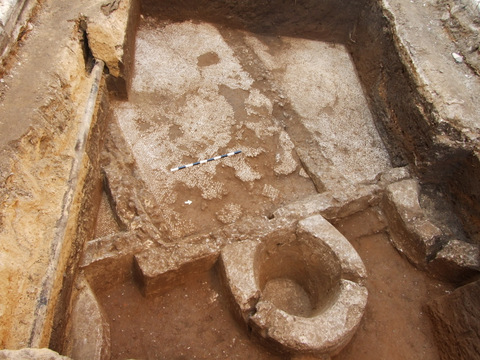
Photograph: courtesy of the Israel Antiquities Authority
An Ancient Industrial Installation was Revealed beneath the Asphalt in Yafo (February 2013)Via Joseph I. Lauer.
The Israel Antiquities Authority exposed remains of an installation for extracting liquid which dates to the Byzantine period
Archaeological excavations of the Israel Antiquities Authority provide a glimpse at hundreds of years of magnificent history that lies beneath the busy streets. The excavations are being conducted prior to modernizing the infrastructure, on behalf of the Tel Aviv municipality, by the Mashlama Le-Yafo, within the framework of the Magen Avraham Compound project. Recently impressive remains of an industrial installation from the Byzantine period which was used to extract liquid were exposed on Hai Gaon Street.
Installations such as these are usually identified as wine presses for producing wine from grapes, and it is also possible they were used to produce wine or alcoholic beverage from other types of fruit that grew in the region. Yafo’s rich and diverse agricultural tradition has a history thousands of years old beginning with references to the city and its fertile fields in ancient Egyptian documents up until Yafo’s orchards in the Ottoman period.
According to Dr. Yoav Arbel, director of the excavations on behalf of the Israel Antiquities Authority, “This is the first important building from the Byzantine period to be uncovered in this part of the city. The fact that the installation is located relatively far from Tel Yafo adds a significant dimension to our knowledge about the impressive agricultural distribution in the region in this period. The installation, which probably dates to the second half of the Byzantine period (sixth century – early seventh century CE), is divided into surfaces paved with a white industrial mosaic. Due to the mosaic’s impermeability such surfaces are commonly found in the press installations of the period which were used to extract liquid. Each unit was connected to a plastered collecting vat. The pressing was performed on the mosaic surfaces whereupon the liquid drained into the vats. It is possible that the section that was discovered represents a relatively small part of the overall installation, and other elements of it are likely to be revealed in archaeological excavations along adjacent streets which are expected to take place later this year”.
Upon completion of the excavation the installation was covered over, and new infrastructures were laid in place above it without damaging it, thereby enabling the continued work on the infrastructure without compromising the preservation of the antiquities for future generations.
The Magen Avraham Compound project constitutes another tier in the development of the tourist, commercial and residential region in Yafo and encompasses seven streets: Noʽam, Magen Avraham, Hai Gaon, Yossi Ben Yossi, Ardon, Ba’alei Ha-Tosafot and Resh Galuta.
The municipality is modernizing the underground infrastructure, roads and sidewalks within the framework of the project. The overhead electrical and telephone wires are being lowered as well and street furniture and landscaping are being added.
The infrastructure development was preceded by the Israel Antiquities Authority excavations because the region is an official, declared antiquities site. As was the case with antiquities that were previously uncovered, this project also reflects the cooperation and balance between the historical archaeological finds and their preservation on the one hand and the necessary development of the city on the other.
Wednesday, February 20, 2013
Sabbath and circumcision
THIS WEEK'S DAF YOMI COLUMN by Adam Kirsch in Tablet Magazine: Birth Right: You wouldn’t expect that the tractate on Shabbat would be the place to discuss circumcision. You’d be wrong.
As I have remarked before, it is difficult to imagine the brutality of the world in which the ancients lived.
Earlier Daf Yomi columns are noted here and links.
When my son was born on a Friday and I contacted a mohel to schedule the bris for the following Saturday, I was surprised to be asked whether the baby had been delivered by Caesarean section. If boys are delivered traditionally, I learned, they must be circumcised on their eighth day of life; but if they are delivered by C-section, the ritual can be postponed if the eighth day falls on Shabbat. I didn’t ask the mohel for the halakhic reasoning behind this distinction—as a new parent I had enough things to think about—but I finally learned it from reading the Talmud this week.Caesarean section in antiquity was usually done either in cases when the mother was already dead or when both mother and baby could be expected to die without intervention. This particular intervention would have a chance to save the baby, but the survival of the mother, although it (remarkably) was not unheard of, would have been unusual. For some data on pre-modern Caesarean section see Samuel Lurie's article The changing motives of cesarean section: from the ancient world to the twenty-first century.
In Shabbat 135a, Rabbi Asi explains that the distinction has to do with the ritual purity status of the mother. Vaginal delivery renders the mother impure, tamei, for seven days, and it is only at the expiration of this term that circumcision takes place, as we learn from Leviticus: “If a woman bears seed and gives birth to a male, she shall be impure seven days, and on the eighth day the flesh of his foreskin shall be circumcised.” The rabbis drew the corollary that, if a woman is not impure because she delivered by C-section, her son does not need to be circumcised on the eighth day. And since it is preferable not to perform a circumcision on Shabbat unless absolutely necessary, the circumcision or milah can be postponed until the ninth day in such cases. Of course, in Talmudic times Caesarean section would have been a very rare and dangerous operation, performed without anesthetic using unsterilized tools. The rabbis could hardly have imagined that in our day almost a third of births would happen this way.
[...]
As I have remarked before, it is difficult to imagine the brutality of the world in which the ancients lived.
Earlier Daf Yomi columns are noted here and links.
Herod exhibition and BAS
BIBLE HISTORY DAILY (BAS) has put up a couple of posts this week on the Herod the Great exhibition at the Israel Museum:
Herod the Great—The King’s Final Journey
Take a closer look at the exhibit with a web-exclusive slideshow (Suzanne F. Singer)
Rediscover Herod's tomb through archaeologist Ehud Netzer's scholarship (Noah Wiener)
Herod the Great—The King’s Final Journey
Take a closer look at the exhibit with a web-exclusive slideshow (Suzanne F. Singer)
The Israel Museum’s exhibit Herod the Great—The King’s Final Journey guides visitors through the Herodian world and the end of the illustrious king’s life, as brought to light by the late archaeologist Ehud Netzer. Read the article “Herod the Great—The King’s Final Journey” by Suzanne F. Singer as it appears in the March/April 2013 issue of BAR , and take a look at additional web-exclusive highlights from the exhibit in the Bible History Daily slideshow.Ehud Netzer Publications Available to Public
Rediscover Herod's tomb through archaeologist Ehud Netzer's scholarship (Noah Wiener)
In a commemoration of the scholarship of Ehud Netzer, Biblical Archaeology Society has made a special collection of his groundbreaking scholarship from the BAS Library available for free.Background on the exhibition is here and links.
Tuesday, February 19, 2013
Stolen artifacts recovered
ARUTZ SHEVA:
Ancient Stolen Artifacts Discovered in Beit Jann
The Carmiel police and the Antiquities Authority Theft Prevention Division discovered hundreds of stolen artifacts during a search of a private home in the Arab village of Beit Jann.
Arrowheads, lamp fillers, counterweights and nails were uncovered, as well as glassware and 300 coins from the Roman-Hellenist period.
[...]
Review of Green, The Aroma of Righteousness
H-JUDAIC BOOK REVIEW
Deborah A. Green. The Aroma of Righteousness: Scent and Seduction in Rabbinic Life and Literature. University Park: Pennsylvania State University Press, 2011. xiv + 286 pp. $69.95 (cloth), ISBN 978-0-271-03767-7.
Reviewed by Jonathan Brumberg Kraus (Wheaton College)
Published on H-Judaic (February, 2013)
Commissioned by Jason Kalman
Tracking the Trail of Scent in Rabbinic Literature
Deborah A. Green’s analysis of the language and sensory experience of smell in early rabbinic Judaism is--I’ll risk the cliché--a breath of fresh air in the often stodgy discipline of rabbinic textual studies. Reading Green’s book reminded me of Wayne Meeks’s critique of “the air of unreality pervading much of the recent scholarly literature” about ancient Christian texts back in the early 1980s.[1] Green’s expansion of what began as a textual study of literary references to olfaction to “the relevant history, archaeology, and cultural data” they presupposed resonated with me (p. 3). At last, a fellow reader who remembers that texts under critical consideration were composed by living, breathing, feeling human beings! And with their olfactory-enhanced concern with the emotionally charged subjects of love and death, the same texts affect us too as living, breathing, feeling human beings, even if not quite in the same way. Just as Meeks and others turned to sociology and social history to flesh out “the air of unreality” pervading descriptions of ancient Christianity, so Green and a cohort of scholars have recently turned to the sensory dimensions of ancient Jewish and Christian texts and practices, to re-embody human experiences and emotions latent in them.[2] This scholarship notably shares a multidisciplinary interest in current biological and cognitive neuroscience research on the physiology of the senses and emotions, as well as philosophical and social historical studies on how western European intellectual tradition generally, and the study of Jewish religious texts in particular, have maligned the “lower senses” of smell, taste, and touch (pp. 3-4).
[...]
Monday, February 18, 2013
Heller on the making of the early Hebrew book
NEW BOOK FROM BRILL:
Further Studies in the Making of the Early Hebrew Book
Marvin J. Heller
Further Studies in the Making of the Early Hebrew Book contains essays on aspects of the early Hebrew book most often treated in a cursory manner if addressed at all. The largest section of the volume is concerned with the makers and places of Hebrew books, mainly addressing book-makers poorly remembered or controversial and print-shops that issued a small number of books in a brief period of time. The section on varia addresses aspects of the book trade such as small books, incomplete books published as a prospectus, competing simultaneous editions, and errors and variations in books. Two smaller sections deal with book arts such as incunabula frames and pressmarks; variations between medieval and current Sephardic Haggadot.
New book by Leonard Greenspoon
PRESS RELEASE:
Biblical Archaeology Society Announces the Digital Publication of Leonard Greenspoon’s New Volume
NewswireToday - /newswire/ - Washington, DC, United States, 02/14/2013 - Biblical Archaeology Society announces the digital publication of Leonard Greenspoon’s new volume, along with new eReader editions of four popular print publications - BiblicalArchaeology.org.
For more than a dozen years, Leonard J. Greenspoon’s “The Bible in the News” column has been one of the most popular and enjoyed sections of the widely read magazines Bible Review and Biblical Archaeology Review (BAR).
For his column, Greenspoon, who is the Philip M. and Ethel Klutznick Chair in Jewish Civilization at Creighton University, scours the world’s newspapers and popular media looking for interesting, entertaining and often surprising references to the Bible and its timeless collection of sayings, characters and fables. Greenspoon’s perceptive eye and insightful commentary are matched by a charming, tongue-in-cheek humor that always brings a sly smile to the reader’s face.
Developed exclusively for eReaders, the brand-new book The Bible in the News: How the Popular Press Relates, Conflates and Updates Sacred Writ brings together all of Greenspoon’s “The Bible in the News” articles and columns into a single collection, beginning with his August 2000 feature article “Extra! Extra! Philistines in the Newsroom!” until his recent column in the November/December 2012 issue of BAR. This entertaining array of columns, whose topics range from Adam and Eve in pop culture to North American highways and byways numbered 666 (the number of the beast according to Revelation 13:18), has been conveniently arranged into chapters focusing on Biblical episodes and passages from both the Old and New Testaments. The book’s final chapter explores general biblical themes and topics that often appear in media reports, from exceptional Bible translations to champagne bottles named for lesser known biblical characters like Rehoboam and Melchizedek.
These and many other fascinating stories about the Bible’s vibrant and continued presence in today’s media culture are found in this eBook, The Bible in the News. Leonard J. Greenspoon is author of BAR’s popular “The Bible in the News” column, and holds the Philip M. and Ethel Klutznick Chair in Jewish Civilization at Creighton University in Omaha. He is editor-in-chief of the Studies in Jewish Civilization series, which is publishing its 24th volume this fall. He also co-authored, with the late Harvey Minkoff, BAS’s free guide to modern Bible translations, The Holy Bible: A Buyer’s Guide. BAS also released new digital editions of four popular print volumes: Aspects of Monotheism, The Rise of Ancient Israel, Feminist Approaches to the Bible and The Search for Jesus.
Sunday, February 17, 2013
New CAL features
THE ARAMAIC BLOG: New Features at the Comprehensive Aramaic Lexicon (CAL).
A bunch of new search options are now available at the Comprehensive Aramaic Lexicon over at Hebrew Union College.
Lod Mosaic in Philly
THE LOD MOSAIC is on its last stop in the United States, before heading to Paris and then back to Israel:
Mosaic floor discovered in Israel on view at Penn Museum in PhiladelphiaBackground on the mosaic and its earlier travels is here and links.
Kristie Rearick/South Jersey Times By Kristie Rearick/South Jersey Times
on February 15, 2013 at 12:38 PM, updated February 15, 2013 at 7:18 PM
Bringing a mosaic floor — one believed to have come from the home of a wealthy Roman living in the Eastern Roman Empire at about 300 CE — into the Penn Museum in Philadelphia, was not an easy task.
[...]
Tomb of ancient sage vandalized
VANDALISM: Temple-Era Sage's Tomb Defaced Near Tzfat (Arutz Sheva).
Unidentified vandals caused damage to the tomb of Second Temple era sage Yonatan Ben Uziel Saturday. The tomb is located near Amuka, in the vicinity of Tzfat, in the Upper Galilee.Including, whatever this means, Druze-themed graffiti.
Anime Metatron
ARCHANGEL METATRON WATCH: 8 Interesting Uses of World Religious Figures.
2. Metatron (Demonbane) In a world of Cthulu mythos, one Jewish archangel rises up as a magical girl-nun trying to stop an evil organization from summoning The Ancient Ones. Specifically, she'd rather not be used as control vessel for them, instead mounting her Hunting Horror motorcycle in a suit of white angelic armor. In Jewish apocrypha, Metatron is the angel incarnation of Enoch and the ancestor of Noah.More in Jewish mysticism than Jewish apocrypha.
Ruth Calderon's Talmud lesson
THE TALMUD BLOG: A Talmud Lecture in the Knesset.
... when was the last time a Talmud shiur went viral like this?
Saturday, February 16, 2013
NYT on Golb identity-theft case
THE RAPHAEL GOLB IDENTITY-THEFT CASE is covered in a thorough and well-informed article in the New York Times:
Much background on this long, sad story is here with many links.
Online Battle Over Sacred Scrolls, Real-World ConsequencesThe current status of the case:
By JOHN LELAND
Published: February 16, 2013
There is a saying about academia that the disputes are so vicious because the stakes are so low. In the case of Raphael Haim Golb, a son of a Dead Sea Scrolls scholar, the last few years have provided ample support for the first half of the saying. But the second half is less accurate.
In his cluttered fifth-floor walk-up apartment in Greenwich Village, Mr. Golb, 53, is waiting to begin serving a six-month sentence for waging an Internet campaign against his father’s academic rivals, including sending e-mails under a rival professor’s name. The younger Mr. Golb, who has a Ph.D. from Harvard and a law degree from New York University, is six feet tall, 120 pounds; digressive, tightly wound, bookish; a gadfly, an irritant, an obsessive. If you saw him on the street, you might worry about his safety.
Between 2006 and 2009, he created more than 80 online aliases to advance his father’s views about the Dead Sea Scrolls against what he saw as a concerted effort to exclude them. Along the way, according to a jury and a panel of appellate court judges, he crossed from engaging in academic debate to committing a crime.
[...]
“I’m not saying anybody here acted well,” Mr. [Ronald] Kuby [a lawyer of Mr. Golb's] said. “I just don’t think anybody acted criminally.”The remark by Mr. Kuby about Robert Cargill's "hurt puppy persona" is generating some commentary—and photoshopping—on Facebook.
After a three-week trial, the jury ruled otherwise, finding Mr. Golb guilty on 30 of 31 counts, including two felonies. On Jan. 29 he lost again on appeal on all but one count. He is currently out on bail pending a decision by the State Supreme Court on whether or not to hear his appeal. Last week, he was granted permission to go to Chicago, where his father was in the hospital after a minor stroke.
Much background on this long, sad story is here with many links.
On 1 Enoch 90:15
EDWARD COOK: A Suggestion About I Enoch 90:15. Sounds plausible to me.
Cross-file under "Aramaic Watch."
UPDATE: Related: Scholarly Papers on 1 Enoch Available For Free (Michael Heiser at PaleoBabble). For you, special deal.
Cross-file under "Aramaic Watch."
UPDATE: Related: Scholarly Papers on 1 Enoch Available For Free (Michael Heiser at PaleoBabble). For you, special deal.
Friday, February 15, 2013
Forthcoming book on source of sin in Second Temple Literature
ASOR BLOG:
The Source of Sin and its Nature as Portrayed in Second Temple Literature
Posted on February 7, 2013 by jennfitz
By: Miryam T. Brand, New York University, National Endowment for the Humanities Fellow
My fellowship at the Albright this year has enabled me to further develop the topic of my dissertation with the aim of producing a book for academic readers: Evil Within and Without: The Source of Sin and its Nature as Portrayed in Second Temple Literature, to be published in the Journal of Ancient Judaism Supplement series. The aim of my study has been to examine how sin, specifically, the source of sin, is presented in Second Temple literature, including Apocrypha, Pseudepigrapha, Philo and the Dead Sea Scrolls. These texts are examined according to their genre: prayer texts, narratives, wisdom literature, and covenantal texts (introductions to legal rules).
[...]
Thursday, February 14, 2013
More Daf Yomi columns
RECENT DAF YOMI COLUMNS by Adam Kirsh at Tablet Magazine:
Can’t Touch This
Talmudic rabbis debate the reach of permissions and prohibitions, and Jews are rewarded for virtuous behavior
The rabbis who reasoned about the day of rest also celebrated it. Plus: The Talmud on iPad and in translation.
Can’t Touch This
Talmudic rabbis debate the reach of permissions and prohibitions, and Jews are rewarded for virtuous behavior
Writing last week about the Talmud’s rule that you cannot extinguish a fire on Shabbat, I noted that presumably an exception must be made for saving human life. I didn’t have to wait long to see how the rabbis approached this question, since it turned out to be one of the major themes of this week’s Daf Yomi reading. When it comes to sick people, women in childbirth, and even suffering animals, the rabbis make clear in Shabbat 128b, the usually strict rules of Shabbat observance can be relaxed or even violated.Queen for a Day
The rabbis who reasoned about the day of rest also celebrated it. Plus: The Talmud on iPad and in translation.
That praise of Shabbat, typically, comes in the course of a technical discussion about a new area of Shabbat law. What kinds of things can be saved from a fire on Shabbat? This is the main subject of Chapter 16, which proceeds on the assumption—never explicitly stated—that it is forbidden to extinguish a fire on Shabbat, since that is one of the 39 melachot. Presumably the law makes an exception for saving human life, always a chief Talmudic value, but the issue doesn’t come up directly. Instead, the chapter begins with a mishnah about something almost as crucial: Is it permitted to put out a fire in order to save “sacred writings”?Earlier Daf Yomi columns are noted here and links.
Review of Nirenberg, Anti-Judaism: The Western Tradition
BOOK REVIEW:
A World Without JewsUPDATE: And here is an essay on the subject by Nirenberg in The Chronicle of Higher Education: Anti-Judaism as a Critical Theory.
An exhilarating new intellectual history argues that anti-Judaism is at the heart of Western culture
By Adam Kirsch|February 13, 2013 7:00 AM|21comments (Tablet)
The title of David Nirenberg’s new book, Anti-Judaism: The Western Tradition, uses a term pointedly different from the one we are used to. The hatred and oppression of Jews has been known since the late 19th century as anti-Semitism—a label, it is worth remembering, originally worn with pride by German Jew-haters. What is the difference, then, between anti-Semitism and anti-Judaism? The answer, as it unfolds in Nirenberg’s scholarly tour de force, could be summarized this way: Anti-Semitism needs actual Jews to persecute; anti-Judaism can flourish perfectly well without them, since its target is not a group of people but an idea.
Nirenberg’s thesis is that this idea of Judaism, which bears only a passing resemblance to Judaism as practiced and lived by Jews, has been at the very center of Western civilization since the beginning. From Ptolemaic Egypt to early Christianity, from the Catholic Middle Ages to the Protestant Reformation, from the Enlightenment to fascism, whenever the West has wanted to define everything it is not—when it wants to put a name to its deepest fears and aversions—Judaism has been the name that came most easily to hand. “Anti-Judaism,” Nirenberg summarizes, “should not be understood as some archaic or irrational closet in the vast edifices of Western thought. It was rather one of the basic tools with which that edifice was constructed.”
[...]
Collins on NPR
JOHN COLLINS IS INTERVIEWED ON NPR: 'Dead Sea Scrolls' Live On In Debate And Discovery.
The Dead Sea Scrolls are the ancient manuscripts dating back to the time of Jesus that were found between 1947 and 1956 in caves by the Dead Sea. Since they were first discovered, they have been a source of fascination and debate over what they can teach — and have taught — about Judeo-Christian history. In his new book, The Dead Sea Scrolls: A Biography, Yale professor John J. Collins tells the story of the scrolls, their discovery and the controversies surrounding the scholarship of them.
February 14th
HAPPY STS. CYRIL AND METHODIUS DAY!
Background here and links. Cross-file under "Old Church Slavonic."
Background here and links. Cross-file under "Old Church Slavonic."
Wednesday, February 13, 2013
More discoveries at Qumran
NOT, ALAS, MORE SCROLLS: Dead Sea Cave Yields New Finds (Popular Archaeology).
Led by Dr. Haim Cohen of Israel's Haifa University, a small team ascended a steep escarpment of rocky terrain to the cave each morning at 5.45 a.m. beginning on November 28 for several weeks of painstaking excavation. The routine climb took 2 hours to reach the excavation site, a cave where Cohen had previously conducted excavations in 2003 and 2006. Cave 27, also called the "Mikveh Cave" or Cave of the Pool at Nahal David, is best known for the Second Temple period (530 BCE to 70 CE) mikveh, or ritual cleansing pool, dated to the time of the first centuries B.C. and A.D. It was discovered and excavated just outside the cave entrance. The cave is located in a cliff approximately 400 meters above the Dead Sea and is accessible from a plateau above the cave. Among the many other finds excavated in past seasons were Early Roman period potsherds, flint tools, remains of straw matting, textiles, date pits, ropes, olive pits, animal bones, two coins of Agrippa I, a glass bottle, an iron trilobate arrowhead from the Early Roman period, a pottery seal with a geometric decoration considered to be from the Chalcolithic period, and an ashen hearth. The most intriguing questions, however, have surrounded the presence of the mikveh at the entrance to the cave, a relatively unusual location for such a feature.Via the Agade list and others.
Now, Cohen and his team have uncovered new artifacts and items that will add to their database of finds, a body of information or evidence that will help them answer some important questions about what the cave was used for, who may have inhabited or used the cave, and what significance the cave holds. Their most recent efforts have uncovered a large amount of pottery dated to the Second Temple period, and some dated to the Chalcolithic and Iron Age. Other finds included a few fragments of Roman period blown glass, identified as the base and rim pieces of perfume bottles; and an abundance of organic material such as twigs, branches of palm trees, animal bones, fragments of reed and straw, dates (one remarkably well preserved), rope, (including one knotted around a ceramic handle), fabric and leather, including a remarkably well preserved part of a sandal.
Samaritan brides again
MORE ON THE UKRAINIAN-SAMARITAN BRIDES:
How Ukrainian women saved the Samaritans of Mount GerizimEarlier coverage indicated that eleven Ukrainian women had recently joined the community.
The Samaritans of Mount Gerizim were a rapidly dwindling religious community facing extinction. Then a handful of young Ukrainian brides made the journey to the West Bank, bringing with them fresh hope
Harriet Sherwood
The Guardian, Monday 11 February 2013
For decades, it seemed as though one of the world's smallest religious communities was doomed. Dwindling and insular, the Samaritans of Mount Gerizim were struggling to survive as inbreeding produced generation after generation of children with serious disabilities on an isolated hilltop in the biblical landscape of the West Bank.
But the threat of extinction is now receding after the deployment of the twin weapons of advanced medical science and internet marriage agencies to import brides from Ukraine. In fact, the community of four extended families totalling 320 people is now looking forward to rapid growth.
"We're hoping our numbers will reach 10,000 in 10 years," jokes high priest Aharon Ben-Av Chisda, with more optimism than realistic prediction. "Before, we were worried about the future of our community. Now we have hope."
Much of this hope stems from five young Ukrainian women who have injected fresh blood to Mount Gerizim after swapping a life of bleak prospects, dismal housing and badly paid employment for space, security and strict observance of the religious dictates of the ancient Samaritan community.
[...]
Herod exhibition opens
THE HEROD THE GREAT EXHIBITION AT THE ISRAEL MUSEUM is now open and is raising predictable political issues: "Herod the Great" show in Israel angers Palestinians (Reuters).
Background here and here and links.
Palestinians said the artefacts were removed without their consent from Herodium, the builder-king's excavated palace on an arid hilltop a short drive from Jerusalem.Also, the Daily Mail has a review with some nice photos: Inside Herod's house: Fascinating exhibition of 2,000-year-old treasures belonging Biblical king who tried to kill baby Jesus... including his bathtub.
The Palestinian minister of tourism and antiquities, Rula Ma'ayah, told Reuters all Israeli archaeological activities in the West Bank were illegal.
Background here and here and links.
Cyrus Cylinder coming soon to USA
THE CYRUS CYLINDER is going on display at the Smithsonian next month: Cyrus Cylinder Brings 2,600 Years of World History to Smithsonian in U.S. Debut (/PRNewswire). This press release covers the usual ground, including the rather inflated view of Cyrus as a human rights pioneer, but it also has some interesting information about the artifact's historical context and its reception history after its discovery in the nineteenth century:
The message of the Cylinder and the larger legacy of Cyrus' leadership have been appropriated and reinterpreted over millennia, beginning with its creators. The Babylonian scribe who engraved the Cylinder attributed Cyrus' victory to the Babylonian god Marduk, a stroke of what could be considered royal and religious propaganda. In the fourth century B.C.E., the Greek historian Xenophon wrote Cyropaedia, a text that romanticizes the philosophies and education of Cyrus as the ideal ruler, which greatly influenced both Alexander the Great and, much later, Thomas Jefferson in his creation of the Declaration of Independence.Background here, with many links.
When the Cylinder was rediscovered in 1879, it immediately entered the fray of public debate as invaluable proof of the historical veracity of events described in biblical scripture. In the early 20th century, supporters of the creation of the state of Israel compared the actions of British King George V to those of Cyrus, allowing Jews to return to Jerusalem. When the Cylinder was loaned to Iran in 2010, it was viewed by more than 1 million people, one of the most visited exhibitions in the country's history.
Those were the days
THE CRIMSON:
In the seventeenth century, Harvard students were required to take three years each of Hebrew, Aramaic, Greek, and Syriac as well as demonstrate fluency in Latin as part of their graduation requirements, according to The Crimson.
Tuesday, February 12, 2013
Paul and the Wisdom of Solomon
OLD TESTAMENT APOCRYPHA WATCH: James McGrath muses on whether the Apostle Paul was disputing with the Wisdom of Solomon in Romans 1:29-31: Who Are You, O Man? (Maybe the Author of Wisdom of Solomon?)
My favorite contribution to this discussion is by R. A. Knox, who once commented that he had toyed with the idea of arguing that the Wisdom of Solomon was actually written by Paul before his conversion.
My favorite contribution to this discussion is by R. A. Knox, who once commented that he had toyed with the idea of arguing that the Wisdom of Solomon was actually written by Paul before his conversion.
Computer-reconstructed proto-languages
UC BERKELEY PRESS RELEASE
The idea that this program could predict language changes should be handled cautiously. It may well be able to indicate a range of possible developments (conditional predictions), but any attempt to make precise extrapolations (unconditional predictions) about how a language will change in the future will quickly run up against far too many sensitive variables to compute (the butterfly effect), involving numerous intangibles about human society. Karl Popper had already described this problem in the days before Chaos Theory, and he also pointed out that the process of scientific advancement of knowledge is itself unpredictable and therefore injects unpredictable variables into any attempts to predict the future.
Scientists create automated ‘time machine’ to reconstruct ancient languagesAnd, of course, Proto-Semitic.
By Yasmin Anwar, Media Relations | February 11, 2013
BERKELEY —
Ancient languages hold a treasure trove of information about the culture, politics and commerce of millennia past. Yet, reconstructing them to reveal clues into human history can require decades of painstaking work. Now, scientists at the University of California, Berkeley, have created an automated “time machine,” of sorts, that will greatly accelerate and improve the process of reconstructing hundreds of ancestral languages.
In a compelling example of how “big data” and machine learning are beginning to make a significant impact on all facets of knowledge, researchers from UC Berkeley and the University of British Columbia have created a computer program that can rapidly reconstruct “proto-languages” – the linguistic ancestors from which all modern languages have evolved. These earliest-known languages include Proto-Indo-European, Proto-Afroasiatic and, in this case, Proto-Austronesian, which gave rise to languages spoken in Southeast Asia, parts of continental Asia, Australasia and the Pacific.
”What excites me about this system is that it takes so many of the great ideas that linguists have had about historical reconstruction, and it automates them at a new scale: more data, more words, more languages, but less time,” said Dan Klein, an associate professor of computer science at UC Berkeley and co-author of the paper published online today (Feb. 11) in the journal Proceedings of the National Academy of Sciences.Despite the try-too-hard time-machine metaphor (no flux capacitor is involved), this sounds like a useful development. It is not a panacea for the reconstruction of proto-languages, nor does it pretend to be, but anything that speeds up the slow and painstaking process of gathering, organizing, and categorizing the raw data is worthwhile and commendable. The claims here (apart from the time travel stuff) are relatively measured in comparison with the reports a few years ago about a computer program that could decipher Ugaritic.
The research team’s computational model uses probabilistic reasoning – which explores logic and statistics to predict an outcome – to reconstruct more than 600 Proto-Austronesian languages from an existing database of more than 140,000 words, replicating with 85 percent accuracy what linguists had done manually. While manual reconstruction is a meticulous process that can take years, this system can perform a large-scale reconstruction in a matter of days or even hours, researchers said.
Not only will this program speed up the ability of linguists to rebuild the world’s proto-languages on a large scale, boosting our understanding of ancient civilizations based on their vocabularies, but it can also provide clues to how languages might change years from now.
“Our statistical model can be used to answer scientific questions about languages over time, not only to make inferences about the past, but also to extrapolate how language might change in the future,” said Tom Griffiths, associate professor of psychology, director of UC Berkeley’s Computational Cognitive Science Lab and another co-author of the paper.
[...]
The idea that this program could predict language changes should be handled cautiously. It may well be able to indicate a range of possible developments (conditional predictions), but any attempt to make precise extrapolations (unconditional predictions) about how a language will change in the future will quickly run up against far too many sensitive variables to compute (the butterfly effect), involving numerous intangibles about human society. Karl Popper had already described this problem in the days before Chaos Theory, and he also pointed out that the process of scientific advancement of knowledge is itself unpredictable and therefore injects unpredictable variables into any attempts to predict the future.
Monday, February 11, 2013
Muslim conference on Hebrew language and culture
INTERESTING:
Muslims Host First Ever Hebrew Conference Held in South AsiaThe topics listed are wide ranging and seem to encompass the full range of Jewish history:
By: Jewish Press News Briefs
Published: February 11th, 2013
The first-ever Hebrew language and culture conference in South Asia was hosted at the Jawaharlal Nehru University in New Delhi and organized by none other than Muslims scholars in a show of Muslim-Jewish amity in India.
[...]
The conference focused on literature and psychology; language and religion; names in ancient and modern Hebrew; Halakhah, Jewish identity and modernization; law and language; Hebrew, Aramaic and Arabic and the mutual influences; the language of the Bible, as well as sessions held on the Indian Jews, and India in Hebrew Literature and Hebrew in India.
Herod exhibition latest
THE HEROD THE GREAT EXHIBITION opens tomorrow at the Israel Museum. Here are a couple of recent articles on it.
Monumental enough for Herod the Great? The Israel Museum’s exhibit on the life and legacy of the controversial king opens this week. (Jerusalem Post)
'Herod the Great': Israeli museum examines infamous leader (USA Today)
Monumental enough for Herod the Great? The Israel Museum’s exhibit on the life and legacy of the controversial king opens this week. (Jerusalem Post)
'Herod the Great': Israeli museum examines infamous leader (USA Today)
Sunday, February 10, 2013
Ancient public board games
GAMES PEOPLE PLAYED:
The national storage facility is in a secure, undisclosed location.
Unearthed board games shed light on ancient holy land trivial pursuitsA wonderful howler in that last sentence: for "century" read "millennium."
A Jerusalem 'artifactologist,' who directs a national storage facility that holds more than a million archaeological items, says games offer insight into human life throughout the ages.
By Nir Hasson | Feb.10, 2013 | 10:53 AM (Haaretz)
A few years ago, a striking street from the Roman period was discovered in the back part of the Western Wall Square. This eastern cardo area features a wide lane, sidewalks, and entryways for stores. Archaeologists, led by Shlomit Wexler-Bedolah from the Israel Antiquities Authority, discovered an inscription in one of the sidewalk areas − the engraving stretches across two quadrants, each divided into squares, and has a large X in its center.
In another area, an engraving features a rectangle divided into 42 squares. An intensive search uncovered another six inscriptions of various types; and searches in other parts of Jerusalem’s Old City uncovered another 21 engravings − in the Damascus Gate square, around the Dung Gate, at the Jewish quarter’s cardo, and elsewhere. Each is actually a public game-board, dating from the Roman period, similar to public chessboards that can sometimes be found in public parks in Europe. Jerusalem in Roman times − Aelia Capitolina − is not unusual in this respect. Archaeologist Dr. Michael Saban, who investigates ancient games artifacts, alludes to hundreds of game boards of different types, from all historical periods. The oldest such board dates to the 7th century B.C.E., 9,000 years ago.
[...]
The national storage facility is in a secure, undisclosed location.
Friday, February 08, 2013
LXX Day
HAPPY INTERNATIONAL SEPTUAGINT DAY!
Whew! Almost missed it. Thanks to Rick Brannan on Facebook for the reminder.
Whew! Almost missed it. Thanks to Rick Brannan on Facebook for the reminder.
Cairo Geniza funding crisis
OH OH:
Slideshow: Oxbridge coalition in bid to save collectionThis is news to me. They have already raised half a million pounds, which is great, but there's lots more to go. If you, dear reader, are, or if one of your friends is, a rich philanthrophist, here's your chance!
Written by Jennie Baker (Cambridge News)
A £1.2 million fundraising bid has been launched by Cambridge and Oxford universities to keep 1,000 years of Jewish history in the public domain.
The Lewis-Gibson Genizah Collection of more than 1,700 fragments of ancient Hebrew and Arabic manuscripts has been housed at Westminster College, a Cambridge theological college, since 1896.
But the manuscripts – dating from the 9th to the 19th century – are in danger of being sold into private collections unless the universities can gather the funds to buy them.
[...]
DSS dynamic duo
OBSCURE HEADLINE OF THE WEEK: Dead Sea Scrolls anchor interfaith series. Unpacked, it tells us that Larry Schiffman and James VanderKam will be doing a joint lecture series on the Dead Sea Scrolls in New Jersey later this month.
Herod exhibition
ASKING THE IMPORTANT QUESTIONS: King Herod’s monument, tomb or temple? Bonna Devora Haberman has some rambling reflections on the new Herod exhibition in the Israel Museum.
Background here and links.
Background here and links.
Thursday, February 07, 2013
Sarajevo Haggadah latest
THE SARAJEVO HAGGADAH is back in the news: Bosnia Refuses to Loan Sarajevo Hagaddah to NY's Met: National Museum in Sarajevo, where the Hagaddah is kept, closed its doors indefinitely due to a lack of funding. (Arutz Sheva).
Background here, here, here, here, and links.
Background here, here, here, here, and links.
Cuneiform top 100
NEWS YOU CAN USE: The One Hundred Most Important Cuneiform Objects.
The list includes the Hammurapi law code, the Gilgamesh Epic, the Gilgamesh Flood story, and the Cyrus Cylinder. Unaccountably, the Sumerian Flood story (or "Eridu Genesis") is missing.
(Via Francis Deblauwe on Facebook.)
The list includes the Hammurapi law code, the Gilgamesh Epic, the Gilgamesh Flood story, and the Cyrus Cylinder. Unaccountably, the Sumerian Flood story (or "Eridu Genesis") is missing.
(Via Francis Deblauwe on Facebook.)
The Early High Christology Club
LARRY HURTADO reminisces about The Early High Christology Club (EHCC).
I guess I'm pretty close to a charter member; I wasn't on the committee, but I attended all the Divine Mediator Figure SBL sessions (the first was in 1991) and I presented some papers in the group. Alas, I wasn't at the famous dinner. My 1998 undergraduate course Divine Mediator Figures in the Biblical World was very much inspired by the work of the group, and it led into the International Conference on the Historical Origins of the Worship of Jesus at St. Andrews, which I organized with Carey Newman. Larry Hurtado and many others from the group attended and gave papers, which were published in The Jewish Roots of Christological Monotheism.
I still have my mug. I'm drinking my morning coffee from it right now.
I guess I'm pretty close to a charter member; I wasn't on the committee, but I attended all the Divine Mediator Figure SBL sessions (the first was in 1991) and I presented some papers in the group. Alas, I wasn't at the famous dinner. My 1998 undergraduate course Divine Mediator Figures in the Biblical World was very much inspired by the work of the group, and it led into the International Conference on the Historical Origins of the Worship of Jesus at St. Andrews, which I organized with Carey Newman. Larry Hurtado and many others from the group attended and gave papers, which were published in The Jewish Roots of Christological Monotheism.
I still have my mug. I'm drinking my morning coffee from it right now.
Wednesday, February 06, 2013
Cataloguing grants at HMML
ADAM MCCOLLUM: Cataloging grants. "The Hill Museum & Manuscript Library (HMML) announces grants available for cataloging work in its eastern Christian collections in Arabic/Garšūnī, Armenian, Old Church Slavonic, and Syriac. ..."
Follow the link for details.
Follow the link for details.
Zippori
A TRAVEL PIECE ON ZIPPORI/SEPPHORIS in Haaretz: Tourist tip #157 / Zippori National Park: The ancient ruins of this once great city lives up to its post-Biblical billing, "the ornament of all Galilee".
Earlier posts on Zippori are here, here, here, and links
With ancient hype billing it as “the ornament of all Galilee” (the Jewish historian Josephus), and “perched on a mountain like a bird” – i.e., a bird’s eye view (the Talmud) and “a land flowing with milk and honey for 16 miles around,” (ditto) even in ruin, the city of Zippori has a lot to live up to. And it does.It includes a late-antique synagogue and some cool mosaics.
Earlier posts on Zippori are here, here, here, and links
Tuesday, February 05, 2013
DSS in Cincinnati
CINCINNATI MUSEUM CENTER: Dead Sea Scrolls swapped out.
By the time you read this, the Cincinnati Museum Center should have completed the mid-exhibit changeover of the 10 ancient Dead Sea Scroll artifacts on display as the centerpiece of its current exhibit.Background here and here and links.
[...]
The [new] set includes Deuteronomy, Psalms, Isaiah Commentary, Book of War, Aramaic Levi, Pseudo-Ezekiel, Apocryphal Lamentations, Papyrus Bar, Community Rule and Leviticus/Numbers.
Timbuktu manuscripts update
THE LATEST ON THE TIMBUKTU MANUSCRIPTS:
From Time Magazine: Timbuktu’s Ancient Libraries: Saved by Locals, Endangered by a Government.
It appears from the latter article that most of the 2000 unaccounted-for manuscripts were locked safely in a basement room in the Ahmed Baba Institute and were not harmed, which is good news. Also, it is not clear to me whether the Institute building was burned or not. This article indicates that it was at least set on fire, but apparently it did not burn down.
Background here and links.
From Time Magazine: Timbuktu’s Ancient Libraries: Saved by Locals, Endangered by a Government.
In fact, Timbuktu’s residents and preservationists had told TIME early last year that they had rescued tens of thousands of manuscripts before the militants seized northern Mali. They agreed to talk on the condition that TIME kept their secret until the jihadists had been defeated. The operation was conducted by Timbuktu’s old families, which have looked after the city’s 300,000 or so ancient documents for centuries. The residents left behind just a few hundred manuscripts in Timbuktu’s only publicly run collection, the Ahmed Baba Institute, in order to conceal the fact that they’d hidden the bulk of them elsewhere; it was those that were destroyed last month. “The vast majority of belligerents are illiterate, and we don’t want them to know how valuable these are,” Stephanie Diakité, an American in Bamako who runs workshops on the manuscripts, told me before the French and African forces freed Timbuktu. “We want them to think that they are just silly books.”From the AP: On vegetable carts, in millet sacks, people of Timbuktu conspire to save priceless manuscripts.
Now that impression is gone forever. Even those jihadists who are illiterate are likely aware of the manuscripts’ high value, given the headline news generated by their potential destruction. Timbuktu’s libraries comprise one the most detailed written accounts of Africa, from when the city was a gold- and salt-trading hub in the 15th and 16th centuries with a thriving community of scholars and several universities. When TIME visited Timbuktu in 2009 to describe the manuscripts, residents explained that each family appointed one of their children to look after the documents for the next generation — a system that has lasted through countless migrations, invasions and skirmishes over the years.
But with the manuscript pages brittle — they can crumble at the lightest touch — preserving them has become urgent. ...
It appears from the latter article that most of the 2000 unaccounted-for manuscripts were locked safely in a basement room in the Ahmed Baba Institute and were not harmed, which is good news. Also, it is not clear to me whether the Institute building was burned or not. This article indicates that it was at least set on fire, but apparently it did not burn down.
Background here and links.
Top 10 archaeological finds
THE CONFIRMATION THAT RICHARD III'S SKELETON was buried in a car park has generated a new top-10 list: Top 10 archaeological finds of all time after discovery of skeleton of Richard III (metro.co.uk).
There's plenty of room for debate about a top-10 list this broad, but the choices in this list do not strike me as unreasonable.
There's plenty of room for debate about a top-10 list this broad, but the choices in this list do not strike me as unreasonable.
Golem: the video game
CAN'T MAKE IT UP: Moonbot Studios of Shreveport announces plans for its next step: a video game, titled 'Golem' (The Times-Picayune).
Although most audiences probably know Moontbot from its Oscar-winning film or from Joyce's award-winning children's books, "Golem" is entirely in in keeping with the studio's expressed goal of telling stories through whatever medium works best.Background here with many links.
"At Moonbot, we've been trying to find different ways to tell stories because that's what we love to do," Joyce said. "And games seem to be a place that had a lot of potential for narrative, and not just for fun or blowing stuff up. And we saw that, as storytelling evolves -- and it is, the way we get stories, the way we see stories -- that gaming is maybe one of the most exciting places to tell a story."
This particular story -- with its ancient origins -- was so appealing because, among other reasons, it holds great potential for both great action and great emotion, Joyce said. "(It is based on) the ancient folktale of the Golem, the invincible man of clay made in Prague to save Prague from the invading hordes," he said. "There's all kinds of different versions of what the Golem did. And they treat this story as truth. ... It has an ancient pedigree in storytelling. It sort of the first monster movie. "
Forthcoming: Macaskill, The Slavonic Texts of 2 Enoch
SPEAKING OF SLAVONIC, this very important critical edition of the Slavonic text of 2 Enoch by my colleague Dr. Grant Macaskill is forthcoming with Brill in June: The Slavonic Texts of 2 Enoch.
UPDATE: Meant to add some links. More on 2 Enoch here, here, and links.
UPDATE: Meant to add some links. More on 2 Enoch here, here, and links.
Slavonic alphabet anniversary
CYRIL AND METHODIUS DAY UPDATE: The Cyril and Methodius Readings have begun at the Russian Scientific and Cultural Center in Rome as part of the celebration of the 1150th anniversary of the creation of the first Slavonic alphabet by Saints Cyril and Methodius (Voice of Russia, TASS)
Background here and links.
Background here and links.
Monday, February 04, 2013
Timbuktu manuscripts update
INFORMATION ON THE FATE OF THE TIMBUKTU MANUSCRIPTS continued to develop over the weekend, but I was knocked down by a bad head cold and wasn't following the media. Lydia Polgreen at the New York Times has the latest: As Extremists Invaded, Timbuktu Hid Artifacts of a Golden Age.
The residents of Timbuktu suffered grievously under Islamic militant rule. Almost all of life’s pleasures, even the seemingly innocent ones like listening to music and dancing, were forbidden. With the arrival of French and Malian troops here on Jan. 28, life is slowly returning to normal.Can't say I blame them. As for that less-fortunate less than 5 percent, Matt Blake and Sam Webb at the Daily Mail have some heartbreaking photos: Mali's history goes up in flames: Pictures show priceless texts torched by Islamist fighters fleeing French forces at Timbuktu.
But the city’s rich historical patrimony suffered terrible losses. Timbuktu is known as the City of 333 Saints, a reference to the Sufi preachers and scholars who are venerated by Muslims here. The Islamic rebels destroyed several earthen tombs of those saints, claiming such shrines were forbidden.
During their hasty departure from the city last weekend, the fighters struck another parting blow, setting fire to dozens of ancient manuscripts at the Ahmed Baba Institute, the city’s biggest and most important library.
[...]
It turned out the worries were not unwarranted. In the chaotic final days of the Islamist occupation, all that changed. A group of militants stormed the library as they were fleeing and set fire to whatever they could find.
Fortunately, they got their hands on only a tiny portion of the library’s collection.
“They managed to find less than 5 percent,” he said. “Thank God they were not able to find anything else.”
None of the city’s libraries are in a hurry to return their collections from their hiding places, even though Timbuktu is back under government control.
[...]
These pictures show the scorched remains of priceless historical documents torched by Islamist fighters before they fled French troops as they closed in on Timbuktu.Background here and links.
The extremists set fire to a library containing thousands of priceless historic manuscripts as they fled French and Malian forces.
Without firing a shot, 1,000 French soldiers backed by 200 Malian troops descended on the ancient desert trading post, as they tried to cut off the escape of al Qaeda-linked fighters.
But before they could be rounded up, the rebels scattered into the desert, torching homes, mosques and libraries, including parts of the city's £16-million Ahmed Baba Institute, home to some 20,000 ancient documents on culture, science and geography, as they left.
[...]
Sunday, February 03, 2013
Animating the Talmud
THE TALMUD in cartoon format:
Animating the Talmud
Studio G-dcast videos bring together animators and storytellers to put a modern spin on ancient Jewish texts
By Samuel Thrope|January 28, 2013 7:00 AM| (Tablet)
Rabbi Eliezer, in his purple robe and flowing gray beard, curls his fists in concentration as he miraculously reverses the direction of a river’s flowing, cerulean water. A paper-cut Moses looks on in surprise as Rabbi Akiva teaches his many students, all colored in yellows and pastels. Rabban Gamliel, sporting a bow tie and monocle, shakes his jowls and wields his gavel as he publicly shames a thin and meek Rabbi Yehoshua.
The Talmud has never looked so good.
Last August, a group of young Jewish artists gathered at San Francisco’s Contemporary Jewish Museum to write, record, and animate the short films from which these scenes are taken. Over the course of one intensive week, the participating animators and storytellers, many of whom were encountering the Talmud for the first time, brought to life six of the Babylonian Talmud’s best-known tales. Organized by G-dcast, the Jewish nonprofit production company best known for its animations of the Bible, this new initiative, called Studio G-dcast, is out to change the way American Jews approach the Talmud.
[...]
Subscribe to:
Posts (Atom)