When I asked Tokayer for an English translation of his book, he told me that none existed, so I bought a Korean Talmud and had it translated into English. There were many versions to choose from, but I selected a 2006 edition that was “very popular,” according to a clerk at a bookstore in Seoul. The title was simply “Talmud,” and the listed author was Marvin Tokayer. Reading it, I felt like the last player in a game of telephone. The book was organized thematically into seven chapters. It consisted mostly of parables, but there was other content as well: first-person narratives, questions posed to the reader (“If you were the king in this story, which of these characters would you pick for your successor?”), and lists of one-sentence aphorisms (“Not increasing your knowledge is the same as decreasing it”). Topics ran the gamut from business ethics to sex advice.
Most of the stories in the book had origins in the Talmud. Others came from derivative commentary that has since been absorbed into the Talmud canon. One story was a Jewish joke, first published in the nineteen-thirties, about the complicated and sometimes contradictory nature of rabbinical interpretation.
The stories and lessons that Tokayer had described to me, such as the one about adulterous sex dreams, were all there. Though sourced primarily from his first book about the Talmud, the stories were a best-of compilation from several of his books, he said, adding, “Whoever pirated that chose wisely.” Some errors had crept in: Rabbi Hillel moved to Israel at the age of forty, not twenty; Tokayer’s grandmother, not his grandfather, died in the Holocaust.
Tokayer could not believe that the book he had written nearly forty-five years earlier in Japan had achieved mainstream popularity in South Korea, that it was his book the Ambassador had been referring to on Israeli public television. But with every conversation I had and every bookstore I visited there, it became increasingly apparent that Rabbi Tokayer had unknowingly helped to create a movement thousands of miles away.
Wednesday, July 01, 2015
The Talmud in Korea, revisited
BACK IN THE NEWS: How the Talmud Became a Best-Seller in South Korea (Ross Arbes, The New Yorker). I noted this story when it was last in the media back in 2011. This article is much longer and more comprehensive. It's difficult to excerpt and worth reading in full, but here's a taste:


Tuesday, June 30, 2015
The Talmud on obeying secular governments
LAST WEEK'S DAF YOMI COLUMN BY ADAM KIRSCH IN TABLET: ‘The Law of the Kingdom Is the Law.’ This week’s ‘Daf Yomi’ Talmud study refutes the ‘dual loyalty’ charges against Jews.
Earlier Daf Yomi columns are noted here and links.
Dina de’malkhuta dina: “The law of the kingdom is the law.” This Aramaic phrase is one of the most famous quotations from the Talmud, and one of the most consequential. It seems to refute, in just three words, the accusation that has been brought against the Jews again and again in the history of the Exile—the idea that Jews are loyal only to themselves, not to the governments they live under. This was the charge that Haman used to convince Ahasuerus to massacre the Jews of Persia, and it was the charge hurled against Alfred Dreyfus when he was framed for spying. In the form of complaints about “dual loyalty” to Israel, it continues to echo even in America today. After all, didn’t the Jews bring with them into Diaspora a set of books—the Talmud itself—which prescribes laws for every area of human life, from money to ritual and from sex to agriculture? How can they be bound simultaneously by those laws and by the laws of non-Jewish governments and societies, especially ones that were often hostile and predatory?
[...]
Earlier Daf Yomi columns are noted here and links.
The Coptic Patriarch on the Gospel of Barnabas
WELL IT'S CERTAINLY APOCRYPHAL: 'Gospel of Barnabas' That Claims Judas Was Crucified Instead of Jesus Is a 'Fake,' Says Coptic Patriarch Tawadros (STOYAN ZAIMOV, Christian Post).
Coptic Patriarch Tawadros II has said that the disputed "Gospel of Barnabas," a document that claims that Judas Iscariot was crucified in the place of Jesus, and that Christ predicted the coming of the prophet Muhammad, is a "fake" and the work of a "forger."Regular readers of PaleoJudaica are well aware that, first, the Gospel of Barnabas is a very late, perhaps early modern, apocryphon; and second, that the Syriac manuscript in question is not of the Gospel of Barnabas; and third, that the Syriac manuscript itself may be a modern forgery. Background here and links.
Fides News Agency reported on Friday that Tawadros said that the text, written in Syriac on animal hide, is "a book full of historical and geographical errors, the work of a forger."
Latest on Isis and antiquities sites
SOME RECENT REPORTS INVOLVING ISIS:
ISIS to Turn Biblical Prophet Jonah's Tomb into a 'Fun Park' (A7/Jewish Voice). I can't imagine what their idea of a "fun park" would be. More on the (traditional) Tomb of Jonah (etc.) is here and links.
Islamic State Transforms Cathedral into 'Mosque of Jihadis' (Raymond Ibrahim, Middle East Forum).
Save Palmyra From ISIS's Rampage (Razi Rumi, Huffington Post). That sounds like a good idea in principle, but the West needs to decide first just how much blood and treasure it is willing to expend if it wants to try to stop the carnage in the region, let along protect Palmyra. Some related reflections from a few years ago are here. Recent posts on ISIS's rampage through the antiquities of the Middle East are here, here, here, and here. And follow the various links for still more.
Palmyra - An oasis of cultural history (DW). A photo essay. Much more on Palmyra here and links. Cross-file this post under Palmyra Watch.
ISIS to Turn Biblical Prophet Jonah's Tomb into a 'Fun Park' (A7/Jewish Voice). I can't imagine what their idea of a "fun park" would be. More on the (traditional) Tomb of Jonah (etc.) is here and links.
Islamic State Transforms Cathedral into 'Mosque of Jihadis' (Raymond Ibrahim, Middle East Forum).
The Islamic State posted notices around the captured city of Mosul announcing that the Syriac Orthodox Cathedral Church of St. Ephrem, seized a year ago, is to be become the "mosque of the mujahedeen," or "jihadis."UN: Islamic State destruction of heritage sites a war crime (AP). Actually the resolution said "may amount to war crimes."
[...]
Save Palmyra From ISIS's Rampage (Razi Rumi, Huffington Post). That sounds like a good idea in principle, but the West needs to decide first just how much blood and treasure it is willing to expend if it wants to try to stop the carnage in the region, let along protect Palmyra. Some related reflections from a few years ago are here. Recent posts on ISIS's rampage through the antiquities of the Middle East are here, here, here, and here. And follow the various links for still more.
Palmyra - An oasis of cultural history (DW). A photo essay. Much more on Palmyra here and links. Cross-file this post under Palmyra Watch.
Joe Golem: Occult Detective
GOLEM WATCH: Exclusive: Mignola and Golden Resurrect Joe Golem for Dark Horse This November (Steven Fox, Paste). A new comic book mini-series about the title character in the novel Joe Golem and the Drowning City, a character who in turn is loosely inspired by the Golem legend.
There's lots more on the Golem legend and its many modern incarnations here and links.
There's lots more on the Golem legend and its many modern incarnations here and links.
Ghost letters resurrect Ben Sira
NOTES FROM THE QUAD: Ghost letters hold clue about long-lost ‘Ben Sira’ chapters (Yale University).
Scholarship around Ben Sira took a major leap forward in 1896 with the discovery in a Cairo synagogue of what were later proven to be authentic Ben Sira Hebrew manuscripts. Among them was so-called Ms A, which was hand-written by scribes around 1100 CE. Just one problem: The manuscript is missing its first folio page, which contains the first two chapters of the text and five verses of the third.Bit by bit, a letter at a time, whatever it takes. Until we're done.
Has some of the missing page finally been discovered thanks to the realization that its letters rubbed off on a surviving page? [Dr. Eric D.] Reymond is convinced the answer is “yes,” and he is excited by the new possibilities this creates for getting a better grasp of what those first chapters contained.
“This gives us a window on the Hebrew text as it was written in antiquity, and sheds light on the history of Ben Sira’s text,” Reymond says. “Because the material is secondary, made up of interpolated verses, it cannot reflect what Ben Sira wrote himself, but rather reflects the ideas of the scribes who read and copied his book in antiquity and in the middle ages.
Monday, June 29, 2015
Back from the Eighth Enoch Seminar
THE EIGHTH ENOCH SEMINAR happened last week on 21-26 June at the Villa Cagnola in Gazzada, Italy, focusing on the subject of "Apocalypticism" and "Mysticism." There were many interesting papers and lots of good discussion. I got some good feedback on my paper, which I will incorporate into the published version.
On Tuesday we took the day to travel to Turin to the Egyptian Museum. And once there, how could we not stop to view the Shroud of Turin on (as it happened) the last day, perhaps for many years, on which it would be on display? We rounded off the day with a boat trip on Lake Maggiore. Click on the images below for a larger view of all but the first one.

The Villa Cagnola.*

The view from in front of the Villa Cagnola. Those are the Alps.

The view of the garden in back. That's Lake Varese.

The same scene at sunset. The bright star is the planet Venus, approaching a rare conjunction with the planet Jupiter (just visible up and a little to the left).

At a certain point it was cool to erect faux ruins in your Italian garden. This tower was put up in the garden in the late nineteenth century to give the impression that it was all that remained of an ancient building such as a monastery.

The last session of the Seminar, which happened to be my paper. You can see me sitting in front of the screen on the right side.*

A column from one of the manuscripts of the Book of the Dead in the Egyptian Museum in Turin. That's the funerary god Anubis.

The Shroud of Turin. It looked just like in all the photos you've seen. Past posts on the Shroud of Turin are here and here and many links.
*Photos with asterisks are courtesy of Gabriele Boccaccini. The other photographs are my own.
On Tuesday we took the day to travel to Turin to the Egyptian Museum. And once there, how could we not stop to view the Shroud of Turin on (as it happened) the last day, perhaps for many years, on which it would be on display? We rounded off the day with a boat trip on Lake Maggiore. Click on the images below for a larger view of all but the first one.
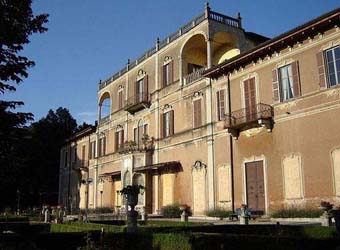
The Villa Cagnola.*

The view from in front of the Villa Cagnola. Those are the Alps.

The view of the garden in back. That's Lake Varese.

The same scene at sunset. The bright star is the planet Venus, approaching a rare conjunction with the planet Jupiter (just visible up and a little to the left).

At a certain point it was cool to erect faux ruins in your Italian garden. This tower was put up in the garden in the late nineteenth century to give the impression that it was all that remained of an ancient building such as a monastery.

The last session of the Seminar, which happened to be my paper. You can see me sitting in front of the screen on the right side.*

A column from one of the manuscripts of the Book of the Dead in the Egyptian Museum in Turin. That's the funerary god Anubis.

The Shroud of Turin. It looked just like in all the photos you've seen. Past posts on the Shroud of Turin are here and here and many links.
*Photos with asterisks are courtesy of Gabriele Boccaccini. The other photographs are my own.
Fourth-century mosaic excavated in Nazareth
AT THE CHURCH OF THE ANNUNCIATION: Early Christian Mosaic Floor Unearthed in Nazareth (Archaeology Magazine).
Mysterious dolphin sculpture
ARTIFACT: Mysterious 2,000-year-old marble dolphin surfaces near Gaza. Archaeologists think 16-inch-high statuette found in southern Israel may have been part of larger sculpture, wonder how it ended up in Byzantine floor (Ilan Ben Zion, Times of Israel). It kind of looks like a relic of the Lovecraftian elder gods.
Developments in Palmyra
PALMYRA WATCH: While I was away, there were some developments concerning the ruins of Palmyra, none of them good.
ISIS Terrorists Mine, Booby-Trap Ancient Palmyra, UNESCO Site (Hana Levi Julian, The Jewish Press).
Background here and links.
ISIS Terrorists Mine, Booby-Trap Ancient Palmyra, UNESCO Site (Hana Levi Julian, The Jewish Press).
It is not yet clear whether the terror organization is preparing the destroy the ancient ruins, or has planted the explosives in order to deter government forces from advancing towards the city.IS destroys ancient Muslim mausoleums in Syria’s Palmyra Deeming venerated tombs ‘a return to paganism,’ jihadists blow them up, reportedly lay mines throughout ancient ruins (AFP/Times of Israel).
Background here and links.
The Church of the Loaves and Fishes
A STORY OF REVERSALS OF FORTUNE: A history of the Church of Loaves and Fishes: Burned down, again. Originally built in the 4th century, the ancient church was lost to time, rediscovered in the early 20th century and rebuilt – only to be badly damaged by fire last week (Elon Gilad, Haaretz). Excerpts:
UPDATE: Thousands of Christians hold protest rally outside burned Galilee church (Peter Kenny, Ecumenical News).
On Wednesday night [i.e., a week ago Wednesday - JRD], the Church of the Multiplication of the Loaves and Fishes in Tabgha, on the shore of the Sea of Galilee, suffered serious damage that the police suspect was caused by arson: Hebrew graffiti found on the site read “False idols will be smashed.” The church was only 33 years old, but was built on the same site of the first church built to mark the spot more than 1600 years ago.Background on the heinous destruction of the church is here and links.
[...]
The gospels do not say exactly where this miracle happened, beyond Luke’s account that it was in “a desert place belonging to the city called Bethsaida.” We are not sure where Bethsaida was either. But during the first three centuries of the Common Era, a tradition developed among local early Christians that the rock formation by the side of the road on the northwestern corner of the Sea of Galilee was the site of the miracle.
First church, 4th century: Founded by the convert Josepos
In the middle of the 4th century CE, a small church was erected on the site, possibly by a convert named Josepos.
[...]
Second church, 5th century: The Egyptian custom
During the second half of the 5th century, a much larger Byzantine church was built on the site of the original church. The patron of the construction project was Martyrios, the Patriarch of Jerusalem.
UPDATE: Thousands of Christians hold protest rally outside burned Galilee church (Peter Kenny, Ecumenical News).
Thousands of Christians have held a protest rally in the Galilee, near the historic church in northern Israel that was seriously damaged after a suspected arson attack which included anti-Christian sentiment scrawled in Hebrew on a wall.Yes, the response of the Israeli government has been exemplary. I hope they catch the perpetrators soon.
The Church of the Multiplication in Tabgha was set on fire early on June 17 and the suspected hate crime drew fierce condemnation from Israeli leaders from major political parties, The Times of Israel reported.
[...]
On the Deuteronomistic History
ASKING THE IMPORTANT QUESTIONS: Who really wrote the biblical books of Kings and the prophets? The paean to King Josiah and exalted descriptions of the ancient Israelite empires beg the thought that he and his scribes lie behind the Deuteronomistic History (Elon Gilad, Haaretz). Excerpt:
I am back from Italy and have a big backlog of stories to post on, and it will probably take me a few days to catch up. I'm working on a brief conference report, but I need to interchange the photos on my various incompatible devices before I can post it. Perhaps this evening.
Scholars have long rejected the idea that the Deuteronomistic History was written by the characters depicted in the story. Firstly, none were written in the first person, which is how witness accounts are generally written. If anything, they are written from the perspective of an all-knowing narrator writing from a vantage point well into the future.This is a good account of the mainstream scholarly view about the origins of the Deuteronomistic History. There is, as the article observes, plenty of variation in the views held by specific scholars, but most would hold to something not far off from this. I have some more observations on the Deuteronomistic History here.
In addition, had these books been written by different people over hundreds of years, we would expect quite a bit of variation in language and style from part to part (note the differences between Middle English and modern!).
Yet the bulk of these books are written in a uniform manner. That indicates they were written at about the same time, if not by the same person.
Take for example the phrase “to this day.” It is rare in the rest of the Bible, appearing only 13 times outside the Deuteronomistic History. But within, the phrase abounds (multiple times in each of Deuteronomy 6; Joshua 13; Samuel 11; Kings 13). This first of all suggests single authorship. It also attests that the author was not writing about contemporary events but events in the distant past.
I am back from Italy and have a big backlog of stories to post on, and it will probably take me a few days to catch up. I'm working on a brief conference report, but I need to interchange the photos on my various incompatible devices before I can post it. Perhaps this evening.
Sunday, June 28, 2015
Of lead codices and lead coffins
FAKE METAL CODICES WATCH: Pondering Lead Sarcophagi and Codices … hmmmm. Over at Rogue Classicism, David Meadows has noted some intriguing parallels.
Background here and links.
Background here and links.
Miller, The Name of God in Jewish Thought
FORTHCOMING FROM ROUTLEDGE:
The Name of God in Jewish Thought
A Philosophical Analysis of Mystical Traditions from Apocalyptic to Kabbalah
By Michael T Miller
Routledge – 2016 – 256 pages
Series: Routledge Jewish Studies Series
One of the most powerful traditions of the Jewish fascination with language is that of the Name. Indeed, the Jewish mystical tradition would seem a two millennia long meditation on the nature of name in relation to object, and how name mediates between subject and object. Even within the tide of the 20th century’s linguistic turn, the aspect most notable in – the almost entirely secular - Jewish philosophers is that of the personal name, here given pivotal importance in the articulation of human relationships and dialogue.
The Name of God in Jewish Thought examines the texts of Judaism pertaining to the Name of God, offering a philosophical analysis of these as a means of understanding the metaphysical role of the name generally, in terms of its relationship with identity. The book begins with the formation of rabbinic Judaism in Late Antiquity, travelling through the development of the motif into the Medieval Kabbalah, where the Name reaches its grandest and most systematic statement – and the one which has most helped to form the ideas of Jewish philosophers in the 20th and 21st Century. This investigation will highlight certain metaphysical ideas which have developed within Judaism from the Biblical sources, and which present a direct challenge to the paradigms of western philosophy. Thus a grander subtext is a criticism of the Greek metaphysics of being which the west has inherited, and which Jewish philosophers often subject to challenges of varying subtlety; it is these philosophers who often place a peculiar emphasis on the personal name, and this emphasis depends on the historical influence of the Jewish metaphysical tradition of the Name of God.
Providing a comprehensive description of historical aspects of Jewish Name-Theology, this book also offers new ways of thinking about subjectivity and ontology through its original approach to the nature of the name, combining philosophy with text-critical analysis. As such, it is an essential resource for students and scholars of Jewish Studies, Philosophy and Religion.
Saturday, June 27, 2015
Slifkin, The Torah Encyclopedia of the Animal Kingdom
NEW BOOK: New from OU Press: “The Torah Encyclopedia of the Animal Kingdom” by Rabbi Natan Slifkin. Note that this is the Orthodox Union Press, not Oxford University Press. Be that as it may, it sound interesting, especially for the lavish illustrations. But I suspect I would not be convinced by some of the identifications of biblical animals with modern ones. For example, Behemoth is a cosmological monster in the Bible and ancient Jewish tradition and is associated with the sea monster Leviathan. I very much doubt that Behemoth is to be identified with the hippopotamus.
John the Jew conference
JAMES MCGRATH: John the Jew (2016 Enoch Seminar Conference). This is the Sixth Nageroni Meeting of the Enoch Seminar, with a venue in Camaldoli, Italy. James will be there and I am planning on attending too.
Nelson, The Temple Complex at Horvat Omrit, vol. 1
NEW BOOK FROM BRILL:
The Temple Complex at Horvat Omrit
Volume 1: The Architecture
Michael C. Nelson, Queens College of the City University of New York. Volumes Edited by J.A. Overman, D.N. Schowalter, and M.C. Nelson.
Volume One of The Temple Complex at Horvat Omrit presents a detailed examination of the surviving architecture of the three Roman period temple phases at the newly excavated sanctuary at the archaeological site of Omrit in northern Israel. All three temples were built according to the Corinthian order and the author describes and illustrates the state of the remains, proposes reconstructions of each phase, and places each temple in the broader historical context.
Friday, June 26, 2015
Pajunen and Tervanotko (eds.), Crossing Imaginary Boundaries.
NEW BOOK FROM THE FINNISH EXEGETICAL SOCIETY:
Pajunen, Mika S. & Hanna Tervanotko (eds.) (2015) Crossing Imaginary Boundaries. The Dead Sea Scrolls in the Context of Second Temple Judaism. Publications of the Finnish Exegetical Society 108. Helsinki: Finnish Exegetical Society.For details see this post by Rick Bonnie at the Changes in Sacred Texts and Traditions Blog: NEW PUBLICATION: “CROSSING IMAGINARY BOUNDARIES: THE DEAD SEA SCROLLS IN THE CONTEXT OF SECOND TEMPLE JUDAISM.”
Review of Kosmin, The Land of the Elephant Kings
ANCIENT JEW REVIEW: Kosmin, The Land of the Elephant Kings. By Nathan Schumer in Book Notes. Excerpt:
... Despite this growing trend, when it comes to the role of the Seleucid Empire in the Maccabean revolt, there is still a regrettable tendency in the field of ancient Judaism to treat the Seleucids as generic advocates of Hellenism, rather than as dynasty with its own specific idioms of imperialism crafted for its territory.I noted the publication of the book here.
Paul Kosmin’s The Land of the Elephant Kings is an invaluable corrective to this problem. In his book he attempts to understand the royal ideology of the Seleucid dynasty, examining how this vast empire was constituted and imagined by its rulers. ...
Ein Tzuba
TRAVEL: Walk through clear water at Tzuba’s ancient underground spring. At kibbutz on outskirts of Jerusalem, a short ladder now leads into a cleaned-out tunnel and an arched chamber completed in Second Temple period (AVIVA AND SHMUEL BAR-AM, Times of Israel).
Ein Tzuba, a spring near Mevasseret in the Judean Hills on the outskirts of Jerusalem, burst out of the ground through a very narrow crack in the rocky soil. Thus, not only was its flow scanty, but in summer its waters ceased to flow entirely. Nevertheless, the tribe of Judah settled in the hills about 3,500 years ago just above the little spring. It is more than likely that their settlement was the biblical Tzova, mentioned in the Talmud as well, and it grew by leaps and bounds.
[...]
Thursday, June 25, 2015
Conference on the Hebrew and Jewish Collections of the John Rylands Library
JOHN RYLANDS RESEARCH INSTITUTE CONFERENCE 2016: 'The Other Within' – The Hebrew and Jewish Collections of the John Rylands Library. Monday 27–Wednesday 29 June 2016 at The John Rylands Library, Deansgate, Manchester, M3 3EH.
Marzouk, Egypt as a Monster in the Book of Ezekiel
NEW BOOK FROM MOHR SIEBECK:
Egypt as a Monster in the Book of Ezekiel
Appealing to Monster Theory and the ancient Near Eastern motif of "Chaoskampf," Safwat Marzouk argues that the paradoxical character of the category of the monster is what prompts the portrayal of Egypt as a monster in the book of Ezekiel. While on the surface the monster seems to embody utter difference, underlying its otherness there is a disturbing sameness. Though the monster may be defeated and its body dismembered, it is never completely annihilated. Egypt is portrayed as a monster in the book of Ezekiel because Egypt represents the threat of religious assimilation. Although initially the monstrosity of Egypt is constructed because of the shared elements of identity between Egypt and Israel, the prophet flips this imagery of monster in order to embody Egypt as a monstrous Other. In a combat myth, YHWH defeats the monster and dismembers its body. Despite its near annihilation, Egypt, in Ezekiel's rhetoric, is not entirely obliterated. Rather, it is kept at bay, hovering at the periphery, questioning Israel's identity.
Kiperwasser and Shapira, "Irano-Talmudica III"
FORTHCOMING ARTICLE: Irano-Talmudica III: Giant Mythological Creatures in Transition from the Avesta to the Babylonian Talmud (Reuven Kiperwasser and Dan D.Y. Shapira, Academic.edu).
Wednesday, June 24, 2015
Bond & Hurtado (eds.), Peter in Early Christianity,
LARRY HURTADO: “Peter in Early Christianity”: Forthcoming Book. The volume contains papers from the 2013 conference on Peter at the University of Edinburgh (noted, e.g., here). Due out in the autumn of this year.
Psalms and Prayers workshop
CONFERENCE REPORT: REFLECTIONS ON WORKSHOP “FUNCTIONS OF PSALMS AND PRAYERS IN LATE SECOND TEMPLE PERIOD JUDAISM” (COPENHAGEN, MAY 7-9) (Rick Bonnie/Jeremy Penner and Mika Pajunen, CSTT.fi blog).
Ulrich, The Dead Sea Scrolls and the Developmental Composition of the Bible
NEW BOOK FROM BRILL:
The Dead Sea Scrolls and the Developmental Composition of the Bible
Eugene Ulrich, University of Notre Dame
Eugene Ulrich presents in The Dead Sea Scrolls and the Developmental Composition of the Bible the comprehensive and synthesized picture he has gained as editor of many biblical scrolls. His earlier volume, The Biblical Qumran Scrolls, presented the evidence — the transcriptions and textual variants of all the biblical scrolls — and this volume explores the implications and significance of that evidence.
The Bible has not changed, but modern knowledge of it certainly has changed. The ancient Scrolls have opened a window and shed light on a period in the history of the text’s formation that had languished in darkness for two thousand years. They offer a parade of surprises that greatly enhance knowledge of how the scriptural texts developed through history.
Tuesday, June 23, 2015
Dead Sea Scrolls Electronic Library
NOW ONLINE FROM BRILL:
Dead Sea Scrolls Electronic Library
Biblical Texts
Editors: Donald W. Parry and Andrew C. Skinner. In consultation with: Emanuel Tov and Eugene Ulrich. Quality control: Ariel Tov
The Dead Sea Scrolls Electronic Library Biblical Texts presents a complete Hebrew transcription and English translation of the Biblical texts, together with high-resolution images. The contents of this online publication is identical to that of the Dead Sea Scrolls Electronic Library Biblical Texts CD-ROM, published by Brill and Brigham Young University but its interface is adapted to Brill's online platform for reference works. Note that Dead Sea Scrolls Electronic Library Biblical Texts is also available from Brigham Young University. Not in the form of a CD-ROM, but as a set of electronic books which can be read and linguistically analysed through the WordCruncher software.
Septimus, On the Boundaries of Talmudic Prayer
NEW BOOK FROM MOHR SIEBECK:
On the Boundaries of Talmudic Prayer
In this work, Yehuda Septimus investigates a boundary phenomenon of talmudic prayer: ritual speech with addressees other than God. These addressees included socially conventional addressees, like judges or celebrants at a religious rite as well as unconventional addressees, like angels and dead people. But whether the addressees were the types one might expect an individual to address in a non-ritual context, they were definitely not the types we would expect a rabbinic Jew to address in a prayer context. And yet talmudic passages treated ritual speech addressed to beings other than God as they treated other forms of conventional prayer. Such treatment forces us to question the way prayer was conceived by the rabbis.
Septimus argues that the rabbis conceived and practiced something similar to but broader than what is conventionally called prayer. He accomplishes this through close analyses of a number of specific ritual recitations with these atypical addressees as they appear embedded in talmudic literature.
The English term "prayer" is usually understood as communication with God or the gods. Scholars of Jewish ritual until now have accepted this characterization and applied it to Jewish tefillah . But does rabbinic prayer indeed necessarily entail second-person address to God, as many scholars of rabbinic prayer to this point have presumed? Often God is the target of communication, even when ritual speech does not address God in the second person. But what if that speech is specifically addressed to beings other than God? What does this phenomenon teach us about the beliefs, ritual tendencies, and prayer culture of the formulators of such ritual speech?
Septimus' book qualifies the assumption that rabbinic ritual communication is directed to God alone. The liturgical relationship between ritual prayer and other ritual recitations is complex; the historical relationship between classical Jewish prayer and a broader range of ritual addresses even more complex. Septimus offers a fresh look at the possible range of performances undertaken by talmudic ritual prayer. Moreover, he places that range of performances into the historical context of the rapid emergence of prayer as the centerpiece of Jewish worship in the first half of the first millennium CE.
Sanders on Aramaic scribal culture
ARAMAIC WATCH: Beyond Borrowing: Aramaic Scribal Culture and the Creativity of Second Temple Judaism (Seth Sanders, Academia.edu).
Monday, June 22, 2015
Monitoring the DSS in transit
TECHNOLOGY WATCH: Protecting ancient artifacts with modern sensors. Fine art shipper tracks temperature and light through the cloud (DCVelocity).
Shippers of high-value goods are always eager to find new tools for tracking and monitoring their cargo during transit. One company is using just such a tool to track items that are literally irreplaceable—fine art and antiques.A little aside on conservation technology for the Dead Sea Scrolls.
Racine Berkow Associates Inc. (RBA) of Long Island City, N.Y., is a global freight forwarder specializing in museum-quality fine art handling services. Serving clients such as museums, galleries, and collectors, the company has transported monumental bronze sculptures by the English artist Henry Moore and priceless world treasures, including The Dead Sea Scrolls.
Whether these items are traveling by road, rail, ocean, or air, they risk damage from exposure to humidity, sunlight, shock, or vibration. So RBA has chosen AT&T Inc.'s CargoView application to monitor the delicate items during transit.
[...]
Paradise in Pennsylvania
Rodef Shalom’s Biblical Botanical Garden is testament to Jacobs’ love for plants, each other (Toby Tabachnick, The Jewish Chronicle).
I noted the Rodef Shalom Garden almost exactly ten years ago, but it seems worth mentioning again.
The late Irene Jacob, founder of Rodef Shalom’s Biblical Botanical Garden, might have been a bit skeptical had her husband been able to share with her his plans for this year’s annual exhibit, “Paradise on Fifth Avenue: Judaism, Christianity, Islam.”Well yes, showcasing Paradise does sound like a challenge.
“With this particular theme, she would have said, ‘Walter, you’re crazy,’” said Walter Jacob, rabbi emeritus of Rodef Shalom Congregation as he stood on the “banks” of the miniature Jordan River that runs through the garden adjacent to the Shadyside synagogue.
Jacob, 85, has been the chief steward of Rodef Shalom’s garden — one of only a handful of biblical gardens in the United States — since his wife died three years ago. It is up to Jacob to plant and tend to more than 100 varieties of shrubs, flowers, herbs, vegetables and other plants flourishing in a space reminiscent of ancient Israel.
[...]
There is a compelling reason, he explained, as to why he has not planted a garden depicting the Jewish concept of paradise: no such illustrations exist in Jewish art, and no real detailed descriptions exist in Jewish writing.There is some robust imagery in the Hymn of the Garden in column 16 of 1QHodayota among the Dead Sea Scrolls. The hymn names many specific plants in Eden.
“The three great religions have all talked about paradise,” said Jacob. “But what it is really like? There are three different answers.” The concept has been traditionally “difficult” for Jews, he said. “We just don’t know.”
While Christians and Muslims have a robust catalogue of art and writings describing paradise and the afterlife, the Jewish vision is less clear, leaving “it totally to the imagination,” he explained.
I noted the Rodef Shalom Garden almost exactly ten years ago, but it seems worth mentioning again.
Three new books
FROM MOHR SIEBECK:
Saul
Israels König in Tradition, Redaktion und früher Rezeption
[Saul. Israel's King in Tradition, Redaction and Early Reception.]
Published in German.
In this study, Hannes Bezzel examines King Saul and the diachronic genesis of this literary character. The starting point is the "early reception history" up to the end of the 1st century C.E., and more precisely, the Saul-images of Ben Sira's laus patrum, the Qumran document 4Q252, the Liber Antiquitatum Biblicarum , and of Josephus' Antiquitates Judaicae . Based on these studies, the author further pursues the phenomenon of "rewritten Bible /scripture" , first into the Books of Chronicles, then into the redaction history of the Books of Samuel. Here, his analysis finds an older Saul tradition in I Sam 9-10*; 11*; 14,47-51*. Within the scope of an enhanced Samuel-Saul-circle (I Sam 1*; 4*; 9-10*; 13-14*; 29*; 31*) the topic of the Philistines was introduced by means of the literary figure Samuel. Only in a third step was this narrative circle connected with the David tradition in the context of a "History of David's Rise."
Das Gottesbild in der Offenbarung des Johannes
Hrsg. v. Martin Stowasser
[The Image of God in the Book of Revelation.]
Published in German.
The Book of Revelation presents a manifold and very complex picture of God. The approaches used to illustrate this in the current volume of collected essays range from the history of religion to theology. The authors consider the perspective of intertextuality with the Old Testament, as well as elements received from contemporary Greco-Roman culture that shape the image of God. They also highlight the elements of political and social critique it is associated with in Revelation. The issue of monotheism is taken up when the question of a functional or essential dimension of the image of Christ and the transfer of divine epitheta to the Lamb are discussed. Finally common features and differences with the Gospel of John when speaking of God are addressed as well as the reception of God's portrait in the Book of Revelation in modern literature.
Covenant and Election in Exilic and Post-Exilic Judaism
Studies of the Sofja Kovalevskaja Research Group on Early Jewish Monotheism. Vol. V
Ed. by Nathan MacDonald
Covenant and election are two theological concepts that dominate the landscape of the Hebrew Bible. If they became the main structuring concepts of the Hebrew Bible, they were not so from the beginning. Their centrality was the result of their utilization by exilic and post-exilic scribes and tradents to focus Israel's traditions into a coherent structure as fitted the revelation of one God. The essays in this collection examine covenant and election across the biblical literature, from the priestly document through Deuteronomy to Jeremiah and the book of Chronicles. They show how the ideas were shaped and refined under the conditions of national disaster and rebuilding.
Sunday, June 21, 2015
HB/OT job at Saint Louis University
TENURE-TRACK POSITION:
The Department of Theological Studies at Saint Louis University is inviting applicants for a tenure-track position as Assistant Professor in Hebrew Bible/Old Testament.(Sent by Dr. Matthew Thiessen.)
Our department is committed to world-class research, as well as innovative and transformative teaching. Faculty in our department work with undergraduate, masters and doctoral students, benefit from extensive library holdings in the area of biblical studies and theology, receive the support of graduate research assistants ranging from 5-20 hours a week, and enjoy a 2-2 teaching load with classes capped at 19 students. We are looking, therefore, for candidates who will not only be effective teachers in the classroom, but also show a great deal of promise in their research. I have included the job advertisement which will appear on the SBL website in the coming months.
SAINT LOUIS UNIVERSITY, a Jesuit, Catholic institution dedicated to education, research and healthcare and located in midtown St. Louis seeks applicants for a tenure-track position as Assistant Professor in Hebrew Bible/Old Testament in the Department of Theological Studies. Candidates will be evaluated on the following criteria: their ability to teach and conduct research in the HB/OT and its historical, literary, and theological contexts, their ability to teach courses at both the undergraduate and graduate levels, their record of publication, and articulation of a strong research agenda. Standard departmental teaching load is 2/2. Applicants must possess a Ph.D. or equivalent doctoral-level degree at time of application in Religion, Theology, or closely related field with focus in Hebrew Bible/Old Testament studies. For more information about our faculty and programs, please visit our Website at: http://theology.slu.edu. Candidates, regardless of their own faith tradition, must be supportive of the Catholic and Jesuit ideals of the university. Review of applications will begin on 2 October 2015. All applications must be made online at http://jobs.slu.edu and must include a letter of application, a curriculum vitae, one sample of scholarly work no longer than thirty pages, a sample syllabus for an Introduction to the HB/OT, and names of three referees with their contact details. Saint Louis University is an Affirmative Action/Equal Opportunity Employer and strongly encourages applications from women and minority candidates.
"Artefacts of Ancient Judaism" at Cambridge
MANUSCRIPTS AT CAMBRIDGE UNIVERSITY: Artefacts of Ancient Judaism.
Eighth Enoch Seminar
I'M OFF TO MILAN FOR THE EIGHTH ENOCH SEMINAR, which is meeting in Gazzada. The theme this year is "Apocalypticism and Mysticism." I am presenting a plenary paper on "Roles of Angels in 1 Enoch and the Hekhalot Literature," with responses from Michael Stone and Gerbern Oegema. I am also a respondent to Annette Yoshiko Reed's paper, "Collection and the Construction of Continuity: 1 Enoch and 3 Enoch in and beyond ‘Apocalypticism' and ‘Mysticism.’"
I have attended several previous Enoch Seminars. You can find posts on the seventh (2013) here, here, and here. That last post also has links to posts on the second (2003), fifth (2009) and sixth (2011) Enoch Seminars.
The Nageroni meeting on Early Islam: The Sectarian Milieu of Late Antiquity? just finished up on Friday at the same venue and with some of the same participants.
Andrei Orlov's Enoch Seminar paper, "A Farewell to the Merkavah Tradition," is available here at Academia.edu.
I expect to be very busy in the coming week, so blogging may be light. But I have made sure that there will still be some new things for you every day, so please keep coming back as usual.
I am not going to post the full text of my paper, but I do want to leave you with something, so here is its Conclusion, minus a few footnotes. Have a good week.
This paper has undertaken a close look at small slice of the evidence from an important ancient Jewish apocalyptic corpus and a somewhat later Jewish mystical corpus. Any generalizations about Jewish or any other kind of apocalypticism and mysticism that appear to arise from it must be tested by a fuller consideration of the evidence from these two collections of texts, not to speak of the evidence of a wider range of apocalyptic and mystical traditions. Nevertheless, some preliminary conclusions suggest themselves.
It seems likely that some of the differences between the two collections can be explained by chronological developments of Jewish tradition, notably the evolution of angelology between the Second Temple period and late antiquity. Most obviously, named angels are rare in the biblical and Enochic literature, but have become far more common in late antique Jewish texts. The understanding of the cherubim and the living creatures as separate classes of angel may also be a later development. It is not found, for example, in the Songs of the Sabbath Sacrifice. The multiplication of appellations is more pronounced in the Hekhalot texts than in earlier literature, but this may in part be due to the mystical perspective of the texts, since a similar tendency has already begun to appear in the Songs of the Sabbath Sacrifice, which refers to “angels of glory, “angels of ornamentation” and the like. But most of the interesting differences are better viewed in phenomenological and ideological terms rather than chronological ones.
In 1 Enoch the angelic revelations are mediated by a patriarch from legendary antiquity—almost always Enoch—and these angels are sent by God. These revelations were relevant to the writers of the Enochic books and their original audience in a number of ways. They provided coveted information about the physical universe, the heavenly realm, and what should be expected at the eschaton, and also important practical information on how properly to follow the divinely ordained solar calendar. They also provided background on heavenly responses to current earthly events at the time of the Maccabean revolt. But all these revelations are mediated by Enoch or, occasionally, Noah. The only possible exception is the descent of the scribal angel to aid Judah the Maccabee in battle, perhaps passing intelligence on to him as well. But similar revelations to Enoch’s followers, the readers of the Enochic books, are never envisaged. Moreover, the one time when angels shared revelations to human beings at their own initiative, the coming of the watchers, the result was disaster.
In the Hekhalot literature the angelic revelations are mediated by certain Tannaitic rabbis and give information on the divine throne room, explain the heavenly background of certain events in legendary antiquity, and give detailed instructions for theurgic rites for the control of angels consisting of adjurations, merkavah hymns, divine and angelic names, and ritual praxes. And their message is that angelic revelations are in principle available to their readers by carrying out these theurgic rites. The various texts do not give a clear or consistent account of just who is qualified to undertake them: the Hekhalot Rabbati seems to require the practitioner to be an expert in Torah or a paragon of virtue or perhaps both (HR §234), whereas at least one component of the Sar Torah seems to say that anyone who follows the rites correctly is qualified, no matter how dull (ST §§304-305). These praxes give unmediated access to the divine realm and therefore to a form of realized eschatology, but they also offer practical theurgical powers, notably supernaturally rapid learning of Torah.
What are we to make of these two perspectives? It is possible that they come down to a different assessment of the risks associated with the crossing of the boundary between the human and angelic realms. For the writers of 1 Enoch, unmediated access to angelic revelations is an unacceptable risk except for great figures like Enoch and except when the initiative rests entirely with God. Enoch himself is so exalted that he was transformed into an angel. It is true that Judah the Maccabee may also be viewed a recipient of an angelic revelation, but his status, while less than angelic, would have been closer to that of Enoch than any of the readers of the Enochic books, and the angel acted in concert with God. From this perspective those who cross the boundary bring about chaos and ruin, exemplified by the story of the watchers, except for these great figures who act under God’s direction. Their followers, the writers and readers of the Enochic books, cannot experience such unmediated access to angels until their own apocalyptic transformation at the eschaton, when they will take on natures suitable for dwelling in the angelic realm.
But for the Hekhalot literature unmediated access to angelic revelations is appropriate for more or less anyone who follows the correct procedures as taught by the great figures of the Tannaitic rabbis, and those who do so are pleasing to God. The crossing of the human-angelic boundary is perilous and can lead the practitioner to death or madness, or bring about even worse disasters, but it can be undertaken safely by the worthy practitioner who follows the rites with full care. Such practitioners can experience proleptic interactions with angels and share with them in the worship of God in the divine throne room before the eschaton. They can even enjoy an attenuated and temporary metamorphosis of their human nature into an angelic one. The texts assume an ultimately apocalyptic eschatology, but show little interest in it because their attention is focused on the realized eschatology offered in them.
By this interpretation the followers of Enoch believed they could benefit from his divinely sanctioned interactions with angels, but they dared not seek such interactions themselves because the perils were too great before their own transformation at the eschaton. The Hekhalot practitioners, however, believed that the teachings of their masters gave them both the wherewithal and the divine sanction to experience such interactions themselves here and now. To paraphrase the old eleemosynary saying, Enoch gave his followers fish, but the Hekhalot rabbis taught their followers how to fish.
There is much to commend this understanding of the texts, but I have two reservations about it. First, although the ideology of the Hekhalot literature is presented reasonably directly, the one reconstructed here for the Enochic literature is inferential and depends on our generalizing a lesson from the story of the watchers, namely, that revelations from angels are too dangerous for lesser mortals to seek without direct divine sanction. The texts may imply this lesson, but they do not teach it explicitly, and it is risky to assume that there is a transparent moral to a story as profound and entertaining as that of the watchers.
Second, even if this is an intended message of the Enochic books, it is difficult to say how much their ideology regarding the human angelic boundary represents (Jewish) apocalypticism in general, while the contrasting ideology of the Hekhalot literature represents (Jewish) mysticism in general. There are reasons to be cautious. The sharp delineation of the human-angelic boundary in 1 Enoch arises to a large degree from the story of the watchers and this story does not figure in every Second Temple Jewish apocalyptic work. Some, including the Book of Daniel, 4 Ezra, and 2 Baruch, present their human protagonist as initiating angelic interactions by means of the sorts of rituals known cross-culturally to generate such experiences. These works do not obviously imply that only such figures from legendary antiquity could use such rites and the ideology operative in the Enochic literature should not be assumed for them too. Moreover, the Book of Revelation presents us, unusually, with an apocalypse that seems to be written in the name of its actual author. It is unclear what John means when he says that he was “in the spirit on the Lord’s day,” in an isolated setting (1:10), but it could certainly be taken to mean that he was undertaking ritual praxes at a sacred time in order to initiate the vision that followed. And although John was still mediating the revelations for his followers, he was not an exalted figure of legendary antiquity and the book does not in any direct way rule out the possibility that its readers could also have similar visions.
As a form of mysticism, the Hekhalot literature allows for human initiation of contact with the divine for the purpose of experiencing the divine in a much more direct way than is possible in normal day-to-day life. But the specific combination of ritual praxis and recitation of adjurations, hymns, and names; the specific ideology of a perilous spiritual world that can be safely navigated by these means; and the specific goals of liturgical union with the angels, domination of angels for theurgic purposes, and even attenuated, temporary, angelification of the practitioner himself, call out for comparison with other forms of mysticism. But such comparisons are outside the scope of this paper.
I close, then, not by offering any definitive conclusions, but rather some synthetic observations about a small slice of our evidence for ancient and medieval apocalypticism and mysticism and some reflections on where those observations may lead us in a wider consideration of the evidence.
Saturday, June 20, 2015
SOTS Booklist 2015
IN THE MAIL:
Deborah W. Rook (ed.) with Holly Morse, Society for Old Testament Study Book List 2015 (London: Sage, 2015).
Jenkins on Josephus
PHILIP JENKINS IS Reading Josephus at the Anxious Bench. The beginning of a new series. The second instalment is here: The Age of Tyrants.
Review of Jenner, The Gold Leaves
BRYN MAYR CLASSICAL REVIEW: Edward Jenner, The Gold Leaves: (Being an Account and Translation from the Ancient Greek of the so-called ‘Orphic’ Gold Tablets). Pokeno: Atuanui Press, 2014. Pp. 160. ISBN 9780992245375. $35.00 (pb).
Reviewed by Miguel Herrero de Jáuregui, Universidad Complutense de Madrid (miguelherrero@filol.ucm.es).
Reviewed by Miguel Herrero de Jáuregui, Universidad Complutense de Madrid (miguelherrero@filol.ucm.es).
PreviewI've not noted these tablets before and I don't recall hearing about them. It's alway interesting to come across another inscription on metal. And, with reference to the contents of the latter post, recent developments on the fake metal codices are noted here and here.
The Orphic gold tablets have generated much bibliography in the last decade. The comprehensive recent works of Bernabé/Jiménez and Graf/Johnston, as well as the collection of studies edited by Edmonds, include thorough editions and translations of all the tablets, and tackle the main problems which they pose.1 E. Jenner’s book has little to add to this scholarship. However, on the tablets are inscribed poetic texts that, due to the lack of external references to them in ancient literature, their comparatively recent discovery, and their esoteric content, have seldom reached a wider public.2 Such is the audience targeted by this book, written by a poet and classicist whose earlier work includes translations of Ibycus and Sappho.
[...]
Review of Masada Opera 2015
LITERALLY: Masada opera festival a cultural oasis in the desert: Littler.
The sheer improbability of the Israeli Opera’s annual outdoor event is breathtaking (William Littler , Toronto Star).
The sheer improbability of the Israeli Opera’s annual outdoor event is breathtaking (William Littler , Toronto Star).
And you wonder why the Israeli Opera decided to venture beyond its handsome modern theatre in Tel Aviv to a place fit for camels? Cultural tourism has been embraced by this beleaguered and divided nation as a means of generating some good news headlines and the effort seems to be paying off.Background here and links.
Not that the performances I witnessed of Puccini’s Tosca and Orff’s Carmina Burana as a guest of the Ministry of Tourism were entirely satisfying from a purely musical point of view. Given the physical conditions of performing in the desert, how could they be?
People come here to participate in an event, some of them staying in Dead Sea resort hotels, some taking a long drive from Jerusalem. In either case they are rewarded with full-scale productions accompanied by a large orchestra and chorus.
Friday, June 19, 2015
Diamond Rose
ANOTHER SEARCH FOR THOSE TWELVE STONES: Will TV show provide enough reason to 'Dig' up Pnina Feldman's failed venture? (Colin Kruger, Syndey Morning Herald).
Another recent story involving the twelve stones on the High Priest's breastpiece is here. And lots more on last season's now-canceled television series Dig is here and links.
The gems from the High Priest's breastplate provided the source material for a locally produced thriller called Diamond Rose, produced by the sister of "Diamond" Joe Gutnick – Pnina Feldman.Ms. Feldman herself has posted a 1997 story about the Diamond Rose company on her blog, diamonds forever.
Feldman was convinced that a geologist in the Pilbara had discovered one of the 12 sacred stones which – according to the Old Testament – were set in the breastplate, known as the hoshen.
She called it "pittado" and promised in the Diamond Rose prospectus that it would make the company "Australia's premier gemstone producer and exporter".
It debuted on the ASX in 1997 with Feldman – a former schoolmistress and mother of 11 children – wheeling in four of her daughters and six rabbis for the grand occasion.
Another recent story involving the twelve stones on the High Priest's breastpiece is here. And lots more on last season's now-canceled television series Dig is here and links.
BASOR 373 (May 2015) for free
AWOL: Bulletin of the American Schools of Oriental Research, No. 373, May 2015 available without charge, for a limited time. Recently I linked to an article from this issue on the new Khirbet Qeiyafa inscription, but that was at Academia.edu. The full issue contains that article and other things of interest for ancient Judaism. For you, special deal!
Antiquities arson in Israel
TWO RECENT INCIDENTS:
UPDATE: 16 arrested, then released, in church torching. Settlers questioned in connection with attack at site where Christians believe Jesus fed 5,000 with five loaves and two fish (Stuart Winer, Times of Israel).
Israeli Police Investigate Arson at ‘Loaves and Fishes’ ChurchAs usual, this is the traditional site of the feeding of the five thousand and there is no way to be sure that it is the actual location of whatever event, if any, is behind the story. And, as usual, the church is an important place of pilgrimage as well as the site of notable antiquities, and the damage to it is tragic. The mosaics in the church date back to the fifth century. They were not harmed in the fire.
By ISABEL KERSHNERJUNE 18, 2015 (NYT)
JERUSALEM — A Catholic church at a revered site near the Sea of Galilee in northern Israel was damaged by fire early on Thursday, in what the police are treating as an arson attack and possible hate crime.
Graffiti denouncing idol worship using the language of a Hebrew prayer was found spray-painted in red on an outside wall of the church, strengthening the suspicion that Jewish extremists may have been responsible for the attack.
The church, known as the Church of the Multiplication, stands on the site where many Christians believe Jesus performed one of the best-known miracles told in the Bible, feeding 5,000 people with two fish and five loaves of bread. Pilgrims have visited and prayed at the site for decades.
[...]
Arsonists torch storerooms with 4,000-year-old artifactsI can find no indication of whom the authorities may suspect as the culprits.
Irreparable damage inflicted to antiquities salvaged during excavation at Tel Kishon, near Galilee’s Mount Tabor
BY ILAN BEN ZION June 16, 2015, 5:15 pm 5 (Times of Israel)
Arsonists in northern Israel torched two storerooms filled with artifacts found at a nearby salvage excavation at Tel Kishon on Monday. Some of the antiquities were over 4,000 years old.
The blaze inflicted irreparable damage to the antiquities, the Israel Antiquities Authority said in a statement Tuesday morning. The authority lodged a report with the police, who opened an investigation into the incident.
[...]
UPDATE: 16 arrested, then released, in church torching. Settlers questioned in connection with attack at site where Christians believe Jesus fed 5,000 with five loaves and two fish (Stuart Winer, Times of Israel).
Two jobs in Syriac
THE HUGOYE LIST: Two jobs in Syriac. These are four-year Research Associate fellowships to work on the Syriac Galen palimpsest at the John Rylands Research Institute in Manchester.
Discounts at Magnes Press
MAGNES PRESS: Sale! 40% and "Buy 1 get 1 free" Discounts on most of our books! Some classics are included. For you, special deal!
Thursday, June 18, 2015
New DSS at the Los Angeles exhibition
PRESS RELEASE: Dead Sea Scrolls: The Exhibition" Unveils New Set of Scrolls.
Sold-out Crowds Continue At the California Science Center.
Sold-out Crowds Continue At the California Science Center.
Since opening on March 10, 2015, the exhibition has sold more than 120,000 tickets, frequently selling out on weekends, as guests viewed the first rotation of scrolls. This second rotation includes 10 scrolls that feature an entirely new set of fragmentary manuscripts, completely replacing the first set. The new installation, which will remain through the end of the exhibition, includes:Background on the Dead Sea Scrolls exhibition at the California Science Center is here and links. The exhibition has also been associated with a couple of good parties.
- Prayer for King Jonathan (Liturgical Text)
It is perhaps the only Dead Sea Scroll, published to date, that can be dated with almost complete certainty to the first half of the first century BCE.
- Songs of the Sage (Liturgical Text)
The Songs of the Sage are prayers or incantations of exorcism that were recited as protection against evil spirits. In this scroll, the act of praising God served to thwart the power of demonic beings.
- Daily Prayers (Liturgical Text)
This fragmentary text is a collection of prayers that, at one time, may have filled as many as thirteen columns of text. A completely different collection of prayers is written on the other side of the papyrus.
- Some Works of the Law (Non-biblical Text)
This text appears to have been written in the form of a letter and is unique in both its style and content. Scholars suggest that the letter includes a description of a 364-day solar calendar and a list of 20 or so laws dealing with the Temple, purity, sacrifices and festivals—several unique to the letter.
- War Scroll (Non-biblical Text)
This scroll is part of a text that describes the final eschatological war between good and evil or "the Sons of Light against the Sons of Darkness," after which a new world order will reign.
Those Roman footprints at Hippos-Sussita
POPULAR ARCHAEOLOGY: I Stood Here for Rome. The clear imprints of the soles of Roman soldiers' footwear leave rare personal signatures at an ancient Roman enclave.
There's lots more on Hippos-Sussita here and links.
The archaeological sites of the ancient Roman Empire constitute without rival the most prolific array of ancient architecture and artifacts that can be attributed to any single civilization or culture. Its remains pockmark the Old World landscape from North Africa and Egypt to Hadrian’s Wall in Britain. The artifacts populate museums the world over.I noted this story back in 2007, but this piece has additional details about this find and about work at the site. It links to another, evidently more informative, Popular Archaeology article by the site's excavation director, but that one is behind the subscription wall.
But comparatively rarely does one find the preserved footprint of an ancient Roman citizen.
That is why excavators and archaeologists got excited when, while digging at the site of Hippos-Sussita (an ancient Hellenistic-Roman site just east of the Sea of Galilee in Israel), they came across what appeared to be imprints of the soles of Roman soldiers’ footwear within the remains of a Roman defensive bastion structure.
[...]
There's lots more on Hippos-Sussita here and links.
A Canaanite coin? No.
CONFUSION: Ancient Coin Of The Canaanite Realm (Steve Lipman, The Jewish Week).
This coin probably was not worth very much when it was minted three millennia ago, but it’s priceless to contemporary historians and archaeologists.There weren't any coins 3,400 years ago; they weren't invented for close to another millennium. This is a scarab seal, a typically ancient Egyptian artifact. If you turned it over you would see a representation of the back of a scarab beetle. Ynet News has a recent article on the Tel Halif cave discoveries here. If you scroll down to the fourth photo, you will see the same scarab on the middle right, along with other scarabs and related finds.
Discovered last year at a cave near Kibbutz Lahav in southern Israel, it is a product of Egyptians who ran an administrative center there about 3,400 years ago, when Canaan was ruled by Egypt; it recently went on display at the Rockefeller Museum in Jerusalem.
[...]
Frank Moore Cross and Wolfhart Peter Heinrichs
THE HARVARD CRIMSON: "MIDEAST SCHOLARS AT PEACE. Among the deceased professors recalled in Memorial Minutes read during Faculty of Arts and Sciences meetings this year, perhaps no duo echoed more resonantly than those honored on May 5: the late Frank Moore Cross, Hancock professor of Hebrew and other Oriental languages, a scholar of the Hebrew Bible and the Dead Sea Scrolls; and the late Wolfhart Peter Heinrichs, Jewett professor of Arabic, a pioneering Arabic philologist and leader in Islamic studies."
Amen. Cross was my doctoral supervisor and Heinrichs taught me Qur'anic Arabic. The latter was also an expert in modern Neo-Aramaic dialects.
Amen. Cross was my doctoral supervisor and Heinrichs taught me Qur'anic Arabic. The latter was also an expert in modern Neo-Aramaic dialects.
The NYT on the Israel Museum's 50th
ANNIVERSARY: To Celebrate 50 Years, the Israel Museum Looks Back Much Further (ISABEL KERSHNER, NYT).
JERUSALEM — A softly lit case displays a small, gnarled implement that is said to be the world’s oldest known complete sickle, dating back 9,000 years. On a wall nearby, a video installation called “Shopping Day,” made by the Israeli artist Doron Solomons and set in an immaculate supermarket, offers a wry reflection on the branding and packaging of modern consumer products.More on the Humankind exhibition is here. More on the Israel Museum's 50th anniversary is here, here, and here.
The two pieces, representing the genesis of agriculture and its latest end products, are part of an exhibit titled “A Brief History of Humankind,” a centerpiece of the 50th-anniversary celebrations this spring at the Israel Museum.
[...]
Wednesday, June 17, 2015
The Journal for Late Antique Religion and Culture
AWOL: Open Access Journal: The Journal for Late Antique Religion and Culture. There's nothing much in the journal on ancient Judaism, but it does have a fair bit on Syriac studies and a little on Gnosticism.
Postdoc at the University of Michigan
THE ANCIENT WORLD PROJECT: Post-Doctoral Fellow in Material Culture of the Ancient Mediterranean (H-Judaic). The desired focus is "the Graeco-Roman eras, and with some knowledge of the Jewish and/or Christian realms." The one-year position begins in September 2015 and the review of applications begins on 20 June. So don't dawdle!
More on vows and sex in the Talmud
THIS WEEK'S DAF YOMI COLUMN BY ADAM KIRSCH IN TABLET: Sex: Sin, Obligation, or Pursuit of Pleasure? Discussing vows, Talmudic rabbis detour into the temptations of Jewish love-making—where almost anything goes.
Earlier Daf Yomi columns are noted here and links.
Last week, the Jewish blogosphere was full of stories about Natan Alexander, a young Israeli rabbi who has started a business selling sex toys to Israel’s ultra-Orthodox. Most of the articles about Alexander made this a man-bites-dog story—the Orthodox! having sex like regular people! But as Daf Yomi readers have learned over the last several years, the ethics of sexual pleasure has always been an important question in Judaism. And in last week’s reading, in Tractate Nedarim, the rabbis offered one of their most comprehensive and enlightening discussions of the subject, which ended up with a ringing endorsement of Rabbi Alexander’s view that when it comes to married sex, almost anything goes.The column is mostly about vows, but it comes back to sex toward the end. Consent figures in the discussion as well.
[...]
Earlier Daf Yomi columns are noted here and links.
Report on the Tyre Day Symposium
PHOENICIAN WATCH: Tyre on the Potomac…. (Joe David, Hollywood on the Potomac).
A Recap of Phoenician History: Washington came alive last week. Dignitaries, scholars, historians, and other prominent world leaders from Europe, Asia and America met in the U.S. Capital with a singular purpose – to draw attention to Tyre, the UNESCO World Heritage site in Lebanon. The week-long activities began officially with a private reception for over 70 dignitaries, celebrities, socialites, and Friends of Tyre at the elegant Washington residence of The Lebanese Ambassador to the United States, The Honorable Antoine Chedid.More on the League of Canaanite, Phoenician, and Punic Cities, founded in 2009, is here. Background on the Tyre Day Symposium is here.
“I am so proud to welcome you to my home,” the Ambassador said to Dr.Maha el-Khalil Chalabi, founder of the League of Canaanite, Phoenician and Punic Cities and of the Tyre Foundation. “You have done so much for preserving this important and ancient Phoenician site. Thanks to you and your many friends around the world Tyre has survived the test of time. You, Dr. Chabali, are truly a woman of boundless energy and vision. Welcome to my home!”
[...]
Tuesday, June 16, 2015
"This is how I lost my faith"
SHULEM DEEN: This is how I lost my faith: Science helped, yes — but finally I accepted the holy texts were written by man. I thought religion and sacred texts held absolute truth handed down from God. I was so powerfully wrong (Salon).
Among people who lose faith, I would later learn, many point to scientific knowledge as the catalyst for their changed worldviews. I, too, found much of what I learned troubling. Wherever I turned, I discovered that ideas I had once taken for granted, trusting in rabbis and sacred texts to convey absolute truths, were dubious at best. The universe was not six thousand years old but closer to 14 billion. Humans shared a common ancestor with apes—and all living things, for that matter— and were not the exalted species created by God’s hand out of clay of the earth on the sixth day of Creation. The sages of the Talmud, by our traditions infallible, were demonstrably wrong in their understanding of the natural world.Just because I go after and condemn Talmud libel, it doesn't mean I don't sympathize with people who struggle with the implications of historical criticism for what they have been taught about the scriptures in their faith tradition. It is one thing to read scriptures sympathetically and to find historical and moral problems in them from our intellectual and moral perspective in the twenty-first century. It is quite another to twist them out of context and disseminate outright lies about them to promote anti-semitism. This essay is an honest and heartfelt account of the author's encounter with historical criticism and how it affected his faith.
Two great balls of fire descended from heaven, and their names were Abaya and Rava, said the old rebbe of ruzhin. The two great masters of the Talmud, their names occurring at least once every three pages, were not humans but chunks of divinity. Balls of fire. Reading the Talmud anew, however, I discovered that the sages were as flawed as could be expected of any ancient people. They were mired in superstition and misogyny and xenophobia, which did not necessarily mark them as villains but offered troubling indications of ordinary humanness.
Nothing, however, had a more shattering impact on my faith than the realization that, stripped of religious exegesis, our primary religious text, the Hebrew Bible, had the markings of human rather than divine authorship; it was beautiful, intricate, layered in poetry and metaphor and heart-stopping drama, but human nonetheless.
[...]
Maaloula rediviva
MODERN ARAMAIC WATCH: Virgin Mary Statue Rebuilt in Ancient Syrian Christian Town. Maalula, one of oldest Christian towns in world where Aramaic still spoken, celebrates as statue of Mary destroyed in fighting rebuilt (Arutz Sheva).
The historic Christian Syrian town of Maalula celebrated Saturday as a new statue of Mary, worshiped in Christianity as the mother of Jesus, was erected in its center, replacing the figure destroyed in rebel attacks in 2013.Background on Maaloula (Ma'aloula, Malula) is here and here and links.
Dozens of families gathered alongside government officials and religious dignitaries in the main square, which was adorned with government flags and a giant portrait of Syrian President Bashar al-Assad.
Located north of Damascus, Maalula is one of the world's oldest Christian settlements, and its inhabitants still speak Aramaic, a language spoken by Jews in Israel at the time Jesus was said to have lived.
[...]
More on the new Khirbet Qeiyafah inscription
EPIGRAPHY: Inscription bearing name from Davidic era found at ancient site. Ishba’al son of Beda, found on 10th century BCE jar, likely not the same as a rival to King David with the same name, but discovery confirms popularity of moniker 3,000 years ago (Ilan Ben Zion, Times of Israel).
A new ancient Canaanite inscription including the same name as a character mentioned in the Bible as a rival to King David was found by archaeologists on a pot unearthed at a site in the Elah Valley, west of Jerusalem, researchers said Tuesday.As usual, PaleoJudaica readers were already well aware of this story. Background here.
The inscription on a large clay storage jar found at Khirbet Qeiyafa dates to the Iron Age, from around 1020–980 BCE, and bears the name of Ishba’al son of Beda, researchers said in an article published in May’s edition of the Bulletin of the American Schools of Oriental Research.
[...]
Ancient menorah graffito
Gladiator Fights Revealed in Ancient Graffiti (Owen Jarus, Live Science).
More on ancient depictions of menorahs is here and here and links.
Hundreds of graffiti messages engraved into stone in the ancient city of Aphrodisias, in modern-day Turkey, have been discovered and deciphered, revealing what life was like there over 1,500 years ago, researchers say.Jarus's parallel article, In Photos: Ancient Graffiti Discovered in Aphrodisias, has a photo of the graffito (fourth photo down).
The graffiti touches on many aspects of the city's life, including gladiator combat, chariot racing, religious fighting and sex. The markings date to a time when the Roman and Byzantine empires ruled over the city.
[...]
Aphrodisias also boasted a sizable Jewish population. Many Jewish traders set up shop in an abandoned temple complex known as the Sebasteion.
Among the graffiti found there is a depiction of a Hanukkah menorah, a nine-candle lamp that would be lit during the Jewish festival. "This may be one of the earliest representations of a Hanukkah menorah that we know from ancient times," said Chaniotis.
[...]
More on ancient depictions of menorahs is here and here and links.
There are still people who want to burn the Talmud
BOOK BURNERS: Extremists plan to destroy Israeli flags and burn Talmud at Golders Green rally (Marcus Dysch, The Jewish Chronicle).
I don't know what, if any, specific claims Mr Bonehill-Paine is making about the Talmud, and I have no inclination to go and look at his website. But I do know that false claims about the Talmud have been circulating in recent years and that they have done a good bit of harm. See here and links.
UPDATE (6 July): More here.
Neo-Nazis plan to destroy Israeli flags during a protest at the heart of the Jewish community next month.Book burning. Where have we seen that before?
Organisers of the July 4 demonstration in Golders Green, north-west London, have also urged supporters to attend a secret burning of the Talmud ahead of the event.
Joshua Bonehill-Paine, a white supremacist activist, wrote on his website on Monday that a “private ceremony” would be held to burn the religious texts “in recognition of its racist anti-white teachings”.
[...]
I don't know what, if any, specific claims Mr Bonehill-Paine is making about the Talmud, and I have no inclination to go and look at his website. But I do know that false claims about the Talmud have been circulating in recent years and that they have done a good bit of harm. See here and links.
UPDATE (6 July): More here.
Monday, June 15, 2015
British Library Conference on Rare Book Trafficking
ON 26 JUNE: British Library Conference on Rare Book Trafficking (REBECCA REGO BARRY, Fine Books Magazine).
On June 26, the British Library will host “The Written Heritage of Mankind in Peril: Theft, Retrieval, Sale and Restitution of rare books, maps and manuscripts,” a conference focused on the illegal trading of priceless cultural materials. The full-day seminar, open to dealers, librarians, collectors, auction house staff, security experts, and interested others, may be a response in part to the Girolamini Library thefts that rocked the rare book world in 2014 and more recent suggestions that Middle Eastern regimes are profiting from plundered books and antiquities. (A report last week claims that ISIS is selling ancient Hebrew and Aramaic manuscripts online.)For the claims about ISIS selling Hebrew and Aramaic manuscripts see the link in the article and also here.
[...]
The Talmud doesn't approve much of vows
LAST WEEK'S DAF YOMI COLUMN BY ADAM KIRSCH IN TABLET: Why Taking Vows Is a Wicked Act. In this week’s ‘Daf Yomi,’ the Talmud explores why oaths are not for the virtuous, except in the rarest of cases.
What kind of Jew makes vows to God? You might think that it would be an especially devout and God-fearing person; vows, after all, are promises to go above and beyond the already demanding laws of Judaism, to make a personal sacrifice in the name of God. For instance, one might vow to God not to eat certain food, or drink wine, or do business with a certain person. But the treatment of vows in Tractate Nedarim, the section of the Talmud devoted to the subject, leaves no doubt that the rabbis did not think vowing made you a better Jew. On the contrary. In Nedarim 9b, Rabbi Meir quotes a line from Ecclesiastes, “Better that you should not vow, than that you should vow and not pay,” and takes it a step further: “Better than both this and that is one who does not take a vow at all.”Earlier Daf Yomi columns are noted here and links.
[...]
The twelve stones and lots of gold
Temple Mount Activists Find Billions of Dollars in Gold on Mount Eilat [VIDEO].
Be that as it may, what really caught my eye was the business of the twelve stones of the high priest's breastplate being associated with a vast treasure of gold. Where have we heard that before? Oh yes, The Treatise of the Vessels:
One more comment: both the article and Rabbi Glick in the video quote Genesis 2:12 in support of their project: “The gold of that land is good; the bdellium and the onyx stone are there.” But the quotation refers to "the land of Havila" around which the river Pishon flows. It's not very clear where this is, if it is a place and not another legendary El Dorado. South Arabia has been suggested, but the southern Negev does not seem to be a promising candidate.
As for the gold, we'll see. Watch this space.
The Treatise of the Vessels also came up recently with reference to the televisions series Dig: see here and here. And also cf. here.
A treasure-trove of raw gold worth billions of dollars is believed to be sitting under Mount Eilat in southern Israel, Breaking Israel News has learned.Actually, in the video Rabbi Glick says "more than a billion," not "billions." But anyway, that would still be a lot of gold. But even if there is that much gold there, one still has to weigh the cost of getting it out, and he says it's a hundred meters down, which sounds pretty expensive. The point is raised, but not really addressed in the article:
In an exclusive interview, Rabbi Yehuda Glick, the Executive Director of The Temple Mount Heritage Foundation in Jerusalem, revealed the news, which had been kept under wraps for the last several years.
[...]
Explaining the discovery, Glick said that everything began with Friedman, a researcher for The Temple Institute, who had been studying each of the 12 unique stones set on the breastplate of the High Priest as described in the Bible. Each stone represents one of the 12 tribes of Israel.The real value of the gold is based on how much it is worth intrinsically, minus the cost of excavating it.
During his studies, Friedman realized that without a geology background he could not properly appreciate the depths and meanings behind each of these stones. This led to his discovery that in 2007 gold had been found in the mountains of Eilat by an Australian research team, who later abandoned the dig because the value of gold at the time was not worth their efforts.
Be that as it may, what really caught my eye was the business of the twelve stones of the high priest's breastplate being associated with a vast treasure of gold. Where have we heard that before? Oh yes, The Treatise of the Vessels:
(XI) And the treasuries of gold and silver from the days of David and until Zedekiah and until when Israel were exiled to Babylon: a myriad myriads of shields of gold and of silver beyond measure and at Tel Baruq underneath the great willow that is in Babylon on whose (branches) they used to hang their lyres (cf. Ps 137:2); and from the House of the Forest of Lebanon they took gold to the measure of 1,009 thousand kors. And all the prophets and the sages and the scribes could not calculate the wealth and the glory that used to be in Jerusalem.In this case the gold is from the Jerusalem Temple and is hidden in Babylon, but the juxtaposition with the twelve stones is still noteworthy and it makes me wonder if Rabbi Glick is acquainted with other similar legends about ancient treasures connected to the temple artifacts.
(XII) And in addition twelve fine stones were transmitted by the hand of Heleq son of Shimmur the Levite, by his hand to preserve them and to return them to the tribes, those on which the names of the tribes were engraved, which used to shine over the heads of the tribes, increasingly outstanding and precious in their value, vying with one another. And no king or prophet or man knew in which place these were hidden, except Heleq son of Shimmur the Levite.
One more comment: both the article and Rabbi Glick in the video quote Genesis 2:12 in support of their project: “The gold of that land is good; the bdellium and the onyx stone are there.” But the quotation refers to "the land of Havila" around which the river Pishon flows. It's not very clear where this is, if it is a place and not another legendary El Dorado. South Arabia has been suggested, but the southern Negev does not seem to be a promising candidate.
As for the gold, we'll see. Watch this space.
The Treatise of the Vessels also came up recently with reference to the televisions series Dig: see here and here. And also cf. here.
Palmyra in 1926
PALMYRA WATCH: From the archive, 12 June 1926: A trip to Palmyra in Syria. An archaeological congress in Syria takes our correspondent to Palmyra, ‘the skeleton of an ancient magnificence’ (The Guardian).
The first tombstones of Palmyra began some twenty miles farther on; and soon we entered, by a starlit but moonless night, a dead valley overshadowed by ghostly hills, in the middle of which lay the entrance to a white and sleeping city. Or so it seemed; but as we approached we saw the scattered and gleaming bones of this skeleton of an ancient magnificence.Background here and links.
Cultural contributions of the ancient Assyrians
ARAMAIC WATCH: Op-Ed: The Assyrians and ISIS: Part I. A most timely account of the ancient Assyrians, on the surface similar to ISIS, but distinguished by their achievements in addition to war and carnage. Their savagery is all that ISIS mimics. (Joe David, Arutz Sheva). An interesting mixture of correct history and dubious assertions. A few comments:
The city of Edessa (in Anatolia - modern-day Turkey) was indeed a key center of early Eastern Christianity and the Aramaic dialect spoken in that city in the second century was the basis for Syriac, the language of the ancient Eastern church.
Much of what they [the Assyrians of the ancient Assyrian empire] accomplished proved to be of value and survived the test of time. Refined by future civilizations, these achievements included a postal system, libraries, magnifying glasses, paved roads, locks and keys, a method for telling time, plumbing with flushing toilets, Hammurabi’s Law (which is generally known for its “eye-for-an-eye” punishment), a system for managing vast land holdings (by using governors to oversee territories), and a useful knowledge of astronomy (acquired, not just for scientific purposes, but to assist superstitious rulers make decisions).The first paragraph is correct, but I am very skeptical of the second. Yes, Ashur was the chief god of the Assyrians. Many ancient peoples had a chief god who was highest among the gods, but at least by the time of Second Isaiah, Israelite monotheism took an additional step and regarded their god YHWH as qualitatively uniquely divine and not just quantitatively the most powerful of many gods. The Assyrians did not take that additional step to what we would today regard as real monotheism and I can see nothing about ancient Assyrian religion that influenced that step for ancient Israel.
For the purpose of this article, one of their most important contributions was their devotion to one god, not the Jewish Patriarch Abraham's monotheism, but related. Although the Ancient Assyrians had many gods, representing different aspects of nature, those other gods were all an extension of their primary God, Ashur. He was their king of all gods, their omnipresent, omnipotent, and universal Creator. By spreading this idea of one God, rather than a multitude of gods, common among some primitive societies, they were able to lay the foundation for what would follow: the birth of one-god religions like Islam, Judaism, and Christianity.
It took about 600 hundred years for the Assyrians to rise from their ashes. In 33 AD they built another empire. This time it was a Christian empire, the very first Christian empire in the world, based on the teachings of Jesus.Well, sort of. The Eastern church included Aramaic-speaking descendants of the Assyrians who eventually converted to Christianity. But Assyrians did not found a "Christian empire" in 33 AD. The originally Jewish Jesus movement spread all over the known world in the first century, including the East, but the Greek-speaking (and eventually Latin-speaking) Gentile church had a couple of pretty good Christian empires going as well in due course.
Their transition to Christianity didn’t occur immediately. Their loyalty to Ashur continued until about 256 AD. But in 33 AD Ashurism began to fade in importance, when the Assyrians converted to Christianity through the teachings of three apostles – Saints Thomas, Bartholomew, and Thaddeus. These three apostles, after founding the Holy Apostolic Catholic Assyrian Church of the East in Edessa, Turkey (in the upper Mesopotamia area), were responsible for providing the direction for what would follow thereafter, the spread of Christianity across Asia.
The city of Edessa (in Anatolia - modern-day Turkey) was indeed a key center of early Eastern Christianity and the Aramaic dialect spoken in that city in the second century was the basis for Syriac, the language of the ancient Eastern church.
Unfortunately, the Assyrian Christians are rarely given much attention in history books. When most people think of the Assyrians, they often think of the Ancient Assyrians, not the Assyrian Christians, despite their significant intellectual and spiritual contributions to civilization. As a result, many of their achievements have been carelessly attributed to other groups. Here are a few of their many accomplishments:This is pretty much right, although this translation process continued for centuries up to Abbasid Baghdad. The rest of the essay moves beyond my areas of expertise, but I don't see anything obviously incorrect in it.
Between the fourth and sixth centuries, they revived the knowledge accumulated by the Greeks and translated it into Syriac and later from Syriac to Arabic. This included many religious works as well as the works of important thinkers like Aristotle, Plato, and Socrates.
Sunday, June 14, 2015
Daf
YONA SABAR: Hebrew word of the week: Daf. Most people probably don't know that the word Daf in Daf Yomi comes from ancient Sumerian.
The History of the Hebrew University of Jerusalem, vol. 4
NEW BOOK FROM MAGNES PRESS: THE HISTORY OF THE HEBREW UNIVERSITY OF JERUSALEM. Who’s Who Prior to Statehood: Founders, Designers, Pioneers. By Assaf Selzer, translated by Jenni Tsafrir. This is the fourth and final volume of the history.
Avestan
BILIOGRAPHIA IRANICA: The problems of the transmission of the Avesta and the Tools for Avestan Text Criticism (TATEC). An article by Alberto Cantera.
Subscribe to:
Posts (Atom)