Saturday, November 26, 2005

PSEUDEPIGRAPHA WATCH: The Old Testament pseudepigrapha and the book of 1 Enoch made it into the news earlier this month in the North Adams Transcript in "Looking at the Bible as a great work of literature." The article interviews Edem Dekel, professor of classics and Jewish studies at Williams College. I suspect that some of the quotations are inaccurate.
The function of the Bible as literature is found not only in its own pages, but in the form of off-shoot texts that were crafted as a compliment to the official sacred ones. A second set of Hebrew books called the Pseudepigrapha — which is Greek for "written under a false names" — contains such things as "The Testament of Adam" and "The Testament of Isaac," which claim either to be written by the Biblical characters they are named after, or sometimes, just be concerned with the story behind the story of these same characters. It's a bit like Biblical fan fiction.

The pseudepigrapha survive almost entirely in languages other than Hebrew. Neither of the two works mentioned is in Hebrew.
One of the most interesting tales to pop up in the Pseudoepigrapha is the Book of Enoch, one of the so-called "begats" between Adam and Noah in the Book of Genesis. The rabbis took an interest because of the wording used to describe Enoch's life — whereas everyone else was listed as dying, Enoch's fate is described as "then he was no more."

"This was always seen as a kind of weird problem," said Dekel. "The Book of Enoch explains to us that Enoch didn't die, he was taken up while he was still alive, taken up to heaven and given a kind of world tour of heaven, of the future of the world, and he was sent to write a vision of everything that he saw that was then transmitted back to earth."

In this way, The Book of Enoch is an early form of the apocalyptic traditions that lead to later works like Revelations. In true literary form, later sections of the Bible often borrow from earlier sections in their stories as a method of not only solidifying the validity of the newer stories, but as an early form of a time-honored storytelling technique. One of the more noticeable places that this happens is in the resemblance between the births of Moses and Jesus.

"Pseudepigrapha" and "Revelation" please. Sigh.
MAIMONIDES IS STILL "IN" according to the Washington Post:
The Doctor Is Still In
Medieval Rabbi-Healer Maimonides Linked Body, Soul

By Philip Kennicott
Washington Post Staff Writer
Saturday, November 26, 2005; Page C01

No one in his right mind today would willingly submit to the medical ministrations of Moses Maimonides, the great 12th-century Jewish doctor and philosopher. Maimonides, very much a man of the medieval world, possessed a medical wisdom that was little more than a mix of herbs and hokum, borrowed from the ancient Greeks. At best, it might meet the basic ethical dictum to do no harm.

Yet Maimonides remains almost a saint among doctors, a medieval Albert Schweitzer, a Jewish Hippocrates. Hospitals around the world bear his name and Jewish doctors still gather together in Maimonides Societies in almost every American city. And as Yale surgeon and best-selling author Sherwin Nuland points out in a new book, many Jews still feel a deep affinity for the man they know by an acronym of his Hebrew name, "the Rambam."

[...]

A long, interesting article. The 800th anniversary of Maimonides's death was in 2004.

Friday, November 25, 2005

ANOTHER BIBLICAL THEME PARK IN ISRAEL? Yep.
'Temple' to be built in the north (YNet News)

A 25-meter-tall (82 feet) replica of Solomon's temple in ancient Jerusalem to be built in northern city of Kiryat Shemoneh. Project will cost 8 million dollars to build, become main feature of city's Bible World amusement park

[...]

(Via Bible and Intepretation News.)
BETTER PHOTOS: A couple of the images I posted yesterday were too dark, so I've replaced them with enhanced versions that are clearer (here and here).
THE UPCOMING EXHIBITION called "Cradle of Christianity," to be held in the Maltz Museum of Jewish Heritage near Cleveland, is covered briefly in Cleveland Jewish News. The Temple Scroll is the most famous artifact to be displayed, but there's more:
It features treasures from the Israel Museum, dating from the time of Jesus through the concurrent development of Judaism and Christianity in the 4th-7th centuries.

Many of these items will be on view for the first time in the U.S., and the Cleveland exhibition includes the first and only presentation outside of Israel of one of the most important Dead Sea Scrolls, the Temple Scroll. Other highlights will include the burial ossuary of High Priest Caiaphas, a graffito of the Menorah that stood in the Second Temple, and a stone inscription from the Temple Mount.

The exhibition starts at the end of March.

Thursday, November 24, 2005

ORIGEN ON SHEVA: obdurate philologists will want to read Shai's post on "The short vowels in the Hexapla" over at the Hebrew and Aramaic Philology blog.
APRIL DECONICK, a member of the SBL Early Jewish and Christian Mysticism Section's steering committee, has a new book out which was reviewed in an SBL session. You can read a notice of the book in this article in the Illinois Wesleyan Today. April's marketing was impressive: as we left the session, the publisher had someone waiting outside the door to hand us fliers for the book. I must keep that in mind.
SBL UPDATES: Today I have updated SBL postings with photos and additional comments here, here, here, and here. Have a look.
POPULAR CULTURE WATCH: This The Three Wise Men animated DVD sounds pretty lame, but it's interesting that one of the human bad guys is named "Belial." This is the name for the Devil in the Dead Sea Scrolls, so it seems that the name and something of its connotations has penetrated the popular consciousness.
Jimmy is a troubled little boy who doesn't believe in Christmas anymore after not receiving a gift. But even though Christmas Day is drawing to a close, his friend Alfredo the shopkeeper knows a way to teach the boy about the spirit of the holiday. He tells him a story about three wise men - Melchor, Baltasar, and Gaspar – who have gone out in search of a treasure. They are helped by Sarah, a rebel warrior. But Herod, the wicked King of Judea, and his second-in-command Belial want the treasure to prove that Herod is the true king.
THE MASADA DATE SPROUT is alive, well, and growing:
2,000-Year-Old Seed Sprouts, Sapling Is Thriving
John Roach
for National Geographic News
November 22, 2005

A sapling germinated earlier this year from a 2,000-year-old date palm seed is thriving, according to Israeli researchers who are cultivating the historic plant.

"It's 80 centimeters [3 feet] high with nine leaves, and it looks great," said Sarah Sallon, director of the Hadassah Medical Organization's Louis L. Borick Natural Medicine Research Center (NMRC) in Jerusalem.

[...]

This article is the most detailed I have seen. Read it all.

(Heads-up, reader Andrew Blumberg.)
YESHIVA UNIVERSITY is hosting a lecture series in recognition of Louis Feldman:
Lecture Series Honors Celebrated Professor

By Eitan Kastner (The Commentator)
Published: Tuesday, November 22, 2005

A series of interdisciplinary humanities lectures have been planned in honor of Yeshiva's classics professor, Dr. Louis Feldman.

Feldman received a PhD. in the classics from Harvard University in the early 1950's and has been teaching at Yeshiva for the past fifty-one years. He has written, co-written, and edited sixteen books and has written over 170 articles.

[...]

The first lecture of the series was given on November 17 by a classics professor from Tel Aviv University, Dr. Jonathan Price. The lecture, which was given during club hour, was entitled "Voices in Stone: What Inscriptions Tell us about Ancient Jewish History."

[...]

A well-deserved honor.
A JEWISH MUSEUM IN ROME:
Renovated Jewish Museum opens in Rome

By Daniel Mosseri in Rome Updated: 23/Nov/2005 18:24
(European Jewish Press)

The Jewish Community of Rome inaugurated its new Jewish Museum on Tuesday starting with a very well-attended ceremony in Rome's main synagogue.

While the public crowded onto both floors of the building, a number of Italian personalities, from the Mayor of Rome Walter Veltroni to the Italian Minister for cultural heritage Rocco Buttiglione, took part in the event.

Leone Paserman, chairman of the Jewish Community, opened the ceremony by thanking Mayor Veltroni for the "important contribution" that has enabled the renovation of the old museum.

The new 600 square metre premises host a large Gallery of Antique Marbles.

[...]

I don't know how much in the museum is ancient by PaleoJudaica's standards, but it sounds like an interesting collection

UPDATE: This article has more:
New museum spotlights Jewish Rome

(ANSA) - Rome, November 22 - Rome's Jewish community, the oldest in Europe, on Tuesday opened a museum to document its long and eventful history .

The 600-square-metre exhibition space is under the city's synagogue, near the river Tiber and close to the heart of the area which was once the capital's Jewish ghetto .

It contains a collection of rare manuscripts, gold and silverware, old robes and fabrics, which illustrate in various ways the stages of the community's 2,200-year life. "If you really want to know Rome you have to have visited the Jewish Museum," said director Daniela Di Castro, adding that its contents touched on history, archaeology, art history, religion and folklore .

[...]

Among its oldest exhibits are its mediaeval manuscripts. Other prized items include silverware from the early 17th century, 15th-century velvet cloths and 17th century cloaks given by the Queen of Sweden .

[...]

They're also asking people to help recover Jewish books etc. pillaged by the Nazis.
HAPPY THANKSGIVING to all my American readers! I hope all SBL attenders are now safely home or wherever they meant to settle down for Thanksgiving. Me, I have to teach today, but we'll be celebrating in the evening.

Wednesday, November 23, 2005

FINAL SBL THOUGHTS: Here are some random thoughts about the conference that I've been meaning to post.

One paper I should note is Ken Penner and Ian Scott, "Publishing Critical Texts on the Web: Issues in Mounting the Online Critical Pseudepigrapha," in the CARG session on Monday morning. This told a little about the history, organization, and objectives of the project and also discussed technical issues. [UPDATE on 24 Nov: Here's a photo of Ken Penner giving his part of the presentation.]

I also attended the Early Jewish and Christian Mysticism Section session on Monday evening and I especially enjoyed the papers by Kelley Coblentz Bautch on "To Rest in the West, to Feast in the East? How Geography and Traditions Relating to Afterlife Interrelate in Early Jewish Mystical Literature" (afterwards she and I discussed whether the realms Enoch visits in the second half of the Book of the Watchers were earthly or otherworldly) and by Andrea Lieber on "'How Great is His Measure': Mapping the Divine (Male) Body upon the Cosmos" (which applied "cognitive mapping theory" to the Shiur Qomah mystical texts that describe God's enormous body). After the session the steering group met for dinner and we have hot topics lined up for 2006, including a session to celebrate the EJCM group's tenth year.

On Tuesday morning I attended the Pseudepigrapha Section session. Tuesday morning sessions are frequently poorly attended, because people are leaving throughout the morning, and the very big and not very full room was freezing cold. But the low attendance was not indicative of low quality in the papers. They were excellent. My favorites were Daniel Machiela's "Divinely Revealed History and Geography in Noah's Vision: Genesis Apocryphon cols. 13-17" and Kelley Coblentz Bautch's "All about Eve: How the First Woman Fares in Enochic Literature." Daniel had an excellent handout (which is surprisingly hard to produce): it translated the main text, had relevent excerpts of parallel texts in the margin, and included an outline of the paper. Kelley's was the last paper of the last session, which must have been frustrating, but the problem of the origin and development of Eve traditions in Genesis and the Enochic literature is fascinating and I stayed for the whole thing -- after which I ran to my room to get my suitcases and managed to meet the 12:00 noon airport shuttle.

One session I really wanted to go to was the Pseudepigrapha session on "Jewish Pseudepigrapha in the Slavonic Tradition." Alas, it was on Sunday morning and this conflicted with the biblioblogging session. I hear it was excellent. It was too bad also that the Pseudepigrapha session on Aramaic Levi was canceled.

I heard many other good papers during the conference, but I don't have time and energy to comment on all of them. Apologies if I've left yours out.

One last thing: this year was the most confusing I've seen in terms of publicizing where sessions take place. I am not sure it was a good decision to remove room listings from the main program book. I appreciate that this made it easier to update the room bookings online to note late changes, but even the downloadable PDF files (which I printed out) had a lot of errors. Next time I will know to ignore them and just go with the Annual Meetings At-A-Glance booklet distributed at the meeting, which did have accurate information.

I have a few pictures to add to the conference posts, but I think that will have to wait until tomorrow.

UPDATE (24 November): Several photos now added to conference posts. I had also meant to mention another paper in that Tuesday Pseudepigrapha session: Don Polaski, "1 Enoch: Writing the Sectarian Subject," which looked at 1 Enoch from the perspective of post-colonial theory. Incidentally, you can find abstracts for all these papers archived here.

And finally, let me second Mark Goodacre's comment:
The SBL is an enormous meeting, and perhaps because of that fact one can take the organisation for granted. In spite of the odd problem here and there, in my experience there are only ever minor glitches. The meeting is superbly organized, and it struck me this year that we really ought to say thank you a bit more often. I suppose that because we can't put a face on the organizers, we often don't take the opportunity to praise them.

In particular, Matthew Collins gets lots of flack (not least from me) when things go wrong, but he deserves great praise for all his work on making them run very smoothly most of the time. Thanks Matthew.
SBL CARG-BLOGGING-SESSION ROUNDUP: Here's a list of all the blog posts I could find in which people who attended the session commented on it.

In addition, some bloggers who weren't able to be present added their comments:

If I've missed some, please e-mail me so I can add them.

My own thoughts? I don't know why there are so few female bibliobloggers, and I hope this changes whatever the reasons, but I did find opaque Paul Nikkel's theory, raised in the discussion and supported by Yasmin Finch, that it had to do with our naming ourselves and some of us suggesting things bibliobloggers should and shouldn't do. Perhaps I am misunderstanding their point and they will comment on their blogs. For the record (and I really don't think this should need to be said), first, I -- and I'm sure all other "bibliobloggers" -- would welcome more females on the biblioblog-roll and I hope any considering opening a blog will take the plunge. Second, if you (whatever your gender) do start a blog having to do with academic biblical studies, I encourage you to write whatever the heck you want to on it and to make up and follow your own rules, and if one of us tells you to do or not do one thing or another, just take this as well-intended advice that you can follow, modify, or ignore, entirely as it pleases you. That's what I do.

Torrey wishes that we had talked more about the future of blogging and I agree that it would have been nice if we had. Frankly, I just forgot about the issue at the time. I predict that over the next couple of years the exponential increase in the number of biblioblogs will continue. Aside from that, Torrey's idea of organizing blogs on specific topics in biblical studies sounds interesting, but it also sounds like work, so I'll leave others to do this if they want to. I'm a great fan of emergent order, so I suspect that something like this will happen over time of its own accord, and that may be the best way to bring it about. (I see now that I have already expressed similar thoughts here.) Long-term, as I've said before, I predict that blogging and other forms of online publishing will grow more and more user friendly and more and more people will develop a personal media voice.

Aside from that, I am very glad that code warriors like Rick Brannan are continuing to refine blogging software and I look forward to benefitting from their work as it becomes code-wimp friendly.

Finally, in response to Danny, I chose most of the examples in my paper from the blogs run by the bloggers on the panel. That was mainly because I only had time to do a thorough review of a limited number of blogs and those seemed the obvious ones to concentrate on for the session. But you all should certainly look at the other blogs Danny mentions and many others besides. By the way, Danny, when you recommend a site, why not link to it in your post?

UPDATE: Cynthia Edenburg e-mails:
I commented once to Joe Cathey that the answer is simple. When I'm at work, I should be working, and at OpenU that involves a lot of papers to read (each student completes 3-5 written assignments per semester, and this semester I have 40 students). When at home, I'm still reading papers, doing virtually all the housework and shopping, providing emotional support for husband and three children, two of whom are old enough to move out, taking my mother to health providers, and when I have some spare time, I try to devote them to completing the translation of my dissertation into English for publication. Oh, did I forget to mention trying to make time for managing a social life and hosting dinners, which is important to my husband?

Y'know, I really wouldn't want to be married to a biblioblogger myself!

UPDATE: Maria Doerfler, who was at the blogging session and who in an e-mail identifies herself as being "in the fringes of the biblio-blogging sphere" comments on the session here. Perhaps I should note that there was at least one other female blogger (although not a biblioblogger) in the audience: Yasmin Finch. (UPDATE [24 Nov]: I had recalled Yasmin saying she wasn't a biblioblogger, but perhaps I misheard or misremembered. She doesn't seem to take a position one way or the other in the bullet-pointed post in the list above.)

UPDATE (24 November): I've added Maria's post and several others to the list above.

UPDATE (26 November): Still more added. Note especially the second post (or go here) by Mark Goodacre ([27 Nov] the third one too). And I have more here.

Tuesday, November 22, 2005

TUESDAY MORNING: I'm checking out the book display one last time, then heading from there to the Pseudepigrapha session. From there I have to run to my room, grab my suitcases, and catch the 12:00 noon airport shuttle. It's been a very good conference. I note that the usual suspects are blogging the CARG blogging session at length. My thoughts are too scattered at the moment to say anything and I'm also still operating under that 15-minute limit. But I'll aim to link to the discussion in a later post and add some comments then. Look for me again sometime on Wednesday.

Monday, November 21, 2005

TEL ZAYIT (ZEITAH) INSCRIPTION SESSION REPORT (part four): Some other details came out in the Q&A session:

Ron Tappy confirmed that the stone must have been inscribed before it was put in the wall, because he checked with his own hands and there was not enough room to incise the letters because the other stones were in the way. He also commented that this inscription at least shows that the inhabitants had the means (i.e., the alphabet) to create a monumental inscription, even if one hasn't been found yet.

Kyle McCarter pointed to an X mark near the lamed - kaph reversal, which he suggested might have been put there by the angry scribe when he realized the mistake.

McCarter wondered why a flawed scribal exercise would be displayed on a wall. But if that isn't what is going on, there are odd coincidences: the inscription was visible on the wall and oriented properly for reading; none of it was covered by other stones; and that unusual onyx stone was right above it. But if it was put there intentionally, why? If it was intended as an exemplar, it is very hard to see without proper lighting. McCarter and Tappy noted the possibility that some sort of magical use was intended, in which case the inscription might not need to be displayed. Tappy also noted ruefully that if it was intended for magical apotropaic (i.e., protective) use, it didn't work: the building was destroyed in a fire.


So what does it all mean? I'm tempted to picture the final exam for scribes: the candidates walk in and sit down. At each desk there is a forty pound stone. The instructor says, "Now incise the alphabet on this stone with your metal tool. You have 50 minutes." Unfortunately, our scribe made several mistakes and flunked out. His final exam was posted on the wall as a warning to other students. Don't let this happen to you.

But I guess that isn't very likely.
TEL ZAYIT (ZEITAH) INSCRIPTION SESSION REPORT (part three): BRUCE ZUCKERMAN. (Bruce and Marilyn, the Thunderbirds of Northwest Semitic epigraphy, flew to Jerusalem on very short notice for four days to photograph this inscription.)

Zuckerman noted that each shot has to be taken from two to five different angles in order to catch the light just right so as to make the scratches stand out. They take (larger) "reference shots" and also many shots of details. The photos are taken both in color and in black and white, since different things stand out with each. They are still working on the production of the images, so the current understanding of the inscription remains tentative.

Part one is here and part two here. To be continued, although this is my third trip through the cyber center today and the staffers are starting to ask me what chapter I'm on.
TEL ZAYIT (ZEITAH) INSCRIPTION SESSION REPORT (part two): KYLE MCCARTER reported that the two-line inscription is of hard limestone and is very hard to see and read. Because it is an abecedary, it is difficult to interpret the text or even to decide which language it is in. It is written by a good, talented scribe on what seems to have been a prepared surface. Later scratches and accretions give it a misleading impression of crude execution. It invites comparison to the Gezer Calendar inscription and also the tenth-century Phoenician inscriptions from Byblos. I won't go into his detailed comments on the individual letters, but the general picture is that almost all the features of the text are more archaic than or as archaic as the Gezer Calendar, which confirms a tenth-century BCE date. There are three or four variants in order compared to the traditional Hebrew alphabet: vav - he, het - zayin, lamed - kaph, and (possibly -- the readings are uncertain) pe - ayin. Only the last, if it is real, is paralleled elsewhere.

Part one is here. To be continued ...
TEL ZAYIT (ZEITAH) INSCRIPTION SESSION REPORT (part one): The session was on Sunday evening from 7:00 to 9:00 in a stifling, standing-only crowded room with several hundred attending. Ron Tappy and I, incidentally, were postgraduates together in the Harvard Near Eastern Languages and Civilizations program and a great many of our contemporaries showed up, many with their spouses, which made part of the crowd an impromptu 1980s Harvard NELC reunion. The panel consisted of Harvard archaeologist Larry Stager, who did the introductions; Ron, the chief excavator of the site; epigrapher Kyle McCarter of Johns Hopkins; and epigraphers Bruce Zuckerman (USC) and Marilyn Lundberg. Ron, Kyle, and Bruce gave presentations. I'll cover Ron's contribution in this post.

RON TAPPY first emphasized that everything he was presenting was still undergoing analysis and was preliminary. Then he gave a detailed account (which I won't try to reproduce) of the stratigraphy of the relevant square and the area around it. The inscription layer was sealed under ninth-century BCE layers and was over a Late Bronze Age stratum. The inscription layer is dated on ceramic grounds to the mid- to late tenth century BCE, so the area seems to have been unoccupied during the Iron Age I period. The inscription layer consisted of two rooms with a door between them, with flagstones on the floor of the room of interest. Much more excavation needs to be done to put it in context, but at present it corresponds to the features of "pillared houses" at other sites.

Tappy's original assumption was that he was excavating a small village, but he is reassessing that idea and now thinks the site may have been much larger, with much of it having been removed a couple of centuries ago through agricultural activitiy. There is a stone sticking up from the wall of the room, which Ron called a "monolith." This room is part of a curved line of as yet unexcavated monoliths. Evidently it was part of a much larger complex of rooms which may have ringed the shoulder of the site, perhaps forr defensive purposes.

The inscription room was destroyed in a conflagration of uncertain origin, but since sling stones were found in the burnt layer, it may have involved an attack on the city.

The inscription is built into a stone wall. It was spotted by a volunteer, who showed it to biblioblogger Michael Homan. Michael called Ron over to see "something important." Indeed.

The stone weighs about 40 pounds and has a sort of bowl carved on the other side; the bowl was facing down in the wall. The stone above it was, unusually, made of (imported) onyx. The inscription would be visible on the wall. The letters are very thinly incised, perhaps by a metal tool. Such tools have been excavated elsewhere on the site.

That's the Tappy presentation. I'm out of time and don't have time to proofread. Apologies for typos. To be continued ...

LATER: Links added and (I hope) typos now corrected.

UPDATE (22 November): Michael Homan posts his own account of the discovery here.

UPDATE (24 November): The room was too dark for good photography during the session, and I don't want to post any unpublished images of the inscription, but here's a photo I took just before the session started. Michael Homan is in the center facing forward. To his left you can see Ron Tappy in profile, facing toward Michael. In the background to the right is a screen with the opening slide of the presentation.
BIBLES -- A GOOD INVESTMENT?
Turning to Bibles for Divine Returns

The Associated Press

More people are turning to the Bible as a safe refuge from a struggling stock market and rising inflation, pouring large sums of cash into rare 1611 King James Bibles, centuries-old Matthew-Tyndale Bible leaves, Hebrew scrolls, prayer books and other ancient liturgical texts.

[...]


On another note, I attended the session on the Tel Zayit inscription last night and took lots of notes, but I don't have time to post them now. Watch this space.
WHERE IS MISS MABROUK OF EGYPT? She is one of the Egyptian bloggers who defended Abdolkarim Nabil Seliman when he was detained by the police. A reader who is here at the conference pointed out to me yesterday that she hasn't posted since before his release. I'm probably just being paranoid, but it's hard not to be in situations like this. Does anyone out there keep in touch with her? Is she okay? Miss Mabrouk, please post something to reassure us!

Sunday, November 20, 2005

CONFERENCE UPDATE: Okay, I only have 15 minutes on this book-display computer, so let's see how far I can get.

The Early Jewish and Christian Mysticism Group had our annual dinner yesterday evening. Excuse a restaurant gripe, but our table arrived at the Ly Michael's at 6:45 when the place was nearly empty. Our starters didn't arrive until 8:15 and the main course perhaps 20 minutes after that, which made us late to our 9:00 pm events. The other tables around us also had slow service, although ours was the slowest. One of us left without eating and I was actually putting on my coat to go when my main course finally arrived. The food was quite good, but it wasn't worth the wait. If you're planning on having dinner there, don't plan on much else that evening.

Now that's off my chest. After that I went to the Harvard and John's Hopkins receptions, which were just around the corner from each other. This was well planned, because lots of us like to go to both. This put me in the vicinity of a remarkably high density of specialists in Phoenician, so I had the opportunity to ask them all a Phoenician related question that has been bothering me and one of them knew the answer. I'll probably blog on this once I get home and can look the relevant inscription up.

This morning I went to the Biblioblogging session. No time to summarize now. I'll try to collect my thoughts and say something later. I thought the discussion went very well.

After this I had lunch with Joe Cathey.

Then in the early afternoon session I went to the Early Jewish and Christian Mysticism session, which reviewed five books:
Jonathan Draper, University of Natal, Presiding
Review of Andrei Orlov, The Enoch-Metatron Tradition (Mohr-Siebeck, 2005)
Rebecca Lesses, Ithaca College, Panelist (15 min)
Andrei Orlov, Marquette University, Respondent (10 min)
Review of Kevin Sullivan, “Wrestling with Angels": A Study of the Relationship between Angels and Humans in Ancient Jewish Literature and the New Testament (Brill, 2004)
Charles Gieschen, Concordia Theological Seminary, Panelist (15 min)
Kevin Sullivan, Marquette University, Respondent (10 min)
Review of April DeConick, Recovering the Original Gospel of Thomas (Continuum, 2005)
Birger Pearson, University of California-Santa Barbara, Panelist (15 min)
April Deconick, Illinois Wesleyan University, Respondent (10 min)
Break (10 min)
Review of Daphna Arbel, Beholders of Divine Secrets - Myth and Mysticism in the Hekhalot and Merkavah Literature (SUNY, 2003)
Alan Segal, Barnard College, Columbia University, Panelist (15 min)
Daphna Arbel, University of British Columbia, Respondent (10 min)
Review of Ra’anan (Abusch) Boustan, From Martyr to Mystic: the Story of the Ten Martyrs, Hekhalot Rabbati, and the Making of Merkavah Mysticism (Möhr-Siebeck, 2005)
Michael Swartz, Ohio State University Main Campus, The, Panelist (15 min

I really must read a number of these.

My time's up.

UPDATE: Just realized that that restaurant did take 30% off our bills because of the lateness, so they do deserve credit for that.

Saturday, November 19, 2005

MY SBL PAPER is now available online:

"Enter the Bibliobloggers"

Details on when and where are included.

NOTE UPDATES: MORE RECENT POSTS ARE BELOW.

UPDATE (5:10 pm): This post was put up at 12:23 on the afternoon of Tuesday, 16 November, but I'll keep it at the top of the page until the presentation on Sunday.

Meanwhile Mark Goodacre has inquired how I intend to indicate the 125 or so hyperlinks in the paper during the oral presentation and I have replied in a comment.

I'm heading home in a few minutes. I'm off to Philadelphia early tomorrow morning and my Internet access may be spotty to nonexistent until Saturday, so blogging may be likewise. But I think there will be facilities available once the conference starts. I have a very busy schedule planned, but I'll try to check in now and again. Have a good week, and safe travel to all those heading to Philly in the next few days.

UPDATE (18 November): I've arrived and am starting to add new posts. As I said, I'll keep this one at the top until Sunday, so keep checking below for new ones.
THE TEMPLE SCROLL is coming to America:
Longest of Dead Sea Scrolls to Visit U.S.

By Associated Press

November 19, 2005, 12:02 PM EST


CLEVELAND -- The longest of the Dead Sea Scrolls is scheduled to go on display in a Cleveland museum next year in its first appearance in the United States.

A traveling exhibition featuring the Temple Scroll, which measures 28 feet, will make its first stop at the Maltz Museum of Jewish Heritage in suburban Beachwood, The Plain Dealer newspaper reported Saturday. The ancient manuscript dates back to the time of Christ.

[...]

This scroll gets around.
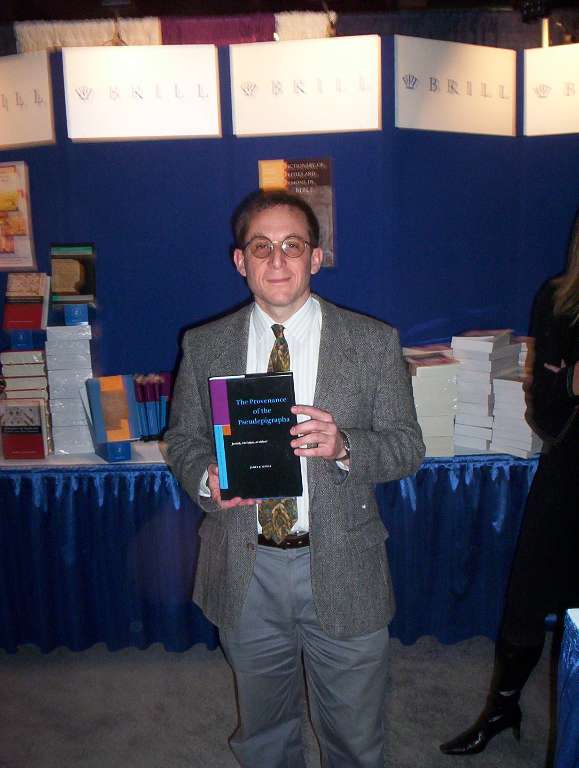
MY BOOK is here: I've hefted the copy in the Brill booth. Feels good to be able to do that.

I've spent the morning meeting with people and looking at the book displays and haven't gone to any papers yet. I met with one of my doctoral students who resides in the States, then went to the e-listers get together. From there I had lunch with Ian Scott (of the Online Critical Pseudepigrapha Project) and Justin Dombrowski (of the Midrash le-Justin blog), then headed up to my room for a bit of a nap. In a few minutes I'm going back to the book display area for another meeting or two. And with luck, I may get to blog there on an actual computer. That would be nice; this television thing is getting tiresome. Then on to the Jewish Christianity session.

I have a couple of photos to go with this post [added on 24 November], but the downloading software is on my computer in St. Andrews, so look for those later on. More blogging presently, I hope.

E-listers group photo

Friday, November 18, 2005

PSCO SESSION: Just got back from the PSCO session, so I may as well pull some (I hope) coherent thoughts from my notes. I reserve the right to correct typos (and errors!) and add a link or two and maybe even a photo when I have access to better Internet facilities.

The session was chaired by two Penn postgraduates, T. J. Wellman and Harry Tolley. A speaker had been planned but had to pull out, so it ended up being an informal discussion of David Frankfurter's paper. The main issue taken up was the perimeters of expertise in the category of "ritual expertise" in the light of David's taxonomy. What about holy people who even worked miracles but who di not have a reputation for ritual expertise (e.g. Honi the circle-drawer)? (Was circle-drawing a ritual?)

A key question was raised by Vasilika Limberis: How do holy people who had a reputation for ethical goodness (saints and other do-gooders)rather than ritual expertise fit into this category of ritual expert and how does this relate to the category of "holy man"?

For the most part I couldn't keep track of names, but here are some thouhts and responses that were raised in the discussion
  • The nature of the holy man depnds on specific and different themes emphasized by different communities.
  • The same actions can be interpreted differently by different worldviews.
  • The story in Luke in which someone who wasn't a disciple of Jesus but who was exorcizing demons in his name was brought in. Did this use of a new "technology" (Jesus' name) make him a ritual expert? David said that we really needed to know if the man was already an exorcist. If he then got the reputation of specializing in this particular praxis, then yes. Someone pointed out that Simon Magus went so far as to offer to pay for this new technology.
  • Bob asked if there is any example of an (exorcism?) formula that appeared with different names used for the deity invoked. "Son of David" and Jesus were mentioned, but I'm not sure how this fitted the question.
  • Different communities are going to define holiness differently.
  • The ritual functions as extending the holiness to others.
  • Are ritual specialists really holy men? Need they be? Does the term holy have taxonomic value.
  • What is the locus of similarity between ritual expertise and being an ethical exemplar? One suggestion was that both are people who have power, but not through the normal channels (e.g., government office; military position; being a bishop -- in a Christian context).
  • What about people who are holy but not powerful (Jerome's Life of Paul; Mary of Egypt -- ascetics who just lived out in the desert), who are efficacious only as religious figures? It was suggested that they did not count as ritual experts.
  • David suggested that Vasilika's holy person who had ethical goodness could be considered as a "saint" as distinct from a "ritual expert."
  • This raised the question of whether a saint who doesn't exercise power counts as a holy man. Posthumous miracles might be invoked to make up the difference.
  • How much is holiness based on the closeness of the figure to the god (Honi, Moses) rather than ritual expertise. David did not find the source of the power to be a useful taxonomic criterion.
  • There was a lot of discussion of the scribe in comparison to the ritual expert, but my notes are too confused to make sense of. If you took better notes, please e-mail me a summary.
  • I was curious whether David agreed with the position that magos and goes (i.e, baddy magicians or sorcerors) never actually existed but were just categories of accusation, especially given that some of the Greek Magical Papyri included highly socially deviant actions such as digging up dead bodies and cutting pieces from executed criminals. David said that the PGM were mainly literary texts and that we didn't have evidence of their ever being used (I had assumed it was taken for granted that they were practical manual, but evidently not.) Also, he suggested that aggressive spells do not necessarily require a specific category of ritual specialist for them. Others agreed that the evidence did not support people claiming to be these categories
  • If holiness is to be useful as a category, it cannot be tied to goodness.
  • There was some discussion of whether emic or etic perspectives were more useful in considering these questions. How much does it matter that the people we put together in some of our categories would stridently object to being associated with one another?
  • Bob asked if the ancient sources take the view that there were inherently good and bad powers that one could harness. David said that powers could be peripheral or ambiguous, but were rarely considered specifically evil.

Those are my notes. If you have better notes and want me to supplement what I've said, then e-mail me. If you think I've gotten something in the discussion wrong, please let me know how you recall it. If I have misunderstood something you've said, please let me know so I can correct it.

Thanks to everyone for a really interesting discussion
I'M HERE! In the Philadelphia Marriott, that is. Mark Goodacre will be pleased to hear that I'm blogging from my television screen, as I did a couple of years ago at another SBL meeting.

I got in last night and had a reasonable night's sleep and a nap this afternoon. Factoring in the coffee, I'm doing pretty well. I've spent most of the day shopping and am looking forward to the PSCO session (see several posts below) at 7:30.

By the way, I've lost my printout of the e-mai that told where the Early Jewish and Christian Mysticism dinner is tomorrow night. If anyone going there should happen to see this, would you please e-mail me with the info?

Bob Kraft just called to let me know that some of the PSCO people are going out for dinner, so I'd better post this and get downstairs.

Wednesday, November 16, 2005

STEPHEN C. CARLSON, who is also one of the panelists for the bibliobloggers session, has posted his SBL paper (a response to Alan Garrow’s paper, “Didache 16: The Tradition Behind 1 Thessalonians 4:13-18”) at Hypotyposeis. Garrow's paper is also available in advance and Stephen has a link to it.
A JERUSALEM ANTIQUITIES DEALER, writing for the Bible and Interpretation website, discusses forgeries and how to detect them:
One Man’s Forgery Is Another Man’s Antiquity

If a group of suspect objects were sold to one collector who was buying primarily from one man, we have more information. Yet, some of the most successful peddlers of fakes have been first-rank dealers who exploited their reputation of handling the finest merchandise.


By L. Alexander Wolfe
November 2005
THE NYU CONFERENCE ON THE LUBAVITCHER REBBE has been the subject of a couple of recent wrap-up articles:

Steven Weiss reports in the Forward:
Conference Weighs Rebbe's Legacy
By Steven I. Weiss
November 11, 2005

The late Lubavitcher Rebbe was the subject of a groundbreaking three-day conference at New York University this week, a generally laudatory program that could set the tone for how the charismatic leader and his movement will be presented in future academic settings.

"What we are really going to do [with this conference is] set off a mode of research," said the event's organizer, Lawrence Schiffman, a Judaic studies professor at New York University. The conference, he added, was "in certain ways a communal research project."

Several of the sessions featured basic introductions to the rebbe, Rabbi Menachem Mendel Schneerson, and the Chabad-Lubavitch Hasidic movement's basic rituals and slogans, including its trademark declaration: "We Want Moshiach [Messiah] Now." Many presenters also offered detailed explications of Schneerson's thought. These were based on a review of his extensive writings, which are relatively unfamiliar to Jews outside of Lubavitch circles.

[...]

And there's this article from the Baltimore Jewish Times:
Lubavitcher Rebbe Meets The Academy

Debra Nussbaum Cohen
Special to the Jewish Times

NOVEMBER 16, 2005
New York

"Reaching for the Infinite: The Lubavitcher Rebbe - Life, Teachings and Impact" was more apt a title for the conference which took place this week at New York University than even its organizers may have realized.

Trying to convey the impact of the late Rabbi Menachem Mendel Schneerson in two dozen or so 20-minute long academic presentations, which were delivered at the conference held Sunday through Tuesday at NYU's student center on Washington Square, was a little like reaching for the infinite with arms only inches long.

This was the first-ever academic conference devoted to the life and work of Rabbi Schneerson, who led the Chabad movement from 1951 until his death in 2004, and helped it grow into the largest Jewish outreach network in the world. Held under NYU's auspices, the meeting was funded by Chabad supporters George and Pamela Rohr, and Craig and Deborah Cogut, and attended by up to 150 people at a time, ranging from Lubavitch chasidim to Reform rabbinical students.

The conference's organizer, Lawrence Schiffman, said in an interview that he hoped "to create an intellectual discourse that didn't exist before" on the rebbe. Schiffman, a Dead Sea Scrolls expert and chairman of NYU's department of Hebrew and Judaic Studies, explained that "the rebbe is a major phenomenon in modern Jewish life."

[...]

Apparently there was a fair bit of discussion of the messianic themes and claims surrounding the Rebbe.
NOT ANCIENT, but archaeology and worth a mention:
Survivors find hidden treasures
15/11/2005 19:36 - (SA)

Warsaw - Four survivors of the Holocaust have found jewellery and other precious objects which they and other prisoners buried some 62 years ago near Majdanek death camp in eastern Poland, the head of the camp's museum said on Tuesday.

"Four survivors - Polish Jews who were sent to Majdanek by the Germans after the Warsaw ghetto uprising in the spring of 1943 - were able to indicate the place where they and their loved ones hid valuable personal possessions," said museum director Edward Balawajder.

[...]

"An archaeological dig allowed us to find, around 35 centimetres below the surface, some 50 objects: rings, wedding rings, watches, earrings, and coins, including a $10 coin minted in 1894," said Balawajder.


... The Majdanek museum has agreed to classify the items and put them on display to the public.

"It's a real treasure, not only because of its financial worth but because it is proof of the tragedy which occurred in the death camps," said Balawajder.

An Israeli archaeologist participated in the excavation.
THE PHILADELPHIA SEMINAR ON CHRISTIAN ORIGINS will be meeting as usual on Friday evening at the SBL convention. Bob Kraft e-mails on the PSCO list:
Sorry for the delay of the notice. Some last minute details are still not in place, but we will meet, at 7:30 pm (not 7:00) in the Regency B room at the Loews Hotel (1200 Market -- #10 on the Conference Hotel map).

Here is the context for discussion, as laid out by the co-chairs:

The topic of the 43rd year of the Philadelphia Seminar on Christian Origins is "Redescribing the Holy Man: Theoretical Frameworks and Specific Applications." We envision this topic as providing a focus for an ongoing discussion about the analytical and explanatory possibilities of recent reassessments or developments of Peter Brown's Holy Man typology. When Peter Brown published his seminal essay, "The Rise and Function of the Holy Man in Late Antiquity" (1971), he introduced an analytical concept immediately lauded by specialists in a number of academic subfields. In the decades since then this concept has been deployed to make sense of various figures and events in Late Antiquity and beyond across the range of religious traditions of the ancient Mediterranean basin. Whether Neoplatonic diadochai, Christian saints, Jewish rabbis, or the priests, healers, and prophets of the diverse local religious cultures of Late Antiquity, the methods and descriptions employed by modern scholars all speak of this shared imaginaire.

Recently, however, Anita Kolenkow and David Frankfurter have each independently suggested developments or refinements of the heuristic concept to focus more closely on the various social roles performed by ritual experts in their communities, grounding the general type in more specific sub-types and social dynamics, and thereby pushing the academic community to a new stage of theoretical reflection and critique. In order to generate an conversation throughout the year's sessions, it is our hope that each presenter will engage to some degree with David Frankfurter's essay, "Dynamics of Ritual Expertise In Antiquity and Beyond: Towards a New Taxonomy of 'Magicians.'" [in Mirecki, Paul and Marvin Meyer, eds. Magic and Ritual in the Ancient World. Brill, 2002. Pages 159-178.] as a starting point for their presentation. By doing so, we can take a second look at the Holy Persons who populated various areas of focus and examine the possibilities and constraints offered by this development from Peter Brown's typology. The question is whether the utility of the comparative taxon "Holy Man" to elucidate data can be increased by refining the concept and, in some cases, employing a more thoroughly comparative method (between traditions, between individuals, between time periods, and between cultures).

Co-Chairs:
T.J. Wellman (University of Pennsylvania) twellman@sas.upenn.edu
Harry Tolley (Univ. of Pennsylvania) tolleyhw@ccat.sas.upenn.edu

Details to follow. Hope to see you there!

Bob

--
Robert A. Kraft, Religious Studies, University of Pennsylvania
227 Logan Hall (Philadelphia PA 19104-6304); tel. 215 898-5827
kraft@ccat.sas.upenn.edu
http://ccat.sas.upenn.edu/rs/rak/kraft.html

Tuesday, November 15, 2005

TEMPLE MOUNT WATCH: Archaeologist Dan Bahat lectured at the University of Connecticut on his recent excavation of a tunnel under the Western Wall.
Archaeologist brings Temple Mount within audience's reach

By Lauren Klein
Special Correspondent (Stamford Advocate)

Published November 14 2005

[...]

Bahat, former chief archaeologist of Jerusalem, spoke about the 1,600-foot tunnel running under the western retaining wall of the Temple Mount. He and his team have been excavating the tunnels since 1985.

The lecture, "The Secrets of the Tunnels of Ancient Jerusalem," was co-sponsored by the Center for Judaic & Middle Eastern Studies at UConn, Temple Beth El in Stamford and the Jewish Historical Society of Lower Fairfield County.

[...]

Bahat highlighted his findings of massive stones used to build the first and second temples; remains of the Herodian road that ran alongside the Temple Mount; and a Hasmonean-period aqueduct that was blocked by King Herod the Great's construction of the Western Wall in about the 1st century, B.C.E

[...]

Monday, November 14, 2005

EGYPTIAN BLOGGER Abdolkarim Nabil Seliman, who was arrested and held incommunicado by the Egyptian Government last month, has reportedly been released. This is based on a new post on his blog and, like the Sandmonkey, I reserve the right to be a little skeptical. But it's definitely good news. At the very least the authorities have been bothered enough to put up a fake post on his blog, one which isn't going to fool anyone for long. More likely (I hope), he actually has been released. If so, I trust he'll keep blogging as usual. Otherwise, we'll all start to get suspicious. Also, I urge Egyptian bloggers to telephone him or, better yet, see if you can see him in person, and report back to us to confirm his release. If you happen to read my post here, please drop me a note if you reach him.

Meanwhile, many thanks to readers who wrote to the Egyptian Embassy and signed the petition. The power of a blog-swarm is not to be dismissed! And the mainstream media sure have been missing a hell of a story.

(Via Instapundit.)

In addition, I should note that an Egyptian blog that helped keep Seliman's case alive has won an award from Reporters Without Borders:
"Manal and Alaa’s Bit Bucket" won the Special Award from Reporters Without Borders in the Deutsche Welle’s 2005 Weblog Awards. The wife-husband pair has become an institution among Arabic bloggers and journalists critical of the Egyptian regime. Manal and Alaa strive to promote freedom of expression and protect human rights as well as highlight the need for political reforms in Egypt. Their Weblog also offers other bloggers free storage space and practical help starting their own initiatives and has been has been crucial is developing a critical and engaged blogger scene in Egypt and the Arabic-speaking world.

Congratulations, Manal and Alaa!

UPDATE (15 November): Bad link fixed. Apologies. And more details about the release of Seliman here.
MARK GOODACRE'S SBL PAPER for the Matthew section is now available online.
THE TEL ZAYIT ABECEDARY is the subject of a thoughtful Chicago Tribune article ("Research on ancient writing linked with modern Mideast conflict"). I can't find the original, but it's being reprinted in lots of places. Excerpt:
Because he found it in the Holy Land, [Tappy's] lecture will raise tempers. Archaeologists generally are gentle folk. But biblical studies imperceptibly shade over from scholarly pursuits to modern-day passions inflamed by contemporary struggles of Israelis and Palestinians. One camp, "the maximalists" implies the other harbors anti-Semites. The "minimalists," in turn, charge their accusers with confusing Zionism with scholarship.

"In the Middle East, you can start a mini war over who got there first," said William G. Dever, professor emeritus of the University of Arizona and a fierce opponent of the minimalists. "This isn't about ancient Israel. It's about modern Israel and the Palestinians."

Philip Davies, professor emeritus at the University of Sheffield in England, is generally considered the founding father of the minimalists - most of whom are European-based. He is coming to the Philadelphia meetings prepared for battle with his American colleagues.

"When I fly the Atlantic, I feel like a gladiator," Davies said. "Tappy's research is going to be a football, kicked around from one side to the other."

Then there's this:
"The minimalists argue that the ancient Hebrews didn't know how to write, so they couldn't have had a real state, a kingdom," noted Hershel Shanks, editor of Biblical Archeology Review. "But Tappy's discovery shows they were already writing in an outlying settlement. Imagine what you must have had in Jerusalem."

I don't recall anyone saying that the ancient Hebrews couldn't write, only that we haven't found monumental inscriptions in Hebrew from the period of the United Kingdom. Am I missing something?

UPDATE: Benjamin Zimmer has a good, links-rich summary post at the Language Log.

Also, Tyler Williams is tracing the letters in the picture of the Tel es-Safi (non-Goliath) inscription with Photoshop. Cool!

Sunday, November 13, 2005

NO NEW JEHOASH TABLET: For the record, since this may be causing some confusion, there is not a new Jehoash tablet find. This Ha'aretz article apparently reappeared on Google briefly and was noted in the latest Explorator. The information is about the Jehoash tablet that was in the news a couple of years ago and which is now widely agreed to be a forgery. The article is old, long out of date, and now inaccurate. Unfortunately, Ha'aretz seems not to keep original dates on its archived articles, which is very confusing. But this Telegraph piece links to the Ha'aretz article (under "External Links" to the right) and dates it to 17 January 2003.

Had there been a new Jehoash inscription found, there would have been a great kerfluffle.
THE MEGIDDO EXCAVATION is looking for volunteers for the 2006 season. (Via Eric H. Cline on the ANE List).
MARK GOODACRE has some good presessional posts on the upcoming SBL CARG session on biblioblogging here and here, in which he suggests ideas for what we can talk about in the session and gives some background links on academic blogging and biblioblogging. I'm adding references to both posts in my paper, which is nearly done.

UPDATE: More from Mark here and here. And Michael Pahl responds here.
SLOW NEWS DAY. The Tel Zayit abecedary is covered by the BBC in a brief but accurate article. Personally, I can't see how this inscription bears on the minimalist/maximalist debate. If it is Hebrew script, we already knew that Hebrew was being written in the tenth century BCE from the Gezer Calendar (apparently a scribal exercise). It's interesting that people in Judah could write too and that they even made crude stone inscriptions, but it's not anything surprising.

On a more amusing note, Pravda also has an article on the inscription and, not having access to an actual photo of it, has posted one they made up or got from somewhere else. The photo on the right shows a stone with the Hebrew alphabet carved thereon in six lines in the modern square script, complete with final (sofit) letters. A little misleading, wouldn't you say?


Pravda means "Truth."

UPDATE (14 November): Seth Sanders e-mails:
It's tough to fit the new inscription into the old (and to my mind unhelpful) debates. Crucially, there is no clear evidence that Gezer is in Hebrew, rather than Phoenician or (more likely, I think) an unmarked Canaanite scribal dialect that may not have been what anyone spoke (an argument advanced nicely in Bill Schniedewind's recent book). The case for Gezer's lack of paleographic and dialectal distinctiveness is already laid out in detail in Joseph Naveh's Early History of the Alphabet.

Chris Rollston, who's done the most recent, detailed and comprehensive studies of Iron Age paleography that I'm aware of, isn't convinced it's Hebrew either:
http://www.post-gazette.com/pg/05313/603007.stm

In fact, our teacher and the stone's epigrapher, Kyle McCarter, describes it as "of a Phoenician type" here:
http://news.bbc.co.uk/2/hi/americas/4422628.stm

For what it's worth, my contribution to the topic, The Invention of Hebrew and the Formation of Ancient Israel (out next year from U of Illinois) will argue that Hebrew, as a formal written standard, was most probably created in the 8th or 9th century. This isn't to debunk the authenticity of earlier Israelite history--just to suggest that if they wrote it down it was either in Phoenician or a Canaanite variety
not yet defined as "Hebrew."

Stay tuned for the SBL session, folks!

Saturday, November 12, 2005

RENOWNED QUMRAN SCHOLAR GEZA VERMES has an essay in the Times of London on Jewish-Christian relations:
Moving on from reproach to rapprochement
By Geza Vermes
Israel’s state visit to the Vatican is a challenge to faith leaders
NEXT Thursday the son of the caretaker of a Jewish school in Tehran will pay a state visit to the son of a Bavarian policeman. In plain language, Moshe Katsav, President of Israel, will be received amid pomp and ceremony in the Vatican by Pope Benedict XVI.

This event leads him to reflect on the history of relations between Jews and Christians, which has not always been constructive, to say the least. He has some advice for both:
Jews will have to stop being afraid of Jesus and treating Him as taboo. When we look at Him through the prism of history, rather than theology, and in the light of all the freshly gained knowledge of the world in which He lived, He reveals Himself as Jesus the Jew, who in the judgment of Martin Buber, one of the greatest modern Jewish thinkers, deserves an “important place in the religious history of Israel”.

The task Christians have to confront is, if anything, even more challenging. They must face up to the fact that the image of Jesus and the formulation of His message have come down to the Church not in their original language — they were delivered to simple Aramaic-speaking Galilean Jews — but in a culturally alien language (Greek) and in a form adapted to the needs of Hellenised non-Jews of Syria, Egypt, Asia Minor, Greece and Rome. The saying, Traduttore traditore (a translator is a traitor), applies not just to texts but to the transmission of religious ideas as well.

Christians will need to discover the Jewish meaning of the authentic message preached and practised by Jesus and a way to apply it to their own circumstances today. Take His command to behave like children of God. Jesus does not advocate childishness, a lack of self-confidence and a constant demand for help and mediation — from priests, saints, the Virgin Mary or even from Himself — but recommends His own Jewish notion of a son of God, which entails boundless trust in the heavenly Father who can be reached directly by all his children. Such an outlook may turn out to be more exciting than the humdrum doctrine which churchgoers quite often hear from the pulpit.

During the past three decades, scholars on both the Jewish and the Christian sides have made great advances in clearing the path for a new understanding of Jesus and His gospel. Will Christian leaders and teachers of today and tomorrow be lion-hearted enough to come to grips with the challenge that beckons?

Let's hope so.
THE "GOLIATH" MEME continues to be spread in the media; that is, that the inscribed postsherd from Tel es-Safi has the name "Goliath" written on it, whereas in fact, at least according to this Jerusalem Post article, there are two names similar but not identical to Goliath: 'WLT and WLT (אולת and ולת). The Independent reprints the AP article that makes the claim about the name Goliath, as do many other newspapers.

In addition, epigrapher Lawrence Mykytiuk is interviewed (apparently in a Purdue University press release) about the potsherd with the correct understanding that the names are similar but not identical to Goliath.

Claims are being made that these names, whether Goliath or something similar, have some bearing on the historicity of the David and Goliath story in 1 Samuel 17. I'm not so sure. It's been a long time since I read about this, but I believe Goliath was a family name used by Jews in the first century BCE, which implies it could have been known and used any time between them and whenever the name originated. I can't find an online discussion that isn't behind a subscription wall, but the main reference seems to be:

Rachel Hachlili, "The 'Goliath' Family in Jericho," Bulletin of the American Schools of Oriental Research 235 (1979): 31-66.

Friday, November 11, 2005

RICK BRANNAN has posted his SBL paper for the upcoming CARG Blogging session. It's really good, so be sure and read it whether or not you can come to the session. I'm working on my paper for the same session and I intend to post it here before I leave for Philadelphia.
REDATING THE SECOND TEMPLE? Diana Edelman summarizes her new book on the Bible and Interpretation website:
Redating the Building of the 'Second' Temple

It is hard see what benefit would have accrued from rebuilding the temple under either Cyrus or Darius while Jerusalem remained unoccupied and in ruins. How would either king have benefited from a pilgrimage site in a destroyed city in an underdeveloped, distant province?

A summary of the main arguments made in D. Edelman, The Origins of the 'Second' Temple: Persian Imperial Policy and the Rebuilding of Yehud (London: Equinox, 2005).


By Diana Edelman
University of Sheffield
November 2005

If I'm reading her right, she thinks the Second Temple was actually built in the reign of Artaxerxes I (c. 464-423 BCE), sometime after the 21st year of his reign. It's very difficult to evaluate this sort of argument on the basis only of a summary of a book, but a few thoughts occur to me.

  • First, the only hard datum about the date of building of the Second Temple I can find is the reference in an Elephantine papyrus dated 407 BCE to the high priest and the priests in Jerusalem, which certainly seems to imply a Temple there and then. See here for discussion. This does not conflict with Edelman's interpretation.
  • Second, she also should take into account the evidence of the Enochic Animal Apocalypse (see link just cited). In fact, 1 Enoch 89:72 could be used to support her argument. One reading says that two "sheep" (Zerubbabel and Joshua?) started rebuilding Jerusalem (the "House"), after which the Temple (the "Tower") was rebuilt (v. 73). But another reading of v. 72 says three sheep, which would include either Sheshbazzar or Nehemiah. If the latter is intended, the text could be read to say that the Temple was rebuilt in his time. This would be especially interesting, because the Animal Apocalypse rejects the validity of the Second Temple and thus is witness to a different propaganda tradition and possibily a different line of historical memory about the Second Temple. But it's a very difficult passage and any interpretation of it is speculative.
  • Third and sed contra, I don't find it incoherent that the exiles might have put more work sooner into rebuilding the Temple than into rebuilding the city. Religious people have their own priorities that don't necessarily make sense from a modern secular perspective. Look at all the time, money, and effort Europeans put into building cathedrals in the Middle Ages. So I don't see a problem in principle with the biblical accounts.

In brief, Edelman's theory seems to involve a lot of speculation and extrapolation, but I wouldn't rule the possibility out. I'll be interested in reading her book.

Bibliography

Patrick A. Tiller, A Commentary on the Animal Apocalypse of I Enoch (SBLEJL 4; Atlanta, Ga.: Scholars Press, 1993), 336-40

George W. E. Nickelsburg, 1 Enoch 1: A Commentary on the Book of 1 Enoch, Chapters 1-36, 81-108 (Hermeneia; Minneapolis, Minn.: Fortress, 2003), 387-95

UPDATE (12 November): Regarding my point #3, reader Robert Schwartz e-mails:
Of course they would have. The Temple was the attraction that would jumps start the city's economy by requiring the people to make their tri-annual pilgrimages.
YOU CAN SEE A PHOTO of part of the Tel Zayit abecedary in this New York Times article. The article also notes some letters that are out of the traditional order. (Via this post at the Language Log, which has a number of useful links and which was found via Yitzhak Sapir on the ANE list.)

These discoveries seem to be pouring in fast and furious and I'm too busy writing my SBL paper etc. to keep up with them properly. But I'm trying at least to note interesting developments.

UPDATE: I see it's the same NYT article I cited before. But the photo wasn't there originally!
GOLIATH WAS HERE. Well, maybe not that Goliath, but a Goliath nonetheless.
Finding Said to Boost Proof of Goliath

JERUSALEM, Nov. 11, 2005
(AP) Archaeologists digging at the purported biblical home of Goliath have unearthed a shard of pottery bearing an inscription of the Philistine's name, a find they claimed lends historical credence to the Bible's tale of David's battle with the giant.

While the discovery is not definitive evidence of Goliath's existence, it does support the Bible's depiction of life at the time the battle was supposed to have occurred, said Dr. Aren Maeir, a professor at Bar-Ilan University and director of the excavation.

"What this means is that at the time there were people there named Goliath," he said. "It shows us that David and Goliath's story reflects the cultural reality of the time." In the story, David slew Goliath with a slingshot.

[...]

A sling, not a slingshot. Sigh.

UPDATE: It seems that maybe it's just someone who had a name a bit like Goliath. That's rather less interesting, although a tenth-century BCE inscribed ostracon is in itself very important news, whatever it has on it. Christopher Heard has lots of links and commentary over at Higgaion.

UPDATE (12 November): More here.

Thursday, November 10, 2005

MANDAEANS IN IRAN: The Gnostic, Aramaic-speaking (in their liturgy) Iraqi Mandaeans have been getting some attention in the news since the war, and rightly so, but let's not forget the plight of the Mandaeans in Iran. From the U.S. State Department's International Religious Freedom Report 2005 on Iran:
There was no substantive change in the status of respect for religious freedom during the reporting period. Members of the country's religious minorities--including Sunni and Sufi Muslims, Baha'is, Zoroastrians, Jews, and Christians--reported imprisonment, harassment, intimidation, and discrimination based on their religious beliefs. Government actions created a threatening atmosphere for some religious minorities, especially Baha'is, Jews, and evangelical Christians.

[...]

Baha'is, Jews, Christians, Mandaeans, and Zoroastrians constitute less than 1 percent of the population combined. ... The Mandaeans, a community whose religion draws on pre-Christian gnostic beliefs, number approximately 5,000 to 10,000 persons, with members residing primarily in Khuzestan in the southwest.

[...]

According to the U.N. High Commission for Refugees' (UNHCR) background paper on the country, the Mandaeans are regarded as Christians and are included among the country's three recognized religious minorities. However, Mandaeans regard themselves not as Christians but as adherents of a religion that predates Christianity in both belief and practice. Mandaeans enjoyed official support as a distinct religion prior to the Revolution, but their legal status as a religion since then has been the subject of debate in the Majlis and has not been clarified. The small community faces discrimination similar to that faced by the country's other religious minorities. There were reports that members of the Mandaean community experienced societal discrimination and pressure to convert to Islam, and they often are denied access to higher education. Mandaean refugees have reported specific religious freedom violations and concerns, such as being forced to observe Islamic fasting rituals and to pray in Islamic fashion, both in direct violation of Mandaean teaching.

As noted, Jews, Baha'is, Christians, Zoroastrians, and even Sufi Muslims don't have it easy in Iran either.
TEMPLE MOUNT WATCH: More Waqf construction?
Archaeologists decry Wakf 'renovation'

By ETGAR LEFKOVITS (Jerusalem Post)

In a renewed dispute, a group of Israeli archaeologists has condemned the Wakf's planned renovation work of an ancient tower adjacent to the Temple Mount, warning that such a move is part of a long-running plan by the Islamic Trust to expand a recently-created mosque at the Jerusalem holy site.

The non-partisan 'Committee Against the Destruction of Antiquities on the Temple Mount,' which has been leading the public campaign against Wakf construction at the site has sent a letter to Prime Minister Ariel Sharon and the Director of the Antiquities Authority Shuka Dorfman lambasting the proposed renovation work on the historic structure.

[...]

I shall be watching this one closely.
THE HOWLER OF THE WEEK goes to this headline at 6abc.com regarding the (roughly?) 10th century BCE abcedary discovered in Israel:

PA Archaeologist Discusses 12,000 Year–Old Alphabet
BNEI MENASHE CONVERSIONS STOPPED:
Israel halts Indian conversions (BBC)

Israel has stopped converting people in north-east India who say they are from a biblical "lost tribe" following complaints from the Indian government.

Delhi did "not view positively" conversions to another religion, Israel's foreign ministry said.

The 6,000-strong Bnei Menashe community in India's north-east say they are descendents of one of the 10 tribes exiled in the 8th Century BC.

Israel says it will now convert members when they emigrate.

[...]

Ha'aretz has more here.
IF YOU BUILD IT, THEY WILL COME. In theory, anyway.
A theme park for the Holy Land?

American Evangelicals and Israeli officials plan to unveil this month a $60 million park where Jesus walked.

By Ilene R. Prusher
| Staff writer of The Christian Science Monitor

JERUSALEM – Officials in Israel say that out of about 2 million people who will realize their dream of visiting the Holy Land this year, more than half will be Christian. And among those, more than half will be Evangelical.

With that in mind, the Israeli ministry of tourism has gone public with a plan to build - in partnership primarily with American Evangelical churches - a sprawling Holy Land Christian Center on the northern shores of the Sea of Galilee, home to some of the most notable chapters in Jesus' ministry. The center, to be built on approximately 125 acres that the Israeli government is offering free of cost, would be a Christian theme park and visitors' center, one that would be particularly attractive to Evangelicals and other Christians who want to spend more time in the places where Jesus walked.

Highlights may include a Holy Bible Garden, full of plants and trees mentioned in the New Testament, and equipped with quiet sites for reflection and prayer. A Sea of Galilee Amphitheater will overlook the mouth of the Jordan River and hold 1,500-2,000 worshippers. And the park will have a Christian Experience Auditorium and a Multimedia Center. The center would also feature an online broadcast center, which would give religious leaders an opportunity to address their followers back home, live, near the tranquil blue waters of the Sea of Galilee (which today is considered a lake).

[...]

This seems kind of goofy to me, but I guess they think there's a market for it. I hope they're right that it won't degenerate into a Disneyland.

Wednesday, November 09, 2005

AN ANCIENT ABECEDARY has been discovered carved in a stone at Tel Zayit in Israel.
A Is for Ancient, Describing an Alphabet Found Near Jerusalem

By JOHN NOBLE WILFORD (New York Times)
Published: November 9, 2005

In the 10th century B.C., in the hill country south of Jerusalem, a scribe carved his A B C's on a limestone boulder - actually, his aleph-beth-gimel's, for the string of letters appears to be an early rendering of the emergent Hebrew alphabet.

Archaeologists digging in July at the site, Tel Zayit, found the inscribed stone in the wall of an ancient building. After an analysis of the layers of ruins, the discoverers concluded that this was the earliest known specimen of the Hebrew alphabet and an important benchmark in the history of writing, they said this week.

[...]

The date is not certain, but evidently both ceramic typology (from the stratum at the site) and epigraphic considerations point in that direction. The inscription is already being brought into the minimalist/maximalist debate, perhaps prematurely.

A few other comments:
The two lines of incised letters, apparently the 22 symbols of the Hebrew alphabet, were on one face of the 40-pound stone. A bowl-shaped hollow was carved in the other side, suggesting that the stone had been a drinking vessel for cult rituals, Dr. Tappy said. The stone, he added, may have been embedded in the wall because of a belief in the alphabet's power to ward off evil.

I'm having trouble picturing this. Was the stone originally part of the wall or reused later as a wall stone? Is the inscription on the same side as the bowl (so you could review your ABCs while you took a drink at the water fountain between classes?) or on the other side (the outside of the wall?)? What is the evidence that the use was cultic rather than, say, in a classroom for a scribal school?
Another baffling peculiarity is that in four cases the letters are reversed in sequence; an F, for example, comes before an E.

F before E? What does that mean? The Pe before the Ayin maybe? Or the Vav before the He?

The ANE list has had rumors of this inscription in recent days. I look forward to Ron Tappy's paper on it in the ASOR/AAR/SBL meetings in Philadelphia later this month.

UPDATE (12 November): More here.

Tuesday, November 08, 2005

HERE'S AN INDEX OF MISHNAIC REFERENCES in M. H. Segal's A Grammar of Mishnaic Hebrew. It was compiled by J. Boas. Click on the relevant link on the page to download the PDF file.

(Via Martin Baasten on the ANE List.)

UPDATE (9 November): Truncated link fixed.
HERE'S A JESUS MOVIE that places him in India during the years of his life which are not covered in the four gospels, and maybe after the crucifixion too:
Kolkata filmmaker traces Christ's 'India trail' (NewKerala.com)

By Sujoy Dhar, Kolkata: Where was Jesus Christ between the age of 12 and 30 years? He supposedly visited India during this period, according to a theory, and a filmmaker here has tried to follow Christ's yet unexplored trail in his new movie.

Though the Bible does not give credence to such theories, engineer-turned filmmaker Subhrajit Mitra's "The Unknown Stories of the Messiah" focuses on the unexplored life of Christ and his unaccounted years in the Bible.

Did Christ visit India after his crucifixion? Is a tomb in the Kashmir Valley that of Christ? These are some of the controversial questions Mitra raises in his film.

[...]

"Neither the Bible nor the mainstream gospels give credence to such theories but the scrolls found in caves near the Dead Sea or at Nag Hammadi (in Egypt), believed to be the first drafts of the Bible, corroborate the alternative theory about Christ," Mitra told IANS.

[...]

This alternative theory was strengthened after some scrolls (dating back to between 200 BC and 100 AD) were discovered in 1947 in a group of caves near Khirbat Qumran in Jordan at the northwestern end of the Dead Sea.

Two years before that, in 1945, some scrolls dating back to 350 AD were found tucked into a large jar at Nag Hammadi village in upper Egypt.

[...]

Maybe it will be an entertaining movie, but this historical rationale is bogus. The Dead Sea Scrolls never mention Jesus and I'm pretty sure they never mention India either. The Nag Hammadi library has a number of noncanonical gospels and apocalypses, but they do not mention India and certainly do not place Jesus there.

I'm not an expert in this area, but as far as I know, the earliest text to connect a first-generation Christian figure with India is the third-century Syriac Acts of Thomas, which has Thomas (not Jesus) evangelizing India. As far as I know, claims about Jesus himself going to India are modern. Here's a site that claims to collect the information, but I can't speak for its accuracy or completeness.
THE EGYPTIAN BLOGGER arrested by the Egyptian authorities is covered again by the AFP (here and here). The mainstream media is not leaping on the story.

UPDATE: More here. Don't forget to sign this petition. It will take you just a minute and you need not have your name posted in public.
THE ANCIENT CHRISTIAN SITE AT MEGIDDO is the subject of a National Geographic photo essay.

Monday, November 07, 2005

A DISTANCE-LEARNING COURSE ON THE DEAD SEA SCROLLS at the University of Copenhagen:
The Faculty of Theology of the University of Copenhagen is pleased to announce an MA-level Distance Learning Course: "Introduction to the Dead Sea Scrolls".

For general information and links to application form, point your browser to www.teol.ku.dk/csbb/default-eng.htm and click "Dead Sea Scrolls Course" in the top bar.

For further information, please contact assistant professor, Ph.D. Søren Holst at mailto:sh@teol.ku.dk


Associate Professor, Ph.D. Carsten Selch Jensen
Coordinator of the Distance Learning Programme
at the University of Copenhagen's Faculty of Theology

(From Søren Holst on the g-Megillot list.)
CONGRATULATIONS TO THE JOURNAL OF SEMITIC STUDIES, which will celebrate its 50th anniversary on 16 November.
THE THIRD-CENTURY "CHURCH" AT MEGIDDO is the subject of a somewhat more temperate article ("Site May Be 3rd-Century Place of Christian Worship") in the Washington Post. Excerpts:
Judging by the age of broken pottery discovered on the floor, the distinctive mosaic style, inscriptions citing Jesus and the apparent pre-Byzantine design of the building, state archaeologists said the structure was most likely a public place of Christian worship that dates to the mid-3rd or early 4th century. If true, the find would join the early 3rd-century Christian gathering place at Dura Europus in Syria as one of the oldest of its kind.

[...]

Some archaeologists not involved in the project said the conclusions, while tantalizing, might be premature given that only 10 percent of the site has been excavated. Workers have yet to turn up a dated inscription or other evidence that firmly establishes the year the structure was built.

Zeev Weiss, an archaeology professor at Hebrew University in Jerusalem who runs the largest excavation project here in the Galilee region, said: "There is no question that what they have found is connected to Christianity. The only questions concern the design of the structure, the use of the structure and the date.

"To my mind, they don't really know what they have," said Weiss, who nonetheless called the discovery "very interesting." "That's probably why they are hesitating to call it a church."