Bar Ilan promotes biblical archeologyUPDATE: From various sources, I see that Professor Aren Maeir has a blog post up in which he indicates that he is misquoted in this article. It is demoralizing to realize just how often this happens.
By ETGAR LEFKOVITS (Jerusalem Post)
Bar-Ilan University on Monday launched a campaign to build a new Institute of Biblical Archeology, in an effort to put the field back on center stage and serve as a counterweight to revisionist historians who are skeptical of connections between archeology and the Bible.
Thse $50 million institute, which is expected to be constructed in the coming years, will be part of the university's Department of Land of Israel Studies and Archeology.
[...]
Wednesday, June 07, 2006
"BIBLICAL ARCHAEOLOGY," it seems, is not dead yet. Not by a good bit.
HEROD'S HARBOR is now open to scuba-diving visitors:
Diving into history in King Herod's harbor
Tue Jun 6, 2006 8:29am ET6
By Corinne Heller
CAESAREA, Israel (Reuters) - Above the glistening waves off the shores of the Israeli city of Caesarea, a group of scuba divers suit up to begin their descent into history.
As they slowly sink underwater, the light disperses to reveal remnants of what experts say was one of the biggest and most sophisticated sea ports of the Roman Empire.
After around 2,000 years, the ancient harbor is again open for business. The tourism business, that is.
Israeli and North American archeologists discovered the ruins some 40 years ago and, since last year, have worked to preserve the remnants, some of which once rested above the surface, to create Israel's first underwater archeological museum.
Metal poles with numbered signs mark 36 exhibits lying about 20 feet below the Mediterranean's surface over an area of 783,000 square feet.
Among the artifacts are remains of a sunken Roman vessel, giant anchors, loading piers, marble and granite columns and an ancient breakwater.
[...]
Tuesday, June 06, 2006
MORE ON THE DEAD SEA SCROLLS EXHIBITION coming to Kansas City:
A look at sacred pages from the past
The scrolls’ importance in archaeology, history and religion will be emphasized.
By MATT CAMPBELL
The Kansas City Star
The Dead Sea Scrolls are coming to Kansas City — their only Midwest stop on the current tour — and Union Station is going to make the most of it.
The Israel Antiquities Authority will allow Union Station to display parts of six of the scrolls, which date back more than two millennia and resound with the words of the Old Testament books of Genesis, Exodus, Joshua, Job and Psalms.
[...]
Union Station will formally announce the exhibit at 2:30 p.m. today in the H&R Block City Stage Theater. In addition to pieces of six original scrolls, there will be replicas of four others, and more than 100 scroll-related artifacts such as pottery and coins.
[...]
Monday, June 05, 2006
NOW YOU CAN TEXT YOUR FRIENDS IN ETHIOPIC:
Feedelix Wireless Inc last week announced the release of FeedelSMS, its first mobile software product for Ethiopic languages. Feedelix provides the first and only existing solution in the market to serve its millions of Ethiopic language users around the world.
NOW PAKISTAN:
'Da Vinci Code' is banned in PakistanMy previous commentary applies here too.
Sunday, June 04, 2006
Associated Press
Islamabad, Pakistan - Pakistan on Saturday banned cinemas from showing "The Da Vinci Code" because it contained what officials called blasphemous material about Jesus.
The film has not been screened in any theater in mostly Muslim Pakistan, but authorities decided to ban it out of respect for the feelings of the country's minority Christians.
Earlier last week, Christians staged protests in two Pakistani cities against the movie, demanding a global ban. Christians make up about 3 percent of Pakistan's 150 million people.
[...]
CATCHY HEADLINE for a truly absurd topic:
David Meadows has pointed out that if we go with the manuscript variant "616" in Revelation 13:18, the big day ought to have been on June 1st. And that's just in the American system. In Britain it ought to have been January 6th. [British date now corrected, thanks to a note from Mark Goodacre.]
Apocalypse tomorrow? 666 arrivesWhat will people think of next?
By Seth Borenstein
ASSOCIATED PRESS
June 5, 2006
Is tomorrow's date -- 6-6-6 -- merely a curious number, or could it mean our number is up?
There's a devilishly odd nexus of theology, mathematics and commercialism on the sixth day of the sixth month of the sixth year. OK, it's just the sixth year of this millennium, but insisting on calling it 2006 takes the devil-may-care fun out of calendar-gazing.
[...]
David Meadows has pointed out that if we go with the manuscript variant "616" in Revelation 13:18, the big day ought to have been on June 1st. And that's just in the American system. In Britain it ought to have been January 6th. [British date now corrected, thanks to a note from Mark Goodacre.]
Sunday, June 04, 2006
I GUESS IT'S NOT OFFICIAL -- YET. A few days ago I reported that the Egyptian Government had officially banned the Da Vinci Code movie. It seems I misread the article. The movie has not been released, but there is not yet an official decision to ban it. Sorry for the error.
Egyptian police seize 2,000 pirated 'Da Vinci Code' DVDs, Christians want film banned
By Omar Sinan
ASSOCIATED PRESS
12:53 p.m. June 3, 2006
CAIRO, Egypt – Police seized 2,000 pirated DVDs of “The Da Vinci Code” on Saturday, and the Egyptian Coptic Christian church demanded the film be banned in Egypt.
The film has not been shown here and the government has not yet decided whether to permit it.
[...]
The head of Egypt's censorship bureau, Ali Abu Shadi said the film hasn't been banned because it has not arrived in Egypt.
“We have to see it first, and according to our rules, we will decide whether to bar the movie or to cut some scenes,” Abu Shadi told the AP.
[...]
Saturday, June 03, 2006
MORE ON THE UPCOMING KANSAS CITY DEAD SEA SCROLLS EXHIBIT from the Kansas City Jewish Chronicle:
Union Station to host Dead Sea ScrollsAnd here is the seemingly obligatory media howler:
By: Rick Hellman, Editor June 02, 2006
The caves at Qumran, where the Dead Sea Scrolls were discovered. (Rick Hellman photo)
For the first time ever, fragments of the Dead Sea Scrolls will be displayed in the Kansas City area Feb. 2-May 5, 2007, as part of a special exhibition that is expected to draw 150,000 people to Science City at Union Station.
[...]
The Israel Antiquities Authority says the Kansas City Dead Sea Scrolls exhibition will be one of four in the United States in 2006-07. "Discovering the Dead Sea Scrolls" closed May 29 in Charlotte, N.C., and opens in September at Seattle's Pacific Science Center. After Kansas City, the San Diego Natural History Museum will host the scrolls.
Udris said the Kansas City exhibition would be unique, created in cooperation with the IAA, and will feature some scroll fragments never seen before outside of Israel. ...
"When the scrolls are all released," Rabbi [Morris B.] Margolies said, "and that's still in the future, we will have a much better idea of the origins of rabbinic Judaism; not of Judaism - Judaism already existed since Moses - but of rabbinic Judaism."All of the Dead Sea Scrolls were released in 1991. Rabbi Margolies has a weekly column in the Jewish Chronicle and is acting as the "scholar/curator" of the exhibition. I suspect he was misquoted here.
Friday, June 02, 2006
MUCH MORE ON THE DERVENI PAPYRUS from the A.P.:
Also Jim Aitken e-mails:
Ancient scroll may yield religious secrets(Via Archaeology Magazine News.)
By NICHOLAS PAPHITIS, Associated Press Writer Thu Jun 1, 9:16 AM ET
ATHENS, Greece - A collection of charred scraps kept in a Greek museum's storerooms are all that remains of what archaeologists say is Europe's oldest surviving book — which may hold a key to understanding early monotheistic beliefs.
More than four decades after the Derveni papyrus was found in a 2,400-year-old nobleman's grave in northern Greece, researchers said Thursday they are close to uncovering new text — through high-tech digital analysis — from the blackened fragments left after the manuscript was burnt on its owner's funeral pyre.
[...]
Also Jim Aitken e-mails:
Let me try and clarify the issue of the Derveni papyri for Plaeojudaica. The original composition is late 5th century BCE, but the papyrus itself is probably 4th or early 3rd century BCE (precise dating is not possible of course). This places it amongst one of the oldest Greek papyri there are, since we have two from the end of the fourth century and then many appearing in the third century. As you say, certainly not the oldest papyrus, but one of the oldest Greek papyri, although maybe only c. 350-300 BCE rather than the implied 5th century.
PHILO OF ALEXANDRIA now has an impressive Wikipedia presence, as noted by Torrey Seland in his Philo of Alexandria blog.
THE EGYPTIAN GOVERNMENT'S CRACKDOWN ON BLOGGERS has been covered recently by Time Magazine and the Washington Post. And in the Christian Science Monitor the Sandmonkey is calling for an economic boycott of Egypt, which makes rather more sense than NATFHE's boycott of Israeli academics. It's something of a moot point for me, since, as I've said repeatedly to the Egyptian Embassy, I will not travel to Egypt at present because I would be in doubt of my personal safety in light of my criticisms the Mubarak Government. That said, I would have no hesitation in collaborating on projects with Egyptian academics if the opportunity arose. They need all the support we can give them.
SEPTUAGINT RESEARCH, a new collection of essays on the Septuagint, is noted on the Evangelical Textual Criticism blog.
SOME DEAD SEA SCROLLS will be coming to Union Station in Kansas City according to an A.P. Article ("Union Station cuts 59 jobs in effort to stanch losses"):
Station officials are prepared to announce in a few days that a traveling exhibit of the Dead Sea Scrolls will arrive next year, made possible by a more than $1 million grant from the Hall Family Foundation.
NEWS ON THE HANNIBAL MOVIE:
Father William Fulco, a professor at Loyal Marymount University, did the Aramaic translations for Gibson's The Passion of the Christ, and presumably he is the expert mentioned here.
"Vin Diesel has hired the expert who translated "The Passion of the Christ" into Aramaic for Mel Gibson for his biopic project about the life of Carthagian general Hannibal. The thesp is apparently attempting to work out a script in Greek, Latin and Punic for the film and is currently scouting locations on the Iberian Peninsula..."This is a Dark Horizons excerpt from a Variety article. You can access the latter here, but it is subscription only (and I don't subscribe).
Father William Fulco, a professor at Loyal Marymount University, did the Aramaic translations for Gibson's The Passion of the Christ, and presumably he is the expert mentioned here.
Thursday, June 01, 2006
AN MOTP BLEG: The More Old Testament Pseudepigrapha Project is trying to track down an Ethiopic manuscript and we need a copy of the following article:
UPDATE: Three offers came in right away. Many thanks, all!
F. A. Terefu, 'The study of Geez Manuscripts in the Tegre Province', Journal of Ethiopian Studies 9 (1971), pp. 21-5So far we've had no luck with any British library. If a reader of PaleoJudaica chances to be near a major research library and can find this article and send me a copy in the post, I would be very grateful. Please drop me an e-mail at the above address if you can help us.
UPDATE: Three offers came in right away. Many thanks, all!
A BOYCOTT BOYCOTT?
US lobby group enters Israeli academic boycott rowI don't think that upping the ante in the boycott department is constructive. What is really going on with the NATFHE boycott vote is clear from this:
Benjamin Joffe-Walt
Wednesday May 31, 2006 (The Guardian)
A powerful American civil liberties group has called on US academics to boycott British lecturers who boycott Israeli universities.
In a backlash following this week's vote by the lecturers' union Natfhe to boycott Israeli academia, the Anti-Defamation League urged American universities and grant-giving bodies to "cut funding, support and contact with any academic who advocates a boycott of Israel."
[...]
Tomorrow Nafthe will merge with the smaller Association of University Teachers (AUT), forming the University and College Union, the world's largest post-16 education union with over 110,000 members. The boycott resolution is only advisory to the new union, and it remains unclear how its leadership plans to deal with the issue.The NATFHE leadership knew perfectly well that this was coming and they slipped in this motion knowing it would be overturned in a few days. That way they got in their little political statement without any expectation that it would become union policy. I think the proper response is not a boycott, but to heap international ridicule and scorn on the union for picking leaders who are more interested in making a cheap and cowardly political statement than in doing their actual job of representing the interests of British academics. In fact, those interests have been notably set back by this move. It's a pity, because there is a real need for such representation. But this isn't it.
Last year the AUT voted for a boycott on two Israeli universities, but after extensive international protest and a revolt by its membership, the smaller union convened a special conference and reversed the decision. Following Monday's boycott vote by Natfhe, the AUT has announced to its members that the Natfhe motion was "fraught with difficulties and dangers and should not be followed by AUT members."
Anthony Julius [who is "acting as solicitor for the boycott's opponents in Britain"] plans to write to the new union tomorrow for confirmation that Natfhe's boycott has not survived the merger.
IT'S OFFICIAL:
Incidentally, the article includes the following:
UPDATE (3 June): Correction: it's not official yet. See here.
Egypt bans 'The Da Vinci Code'I have already commented on this here.
Joseph Mayton
Middle East Times
May 31, 2006
CAIRO -- On May 19 The Da Vinci Code, with all its controversy, was released to theaters worldwide. Middle Eastern countries, however, have been quick to pull the plug on the film. In Egypt, the film based on Dan Brown's international bestseller did not make it to its planned release on May 23, as censors did not give the go ahead.
Incidentally, the article includes the following:
The film is a fictional portrayal that speculates that Jesus did not die on the cross, but instead married Mary Magdalene and that their descendants exist in secret up to this day. Following a murder in the Louvre, the story takes the viewer on a whirlwind tour through ancient secrets that unfold to reveal that Christ's heirs still survive. It is a fictitious account of what could have been.Actually neither the film nor the book deny that Jesus died on the cross. The Qur'an, by the way, teaches that he didn't die on the cross and in fact was not crucified (Surah 4.157), although it doesn't teach any of the rest regarding Mary Magdalene.
UPDATE (3 June): Correction: it's not official yet. See here.
Wednesday, May 31, 2006
OLDEST PAPYRUS? Nowhere near.
Still, I'm glad this Greek text is getting the benefit of some new technology for its decipherment.
Bit by bit, a letter at a time, whatever it takes. Until we're done.
(Via Archaeologica News.)
UPDATE (1 June): New blogger Random Colin comments:
UPDATE (2 June): More here.
Oldest’ papyrus is decodedBoth the headline and the first paragraph of this article are misleading. The third paragraph may be correct that this is the oldest papyrus written in Greek; I don't know. But certainly there are many earlier literary papyri in other languages. The Aramaic text of Ahiqar comes from the fifth century as well. And there are plenty of earlier Egyptian literary papyri, such as the Story of Sinuhe, of which papyrus fragments survive from across much of the second millennium B.C.E.
(Kathimerini)
Greek and foreign experts have used cutting-edge technology to decode the Greek text of the world’s oldest literary papyrus more than four decades after its discovery, it was revealed yesterday.
The Derveni Papyrus — which has been in the Archaeological Museum of Thessaloniki since its charred fragments were found among the remains of a funeral pyre in 1962 — is described as a “philosophical treatise based on a poem in the Orphic tradition and dating to the second half of the 5th century BC.”
”It is particularly important to us as it is the oldest (papyrus) bearing Greek text,” Apostolos Pierris, director of the Patras Institute of Philosophical Research, told Kathimerini.
[...]
Still, I'm glad this Greek text is getting the benefit of some new technology for its decipherment.
Bit by bit, a letter at a time, whatever it takes. Until we're done.
(Via Archaeologica News.)
UPDATE (1 June): New blogger Random Colin comments:
Preach it brother. I think that a lot of people fail to understand the incredibly painstaking work involved in getting an ancient document from wherever it got left 2000 years ago to a bookshelf near you. For some reason I found this comment kind of encouraging and inspiring today...nothing like a long day reading ancient literary theory while trying to make some kind of sense of your thesis in your head to make you get a little twitchy.Amen. I had hoped that my little comment would inspire that kind of reaction in readers.
Remember, this world is a product of the world that was.
UPDATE (2 June): More here.
ARAMAIC WATCH: The Monastery of the Syrians in Egypt is a vast repository of manuscripts in Syriac and other languages. Lubna Abdel-Aziz reports on it in "Desert Fathers" (Al-Ahram):
(Via the Egyptology News blog.)
Several monasteries were established in the vast Egyptian desert, especially between the Nile Valley and the Red Sea coast during the fourth century. Dozens of active monasteries are scattered all over Egypt from Alexandria to Cairo, Fayoum, Minya, Assiut, Edfu, Luxor and Aswan. Most famous of all is the Greek Orthodox Monastery of St Catherine in the Sinai, a popular tourist destination, as are several others. The most intriguing however, is the Monastery of the Syrians, (Deir Al-Surian) that houses the richest library, including the earliest Biblical texts and writings of the fathers of the desert. Most of the manuscripts are in Syriac, a branch of Aramaic, and the language of Jesus, as well as Pharaonic, Coptic, Arabic and Ethiopic.Fortunately, some efforts are being made for their preservations by Syriac specialists associated with the Levantine Foundation.
The Monastery of the Syrians was established by the monks of St Bishoi, who were opposed to the then popular Julianist monophysitism doctrines -- belief in one "divine" nature for Jesus not two, the "divine" and the "human". With the evaporation of the Julianists, the monastery was sold to a group of wealthy Syrian merchants and renamed the Monastery of the Holy Virgin of the Syrians. Syrian monks had always frequented Wadi Al-Natrun ever since the fourth century. By the 17th century, only Coptic monks inhabited the monastery, caring for the library, the paintings, and the invaluable manuscripts. Forty of these ancient texts were acquired by Pope Clement IX between 1715-1735. These documents are safely kept today in the Vatican Library. A century later, (1839-1851), the British Museum of London procured 500 Syrian manuscripts of religious, philosophical and literary context. Lord Curzon and other Britons purchased a considerable quantity of these documents which inspired intense research in the Syriac language and culture.
Despite the numerous losses, the monastery of the Syrians still retains rare works in art and history, and religious manuscripts of "inestimable scholarly value". Now they are threatened by decay. After 1,500 years, time has ravaged the priceless treasures. They need a serious rejuvenating process to bring them back to their original status. To study, survey, restore and preserve this unique heritage for future generations, time, effort dedication, and above all, funds are needed.
(Via the Egyptology News blog.)
ARAMAIC WATCH: Lebanon is full of churches with medieval frescoes, some of which have inscriptions in Greek, Syriac, and Arabic. But effort has not been put into their restoration and preservation until recently.
Lebanon may never pull in the same volume of tourists as Italy or Greece, but it does have the historical artifacts and relics to compete. The areas of Byblos, Batroun, Koura and the Qadisha Valley in particular are full of old chapels and churches. Some date back to the 12th and 13th centuries, and many are covered from floor to ceiling with frescoes.
The significance of these decorative paintings extends to several disciplines, from religious scholarship and theological debate to the rather more secular study of art history. Many are inscribed in three languages - Greek, Syriac and Arabic. Some look as if they had been sprung from the surrealist imagination of Andre Breton, with elaborate systems of symbols, including seraphim wings that open to reveal an allover pattern of watching eyes. The problem, however, is that little to no attention has been paid to their proper preservation.
In September 2005, Mouawad, who is a professor at the Lebanese American University and a researcher at St. Joseph University, formed an association with four of her colleagues in the field - Suad Slim, chairman of Antioch studies at Balamand University; Levon Nordiguian, director of the prehistory museum at St. Joseph University and co-author of "Chateaux et Eglises du Moyen Age au Liban," the book Mouawad is presently using as a reference; Nada Helou, an art historian and Byzantine specialist at the Lebanese University; and economist and fund manager Bernard Jabre.
The idea for the Association for the Restoration and Study of Lebanon's Medieval Frescoes was born a year before that, when Mouawad was one of a number of specialists to host a delegation of 100 visitors to an academic conference.
ARAMAIC WATCH -- Some interesting epigraphic material has been excavated in Turkey:
The excavation results will be presented in a conference in Turkey whichstarts started on Monday.
Ancient stone tablets could shed light on Surtepe excavationsThat last bit is rather odd. If it's that decipherable it should be possible to classify the language of the inscription more precisely than just "Semitic." I suspect the reporter is confused here.
Wednesday, May 31, 2006 (Turkish Daily News)
Results are being presented this week at the 28th International Congress on Excavations, Surveys and Research in Turkey, which started on Monday in Çanakkale, a western province that is also home to the ruins of ancient Troy
ANKARA - Turkish Daily News
Ancient stone tablets and seals unearthed during archaeological excavations at the Surtepe tumulus, seven kilometers north of Birecik in the southeastern province of Şanlıurfa, could shed light on other ancient structures discovered in the area.
A team of experts headed by project director Jesus Gil Fuensanta of Spain who have been working in the area as part of the Tilbes salvage project, discovered a monumental building -- believed to belong to the Persian-Achaemenid period prior to the conquest by Alexander the Great -- at the Surtepe mound during excavations in 2005.
[...]
Another impression on a jar shows a typical iconograph of royal worship. Experts say the excavations provided evidence of ostraca (ceramic fragments with inscriptions). According to Herbert Sauren, a German specialist in ancient Semitic languages, one of the seals has official Aramaic (the administrative language of the Achaemenids) writing and refers to the capacity of a vessel.
Fuensanta believes that an enigmatic finding from the same archaeological season, a stone tablet with an inscription, could be associated with the Persian building. According to a preliminary study by Sauren the inscription on the find was made in Semitic, in use around the middle of first millennium B.C. The language has the main elements of usual big groups of Semitic languages. After Sauren's translation and interpretation, it was discovered that the stone document was issued by the leader of this city (Surtepe, the ancient name of which is not yet clear) to thank a deity for his assumption of power.
[...]
The excavation results will be presented in a conference in Turkey which
Tuesday, May 30, 2006
ANOTHER REPORT on the Syriac conference held recently in Aleppo:
From mecc < mecc@cyberia.net.lb>From the Worldwide Faith News archives www.wfn.org.
Date Tue, 30 May 2006 11:38:19 -0700
The Centre of Oriental Studies & Research of the Syriac Patrimony (Lebanon) in cooperation with the Council of Churches in Aleppo, held the XIth Syriac Patrimony Conference in Aleppo, Syria, from May 11 to 14, 2006. The Conference theme was "St Ephrem the Syriac, a Poet of our Times² in remembrance of the 1700 year of the poet¹s birth (306 2006). It was organized within the celebrations of Aleppo as a Capital of Islamic Culture 2006.
[...]
LEAVES FROM THE ST. JOHN'S BIBLE are on display in Tyler, Texas:
St. John's Bible on Show at the Tyler Museum of Art
(Art Daily)
TYLER.- The Tyler Museum of Art presents the exhibit Illuminating the Word: The Saint John's Bible. The show presents what has been called "the most significant handwritten and illuminated Bible" commissioned since the advent of the printing press. The Saint John’s Bible, a richly ornamented masterwork hand-illustrated with gold leaf on oversized vellum, is an unprecedented undertaking in contemporary book arts and a major cultural and interfaith endeavor.
The Saint John's Bible is the first illuminated, handwritten Bible of monumental size to be commissioned by a Benedictine Monastery in 500 years. Each page is 24.5 x 15.875 inches, making an open volume almost three feet wide. The completed works will contain 160 illuminations and marginalia (small decorative illustrations appearing in the margins, often created with gold leaf and other gilding) among the approximately 1,150 pages which comprise all 73 books of the Bible (New Revised Standard Version).
[...]
METATRON WATCH: Somehow I missed the 1999 film Dogma, in which the angel Metatron is a character. But Channel 4 News, UK, has a review, I guess of the DVD:
Dogma
avg. user rating (1-10): 9.39
(96 votes)
128 minutes
USA (1999)
15
starring Ben Affleck , George Carlin , Matt Damon , Linda Fiorentino , Salma Hayek , Jason Lee , Alanis Morissette , Kevin Smith , Jason Mewes
directed by Kevin Smith
The apocalypse as anticipated by high Catholicism comes to 90s New Jersey mall culture. And makes a few fundamentalists bridle
Matt Damon and Ben Affleck star as unlikely fallen angels Loki and Bartleby. Bored of Earth, they are trying to trick their way back into heaven on a theological technicality - the only problem with their plan is that if they succeed, all creation will end.
It's up to lapsed Catholic abortion clinic worker Bethany (Fiorentino) to save the world - being a distant descendent of Jesus it's her destiny, according to the angel Metatron (Rickman). She's aided in her mission by the forgotten thirteenth apostle, Rufus (Rock), muse-turned-stripper Seredipity (Hayek) and Smith's regulars Jay (Mewes) and Silent Bob (the writer-director himself).
[...]
Monday, May 29, 2006
NATFHE HAS PASSED THE MOTION calling on its membership to boycott Israeli academics and academic institutions. YNet News reports:
UPDATE: Scholars for Peace in the Middle East has issued a press release condemning the decision.
UK educators shun Israeli academicsAs I said before, the unions for British academics have clearly been taken over by hardliners with an anti-Israel (and, apparently, pro-Hamas) agenda.
One of Britain’s biggest teachers’ unions votes to shun Israeli academic institutions that don't renounce 'apartheid policies'
Hagit Klaiman
LONDON - Britain's National Association of Teachers in Further and Higher Education (NATFHE) Monday approved an academic boycott on Israeli higher education institutions that do not condemn Israel’s “apartheid policy.” NAFTHE, which with a membership of 67,000 educators is one of the UK’s largest teachers' unions, voted 106 to 71, with 21 abstentions, in favor of the boycott during a Blackpool convention.
[...]
Meanwhile, union members heard an urgent recommendation to condemn a decision by the EU and the US to end the flow of funds to Palestinian institutions following the rise of Hamas to power, and called on the restrictions to end.They don't care what damage they do to the international reputation of British academics as long as they can make their own political statements. I doubt that this will do any serious harm to Israeli academics, but it will make those in Britain the object of much ridicule, and I have to say they have it coming. The membership of NAFTHE should be ashamed of their leadership.
UPDATE: Scholars for Peace in the Middle East has issued a press release condemning the decision.
NEWS ON ALAA FOR MEMORIAL DAY:
Egypt democracy activist blogs from cellAnother detained Egyptian blogger, Ahmed El Droubi, was released a few days ago, so there continues to be progress. Keep up the pressure!
By LAUREN FRAYER, Associated Press Writer
Sun May 28, 5:40 PM ET
CAIRO, Egypt - Even from his cell in an Egyptian prison, Alaa Abdel-Fattah is blogging — scribbling messages on slips of paper that make their way to the Internet and spread around the world.
The 24-year-old Abdel-Fattah's blog, which he does with his wife Manal Hassan, has become one of the most popular pro-democracy voices in Egypt. He has continued writing despite being arrested in early May during a street demonstration in Cairo — part of a crackdown on reform activists by Egyptian security forces.
"We covered the walls of our cell with graffiti of our names and slogans and Web site addresses," Abdel-Fattah wrote one time, referring to himself and fellow imprisoned activists. "We chanted and sang and the mood was great."
But another posting was very different. "I'm sitting here terrified they'll move me to a worse cell or cut off my visits. What should I tell you — that the day will come for them (the regime)? I'm afraid our grandchildren won't see that day, much less us."
[...]
THE BIBLICAL ARCHAEOLOGY SOCIETY reports that Oded Golan has a photo of the James Ossuary from the 1970s. In the context of a report on the trial testimony of epigrapher Ada Yardeni (who still thinks the inscription is genuine) we read:
(Also via Deinde.)
UPDATE (1 June): Danny Zacharias reminds me that this picture has been mentioned before. I had forgotten. This is interesting, but I'm not going to get excited about the picture until it's been authenticated and I see it.
The questioning by [defense attorney] Mr. Bringer also discloses that defendant Oded Golan, who is the only defendant charged with forgery in connection with the ossuary inscription, has a photograph of the ossuary from the 1970s. If that is so, and if the inscription is already there (and it must surely be there or Mr. Bringer would not refer to it), then for the inscription to be a forgery, it must have been forged more than a quarter century ago.Let's see the photo please. And why wasn't it produced long before all this went to trial?
(Also via Deinde.)
UPDATE (1 June): Danny Zacharias reminds me that this picture has been mentioned before. I had forgotten. This is interesting, but I'm not going to get excited about the picture until it's been authenticated and I see it.
LARRY HURTADO eviscerates The Da Vinci Code over at Slate:
(Via Deinde.)
Ungodly ErrorsRead it all.
Scholarly gripes about The Da Vinci Code's Jesus.
By Larry Hurtado
Posted Monday, May 22, 2006, at 5:19 PM ET
In a climactic scene in the movie The Da Vinci Code, the supposed Holy Grail expert, Sir Leigh Teabing, lays out the conspiracy theory at the heart of the movie and the novel: "Almost everything our fathers taught us about Christ is false," he declares. Actually, just about everything author Dan Brown puts in the mouth of Teabing is ludicrously false history. ...
In fact, in pretty much the entire body of early Christian writings from the first three centuries, Jesus' divinity is taken for granted. Christians differed not over that basic assumption but rather over how to understand his divine nature. At the Council of Nicaea in A.D. 325, the crucial question was how to reconcile Jesus' divinity with Christian monotheism.
Curiously, The Da Vinci Code presents the so-called Gnostics, who regarded other Christians as lesser beings than they and were in turn treated as heretics, as the heroic defenders of a thoroughly human Jesus. But actually the historic Gnostics and the gospels often linked with their circles did not emphasize Jesus' human nature at all—quite the opposite. Typically, Gnostic Christians portrayed Christ as a heavenly being who came down to earth to awaken them from their spiritual slumber by disclosing their own divine inner nature. Regarding the physical world as a source of delusion and place of confinement, Gnostics were deeply negative about bodily existence, including their own. ...
(Via Deinde.)
A BIOGRAPHY OF NELSON GLUECK has been published by his nephew:
Coincidentally, Glueck was mentor to America's first female rabbi, who is just now retiring:
Signing Features Book on Biblical ArcheologistRequires a fairly intrusive, but free registration to access.
By Val Van Meter
The Winchester Star
Are you willing to get up at 5:30 a.m. for the next five years?
That was the question Lawrence Kutler asked Rabbi Jonathan Brown as Brown began his quest to write the biography of his uncle, Nelson Glueck.
And the answer is his recently published book whose title bears his uncle’s name.
Glueck, born in Cincinnati, Ohio, lived an extraordinary life in tumultuous times, according to Alfred Gottschalk, chancellor emeritus of the Hebrew Union College, in Cincinnati, where Glueck studied and became president.
Glueck spent the first 18 years of his working life as an archaeologist in Israel, Brown noted, where he dressed like an Arab.
His next 24 years were spent heading Hebrew Union College-Jewish Institute of Religion, and writing about the archeology of his younger days.
[...]
Coincidentally, Glueck was mentor to America's first female rabbi, who is just now retiring:
Although [Rabbi Sally] Priesand could not find a female role model, she was mentored by a male rabbi, Nelson Glueck, who was also the president of the Hebrew Union College-Jewish Institute of Religion (HUC-JIC).
"He very much wanted to ordain a woman. He fulfilled one of his life's goals by ordaining me," she said.
Sunday, May 28, 2006
THAT ANCIENT EGYPTIAN "TOMB" discovered recently may not be a tomb, but it's not clear what exactly it is. MSNBC has a long, informative article that interviews the expedition head, Otto Schaden:
Mysteries still surround Egyptian chamber(Via Archaeologica News.)
Is it a tomb? A supply room? Ancient coffins may tell a complex tale
By Alan Boyle
Science editor
MSNBC
Updated: 6:41 p.m. ET May 26, 2006
Is it a royal Egyptian tomb, a glorified supply room for ancient embalmers, or something in between? A year after the discovery of a chamber that had lain hidden in the Valley of the Kings for millennia, archaeologists are still asking themselves exactly what they've found.
When the find was announced in February, it was portrayed as the first tomb to be uncovered in the pharaonic city of the dead since the discovery of King Tutankhamun's treasures in 1922. But a month later, top Egyptian archaeologist Zahi Hawass said the chamber was merely a "room for mummification" rather than a royal resting place.
Now it looks as if neither of those claims was true. One scenario is that the chamber, known as KV-63, was originally created as a tomb, then ended up as a cache for sacred supplies. However, the head of the KV-63 expedition is still holding out the possibility that at least one mummy will be found among the chamber's seven coffins.
[...]
THE DEAD SEA SCROLLS EXHIBIT AT CHARLOTTE is concluding on Monday, having well exceeded its ticket sales goal. The Charlotte Observer reports:
Monday last day for Dead Sea Scrolls exhibit
The best-attended exhibit in the 25-year history of Discovery Place ends its 102-day run on Monday -- and still some folks haven't quite gotten the name right.
So many people called for information on the Dead Sea Squirrels exhibit that the uptown Charlotte museum made a squirrel the official mascot of the Dead Sea Scrolls.
Discovery Place, at 301 N. Tryon St., surpassed its goal by selling some 220,000 tickets since the exhibit of ancient scroll fragments and other artifacts opened Feb. 17. ...
Saturday, May 27, 2006
STILL MARKING EXAMS. Almost there. Meanwhile, here are a couple more Da Vinci Code reviews:
Lesa Bellevie on the Magdelene Review blog:
A funny one by Anthony Lane, posted on Dr. Cathey's blog:
Lesa Bellevie on the Magdelene Review blog:
"Da Vinci, slowed..."She says to wait for the DVD. If you want to bother to see it at all, that's probably good advice.
A funny one by Anthony Lane, posted on Dr. Cathey's blog:
"Heaven Can Wait"
Friday, May 26, 2006
ANOTHER ACADEMIC BOYCOTT OF ISRAEL is being proposed in Britain. The lecturers' union known as NATFHE (National Association of Teachers in Further and Higher Education) is considering a motion to boycott Israeli academic institutions and individual academics in its annual conference, which starts tomorrow. Here's the full text of the motion from the NATFHE website:
I don't have a lot of time to comment on this, so I'll just say that it's amazing to find this happening only a year after the similar AUT motion was passed and then, in an embarrassing climbdown, unpassed. The international reputation of the AUT suffered greatly and won't recover for a long time to come. The only conclusion I can come to is that lecturers' unions in the U.K. are led by people with hard-leftist, anti-Israel agendas that are more important to them than any prospect of doing any good for actual British lecturers. Especially at this very sensitive time of the controversial AUT [update: NATFHE too] work slowdown, this is hardly the sort of international publicity that the academic unions need.
If any NATFHE members who are going to the conference are reading this, I strongly urge you to vote against this motion. Besides the fact that passing it would be grossly unfair and disproportionate (see my AUT-motion post above), it also would only create an international blowback that would seriously damage NATFHE's reputation and futher damage the AUT. NATFHE would be faced either with having to try to undo the damage later on by revoking the motion, as the AUT did, or else it would be faced with mass defections.
Don't go there.
UPDATE (27 May): Scholars for Peace in the Middle East has an online petition opposing the NATFHE motion. At the moment they have about 4700 signatures.
UPDATE (29 May): They passed it. Obviously this is not about looking after the interests of British academics. It's about about scoring imagined political points on another subject even at their expense.
UPDATE (1 June): More here. A proposed boycott boycott and some comments on the shady timing of the boycott motion.
UPDATE: (11 June): As I predicted, the motion has been revoked, but only after adding much further damage to the reputation of the union.
198C ACADEMIC RESPONSIBILITYFurther background here and here.
Conference notes continuing Israeli apartheid policies, including construction of the exclusion wall, and discriminatory educational practices. It recalls its motion of solidarity last year for the AUT resolution to exercise moral and professional responsibility.
Conference instructs the NEC to facilitate meetings in each university and college, and to circulate information to Branches, offering to fund the speakers' travel costs.
Conference invites members to consider their own responsibility for ensuring equity and non-discrimination in contacts with Israeli educational institutions or individuals, and to consider the appropriateness of a boycott of those that do not publicly dissociate themselves from such policies.
South East Region
I don't have a lot of time to comment on this, so I'll just say that it's amazing to find this happening only a year after the similar AUT motion was passed and then, in an embarrassing climbdown, unpassed. The international reputation of the AUT suffered greatly and won't recover for a long time to come. The only conclusion I can come to is that lecturers' unions in the U.K. are led by people with hard-leftist, anti-Israel agendas that are more important to them than any prospect of doing any good for actual British lecturers. Especially at this very sensitive time of the controversial AUT [update: NATFHE too] work slowdown, this is hardly the sort of international publicity that the academic unions need.
If any NATFHE members who are going to the conference are reading this, I strongly urge you to vote against this motion. Besides the fact that passing it would be grossly unfair and disproportionate (see my AUT-motion post above), it also would only create an international blowback that would seriously damage NATFHE's reputation and futher damage the AUT. NATFHE would be faced either with having to try to undo the damage later on by revoking the motion, as the AUT did, or else it would be faced with mass defections.
Don't go there.
UPDATE (27 May): Scholars for Peace in the Middle East has an online petition opposing the NATFHE motion. At the moment they have about 4700 signatures.
UPDATE (29 May): They passed it. Obviously this is not about looking after the interests of British academics. It's about about scoring imagined political points on another subject even at their expense.
UPDATE (1 June): More here. A proposed boycott boycott and some comments on the shady timing of the boycott motion.
UPDATE: (11 June): As I predicted, the motion has been revoked, but only after adding much further damage to the reputation of the union.
NEWS ON THE ONLINE CRITICAL PSEUDEPIGRAPHA PROJECT:
1. New, permanent URL for the Project website: http://www.purl.org/net/ocp.(Via Torrey Seland's Philo of Alexandria blog.)
2. The Apocryphon of Ezekiel material has been updated.
3. The Aristobulus fragments have now been published.
A NEW BOOK ON RASHI is reviewed in Haaretz
'I will sing for Rashi'
By Rafael Benjamin Posen
"Rashi" by Avraham Grossman, The Zalman Shazar Center for Jewish History, 311 pages, NIS 76
[...]
The Zalman Shazar Center for Jewish History came up with a worthy idea: publishing a 15-volume series of works by masters of Jewish thought. At the gathering held to celebrate the appearance of the first three volumes (the one discussed here, as well as Shmuel Feiner's book on Moses Mendelssohn and Joseph Dan's on Rabbi Yehuda Hachasid), series editor Prof. Avi Ravitzky described the deliberations of the editorial team over the choice of writers. To demonstrate the dilemma, he listed a number of illustrious figures who were included after many arguments, and others who were reluctantly left out despite their considerable renown.
Greatest figures
However, Rashi's uniqueness was above dispute; the claim made by the book's author, Prof. Avraham Grossman, that "in a historical perspective, Rashi is one of the greatest figures the Jewish nation has produced over the generations," is a matter of consensus. One need only mention his exegetical writing on the Torah: Rashi's commentary, the first Hebrew book to appear in print, has itself been the subject of hundreds of interpretive works, a labor that continues to this day.
[...]
And still, Rashi - who lived a century before Maimonides (1040-1105) and owed his fame mainly to his two tremendous interpretive projects, his commentary on the Bible and on the Babylonian Talmud - has additional qualities to recommend him: his delightful and captivating personality, his exquisite style, his simplicity and humility. In my opinion, the achievement of the present monograph lies in its handling of this secondary aspect - Rashi's personality - of which the author has managed to provide a masterful portrait.
[...]
MORE ON THE ISRAEL MUSEUM RENOVATION from the Art Newspaper:
Israel Museum gets biggest overhaul in its 40-year historyThe article has a nice photo of the new entry pavilion.
Foreign donors give the lion’s share of the $50m needed for renovation and remodelling
By Lauren Gelfond Feldinger | Posted 25 May 2006
JERUSALEM. The 41-year-old Israel Museum, an encyclopedic national museum holding around 500,000 works from prehistory to contemporary art, will undergo a $50m redesign and expansion starting in mid-2007, officials announced last month.
The museum buildings, which sit on a 20 acre site, have grown from 5,000 to 50,000 sq. m since the museum opened in 1965. Plans are being drawn up to reorganise, expand and update the various museum buildings and create new buildings to improve entry, services and circulation for the visitors, which vary between 500,000 and one million a year.
[...]
Thursday, May 25, 2006
THAT MODEL OF SECOND TEMPLE JERUSALEM has been moved to the Israel Museum and opens to the public on 12 June.
Second Temple Model moves to Israel Museum
By ETGAR LEFKOVITS (Jerusalem Post)
On a crest of Jerusalem's Hill of Tranquility
overlooking the Valley of the Cross, the Knesset, the Supreme Court, The Hebrew University of Jerusalem, and the National Library, a model of the Second Temple has been relocated adjacent to the Shrine of the Book on the campus of the Israel Museum, in a spot where history and archeology intersect.
The Second Temple Model, which was located for the
last four decades since its construction in the mid 1960's on the grounds of Jerusalem's Holyland Hotel, was moved to the Israel Museum this winter due to the construction of a new residential complex on the slopes of the city's Holyland hill.
[...]
Wednesday, May 24, 2006
IN THE MAIL:
UPDATE: Follow the link above and scroll down for Tabor's review of the The Da Vinci Code movie. He also notes its tendency to correct errors in the book and he gives another good example that I'd forgotten. He liked it better as a movie than I did.
James D. Tabor, The Jesus Dynasty: The Hidden History of Jesus, His Royal Family, and the Birth of ChristianityKindly sent to me by the author.
UPDATE: Follow the link above and scroll down for Tabor's review of the The Da Vinci Code movie. He also notes its tendency to correct errors in the book and he gives another good example that I'd forgotten. He liked it better as a movie than I did.
THE INK AND BLOOD EXHIBITION is moving to Daytona Beach, Florida, where they hope to pick up some business from the Da Vinci Code movie.
Ancient mysteries of 'Ink & Blood'If you're thinking of going, remember that their Dead Sea Scrolls look like burnt cornflakes and that the Marzeah Papyrus may be a forgery.
An exhibition probes Bible history and 'The Da Vinci Code.'
Ken Ma | [Orlando] Sentinel Staff Writer
Posted May 23, 2006
DAYTONA BEACH -- William Noah didn't set out to debunk the The Da Vinci Code.
The 45-year-old pulmonary physician from Tennessee wanted to put together an exhibition that would tell the story behind the story of the Bible -- how its history can be used to teach the history of much of Western civilization.
Along the way, though, there was no escaping Dan Brown's best-selling book, which hit store shelves the same year Noah's exhibition first opened in Murfreesboro, Tenn.
Plagued by questions about the novel that claims Jesus and Mary Magdalene were man and wife, the Rollins College graduate added a section to his traveling exhibition -- which opens Friday in Daytona Beach -- to set the historical record straight.
"It's just a fiction story like Gone With the Wind," Noah said of the book, which has been turned into a box-office smash.
Officials with Daytona Beach's Museum of Arts and Sciences hope Noah's "Ink & Blood: Dead Sea Scrolls to the English Bible" can boost museum attendance by drawing on the interest in the movie, which made $77 million in the U.S. during its debut this weekend.
[...]
Tuesday, May 23, 2006
CARNIVALESQUE XV has been published by Brandon Watson on Siris. It is an Ancient/Medieval edition and a good number of bibliobloggers are cited.
A JOINT CONFERENCE ON HEBREW AND ARAMAIC by "the five Hebrew Language Departments in Israel (Haifa, Tel Aviv, Bar Ilan, Ben-Gurion and the Hebrew University) and the Academy for the Hebrew Language is about to take place on June 12th." Shai Heijmans gives the program at the Hebrew and Aramaic Philology blog.
FORGOTTEN FRAGMENTS FROM THE CAIRO GENIZA have been rediscovered in Geneva. Manuscript Boy has the story over at Hagahot.
DA VINCI CODE REVIEW (THE MOVIE): I saw The Da Vinci Code last night. My expectations were low, but it was better than I'd anticipated. I didn't think it dragged and it was pretty entertaining throughout. The acting of Tom Hanks and Audrey Tautou was wooden, although Ian McKellan's hamming it up helped to keep the pace moving. Most people will see the film already knowing who the Teacher is, so that element of surprise is lost.
My comments below contain a few minor spoilers, so if you haven't seen the movie and you care, stop here. I have reviewed the book here.
I thought it was interesting that the movie not only corrected some errors by omission (e.g., that the Dead Sea Scrolls were Christian documents), it also seemed to go out of its way to correct a few (by no means all!!) of the historical errors in the book. Langdon challenges Teabing's reference to the Priory of Sion and says that it's been discredited. (Teabing, of course, says ha ha that's what they want you to think.) And when Teabing spouts the nonsense about the idea of a divine Jesus only arising in Constantine's time, Langdon vigorously and correctly asserts that it had been around for a long time before that, and Teabing does not disagree [but see update, 3 June, below]. All in all, that awful bogus infodump in the middle of the book is made more bearable in the movie, mainly because it's shorter.
Also, the movie is very careful to make clear that neither the Vatican nor Opus Dei are part of the evil plot. The baddies are part of a secret faction within Opus Dei (I believe Langdon once refers to them as "fascist Opus Dei," although I'm not sure I heard this clearly.) Indeed, Captain Bezu Fache is made a member of the real Opus Dei and he pursues and captures the Teacher in righteous wrath once he figures out what's really going on.
So it's an okay movie that tries to undo a little of the damage of the book, although it probably does that much damage and more by spreading the rest of Brown's nonsense even more widely so that more gullible people will believe it. But the up side is that millions of people are now enthusiastically debating historical and theological issues that they were not even aware of a few years ago. It reminds me of what the fourth-century visitor to Constantinople wrote:
Meanwhile, if I want to watch a historical-nonsense thriller again, I'll be getting out Raiders of the Lost Ark or The Mummy, not this one.
UPDATE (1 June): Over the weekend AKMA e-mailed:
UPDATE: Robert S. Schwartz e-mails that Gibbon's footnote (which is not at the site I linked to, but can be found here) indicates that he himself did not have the reference:
UPDATE (3 June): Teabing does not dispute Langdon's correction that the idea of Jesus' divinity had been around for a long time, but he does reply with this howler: "Facts, for many Christians: Jesus was mortal one day and divine the next." Nonsense. The idea of Jesus as a divine being goes back to the first-generation Jesus movement and it's possible it even goes back to Jesus himself. Such ideas about people like Enoch and Melchizedek were circulating in the Judaism of Jesus' time. People in the time of Constantine who considered themselves to be "Christians" all believed in the divinity of Jesus, although they disagreed widely and violently about what exactly this meant. (I follow the transcript of Langdon and Teabing's conversation posted on Mark D. Roberts's blog. Scroll to the bottom of the page.)
My comments below contain a few minor spoilers, so if you haven't seen the movie and you care, stop here. I have reviewed the book here.
I thought it was interesting that the movie not only corrected some errors by omission (e.g., that the Dead Sea Scrolls were Christian documents), it also seemed to go out of its way to correct a few (by no means all!!) of the historical errors in the book. Langdon challenges Teabing's reference to the Priory of Sion and says that it's been discredited. (Teabing, of course, says ha ha that's what they want you to think.) And when Teabing spouts the nonsense about the idea of a divine Jesus only arising in Constantine's time, Langdon vigorously and correctly asserts that it had been around for a long time before that, and Teabing does not disagree [but see update, 3 June, below]. All in all, that awful bogus infodump in the middle of the book is made more bearable in the movie, mainly because it's shorter.
Also, the movie is very careful to make clear that neither the Vatican nor Opus Dei are part of the evil plot. The baddies are part of a secret faction within Opus Dei (I believe Langdon once refers to them as "fascist Opus Dei," although I'm not sure I heard this clearly.) Indeed, Captain Bezu Fache is made a member of the real Opus Dei and he pursues and captures the Teacher in righteous wrath once he figures out what's really going on.
So it's an okay movie that tries to undo a little of the damage of the book, although it probably does that much damage and more by spreading the rest of Brown's nonsense even more widely so that more gullible people will believe it. But the up side is that millions of people are now enthusiastically debating historical and theological issues that they were not even aware of a few years ago. It reminds me of what the fourth-century visitor to Constantinople wrote:
'This city,' says he, 'is full of mechanics and slaves, who are all of them profound theologians, and preach in the shops and in the streets. If you desire a man to change a piece of silver, he informs you wherein the Son differs from the Father; if you ask the price of a loaf, you are told, by way of reply, that the Son is inferior to the Father; and if you inquire whether the bath is ready, the answer is, that the Son was made out of nothing.'" (Gibbon)Those of us who specialize in areas Dan Brown has made popular should find opportunities for some teachable moments and we should take advantage of them.
Meanwhile, if I want to watch a historical-nonsense thriller again, I'll be getting out Raiders of the Lost Ark or The Mummy, not this one.
UPDATE (1 June): Over the weekend AKMA e-mailed:
Wasn't the "visitor to Constantinople" to whom Gibbon adverted Gregory of Nyssa? My notes suggest that the quoted passage comes from "On the Deity of the Son and of the Spirit."Could be. Anyone have the reference?
UPDATE: Robert S. Schwartz e-mails that Gibbon's footnote (which is not at the site I linked to, but can be found here) indicates that he himself did not have the reference:
Footnote 25: See Jortin's Remarks on Ecclesiastical History, vol. iv. p. 71. The thirty-third Oration of Gregory Nazianzen affords indeed some similar ideas, even some still more ridiculous; but I have not yet found the words of this remarkable passage, which I allege on the faith of a correct and liberal scholar.Oh well, it's a good story. Does anyone have Gregory's quote handy?
UPDATE (3 June): Teabing does not dispute Langdon's correction that the idea of Jesus' divinity had been around for a long time, but he does reply with this howler: "Facts, for many Christians: Jesus was mortal one day and divine the next." Nonsense. The idea of Jesus as a divine being goes back to the first-generation Jesus movement and it's possible it even goes back to Jesus himself. Such ideas about people like Enoch and Melchizedek were circulating in the Judaism of Jesus' time. People in the time of Constantine who considered themselves to be "Christians" all believed in the divinity of Jesus, although they disagreed widely and violently about what exactly this meant. (I follow the transcript of Langdon and Teabing's conversation posted on Mark D. Roberts's blog. Scroll to the bottom of the page.)


Monday, May 22, 2006
BILL GATES has expressed in interest in learning the methods of Gemara (the Talmudic commentary on the Mishnah) and investing in a relevant Yeshiva computer program, according to Arutz Sheva.
"GNOSTIC GOSPELS one key to Da Vinci Code origins." The Houston Chronicle interviews April DeConick and Harold Attridge about the Gnostic Gospels.
DA VINCI CODE KNOCK-ON EFFECT:
I'm a little under the weather today and am at home, marking final exams (or trying to). So I'm probably grumpier than usual. But the tone of the article is irritating. It's reasonable to cover such things, but it isn't reasonable to try to set up an equivalence between academics who reject the ideas and some other "open-minded" "many" who find them "convincing" because they are "impossible to disprove." Sigh.
'Da Vinci Code' breathes new life into old theoriesThere's a certain Orwellian element to the language in this story. Silly, unfounded notions about history are "theories." Gullible is "open minded." These "theories" are worth covering because academics "say the ideas are fanciful -- but impossible to disprove." (Someone make this reporter write an essay on the concept of "burden of proof.") They are also "convincing to many" (of the gullible people mentioned above.)
By Douglas Belkin, [Boston] Globe Staff | May 21, 2006
SALEM, N.H. -- Dennis Stone looks at the 9-foot-long, 4 1/2-ton slab of granite on a hilltop here in southern New Hampshire, and sees a 4,000-year-old sacrificial altar built by the ancient Phoenicians to honor their gods. He sees an ancient locus of magic and mystery, birth and death.
Ken Feder, a professor of anthropology at Central Connecticut State University who has studied the 20-acre site, looks at the slab and sees a place to make soap.
''It's a lye stone," Feder said. ''About 300 years old."
After the bestseller ''The Da Vinci Code," Stone's version of history is finding a receptive audience. About 75 percent of people who come to ''America's Stonehenge" walk away believing that the rocks and caves are an ancient religious site.
''People were more skeptical in the '70s," Stone said. ''They're more open-minded now."
[...]
I'm a little under the weather today and am at home, marking final exams (or trying to). So I'm probably grumpier than usual. But the tone of the article is irritating. It's reasonable to cover such things, but it isn't reasonable to try to set up an equivalence between academics who reject the ideas and some other "open-minded" "many" who find them "convincing" because they are "impossible to disprove." Sigh.
Sunday, May 21, 2006
THE LOST GOSPEL: The Quest for the Gospel of Judas Iscariot, by Herbert Krosney, is reviewed by William Murchison in the Washington Times. Excerpt:
Then to the point. Says Jesus to Judas: "[Y]ou will exceed all of [the disciples]. For you will sacrifice the man that clothes me." Mr. Krosney explains: "Jesus is asking Judas to hand him over and sacrifice him. The reasons become clearer. Jesus' life on Earth is only in the guise of a man. The man provides clothes for the spirit within. Jesus is an eternal figure; he is part of the higher God . . ."I trust the book makes clear that the "early era" is the second century and not the first.
Believe it if you like. Just don't confuse it with Christianity, notwithstanding Mr. Krosney's praise of this "fresh and authentic witness [to] an early era" of the faith. "Fresh" and "authentic" aren't the words that come most readily to mind. Wild and woolly or febrile and fraudulent are among the likelier possibilities for characterizing the contents of the Judas gospel.
There's also a word for this whole publishing project: Cynical or credulous, take your pick.
THE CRADLE OF CHRISTIANITY EXHIBITION in Cleveland gets a good review from Tom L. Freudenheim in the Jewish Journal of Greater Los Angeles:
Show Decodes Early Years of 2 Religions
by Tom L. Freudenheim
Whether it's good luck or good planning, the Maltz Museum of Jewish Heritage in the Cleveland area has hit the exhibition jackpot with its current show, "Cradle of Christianity," which runs through Oct. 22. Because while the film version of "The Da Vinci Code" is generating buzz over a purported tale of Jesus, here's an exhibition with tantalizing real objects that provide an actual glimpse from the years of early Christianity.
The exhibit's revelations are more subtle than, say, an uncovering of a liaison between Jesus and Mary Magdalene, but there is evidence of fascinating links between the older and newer religions: Judaism and Christianity.
That is especially evident in items used in liturgical contexts - two Byzantine oil lamps - one with a menorah and the other with a cross. The fact that both lamps are otherwise virtually identical is a useful reminder that, even in our own time, it's often the decorative motifs rather than the object's basic form that identifies the group using it - as, for example, in the case of drinking vessels or candlesticks.
[...]
Saturday, May 20, 2006
THE DEAD SEA SCROLL EXHIBIT IN CHARLOTTE has met its sales target, with more than a week to spare. The Charlotter Observer reports:
Scrolls exhibit tops 200,000-tickets goalI'm not surprised.
The Dead Sea Scrolls exhibit at Discovery Place in Charlotte has proved to be as popular as museum leaders had hoped.
Officials at the museum, 301 N. Tryon St. uptown, reported Thursday that ticket sales have topped the goal of 200,000 -- 204,663 to be exact, with 186,692 visitors through Wednesday. ...
ANCIENT ARAMAIC CULTURE IN BULGARIA? Evidently.
"Twin" of Bulgarian Tatul Sanctuary Found in Syria
Lifestyle: 19 May 2006, Friday. (Sofia News Agency)
The sanctuary located in the Bulgarian village of Tatul has an almost identical analog in Syria.
The founder of the Tatul sanctuary professor Nikolay Ovcharov broke the news upon his return from an expedition in Syria and Jordan. Professor Ovcharov explained that he visited a town hewn into the rocks on the top of which he discovered the temple that resembled the Bulgarian sanctuary. The town was situated some 60 km northwest of Damascus.
There is an old Aramaic sanctuary built up during the Roman period and its construction history is almost the same as the one of the Bulgarian temple.
[...]
Friday, May 19, 2006
THE MASADA DATE PALM is discussed by horticulturalist Maureen Gilmer of DIY Network.
(Via Archaeologica News.)
2,000-year-old seed has roots in King Herod's palaceThe essay has a lot of interesting information about the biology and history of date palms.
By MAUREEN GILMER
DIY Network (Scripps Howard news Service)
15-MAY-06
In Israel, at Kibbutz Ketura, a 14-inch seedling date palm goes by the name Methuselah.
The seed from which it sprouted 14 months ago was found in archeological excavations of King Herod's palace on Mount Masada. Lying dormant for 2,000 years, it is the oldest seed to ever produce a viable tree. And this is no ordinary date palm, but the extinct Judean form considered uniquely medicinal.
[...]
So whether you grow a California date or one like Methuselah raised from the dustbin of history, all Phoenix dactyliferas carry an extraordinary heritage. It is perhaps the most ecumenical plant ever, shared by Judaism, Christianity and Islam.
And it is chronicled in the ancient literature of all three religions for its diverse powers _ from an aphrodisiac to a contraceptive _ and as a cure for a wide range of diseases including cancer, malaria and toothache. Now modern scientists may one day have a chance to test those contentions.
(Via Archaeologica News.)
MUCH DA VINCI CODE HYPE, with the worldwide release of the movie today. I can't bring myself to read even a representative sampling of the reviews, but a lot of people seem to think it's boring. If you're interested, here's Google's Da Vinci Code" review results page. Enjoy.
UPDATE: Ben Witherington has seen the movie and thinks it isn't too bad.
UPDATE: Ben Witherington has seen the movie and thinks it isn't too bad.
Thursday, May 18, 2006
THE INDIAN GOVERNMENT is blocking release of the Da Vinci Code movie:
UPDATE: The early response to the movie is not promising anyway, although Lesa Bellevie reports the good news that some of the anti-Catholic elements in the book have been toned down. I'm planning on seeing it on Monday. I'll let you know what I think.
India puts Da Vinci Code film on holdI think it's a bad sign when governments start interfering with things like this to protect people's sensitivities. Related comments here.
UNI (DNA)
Tuesday, May 16, 2006 19:43 IST
NEW DELHI: Taking a cautious approach, the government has decided not to give clearance to the screening of the controversial film, the Da Vinci Code, till the Information and Broadcasting Ministry and Catholic Church are satisfied the film will not hurt the sensitivity of Christians in the country.
Information and Broadcasting Minister P R Dasmunsi told reporters here on Tuesday that he along with members of the Catholic Church, and officials of the I&B ministry and Censor Board would view the movie in camera and only then a decision would be taken about its screening.
[...]
UPDATE: The early response to the movie is not promising anyway, although Lesa Bellevie reports the good news that some of the anti-Catholic elements in the book have been toned down. I'm planning on seeing it on Monday. I'll let you know what I think.
DARRELL BOCK reviews Tabor's The Jesus Dynasty for Christianity Today. Excerpt:
Four major historical problems exist with Tabor's portrait beyond the mere worldview issues that drive his portrait. It is ironic that what Tabor's study represents is a type of reverse Marcionism. Whereas Marcion in the second century wished to reduce and remove those Jewish features tied to Christianity, Tabor, by reducing the status of Paul and the books of Luke and Acts, rejects those very books Marcion wanted to keep. Perhaps the solution is to reject both the approach of Marcion, who shut out the Jewishness of early Christianity, and the approach of Tabor, who in seeking to maintain the Jewishness leaves out the contribution of the most Jewish-instructed of all the apostles, Paul.
Wednesday, May 17, 2006
FORGERY BOMBSHELL? Well, maybe. The Biblical Archaeology Society has posted the following on its website:
Second, if this paper is such a bombshell, let's see it published in a peer-review journal. I'll be much more inclined to take the time to read it if that happens.
Not such a slow news day after all.
(Via the Agade list.)
Update—Finds or Fakes?I've read the summary, but not the full report. It sounds interesting, but I have two comments. First, the summary concludes:
Forgery Bombshell
May 16, 2006
The ossuary inscribed "James, son of Joseph, brother of Jesus" has recently been studied by Professor Wolfgang E. Krumbein, a world-renowned authority. He has reached startling conclusions that will change the debate over this highly controversial artifact. Printed below is a summary of Professor Krumbein's report; click the following links for the full text of the report and the accompanying photographs.
As this is being written, Israeli antiquities collector Oded Golan is being tried in criminal court for forging the now-famous James ossuary inscription ("James, son of Joseph, brother of Jesus"). A new report by a leading German scientist, however, may blow the case out of the water.
According to Professor Wolfgang E. Krumbein, of Oldenburg University, Germany, a well-known expert in geology, geochemistry and microbiology, "We can state with certainty that a period of 50-100 years, at least, was necessary for the formation of the specific composition of patina whose traces were identified inside the ossuary inscription."
[...]
Professor Krumbein also analyzes the Yehoash (or Jehoash) inscription and the ornamentation on a stone oil lamp, both of which have been charged to be forgeries. In these cases, too, Professor Krumbein finds evidence supporting the authenticity of the inscription and the ornamentation.That puts me off some, since I think on philological grounds that the Jehoash inscription is probably a forgery.
Second, if this paper is such a bombshell, let's see it published in a peer-review journal. I'll be much more inclined to take the time to read it if that happens.
Not such a slow news day after all.
(Via the Agade list.)
THE CONTROVERSY over the Leon Levy Foundation's $200 million contribution to NYU is noted in the Art Newspaper, but with no new details as far as I can see.
Storm of criticism greets Levy donation
Academics are divided over $200m gift
By Martha Lufkin | Posted 16 May 2006
NEW YORK. A gift of $200m to New York University (NYU) to fund a new Institute for the Study of the Ancient World has resulted in a resignation and in criticism from archaeologists because of the source of the donation.
[...]
HERE'S A GOOD DA VINCI CODE HEADLINE:
Slow news day.
"Veni, Vidi, Da Vinci: The Code's Appeal"This one is from CTV.ca, but I also saw "Veni, Vidi, Da Vinci" in a Saturday Times headline a week or two ago. In fact, a Google search indicates that a number of people have thought of it, going back to Publisher's Weekly in 2003. (Actually, the headline appeared in the Seattle Weekly in 1998, long before The Da Vinci Code was published, with reference to a museum exhibtion on Leonardo.
Slow news day.
Tuesday, May 16, 2006
JEWISH STUDIES, AN INTERNET JOURNAL has posted another article in volume 4 (2006) which can be downloaded in Word or PDF formats from the website:
Ishay Rosen-Zvi, "'Tractate Kinui’: A Forgotten Tannaitic Debate About Marriage, Freedom of Movement and Sexual Supervision"The article is in Hebrew, but there is an English abstract:
Mishnah Sotah opens with a discussion of the evidence required to force a married woman to undergo the biblical ordeal for a suspected adulteress (sotah). The first two Mishnayot in this tractate discuss the mandatory warning procedure (kinui) whose violation (setirah) renders a woman a suspected adulteress, requiring her to undergo the sotah ritual. Through a close reading of these two Mishnayot, related Tannaitic material, and the discussion of the relevant passages in the two Talmudim, this paper offers a reconstruction of a large scale rabbinic debate about the limits of freedom of movement and socializing for married women. This debate stems from a fundamental dilemma: On the one hand, the rabbis, unlike some of their Hellenistic Jewish contemporaries, were unwilling to completely lock up married women in their homes. On the other hand, the rabbis were extremely troubled by the dangers of free socializing. This paper analyzes the different and sometimes contradictory solutions offered by rabbinic sources to this dilemma.
JAMES TABOR responds to the Toronto Star article on his book:
Thanks for the mention of the Toronto Star article on my book, The Jesus Dynasty in your blog recently. As reporters go I felt that Mr. Laidlaw did a fair job but he really got some things wrong, especially about the DNA business. I surely did not say I hope to live to see the bones of Jesus or the tomb of Jesus found--that to me would be an exceptionally foolish and silly thing to say. What I did say is that Gibson and I had formally asked that DNA tests be done on the James ossuary remains to compare them with the extensive DNA profile we already have of the 17 individuals in the "Tomb of the Shroud," and we were turned down. As far as I know the remains from the 1980 Talpiot tomb were long ago lost or buried, though the names remain interesting and might be statistically studied. I do indeed think that the entire James ossuary inscription is likely authentic based on evidence that the owner has presented to others which I am not at liberty to disclose. In addition I have not found the IAA report given the subsequent discussion thereof by critics, as catalogued at the BAS Web site, for example, convincing on several points. The matter is complex of course, but I hope in due course will come out. In the meantime I continue to think there is strong circumstantial evidence the James ossuary, even with "James son of Joseph," alone, came from the Shroud tomb.On the last point, Shimon Gibson, the tomb's excavator, agrees. As for the disputed part of the James Ossuary inscription (the "brother of Jesus" phrase), I haven't done any serious work on it, but from what I've seen, the epigraphic and philological evidence point away from its being genuine, but not decisively so. But the clinching argument seems to be the modern origin of the patina, and I am not qualified to evaluate that. My starting position is to be skeptical, but I'll keep watching the discussion with interest.
THE ISRAEL ANTIQUITIES TRIAL THUS FAR -- The Boston Globe has a summary:
Trial sheds light on shadowy antiquities worldAnd here's something to worry about:
By Matthew Kalman, Globe Correspondent | May 16, 2006
JERUSALEM -- Testimony in a Jerusalem District courtroom is giving a rare glimpse into the shadowy world of biblical antiquities.
Three of Israel's most respected experts in ancient archeological treasures are on trial, charged with 18 counts of fraud, receiving money through deception, damaging antiquities, and violations of Israeli antiquities laws.
The defendants -- collector Oded Golan, dealer and writer Robert Deutsch, and former Israel Museum conservator turned dealer Rafi Brown -- are accused of faking a range of artifacts, including the burial box of Jesus's brother, a wine decanter used in Solomon's Temple and ancient seal impressions and inscriptions, some of which were sold for hundreds of thousands of dollars.
Since the trial began in September 2005, witnesses have described furtive encounters with Arab graverobbers, international smuggling, and transactions involving hundreds of thousands of dollars based on a handshake.
Lawyers involved in the case expect court proceedings to continue for at least another year.
[...]
Commander Shaul Naim, head of the two-year police investigation, said: ''This was fraud of a sophistication and expertise which was previously unknown. They took authentic items and added inscriptions to make them worth millions."Not everyone is convinced, though. Developing ...
Naim said forgers managed to fake inscriptions, decorations, and even the patina -- the thin sediment created over centuries by moisture collecting on the item underground or in a cave. ''We believe that there are many more items in museums and collections around the world which are yet to be identified," he said.
LAG B'OMER AND BAR KOKHBA -- Eli Kavon has some reflections in "The birth of Lag Ba'omer" in the Jerusalem Post. Excerpt:
IN OUR own epoch the centuries-old rabbinic critique has been replaced by a much different perception. The Zionist movement rehabilitated Simon Bar Kosiba, failed messiah, and converted him into Simon Bar Kochba, rebel hero.
Lag Ba'Omer, a minor Jewish holiday rooted in the legend of the cessation of a plague that killed the students of Rabbi Akiva, became a celebration of the last chapter of Jewish sovereignty in Eretz Yisrael.
No longer did Jews associate Bar Kochba with the devastation of a hopeless rebellion fueled by a messianic fantasy that a small group of Jews could overthrow an all-powerful empire. Rather, Bar Kochba was the forerunner of the heroes of the modern Zionist movement and State of Israel.
Although Bar Kochba himself signed his letters as "Bar Kosiba," the latter name has been expunged from the collective memory of the Jewish people. Today we celebrate the man's heroism as a national icon, forgetting that his rebellion was crushed in a national catastrophe.
WHILE WE should certainly celebrate the Bar Kochba revolt as a heroic attempt to establish an independent Jewish state in the face of overwhelming odds - that is, indeed, the story of modern Zionism - we should not just discount a long-standing perception of the rebellion's leader.
Rabbi Akiva, despite his best intentions, his fervent love of the Jewish people, and his death as a martyr at the hands of Rome, was, in the end, tragically mistaken. Bar Kosiba was not the messiah, and the Roman Empire would not be defeated in an apocalyptic final battle.
MEKHILTA ONLINE: Manuscript Boy reports the following over at Hagahot:
The Tosefta Online site now has complete transcriptions of all manuscripts of the Mekhilta de-Rabbi Yishmael.The Mekhilta de-Rabbi Ishmael is one of the earlier ("Tannaitic," that is pertaining to rabbis mainly of the first and second centuries C.E.) midrashim.
OBITUARIES for Simon Parker, John C. Trever, and Daryl D. Schmidt have been published in this month's SBL Forum.
Monday, May 15, 2006
JOHANN ALBERT FABRICIUS (1668-1736) was an amazingly prolific polymath who published, among other things, vast histories of Greek and Latin literature (the Bibliotheca Latina and Bibliotheca Graeca), an edition of New Testament Apocrypha (the Codex Apocryphus), and the first scholarly collection of Old Testament pseudepigrapha: Codex pseudepigraphus Veteris Testamenti (1722-23). Unfortunately, Fabricius's Wikipedia entry does not at present mention his work on the Old Testament pseudepigrapha. Perhaps one of my readers would like to remedy that. I don't have time right now myself.
(For those new to this site, the Old Testament pseudepigrapha are ancient books that claim [fictionally] to be written by characters in the Old Testament/Hebrew Bible or to be set in OT/HB times, but which do not belong to the Jewish, Catholic, Protestant, or [with an exception or two] Orthodox biblical canons. For more discussion and some related definitions see here, here, and here.)
Anyhow, as I was getting ready for a seminar presentation on the More Old Testament Pseudepigrapha Project which Alex Panayotov and I gave last Wednesday, on a whim I checked the St. Andrews University Library catalogue and I found that it has a copy of Fabricius's Codex pseudepigraphus. Our library used to be a copyright library and it seems to have nearly everything that was published in the early modern period, but this copy, as you will see, seems to have come to it only recently. (I have commented on other treasures in it here and here.) So I went down to the Archives and requested the book. Here are some photographs. You can click on each one to get a larger image.
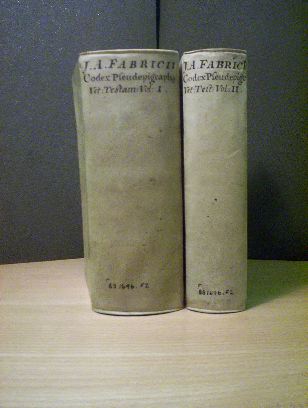 These are the two volumes of Fabricius's Codex pseudepigraphus Veteris Testamenti.
 Here are the frontispiece and title page of volume one. (The beaded necklaces are called "snakes" and are used by librarians to hold open a fragile book. These volumes were tightly bound and somewhat brittle, so we had to be very careful not to open them too wide, lest we crack the binding.)
 Here is the title page of volume 2.
 Apparently this set was owned by someone named Henry Labarge (?) about whom I know nothing. It passed into the hands of St. Andrews Semitist A. M. Honeyman, who donated it to the University Library in 1985.
 Fabricius included many of the works found now in the two Pseudepigrapha volumes edited by Charlesworth, although not all of the Charlesworth texts were know in Fabricius's time. Here is the entry for the Testaments of the Twelve Patriarchs.
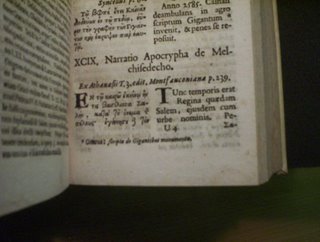 Fabricius also included some texts that are not in the Charlesworth volumes but which are now included in the More Old Testament Pseudepigrapha Project. For example, the Story of Melchizedek is a Greek rewritten scripture about Melchizedek. Sometimes it is attributed pseudonymously to Athanasius but mostly it is transmitted without an author.
 Likewise, the Melchizedek Story in the Chronicon Paschale is part of the MOTP corpus.
 I brought both volumes to the seminar on Wednesday. You can see other pseudepigrapha collections (Charles, Charlesworth, James) and related works (including M. R. James's ghost stories and my own book) scattered about on the table.
I am grateful to the Special Collections Department of the Main Library of the University of St. Andrews for making these volumes available to me, our students, and the readers of PaleoJudaica.
[PHOTO ESSAY -- bumped to the top of the page for 15 May. Lots more posts below.]
(For those new to this site, the Old Testament pseudepigrapha are ancient books that claim [fictionally] to be written by characters in the Old Testament/Hebrew Bible or to be set in OT/HB times, but which do not belong to the Jewish, Catholic, Protestant, or [with an exception or two] Orthodox biblical canons. For more discussion and some related definitions see here, here, and here.)
Anyhow, as I was getting ready for a seminar presentation on the More Old Testament Pseudepigrapha Project which Alex Panayotov and I gave last Wednesday, on a whim I checked the St. Andrews University Library catalogue and I found that it has a copy of Fabricius's Codex pseudepigraphus. Our library used to be a copyright library and it seems to have nearly everything that was published in the early modern period, but this copy, as you will see, seems to have come to it only recently. (I have commented on other treasures in it here and here.) So I went down to the Archives and requested the book. Here are some photographs. You can click on each one to get a larger image.
 These are the two volumes of Fabricius's Codex pseudepigraphus Veteris Testamenti.
 Here are the frontispiece and title page of volume one. (The beaded necklaces are called "snakes" and are used by librarians to hold open a fragile book. These volumes were tightly bound and somewhat brittle, so we had to be very careful not to open them too wide, lest we crack the binding.)
 Here is the title page of volume 2.
 Apparently this set was owned by someone named Henry Labarge (?) about whom I know nothing. It passed into the hands of St. Andrews Semitist A. M. Honeyman, who donated it to the University Library in 1985.
 Fabricius included many of the works found now in the two Pseudepigrapha volumes edited by Charlesworth, although not all of the Charlesworth texts were know in Fabricius's time. Here is the entry for the Testaments of the Twelve Patriarchs.
 Fabricius also included some texts that are not in the Charlesworth volumes but which are now included in the More Old Testament Pseudepigrapha Project. For example, the Story of Melchizedek is a Greek rewritten scripture about Melchizedek. Sometimes it is attributed pseudonymously to Athanasius but mostly it is transmitted without an author.
 Likewise, the Melchizedek Story in the Chronicon Paschale is part of the MOTP corpus.
 I brought both volumes to the seminar on Wednesday. You can see other pseudepigrapha collections (Charles, Charlesworth, James) and related works (including M. R. James's ghost stories and my own book) scattered about on the table.
I am grateful to the Special Collections Department of the Main Library of the University of St. Andrews for making these volumes available to me, our students, and the readers of PaleoJudaica.
[PHOTO ESSAY -- bumped to the top of the page for 15 May. Lots more posts below.]
WHEN IT RAINS IT POURS. It figures that when I spend hours putting together a big post with lots of photos and I save it for a Monday for maximum exposure, on that Monday I'm deluged with other things to post -- to the point that I'm pretty sure this is my record for number of postings on a single day. I didn't plan it that way, but there it is. Actually, I have a couple more things I still want to post but, all things considered, I think I'll leave them for tomorrow.
THE BIBLE PLACES NEWSLETTER, by Todd Bolen, has just published a new issue (Vol 5, #2 - May 15, 2006). There are some good Featured Photos of Jericho, including the synagogue that was reported to have been destroyed. According to Bolen there is now no discernible damage to it.
JEWISH STUDIES, AN INTERNET JOURNAL, has just published a new article in volume 4 (2006) which can be downloaded in Word or PDF formats from the website:
UPDATE: I've also corrected the mistake in the title.
Aharon Mondschein, "From Prayer of Personal Gratitude to Cosmic Hymn: The Riddle of Ibn Ezra’s Commentary on Chronicles"UPDATE (16 May): I should note that the article is in Hebrew.
UPDATE: I've also corrected the mistake in the title.
I GUESS ASTERIX SHOULD STICK TO LATIN. The Asterix books are a lot of fun and are generally well done. And some of them have even been published in Latin. But Simon Montagu at the the Al Ha veDa blog has caught an embarrassing Phoencian-language error in one of them.
DA VINCI CODE refutations are legion these days, with the movie about to come out. But I'll link to this one by John R. Huddlestun because it mentions the pseudepigrapha and I like to keep track of such things.
Professor divides truth from myth in 'Code'
(Charleston Post & Courier)
'Isn't it true that the Vatican conspired to hide the Dead Sea Scrolls from the public because of what they said about Jesus? Wasn't Jesus the leader of the Dead Sea Scroll sect, its Teacher of Righteousness?" Aren't the Nag Hammadi texts the same as the Dead Sea Scrolls?" -- these are frequent questions from my students. Add to these the media- and money-driven eternal mysteries of the Dead Sea Scrolls, the Gnostic gospels, the Apocrypha, the Pseudepigrapha, the James ossuary, the Gospel of Thomas (who could forget the film "Stigmata"?) and don't forget the sensational new Gospel of Judas, and you get a sense of my job as a professor of biblical studies at the College of Charleston.
Why is it that everything is always a mystery, or better yet, part of a conspiracy?
[...]
HMMM ... Maybe I should have another look at the Copper Scroll and the Massekhet Kelim.
Egyptian map leads to gold(Via the Agade list.)
Egypt: Saturday, May 13 - 2006 at 11:18 (AmeInfo.com)
Centamin Egypt will produce its first gold bar next year, Egyptian Petroleum and Mineral Resources Minister, Sameh Fahmy, told Bloomberg. The company was encouraged to explore for gold at the Sukari mining lease site by a 3,000 year old map thought to have been drawn by King Seti, outlining possible gold sites and now housed in Milan. The 160 sqkm area has proven reserves of 6m ounces of gold, worth more than $4bn.
Subscribe to:
Posts (Atom)