She is a daughter of Phyllis and Irwin Margolin of Ardsley, N.Y. Her father retired as a director of product research at the Revlon Research Center in Edison, N.J. Her mother is a professor of English at Monroe College in the Bronx.
The bridegroom, 47, is the Gerson D. Cohen professor at the Jewish Theological Seminary of America and a director of the graduate program in ancient Judaism. He graduated magna cum laude from Yeshiva and received a Ph.D. in ancient history from Columbia. He is the author of “Imperialism and Jewish Society: 200 B.C.E. to 640 C.E.” (Princeton University Press, 2001).
Saturday, September 09, 2006
CONGRATULATIONS to Seth Schwartz and his bride Judith Margolin.


PETRA is the subject of a Travel piece in the New York Times. It's short on pictures, but you can find more of those over at BiblePlaces.com.
Friday, September 08, 2006
TWO NEW ARTICLES have been published by Jewish Studies, an Internet Journal (both downloadable here):
Rivka Raviv, "The Talmudic Formulation of the Prophecies of the Four Kingdoms in the Book of Daniel"
Abstract
The concept of four kingdoms is found in several prophecies in the Book of Daniel, and similar non-biblical traditions are shared by many cultures (Persian, Greek and Roman). Our article deals with the formulation of the concept of four kingdoms in classical rabbinic literature. First, we will investigate to what extent the rabbis’ discussion relates directly to the biblical concept and not to the extra-biblical concept of four kingdoms. Next, we will review areas in which the rabbis reformulated the biblical concept: by updating its interpretation according to historical changes, and identifying the fourth creature as a boar, which represents the Roman Empire; and by granting great significance to the concept and thus transforming it from a marginal biblical concept to a seminal rabbinical concept. At the same time, we will see how the concept of four kingdoms became a central motif in the interpretation of the entire Bible, grapple with the deterministic view that emerges from the prophecies in the Book of Daniel, and compare this view to the one commonly found in classical rabbinic literature.
Baruch Alster,"The ‘Forlorn Lady’ in the Interpretation of the Song of Songs
Abstract
This article discusses the idea, raised by a few traditional Jewish exegetes, that the female protagonist of the Song of Songs is a “forlorn lady” whose husband deserted her, and who is arguing with her friends (the “Daughters of Jerusalem”) over the chances of his return. After viewing the concept of the “forlorn lady” in opposition to other traditional narrative approaches to the Song, we introduce two major commentaries (Rashi and R. J.H. Altschuler) that interpret the Song according to this concept, and show how they develop the plot along these lines. We then attempt to explain why Peshat exegetes adopted this idea, which to many readers seems incompatible with the simple sense of the Song
Thursday, September 07, 2006
AN OBITUARY FOR TIKVA FRYMER-KENSKY has been published by the University of Chicago. Excerpt:
"She was unique. I don't know of another scholar in the world who combined as she did mastery of Assyriology with sustained attention to feminist readings in the service of biblical theology," said Divinity School Dean Richard Rosengarten. "Hers was a capacious intellect, and all her work was inflamed by her deep passion for the material both in its original context and in ours. This combination made her a remarkably compelling scholar and teacher, and one whose absence is deeply felt already."(Via the Agade list.)
Around the Divinity School, Frymer-Kensky was known for her warmth and also her staunch commitment to interreligious dialogue and understanding as well as for her scholarship. William Schweiker, Professor of Theological Ethics, recalled that Frymer-Kensky was committed to the full range of programs in the Divinity School, at home during Divinity School worship services, and that she loved working with the students in theology and ethics as well as the school's Christian ministerial students.
A CHALDEAN FESTIVAL IN MICHIGAN:
Let the festivities beginSome of the musicians will perform in Aramaic.
Chaldean Festival and Southfield’s Autumnfest take over Evergreen this weekend
By April Lehmbeck
C & G Staff Writer
SOUTHFIELD — Welcoming the autumn season is an annual tradition in the city, but this year there’s another reason to celebrate.
The Chaldean American Chamber of Commerce is hosting its first Chaldean Festival on the front lawn of the Southfield Civic Center.
“The festival is going to have a lot of free family entertainment. We expect to see thousands,” chamber Executive Director Martin Manna said, adding that they hope the two events that weekend will complement each other. “We’re proud of the relationship we’ve established with the city of Southfield.”
The Chaldean Festival will run from noon to 10 p.m. on Sept. 9 and 10.
The event is being held to celebrate the heritage of Chaldean-Americans, who are from Iraq, speak Aramaic and are Catholic. Activities will include music, food and shopping. Activities will be available for children, as well.
[...]
FIRST-CENTURY B.C.E. BURIAL CHAMBERS have been found by construction workers in Tel Aviv:
Ancient Burial Cave Found Under Tel Aviv School
September 6, 2006 7:30 a.m. EST
Ryan R. Jones - All Headline News Middle East Correspondent
Jerusalem, Israel (AHN) - Tel Aviv municipal workers doing routine street repairs last week stumbled upon a large ancient burial cave that extends under a nearby high school.
[...]
PAULA FREDRIKSEN is interviewed by Vision's David Hulme about Paul and Judaism. Much of the interview is given also on video. Excerpt:
DH Can you speak to the problem of anachronism and its effect on understanding Paul?
PF I’m a historian, and the most grave “original sin” for a historian is anachronism. What that means is that you lift something out of its historical context and put it in a different historical context, and so misinterpret it. If in addition we think of Paul as an orthodox Christian, we will only misinterpret him that much more. He’s living in a period where he’s not thinking in a Trinitarian manner. The idea of the Trinity hasn’t been conceived yet. His letters will have Jesus Christ in them; they will have God the Father in them; he will talk about the Spirit of God. Those are the textual origins that will be used to formulate the doctrine of the Trinity, but Paul’s not thinking in a Trinitarian way.
People reading Paul assume that he’s hostile to Judaism because he’s the “inventor” of Christianity. In fact, he’s still imagining himself as a Jew and he’s presenting Christianity in continuity with Judaism. The fact that Paul is such a huge figure for Christianity makes it almost impossible for us not to interpret him anachronistically when we look at him, because it’s so important that his message speak immediately to modern Christianity. If we allow ourselves to see how much his message actually cohered with first-century Judaism, then we have to relinquish an immediate connection between him and us, between this ancient Jewish messianic movement and the modern church.
Wednesday, September 06, 2006
THE DEAD SEA SCROLLS EXHIBITION at the Pacific Science Center in Seattle starts later this month:
Dead Sea Scroll exhibit offers abundant educational opportunitiesI've already noted the exhibit here and here.
By Sam Bennett (Lynnwood Journal Newspapers, WA)
09/05/2006
Pacific Science Center's new exhibit, "Discovering the Dead Sea Scrolls," is designed to enlighten, as well as attempt to set the record straight.
The exhibit, which runs Sept. 23 through Jan. 7, will attract international attention for unveiling four scrolls never seen by the public.
An important aspect of the exhibit will be it's educational component in the form of a series of lectures that coincide with the run dates.
[...]
Tuesday, September 05, 2006
A BNTC ROUNDUP has been posted by Mark Goodacre. Mark calls for photographs. I took very few this time and the only one I'm inclined to publish is here. Maybe some of the others will oblige. I also have conference-related posts here, here, and here.
Many thanks to Sheffield University for hosting a very successful conference and to all the people involved in making it work. And thanks especially to Ela Nutu, who set me up with an Internet connection in my room and helped me sort out initial gremlins with it, and who seemed to be everywhere at once throughout the conference, making everything run smoothly.
Many thanks to Sheffield University for hosting a very successful conference and to all the people involved in making it work. And thanks especially to Ela Nutu, who set me up with an Internet connection in my room and helped me sort out initial gremlins with it, and who seemed to be everywhere at once throughout the conference, making everything run smoothly.
GEORGE E. MENDENHALL is interviewed by OpEdNews about the origins of Israel and the Jewish people:
The Common Origin of and Split Between Arabs and Jews - An Interview with Professor George E. MendenhallEvidently this is only the first part of the interview and there is more coming.
AN ANCIENT COIN seems to have been found in someone's grocery change in South Carolina. This according to WLTX.com:
UPDATE (6 September): Ian Werrett wrote to suggest that the coin is a fake:
Woman Finds Potentially Ancient Coin In Grocery ChangeI'm not a numismatist, but it sounds like Mr. Lyles thinks it's a coin from the Bar Kokhba Revolt. The photograph is dreadful. The letters look like they might be Hebrew, but I can't make out what the inscription says. Would any coin experts out there like to comment?
(Sumter) When the coins come out of the cash drawer, they all sound the same. And when Lynn Moore picked up her change and walked out of a Sumter Bi-Lo last November, she had no reason to believe her coins were any different.
Boy, was she wrong.
“It's definitely not a penny," said Lynn.
It wasn't until she emptied her change that she noticed.
“I threw it in a vase right next to my kitchen table," said Lynn. She continued, "I dumped it out into my hand and noticed that one coin was very odd looking."
For 10 months, she kept it to herself. Then, Ken Lyles saw it. Ken has collected and studied coins for 50 years, and says this one is definitely not American.
“My research on it would tell me that it (was made in) approximately 132 to 135 A.D."
Mr. Lyles says the shape, uneven edges, and weight of the coin means it definitely pre-dates modern mints. According to his reference books, the coin is from ancient Hebrew society.
[...]
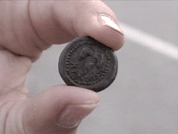
UPDATE (6 September): Ian Werrett wrote to suggest that the coin is a fake:
In particular, the dots around the border and the vine leaf are far too pronounced to be the genuine article. Furthermore, the edge of the coin, with its rounded edge that is free from any obvious dings or dents, has a very similar look to those coins that have been produced by modern companies in order to be sold as souvenirs in Jerusalem and elsewhere.Then in a later message he found the coin on this website with a clear picture showing that the Hebrew script is modern. The web page owner, David Garstang, notes:
There is no question that these are NOT real ancient coins. The only question is whether they were created with intent to fool collectors or as some sort of commemorative token. I suspect the latter, because the script is such an obvious giveaway to anyone with much experience.Bottom line: it's a modern fake. It sounds as though copies of it are circulating widely.
BEWARE!!! There are many of these coins (most in the lighter brass-colored metal) floating around, and they are turning up as "sucker bait" on web auction sites. One fellow asked me (and others) for help in authenticating one of these. I told him that, though I was not an expert, I knew it was not authentic. It then came up for auction, with the fellow claiming, you guessed it, "I know nothing about this coin, but someone says it might be a Bar Kochba".
Monday, September 04, 2006
GOOD PAPERS AT THE BNTC: I don't have the energy to summarize (even briefly) every paper I heard during the conference, but these struck me as particularly interesting. I enjoyed other papers as well, so no offense to those I don't mention.
James Harding, (title changed to something like the following) "Noah, Enoch and Mediatorial Polemics in Luke 17:22-37."
Follows recent proposals by VanderKam and Orlov that Enoch sees the Son of Man as his heavenly double in 1 Enoch 71. Proposes that in the Gospel of Luke (at least), Jesus regarded the Son of Man as his own heavenly double, as with Enoch in the Similitudes.
Jonathan Campbell, "Early Jewish Scriptures: Eight Theses."
I reproduce his eight theses from the handout with his permission, with one or two clarifications in square brackets:
Peter Williams, "Farewell to the Prologue of John" (abstract here).
The prologue of the Gospel of John is uncontroversially taken today to consist of John 1:1-18. But Pete showed in a dazzling, graphics-rich presentation that the ancient manuscripts of and commentators on John did not divide the text up this way. Their paragraph markers and comment show that generally saw a strong break after verse 5, and weaker breaks in other spots, but no strong break after v. 18. So 1:1-18 was not widely accepted as a unit until the early modern perod.
Grant Macaskill,"Calendar and Polemics in 2 (Slavonic) Enoch."
The calendrical system described in 2 Enoch has suffered enormous corruption in the surviving medieval manuscripts, but it refers to an annual solar cycle of movement through "gates" over a period of 364 days. The text of the parallel lunar cycle of "gates" is extremely corrupt in the manuscripts but could possibly be reconstructed approximately along the lines of the Qumran/Jubilees year of twelve 30-day months with four intercalary days, one in each of the four seasons. But this is by no means certain.
UPDATE (5 September): Conference roundup info here.
James Harding, (title changed to something like the following) "Noah, Enoch and Mediatorial Polemics in Luke 17:22-37."
Follows recent proposals by VanderKam and Orlov that Enoch sees the Son of Man as his heavenly double in 1 Enoch 71. Proposes that in the Gospel of Luke (at least), Jesus regarded the Son of Man as his own heavenly double, as with Enoch in the Similitudes.
Jonathan Campbell, "Early Jewish Scriptures: Eight Theses."
I reproduce his eight theses from the handout with his permission, with one or two clarifications in square brackets:
- (1) late Second Temple scripture was essentially bipartite [Mosaic and prophetic]
- (2) presumed antiquity was the main desideratum for all scripture
- (3) previously unknown scriptures were periodically '(re-)discovered'
- (4) neither the Torah nor the Prophets constituted canons
- (5) disputes sometimes arose about scriptural authority
- (6) pseudepigraphy does not relate primarily to scripture's reception
or pseudepigraphy pertains chiefly to the production of scripture- (7) the compositional-redactional production of scripture continued up to 100 CE [and beyond]
- (8) geography and finance impacted on both scripture's production and reception
Peter Williams, "Farewell to the Prologue of John" (abstract here).
The prologue of the Gospel of John is uncontroversially taken today to consist of John 1:1-18. But Pete showed in a dazzling, graphics-rich presentation that the ancient manuscripts of and commentators on John did not divide the text up this way. Their paragraph markers and comment show that generally saw a strong break after verse 5, and weaker breaks in other spots, but no strong break after v. 18. So 1:1-18 was not widely accepted as a unit until the early modern perod.
Grant Macaskill,"Calendar and Polemics in 2 (Slavonic) Enoch."
The calendrical system described in 2 Enoch has suffered enormous corruption in the surviving medieval manuscripts, but it refers to an annual solar cycle of movement through "gates" over a period of 364 days. The text of the parallel lunar cycle of "gates" is extremely corrupt in the manuscripts but could possibly be reconstructed approximately along the lines of the Qumran/Jubilees year of twelve 30-day months with four intercalary days, one in each of the four seasons. But this is by no means certain.
UPDATE (5 September): Conference roundup info here.
THE UNDERWATER MUSEUM OF CAESAREA MARITIMA is reviewed by Michael Luongo for Bloomberg.com. Excerpt:
In mid-August, just two days after a cease-fire halted the war between Israel and Hezbollah, I went to see the ruins. A few days earlier, cafe customers could see missiles flying over Haifa, about 35 kilometers (22 miles) away, though no bombs landed in Caesarea. On the day I visited, the place was almost deserted when I dove off the pier and plunged into the Mediterranean with my underwater guide Natasha.
Sunken Remains
The brackish green sea was as warm as the desert air; it also was silty, with sand and sediment floating around us. As we went farther out, the pressure increased, the temperature decreased and the currents got stronger.
Soon we spotted huge concrete caissons that were the port's foundations, serving as walkways and the ground floor of warehouses. Some are still solid, while others have been broken apart by earthquakes or waves.
The tops of some caissons have cross forms hashing their surfaces, hollowed out remains of the long-gone wooden beams used to mold them in the open sea. A concrete mix, using volcanic ash from Mount Vesuvius, was poured into the wooden forms. Both the material and the method were innovations developed especially to create the port.
MORE ON THE LEBANESE OIL SPILL:
Lebanon's Coast Is Drowning in OilByblos is not mentioned in this article, but it is surely still very much affected.
A spill caused by an Israeli airstrike has blackened popular beaches and threatens the economy and delicate ecosystems.
By Borzou Daragahi, [Los Angeles] Times Staff Writer
September 4, 2006
BEIRUT — The azure waters of the Mediterranean have long been a symbol of Lebanon's fun-loving character and proud maritime history. But the country's prized 135-mile coast has become its biggest environmental disaster.
Thick gobs of oil have clogged the coast's coral reefs. Sandy beaches have become black-stained no-go zones. Rocky fishermen's coves have become dark soups of crude. All are the result of Israeli airstrikes on seaside oil tanks in the first days of the war against Hezbollah.
Between 3 1/2 and 5 million gallons of oil have fouled more than half of the Lebanese coast, and the damage grows each day that the fractured central government fails to begin the cleanup. Scientists have compared it to the 1989 Exxon Valdez tanker, which ran aground in Prince William Sound, Alaska, dumping 11 million gallons of oil.
JEWISH TOMBSTONES IN YEMEN are the subject of an article ("Jewish Tombstones in Aden (Part 1)") by Professor Aviva Klein-Franke in the Yemen Times. Excerpt:
Discoveries of Hebrew epitaphs by travelersThere has been some controversy about the dating of the tombstones.
Jacob Saphir was the first to copy Hebrew inscriptions in Aden’s ancient cemeteries and to publish ten of them. Looking for physical evidence supporting the legends of the Jews’ arrival in southern Arabia in biblical times, Saphir felt that he had made an important discovery. In his opinion the ages of the inscriptions which he had copied corresponded to the time referred to in the legends. The earlier dates among the inscriptions copied by Saphir fell between the first and the sixty-first year of the Contracts Calendar. Saphir believed that these dates related to the third century BC. He also documented other epitaphs from the end of the first millennium CE and from the beginning of the second millennium CE. He noted that there were inscriptions written in different styles, despite the fact that those inscriptions gave closed dates and the epitaphs were found side by side in the same area. Saphir discovered a group of epitaphs from the twelfth and thirteenth centuries CE, which belonged to one family clan of H alfon, Bundar and Madmu n. According to Ben-Zvi and Goitein, Madmun in Hebrew means S emarya.
Saphir’s discoveries indicated that the cemetery was used by the community for many generations throughout the centuries and that individuals could own part of the cemetery for use by their families.
As a member of an Austrian scientific delegation, Heinrich David Mu¨ ller travelled to southern Arabia at the end of the nineteenth century. In 1889 Mu¨ ller brought to Vienna approximately 100 squeezes of Hebrew inscriptions. Among these was a group of inscriptions from Aden’s Jewish cemeteries. Most of them date to the years between 20 and 54 in the Calendar of the Contracts. Izhak Ben-Zvi travelled to Aden in January, 1950. He visited the ancient cemeteries, the local state archaeological museum and a private museum, belonging to Mr. Kaiky Muncherjee, an Indian merchant residing in Aden. Ben-Zvi claimed that there were hundreds of sepulchral slabs in the ancient cemeteries. The deeper he entered into the ancient cemetery the earlier were the dates on the epitaphs. He mentioned that many people had epitaphs in their homes and added that it would be difficult to estimate how many slabs with Hebrew inscriptions there were in total. All the inscriptions he examined were dated in relation to the Seleucid Era. For the first time, photographs of four of them were published.
Sunday, September 03, 2006
HENRY ASGARD KELLY'S BOOK ON SATAN is discussed in the Chicago Tribune (reprinted in Dallas Morning News):
Satan: Father's little helper?For more on Kelly's book, see here.
12:00 AM CDT on Saturday, September 2, 2006
By MANYA A. BRACHEAR Chicago Tribune
For centuries, popular culture has treated Satan as God's nemesis – an angel consumed by pride and cast out of heaven to run his own evil empire.
But Henry Ansgar Kelly says poor Satan has gotten a bad rap. For decades he has pleaded the devil's case, arguing that Satan is simply one of God's celestial agents with the dirty job of gauging humanity's virtue.
While that job has made Satan cynical and jaded over time, Dr. Kelly said, it doesn't make him the mastermind of evil.
"Christian tradition has laid a lot of blame on Satan for things they're causing themselves," said Dr. Kelly, 72, a former Jesuit exorcist and now a medieval scholar at the University of California, Los Angeles and author of three books about the devil. "I am pessimistic about human nature. I think we are totally capable of doing what we have done. You can blame it on psychosis if you want."
But you can't blame it on Satan, he said.
During a three-day "Satan Seminar" at Loyola University Chicago last month, Dr. Kelly – the author of Satan: A Biography (Cambridge University Press, $19.99) – preached his controversial gospel to an understandably tough crowd of biblical scholars.
[...]
Saturday, September 02, 2006
PRETTY QUIET in the media at the moment, as least as far as ancient Judaism goes, but here's an interesting article on female Torah scribes in St. Louis.
I'm heading back to St. Andrews now. It's been a good conference and I'll post some thoughts on it later.
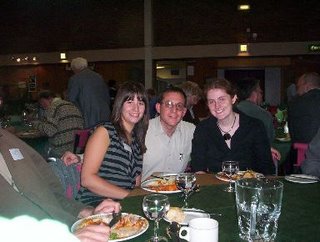
Hi Mark! Wish you were here!
From Helen Ingram, Jim, and Catherine Smith (L to R).
UPDATE (10:15 pm) I'm back in St. Andrews. And happy third blogiversary to Mark's New Testament Gateway blog and David Meadows's Rogue Classicism.
I'm heading back to St. Andrews now. It's been a good conference and I'll post some thoughts on it later.
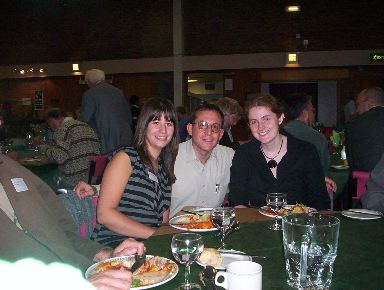
From Helen Ingram, Jim, and Catherine Smith (L to R).
UPDATE (10:15 pm) I'm back in St. Andrews. And happy third blogiversary to Mark's New Testament Gateway blog and David Meadows's Rogue Classicism.
Friday, September 01, 2006
BIBLICAL STUDIES CARNIVAL IX has been published by Stephen Carlson over at Hypotyposeis. This carnival is an increasingly important resource for keeping track of what's happening in the Biblioblogosphere and Stephen has produced an exemplary edition. Go have a look.
FROM THE BNTC BOOK DISPLAY: I don't want to have to carry too many extra books home on the train, but I couldn't resist these small volumes from SPCK at half price:
Margaret Barker, Temple Theology: An Introduction
R. H. Charles, The Book of Enoch (The 1917 edition, still in print.)
Kenneth Schenck, A Brief Guide to Philo
WE MISS YOU TOO, MARK. I've heard a number of people comment how odd it feels not to have Mark Goodacre around at this year's BNTC.
TIKVA FRYMER-KENSKY has passed away, I am sorry to report. The following details have been posted by Jack Sasson on the Agade List:
This very sad news came from Jeffrey Tigay jtigay@ccat.sas.upenn.edu:May her memory be for a blessing.
=================================================
I am sorry to inform you that Tikvah Frymer-Kensky, a much-cherished and admired friend and member of the Biblical Colloquium, passed away this afternoon after a long illness which she fought valiantly until the end.
Her funeral will take place Sunday, I presume at her husband's synagogue in Wilmette, Illinois. I know that all who knew her join in condolences to her husband Rabbi Allan Kensky and their children Meira and Eytan.
*******************************
[This brief profile comes from http://divinity.uchicago.edu/faculty/frymer-kensky.shtml
Professor of Hebrew Bible and the History of Judaism in the
Divinity School; also in the Law School and the Committees on the
Ancient Mediterranean World and Jewish Studies
M.A., Ph.D. (Yale University)
Tikva Frymer-Kensky’s areas of specialization include Assyriology
and Sumerology, biblical studies, Jewish studies, and women and
religion. Her most recent books are Reading the Women of the
Bible, which received a Koret Jewish Book Award in 2002 and a
National Jewish Book Award in 2003; In the Wake of the Goddesses:
Women, Culture and the Biblical Transformation of Pagan Myth; and
Motherprayer: The Pregnant Woman’s Spiritual Companion. She is
also the English translator of From Jerusalem to the Edge of
Heaven by Ari Elon (Alma Dee, original Hebrew). ]
Thursday, August 31, 2006
NEW FUNDING FOR THE TIBERIAS DIG -- Haaretz reports:
Prime Minister Ehud Olmert yesterday pledged NIS 22 million in government funds for the archaeological park in Tiberias. The project centers on excavating the Roman theater built in the second and third centuries C.E. at the foot of Mount Berenice, remnants of which were discovered in 1990 by the Israel Antiquities Authority. Archaeologists were surprised by the find, since written sources contain no mention of this theater. City officials believe the theater, located 200 meters from the shore of Lake Kinneret, has major economic potential. Olmert's pledge came during a tour of Tiberias with Minister Shimon Peres. (Eli Ashkenazi)
BAALBEK UPDATE: The BAS site has new information (dated 30 August). It seems the Temple of Bacchus was not damaged after all, and that damage to the temple complex was very minor. But there was considerable damage elsewhwere to the old souk. Plus there are some new discoveries. Read it all.
I'M IN SHEFFIELD, blogging from the British New Testament Conference. I'm not presenting a paper this time, but I'm co-chairing the Seminar on NT & Second Temple Judaism and am also chairing one of the short paper sessions. The seminar programs and abstracts are available here and those for the short papers here. Main speakers are listed here. The organizers have kindly arranged Internet access for me, so blogging should continue through the conference (as time permits).
Wednesday, August 30, 2006
O TEMPORA! O MORES! In Slate, Emily Watson mourns the decline of traditional philology signaled by the success of the Loeb Classical Library series:
(Via Rogue Classicism.)
The series surivived, despite these shortfalls, because it was the only thing of its kind, and because many authors have been hard to find in any other current English translation. (I believe that the Loeb Plutarch offers the only complete translation into modern English of this essential classical author.) But where have the "ordinary amateurs" gone, you might well wonder? One could argue that they have taken over the academy. Just as scholars once feared, there has been a steady decline in hard-core classical philology—and thanks in part to that, the Loeb Library has lately thrived. Figures like the Oxbridge don in Robert Browning's "A Grammarian's Funeral"—who devotes his whole life to parsing the minutiae of ancient Greek while proclaiming, "What's time? Leave Now for dogs and apes!/ Man has Forever"—are ever rarer in modern classics departments. We no longer feel we have forever: The tenure clock stops for nobody. Increasingly alive to the fact that ancient literature is about something, not mere grammar, even professional classicists want to hurry ahead to the gist and skip the boring stuff. Many of us turn to Loebs because there just isn't time to study every particle of classical literature in the detail it might deserve. (That Browning's shuffling, dusty don would be unlikely to find a job today perhaps shouldn't make the profession entirely proud.)All this is true and is a matter for concern. But I have to say that students using published translations to help them prepare their own translations generally doesn't bother me. When I teach or have taught reading courses in ancient Greek, Hebrew, or Aramaic, I tell the students to use whatever translation they like, but that when I call on them I will ask them to defend their translation in detail on the basis of the grammar and vocabulary of the original text. And I do, both in class and on exams. Cribs can help with an initial understanding, but you either understand the grammar or you don't.
[...]
Yet I admit a churlish part of me feels a tiny pang. I still wonder whether we really should be welcoming these splendid new translations with open arms. I, for one, would be extremely wary of recommending a Loeb in an undergraduate class in which the students were expected to read the original Latin or Greek. The temptation to rely too heavily on the translation would be all the greater now that the translations are so much better than they used to be. That's perhaps why I enjoyed the 500th volume of the series, a splendid edition by D.R. Shackleton Bailey of Quintilian's Lesser Declamations, as much as I did. It is a reminder that the old Loeb style is not entirely dead, after all. Shackleton Bailey is a senior and rightly respected Latinist whose English shows little danger of keeping up with the times.
(Via Rogue Classicism.)
THE JOURNAL OF SEMITIC STUDIES has a new issue out (51.2, Autumn 2006). Here's the table of contents (articles only):
Requires a paid personal or institutional subscription to access.
George AthasThere are lots of interesting book reviews too.
Setting the Record Straight: What are we Making of the Tel Dan Inscription?
J Semitic Studies 2006 51: 241-256; doi:10.1093/jss/fgl001
Arne A. Ambros and Michael Jursa
No Flight of Peace, No Lover of Wisdom? A Reconsideration of Two Phrases in Phoenician and Punic
J Semitic Studies 2006 51: 257-265; doi:10.1093/jss/fgl002
David F. Graf and Salah Said
New Nabataean Funerary Inscriptions from Umm al-Jimal
J Semitic Studies 2006 51: 267-303; doi:10.1093/jss/fgl003
Adil Hamil Al-Jadir
A New Inscription from Hatra
J Semitic Studies 2006 51: 305-311; doi:10.1093/jss/fgl004
John F. Healey
A New Syriac Mosaic Inscription
J Semitic Studies 2006 51: 313-327; doi:10.1093/jss/fgl005
Na'ama Pat-El
Syntactical Aspects of Negation in Syriac
J Semitic Studies 2006 51: 329-348; doi:10.1093/jss/fgl006
Diana Dressel
Intisar al-Fadila aw Hadithat al-Ibna al-Isra'iliyya as an Adaptation of Nathan der Weise
J Semitic Studies 2006 51: 349-371; doi:10.1093/jss/fgl007
Requires a paid personal or institutional subscription to access.
Tuesday, August 29, 2006
MANDAEANS CONFERENCE: From the Aram Society's forthcoming conferences page (via the Agade list).
• The Mandaeans, 8-10 July 2007 (Sydney University)Lots of other conferences on Aramaic-related subjects are also listed through 2012.
ARAM Society for Syro-Mesopotamian Studies is organising its Twenty Fourth International Conference on the theme of The Mandaeans, to held at Sydney University, 8-10 July 2007.
The conference will start on Sunday morning 8th July with a Mandaean baptism, and a special exhibition of Mandaean culture will be part of the opening ceremony. Scholarly papers will be presented on Monday and Tuesday 9-10 July, and each speaker's paper is limited to 30 minutes, with an additional 10 minutes for discussion.
If you wish to participate in the conference, please contact our Oxford address:
ARAM, the Oriental Institute, Oxford University, Pusey Lane, Oxford OX1 2LE, England. Tel. ++1865-514041. Fax ++1865-516824. E.Mail: aram@orinst.ox.ac.uk
All papers given at the conference will be considered for publication in a future edition of the ARAM Periodical, subject to editorial review.
LEBANON'S MAJOR ANTIQUITIES SITES ARE UNSCATHED after the war, according to the National Geographic Society, which has brief reports and a photo gallery on six of them. There's this general statement:
Also, the report on Byblos does not mention the oil spill. I'm not sure why. Are the ruins back from the coast so they weren't affected? Still, I would think it merited a mention.
But as fighting escalated after a Hezbollah raid into Israel on July 12, many people feared for Baalbek and Lebanon's other archaeological and cultural treasures. Now that a tentative cease-fire has been declared, experts returning to the country say that the sites—which have successfully survived decades of violence in the war-torn region—appear to have once again emerged unscathed.This seems to contradict the report of damage to the Temple of Bacchus at Baalbek. I hope the new report is right, but we'll see. Regarding the Baalbek temples, the National Geographic report says:
During the recent conflict between Hezbollah and Israel, the temples were considered a Hezbollah stronghold, with militant fighters patrolling the ruins.I trust we'll be hearing lots of condemnations of this blatant violation of the Hague Convention by Hezbollah.
Also, the report on Byblos does not mention the oil spill. I'm not sure why. Are the ruins back from the coast so they weren't affected? Still, I would think it merited a mention.
Monday, August 28, 2006
DONNY GEORGE, president of Iraq's State Board of Antiquities and Heritage has reportedly resigned and left the country.
Saviour of Iraq's antiquities flees to Syria(Again, via the Agade list.)
· Violence and Sadrists drive away archaeologist
· Looting fear as funds run out to pay protection force
Michael Howard in Irbil
Saturday August 26, 2006
Guardian
Iraq's most prominent archaeologist has resigned and fled the country, saying the dire security situation, an acute shortage of funds, and the interference of supporters of the radical Shia cleric Moqtada al-Sadr had made his position intolerable.
Donny George, who was president of the State Board of Antiquities and Heritage, achieved international recognition for his efforts to track down and recover the priceless antiquities looted from Iraq's National Museum in the mayhem that followed the fall of Baghdad in 2003.
But this week he revealed that he had resigned and was in hiding with his family in the Syrian capital Damascus. In an interview with the Art Newspaper, Dr George said Baghdad was now so dangerous that the National Museum, which houses a trove of Sumerian and Babylonian artefacts, had been sealed off by concrete walls to protect it from insurgent attacks and further looting.
[...]
A TIMELY REVIEW:
Maria José Strazzulla, Ancient Lebanon: Monuments Past and Present. Los Angeles: J. Paul Getty Museum, 2006. Pp. 71; color ills. 80, map 1, site plans 4, color overlays 16. ISBN 88-8162-142-8. $29.95.(BMCR, via the Agade list.)
Reviewed by Michael Decker, University of South Florida
Sunday, August 27, 2006
AN EXHIBIT OF "HOLY LAND ARTIFACTS" is coming to Atlanta and then moving around the USA:
Holy Land artifacts show in AtlantaThe opening date should be September 15, not August. The exhibition's website is here.
An exhibit of 340 sacred texts and artifacts from the Holy Land, the largest such show ever in the United States, will open in Atlanta on Aug. 15. "From Abraham to Jesus" will also tour 27 other cities, including Nashville.
The display includes the Isaiah Scroll, one of the Dead Sea Scrolls, and a box that some experts believe held the remains of Simon the Cyrene, who carried Jesus' cross.
[...]
Saturday, August 26, 2006
ISRAEL AS CARTHAGE? The analogy is kind of jarring, but perhaps that was intended. At least this time Rome isn't America. Elyakim Haetzni makes the comparison in two essays, one in Arutz Sheva and the other in Ynet. Excerpt from the latter:
UPDATE (27 August): Joshua Tallent comments here.
Carthage was ruled by a "peace party" of elites - corrupt, incompetent and sold on the Romans. In opposition stood the "war party," who claimed that compromise bought only time, and that Rome's goal was to destroy, not co-exist, with Carthage.Make of it what you will. David Meadows (who is back from Sicily and blogging like a fiend) notes this piece as well.
[Theodor] Mommsen's description [in "The History of Rome"] could well be talking about modern-day Israel: "In a country clearly threatened with a war of destruction, the geniuses, the determined and the committed will plan immediately to attack, but they will be swallowed up by the lazy, cowardly money-worshippers, who will push off the final battle at any cost, in order to live, and to obtain their deaths, in peace."
Army chief Hamilcar Barca and his son Hannibal planned the defensive war against Rome far away from home, with funding they had to raise themselves - from provinces they'd captured in Spain.
Hannibal crossed the Alps, attacked the Romans on their own territory and reached the gates of Rome. His fall was in part due to the fact that he was not supported financially from home, and reinforcements arrived sporadically.
UPDATE (27 August): Joshua Tallent comments here.
Friday, August 25, 2006
ARCHAEOLOGY MAGAZINE has a new issue online (59.5, September/October 2006). Highlights include: Brian Fagan offers forecasts for the next 50 years of archaeology (abstract); President Jane Waldbaum tells you why you should become a member of the AIA; a review of the online exhibit of the Oxyrhynchus Papyrus Imaging Project; and a review of the Cradle of Christianity exhibition at the Maltz Museum of Jewish Heritage in Cleveland. Plus lots of other articles (mostly just the abstracts online) and notes about archaeology all over the world.
BYBLOS OIL-SPILL UPDATE:
Race to save historic town from sea of oil
Sarah Smiles in Byblos, Lebanon
August 25, 2006 (Sydney Morning Herald)
LEBANON's most famous seafood restaurant, Pepe's Fishing Club at Byblos, has served just three tables since war broke out last month.
After Israel bombed a coastal power plant near Beirut, sending about 15,000 tonnes of fuel oil spilling into the Mediterranean - there have been few customers at this quaint seafood restaurant where Brigitte Bardot once dined.
The ancient city of Byblos, which has been inhabited for 7000 years, is about 35 kilometres north of Beirut, and has been one of the clean-up priorities. With the help of a pump donated by the Norwegians, Lebanese authorities are frantically trying to clean the bay of a thick layer of sludge.
Oussama Kallab, an architect who restores Phoenician artifacts, has volunteered to help clean Byblos's contaminated ruins. Oil has even seeped into the sandstone foundations of a watchtower built by Crusaders.
[...]
STAND-UP COMEDY IN ARAMAIC:
Stand-up in Aramaic?
Sometimes, when Gila Hakimi leaves a note for her husband, she writes it in Rashi script, in Aramaic. That's only natural: This is the language used by the Hakimis for everyday discourse as well; they speak Aramaic to their eldest son too.
I phoned her in my search for the story furthest removed from the war, but Gila Hakimi said it isn't all that remote. Anyone who says prayers, opens the Talmud, and in effect anyone who speaks Hebrew speaks Aramaic in one way or another. But as an everyday language of discourse? Yes, says Hakimi. At least several thousand Israelis, who are generally described as "Kurds," speak Aramaic, in one dialect or another. Unfortunately, more and more people are ceasing to conduct their everyday lives in Aramaic and are forgetting the language. That is why Hakimi created her one-woman show. As far as is known, she is the first Aramaic stand-up comedian. She is extremely successful.
[...]
Hakimi was the principal of the Yeshurun religious state elementary school in Pardes Hannah-Karkur, and when she retired five years ago, she decided to fulfill an old dream and went onstage with a show that revives the folklore of the past with a smile, here and there satirically, and all in Aramaic. The beginning was very modest, without any celebrity mannerisms, but in recent months she finds herself in the center of a major Aramaic awakening: She travels from city to city with her show, and attracts large audiences everywhere. She is told that more and more family celebrations are now being held in Aramaic, and this week she was invited to conduct a course in spoken Aramaic.
She feels as though she has extracted from the members of her ethnic group something that was hidden inside them, and perhaps until now they were embarrassed to reveal it, or neglected it and now are rediscovering it. Something of the kind has been happening for several years to Yiddish speakers, as part of the return to Judaism. Like most of the shows in Yiddish, Hakimi goes for nostalgia. One of her subjects is the traditional status of women, when the prevailing practice was "All glorious is the King's daughter within the palace." She levels criticism at modern feminism. We argued about that a little, in Hebrew; I assume that it sounds better in Aramaic.
Thursday, August 24, 2006
MORE PHOENICIAN REMAINS IN SICILY:
Phoenician tombs found in SicilyA Phoenician temple was found in the vicinity of Motya earlier this year.
40 sarcophagi unearthed at necropolis near ancient colony
(ANSA) - Marsala (Trapani), August 23 - Archaeologists have unearthed 40 sarcophagi in what was once the sacred Phoenician burial grounds of Birgi, near the ancient colony of Motya .
[...]
Although they failed to find objects inside the sarcophigi, archaeologists unearthed several vases of different sizes and shapes in the field .
"The vases were most likely used during propitiatory rites just before the burial took place," the experts said .
According to the experts, the tombs had clearly been ransacked by tomb raiders or perhaps by Joseph Whitaker, an archaeologist related to a noble British family that produced and exported Marsala wines from Sicily in the 19th Century .
Whitaker, who was responsible for the rediscovery of Motya, built a house on the island and moved all his finds there in 1908 .
His house now serves as the archaeological museum .
[...]
THE MUFTI OF EGYPT, Sheikh Dr. 'Ali Gum'a, recently reaffirmed the blood-libel myth as presented in nineteenth-century anti-Talmud propaganda. MEMRI has translated excerpts from the Al Ahram article. The relevant passage is:
"Anyone who follows the news will discover that the Hebrew entity has turned into a [source] of [empty] talk, while the Arab discourse, which was characterized in the sixties [as empty talk], has developed significantly. [The Arabs] have learned a lesson and have moved from talk to action, and from the fostering of illusions to honesty, transparency, realistic goal-setting and ability to change. The Israeli discourse, [on the other hand], has turned to false declarations based on illusions, with wishful thinking taking precedence over facts.Regrettably, the cited book can be found online in Arabic.
"These lies have exposed the true and hideous face of the blood-suckers who were described by Filmange in his book The Treasure Hidden in the Talmudic Laws [sic], which tells how [the Jews] planned [to prepare] a matzo [unleavened Passover bread] using human blood. ...
MOZART AND JUDITH - The New York Sun has a review of a performance of Betulia Liberata:
Lawfully Wedded OperasAnd there's more on the performance if you follow the link.
Classical Music
By JAY NORDLINGER
August 22, 2006
For Mozart's 250th-anniversary year, the Salzburg Festival set out to do all 22 of the composer's stage works, and they are. ...
When he was 15, Mozart wrote "Betulia Liberata." It is not exactly an opera, more like an oratorio — more specifically, an "azione sacra," or sacred action, in two acts. Mozart wrote it on a text of Metastasio, the master of opera seria. And that text is from the Book of Judith, which belongs to the Apocrypha.
The story tells of "Betulia liberated" (as Mozart's title has it). What happens is basically this: The Israelite town of Betulia is under siege by an Assyrian army. All seems lost. But Judith, a widow, has a plan. She goes into the enemy camp, makes nice with the leader, and returns with his head — I mean, literally.That's it, in an extremely tight nutshell. The piece, true to its form, gives you recitative and aria, recitative and aria, at length. It may not be Mozart's most inspired work, but it is still Mozart, and not at all bad for a mid-teenager (or for anybody).
The Salzburg Festival presented a single performance of "Betulia Liberata," with no staging. The concert took place on Friday night in the Felsenreitschule, in front of that multi-tier parking garage that serves as the set of "La Clemenza di Tito." The orchestra was a good one: the Munich Chamber Orchestra, led by a good conductor: Christoph Poppen. Mr. Poppen, a German, has been music director of this group for 11 years; his tenure will come to a close at the end of this season.
[...]
Wednesday, August 23, 2006
MORE ON THE OIL SPILL AT BYBLOS:
FEATURE-Lebanese oil slick hits ancient Phoenician port
23 Aug 2006 01:04:14 GMT
By Gideon Long
BYBLOS, Lebanon, Aug 23 (Reuters) - The Lebanese port of Byblos has survived the Romans, the Crusades and the armies of Alexander the Great but now it faces a 21st century menace, brought to its shores on a tide of war -- oil pollution.
A slick caused by Israel's bombardment of a power plant last month during its conflict with Hizbollah guerrillas has spewed a black tide along a 140-km (87-mile) stretch of the coastline.
Few places have been hit harder than Byblos, which dates back 7,000 years and lies 35 km (22 miles) north of Beirut.
Thick black oil laps against the ancient stone wall of the harbour under the shadow of a 13th century watchtower. Workers use a mechanical digger to scoop it from the water and dump it into plastic tanks on the quayside.
[...]
THE RAMAT RAHEL WATER SYSTEM is covered today in a Reuters article that has some new details:
Ancient biblical waterworks found in Israel
Wed Aug 23, 2006 2:43am ET147
By Corinne Heller
RAMAT RACHEL, Israel (Reuters) - Archaeologists in Israel have unearthed an ancient water system which was modified by the conquering Persians to turn the desert into a paradise.
[...]
The infrastructure of the palace was remodeled throughout the centuries to fit the needs of the Babylonians, Persians, Romans and Hasmoneans who ruled the Holy Land, said Lipschits, who heads the dig with an academic from Germany's University of Heidelberg.
But it was the Persians, who took control of the region around 539 BC from the Babylonians, who renovated the water system and turned it into a thing of beauty.
[Oded] Lipschits said they added small waterfalls to try to turn a desert into a paradise.
[...]
Tuesday, August 22, 2006
THE ZEALOTS-AS-SUICIDE-KILLERS MEME appears again. According to the publisher's blurb reproduced by OpenDemocracy, Robert A. Pape makes this claim in his new book:
(My underscoring.) The "Zealots" (i.e., the Sicarii) were murderous thugs and carried out targeted assassinations, but they were not suicide killers. I have replied to this claim in detail here and here and have more on the Sicarii here. If Pape really does make this claim (and publishers' blurbs are not always the most accurate source for the content of a book), it doesn't inspire confidence in the book's research. In any case, once a claim like this starts, it tends to be perpetuated, because very few people will bother to check the original sources to see if it's true.“Dying to win: why suicide terrorists do it”
by Robert A. Pape
Random House (US) / Gibson Square (UK) | August 2006 (UK) | ISBN 0679454713
What the publisher says: “In Dying to Win Robert Pape presents the findings of the first comprehensive database of every suicide terrorist attack in the world from 1980 until today. Discrediting widely-held misconceptions on suicide terrorism, he creates for the first time a clear psychological, sociological and strategic profile for combating suicide attacks. His thesis — initially drawn from the 354 attacks throughout the world up to 2003 — has been remarkably born out by the ones that have followed (the 192 attacks from 2004 up to May 2006 are included in Dying to Win). Pape also examines the early practitioners of this guerrilla tactic, including the ancient Jewish Zealots, who in A.D. 66 wished to liberate themselves from Roman occupation; the Ismaili Assassins, a Shi’ite Muslim sect in northern Iran in the eleventh and twelfth centuries; World War II’s Japanese kamikaze pilots, three thousand of whom crashed into U.S. naval vessels; and the Tamil Tigers in Sri Lanka, a secular, Marxist-Leninist organization responsible for more suicide terrorist attacks than any other group in history.”
THE RAMAT RAHEL EXCAVATION has uncovered an impressive Iron Age water system:
Dig shows Ramat Rahel was once major royal Judean site
By JUDY SIEGEL-ITZKOVICH (Jerusalem Post)
A highly sophisticated ancient water system dating back to the end of the Kingdom of Judah in the Seventh Century BCE and a Muslim structure from the Eighth or Ninth Century CE have been uncovered by Israeli, American and European archeologists at Kibbutz Ramat Rahel south of Jerusalem.
Experts from Tel Aviv University, the University of Heidelberg and other academic institutions were involved in the dig. Its discoveries are said to have changed the known historical picture of Ramat Rahel, which turns out to have been a major royal site whose exact identity is not yet known.
[...]
The Ramat Rahel dig began in the summer of 2005 to investigate a number of principle questions such as the nature of the biblical-era citadel and the magnificent palace at a place that served as an administrative center during various important historical periods.
Evidence for this is provided by a large collection of seals marked "The King," "Lion" and "Yehud." The current digging season is the second of five that are planned. Some experts claim the fortress - which has no parallel inside Jerusalem - was used by the kings of Judah, while others claim it dates back to the Assyrian Empire or to the Israelite kings who ruled for a certain period in Judah.
[...]
Monday, August 21, 2006
A QUIET DAY, as least as regards ancient Judaism. But on the technology front, here is another ray gun (cf. here and here) being used to do archaeology.
(Via Archaeologica News.)
(Via Archaeologica News.)
Sunday, August 20, 2006
TC: A Journal of Biblical Textual Criticism is up and running again. The current issue is Volume 11 (2006).
(Via Tommy Wasserman at the Evangelical Textual Criticism blog.)
(Via Tommy Wasserman at the Evangelical Textual Criticism blog.)
Saturday, August 19, 2006
ARAMAIC WATCH -- An Assyrian town in Turkey is profiled by Eurasianet:
ASSYRIANS EXPERIENCE SLOW CULTURAL REVIVAL IN SOUTHEASTERN TURKEY
Yigal Schleifer 8/18/06
Filled with honey-colored stone homes with exquisite relief carvings, Midyat, located in southeast Turkey, is one of the country’s most beautiful ancient towns. It is also one of its most haunted.
Once almost exclusively populated by Assyrian Christians � an ancient sect that traces its roots back to the earliest days of Christianity and that still uses Aramaic, the language spoken during the time of Jesus, for its liturgy � the town is now almost completely devoid of its original inhabitants.
Caught up in the violence that resulted from the separatist war that was fought in the area in the 1980’s and 90’s between the Kurdistan Workers’ Party (PKK) and Turkish security forces, Assyrians from Midyat and several other towns and villages in the area fled to Europe, particularly Germany and Sweden, leaving their ancestral homeland behind.
Some 30-40,000 Assyrians lived in the area around Midyat, known as the Tur Abdin Plateau, 40 years ago. Nobody is sure what the population is today, although in Midyat only 100 Christian families remain.
Still, there are signs of Assyrian life throughout the region. ...
PEOPLE HAVE BEEN SENDING ME REFERENCES to the new documentary "The Exodus Decoded" by Simcha Jacobovici. I gather it's airing tomorrow in the USA. I have commented on Jacobovici in a similar context here. He has also been involved with the James Ossuary controversy. My experience is that such documentaries are predictably dire and the Washington Post article I've linked to above gives me no reason to think otherwise in this case. If it shows in Britain, I don't intend to waste my time on it.
DEFENDING THE DEVIL:
What the Devil? Prince of Darkness Is Misunderstood, Says UCLA ProfessorThe article summarizes Kelly's exegesis of biblical passages in detail. One can debate some of it, but he's basically correct and what he says won't be new or controversial to biblical scholars. But I don't see that it follows that "If Satan isn't really in opposition to God and he isn't really evil, then that means the fight between good and evil isn't an authentic part of Christianity." One certainly doesn't get that impression from, say, the book of Revelation. Or Paul, for that matter. It would be more fair to say that the traditional picture of Satan is the product of postbiblical eisegesis of biblical texts. Of course, that's true of a great many traditional ideas in both Christianity and Judaism.
(PhysOrg)
He's not the enemy of God, his name really isn't Lucifer and he isn't even evil. And as far as leading Adam and Eve astray, that was a bad rap stemming from a case of mistaken identity.
"There's little or no evidence in the Bible for most of the characteristics and deeds commonly attributed to Satan," insists a UCLA professor with four decades in what he describes as "the devil business."
In "Satan: A Biography" (Cambridge Press), Henry Ansgar Kelly puts forth the most comprehensive case ever made for sympathy for the devil, arguing that the Bible actually provides a kinder, gentler version of the infamous antagonist than typically thought.
"A strict reading of the Bible shows Satan to be less like Darth Vader and more and more like an overzealous prosecutor," said Kelly, a UCLA professor emeritus of English and the former director of the university's Center for Medieval and Renaissance Studies. "He's not so much the proud and angry figure who turns away from God as [he is] a Joseph McCarthy or J. Edgar Hoover. Satan's basic intention is to uncover wrongdoing and treachery, however overzealous and unscrupulous the means. But he's still part of God's administration."
[...]
ROBERT ALTER lists his top five books on the Bible for the Opinion Journal. Not surprisingly, his emphasis is on literary criticism.
Friday, August 18, 2006
SYRIAC INSCRIPTIONS DESTROYED IN IRAQ? Roger Pearse, at the Thoughts on Antiquity blog, notes a 2004 report on ChaldoAssyrian Churches In Iraq (PDF file) by the Assyrian Academic Society, which mentions:
This certainly sounds like a very serious situation. At the link above, Roger has more information on the fate of some manuscripts from this monastery.
... Rabban Hormizd, the ancient stone monastery outside Alqosh on the Nineveh plain which was bombed so severely that many of its magnificent epigraphic memorials, dating from a hundred centuries ago, have been shattered. These memorials were some of the most precious classical Syriac stone carvings in the world. They lie in a makeshift museum in Alqosh in desperate need of restoration.The claim is that the Kurds are responsible for the destruction. No date is given, although the rest of the report gives dates for other acts of destruction mostly in the 1970s and 1980s. Obviously, the "hundred centuries" is a wild exaggeration; no writing of any kind has been proved to have existed anything like that early and Syriac is the Edessan dialect of Aramaic from late antiquity. But the point remains. A footnote adds:
An appeal to the US National Endowment for the Humanities (NEH) for funding to preserve rare Syriac materials under the special funds for Iraq allocated by Congress has been refused on the grounds that these materials are of a religious nature and not held at “public” institutions.The report continues:
Some of the edifices listed below, now turned to rubble, had considerable historic value due to their antiquity and continuous use by the members of the several indigenous Christian denominations in Iraq that have historically made up the ChaldoAssyrians. Readings of historical geographies, as well as the colophons of Syriac manuscripts, provide clues to the early dates of some of these religious buildings even when foundation or reconstruction inscriptions lie under rubble.There is more on the site of Rabban Hormiz Monastery on p. 19, with a photograph of a Syriac epitaph from the early 17th century.
In the rush to destroy these churches, manuscripts of considerable antiquity may also have been destroyed. The history of the destruction needs to be collected from oral sources so that the whereabouts of the precious manuscripts may be retrieved. This is part of the history of Iraq and a witness to its diversity, no matter what forces of ethnic uniformity may arise.
This certainly sounds like a very serious situation. At the link above, Roger has more information on the fate of some manuscripts from this monastery.
HERE'S SOME BACKGROUND TO THE FUNDRAISING for upgrades to the San Diego Natural History Museum in advance of their 2007 Dead Sea Scrolls exhibition. I have lots of memories of visiting this museum when I was a kid and I'm looking forward to seeing its new incarnation at the Scrolls exhibit.
DAY-CAMP ARCHAEOLOGY:
These Campers Get a Chance to Grab a Shovel and Really 'Dig the Past'In Philadelphia, that is, at a simulated archaeological dig.
August 17, 2006 - Bryan Schwartzman (Jewish Exponent)
Jacob Fischer and Jordan Baum were both hunched over the dirt, intensely examining the ground for hidden artifacts. The excavation had already proved fruitful; the pair of 11-year-olds had uncovered part of an oil lamp, bones (not real ones, Jordan pointed out), shards of pottery and tiles marked with ancient Hebrew script.
Other campers had managed to find charcoal from when the Romans burned down the home of a Jewish family nearly 2,000 years ago.
Not bad for a morning at Ramah Day Camp in Elkins Park.
Thursday, August 17, 2006
ARAMAIC IN THE UAE? This Gulf News article on archaeology in the UAE (via the Agade list) has an interesting aside. It begins:
Sharjah treasures its prehistoric linksIt goes on to discuss excavations in Sharjah and then the Archaeological Museum and its displays. Then we read:
By Mariam M. Al Serkal, Staff Reporter
The UAE has a long history that was shaped over the centuries by the waters of the Arabian Gulf and the sands towards Rub Al Khali, also known as the Empty Quarter.
Little archaeological research was conducted in the Arabian Peninsula before World War II and only the remains in Yemen and Bahrain were studied. The first excavations in the UAE originally began in the late 1950s, when a Danish team of archaeologists investigated sites at Al Ain Oasis.
In 1992, a local archaeological team from the Directorate of Antiquities in Sharjah launched its first excavation in Khor Kalba and other parts of the emirate that are currently displayed in the new Archaeological Museum, which was inaugurated in May 1997 by His Highness Dr Shaikh Sultan Bin Mohammad Al Qasimi, Supreme Council Member and Ruler of Sharjah.
The fourth stage covers the period from 300 BC-611 AD, where models of burial methods and housing units are on display.This makes it sound as though there are Aramaic inscriptions in the museum and therefore that there were speakers of Aramaic in the region in antiquity. The Museum website has more details:
Exhibits include samples of weapons used at the time, such as arrow heads, spears, daggers and ornamentation items.
This period marks the appearance of writing in the region, which is represented in the Southern Musnad calligraphy and Aramiac writings that are on display.
Also on display in the hall that covers this period are several ornamentation materials in use during the period. It records the beginning of the appearance of writing in the area represented in the Southern Musnad Calligraphy (Southern Arabian writing found mainly in the Kingdoms of Yemen and used by the people of North-Eastern Arabia) and some Aramaic writings which were in practice in Maleeha, a district of Sharjah, and finally replaced the Southern Arabian writing which apparently disappeared at the advent of Christianity.The page goes on to say that Maleeha was a port, so presumably Aramaic-speaking traders could have traveled through it. Or is this rather a reference to an Aramaic-inspired alphabet in which an Arabian dialect was written? I don't know the ancient history or philology of the region. Can anyone clarify?
Wednesday, August 16, 2006
THERE'S A VIDEO that goes with yesterday's New York Times article on the Dead Sea Scrolls. It's titled "A New Dead Sea Challenge" and is narrated by science reporter John Noble Wilford. It raises some of the main issues that have been advanced to challenge the Essene hypothesis. One small correction: it was Eliezer Sukenik who first advanced the Essene hypothesis, not Roland de Vaux.
(Heads up, reader Andrew Blumberg.)
(Heads up, reader Andrew Blumberg.)
THE SAN DIEGO NATURAL HISTORY MUSEUM is being upgraded to accommodate its upcoming Dead Sea Scrolls exhibition, according to the San Diego Business Journal:
Legal Help Opens Door to Scrolls
The San Diego Natural History Museum has secured $1.3 million in bond financing to buy special climate and ventilation systems to protect the fabled Dead Sea Scrolls — a major exhibit scheduled to be unveiled in 2007.
[...]
THE ARCHAEOLOGICAL AND ENVIRONMENTAL DAMAGE of the Israeli-Hezbollah war is summarized in an article by Mike Di Paola in Bloomberg News. I don't see much of anything new in it, but it collects most of the relevant information in one place.
By the way, I think most people who talk about the "Rapture" place it before the battle of Armageddon.
By the way, I think most people who talk about the "Rapture" place it before the battle of Armageddon.
Tuesday, August 15, 2006
PSEUDEPIGRAPHA AND APOCRYPHA WATCH: Today is the Feast of the Assumption of the Blessed Virgin Mary, which has inspired Tempo in the Philippines to publish a brief piece on assumptions (i.e., translations live into heaven) in ancient Jewish and Christian literature. Excerpt:
At the time of Jesus, Jews thought that friends of God became members of the heavenly court when they finished their work. The Hebrew Scriptures describe how holy people were “taken up” by God into heaven. One example is Elijah who rode to heaven in a chariot of fire (2Kgs2). Jewish narratives described the assumption of Moses, Isaiah and other prophets. The Jews believed that holy people are protected by the power of the Almighty. ...The pseudepigrapha alluded to are the Martyrdom and Ascension of Isaiah and the Assumption/Testament of Moses (although the surviving Latin fragment doesn't extend to an assumption of Moses and may not actually have included one). Technically speaking, Isaiah wasn't assumed, since he returned to earth and died there. But Enoch, who isn't mentioned, was. There's a large ancient literature on the assumption of Mary, starting in the fourth or fifth century. A number of the texts are collected by Stephen J. Shoemaker at his Early Traditions of the Virgin Mary's Dormition (Dormitio Mariae) website.
Belief in the assumption of the Virgin Mary is attested in a number of books written after the year 300 AD. These books describe the death of Mary under various circumstances. Some claim that Mary was raised after three days, others that her body was taken up to heaven during the funeral procession. Other books claim that Mary’s tomb was opened and found to be empty. These writings claim that Mary died anywhere from three to 50 years after the death of Jesus.
THE DEAD SEA SCROLLS feature in a New York Times article ("Archaeologists Challenge Link Between Dead Sea Scrolls and Ancient Sect") on the recent challenge to the Essene hypothesis by two archaeologists who have been excavating Qumran. Excerpt:
Chris Weimer has also commented on the article.
UPDATE (16 August): More here.
But two Israeli archaeologists who have excavated the site on and off for more than 10 years now assert that Qumran had nothing to do with the Essenes or a monastery or the scrolls. It had been a pottery factory.The article is based on a Biblical Archaeology Review article ("Qumran—The Pottery Factory") which is behind their subscription wall. The NYT piece also discusses the theory of Norman Golb and concludes as follows:
The archaeologists, Yizhak Magen and Yuval Peleg of the Israel Antiquities Authority, reported in a book and a related magazine article that their extensive excavations turned up pottery kilns, whole vessels, production rejects and thousands of clay fragments. Derelict water reservoirs held thick deposits of fine potters’ clay.
Dr. Magen and Dr. Peleg said that, indeed, the elaborate water system at Qumran appeared to be designed to bring the clay-laced water into the site for the purposes of the pottery industry. No other site in the region has been found to have such a water system.
By the time the Romans destroyed Qumran in A.D. 68 in the Jewish revolt, the archaeologists concluded, the settlement had been a center of the pottery industry for at least a century. Before that, the site apparently was an outpost in a chain of fortresses along the Israelites’ eastern frontier.
Despite the rising tide of revisionist thinking, other scholars of the Dead Sea scrolls continue to defend the Essene hypothesis, though with some modifications and diminishing conviction.This is neither accurate nor fair. The Essene hypothesis is still the most widely held position and continues to be refined (notably, in recent years, by the work of Gabriele Boccaccini). Certainly a good many Qumran specialists continue to hold it with no particular lessening of conviction.
Chris Weimer has also commented on the article.
UPDATE (16 August): More here.
TEMPLE MOUNT WATCH: Hershel Shanks e-mails to alert me to a piece about the "Destruction of the Temple Mount" on the BAS website. It opens:
Muslim building projects on the Temple Mount and the expansion of a Muslim cemetery alongside the Mount have led to significant damage to the site in recent years and have created an unsightly hodge-podge of repairs and construction.and proceeds to summarize the worrisome recent history of the site. It's not clear exactly when the article was written (a date on the page would be helpful), but the latest reference is to the summer of 2005. It also contains some good photos of the area.
Monday, August 14, 2006
UPDATES: As promised, I've posted updates with reader comments and corrections to recent posts on Yohanan ben Zakkai, the Tomb of the Kings in Jerusalem, articles on the Temple Mount, and Vindolanda. Thanks, as always, for the feedback.
TED WAITT, the man who funded the restoration and preservation of the Gospel of Judas, is interviewed by Copley News Service. He gives some interesting background information on the negotiations. He seems well informed about the practical issues, although less so about the historical ones. His understanding of the origins of the canonical four gospels and the apocryphal gospels is pretty mixed up:
It's disappointing to see Waitt holding and passing on these misunderstandings, but he did do a lot of good by helping to save the Gospel of Judas and he deserves plently of credit for that.
Imagine this. Let's say you died about 2,000 years ago, and your friends told their stories about you to their children and friends for approximately 100 years after you died. And then someone decides to write these stories down. And then they get translated from one language into another. And there's as many as 30 different versions written down. And someone picks just four as the only ones anyone should see, renounces the others, and all this happens approximately 150 years after you die.The four gospels are generally agreed to have been written 40-80 years after the crucifixion, and we have them in their original language (Greek). They are not the best of historical sources, but such information as we have about the historical Jesus comes almost entirely from them. Other gospels (some surviving only in translation) continued to be produced from the later end of this time range and for centuries thereafter, but those that survive are not of historical value for the first century. The possible exception is The Gospel of Thomas. It is the only one with a serious claim to contain early material that could go back to Jesus himself, and it itself may be quite early, but both of these issues are stridently debated by specialists.
Would you expect them to all be the same? Would you be happy with just those four that some person who didn't know you selected? Maybe, maybe not. But what about the other 26 versions of events? Maybe they were true, maybe not. Maybe they had other things in them that actually happened or that were important to you. No one really knows for sure. But odds are, there's something in the 26 that you might have supported, and maybe something from the four that you might not have. The key is in understanding the general tone and intentions of your life in all of them, and making some important observations from that.
It's disappointing to see Waitt holding and passing on these misunderstandings, but he did do a lot of good by helping to save the Gospel of Judas and he deserves plently of credit for that.
Sunday, August 13, 2006
VINDOLANDA was a minor Roman fortress community from the late first century CE into the 400s. Early in its history (roughly the 20s of the second century), Hadrian's Wall was built about a mile north of it. For those stumbling onto this entry and wondering what it's doing in a blog on ancient Judaism, I visited the site last week with my family and I'm posting some photos and reflections, including some thoughts relating to ancient Judaism.
The earlier fort was made of wood, the later of stone. This photo shows a reproduction on the site of buildings from both periods:

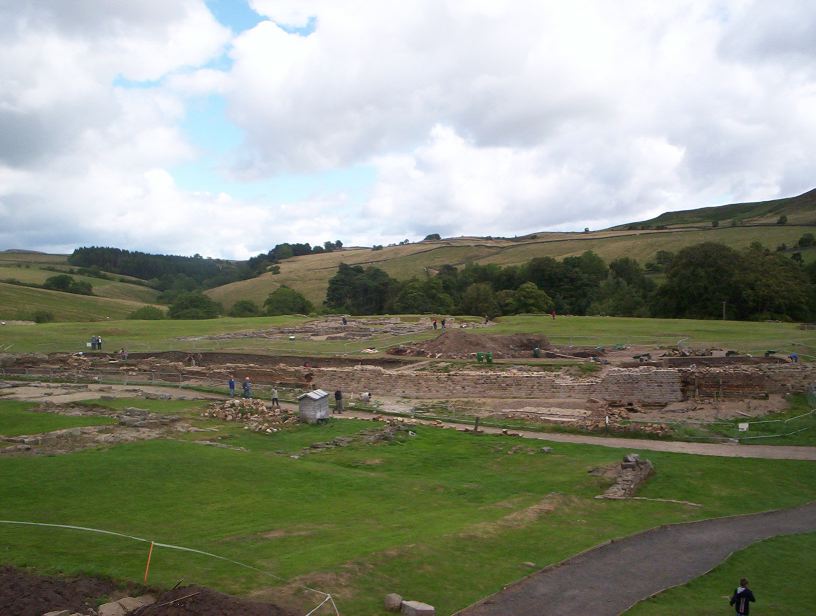
And here is a picture of part of the ongoing excavation on the site, taken from the stone tower in the first photo. This area is from the later period, with stone buildings:

Below is a Roman bathhouse from the early (pre-Hadrianic, epigraphically rich) period.
Despite its minor status as a Roman fort, Vindolanda is extraordinarily important for the epigraphic discoveries that have poured out of it since the early 1970s. Hundreds (thousands?) of thin wooden writing tablets have been recovered from the earliest strata. These inscribed tablets survived with writing intact (recoverable through infra-red photography) because these early layers (late first and early second century) were leveled, covered over with clay and then new sod, and built over. This sealed the early strata into what quickly became an anerobic environment that arrested the decomposition of organic matter until the excavators rediscovered it. You can read in detail about the epigraphic remains from Vindolanda here. My favorite is the birthday party invitation to Lepidina, the wife of the commander of the fort. Lepidina's family, who were real people, are the main characters in the Minimus books and the birthday of her friend is recounted in the first one. The Vindolanda texts were voted the number one treasure of the British Museum, and rightly so. They are as important for the early history of Britain and the history of the Roman Empire as the Dead Sea Scrolls are for early Judaism. The content of the Vindolanda tablets and the Dead Sea Scrolls are quite different and each leaves us with important gaps. The Vindolanda tablets are documentary texts (administrative texts, personal letters, etc.) which tell us about day to day life of individuals and about the running of the fort, but which contain almost no literary texts (just a few classical quotations). We are left knowing that they read, but longing to know the contents of their library. The Dead Sea Scrolls preserve the library (or a collection of the libraries) of a first-century Jewish sectarian group, but they include almost no documentary texts. We are thus left knowing all about what literary works they read, but longing to know about who the people in the group were and what their daily lives were like. (The later Judean Desert texts from the period of the Bar Kokhba Revolt -- about a generation after the Vindolanda texts -- are mostly documentary texts, with some literary texts mixed in. But these were not left by the Qumran sectarians and still leave us in the dark about them.)
Despite the gaps, we are extraordinarily lucky to have both the Vindolanda texts and the Dead Sea Scrolls. And in the future, with more luck, it's possible that some of those gaps will be filled in.
Also, while we were in the vicinity, we visited Hadrian's Wall, near the Roman Army Museum. We stayed at a B&B in Haltwhistle. This was at a nice farmhouse built in the ealy 19th century, which is reputed to have been made of stones from the Wall.

And here is a picture of the view from the Wall, looking southeast.

I've also posted another picture of the Wall here. You can click on any of the photos to get a larger image.
UPDATE (14 August): Peter Head e-mails:
I use "inscribe" to mean to write on something and "inscription" as something with writing on it. Likewise, I use 'epigraphic" to mean pertaining to ancient inscriptions. Therefore, texts written in ink on ancient surfaces are inscriptions and are of interest to the epigrapher. I don't have a Webster's in my office, but my American Heritage Dictionary agrees with these usages. This is the normal terminology for Northwest Semitic epigrapy (e.g., ink-inscribed ostraca are described as inscriptions and studied by epigraphers). Maybe Classical epigraphers use the terms differently. And there's some wiggle-room, since ancient scrolls generally aren't called inscriptions, although I suppose that technically they are. But I stand by my usage above.
The earlier fort was made of wood, the later of stone. This photo shows a reproduction on the site of buildings from both periods:

And here is a picture of part of the ongoing excavation on the site, taken from the stone tower in the first photo. This area is from the later period, with stone buildings:
Below is a Roman bathhouse from the early (pre-Hadrianic, epigraphically rich) period.

Despite its minor status as a Roman fort, Vindolanda is extraordinarily important for the epigraphic discoveries that have poured out of it since the early 1970s. Hundreds (thousands?) of thin wooden writing tablets have been recovered from the earliest strata. These inscribed tablets survived with writing intact (recoverable through infra-red photography) because these early layers (late first and early second century) were leveled, covered over with clay and then new sod, and built over. This sealed the early strata into what quickly became an anerobic environment that arrested the decomposition of organic matter until the excavators rediscovered it. You can read in detail about the epigraphic remains from Vindolanda here. My favorite is the birthday party invitation to Lepidina, the wife of the commander of the fort. Lepidina's family, who were real people, are the main characters in the Minimus books and the birthday of her friend is recounted in the first one. The Vindolanda texts were voted the number one treasure of the British Museum, and rightly so. They are as important for the early history of Britain and the history of the Roman Empire as the Dead Sea Scrolls are for early Judaism. The content of the Vindolanda tablets and the Dead Sea Scrolls are quite different and each leaves us with important gaps. The Vindolanda tablets are documentary texts (administrative texts, personal letters, etc.) which tell us about day to day life of individuals and about the running of the fort, but which contain almost no literary texts (just a few classical quotations). We are left knowing that they read, but longing to know the contents of their library. The Dead Sea Scrolls preserve the library (or a collection of the libraries) of a first-century Jewish sectarian group, but they include almost no documentary texts. We are thus left knowing all about what literary works they read, but longing to know about who the people in the group were and what their daily lives were like. (The later Judean Desert texts from the period of the Bar Kokhba Revolt -- about a generation after the Vindolanda texts -- are mostly documentary texts, with some literary texts mixed in. But these were not left by the Qumran sectarians and still leave us in the dark about them.)
Despite the gaps, we are extraordinarily lucky to have both the Vindolanda texts and the Dead Sea Scrolls. And in the future, with more luck, it's possible that some of those gaps will be filled in.
Also, while we were in the vicinity, we visited Hadrian's Wall, near the Roman Army Museum. We stayed at a B&B in Haltwhistle. This was at a nice farmhouse built in the ealy 19th century, which is reputed to have been made of stones from the Wall.
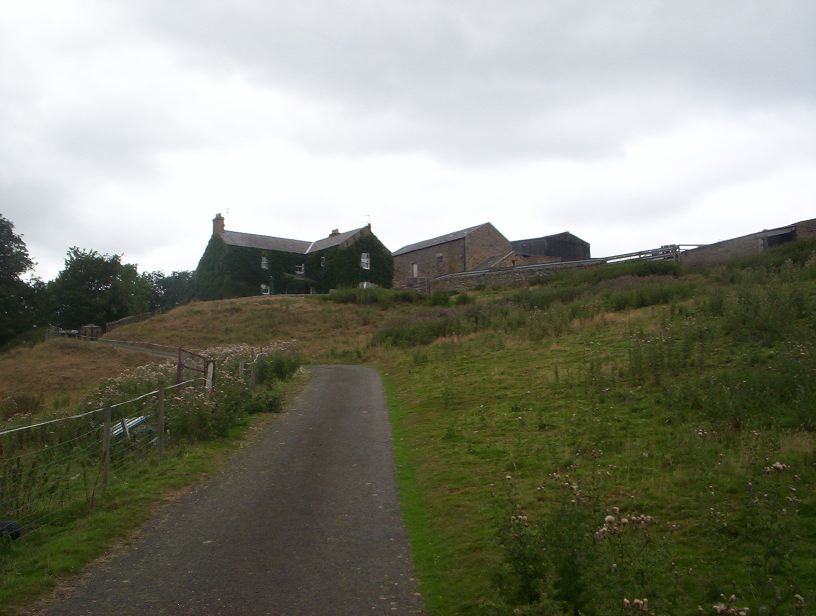
And here is a picture of the view from the Wall, looking southeast.

I've also posted another picture of the Wall here. You can click on any of the photos to get a larger image.
UPDATE (14 August): Peter Head e-mails:
I would respectfully suggest that it is not accurate to describe the Vindolanda tablets as "inscribed tablets" and therefore as "epigraphic" discoveries. They are predominantly written by pen in ink on the wood as discussed at the Vindolanda on-line site: "it is also misleading to categorise them, as is usually done, as 'incised' rather than `written' material." (http://vindolanda.csad.ox.ac.uk/tablets/TVI-2-1.shtml)Yes, they are mostly written in ink. It is the carbon ink that makes the writing stand out under infra-red light, as I noted above. It's the same with the Dead Sea Scrolls.
[in a broader discussion]
Thanks for the photos
I use "inscribe" to mean to write on something and "inscription" as something with writing on it. Likewise, I use 'epigraphic" to mean pertaining to ancient inscriptions. Therefore, texts written in ink on ancient surfaces are inscriptions and are of interest to the epigrapher. I don't have a Webster's in my office, but my American Heritage Dictionary agrees with these usages. This is the normal terminology for Northwest Semitic epigrapy (e.g., ink-inscribed ostraca are described as inscriptions and studied by epigraphers). Maybe Classical epigraphers use the terms differently. And there's some wiggle-room, since ancient scrolls generally aren't called inscriptions, although I suppose that technically they are. But I stand by my usage above.
HAPPY 90th BIRTHDAY to George E. Mendenhall:
George E. Mendenhall, Prof. Emeritus, Univ. of Michigan. Dept. of(From Herbert B. Huffmon on the Agade List.)
Near Eastern Studies, celebrates his 90th birthday, August 13,
2006, with the publication of his latest book,
Our Misunderstood Bible:
# Paperback: 64 pages
# Publisher: BookSurge Publishing (July 5, 2006)
# Language: English
# ISBN: 1419637223
List Price: $10.99
Book Description
Our Misunderstood Bible is a selection of some of the most
interesting and abused passages, and an examination of how they
came to be and how they evolved over time.
THE DAUGHTERS OF RASHI are the subject of a new novel by Maggie Anton, the first of a projected trilogy.
Saturday, August 12, 2006
HUGOYE: JOURNAL OF SYRIAC STUDIES has a new issue out (Vol. 9 No. 2, July 2006). Table of contents:
Obituary
Helga Anschütz (April 19, 1928 - May 13, 2006).
Andreas Juckel, University of Münster
Papers
Rhetorical Practice in the Chreia Elaboration of Mara Bar Serapion.
Catherine Chin, The Catholic University of America
Classical Syriac Manuscripts at Yale University: A Checklist.
Leo Depudyt, Brown University
Caught in a Compromising Position: The Biblical Exegesis and Characterization of Biblical Protagonists in the Syriac Dialogue Hymns.
Kristi Upson-Saia, Duke University
Publications and Book Reviews
Jerome A. Lund, The Old Syriac Gospel of the Distinct Evangelists: A Key-Word-in-Context Concordance.
David G.K. Taylor, University of Oxford
Ignatius Aphram I Barsoum (translated and edited by Matti Moosa). The Scattered Pearls: A History of Syriac Literature and Sciences.
David G.K. Taylor, University of Oxford
Conference Reports
Dorushe Graduate Student Conference for Syriac Studies at CUA, February 3-5, 2006.
Jean-Nicole Saint-Laurent, Brown University
Travelogue
Encountering the Suryoye of Turkey.
Jean-Nicole Saint-Laurent, Brown University
Announcements
Call for Papers for Syriac Book of Steps (Liber Graduum) Volume.
Advertisements
Journal of Aramaic Studies
Beth Mardutho Amazon Associates
Journal of the Canadian Society of Syriac Studies
Gorgias Press
Friday, August 11, 2006
HADRIAN was made emperor on this day in 117 CE. It must be cosmically significant that I walked on Hadrian's Wall this afternoon for the first time, but I'm not exactly sure how.

UPDATE (12 August): Photo added. More coming.
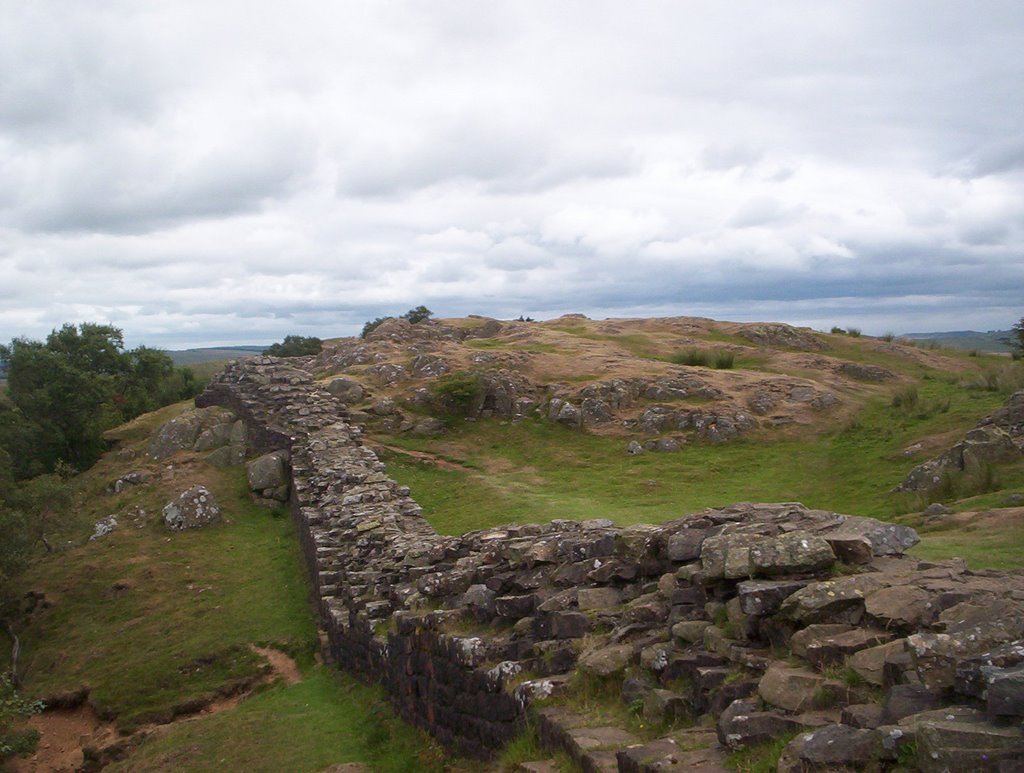
UPDATE (12 August): Photo added. More coming.
MORE ARCHAEOLOGICAL SITE UPDATES on the BAS website. Ramat Rahel is still excavating, the Kinneret excavation has been canceled, and the harbor of ancient Byblos is suffering from the oil spill. And more.
Wednesday, August 09, 2006
 "MINIMUS SUM. MUS SUM." "I am Minimus. I am a mouse." So begins Minimus: Starting Out in Latin, an excellent children's introduction to Latin. It's pitched just right for kids; based around two comic-book-format episodes in each lesson, in which we learn about Minimus the mouse, his nemesis Vibrissa the cat, and the human family they live with in the military town of Vindolanda at Hadrian's Wall. My son and I spent the last year going through the book at a leisurely pace, with lots of backtracking and review. As a result, he now knows the parts of speech, some basic Latin grammar and vocabulary, and a little about the Roman occupation of Britain. He already knew the Greek and Roman mythology, but it's been reinforced too. Pretty good for someone who's not yet ten. The book is engaging and makes the subject fun, and I recommend it highly. We're about to start the second volume in the series.
I'm less enthusiastic about the Minimus Teacher's Resource Book. It's true that I know Latin and didn't need it,
There is also a Minimus website. I haven't looked at it much, but it has lots of ancillary material.
I bring all this up not only to praise the pupil's book, though it deserves it, but because, in celebration of finishing it we're heading south this morning to visit Vindolanda, which is an important Roman-era excavation and tourist attraction at Hadrian's Wall, between Carlisle and Newcastle. We hope to get better acquainted with the people we've been reading about and to learn more about how they lived and the records they left. We also want to visit the nearby Roman Army Museum. Blogging will be on hiatus unless I run across a wireless hotspot, which seems unlikely. But we'll be coming back up on Friday and spending Friday night with our friends in Edinburgh, so I should be able to check in with you then. And I'll have a report and photographs for you when we get back to St. Andrews.
UPDATE (11 August, evening): I'm back in Edinburgh, after a great trip to the Wall. More from me later, but for now let me note that a couple of people, including the book's illustrator, have written to demonstrate that Vibrissa does mean "whiskers" in scientific Latin. The Lewis & Short entry defines it as human nose hairs, but close enough. Sorry about that; I have struck out that complaint.
Also, I have a number of other supplements and corrections to post, but I've been away and I'm pretty busy right now. If you wrote to me, assume I got it. I'll try to put up a round of updates in the next couple of days.
UPDATE (18 August): I see that my review brought Minimus at least one new customer. Good.
Tuesday, August 08, 2006
HAPPY BIRTHDAY TO ME! And maybe I am in a time warp. Or, more likely, Google News, which for some reason has a lot of articles from some years ago on today's listing.
I'm taking this week off work and will probably get out of the house for the day, although the weather isn't quite as nice as it has been. And we've got an historic holiday planned, starting tomorrow. More on that presently.
I'm taking this week off work and will probably get out of the house for the day, although the weather isn't quite as nice as it has been. And we've got an historic holiday planned, starting tomorrow. More on that presently.
Subscribe to:
Posts (Atom)