Thursday, November 23, 2006


WOLF LESLAU, professor emeritus of Hebrew and Semitic linguistics at UCLA, has died at the age of 100.
May his memory be for a blessing.
UPDATE (20 January 2007): More here.
Wolf Leslau, 100; UCLA professor sought out and recorded Ethiopian languagesThere's a little more information on Professor Leslau here. He had already retired by the time I came to UCLA in 1978, although I think he was still around and even teaching classes. But I don't recall ever meeting him in person.
By Jocelyn Y. Stewart, [Los Angeles] Times Staff Writer
November 23, 2006
Wolf Leslau, professor emeritus at UCLA and a leading expert on Ethiopian languages and culture, died of natural causes Nov. 18 at a nursing home in Fullerton, said his daughter, Eliane Silverman. He was 100.
Leslau learned to use a computer at 80, and the last of the nearly 50 books that he wrote was published when he was 98. He spoke 17 languages.
[...]
May his memory be for a blessing.
UPDATE (20 January 2007): More here.
Wednesday, November 22, 2006
CONFERENCE REFLECTIONS: As promised, here are some thoughts about the sessions in which I participated at the SBL conference.
I got lots of feedback on my paper "'Scripture as Prophetically Revealed Writings." Often I didn't know the names of the questioners and my notes are not always clear on who asked what, so I won't attach names to specific questions, but here are the questions:
A few other random notes:
On Monday I also attended S20-30, Religious Experience in Early Judaism and Early Christianity, the theme of which was "the experience of possession." I was especially interested to hear Guy Williams's paper, "Spiritual Possession in Judaism and Paul's Relationship with Christ," in which he argued that Paul was possessed by the spirit of Jesus, a position that is close to mine -- in my "'Scripture' as Prophetically Revealed Writings" paper -- that Paul was channeling Jesus.
I also stopped for a while at S20-82, the review of DJD 17 (the Samuel manuscripts from Cave 4), on which I have already commented here. I was very sorry that Frank Moore Cross, the chief editor of the volume and my doctoral supervisor was unable to attend. I had been hoping to see him.
I also attended the business meeting of the Enoch Seminar on Monday evening and I can report that there will be another Enoch Seminar at Camaldoli in Italy in July of 2007 (and, yes, I plan to go). The topic will be Enochic Judaism and the book of Jubilees. There is also a tentative plan for a panel discussion at next year's SBL in San Diego which will be devoted to the proceedings volume of the 2005 Camaldoli Enoch Seminar on the Similitudes.
I got lots of feedback on my paper "'Scripture as Prophetically Revealed Writings." Often I didn't know the names of the questioners and my notes are not always clear on who asked what, so I won't attach names to specific questions, but here are the questions:
- Alongside the question of any altered state of consciously in the production of pseudepigraphic books, would it not also be rather convenient for the authors to have, for example, Jubilees or the Temple Scroll to advance their agenda? (I entirely agree with this and said that altered states of consciousness often converge with convenience.)
- What did the ancient authors mean by a "prophecy"? How would they have defined it? (My first shot at answering this was that a prophecy was a writing by a prophet, but see the next question.)
- Did everything a prophet wrote count as prophecy? If not, what made it a prophecy? (No, and this is a good point. A love letter or a note to the milkman would not be a prophecy just because a prophet wrote them. This raises the question of what genres count as prophecy and I need to defer this one to think about it more.)
- What did the ancient exegetes think about the prophetic books mentioned in the Bible but which are now lost. (I don't know. It would be very interesting to trawl through the ancient Jewish and Christian literature to see if the exegetes ever commented on such lost books and, if so, what they said.)
- It was pointed out that the evidence I had collected came from a wide geographic area over a long period of some centuries and this made it problematic to generalize about. (I agree, but this was just an initial attempt to collect all [or at least much] of the relevant evidence.)
- It would be worthwhile to see how well the model applies to groups that existed after the time of the ancient apocalypses but before the Merkavah mystics, particularly the Manicheans. (Indeed. I don't control the Manichean literature, but perhaps I should at least have a look at the Greek Life of Mani with this in mind.)
- Was there an apocalyptic movement of which all the writers of the surviving ancient apocalypses considered themselves to be a part? (Perhaps there was from our [etic] perspective, but from their [emic)] perspective they often would have disagreed violently on important issues. For example, the author of the Animal Apocalypse advocates armed resistance during the persecution of Antiochus whereas the contemporary author of Daniel promotes pacifist martyrdom. It is hard to imagine that they considered themselves part of the same movement.)
- What can we say about the social context of the writers of the ancient apocalypses along the lines of my reconstruction of the social context of the Merkavah mystics in my book Descenders to the Chariot? (I can't remember what I said here except that we have a lot less information on the former than the latter.)
- Can the model be applied as far back as to the book of Ezekiel, which is the font of much apocalyptic and mystical thought in Judaism? (I don't think that this specific model would work very well with the book of Ezekiel, but Ezekiel is certainly a character who makes use of altered states of consciousness and had visions of the divine realm. My suspicion is that Ezekiel presents us with a much more realistic view of what a priest in the Jerusalem Temple was like and that Leviticus is a bowdlerized account by a movement that rejected the visionary elements of the Jerusalem cult.)
- One of my main objectives in writing the book was to get people talking about the methodology for identifying the provenance of pseudepigraphic books, and I am delighted that the book is getting so much attention. Ultimately it doesn't really matter if I am right or wrong about the provenance of a particular book or even about any given point of methodology. What matters is that we are now discussing these issues on a more sophisticated level.
- The most general criticism from the panel was that I did not go far enough and that I should have approached the problems from an even more abstract and higher-order level (e.g., dispensing with or being even more sceptical of labels like "Jewish" or "Christian"). I don't doubt that there is some truth to this and I am not surprised to hear it from this panel, which consisted mostly of OT pseudepigrapha specialists. But another important audience I am trying to reach is New Testament scholars, and the book was written for them too. I suspect some of them think (assuming they bother to read it, which I hope they do) that I've gone entirely too far as it is. Let's see how far we get with level of abstraction and label-rejection before we call for more.
- The quest for the viewpoint of the original authors and audiences of these works is worth pursuing for two reasons, even though such questions are out of fashion. First, our job as historians of religion is to reconstruct the reception history of these documents from their inception to the present, so the original audience is one audience (of many) that we should consider. Second, we are already handed the agenda of finding the viewpoint of the original audience and author by New Testament scholars who want to know which texts they can use as first-century "Jewish background." We specialists need to guide them on this question, because it is not going to go away.
- The methods I have advanced in the book need to be applied by specialists who control the language and culture of particular areas (Armenian, Coptic/Egyptian, Ethiopic. Syriac/Eastern Church, Slavonic, etc.). They may well be able to refine and correct my conclusions about specific texts.
- One suggestion in the discussion was that junior scholars who wish to work with Second Temple literature and Pseudepigrapha should develop a subspecialty in at least one of the more obscure church languages and cultures that transmit OT pseudepigrapha. I also underlined the importance of team work in approaching such texts. Often a single pseudepigraphon is transmitted in more than one such language and we may need several specialists collaborating in order to understand the transmission and origin of the work. I hope that on the coat tails of the More Old Testament Pseudepigrapha Project I will be able to edit a collection of essay that gives an introduction and bibliography for each of these languages and cultures. I am discussing this with a publisher right now.
A few other random notes:
On Monday I also attended S20-30, Religious Experience in Early Judaism and Early Christianity, the theme of which was "the experience of possession." I was especially interested to hear Guy Williams's paper, "Spiritual Possession in Judaism and Paul's Relationship with Christ," in which he argued that Paul was possessed by the spirit of Jesus, a position that is close to mine -- in my "'Scripture' as Prophetically Revealed Writings" paper -- that Paul was channeling Jesus.
I also stopped for a while at S20-82, the review of DJD 17 (the Samuel manuscripts from Cave 4), on which I have already commented here. I was very sorry that Frank Moore Cross, the chief editor of the volume and my doctoral supervisor was unable to attend. I had been hoping to see him.
I also attended the business meeting of the Enoch Seminar on Monday evening and I can report that there will be another Enoch Seminar at Camaldoli in Italy in July of 2007 (and, yes, I plan to go). The topic will be Enochic Judaism and the book of Jubilees. There is also a tentative plan for a panel discussion at next year's SBL in San Diego which will be devoted to the proceedings volume of the 2005 Camaldoli Enoch Seminar on the Similitudes.
Monday, November 20, 2006
BOOK PLUG: I've mentioned this before, but I received my contributor's copy yesterday at the EJCM panel session, so I'll note it again: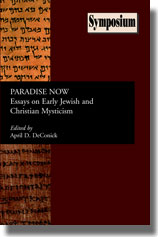
I checked out the conference book display area on Saturday and didn't find anything I needed urgently, so this may be the only professional book I bring home this time. Perhaps just as well, since I've already filled much of my spare luggage space with science fiction paperbacks and the 2007 Dilbert calendar.

Paradise Now: Essays on Early Jewish and Christian MysticismHighly recommended.
/April D. DeConick, editor/
A substantial introduction to the study of early Jewish and Christian mysticism, this volume examines major aspects of the mystical tradition within early Judaism and Christianity. This tradition was centered on the belief that a person directly, immediately, and before death can experience the divine, either as a rapture experience or one solicited by a particular praxis. The essays define and analyze the nature and practices of mysticism as it emerges within early Judaism and Christianity, recognizing this emergence within a variety of communal environments. Larger questions about the relationship between hermeneutics and experience, as well as the relationship between mysticism and apocalypticism are also discussed, and a substantial bibliography of the field is provided. The book is the result of ten years of work of the Early Jewish and Christian Mysticism unit of the Society of Biblical Literature.
Paper, $49.95 - ISBN: 1-58983-257-4 - 480 pages - Hardback edition available from Brill
Symposium Series 11
I checked out the conference book display area on Saturday and didn't find anything I needed urgently, so this may be the only professional book I bring home this time. Perhaps just as well, since I've already filled much of my spare luggage space with science fiction paperbacks and the 2007 Dilbert calendar.
TEMPLE MOUNT WATCH: The Southern Wall is the subject of a Ynetnews Travel column. Uma Thurman is mentioned but she is not of central importance to the site.
THE SESSION ON MY BOOK produced a good and vigorous discussion of the current state of the question on the Pseudepigrapha and I was quite happy with it. Again, I'll post some notes on it and on the tenth-anniversary EJCM section when I get a chance, perhaps not until after the conference.
I depart for Scotland tomorrow afternoon. I may or may not be able to blog tomorrow. If not, look for me again on Wednesday.
UPDATE (22 November): More here.
I depart for Scotland tomorrow afternoon. I may or may not be able to blog tomorrow. If not, look for me again on Wednesday.
UPDATE (22 November): More here.
Sunday, November 19, 2006
MY TWO PAPERS went well yesterday. When I get a chance, I'll post some notes on the feedback I got. The Early Jewish and Christian Mysticism Group went out to dinner last night and afterwards I stopped at the Harvard reception for a while. But I did manage to get to bed pretty early because I figured (correctly) that I would wake up early anyway -- hence the obscenely early hour of these posts.
The gym in the Grand Hyatt doesn't open until 8:00 am on Sundays, which seems pathetic to me. Most hotels have twenty-four hour access (and most of them don't charge extra for use either, unlike the Hyatt). But the session on my book is this morning and I need to get my notes on the presentations into some kind of order, so I do have something to keep me occupied. The EJCM panel discussion is this afternoon as well.
UPDATE (22 November): More here.
The gym in the Grand Hyatt doesn't open until 8:00 am on Sundays, which seems pathetic to me. Most hotels have twenty-four hour access (and most of them don't charge extra for use either, unlike the Hyatt). But the session on my book is this morning and I need to get my notes on the presentations into some kind of order, so I do have something to keep me occupied. The EJCM panel discussion is this afternoon as well.
UPDATE (22 November): More here.
A NEW BOOK ON MARY MAGDALENE by Betty Conrad Adam is reviewed in the Houston Chronicle (free registration required). It is devotional rather than scholarly:
What makes Adam's book different from others is its conversational tone, roundup of past research and legends, and a focus on adapting Mary Magdalene's spirituality for today's world.Mary Magdalene's teachings are pretty thin on the ground, but perhaps she is referring to the Greek and Coptic Gospel of Mary, which is mentioned in the article as well. Like the Gospel of Judas, this gospel is much later than the canonical ones and tells us interesting things about the second century church, but nothing new about the time of Jesus.
"It helps us envision our spirituality in new ways," she said. "It's a message that I believe inspires a new way of thinking about ourselves and others. I talk about it in terms of the contemporary community here."
Adam and others refer to the Gospel of Mary, as the "gospel of peace" and look to Magdalene's teachings as a way to bridge barriers in today's world.
Saturday, November 18, 2006
ONE NIGHT WITH THE KING is given a "tepid" review by the Catholic News Service. Excerpt:
The biblical drama has impressive production value and cameos by Oscar-pedigreed actors such as Omar Sharif and Peter O'Toole, but it's handicapped by an inferior screenplay by Stephan Blinn -- which makes some changes to the story -- and awkward, if earnest, direction by Michael Sajbel.
Still, the power of the tale's enduring theme of faithful witness in the face of persecution isn't completely diminished by the filmmaker's uninspired telling.
THERE'S A TENURE CONTROVERY regarding a Barnard College anthropologist who has written a controversial book on the historical relationship of Jews to Palestine:
There's an online review by Alexander Joffe in a recent issue of the Journal of Near Eastern Studies, but it's behind a subscription wall and I can't get at it at the moment. And I see that I already noted the controversy over the book a little over a year ago.
UPDATE (27 November): More here.
UPDATE (28 November): If you were referred here to see my "daft" quote, please read what I actually said above, which is a little more cautious than was reported, and then read my comments, including in the update, in this post.
UPDATE (28 September 2007): I have now reviewed Abu El-Haj's book here.
Barnard Alumnae Opposing Tenure for AnthropologistI haven't seen the book, but the Sun summarizes some points from it as follows:
By GABRIELLE BIRKNER
Staff Reporter of the [New York] Sun
A group of Barnard College alumnae is attempting to stop their alma mater from giving tenure to an assistant professor who minimizes Jews' historical connection to Israel.
In her 2001 book, "Facts on the Ground: Archaeological Practice and Territorial Self-Fashioning in Israeli Society," published by the University of Chicago, the professor of anthropology, Nadia Abu El-Haj says Israeli archaeology manipulates evidence to justify a modern Jewish state in the region.
Relying heavily on the input of anonymous archaeologists, tour guides, and tour participants, the book portrays Israeli archaeologists as ideologues who, driven by a desire to "efface Zionism's colonial dimension," have fabricated Jews' territorial claims to Israel.
In "Facts on the Ground," Ms. Abu el-Haj suggests Jerusalem was destroyed not by the Romans, but by the Jews themselves due to rising class tensions among them. Yet, the 1st-century historian and scribe Josephus described in great detail the Roman siege of Jerusalem. Additionally, carvings in the Arch of Titus in Rome depict the Roman General Titus showing off menorahs and other objects looted from the Second Temple.If this is an accurate representation of what the book says (always a big if in a newpaper article), it does seem daft.
In another passage, Ms. Abu El-Haj relates how a tourist questions a Jerusalem tour guide's explanation that the Judean King Hezekiah saved the city from an Assyrian conquest in 701 B.C.E. The tourist refutes the statement, claiming that Hezekiah's actions actually led to the destruction of the nearby Israelite kingdom. "Although the tourist's objection would appear to undermine the guide's interpretation … this is a ludicrous claim, since the Israelite kingdom had been conquered twenty-one years earlier!" an archaeology professor at Israeli's Bar-Ilan University, Aren Maeir, wrote two years ago in a University of Chicago journal, Isis.
There's an online review by Alexander Joffe in a recent issue of the Journal of Near Eastern Studies, but it's behind a subscription wall and I can't get at it at the moment. And I see that I already noted the controversy over the book a little over a year ago.
UPDATE (27 November): More here.
UPDATE (28 November): If you were referred here to see my "daft" quote, please read what I actually said above, which is a little more cautious than was reported, and then read my comments, including in the update, in this post.
UPDATE (28 September 2007): I have now reviewed Abu El-Haj's book here.
TEMPLE MOUNT WATCH -- More on the salvage excavation of the rubble from the Temple Mount that was removed by the Waqf:
Near the end of the article there is this less than construction comment from the Waqf:
At Mideast holy site, what is treasure?Oddly, there is no mention of the recent finding of an inscription in the rubble that mentions Flavius Silva.
By MATTI FRIEDMAN
ASSOCIATED PRESS WRITER
JERUSALEM -- Off an East Jerusalem side street, between an olive orchard and an abandoned hotel, sit a few piles of stones and dirt that are yielding important insights into Jerusalem's history.
They come from one of the world's most disputed holy places - the square in the heart of Jerusalem that is known to Jews as the Temple Mount and to Muslims as the Noble Sanctuary.
The story behind the rubble includes an underground crypt, a maverick college student, a white-bearded archaeologist, thousands of relics spanning millennia and a feud between Israelis and Palestinians which is heavily shaped by ancient history.
Among finds that have emerged are a coin struck during the Jewish revolt against the Romans, arrowheads shot by Babylonian archers and by Roman siege machinery, Christian charms, a 3,300-year-old fragment of Egyptian alabaster, Bronze Age flint instruments, and - the prize discovery - the imprint of a seal possibly linked to a priestly Jewish family mentioned in the Old Testament's Book of Jeremiah.
And the finds keep coming. On a drizzly November morning, Gabriel Barkay, the veteran biblical archaeologist who runs the dig, sat in a tent near the mounds examining some newly discovered coins stamped by various Holy Land powers: the Hasmonean dynasty of Jewish kings more than 2,000 years ago, a Roman procurator around the time of Pontius Pilate, the early Christians of the Byzantine Empire, two Islamic dynasties and the British in the 20th century.
Near the end of the article there is this less than construction comment from the Waqf:
For its part, the Waqf says it wasn't destroying any evidence of Jewish presence - because there isn't any.
"I have seen no evidence of a temple," said the Waqf's director, Adnan Husseini. He had heard "stories," he acknowledged, "but these are an attempt to change the situation here today, and any change would be very dangerous."
I ARRIVED IN WASHINGTON late on Thursday evening. Even though the conference technically begins only today, there was lots to do on Friday. In the morning and early afternoon I went to a seminar on "How to Study the Dead Sea Scrolls: An International Working Group on Methods and Scrolls Scholarship," chaired by Maxine Grossman of the University of Maryland. She's editing a book on this topic and a number of contributors attended. I'm doing a chapter on "counterfactual history" and you can get a general idea of what it's about from this conference paper from a couple of years ago.
In the evening I went to a session of the Philadelphia Seminar on Christian Origins in which David Brakke of Indiana University gave the following very interesting paper:
In the evening I went to a session of the Philadelphia Seminar on Christian Origins in which David Brakke of Indiana University gave the following very interesting paper:
In his recent book, _Demons and the Making of the Monk: Spiritual Combat in Early Christianity_ (Harvard University Press 2006), Brakke considers the creation of Egyptian monastic identity alongside the development of demonology. Using recent theoretical discussions of race and gender to explore the Othering of these demonic forces, Brakke's insights fit well into our theme for this year.
The title for his presentation is "Shifting Strategies: Monks, Demons, and Historians."
There are two recommended reading items:
1. "The Lady Appears: Materializations of 'Woman' in Early Monastic Literature." Journal of Medieval and Early Modern Studies 33 (2003): 387-402. Reprinted in The Cultural Turn in Late Ancient Studies: Asceticism, Gender, and Historiography, 25-39. Ed. Dale B. Martin and Patricia Cox Miller. Durham, N.C.: Duke University Press, 2005.
2. "Ethiopian Demons: Male Sexuality, the Black-Skinned Other, and the Monastic Self." Journal of the History of Sexuality 10 (2001): 501-35. A briefer and less theoretically explicit version is chapter 7 of Brakke's Demons and the Making of the Monk (Harvard University Press, 2006).
Wednesday, November 15, 2006
I'M OFF TO WASHINGTON D.C. for the annual meeting of the Society of Biblical Literature. I leave first thing tomorrow morning. I am presenting two papers, which I have now posted online. You can read them by clicking on the links below.
In addition, there is a session on my book:
I'm also listed as a panelist in the following, although given my level of involvement elsewhere, I'll try to keep pretty quiet in this one:
UPDATE (22 November): My other SBL posts for this year are here, here, here, here, and here.
UPDATE (17 November 2010): Dead links now fixed!
'Scripture' as Prophetically Revealed Writings
S18-71
Rethinking the Concept and Categories of 'Bible' in Antiquity
11/18/2006
1:00 PM to 3:30 PM
Room: 203B - CC
The Hekhalot Literature and the Ancient Jewish ApocalypsesThe second is a summary of an article that has just been published in full here. This is a volume that represents many years' work of the Early Jewish and Christian Mysticism SBL Group and it is highly recommended.
S18-112
Early Jewish and Christian Mysticism
11/18/2006
4:00 PM to 6:30 PM
Room: 142 - CC
In addition, there is a session on my book:
S19-28I don't have a formal slot in this one, but I will be there, I've seen at least early drafts of most of the papers, and I will have some comments. These will be fairly extemporaneous, so I'm not posting anything here.
Pseudepigrapha
11/19/2006
9:00 AM to 11:30 AM
Room: 150A - CC
Theme: The Pitfalls of Categorization: A Panel Discussion of James R. Davila, The Provenance of the Pseudepigrapha: Jewish, Christian, or Other? (Brill, 2005)
Andrei Orlov, Marquette University, Presiding
Pierluigi Piovanelli, University of Ottawa
In Praise of 'The Default Position,' or Reassessing the Christian Reception of the Jewish Pseudepigraphic Heritage (25 min)
Chad Day, University of North Carolina, Charlotte
"The Way Forward" or Two Steps Back? Assessing Davila's "The Provenance of the Pseudepigrapha" (25 min)
Magnar Kartveit, School of Mission & Theology, Misjonshogskolen i Stavanger, Norway
The Jewish source in the Ascension of Isaiah (25 min)
John C. Reeves, University of North Carolina, Charlotte
‘A Demonstrably Jewish Text’? Reconsidering the Similitudes of Enoch (25 min)
Panelist responses
Discussion (20 min)
Audience responses
Discussion (30 min)
I'm also listed as a panelist in the following, although given my level of involvement elsewhere, I'll try to keep pretty quiet in this one:
S19-111I'll be taking my laptop and I expect to continue blogging through the conference -- as usual, as time permits. As I said, I leave early tomorrow morning. It may be two or three days before I'm back in touch.
Early Jewish and Christian Mysticism
11/19/2006
4:00 PM to 6:30 PM
Room: 149A - CC
Theme: Tenth Anniversary Celebration & Panel Discussion
In this session, we will celebrate the tenth anniversary of our group as well as the release of a volume of collected papers entitled Paradise Now. The panel will consider the questions: what contributions have we made over the past decade and where do we go from here? The panelists have been invited, but all are welcome to join us and contribute.
April Deconick, Illinois Wesleyan University, Presiding
Rebecca Lesses, Ithaca College, Panelist
Kevin Sullivan, Marquette University, Panelist
Charles Gieschen, Concordia Theological Seminary, Panelist
Ra'anan Boustan, University of Minnesota-Twin Cities, Panelist
Celia Deutsch, Barnard College, Panelist
Kelley Coblentz Bautch, St. Edward's University, Panelist
Seth Sanders, Cornell University, Panelist
Frances Flannery-Dailey, Hendrix College, Panelist
Andrei Orlov, Marquette University, Panelist
James Davila, University of St. Andrews-Scotland, Panelist
Andrea Lieber Merwin, Dickinson College, Panelist
UPDATE (22 November): My other SBL posts for this year are here, here, here, here, and here.
UPDATE (17 November 2010): Dead links now fixed!
THE ORIENTAL INSTITUTE responds to complaints about the plaque in the Megiddo Gallery. This is from an article ("Oriental Institute Museum denies accusations of pro-Muslim bias") in the Chicago Maroon, a student publication:
Fred Donner, professor of Near Eastern Languages and Civilizations at the Oriental Institute, said the attention surrounding the Muir article “made a mountain out of a molehill.”Read it all. I have not accused the Oriental Institute of any bias (and do not), but I think the errors in the plaque should be corrected.
“This is all a political issue for some people,” Donner said, referring to Muir’s allegations. In response to questions of historical accuracy surrounding Prophet Muhammad’s ascent to heaven, Donner pointed to the historical relevance of the story of the Jewish prophet Moses crossing the Red Sea.
In defense of the museum’s scholarship, both Donner and Emberling also noted that some parts of the disputed captions could have been made clearer to prevent such misunderstandings.
“The label should have said, ‘According to Muslim tradition, the Prophet ascended to heaven,’” Donner said.
Reflecting those sentiments, Emberling added the captions could have been improved when the exhibit was first installed a year ago.
“We may have made an error in our editorial process,” he said. “But certainly to claim that there is any propagandistic intent is very far from truth.”
The scholars maintained that Muir’s accusations are incorrect and have not affected operations at the museum.
“I think this is an overreaction by that one person,” Donner said. “But people are entitled to their overreactions.”
THE EARLY JEWISH AND CHRISTIAN MYSTICISM GROUP of the SBL has its tenth anniversary this year and it is profiled in this month's SBL Forum. I've been a member of the group from the beginning.
Also in the SBL Forum, Larry Hurtado has a piece on "Manuscripts and Munificence: The Centenary of the Freer Biblical Codices."
Also in the SBL Forum, Larry Hurtado has a piece on "Manuscripts and Munificence: The Centenary of the Freer Biblical Codices."
Tuesday, November 14, 2006
AN ANCIENT LATRINE has reportedly been discovered near Qumran, and the implications are very interesting.
The War Scroll and the Temple Scroll don't actually refer to the site of Qumran, but it appears (assuming the research is found convincing once published) that the sectarians applied the same principles in these scrolls to their own site and the placement of its latrine. I look forward to reading the article, which is due out in the next issue of Revue de Qumran.
UPDATE (15 November): James Tabor himself blogs the story with photos at the Jesus Dynasty blog. (Heads-up, Ian Werrett.)
Stringent religious purification proved lethalRead it all.
By JUDY SIEGEL-ITZKOVICH (Jerusalem Post)
Strict hygienic practices of the ancient Jewish sect at Qumran near the Dead Sea, which kept Jews healthy in other times and places, are believed to be responsible for their short life expectancy in that very dry area, according to new scientific findings on their burial of feces far from their camp and use of ritual immersion.
The findings by an international research team including Americans, French and Israelis give direct evidence of the presence of the Essenes at Qumran, as described in the Dead Sea scrolls, confirm the existence of a communal latrine located at a remote distance from the camp and provide a window into the dynamic relationships between the sect's rigorous religious practices and the community's health.
[...]
University of North Carolina at Charlotte biblical scholar Prof. James Tabor suggested the investigation at a site outside the ruins of Qumran, noting instructions in two of the Dead Sea Scrolls (the "War Scroll" and the "Temple Scroll") specifically requiring latrines to be located at a significant distance "northwest of the city" and also to be "not visible from the city."
Tabor had also noted that the first century Jewish historian Josephus described very similar exotic toilet practices among the Essenes.
Analysis of the site by Israeli paleopathologist Joe Zias and soil analysis by Stephainie Harter-Lailheugue, a French parasitologist from the Centre National de la Recerche Scientifique, confirmed the area as an ancient latrine site through the presence of desiccated eggs from three distinct human-specific intestinal parasite species.
[...]
Zias and Tabor also note that the settlement's unusual latrine practices may be clues in solving some of Qumran's other archeological puzzles - in particular, questions raised by the 1,100 graves found at the site, which are almost exclusively male.
"The graveyard at Qumran is the unhealthiest group that I have ever studied in over 30 years and this is readily apparent," said Zias, who has done previous work on the Qumran burials. "For example, 2,000 years ago in Jericho 14 kilometers to the north, the chances of an adult male dying after 40 were 49 percent. But when you go to Qumran, the figure for people surviving to 40 falls to 6% - the chances of making it to 40 differ by a factor of eight!
[...]
The War Scroll and the Temple Scroll don't actually refer to the site of Qumran, but it appears (assuming the research is found convincing once published) that the sectarians applied the same principles in these scrolls to their own site and the placement of its latrine. I look forward to reading the article, which is due out in the next issue of Revue de Qumran.
UPDATE (15 November): James Tabor himself blogs the story with photos at the Jesus Dynasty blog. (Heads-up, Ian Werrett.)
Monday, November 13, 2006
THE SMITHSONIAN EXHIBITION of biblical manuscripts is reviewed in the Baltimore Sun:
UPDATE (14 November): Tommy Wasserman (Centre for Theology and Religious Studies, Lund University, Sweden) e-mails:
The word of God: captured, transcribed and embellishedBy the way, I had thought that the exhibit contains only part of Codex Sinaiticus, not the whole codex (or what survives of it), which is located in four different places. Can someone tell me if that is correct and, if so, which part is included in the exhibit? Is it the 347 leaves from the British Library?
Smithsonian exhibit of ancient Bibles reveals fascinating works of astounding beauty
By Joe Burris
Sun Reporter
Originally published November 12, 2006
Ninth-century Vikings almost certainly did not care that the elaborately ornamented book of New Testament works that they looted came out of a tradition including the commandment "Thou shalt not steal."
Yet the Codex Aureus (Latin for Golden Book) that the men stole from a church in Kent, England, was worthy of coveting - made of purple-stained vellum pages and written in gold and silver ink. Its detailed drawings and lettering are a fusion of Roman, Byzantine, Celtic and German art.
The book was so valuable that a local earl paid a ransom in pure gold for its return.
The Codex Aureus is among the artifacts in the Smithsonian Institution exhibit In the Beginning: Bibles Before The Year 1000, which illustrates the Western world's efforts to transcribe, glorify and preserve the word of God.
[...]
UPDATE (14 November): Tommy Wasserman (Centre for Theology and Religious Studies, Lund University, Sweden) e-mails:
You are correct, it is in four different locations (in St Petersburg, Lepizig, St Catherine's monastery and British Library). Right now David Parker in Birmingham is directing a major project to digitize the compete codex. You will find details (and sample images) here http://www.itsee.bham.ac.uk/projects/sinaiticus/index.htm
The leaves from Codex Sinaiticus on display at the exhibit in Washington is from St Catherine's monastery at Sinai, where the codex was originally discovered by Tischendorf. In 1975 when they were rebuilding the monastery, a hidden room was discovered where many new manuscript fragments were discoved, including new leaves from the Codex Sinaiticus.
A BOOK REVIEW in the Washington Post:
Judgment DayThe article also discusses some speculations on the origins of the thought world that produced the genre "apocalypse."
Why Revelation remains the most incendiary chapter of the New Testament.
Reviewed by Jay Tolson
Sunday, November 12, 2006; Page BW06
A HISTORY OF THE END OF THE WORLD
How the Most Controversial Book of the Bible
Changed the Course of Western Civilization
By Jonathan Kirsch
HarperSan Francisco. 340 pp. $25.95
The question of whether religions have historically done more harm or good is one of those debates that persist well beyond their proper sophomore-year expiration date. But there is a less futile variation on the argument: What is it in specific faith traditions that can lead to dangerous interpretations?
In the five years since 9/11, much time has been devoted to identifying the elements of Islam that lend themselves to a hateful jihadist ideology. Less has been devoted to what is incendiary in the other two Abrahamic traditions: Judaism and Christianity. Jonathan Kirsch, the author of several acclaimed books on religious themes, goes some way toward remedying that deficit in this thoughtful history and analysis of the most controversial book of the New Testament, the Book of Revelation.
[...]
Sunday, November 12, 2006
THE TIMBUKTU MANUSCRIPTS are in the news again:
UPDATE: Scientific American has a longer version of this article.
Fighting to preserve ancient Timbuktu textsThe talk is that more than a million manuscripts may survive there. As noted before, some are in Hebrew and Greek, as well as Arabic. Note this as well, and for both posts follow the links back from there.
Researchers say they reveal a written history in Africa as old as the Renaissance
By NICK TATTERSALL
Reuters News Service
TIMBUKTU, MALI — Researchers in Timbuktu are fighting to preserve tens of thousands of ancient texts which they say prove Africa had a written history at least as old as the European Renaissance.
Private and public libraries in the fabled Saharan town in Mali have already collected 150,000 brittle manuscripts, some from the 13th century, and local historians believe many more lie buried under the sand.
The texts were stashed under mud homes and in desert caves by proud Malian families whose successive generations feared they would be stolen by Moroccan invaders, European explorers and French colonialists.
[...]
Some academics say the texts will force the West to accept Africa has an intellectual history as old as its own. Others liken them to the Dead Sea Scrolls.
UPDATE: Scientific American has a longer version of this article.
THE FROM ABRAHAM TO JESUS EXHIBITION is coming to Columbus:
Holy meets history
Touring exhibit in Columbus blends biblical stories with artifacts, technology
By Colette M. Jenkins
Beacon Journal religion writer
A touring exhibit that promises to transport people back to the Holy Land as it was thousands of years ago opens Monday in Columbus.
``From Abraham to Jesus'' is a nearly 40,000-square-foot exhibit that blends biblical stories with historic artifacts and modern technology to take visitors on a walk through the birth of Judaism and Christianity.
It features some of the Dead Sea Scrolls; the ossuary, or bone box, that archaeologists believe held the remains of a son of Simon the Cyrene, who carried the cross for Jesus; a musical score produced by national recording artist Don Moen and a 5,000-square-foot bazaar.
[...]
Saturday, November 11, 2006
BISHOP TOM WRIGHT is dissing neo-Gnosticism:
UPDATE: Justin Dombrowski e-mails to point to this site,which contains, among many other things, a neo-Gnostic essay on "The Mystery of Iniquity." Excerpt:
Bishop assails Gnostic fad that ‘Code’ boostedI don't know a lot about modern neo-Gnosticism. Does the demiurgic myth (that the biblical creator god is actually an evil derivative and secondary god) actually play a large part in the doctrine of such groups? Can anyone point me to relevant websites, etc.?
By RICHARD N. OSTLING
For AP Weekly Features
Gnosticism, the religious rival that lost out to orthodox Christi-anity in ancient times, has be-come fashionable again thanks to Dan Brown’s huge-selling novel “The Da Vinci Code” and the efforts of professors like Princeton’s Elaine Pagels.
Harvard University picked Pagels to deliver its prestige-laden William Noble Lectures in theology for 2001. But this year’s Noble lecturer, scholarly Church of England Bishop N.T. Wright, assailed Gnostic chic.
He said the central issue is: “Do we or don’t we believe in a good God who made the world?”
For Wright, that’s no esoteric scholarly issue. He told the Ivy Leaguers that Gnosticism — ancient or modern — fosters spiritual elitism and political escapism, and undercuts truth and social betterment.
“Da Vinci” was popular because it “tapped into a deep desire in our culture for secret knowledge,” Wright said, and similarly, Gnostics conveyed Jesus’ supposed secret teachings to a spiritual elite.
Like “Da Vinci,” Gnosticism claimed that “Christianity as we have known it was based on a gigantic mistake” and “the church has hushed up the real Jesus,” he added.
That false history, the bishop asserted, appeals to growing numbers of Westerners who think truth cannot be known, who distrust authority, who seek private spiritual experience and who love conspiracy theories.
Analysts will doubtless debate Wright’s remarks about 21st-century Gnostic-style thinking. But his depiction of ancient Gnosticism is well-documented by the “Gospel of Judas,” a Gnostic text released last spring by National Geographic amid intense promotion.
[...]
UPDATE: Justin Dombrowski e-mails to point to this site,which contains, among many other things, a neo-Gnostic essay on "The Mystery of Iniquity." Excerpt:
Contemporary Gnostics for the most part agree with the fundamental insights of their ancient counterparts. Do modern Gnostics believe in the Demiurge? Do they believe in Messengers of Light? Do they regard such ideas as metaphysical truths or as mythologems hinting at more subtle and mysterious realities? The answer is that some Gnostics may believe these things more in a literal sense, while others may believe them symbolically; still others may hold a mixture of both views.The site also has a neo-Gnostic theological reflection on the 2004 tsunami. It does indeed draw on the demiurgic myth toward the end, but it doesn't sound to me as though it "erodes the basis for work to improve society." Excerpt:
What matters is not the precise form of these teachings but their substance. And this is clear enough. It speaks of the reality and power of evil, of its fundamental presence in all of manifest existence. It declares that while we may not be able to rid the world or ourselves of evil, we may and indeed will rise above it through gnosis. And when the task of this extrication is accomplished, then we shall indeed no longer fear the noonday devil or the terror that walks by night.
Thus we are left with the eternal Gnostic realization: Only the liberating insight of Gnosis will ultimately lift us out of a reality where horrors of this kind prevail. In a Gnostic sense earthly life itself is a disaster. Like so many of the unfortunate men, women, and children who were living (or vacationing) in areas that were like Paradise and were then so cruelly deprived of their lives in the twinkling of an eye, so have we come forth once from the Fullness (Pleroma) and have been swept away by a dreadful torrent that carried us far away from the glories and beauty of our true home. Horrible as this realization strikes us, we must balance it with the afore noted recognition: There is a liberating insight, which we call Gnosis, that can reverse the process and take us back to our true dwelling place. In a very true sense, this is really all that matters. And until then, let us treat each other with compassion, let us extend such help and love as we may be able to offer. For while it is beyond our power to change this dark and violent reality, it is within our ability to shed some light on the path upon which we move toward our goal beyond this world.Anyway, have a look and see what you think. And let me know if you find any other interesting sites.
THE OLD CITY OF JERUSALEM has been named as one of the Seven New Wonders of the World by USA Today:
If I forget thee, O JerusalemThe Potala Palace and Jokhang Temple: Lhasa, Tibet has also been put on the list.
Posted 11/10/2006 6:00 AM ET
By Jerry Shriver, USA TODAY
Mankind's capacity for wonder is profoundly expressed in Jerusalem's Old City, which has served as a spiritual nexus for the world's three major monotheistic faiths — Judaism, Christianity and Islam — for millennia.
Our six experts chose the ancient city as one of the seven New Wonders of the World for its central place in religious history and struggles for tolerance.
[...]
Friday, November 10, 2006
MORE TEMPLE TREASURE LEGENDS -- sort of. I found this today in a bookstore in Edinburgh:
We'll see. I normally avoid such Bible-related historical thrillers, since the historical elements are often irritatingly poorly done. But I'm keeping my eyes open right now for both scholarly and popular material that deals with the lost Temple treasures, as part of my research on the Temple treasure legends in the Massekhet Kelim, The Treatise of the Vessels, for the More Old Testament Pseudepigrapha Project. I may not get around to reading this one very soon, but I'll let you know what I think.
UPDATE: I forgot to mention that I also got this, which is now out in paperback:
Paul Sussman, The Last Secret of the Temple (Bantam, 2005)It's blurbed by the Independent as "The intelligent reader's answer to The Da Vinci Code."
We'll see. I normally avoid such Bible-related historical thrillers, since the historical elements are often irritatingly poorly done. But I'm keeping my eyes open right now for both scholarly and popular material that deals with the lost Temple treasures, as part of my research on the Temple treasure legends in the Massekhet Kelim, The Treatise of the Vessels, for the More Old Testament Pseudepigrapha Project. I may not get around to reading this one very soon, but I'll let you know what I think.
UPDATE: I forgot to mention that I also got this, which is now out in paperback:
Anne Rice, Christ the Lord: Out of Egypt (Arrow, 2005)For lots more on this book, look at this post and the one immediately below it and follow the links back from there.
Thursday, November 09, 2006
I SHALL BE IN EDINBURGH most of tomorrow, giving a paper at the biblical studies seminar at New College. The paper is "The Hekhalot Literature and the Ancient Jewish Apocalypses," of which I will also be presenting a shorter version at the SBL meeting in Washington D.C. in the middle of this month. Stay tuned for the short version, which I will post before I leave for D.C.
I'm busy tomorrow evening too, so blogging may be light to naught tomorrow.
I'm busy tomorrow evening too, so blogging may be light to naught tomorrow.
UPDATE ON THE ORIENTAL INSTITUTE PLAQUE: Jonathan Hirsch, the President of Chicago Friends of Israel at the University of Chicago, has gone to look at the plaque and sends the following transcription and photo: (Click on the image for a larger version.)
I would say my earlier points stand. The independent Hasmonean kingdom is not mentioned and probably should have been, since one could easily take the plaque to be saying that there was no independent Jewish state in the area again until the modern period. It doesn't say this explicitly, but it lends itself to misreading along those lines.
Also, it's worth underlining that the claim that Muhammad visited Jerusalem is quite misleading, since this "visit" took place only in a vision (and this only according to a post-Qur'anic interpretation of a very enigmatic Qur'anic verse). A reader who did not know this would assume that Muhammad paid a this-worldly visit to Jerusalem by traveling there. This is not without relevance to modern political controversies about Jerusalem and the unfortunate phrasing could cause confusion.
I hope the Oriental Institute rethinks this plaque.
UPDATE (15 November): More here.
Land of the Bible
600 BC to the Present
Three Major Religions Grew in the Southern Levant
Long after the Canaanites and the Israelites, the southern Levant (today primarily modern Israel) has continued to play an important role in the religions of Judaism, Christianity, and Islam.
These artifacts from the Levant dating to the last 2,500 years reflect these religious traditions: an early jewish "bone box" or ossuary, a mosaic fragment from a church floor, and a fragment from a Dead Sea Scroll.
The golden days of Israel and Judah ended at the hands of the Babylonians with the destruction of the Jerusalem Temple in 586 BC and subsequent mass exile of the Israelites. Although many returned to the southern Levant under the rule of the Persians (539-332 BC), they would not soon regain their autonomy. The city of Megiddo faded from prominence after 332 BC.
But the Israelite religion continued to develop. At the turn of the first millennium AD, several religious sects broke away in response to Roman rule and the local political climate. One of these lines led ultimately to the tradition of modern Jewish religion. Jesus was born into the context, and was hailed by his followers as the Messiah, son of God. Six centuries later, the Prophet Mohammed would visit Jerusalem where he would experience his Night Flight and Ascension to heaven. Today Jerusalem is the third holiest place in Islam, next to Mecca and Medinah.
 (Click on the image for a larger version.)
I would say my earlier points stand. The independent Hasmonean kingdom is not mentioned and probably should have been, since one could easily take the plaque to be saying that there was no independent Jewish state in the area again until the modern period. It doesn't say this explicitly, but it lends itself to misreading along those lines.
Also, it's worth underlining that the claim that Muhammad visited Jerusalem is quite misleading, since this "visit" took place only in a vision (and this only according to a post-Qur'anic interpretation of a very enigmatic Qur'anic verse). A reader who did not know this would assume that Muhammad paid a this-worldly visit to Jerusalem by traveling there. This is not without relevance to modern political controversies about Jerusalem and the unfortunate phrasing could cause confusion.
I hope the Oriental Institute rethinks this plaque.
UPDATE (15 November): More here.
Wednesday, November 08, 2006
EGYPTIAN BLOGGER Abdolkarim Nabil Seliman has been arrested for his blogging -- again! -- by the Egyptian authorities. For the story of his arrest and release in 2005, go here and follow the links. For the current situation, see the Free Kareem! blog. I've also received the following e-mail from HAMSA (Hands Across the Mideast Support Alliance):
The freedom to say what you believe is a universal human right. But, as two prominent Middle Eastern bloggers discovered in the last week, freedom of expression is not always guaranteed. One blogger had his site blocked for text he posted. The other is currently in jail – and needs you help.Readers, if you get something out of PaleoJudaica and feel it makes some small contribution to your life, I would be very grateful if, in return, you would take just a minute or so to go to this site and sign the petition to release Kareem. The message will be sent to a number of Egyptian and American officials. If you don't want your name listed online, you can tick a box that keeps it off the public list. In the past, petitions like this have made a significant difference, so please do add your name and please also draw the situation and the petition to the attention of your friends.
Mahmood Al-Yousif is know as the godfather of the blogging scene in Bahrain. A Bahraini entrepreneur, he runs a popular blog called Mahmood’s Den and serves as a judge for HAMSA’s Dream Deferred Essay Contest.
Last week, Bahrain’s Ministry of Information issued an order blocking Mahmood’s Den. They objected to his blogging about a recent scandal in Bahraini politics, and so suddenly readers in Bahrain could no longer access Mahmood’s blog. Along with a group of local activists, HAMSA launched a campaign to unblock Mahmood’s blog. Over 200 people sent emails to Bahraini officials.
A few days later – after negotiations with Mahmood – the site was unblocked.
One of the Middle Eastern bloggers who supported the campaign was Abdelkareem Soliman. Kareem, as he is also known, received international attention last year when he was kicked out of Al Azhar University in Egypt for criticizing the school on his blog.
Yesterday, Kareem was called into the prosecutors office in Alexandria, Egypt, where he lives. A lawyer from the Arabic Human Rights Network went with him. The Egyptian officials began interrogating Kareem about his blog, as well as his religious beliefs (“Do you fast on Ramadan? Do you pray? What do you think of what is happening in Darfur?”).
Kareem stood firm. He would not retract anything he wrote on his blog. So the prosecutors threw Kareem in jail, where he remains as you read this. He faces several charges including "defaming the President of Egypt" and "highlighting inappropriate aspects that harm the reputation of Egypt." His case is currently on the front page of The Daily Star, one of Egypt’s largest independent English papers.
Kareem is a soft-spoken young man. He entered the HAMSA essay contest and joined a recent human rights seminar we recently organized in Cairo. We will not abandon him. And we hope you will take a moment to speak out on his behalf.
To stay updated on the campaign, read the Free Kareem blog started by his friends. And please take one minute to sign an email/petition to Egyptian and America authorities urging Kareem’s immediate release. In less than 24 hours, over 130 people have signed.
Please add your voice. Thank you for your attention and support.
In Freedom,
Jesse Sage
HAMSA Project Director
Tuesday, November 07, 2006
A PLAQUE at the Oriental Institute is being challenged by Diane Muir at the History News Network as presenting revisionist history of Judaism and Palestine.
If her transcription is accurate and complete, the text of the plaque does seem to have some problems. It glosses over the independent Hasmonean state. It also asserts, oddly, that Muhammad visited Jerusalem, where he had a vision. According to Islamic tradition a passage in the Qur'an (Sura 17.1) does refer to a visionary journey of Muhammad to Jerusalem and then to heaven (the Miraj), but there is no historical claim that he ever visited Jerusalem apart from in the vision. The phrasing of the plaque is rather misleading.
Can anyone at the Oriental Institute confirm the text of the plaque?
UPDATE: More here.
If her transcription is accurate and complete, the text of the plaque does seem to have some problems. It glosses over the independent Hasmonean state. It also asserts, oddly, that Muhammad visited Jerusalem, where he had a vision. According to Islamic tradition a passage in the Qur'an (Sura 17.1) does refer to a visionary journey of Muhammad to Jerusalem and then to heaven (the Miraj), but there is no historical claim that he ever visited Jerusalem apart from in the vision. The phrasing of the plaque is rather misleading.
Can anyone at the Oriental Institute confirm the text of the plaque?
UPDATE: More here.
ANOTHER PULSA DE-NURA CURSE is threatened:
It's interesting from a sociological perspective, but I think it's in poor taste.
Rabbis to curse parade organizersIt isn't a kabbalistic ceremony; it's only about a century old. For some background, see here and here. (The Philologos link seems to have rotted. Sorry.) And there are lots more PaleoJudaica posts on this ceremony. Just run the search term "pulsa" through the search engine on the right to find them.
By MATTHEW WAGNER (Jerusalem Post)
A Jewish invocation will be used by ultra Orthodox rabbis in Jerusalem to curse the organizers of the Gay Pride March and the police who protect them, said a spokesman for the Edah Haredit Monday.
In a ceremony known as "Pulsa D'nura" (blows of fire), rabbis of the anti-Zionist Edah Haredit rabbinic court will convene sometime before the march, which is scheduled for Friday, to conduct the kabbalistic ceremony which is believed to unleash unearthly powers against specified sinners.
[...]
It's interesting from a sociological perspective, but I think it's in poor taste.
AN ANCIENT GRAVEYARD in an unexpected place:
Archeologists Discover Ancient Graveyard Where Second Temple Model Once Stood
13:54 Nov 07, '06 / 16 Cheshvan 5767
(IsraelNN.com) Archaeologists working at the site of the Holyland Park building project in Jerusalem have discovered a graveyard that is over 4,000 years old.
The graveyard formerly had a model of the Second Holy Temple on top of it. The model was recently relocated to the Israel Museum.
[...]
Monday, November 06, 2006
A REPORT on the preview reception and dinner for the In the Beginning: Bibles Before the Year 1000 exhibition appears in the Washington Times.
An eclectic group of social and cultural connoisseurs gathered to celebrate what is, in a sense, a double whammy since the exhibit coincides with the 100th anniversary of the Freer Gallery of Art. "An exceptional gift of magnificent collections, a fine building and a generous endowment that was presented to the nation in 1906 by Charles Lang Freer," in the words of Julian Raby, director of both the Freer and Sackler. "When the gallery opened to the public in 1923, it was the first fine arts museum in the Smithsonian."I think Bede (mentioned in the first part of the article) would be pleased to have his work displayed in such good manuscript company.
Freer "was no biblical scholar," Mr. Raby noted by way of explaining how a museum devoted to mainly Asian art has undertaken an exhibit devoted to biblical scholarship. "But so important was scholarship and research to him that he supported a group of scholars to produce some of the most important 20th century studies on biblical texts of the early period." Few if any biblical manuscripts in the Freer have been on view since 1978, he added. Some never have been seen in public before.
Sunday, November 05, 2006
BUT HERE'S A MUCH BETTER PIECE on the Dead Sea Scrolls. It's an interview with local Rabbi David Weiner about the Seattle exhibition. He's involved in an interfaith forum on the Scrolls coming up next week.
These days "Second Temple period" is preferred over "Intertestamental period," as being less confessional. But otherwise, the article is pretty good.
These days "Second Temple period" is preferred over "Intertestamental period," as being less confessional. But otherwise, the article is pretty good.
NEIL ALTMAN'S NONSENSE has just been reprinted by the Toronto Star. (For those not familiar, he claims that the Dead Sea Scrolls are medieval and contain Chinese characters.) The article was originally published in the Arkansas Democrat-Gazette last June. I commented on it then here and I posted more comments later in June here. My conclusion in the latter post applies more than ever: "Altman and his friends are making fools of a good many journalists and newspaper editors, who don't have sense enough to vet their claims independently with real specialists."
Note also this essay by Jay C. Treat.
(Heads up, Joseph I. Lauer.)
Note also this essay by Jay C. Treat.
(Heads up, Joseph I. Lauer.)
Saturday, November 04, 2006
TEMPLE MOUNT WATCH: The controversy over the plan to build a fifth minaret on the Temple Mount receives a useful backgrounder in Haaretz ("Higher than the Al-Aqsa Mosque"). I'll give one excerpt, but I encourage you to read it all:
About 10 years after the construction of the Al-Marwani Mosque, the southeastern corner of the Temple Mount is again abuzz with provocative plans. A few weeks ago, to Israel's dissatisfaction, Jordan's King Abdullah announced the construction of a fifth minaret in the Temple Mount area. The minaret is to be named after King Hussein, Abdullah's father. One of the places designated for the minaret is the empty, southeastern corner of the Temple Mount, above the mosque in Solomon's Stables. Abdullah even declared a competition for the best minaret design.
The religious right is skeptical of the government's unofficial attempts to placate them. When it comes to the Temple Mount, the religious right is tired of denials, which ultimately turn out to be false, concerning the third mosque in Solomon's Stables, the fourth mosque in ancient Al-Aqsa, and the archaeological damage to the Temple Mount during the construction of the Waqf (the Moslem trust) over the years.
Perhaps this is why now, of all times, MK Uri Ariel (National Union-National Religious Party) is presenting a plan of his own for building a synagogue on the Temple Mount. He is also discussing the southeastern corner of the Mount, and this is apparently no coincidence. Ariel is presently looking for an architect, and he plans to submit the plan for the approval of the Jerusalem Municipality's planning committee - not that it has a chance. However, it will cause a commotion. "Such an act will repair a historical injustice much more than did the transfer to Israel of the remains of Herzl's children," says Ariel. "Throughout the generations we were expelled from the site. This is an opportunity for the Muslim world to prove that it is sufficiently tolerant to contain beliefs that differ from its own."
JEWISH STUDIES, AN INTERNET JOURNAL has published a new article by Joseph M. Baumgarten: "Immunity to Impurity and the Menorah" (downloadable from this link as a PDF file)." Abstract:
This paper surveys the objects classified as immune to impurity in biblical and tannaitic Halakhah. It then focuses on the Tosefta, which records the Sadducees’ ridicule of the Pharisaic immersion of the Menorah. This contrasts with the general Sadducean stringency in matters of purity. Prof. Sussmann’s original attempt to reverse matters by claiming that the Sadducees were actually protesting Pharisaic liberalism in allowing public access to the sacred vessels does not seem to be in accord with the straightforward sense of the Tosefta. We suggest that the Sadducean position derives from a priestly tradition concerning the cosmic symbolism of the Menorah. This symbolism is reflected in the Book of Zechariah and Hellenistic writings from the Second Temple period.
Friday, November 03, 2006
ASSIMILATED TO THE BLOGOSPHERE: There is now a new blog called Apocryphicity which is devoted to study of the Christian Apocrypha. It is run by Tony Chartrand-Burke. I encouraged Tony at the Ottawa conference to think about doing this and I'm glad he has decided to go ahead.. Welcome Apocryphicity!
(Via Philip Harland.)
(Via Philip Harland.)
Thursday, November 02, 2006
THE RUINS OF ANCIENT PALMYRA are being restored to the tune of 3 million Euros. More on Palmyra here. The language of Palmyra was a Western Aramaic dialect.
(Via Archaeologica News.)
(Via Archaeologica News.)
THE ONLINE CRITICAL PSEUDEPIGRAPHA PROJECT is being advertised in an SBL Publications News e-mail, so this is a good time to mention it again here.
Also, a new issue (vol. 125.3) of the Journal of Biblical Literature has just been posted on the SBL website. You have to log in as a member to access it (earlier issues are available for free as PDF files), but here's the current table of contents:
Also, a new issue (vol. 125.3) of the Journal of Biblical Literature has just been posted on the SBL website. You have to log in as a member to access it (earlier issues are available for free as PDF files), but here's the current table of contents:
The Context and Meaning of Proverbs 8:30a
Stuart Weeks
Zedekiah’s Fate and the Dynastic Succession
Juha Pakkala
Taxo’s Martyrdom and the Role of the Nuntius in the Testament of Moses: Implications for Understanding the Role of Other Intermediary Figures
Kenneth Atkinson
Questioning and Conviction: Double-voiced Discourse in Mark 3:22–30
Austin Busch
The Disputed Words in the Lukan Institution Narrative (Luke 22:19b–20): A Sociological Answer to a Textual Problem
Bradly S. Billings
From the Holy to the Most Holy Place: The Period of Hebrews 9:6–10 and the Day of Atonement as a Metaphor of Transition
Felix H. Cortez
Just a Busybody? A Look at the Greco-Roman Topos of Meddling for Defining αλλοτριεπισκοπος in 1 Peter 4:15
Jeannine K. Brown
Book Reviews
Wednesday, November 01, 2006
TEMPLE MOUNT WATCH: The Waqf's excavations have reportedly produced a stone inscription that mentions Flavius Silva, the Roman governor who conquered Masada. This is the first I can remember hearing of it.
The article says that Haaretz is publishing photographs, but none are present.
(Via the Agade list.)
UPDATE (2 November): Menachem Brody e-mails to point out this image, but unfortunately its quality is very poor.
Hungarian archaeologist discovers tablet mentioning Masada's destroyer(You may see code glitches at the article's web page.) If this is accurate, it supports the view that the fill in the Temple Mount contains important artifacts and should not be tampered with apart from controlled scientific archaeological excavations.
By Nadav Shragai
Last Update: 01/11/2006 12:23 (Haaretz)
In 73 CE, the Roman governor of Judea, Flavius Silva, laid siege to Masada with Legion X Fretensis. When the walls were broken down by a battering ram, the Romans found the fortress' defenders had set fire to all the structures and preferred mass suicide to captivity or defeat. Masada has since become part of Jewish mythology, as has the name Silva, who Josephus Flavius mentions in his writings. It is therefore no great surprise that Hungarian archaeologist Dr. Tibor Grull, studying in Israel three years ago, was excited to discover a stone tablet during a visit to the Temple Mount with a Latin inscription of the name of Masada's destroyer.
Grull asked officials of the Waqf, the Muslim trust for the Temple Mount, where the tablet came from, and they explained it had been found in the large hole dug in the mount in 1999 when the entrance to Solomon's Stables was opened. The Hungarian archaeologist received rare permission to photograph and document the finding.
[...]
The article says that Haaretz is publishing photographs, but none are present.
(Via the Agade list.)
UPDATE (2 November): Menachem Brody e-mails to point out this image, but unfortunately its quality is very poor.

BODMER PAPYRI FOR SALE. This is disturbing. David Nishimura and Peter Williams note the story. There is discussion in the comments to Peter's post.
THE JOURNAL OF GRECO-ROMAN CHRISTIANITY AND JUDAISM has articles posted for volume 3. Mark Goodacre and Rick Brannan have details.
Tuesday, October 31, 2006
TICKETS ARE ON SALE already for the San Diego exhibition of the Dead Sea Scrolls, which opens at the end of June 2007. The general public can start buying them today. The museum has sold more than 5,000 tickets so far to members and groups.
ONE NIGHT WITH THE KING is reviewed by Darius Kadivar in the Persian Mirror. Excerpts:
The film's budget of $20 million is relatively small for a story of such epic proportions. But what could be considered as an achievement is flawed by the lack of historical research in both the costumes and sets. This is anything but Ancient Persia ! Where are the Zoroastrian Priests, Persepolis and its Halls of a Hundred Columns topped by the double headed lions or bulls or its tall walls and bas-relief’s ornated by the winged Griffin’s, or Susa and its emerald looking Immortal Guards that commanded respect to any unwelcome visitor of the Kings Palace. Instead lndia and its extravagant palaces were used to replace those of Ancient Persia. The sets are as Kitsch as any Bollywood Soap Opera Production and needless to say nothing, absolutely NOTHING looks or sounds Persian of the Aechemenid Era in the slightest way.
[...]
The truly sad aspect of this production is precisely to have such a good cast and legendary film Stars like Sharif and O’Toole who made Movie History in David Lean’s Lawrence of Arabia, be reduced to appearing in a parody of an Epic in the true sense of the word.
As an avid moviegoer myself, I will never call to boycott any film. After all one can always recreate a film genre as Ridely Scott did so brilliantly with Gladiator. But at least good Ol’ Ridley is a believer and his faith is called “Cinema”. If the producers of One Night with the King believe in anything, I very much doubt it is what Hollywood was so good at in the late 50’s and 60’s combining entertainment and a minimum of historical education.
Monday, October 30, 2006
MY BOOK, The Provenance of the Pseudepigrapha, receives a sympathetic and thoughtful review by Sabrina Inowlocki in the Review of Biblical Literature. It's always rewarding to have one's work read and thought about this carefully.
IN THE MAIL -- My review copy of:
Todd E. Klutz, Rewriting the Testament of Solomon: Tradition, Conflict and Identity in a Late Antique Pseudepigraphon (Library of Second Temple Studies 53; London: T&T Clark, 2005)
Sunday, October 29, 2006
Q IS FOR QUMRAN. The Religion Column of the Dallas Morning News has a brief description of the site and the usual interpretation of its inhabitants and importance.
Blogger has been down most of this morning and has been glacially slow when available at all. I have more to post, but my time to waste over this is limited.
Blogger has been down most of this morning and has been glacially slow when available at all. I have more to post, but my time to waste over this is limited.
Saturday, October 28, 2006
"THERE WERE ERRORS." Some sort of Blogger glitch kept me from posting today until just now. The posts showed up on my dashboard, but I kept getting this message when I tried to published them and they refused to appear on the blog. Blogger has been having a lot of technical trouble this week (and, to give them credit, they've apologized profusely on the Blogger blog). Sorry for the delay.
THE BIBLE BEFORE THE YEAR 1000 EXHIBITION was reviewed last week by the Washington Post:
A Testament To Change: Early Scraps Of the BibleEhrman's story is interesting, but I don't think that textual criticism has that much effect on most people's faith when they become aware of it.
Rare Fragments Show Evolution of Scripture
By Alan Cooperman
Washington Post Staff Writer
Saturday, October 21, 2006; Page C01
If 40 percent of Americans refuse to believe that humans evolved from earlier hominids, how many will accept that the book we know as the Bible evolved from earlier texts and was not handed down, in toto, by God in its present form?
The fossil evidence for human evolution is permanently on display at the American Museum of Natural History. Hard evidence that the Bible took its present shape over centuries will be on display for the next 11 weeks, from today through Jan. 7, across the Mall at the Smithsonian's Arthur M. Sackler Gallery.
They are rarer than dinosaur bones, these fragments of papyrus and animal skin that tell the Bible's story. With names such as Codex Sinaiticus, the Macregol Gospels and the Valenciennes Apocalypse, they evoke lost empires and ancient monasteries as surely as archaeopteryx and ceratosaurus conjure up primeval swamps and forests.
The Sackler's exhibition, "In the Beginning: Bibles Before the Year 1000," is one of the broadest assemblages of this material ever brought together in one place. "It has not happened before, and we will not see its like again in our lives," said guest curator Michelle P. Brown, professor of medieval manuscript studies at the University of London.
These are documents with the proven power to shake faith. That's what happened to Bart D. Ehrman, author of the 2005 bestseller "Misquoting Jesus: The Story Behind Who Changed the Bible and Why."
[...]
A NEW JESUS MOVIE has just come out, in which Jesus is black:
New Jesus film puts race into religion
POSTED: 8:01 a.m. EDT, October 27, 2006
By Simon Hooper for CNN
(CNN) -- The life of Jesus has always provided controversial subject matter for filmmakers.
From Monty Python's irreverent "The Life of Brian" to Martin Scorsese's "The Last Temptation of Christ," which depicted a sex scene between Jesus and Mary Magdalene, Hollywood's often iconoclastic interpretations of the gospel story have rarely failed to stir up religious fury.
Earlier this year Mel Gibson's bloody account of the final hours of Jesus, "The Passion of the Christ," was named the most controversial Hollywood movie of all time by U.S. magazine "Entertainment Weekly."
Appearing at No. 13 on the same list was the movie adaptation of Dan Brown's blockbuster, "The Da Vinci Code."
But a new film covering the last two days of Jesus' life is aiming to stir up a new debate about popular representations of Christ by depicting him as black. Furthermore, the film suggests that the persecution suffered by Jesus may have been racially motivated.
[...]
Friday, October 27, 2006
GHOST STORIES and the Dead Sea Scrolls:
Tess Gerritsen, author of the novel The Mephisto Club (Ballantine Books):Timely.
"It all starts with `the chill.' While reading the news, or listening in on a conversation, I'll hear something that makes the hairs stand up on the back of my neck, and I know this will be my next plot.
"Reports of a corpse who woke up in the morgue inspired my novel Vanish. Ancient accounts of demons described in the Dead Sea Scrolls launched The Mephisto Club. Both books started with `the chill.'
ARAMAIC IN A POLITICAL AD?
UPDATE: Joe Cathey e-mails to point to the Caviezel ad here. The beginning of the ad seems to be cut off and the first Aramaic word is missing: he says (in Aramaic) "- the Son of Man with a kiss."
He said what?Did anyone out there who knows Aramaic see this ad? I can't find it on YouTube (let me know if you can) but here's the scene from The Passion of the Christ in which Caviezel says the words in question.
The mystery over what actor James Caviezel says in Aramaic at the end of an ad opposing Missouri Amendment 2 on stem cells has an answer. Some scholars say Caviezel, who portrayed Jesus in “The Passion of the Christ” says, “You betray the Son of God with a kiss.”
Jaci Winship of Missourians Against Human Cloning confirmed that: “The point is, Amendment 2 is a betrayal.”
One wag joked that Caviezel was saying, “I’m Jesus, and I approved this message.”
The ad, which features baseball players Mike Sweeney and Jeff Suppan, was to air for the first time in the World Series on Thursday night.
UPDATE: Joe Cathey e-mails to point to the Caviezel ad here. The beginning of the ad seems to be cut off and the first Aramaic word is missing: he says (in Aramaic) "- the Son of Man with a kiss."
SPEAKING OF INDIANA JONES, his (unsuccessful) tenure review can be read here.
(Heads-up, Chuck Jones.)
(Heads-up, Chuck Jones.)
Thursday, October 26, 2006
INDY 4 NEWS:
By the way, it's "Ark," not "Arc."
At age 64, Ford says he's still fit to play IndyNot much in the way of detail in that article, but someone named Mark Harrison publishes some rumors in the Alabama Times-Journal::
Oct. 24, 2006. 01:00 AM (AP)
ROME-Harrison Ford says he feels "fit to continue" to play Indiana Jones, despite growing older.
[...]
Ford has said the fourth movie will be set in slightly more recent times, to reflect a proper degree of aging for the characters. It will be interesting to see is how well the concept itself has aged, and whether audiences can still feel quite so detached from the concept of pure evil in a post 9-11 world. Suddenly, the concept of evildoers trying to get their hands on weapons of great power seems a little less like fantasy.We'll see.
By the way, it's "Ark," not "Arc."
THE DEMISE OF SECRET MARK is described by Bruce Chilton in "Unmasking a False Gospel" in the New York Sun. Excerpt:
UPDATE: Loren Rosson takes a somewhat different view over at The Busybody. And (via a comment by Stephen Carlson in the same post) a neo-Gnostic responds to Chilton here.
ANOTHER UPDATE: More from Loren here.
A recent book by Stephen C. Carlson shows us how the basics of scholarship were eclipsed by sensationalism on the left, compounded by willful dismissal on the right, and why "Secret Mark" needs to be seen as a fraud. In "The Gospel Hoax: Morton Smith's Invention of Secret Mark" (Baylor University Press, 151 pages, $24.95), Mr. Carlson, a lawyer, argues his case as if in a civil proceeding, meeting the test of proof by preponderance of evidence, rather than beyond a reasonable doubt. He has mastered his brief impressively, and although in my view he does not quite prove that Smith was a forger, he does demonstrate - within the limits of certainty that incomplete evidence involves - that "Secret Mark" is someone's forgery, and that Smith, who died in 1991, was the likely culprit.He'a also pretty hard on modern "neo-Gnostics":
Publicity and naïveté have encouraged the rise of a form of neo-Gnosticism, a fashion greatly encouraged by recent discoveries and alleged discoveries. In embracing these ancient sources, the neo-Gnostics are unlike their ancient counterparts. They want to embrace the earth, not subjugate it; they don't wish to be elitist. Above all, they want to insist on the gender-equality of women with men. You need to cherry-pick Gnostic sources, and ignore a great deal of what they say, to make that picture work as an account of the Nag Hammadi library. Neo-Gnostics do just that, and falsify history. Many ancient Gnostics were openly anti-Semitic, taught that the physical world was the hopelessly corrupt product of a false god, and insisted that only the predestined elect could know the divine truth. These are persistent tendencies, rather than a set of precise ideas that all Gnostics repeated, but they are facts that can't be denied.One can make the same sort of criticisms of a lot of religions, and I'd rather see them improve on Nag Hammadi Gnosticism than the alternative. But that's just me. The final paragraph has some searching criticism of scholars:
No literature has suffered more from this problem than that of the second century of Christianity. In the case of "the Secret Gospel," a modern researcher ( Morton Smith himself, or someone whose forgery duped Smith) has made up a Gnostic document up in the attempt to manipulate scholarly discussion and public perception. The fact that this attempt succeeded for so long stands as an indictment of American scholarship, which prides itself on skepticism in regard to the canonical Gospels, but then turns credulous, and even neo-Gnostic, when non-canonical texts are concerned.UPDATE (27 October): To clarify, regarding the neo-Gnostics: Many, perhaps most, religions can be accused of misconstruing and selectively reading their own scriptures to suit later agendas. Some go as far as falsifying history (for example, Christian fundamentalist creationists and Muslims who deny that a Jewish Temple stood on the Temple Mount in Jerusalem). If people today want to be Gnostics (and it's not for me to tell them whether they should be or shouldn't), I would rather they be Gnostics who support women's rights and the prudent use of the earth's resources and who aren't anti-Semitic. If any of that is untrue to ancient Gnostic scriptures or doctrines, so be it. (But if they want to claim that these are the actual values of ancient Gnostics, I will, as usual, call them on any historical inaccuracies.)
UPDATE: Loren Rosson takes a somewhat different view over at The Busybody. And (via a comment by Stephen Carlson in the same post) a neo-Gnostic responds to Chilton here.
ANOTHER UPDATE: More from Loren here.
Wednesday, October 25, 2006
Tuesday, October 24, 2006
GOLB AND THE SCROLLS -- Various people have been sending me this article from the Chicago Tribune (requires free registration to access):
Until recently, everyone seemed to agree that Golb was wrong about Qumran being a fortress, on the grounds that the water system is inadequately defended. But this has been challenged now for some time (see this post from 2004). For more on the theory of Magen and Peleg, see here. And Golb's theory has already received attention in relation to the new excavations.
UPDATE (25 October): David Stacey e-mails:
U. of C. professor may be right after allI've always found Golb's ideas interesting and worth thinking about (see, e.g., here and here). And it does seem plausible to me that numerous small libraries from around Judea were consolidated during the Judean revolt with whaterver library was at Qumran. But the contents are uniformly sectarian or at least unobjectionable to sectarian sensibilities (with vanishingly few, if any, exceptions), so I think the collections of scrolls that were brought to Qumran came from sectarians living outside it.
Chicago scholar's long-discredited theory on Dead Sea Scrolls finds support in new archeological dig
By Ron Grossman
Tribune staff reporter
Published October 22, 2006
The Dead Sea Scrolls have provoked endless controversies since the ancient manuscripts, hidden away in the age of Jesus, were recovered in an obscure corner of the Holy Land in the late 1940s.
But one thing scholars have agreed upon: Norman Golb is wrong.
Golb, a feisty University of Chicago professor, has long argued that the scrolls are a sort of library of writings by different Jewish sects hidden near a site known as Qumran to protect the texts from Roman invaders.
Most scholars, meanwhile, have insisted that the scrolls are the work of a tiny sect that wrote them in a monastery at Qumran.
"In 40 years, about the only one Golb has been able to convince is himself," said Eugene Ulrich a University of Notre Dame professor and eminent scrolls scholar.
But a new archeological dig has produced evidence that puts a spotlight on Golb's long discredited theories and suggests new ideas about the missing link between Judaism and its offshoot, Christianity.
"A lot of people said he was wrong," said Hershel Shanks, editor of Biblical Archaeology Review, "But Norman had one small piece of the puzzle all along."
[...]
Now, comes independent verification of Golb's hunch. As noted in Biblical Archaeology Review, Yitzhak Magen and Yuval Peleg concluded that the site wasn't a monastery and had nothing to do with the Essenes. It began as a fortress--just as Golb said--when the Jews had an independent kingdom. When the Romans afterward took over Palestine, it housed a pottery factory.
"Whosoever severs the link between the site, its Essene community and the scrolls found in the caves, of necessity also undermines all previous ideas about the nature and provenance of the scrolls," Magen and Peleg wrote.
[...]
Until recently, everyone seemed to agree that Golb was wrong about Qumran being a fortress, on the grounds that the water system is inadequately defended. But this has been challenged now for some time (see this post from 2004). For more on the theory of Magen and Peleg, see here. And Golb's theory has already received attention in relation to the new excavations.
UPDATE (25 October): David Stacey e-mails:
Jim, In today's blog you flag up an old internet article of mine. That was written before I'd had a chance to study de Vaux's field notes which are not in C.U. library. When interlibrary loans eventually produced a copy I realised that there was a fundamental error in his interpretation of the archaeology of the aqueducts, an error that has been reproduced without question subsequently. (The 'main' aqueduct together with the so-called 'main building' could not have been built before the time of Herod). An article has been accepted for publication in DSD but will not get to the head of the queue before the end of next year. A shortened version without plans or photos can be accessed at [this link (word file)].
Monday, October 23, 2006
COPTIC is still a living language. Barely.
(Via the Agade list.)
UPDATE (25 October): Daniel Foster e-mails to note this post on the Logos Bible Software Blog.
Coptic language’s last survivorsThat's a pity.
By Joseph Mayton (Daily Star, Egypt)
First Published: December 10, 2005
CAIRO: Considered an extinct language, the Coptic language is believed to exist only in the liturgical language of the Coptic Church in Egypt. The ancient language that lost in prominence thanks largely to the Arab incursion into Egypt over 1300 years ago remains the spoken language of the church and only two families in Egypt.
[...]
Mona Zaki is one of only a handful of people that continue to use the language in everyday conversation. She speaks a colloquial form of Coptic with her parents and a few relatives that dates back 2,000 years.
“In many ways it helps strengthen my faith,” Zaki said. “It has really helped when I go to church because they still use a form of Coptic for many services.” Her dialect, however, differs slightly from the standard Coptic that is used for study and church services.
She does not speak Coptic with her children.
“I felt that Coptic was a worthless language to have my children speak, therefore I did not do so when they were young,” said Zaki.
[...]
“My parents felt it was an important part of our heritage and spoke to me in Coptic since I can remember,”
Zaki revealed. “Why I didn’t pass on the language to my children, I don’t know.” Zaki says that she often receives strange looks when she is overheard speaking Coptic on her mobile phone. “People look at me as if I am an alien and I don’t belong. I guess that is what my ancestors had to deal with,although violently in some instances,” she said,which is the main reason that Zaki chose not to speak Coptic with her children.
“I didn’t want my kids to have to experience the exclusion that Coptic had with me when I was younger,” she revealed. “I can remember my friends making fun of me when I talked to my parents
[...]
(Via the Agade list.)
UPDATE (25 October): Daniel Foster e-mails to note this post on the Logos Bible Software Blog.
Sunday, October 22, 2006
THE SITE OF HATRA IN IRAQ seems to be pretty well secured, unlike most of the major archaeological sites there. The News Tribune has a profile, which is reprinted by AINA.
Meanwhile, today, Aramaic-speaking Christians in Iraq are fleeing the country in droves because of Islamist persecution.
Along the Silk Road, troops find hopeHatra was a major Aramaic-speaking polytheistic religious center into late antiquity.
SEAN COCKERHAM; The News Tribune
Published: October 18th, 2006 01:00 AM
HATRA, IRAQ – Remains of the giant columns, temples and fortifications of the 2,600-year-old city of Hatra tower over the Iraqi desert.
This was a major city along the Silk Road. Hatra sent caravans of traders throughout the Middle East with spices, woodwork and gems. It was a tolerant center of diverse religions that twice repulsed Roman invaders.
Now the 1st Battalion of the 37th Field Artillery Regiment from Fort Lewis does daily combat patrols in the area, and religious tolerance is hard to come by. Just a month ago, a suicide car bomber killed several people in the neighboring settlement of al-Hatra.
But the U.S. soldiers draw inspiration from the beautiful ruins, hoping someday they can be a world-renowned center of tourism.
[...]
Academics say the Hatra site, 68 miles southwest of Mosul, is arguably the most spectacular archaeological site in Iraq. It is one of two places in this country to be designated by the United Nations as a World Heritage Site. The other is the city of Ashur, the capital of ancient Assyria.
Hatra, mostly built of limestone and gypsum, blends Greek, Roman and Arab architecture. Remains of public baths, statues and defensive towers give a feel for its former grandeur.
It’s not known how much more remains underground. About 70 percent of the ancient city’s 750 acres have not yet been excavated.
Staff Sgt. Adam Armstrong, a 30-year-old who lives in Puyallup, had his re-enlistment ceremony at Hatra. The inscriptions within the ruins are mostly in Aramaic, the language spoken by Jesus Christ.
“I’m a Christian and this is over 2,000 years old,” Armstrong said. “Knowing Christ possibly could have walked on these grounds is phenomenal.”
Hollywood took note of the ruins in the early 1970s. Hatra is featured in the opening scene of “The Exorcist” as the site where a priest discovers a relic foreshadowing that he will soon be facing evil.
The ruins also are a testament to Saddam Hussein’s staggering ego. Saddam ordered that the bricks used in renovating the historic site in the 1990s had to be carved with his initials.
The new era of violence in Iraq has impacted the ruins. A U.N. archeological team investigated the site and found looters damaged two features after the U.S. invasion in 2003. The archeologists also complained the U.S. was threatening the stability of the buildings through the destruction of stockpiles from a nearby Iraqi ammo dump.
“These delicate and sensitive remains are vulnerable to permanent and irreparable damage owing to the detonation of recovered ordnance nearby,” Jane Waldbaum, president of the Archaeological Institute of America, wrote the U.S. government in 2004.
The blasts were reduced, and the U.S. and Iraqi forces now have secured relative calm in this area, although insurgents operate not far away.
Archaeologists still find Hatra too dangerous for excavations, and few visitors come to the site.
[...]
Meanwhile, today, Aramaic-speaking Christians in Iraq are fleeing the country in droves because of Islamist persecution.
Subscribe to:
Posts (Atom)